South-eastern Sojourn Part 6

Day 12

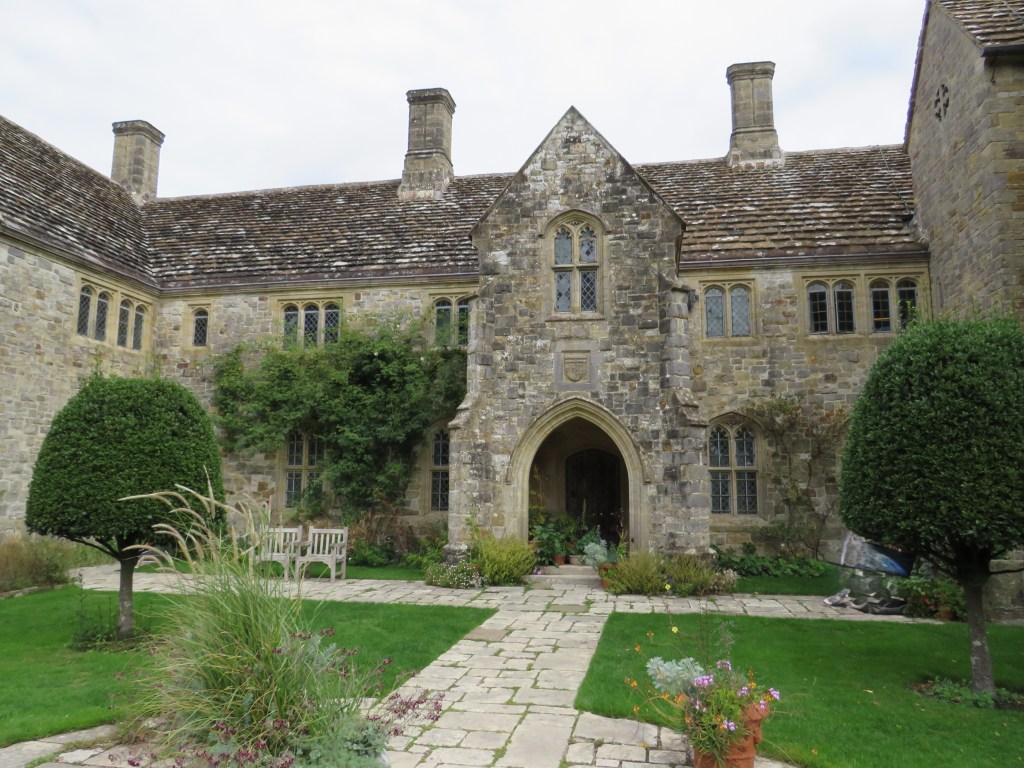
This morning, it is time for the trip I’ve been looking forward to the most. I’ve wanted to go to Ightham Mote for nearly sixty years, since I first read Anya Seton’s Green Darkness in which the Mote figures prominently. My first problem is the pronunciation. In my head I’ve always pronounced it Igg-ham Mott but no and I can see it now, it is Itum Moat, who knew – not sure I can undo decades of mis-pronunciation. This time, we trust the satnav and have an uneventful and speedy journey.

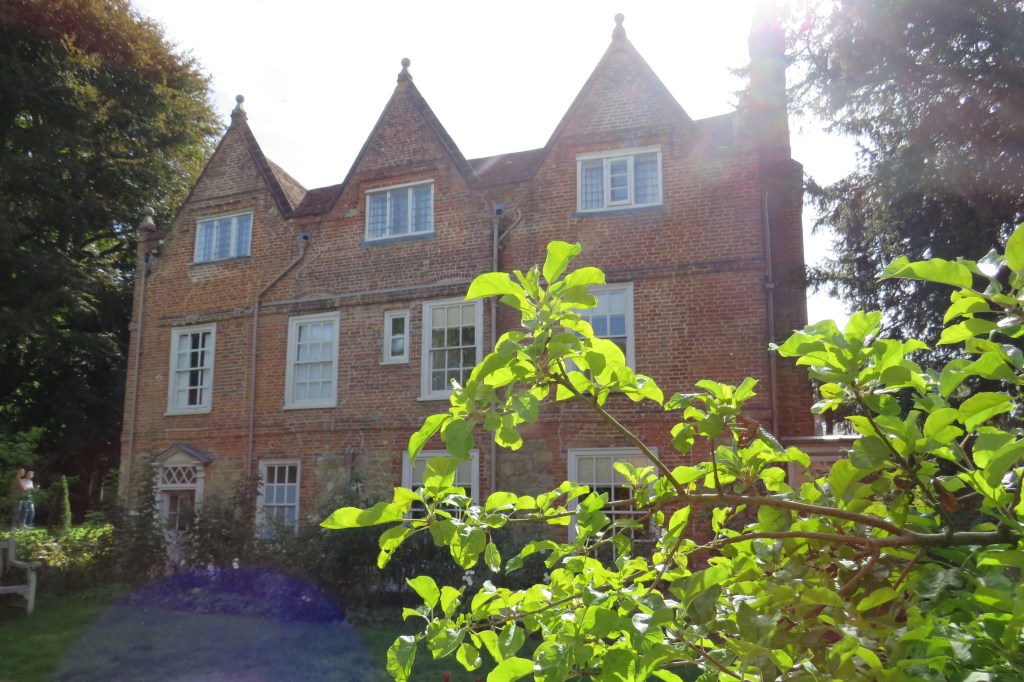
It is a beautiful day and the moated Medieval manor house is looking impressive. It was built in the 1320s and is the most complete surviving moated manor house in the country, having narrowly escaped demolition in the 1950s, when it was rescued by American, Henry Robinson. We have a short wait for an introductory talk, so look at the lovely walled garden, which contains many, now rather past it, sunflowers and the sit in the sun. The manor grew up here because of the nearby stream and a mill with five mill ponds was sold with the estate just before the current manor was built. The first known owner was Sir Thomas Cawne from Staffordshire who purchased it in the 1360s with profits he had accrued from the French wars. His son was imprisoned for throwing his wife down a well. In the 1400s, the Hawte or Haute family owned the manor, following a Hawte/Cawne marriage. Richard Hawte inherited in 1462. His connection with the Woodville family, saw his social standing rise and the Mote was enhanced to become a fashionable home. The moat was constructed as a fashion statement and to assist with the disposal of sewage, rather than as a defensive mechanism.
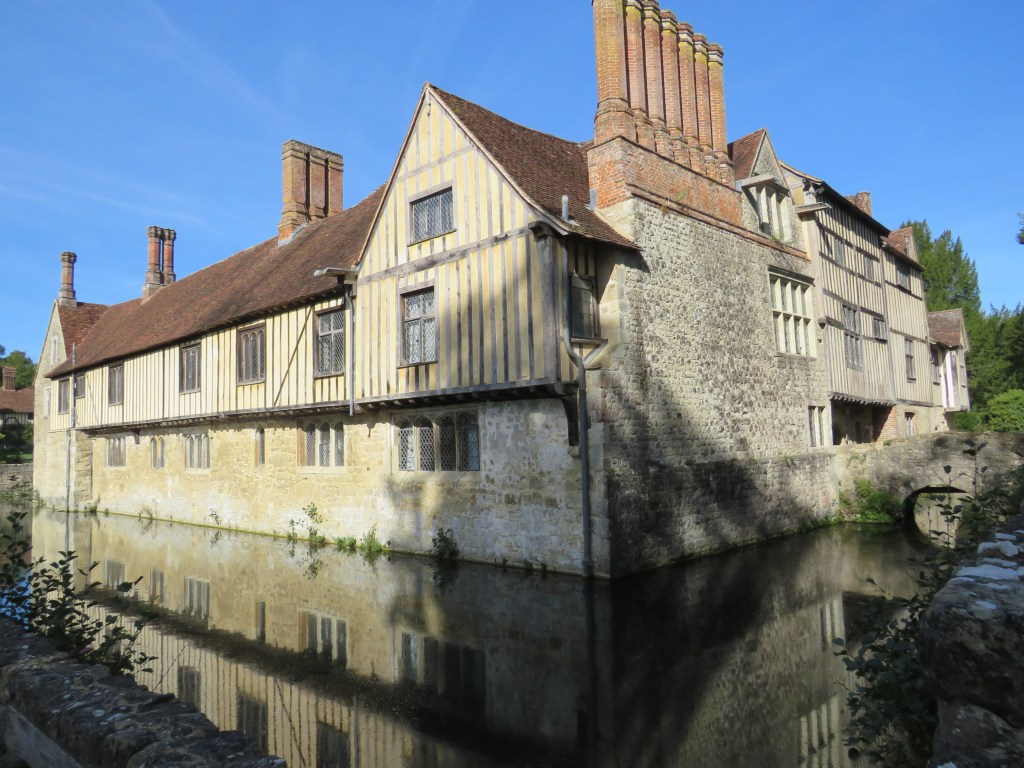
In 1521, Richard Clement bought the estate. Clement had been a page to Henry VII and worked his way up. He built the tower at Knole and added various Tudor embellishments. Then the Selby family from Northumberland held the estate for three hundred years. They ordered a huge fireplace surround that didn’t fit in the room, so they raised the ceiling. In the late nineteenth century, Sir Thomas Colyer-Ferguson bought Ightham Mote; his wife was a descendant of the earlier owners the Hawtes. No buyer could be found for the Mote when it went up for sale in 1951 but it was rescued by three local businessmen to prevent its demolition. They were able to sell it on to Henry Robinson two years later. Robinson was on board ship, back to America and was planning to change his mind about the purchase but the letter was never delivered. The differing sale prices over the centuries are interesting, The house and land sold for £400 in 1521, £4000 in the late sixteenth century and £35,000 in the late nineteenth century. The 1951 sale price was just £5000. It was given to the National Trust in 1985 and the Trust had to spend £10 million on conservation, which was not completed until 2004.

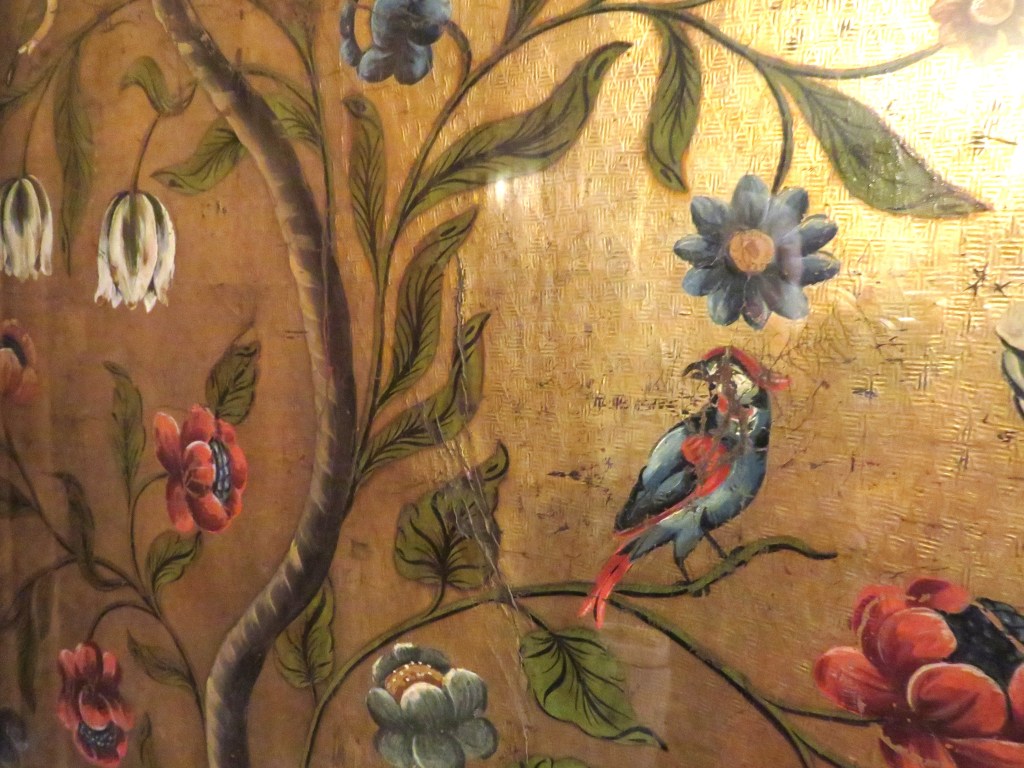
Things of note were a grade 1 listed dog kennel, witchmarks over the fireplace, tiles, some eighteenth century wallpaper, a tavern clock, an unusual painted ceiling, a sampler collection, photographs of the twentieth century staff, and a distinct ‘atmosphere’ in the crypt.

Not fancying any of the offerings in Ightham’s café, we move on to nearby Knole and start our visit in the café there . In 1783, the owners, the Sackvilles, had their servants painted and reproductions of the portraits are on display in the café.

Originally a typical Medieval manor, there have been numerous upgrades and alterations at Knole. From 1456, it was the official palace of successive Archbishops of Canterbury. After the Reformation, it passed into the ownership of the king, Henry VIII, who seized it from Thomas Cranmer. He expanded the park and used Knole, which is still famous for its deer, as a hunting lodge. We do see some deer. Elizabeth I gave it to her favourite, Robert Dudley but he returned it saying it was too large. The estate was purchased from the crown by Thomas Sackville, 1st Earl of Dorset in 1604. Thomas’ fortune was amassed as he was Elizabeth I’s Lord Treasurer and he was able to rebuild and decorate Knole lavishly, with the aid of royal craftsmen. Charles, the 6th earl, was the royal chamberlain and acquired cast off furniture from royal palaces. This is another property with a literary connection; Vita Sackville-West spent her childhood at Knole. In another cross over, Lionel Sackville was Lord Warden of the Cinque Ports three times. It is a substantial property with, we are told, seven acres of roof. The Sackvilles started showing Knole to visitors from the 1700s. At Knole, as a Petworth, there is an extensive art collection but it is not so overpowering here. I was particularly taken with a portrait of Sir Theodore de Mayerne, seventeenth century Huguenot and royal physician. I noted some interesting lead downpipes, seventeenth century blackjacks and an enormous dish about two feet in diameter.

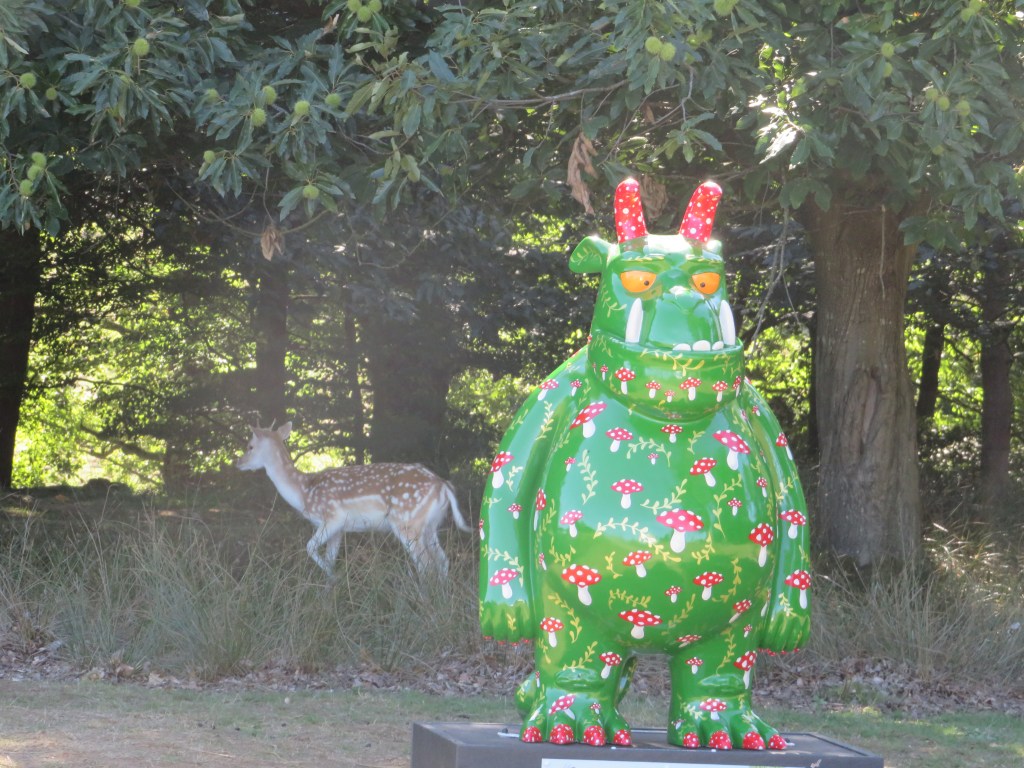
There is a bonus at Knole, a Gruffalo Trail. This is clearly not aimed at our demographic but I manage to capture most of the fibreglass, decorated Gruffali (?) in the grounds.
Day 13

Today’s destination was not originally on our itinerary but we made room for it by doing two things in one day earlier in the week. One advantage of this for our last day is that it is only six miles from our site, so not too much driving before tomorrow’s long journey. We are a little apprehensive on two  counts. Firstly, the tickets are on a pdf on my phone. Normally I would be belt and braces and have printed them off but we only booked them two days ago, so, as we don’t tend to carry a printer on our travels, that was not possible. I am fully competent at displaying a pdf ticket on my phone, I am just always worried that my fully charged battery will somehow have diminished to nothing, or there will be no phone signal. I am sure this is quite ridiculous but nonetheless, I do take the precaution of writing down the ticket numbers.

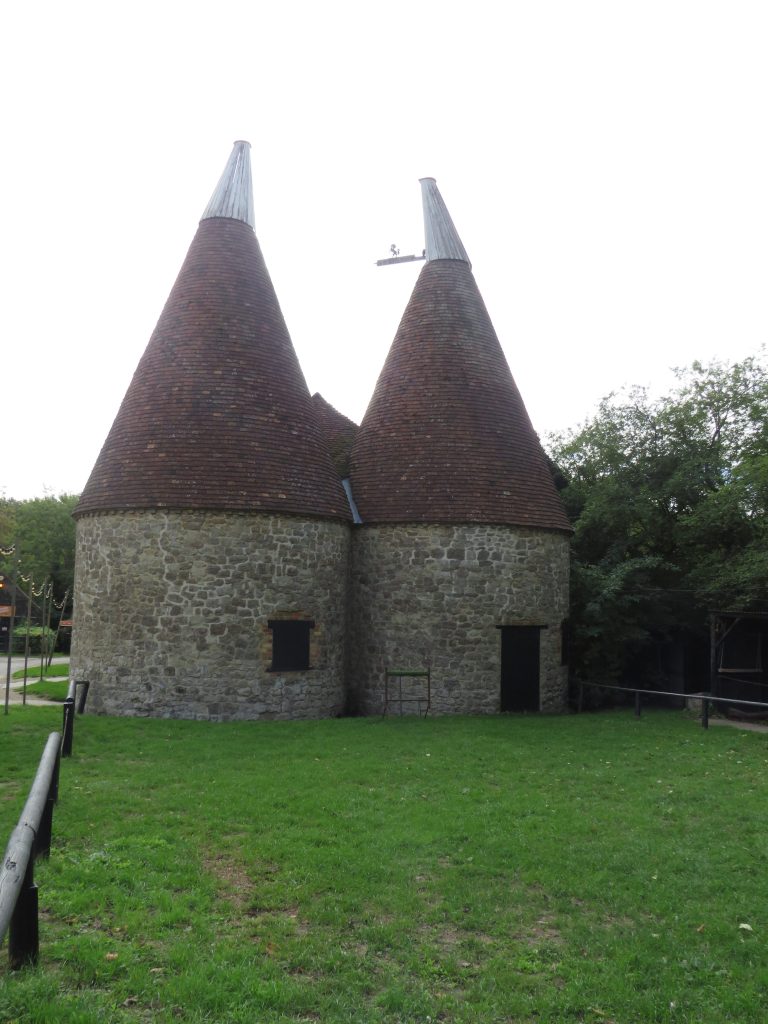
Today we are at Kent Life Heritage Farm Park and our second concern is that its focus is on family fun and we don’t have any spare six year olds with us. Although their main target audience is clearly somewhat younger than us, as is evidenced by the school parties of five year olds on site, there are some preserved historic buildings that we want to see. We don’t mind cooing over the odd farm animal, so here we are.  Understandably, much is made of Kent’s hopping industry, which goes back for at least 500 years. The iconic, coal-fired oast houses are a feature of the Kent  landscape. The hops were dried here for about eight hours before being sold to the brewers. Until the mid-twentieth century, droves of workers from the East End of London would spend a few weeks in Kent each summer, living in tiny tin shacks, or hastily constructed hovels, to pick the hops. This was always a family affair and the East Enders viewed it as a holiday, returning to the same shacks year after year. The locals benefitted from selling to the hop pickers but ‘strangers’ were viewed with suspicion. The coming of the railway facilitated the influx of pickers but they were certainly making the journey from at least the 1750s. Even in the 1900s, some pickers walked, to save the train fair, taking their belongings in a cart or pram. The crowded, poorly built shelters harboured disease, giving the locals another reason to resent the incomers.

We enjoy looking round the buildings, most of which were originally sited elsewhere and had been reconstructed on this site. There are oast houses, a chapel, a village hall and a row of World War 2 cottages, as well as hoppers huts from different time periods. The chapel includes a war memorial that was rediscovered in 2010. One of the farm houses is set up as a 1950s kitchen, although I spot that the brownie uniform hanging on the washing line is one from 1967 onwards. Another farmhouse, that has been styled as it would have been in the 1930s, was built on its current site in 1555 and was let to tenant farmers for centuries. Some areas, such as the herb garden, do look a little neglected. This garden is supposed to represent four different eras, with culinary, aromatic and medicinal herbs.

All in all, we enjoyed our visit and it didn’t diminish any of our other outings to make time for it. We return to the van via the supermarket and have a lazy afternoon in the sunny caravan site.
Day 14

Time for the long journey home, via numerous motorways. This is uneventful, although there were some holdups at the beginning due to traffic coming from the continent. We enjoyed our visit and were able to see plenty. It somehow didn’t seem as restful as some holidays, probably because we crammed in two visits on several days, when normally we would go for one, followed by a relaxing afternoon. Stand by, in less than a month’s time we will be adventuring again.
South-eastern Sojourn Part 5

Day 10

It is moving on day again, this time to our final site for this trip, just outside Maidstone at Bearstead. This time, I manage to put the right destination in the satnav. It is a tricky one this; we have to be off our current site by 12 and can’t access the new one before 1pm but it is a journey of under an hour. We try to solve this issue by going via a supermarket near us to purchase bread and milk. The snag with going via a supermarket with a caravan on the back is of course parking and it only works if there is the option to drive through and occupy two spaces. There isn’t. We end up up a dead end in the car park, where there is only room to turn round by dint of high level towing skills and the lack of a barrier pole that had been flattened by another driver. I rush into the shop to make our purchases, whilst Chris circles the car park. Both shop and carpark are huge. I end up chasing after the retreating van to try to catch up with it as it circles past me. The site is almost full but we secure another corner site with a WiFi signal and an adequate television signal if you aren’t to fussy about what channel you watch.

Day 11

The day did not start well. The satnav insisted on adding twelve miles to our journey and taking us to our destination along the M20 and M25. There is a much shorter route along the A20, albeit admittedly one minute longer. No amount of persuasion would persuade the satnav to take us via this route. No problem, I have a map. The A20 runs very close to the site, we follow the signs to the A20. As we progress I am puzzled by the lack of settlements we should be passing according to the map. We have gone rather further than ideal before I realise the issue. A20 yes, right direction no. We turn around where possible and eventually arrive at our destination about forty minutes later and rather a lot of miles further than intended. In retrospect, we should have gone with the satnav, hindsight and all that. Then there was the issue of finding somewhere to park. The nearest car park to our destination was full of cars bringing young footballers in for a tournament. Luckily, someone was just leaving and we were able to acquire their space in the overflow car park. A bonus was that weekend parking was free.

Today’s National Trust property of choice is Quebec House. When planning this itinerary, this was the only day when we were in the area that the house was open and fortuitously, there’s a special event on. I have brought my notebook but somehow have neglected to equip myself with a writing implement. I have to rely on memory and photographs of interpretation boards. Quebec House itself was the childhood home of Major General James Wolfe. Typically, the National Trust have to have a ‘hook’ for a property and here, much is made of the Wolfe connection, even though the family only rented the property for a few years from 1725 to 1738, leaving when Wolfe was eleven.  A successful career soldier, Wolfe helped to put down the 1745 Jacobite Rebellion and later enhanced his career during the Seven Years War 1756-1763 between Britain and her allies against France and hers. His role in the taking of Quebec, which facilitated the end of French rule in North America, made him a hero after he lost his life at the Battle of the Plains of Abraham. His body was brought back to England, By this time the corpse was not in a sufficient state for a death mask to be made, so a servant was used as a model for a bronze bust that was created. Chris uses his knowledge of musketry to explain the workings of a flintlock musket to a fellow visitor.

The special event and the other focus of the property really celebrates not Quebec House but nearby Chartwell. Although, in 1760, both properties were owned by Thomas Ellison; at this point Quebec House was called Spiers. After London Foundling Hospital was established by Thomas Coram in 1739, it soon became obvious that the number of children needing care exceeded the capacity of the London home. A satellite home was established in Westerham, at a house called Wellstreet, in 1760. This is the property now known as Chartwell. Detailed records survive and 469 children were cared for at Wellstreet. Present at Quebec House today is Mrs Wadham, the first Matron of the Westerham annexe when it opened in 1760. Mrs Wadham is full of ‘useful’ remedies to cure the children of all ills. Mistress Agnes would have enjoyed meeting her. When a child entered the hospital, their name was stripped from them and they were given a number. On display are representations of the tokens that were left with foundling children, so that they could be identified should their parents come back to claim them. Although receipts replaced tokens before the Westerham branch opened, some mothers still provided them. There is plenty of information available about life at Wellstreet, which functioned for nine years. There were twelve dormitories and three children shared each bed, which was four foot two inches wide and five feet six inches long.

There is also a FindmyPast demonstration on a large screen and a National Trust volunteer is attempting to help a visitor. I can’t stomach listening to the misinformation for more than a few minutes. I manage to acquire a pencil for future notes.

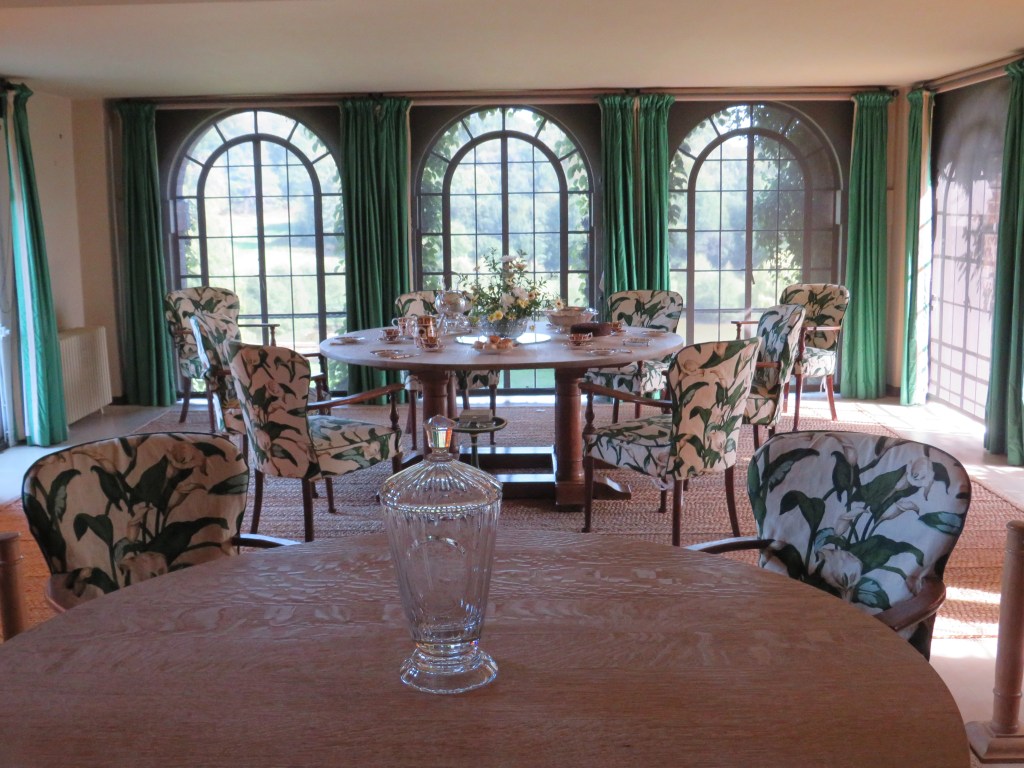
An off the cuff change to itinerary, which we had already adapted, took us to nearby Chartwell, formerly not just Wellstreet foundling hospital annexe but more famously the home of Winston Churchill. Again, parking spaces are in short supply. First stop the café, where today’s cake of choice is iced cherry cake. The property had been empty for a few years when the Churchill’s purchased it, in 1922, for £5000, having knocked £500 off the purchase price. It cost another £20,000 to refurbish it. We are aware of the connections between Clementine Churchill and Bucks Mills, as well as the links to the Mitford family and there were Mitford signatures in the visitors’ book that was on display. We are given a timed ‘invitation’ to visit the house. We have been allocated am persona of a genuine visitor. I am Churchill’s daughter, Sarah and Chris is Professor F A Lindemann, no me neither.  It seems he was a physicist and became Churchill’s scientific advisor. Some of the rooms were dressed as they would have been when the Churchills were in residence, I particularly liked the dining room and the library. Other rooms were exhibition spaces, which I found less appealing, They told the story of Churchill as an artist, an author and a wartime leader. The grounds were impressive and the views were glorious. We walked round the huge walled garden, so large that you couldn’t help wondering if the effect of being walled was largely lost.

For the homeward journey, we let the satnav take the strain and after forty minutes on the motorway, we were back. A much less stressful and less time consuming, if not very inspiring, journey.

South-eastern Sojourn Part 2

Day 3

We arrive at Nymans in time for a tour by garden guide Rob. We’ve learned that tours are a good thing if you want additional information. Rob does not disappoint, although the tour does eat into rather more of our time available than was ideal. The estate itself dates back to at least the fourteenth century and the attraction of the area was probably the iron mining potential. Early owner, Philip Nynian, gave his name to the estate. For three centuries it was owned by the Gatland family and then several nineteenth century owners added to the estate, extensively adapting the medieval house in 1839. The major changes came under the ownership of German-born Ludwig Messel, who paid £20,000 for Nymans in the 1870s. He remodelled the house using plans drawn up by his brother, who was an architect and the finished house had a Germanic style. Ludwig was a collector of exotic plants and exploited the good growing soil at Nymans to house many rare plants and trees from across the world. James Comber served as head gardener for fifty eight years from 1895.

Ludwig’s son, Leonard, inherited in 1915 and his wife, Maud, prompted a remodelling of the house, so that the Germanic influences, unpopular in the wake of the First World War, were eradicated. The work was carried out in the 1920s and at Maud’s request, the result resembled a medieval manor house, with ecclesiastical influences.

The Pinetum is impressive and despite losing 400 trees in the 1987 storm, the estate has approaching 100 ‘Champion Trees’, those that are the tallest, or have the greatest girth for their species. As we tour round the grounds near the house itself, a blackcap is singing loudly (thanks again Merlin).

Nymans ranks eighth for footfall amongst National Trust properties; the numbers are swelled today as entrance is free for Heritage Weekend. I am surprised to find that the house itself is quite small and is partly in ruins. It was destroyed by fire in the big freeze of 1947 when they tried to unfreeze the pipes in the roof using a blow torch. A stray spark caused the fire, exacerbated by the oil that had been put on the timbers to deter woodworm. Leonard’s children included Oliver Messel, a notable costume designer; his work is celebrated at Nymans. Leonard’s daughter. Ann, was mother of Lord Snowdon and she lived in the partly restored Nymans until 1992. As we have a guide with us, we are able to view the ruins, which have been repurposed as an outdoor garden.

There is just time for a refreshment break before we head to Lewes to collect a friend from my college days; we haven’t met for about twenty five years. Together, we tour Monk’s House, the country retreat of Virginia and Leonard Woolf, who bought Monk’s House in 1919 for £700. The seventeenth century property was once three separate workers’ cottages, home at various times to the Cleere, Glazebrook and Verrall families. When the Woolf’s London property was bombed, they made Monk’s House their permanent home. It became a centre for the Bloomesbury Set and there were several paintings by Virginia’s sister, Vanessa Bell. We viewed the extension, built so that Virginia could have her own space and we see her writing lodge in the attractive gardens.

Day 4

Another day and yes, another National Trust property, this time Batemans, the former home of Rudyard Kipling and his American wife, Caroline. Like Nymans, the attraction of the area was the iron mining, which was centred in Sussex before the industrial revolution. The property itself dates from 1634 and the Kiplings aimed to enhance its seventeenth century heritage after they purchased it and thirty surrounding acres in 1902, for £9200. Items of note include wall coverings made from calves’ leather, which was made in the early eighteenth century and purchased by the Kiplings for 100 guineas. There was also a clock dating from the 1630s, an Eddison cylinder phonograph, whose volume control is the origin of the phrase ‘put a sock in it’. Also on display were some modern Jungle Book illustrations by Gruffalo illustrator Axel Scheffler. Other things that caught my eye were a Tiffany inkwell, a botanical crockery set, some tiles, miniature globes made in 1756, a paper model of Batemans, created out of pages covered in Kipling’s tiny handwriting and an alphabet necklace, based on Kipling’s Just So Story How the Alphabet was Made.

We look round the gardens and the overshot water mill, Park Mill, built in 1750; although there has been milling here since the thirteenth century. This visit was enhanced by meeting my friend and also my second cousin, who by a chain of co-incidence know each other and we spend ages chatting in the café.

South-eastern Sojourn Part 1

Yes, we’ve been away again, this time to Sussex and Kent. These are both counties I’ve visited before but extended visits were in childhood, so it was time for a return as part of the ‘Let’s visit every county in England’ campaign, to which I’ve now added and visit at least one National Trust property and one English Heritage property in each, meaning that I may just have to revisit one or two. You’ve had to wait for me to be back in the land of decentish WiFi for me to post this, so, as ever, these are not real time adventures.

Day 1

Having already cut two days off our holiday to accommodate the fitting of a smart meter at the home of the fisherman of my acquaintance, we knew that we were unable to leave as early as we might have liked. This smart meter has been somewhat of a bone of contention. Having been pestered to have one and refusing for many years, this has now become a necessity in order to benefit from the feed-in tariff from his newly installed solar panels. He’s been trying to get an appointment since April. Having muttered the word Ombudsman, an appointment  was finally arranged for what should have been two days into our latest trip. Fortunately, it was the sort of trip where two days fewer was a possibility and as the appointment was for ‘between 8 and 12’, we could get to our destination afterwards, or so we thought. They also promised to message half an hour before arrival. At 11.45, with no sign of said message, we ring to be told that they are unable to guarantee that they will come at all today.

After a great deal of gnashing of teeth, we set off at 1.45pm, with still not a meter man in sight. By this time, it is touch and go whether we will arrive at our chosen site in time to get a pitch before they close at 8pm. Fortunately, this is a site where there is an area where late night arrivals can pitch but this might mean we can’t get onsite until 1pm tomorrow, which would impact on going out for the day. As we leave, the sat-nav, which knows we are towing a caravan, thus limiting our speed on motorways to 60mph, reads 7.22 as an arrival time. The route means encountering the car park known as the M25 at rush hour. There is also the issue of whether we can do a five and a half hour journey without a comfort stop. A 7.22 arrival was always going to be a big ask.

Given the nature of the journey, we do well. There are some sections where we can make up time, which compensate for the parts where we are delayed. The last few miles, through the centre of Brighton, take a disproportionately long time; there are an awful lot of traffic lights in Brighton. We managed to avoid stopping for fuel or comfort and arrive at 7.25. Very hungry and in need of said comfort but in time.

Our site at East Brighton Park is, as the name suggests, on the eastern edge of Brighton and nestled in the shadow of the South Downs. It must be popular as we are allocated the last vacant pitch, fortunately, it seems to have a WiFi signal, so I am happy.

Day 2

We are blessed with a lovely sunny day and set off for Petworth House, today’s National Trust property of choice. I follow along on the map as usual, as we enjoy the views over the downs and travel up the Adur Valley. Here, we are close to the ancestral villages of Steyning and Henfield but I’ve visited before, so have put family history to one side for this holiday.

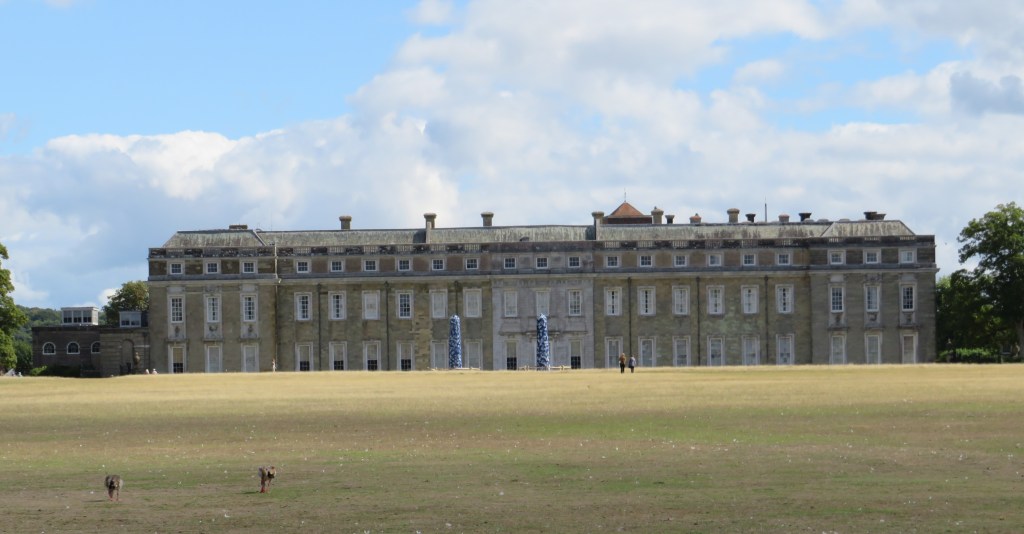
It is difficult to describe my reaction to  Petworth House. It is still a private residence and the portion that is open to the public was built as a Baroque show-home in 1688, designed to impress visitors and house an extensive art collection, rather than to be lived in. Impressive yes, overwhelming yes and definitely over the top. It was interesting but I am not especially fascinated by works of art, even though these include those by Lely, Van Dyke, Turner, Reynolds, Gainsborough and Titan. There are also nearly a hundred marble sculptures, most of which are huge. We also see a temporary exhibition ‘Expressions in Blue’ with more massive, mostly blue, modern pieces, by English artist Felicity Aylieff, inspired by Petworth but made in Chinese porcelain factories. These include two in the grounds that are about five metres tall. Petworth’s incredibly high ceilings, almost all of which are undecorated, help to accommodate all the large-scale artwork. My preference is for more homely properties. So in summary, yes I’m glad we went but it wouldn’t be high on my list for a revisit; others will feel differently of course.

As the focus is on the art collection, trying to find out more about the history of the building itself and its owners is quite difficult. The site has 900 years of history and the current building replaced a fortified manor house. There are traces of earlier building, notably the fourteenth century chapel, with heraldry abounding. The estate was given to Joscelin of Louvain in the twelfth century by his sister Adeliza, consort of Henry I. Louvain married a Percy heiress and took her name. They were the progenitors of the Earls of Northumberland, who held Petworth as their seat in the south for centuries. The Percy family’s Catholicism was unpopular during the Reformation and its aftermath. The 7th Earl, Thomas Percy, did not exactly endear himself to Elizabeth I when he sided with Mary Queen of Scots and led the Northern Rebellion, which aimed to replace Elizabeth with her Catholic cousin Mary. Understandably, Thomas was executed, although Elizabeth I agreed that his brother, Henry, could inherit as long as he stayed in the south at Petworth, where she could keep an eye on him.

In 1670, the 11th Earl, Josceline Percy, died without a male heir, so the estate passed to his daughter, Elizabeth. Elizabeth, although only sixteen, had already been widowed twice and her third husband was Charles Seymour, 6th Duke of Somerset. It was they who built the current house in 1688, although there were some alterations in the 1870s, overseen by the architect Salvin.  In 1750, the estate passed to the Wyndham family.

As ever, it is the quirky bits that catch my eye, so pottery dating from 420BCE; what is thought to be the earliest English terrestrial globe, made by Molyneaux in 1592 and believed to have been given to Henry Percy by Walter Raleigh; an ornate screen; Grinling Gibbons carvings; a portrait of Ralph Hopton, prominent in the Battle of Torrington story; a whole row of (probably replica) fire backs; some unusual chairs; an organ set in a door and some seventeenth century door handles, which I neglect to photograph. We also look at the kitchen block, , which is more to my taste, where there is an eighteenth century fridge and some incredibly heavy copper pans.

The 700 acre estate and deer park were landscaped by Lancelot ‘Capability’ Brown. We investigate the deer park. We see no deer but there are large numbers of Canada Geese and a few Egyptian Geese by a lake. The grounds also include many enormous sweet chestnut trees, an Ionic rotunda and a Doric temple but no Corinthian anything.

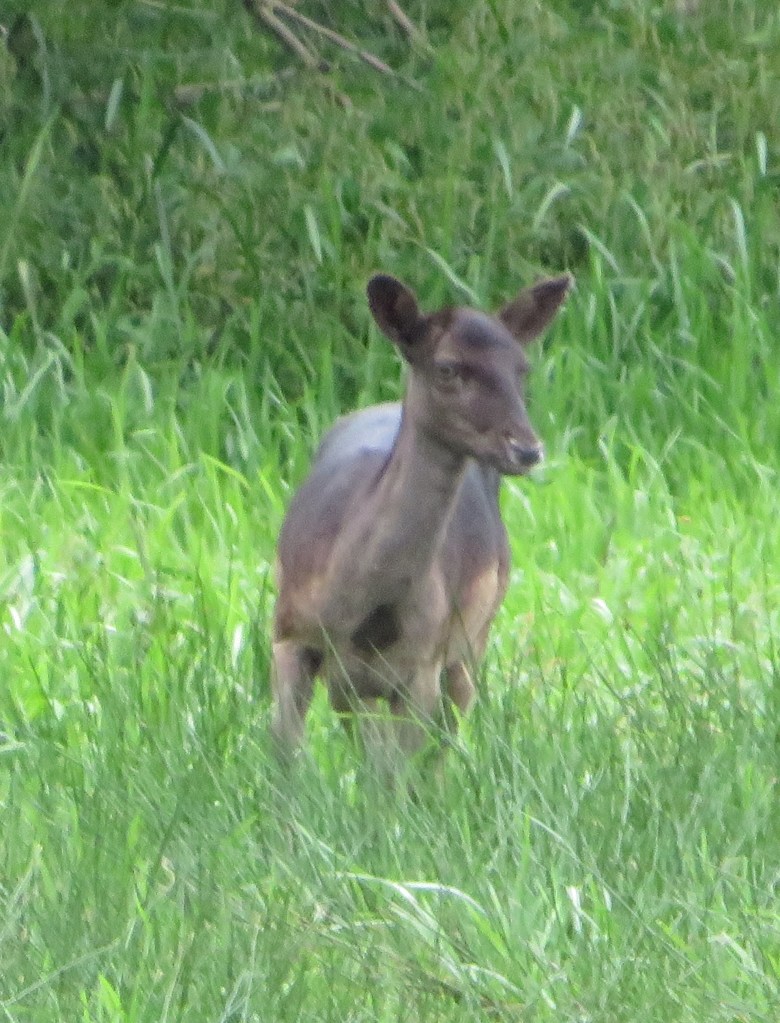
We had planned to visit Pulborough Brooks RSPB Nature Reserve on a different day but we had passed this on the way to Petworth, so it seemed sensible to call in on this day, as we had time, rather than come this way again. This is a good decision as we have plenty of time to see all that Pulborough has to offer. Unfortunately, they have run out of maps and I am never very good at working with photographed options. There is a distinct lack of signage and we could do with maps at strategic points but no. Nonetheless, we manage to find our way to the hide overlooking the not so wetlands. It is our usual kiss of death wildlife wise, not helped by some very loud chain-sawing in the vicinity. We see great tits, wood pigeons, many Canada Geese and a single heron and hear a wren (thank you Merlin app). Here though are the fallow deer that were conspicuous by their absence at Petworth. Some of these are the more unusual melanistic deer, with black coats. Recently re-introduced white-tailed eagles have been seen in the area and I do spot a couple of birds of prey that may or may not have been white-tailed eagles. Then it is back to the van via a fuel and shop stop at Brighton Marina, where we see the many windfarms out to sea.

Holidaying in Herefordshire Part 4

It always feels strange posting about trips away when I am safely back home but I don’t normally post in real time. This was the day that the sat-nav decided not to work; this was apparently my fault. Never fear, I can do old school with my trusty ordnance survey map. I could locate the day’s National Trust property of choice, in this case Croft Castle, although it was a little difficult to work out on which side of the large estate the entrance lay. We overshot it at the first attempt, as we were expecting a useful brown sign. It turned out there was a very small brown sign, totally obliterated from our first approaching direction due to an overgrown tree.

We’ve been really fortunate that, throughout our visit to Herefordshire, the weather has been a lot less rainy than forecast, so we decided to risk one of the parkland trails. Not wishing to push our staying dry luck or our stamina we opted for the shortest, brown trail labelled Fishpool Dingle ‘Picturesque’ Walk. We wondered if ‘picturesque’ was going to be doing some heavy lifting here. Apparently, the eighteenth century ‘picturesque’ movement was a contrast to the pastoral naturalisation beloved of Capability Brown. This ‘gothic paradise’, complete with grotto viewpoint, was created in the Fishpool Valley in the late eighteenth century. It was a very pleasant woodland stroll, where we could see some industrial heritage include a restored medieval dam, a lime kiln and the ‘gothic’ pump house, dating from about 1800, which housed the water wheel and pump that provided the castle with water. There was also the remains of a charcoal burning platform; the charcoal was then used to fire the limekiln. There was a profusion of blackberries and elderberries as well as some birds including blackbirds, robins, great tits, a wren and woodpigeons. According to Merlin, we could hear a goldcrest, a chiff chaff (one I can actually just about recognise for myself) and a greater spotted woodpecker.

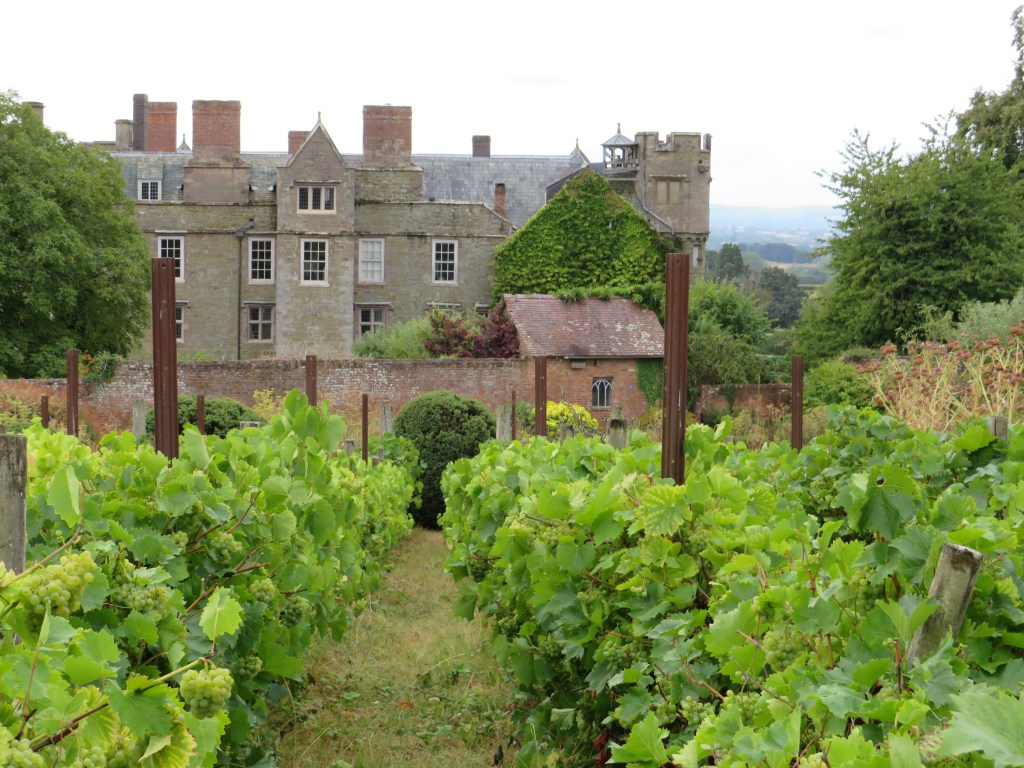
A brief pause for refreshment next and as none of the cake on offer appealed, today we were ’forced’ to consume caramel Magnums instead, no hardship there. Continuing to ride our ‘it is still dry’ luck we next explored the walled garden. The walls round the two acre plot were built in 1801; there were plenty of grapevines in evidence. The whole garden covers nine acres. This is managed by just two paid gardeners, supported by volunteers. Whilst most of the gardens and woodland looked positively autumnal, there were carpets of miniature cyclamen outside the walled garden, which I would normally expect to see in early spring.

We then looked at St. Michael and All Angels Church, which was the Croft family’s chapel but was also open to parishioners. This was built in the mid-fourteenth century, extended early in the sixteenth century and re-dedicated in 1515. There was a partial rebuilding in the early seventeenth century. The church includes Sir Richard Croft’s ornate tomb, which dates from the fifteenth century, Sir Richard fought on the side of the Yorkists in the wars of the Roses and was the treasurer for the household of Henry VII.

The Croft estate was founded about 1055 and a motte an bailey castle was erected by Bernard de Croft aka Bernard the Beaded, who was a Norman who had arrived in the reign of Edward the Confessor. Croft was part of the chain of Norman castles intended to protect the Welsh-English border. The fifteenth century Crofts descended from Owen Glyndower. In 1544, Sir James Croft was one of the leaders of the Wyatt Rebellion, which was a protest against Mary Tudor’s proposed marriage to Philip of Spain. Croft was pardoned, served Elizabeth I as Comptroller of the Royal Household and was buried in Westminster Abbey. James’ son, Edward, was accused of casting spells to bring about the death of Elizabeth I’s favourite, Dudley, in 1588. Royalist, Sir William Croft was killed during the English Civil War. The then Castle was deliberately demolished so it could not become a Parliamentarian stronghold. His brother, Herbert Bishop of Hereford, rebuilt the castle as a home, rather than a defensive structure.  It was sold to the Johnes family in 1746 and they did further alterations. In 1780, Thomas Johnes II inherited both Croft and Hafod, which is an estate near Aberystwyth. He spent a fortune on Hafod and had to sell Croft in 1799 to pay his debts. Further remodelling took place in the 1910s, when the Kevill-Davies family owned the Castle, which was at that time tenanted. In 1923, after an absence of over 170 years, the Croft family bought the Castle back.

The increasing efforts by the National Trust to be both family friendly and inclusive were in evidence. Here there were 3d printed ‘touchable’ objects and there was a Wyvern trail to follow. There were several objects that particularly appealed including a wall hanging made by staff, volunteers and visitors in 2018 to commemorate the Representation of the People Act, which gave women the vote; a slice from the tree under which Sir William Croft was killed at the Battle of Stokesay in 1645; some 1760 fireplace tiles by Sadler and Green; a seventeenth century stump-work box; a small fabric collage of the castle and an inlaid table displaying many semi-precious stones.

The return journey was relatively uneventful, although we did overshoot the final turning. We should have been alerted by the pervading smell of guano, as farmers near the site have been spreading fertilizer over the past few days.

Holidaying in Herefordshire Part 3

After a resounding early morning thunderstorm, we utilised our National Trust membership as usual and paid a visit to Berrington Hall near Leominster, pronounced Leminster. The rain had died down to an occasional drizzle by the time we arrived. We began by  looking at the house. Co-incidentally, one of the volunteers was a former vicar of a parish near home.

Thomas Harley, the fourth son of the Earl of Oxford was a London wine merchant, an MP and the Lord Mayor of London in 1767. Wanting a country residence, in 1775, he acquired the Berrington estate and Henry Holland designed the Georgian mansion that now stands. Holland’s detailed estimate, dated 1778, survives and he quoted a total price of £14.500. The house was finished in 1783. Inevitably, it went over budget and expensive structural repairs were soon needed. Berrington’s landscaped gardens were the final project of Lancelot ‘Capability’ Brown and in 1775, the five daughters of Thomas Harley each planted a plane tree, one of which still survives.

After Thomas Harley’s death in 1804, his daughter, Ann and her husband George Rodney, inherited Berrington. Their descendants lived there until the depletion of their fortunes and in 1901, the estate was sold to MP and Manchester cotton merchant, Frederick Cawley. The house was used as a convalescent home for wounded soldiers in World War II. In 1957, Frederick’s grandson gave Berrington to the National Trust on the condition that his grandmother, Frederick’s wife, the dowager Lady Vivienne, could remain living there until her death. Lady Vivienne lived to the age of 101 and was still inhabiting Berrington twenty years later. The family were keen horse owners and horse trials were held at Berrington until into the twenty-first century.

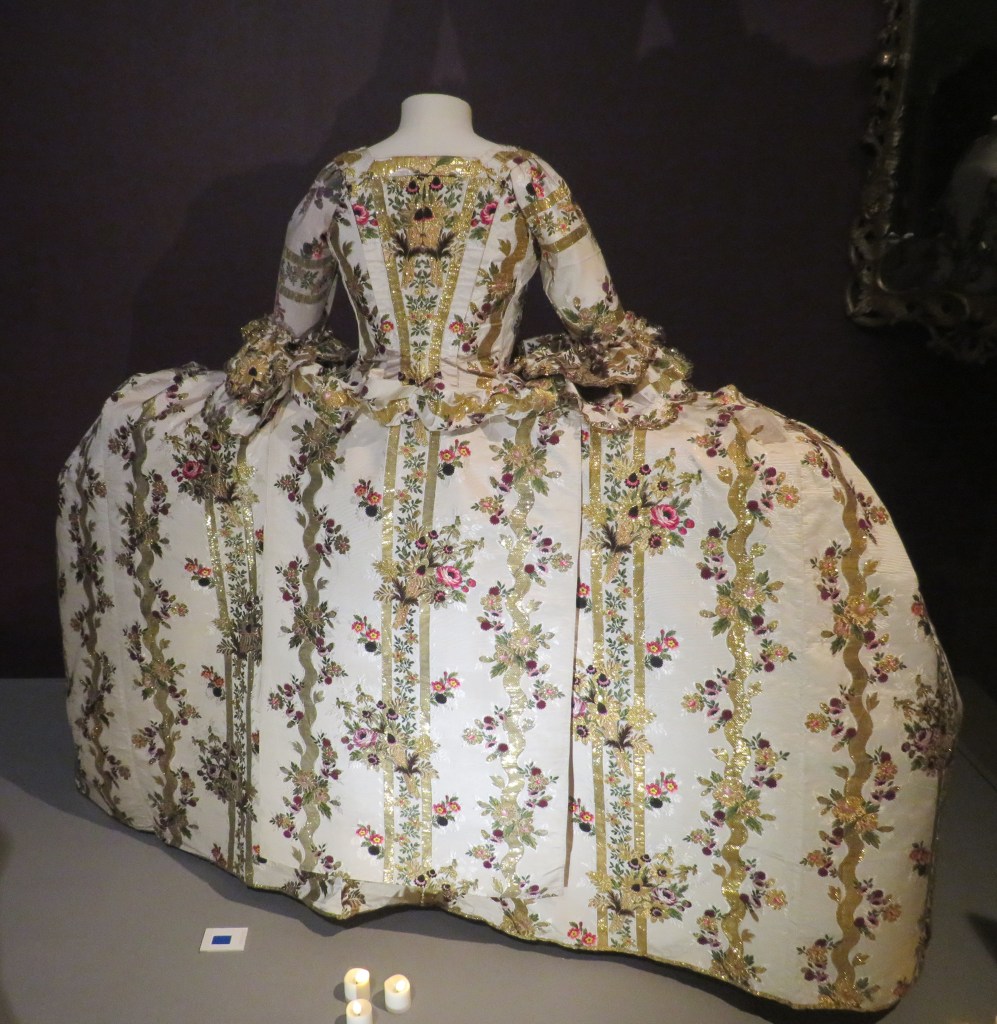
Furnishings are sparse at Berrington but the downstairs ceilings are spectacular and their USP is the display of costumes, many of which are handmade by the volunteer sewing team. I particularly liked a display of replica pockets and reticules, a miniature labourer’s smock and a wig made from crepe paper. We couldn’t resist dressing up; my dress was incredibly heavy. There were also several displays relating to conservation and cleaning. Currently on view was the widest dress owned by the National Trust; it is often not appreciated that the Trust is responsible for the conservation of 40,000 items of clothing. The dress in question is a court mantua, worn by Ann, wife of Thomas Harley, just once, in 1760, at the court of George III. There is four metres of material in the skirt alone and a further three metres in the train.  Ninety percent of what was on display was original; when found stored in a box, the dress was missing a left sleeve and a stomacher. The dress is due to be removed from display in November, while a more suitable case for it is made. Today’s cake of choice was orange and poppy seed; not quite up to yesterday’s standard. We had a quick look round the walled garden but the weather was a deterrent. It was lovely to see the names of all Berrington’s former and current gardeners inscribed on the beams of the potting shed.

Family Reunions and Gothic Revival Houses

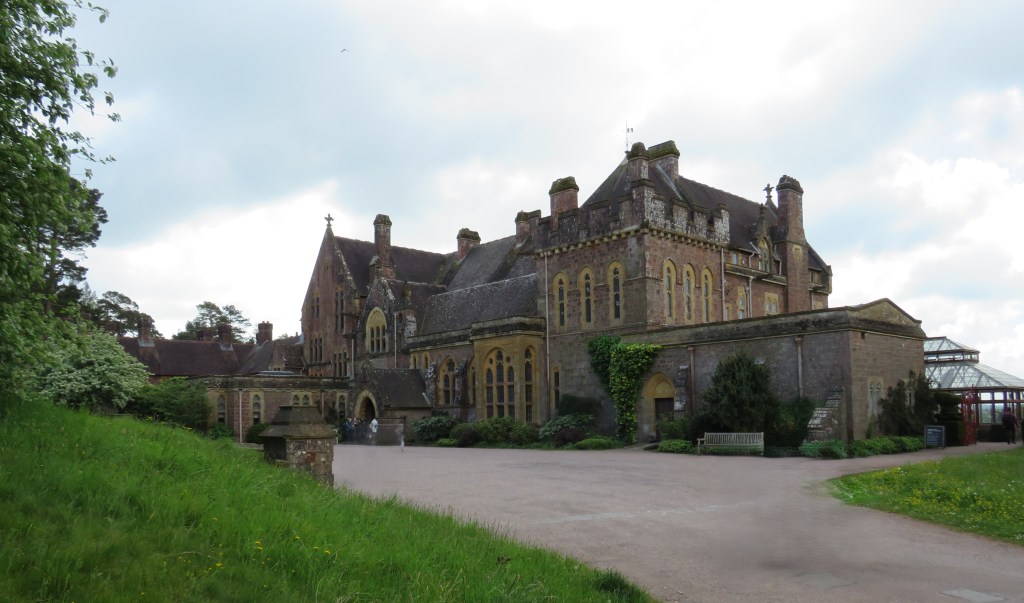
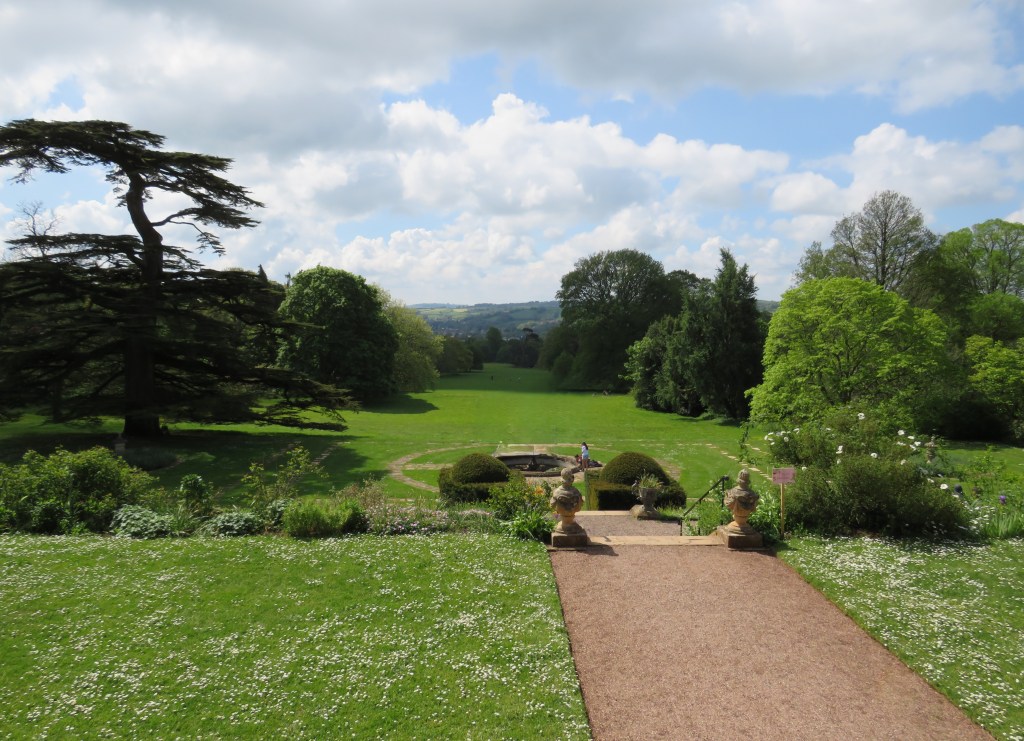
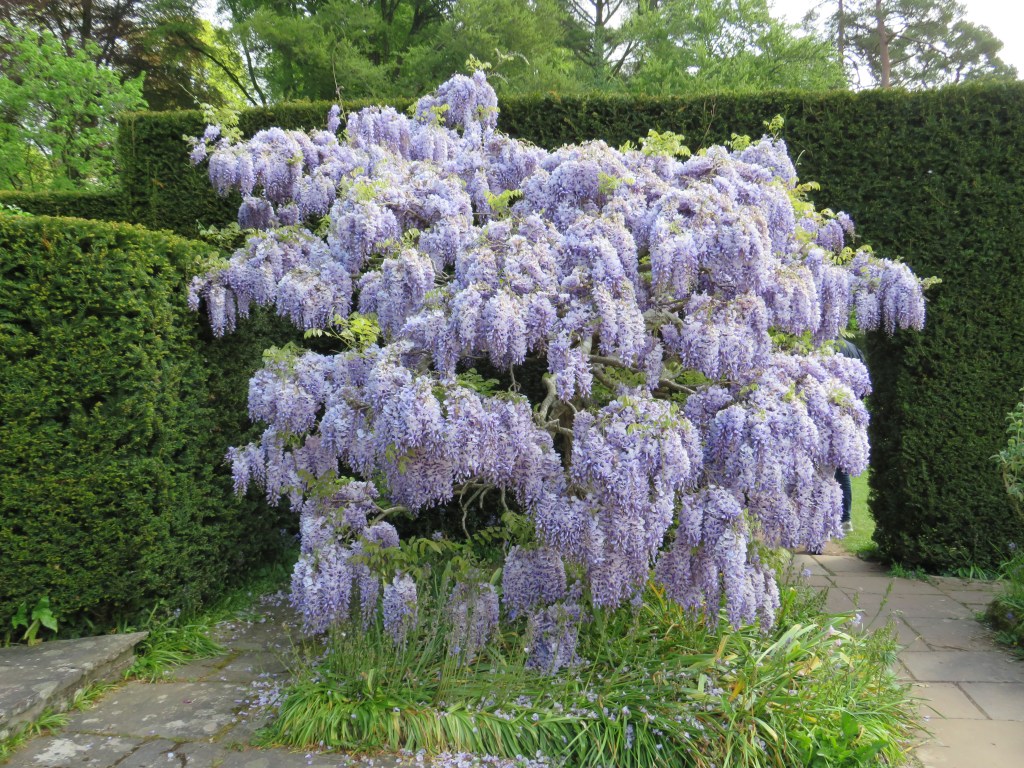
Each year since the 1980s, the first May Bank Holiday weekend has been the time for members of the extended Braund family to reunite in North Devon. This year we had visitors from Australian and New Zealand, as well as those joining in from the USA on zoom. This occasions are always an opportunity for eating far too much but we also try to see some of Devon’s historic sites. This year’s offerings included a guided walk round Bideford, which has a fascinating history and an outing to Knightshayes Court. Knightshayes was the home of the Heathcot-Amory family from 1872-1997. The family’s fortune was due to the bobinet lace making machine invented by John Heathcote. This made the process much quicker and therefore more profitable but was very unpopular as it required less labour, so put people out of work. Forced to move from his native Midlands, John Heathcote took over a disused woollen mill in Tiverton and located his lace-making factory there. The factory still exists but has passed into other ownership. It was his grandson, Sir John Heathcote-Amory, MP for Tiverton and later a baronet, who used his grandfather’s fortune to commission Knightshayes in order to demonstrate the family’s wealth and status. William Burges was appointed to be the architect of this Gothic Revival style stately home but when his ideas proved to be too extreme, he was replaced by John Dibblee Crace, whose designs were out of fashion before they were finished. Various features were dismantled and stored by the family and the National Trust have been able to restore some of this to reflect Crace’s vision. The house was requisitioned as a hospital for the wounded during both world wars.

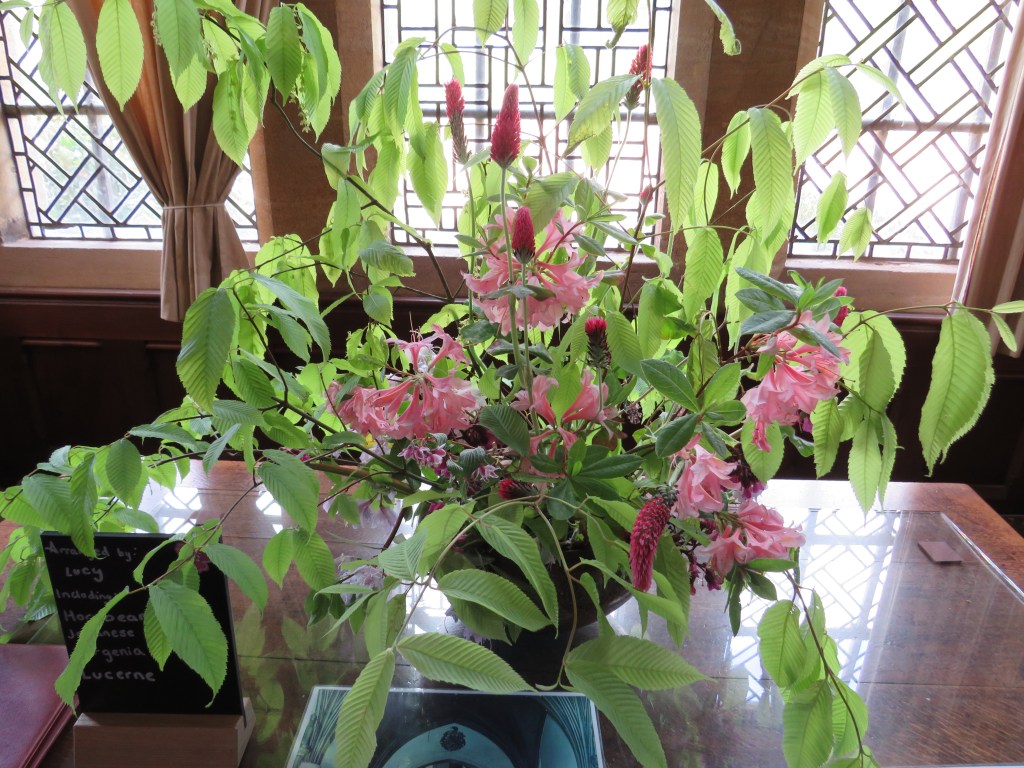
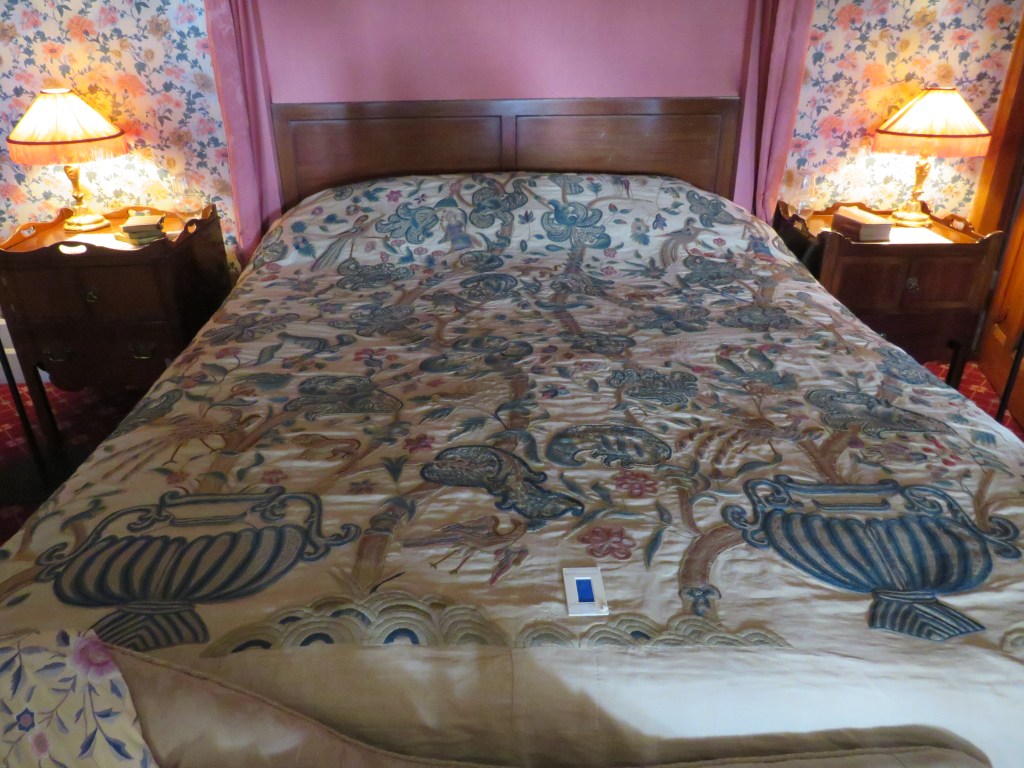
Flowers picked from the gardens and grounds appear in most of the  rooms, together with details of the flowers that have been used and the name of the volunteer who arranged them. A beautiful crewelwork bedspread was worked on by Lady Heathcot-Amory, who invited her guests to add a few stitches. There was an exhibition dedicated to Joyce Heathcot-Amory née Wethered, who was a well-known championship golfer, renowned for her swing. She turned professional and was inducted into the World Golf Hall of Fame.

We will do it all again next year by which time I may have lost the weight that I put on this year.

Continuing the Cornish Adventures

We needed to return home for the day and thought it was about time we refuelled the car. The chauffeur of my acquaintance had neglected to bring his wallet. I believe that a newly installed app on my phone might have been a satisfactory substitute but needless to say, despite my increasing proficiency with the phone over the past weeks (to the extent that I have exceeded my, albeit meagre, data allowance), this was a step too far. Fear not, my bank card is in the rucksack. Ah that would not be the rucksack we have with us but the one that is ……. in the caravan. Fortunately, we made it home and were able to retrieve alternative means of paying. Then it was back to the van. The A30 on a Friday rush hour is never a great idea, so the return journey was a little on the slow side but we were back in time for the mobile fish and chip van’s visit to the site and even managed a walk out to Wheal Coates to try to counteract the ill effects of said fish and chips, or in my case, fishcake and chips, in the evening.

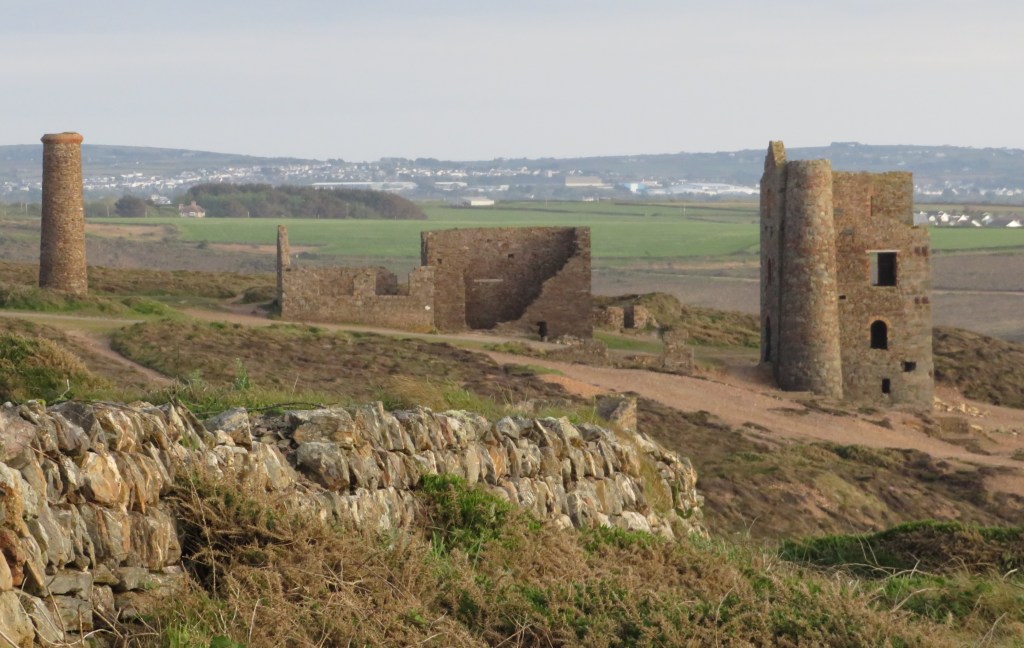
Wheal Coates

Further westward the following day and a trip to Newlyn. We overshot the entrance to the car park and before we had a chance to turn round saw several parked cars with a space for us. We looked carefully for notices that said that parking was restricted, or for permits in the windows of the other cars. A nearby gardener assured us that parking there was fine. I was a little less confident as this lay-by appeared to be a bus stop. Could the other half a dozen cars and the gardener be wrong? I left the decision to the car’s owner and we stayed put. A quick trip to a nearby boatyard so the fisherman of my acquaintance could chat boats, then we walked on to Mousehole where I had the drippiest ice cream cone I have ever encountered. Interesting to see that black-backed gulls seem to be outnumbering herring gulls. No sign of any clamp or parking ticket on the car so we returned to the van via a mercy dash to a supermarket near us to get yoghurt, which we should have brought back from my home fridge yesterday but we failed to do. A late afternoon relax in the sun followed.

Another day and back to the south coast for a visit to St. Michael’s Mount. We’d timed the trip so we could walk out across the causeway. I even managed to show evidence of my booking on my phone, which was an achievement in itself. It is quite a climb up to the castle, so not ideal for anyone with mobility problems but the views over Mounts Bay are impressive.

The Cornish name for the island is Karrek Loos yn Koos, or the grey rock in the woods, which may date from the time 4000 years ago when the mount was not cut off by the tide but was surrounded by woods. The remains of tree trunks are still occasionally seen at very low tides. In 2009, a bronze age hoard was discovered by one of the gardeners, suggesting that, 3000 years ago, the mount was a trading centre. It is thought that Edward the Confessor granted the island to Benedictine monks from Mont St Michel in Normandy and established a chapel there. The mount became a place of pilgrimage but also a focus for conflict. In 1193 it was seized by Henry de la Pomeray, who had disguised his men as pilgrims in order to gain control on behalf of Prince John. John was attempting to stage a coup and take advantage of his brother Richard I’s absence on Crusade. Much of the current building dates from the fourteenth century, with substantial later additions. The dissolution of the monasteries was late to reach the far south west, so the religious community survived until 1548. The following year the mount was seized by those involved in the Prayer Book Rebellion. It became a Royalist stronghold during the Civil War but surrendered to Parliament, with Colonel John St Aubyn as the captain. St Aubyn purchased the castle in 1660 and it has been the home of the St Aubyn family since then.

Several myths and legends are attached to the island. The discovery of a seven foot skeleton on the island, buried vertically, fuelled the legend of ‘Jack the giant killer’; allegedly Jack from Marazion killed Cormoran the giant who built the mount and terrorised locals. Visitors can view the giant’s well and a tiny heart-shaped stone in the cobbles is labelled as the giant’s heart. Some features that caught my eye included the stained glass in the chapel, seventeenth century tiles and the ceremonial barge, that took part in the Queen’s diamond jubilee pageant. This is one of the oldest working boats in the country, having been constructed using wood felled on the St Aubyn estates in 1750. A collection of postcards of the Mount over the decades were cleverly displayed so that you could see both sides. There was also a model of the castle made from champagne corks by the butler. Two observations here, they must have drunk an awful lot of champagne and the butler really needed to get a life.

We wandered back into Marazion, where I felt obliged to sample yet another ice cream flavour, gingerbread this time. Then we beat the rain back to the van.

More Westward Wanderings

With the forecast heavy rain very much in evidence it seemed sensible to head for somewhere with a modicum of ‘indoors’, so it was off to Trerice, a manor house built by John Arundell in 1570. Inside there is a striking 576 pane window, predominantly made up of C16th and C17th glass. There are also numerous portraits, include some by Kneller. A 1950s wing replaces the former north wing. In the grounds there is an Elizabethan knot garden, given over largely to lavender and also an impressive potager full of vegetable and salad produce. If there were 100 hours in every day I’d want my garden to look like this. There are several mown mazes in the grounds, one being based on the maze at Troy Town on Scilly, which is known as the three circuit maze and was used by Scandinavian fishermen to trap bad spirits. I managed to escape.

Trerice is lovely but there isn’t really the scope for an all day excursion. The weather had improved so we decided to move on to Trengwainton Gardens, getting yet more value form the National Trust life membership. Here the rhododendrons were in full bloom. There is always something soothing about being in a garden and this one has the bonus of overlooking the River Fal. We walked down to where the King Harry chain ferry takes vehicles and passengers across the river. A steam ferry first crossed the river in 1888. It is one of only five chain ferries in England.

Next day and I was awake early to watch the misty dawn break over the sea, all accomplished without getting out of bed! The first stop of a busy day was Restormel Castle, which was built for the Earl of Cornwall, in good defensive position, overlooking River Fowey. It was originally used as a hunting lodge and was set in the largest hunting park in Cornwall. The park was also home to several hermits who were expected to pray for the souls of the castle’s owners. The remains are thirteenth century and the castle was owned by the Black Prince in the fourteenth century. After a skirmish during the English Civil war the castle fell into disrepair and was not deemed to be of sufficient use to maintain. English Heritage are now putting the headings of their interpretation boards in Cornish as well as English, A great first step but it is a pity that the text isn’t in Cornish too.

It doesn’t take too long to exhaust the possibilities of Restormel, so we move on to Lanhydrock House. The volunteer asks if I have visited before. I reply that I have but it was ‘a long time ago’. Do I remember the kitchen? I am asked, perhaps I should have explained that ‘a long time ago’, was about 39 years! The house was the home of the Robartes family, which I’ve always pronounced Row-bar-tes but, according to the information video is Row-barts. In April 1881 Lanhydrock was severely damaged by fire and the then owners died shortly afterwards, leaving the next generation of Agar-Robertes to take over. Ahead of her time, in 1894, the then Lady Robartes opened Lanhydrock to the public and establish a ‘bazaar’ there to raise funds in what seems to have been a glorified jumble sale. Her terse instruction cards to visitors have been replicated.

As always, I am attracted to the huge library, whose collection includes twenty five incunables. I had no idea what that meant either but just so that every day is a school day for you too (unless you already knew of course), these are books printed before 1501. There was also a fascinating and enormous steam jack in the kitchen. The National Trust seem to have developed an unfortunate trend for printing interpretation comments on the soft furnishings, which seriously spoils the authentic look of the rooms. I guess someone decided that it appealed to the visitors – not to this one though. We heard the story of how all the house’s laundry was sent to St Faith’s, a home for fallen women in Lostwithiel; I immediately wanted to scramble for census returns. Lanydrock’s gardens are extensive, with more rhododendrons in evidence. I would think that this is the best time of year for the gardens. I suspect they will be less impressive in a few month’s’ time.

Lanhydrock

On to Fowey and first the challenge of finding a car park. We located one at the top of the town but allegedly there could be one nearer to the church, where we want to be, so we decided to keep searching. Fowey is a tortuous warren of narrow, steep, winding streets. We do narrow, steep and winding but this is something else. Some vehicles were pulling in their wing mirrors to negotiate parts of the one-way system. Just because we were enjoying it so much (not), we completed the circuit several times before ending up in the car park where we first started and getting the town bus down the street. This doesn’t run after 5pm but the driver was able to tell us the best way to get back up the hill to the car park. I thought this might have been a first outing for my newly-acquired bus pass but the service was run by a private company and I didn’t like to ask if passes applied.

Fowey has been an established harbour for over 2000 years, exporting fish, wool and tin and being a point of departure for pilgrims to Spain. The returning vessels brought back with them wine, salt and iron. Fowey is noted for being the home of Daphne Du Maurier and we are here for a concert that is part of the Arts and Literary Festival that formerly bore Du Maurier’s name. There is little left of traditional Fowey, which now clearly caters for the yachting fraternity. Most of the food options were of the two peas and a bit of drizzle for £30 variety. We finally found The Lugger, which was more suitable to the sizes of both our pockets and stomachs.

The day finished with a Fisherman’s Friends concert in the local church. I was able to admire the heraldry round the church and practice my extremely rusty blazoning skills, while I was waiting for the concert to start. The downside was the less than comfortable pews. The evening was a sell out and was excellent, as we expected it to be. Even better, there was a community bus, with just two spaces, waiting to take us a ridiculously long way round to the top of the hill car park.

More Cornish Wanderings with Family History for Good Measure

I know it was a while ago now but I did have another day of holidaying to share. So just in case anyone is wondering why they have been left in limbo, or in our case in Cornwall, here is the final episode.

After an early morning look at Looe for another fishing boat fix for my travelling companion, we head to Cotehele. On the way we fit in another family history parish. Since I have been home, I have been trying to take these newly-found Cornish ancestors further. One just might be a ‘gateway’ ancestor, taking me back to Medieval times and potentially royalty but let’s not get ahead of myself. It holds together well back to 7x great-grandfather Richard Rowse/Roose/Ruse/Ruze but I need to convince myself that his potential father Walter (who does seem to be the only Walter around at that date, didn’t marry until he was in his forties. Further speculation needs to wait until I can get to the new Cornwall archives.

082 15 July 2019 CoteheleOur first task at Cothele is to hunt out our memorial tree in the fruit orchard. We think we know roughly where it is. We also think we know what variety it is but we fail to locate it. Once again we are hampered by the environmentally friendly attempt to let the orchard go wild. Tramping through long grass trying to find a variety label that has probably long since gone is not fun. Reception provide us with a guide, which suggests that we are looking for the wrong type of tree. I am still not sure that the tree we pay homage to is actually the one that Martha and I planted in 2008; we are both convinced it was a different variety, to the extent that I purchased one of the same type for my garden.

We tour Cothele house, which belonged to the Edgecumbe family. Most of the present building is Tudor but the interior is largely seventeenth century in style. It is one of my favourite National Trust properties and always seems very homely. Surprising then to discover that the family only lived there full time during Civil War. Somehow this had escaped me on previous visits. Not bad for a holiday home. They used it as a showcase for their various collectables. To this end, bizarrely, they have a china closet in the bedroom, presumably so guest can admire the cups and saucers at night. This showcasing lark is not always successful as various tapestries have had bits hacked off them in order to fit the rooms. We manage to miss being in the right place to hear the iconic clock strike twelve. We walk down to the quay before deciding that it really is too hot to be outside and returning to our van.

All in all, it was a gentle sort of holiday and because we are not far from home and have been many times before and hopefully can again, there was no pressure to rush round places thinking this will be our only opportunity. Nothing beats glorious landscapes, the sea, sunshine and the chance to immerse yourself in heritage, both personal and more general.