Monday 18 May 2026
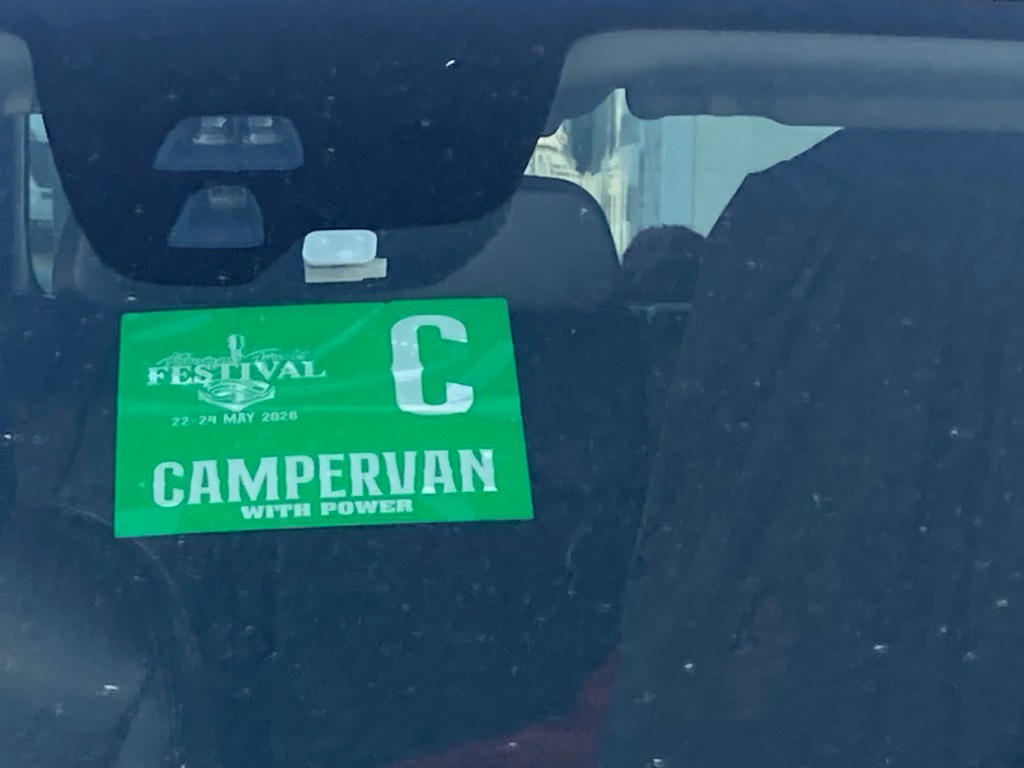
It hadn’t been the greatest of weeks. I’d been looking forward to the Fisherman’s Friends Festival for best part of a year. When I looked at our tickets, to my horror, I realised I’d somehow booked a campervan ticket and not a caravan space. The pitches are the same size and the same price but clearly I do not have the right ticket. My frantic ‘help’ emails were not answered. I feel physically sick. We can’t think of anyone with a handy campervan we could borrow. I run through the possibilities, which include sleeping in the car. We can’t park the van elsewhere and come in for the day as we don’t have a carparking ticket and once on the campervan site received wisdom was that you wouldn’t be able to leave. We’d booked a few days in Cornwall beforehand but instead of enjoying this, I anticipate more sleepless nights.
We move to our caravan site. Thinks aren’t getting any better. This is not the caravan site I thought it was, nor the one I probably should have booked. So not the one nearest to the festival site, nor the one with the lovely view of the sea, whose only downside was that you had to have the pitch next to the laundry to get wifi. This one has wifi but zero television signal. That’s ok, I have my computer (not enough wifi for TV streaming) and my companion can just sleep instead of sleep in front of rubbish TV. Once pitched, we drive to the showground where the festival is being held to see if my fears can be allayed. Someone, whose decision it won’t be, says she’s sure it will be fine. I am not reassured. She also says she will contacted the ticketing folk, whose base seems to be in Switzerland and they will let me know if there’s a problem. I am still not reassured.
Tuesday 19 May 2026
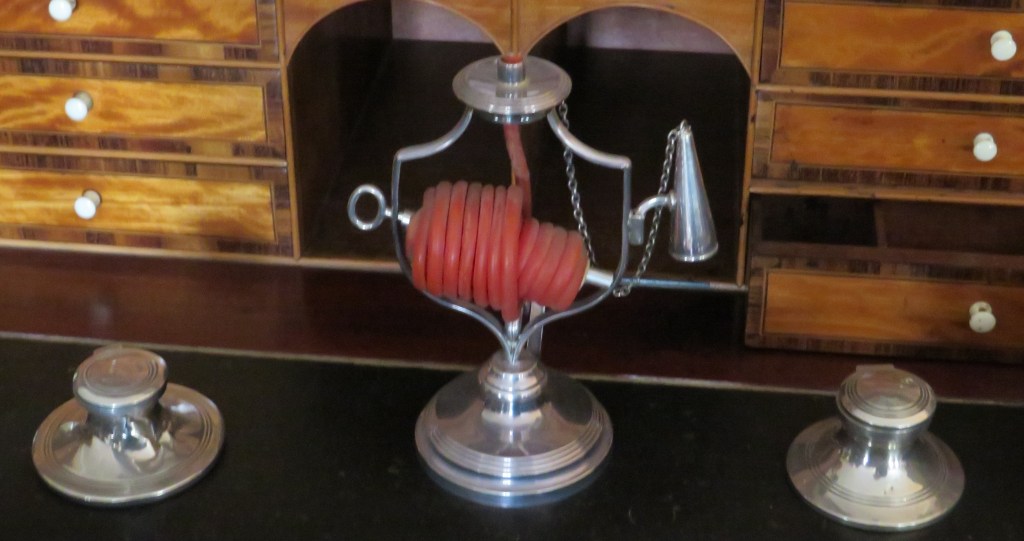
Despite unseasonably cold weather and threatening showers we decide to make the most of our time in Cornwall. It is definitely the sort of day to go somewhere with some indoors, so no strolling along the coastal footpath. We opt for a return trip to Trerice, where we’ve been a couple of times before, so here is not the place to write about it in much detail. My eye was caught by the knot garden, a nifty sealing wax dispenser (no home should be without one) and a late sixteenth century set of oak Kales, which are similar to skittles and the cheese (ball). The game was first recorded in 1509, when there were ten pins, although this set has nine and were arranged 1,2,3,2,1. Due to the gambling that became associated with the game in Tudor times, laws had to be passed ensuring that bowling greens were licensed and it became an expensive and therefore high-status, game.
We listened to a talk by a volunteer, braving wind and showers that eventually drove the talk indoors. There was a farmhouse on the site in 1230, when John Treise was in occupation. By the fourteenth century, it belonged to the Arundell family and we heard about a confusing succession of John Arundells. By the time we got to John Arundell Vth, I was feeling a bit dizzy and had rather lost the thread. I think it is a combination of a stressful few days, not just because of the ticket issue, a high pollen count and very humid weather. I went for a restorative slice of cake and then we decided to cut our visit short so that I could lie down in a darkened room (well a caravan at least), stopping only for supplies at a supermarket near us. I did note that the current Trerice was built in 1572 by John Arundell Vth, that the family supported the king in the English Civil War and that the window of the Great Chamber contains 576 panes of glass that date from the sixteenth century, as does the plaster ceiling in the upstairs room. From 1760 the house was in the hands of tenant farmers and fell into disrepair.
Wednesday 20 May 2026
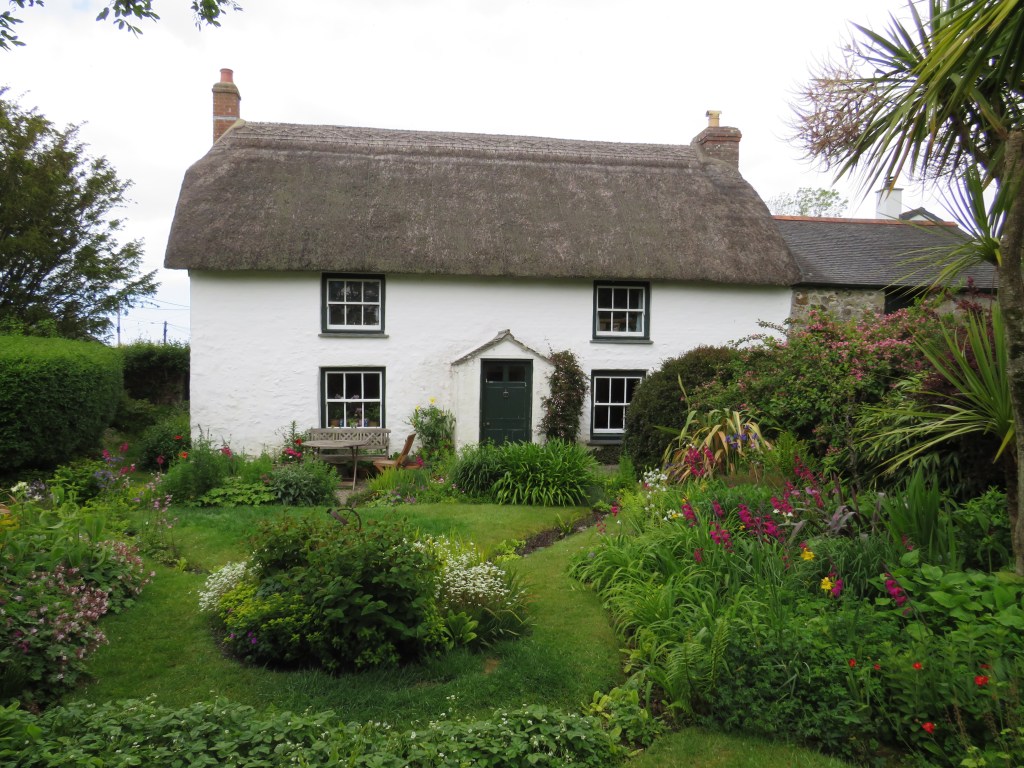
Having recently spent some time listing all the different National Trust properties I’d been to (74), I was keen to see if there were any Cornish ones close enough that I had not ticked off the list. East Pool Mine was one but that is closed for repairs, however, I was alerted to Trevithick Cottage, open by appointment only. I’ve had a fascination with the mining engineer Richard Trevithick (1771-1833) since reading the Poldark books in the 1980s, so was keen to go and booked without incident. We found it without too much trouble, aided by asking a local and after a bit of a fiddle trying to park so as not to upset the neighbours, we were shown round by the current tenant. The granite and cob cottage dates from about 1700 and has a grade 2* listing which applies to the cottage and associated outbuildings. The thatch is traditional long-straw thatch, which I know from my straw-plaiting endeavours is very hard to acquire. The cottage was Trevithick’s family home from the age of two until his marriage; his father was a mine captain at the nearby Dolcoath mine.
Thursday 21 May 2026
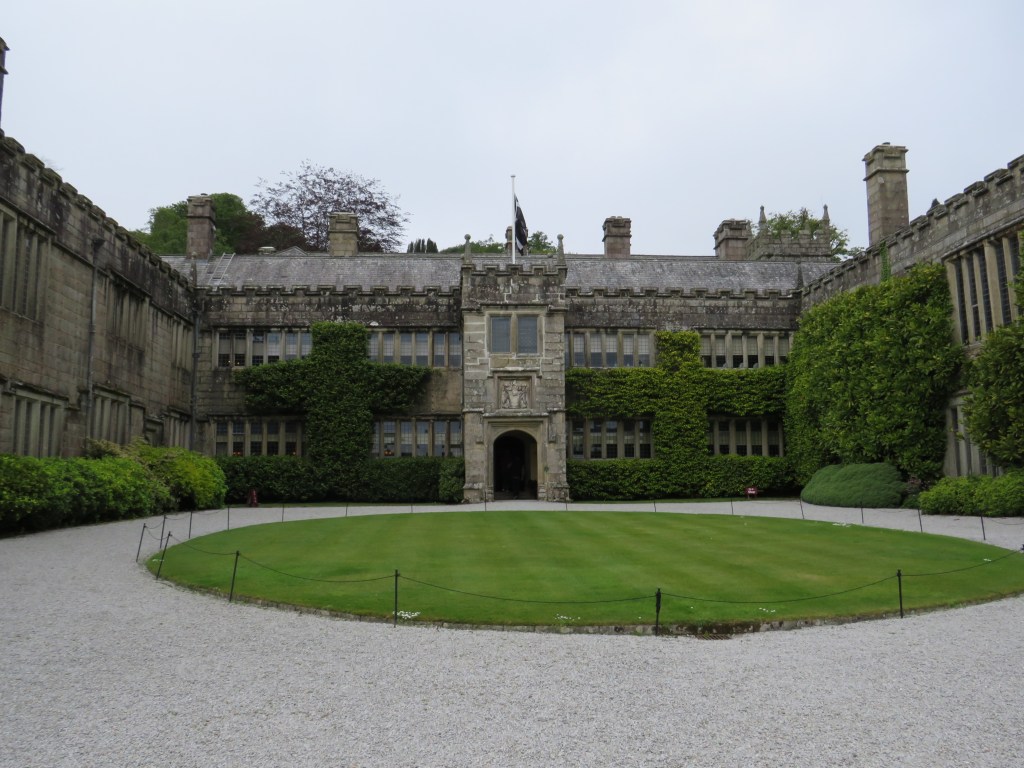
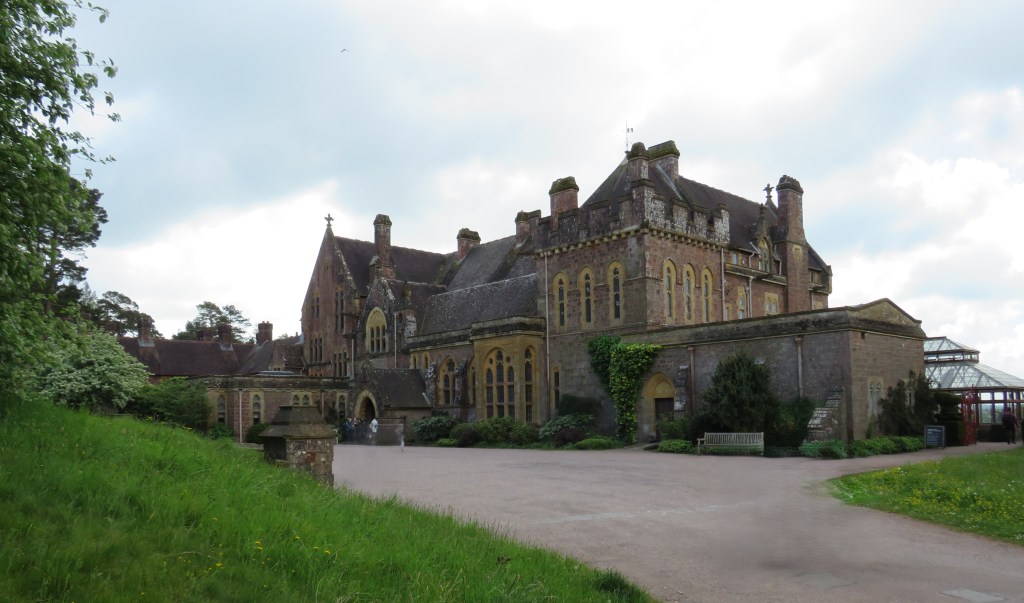
Another day another National Trust property, this time Lanhydrock. This too was a return visit. We were last here four years ago but my travelling companion has no recollection of it at all. I had forgotten quite how far it was from the car park to the house but it seems I am not as feeble as I was on Tuesday as I make it there and back without coming over all unnecessary. Lanhydrock was the home of the Robartes family, purchased by Richard Robartes in 1620, using money he’d made supplying both fuel and credit to the nearby tin mines. There was a disastrous fire in the 1800s and Thomas Charles Agar-Robartes spent the equivalent of 8∙7 million pounds restoring it. At the same time, he built a new modern kitchen block, where twenty five people worked, there weres a further fifteen indoor staff and forty estate workers. The displays name some of the staff and tell us a little about them. The kitchen designs were based on a book by Robert Kerr, The Gentleman’s House. I continue my research into caramel magnum quality, I fear I will need a few more before passing judgement.
Friday 22 May 2026
We are now in the position of needing to leave this caravan site before the incoming vans arrive at 1pm, yet not arrive at our destination half an hour away before 2pm. Even given that we are not the fastest driver in the west this is a logistical problem. Normally we’d ask to stay late on the site and that’s usually not a problem but the road to the site is single track for much of the way and we really don’t want to meet something larger than a car coming the other way as new holidaymakers arrive. I try to stem my ‘will we be allowed on site?’ stress as much as I can, as well as running through plans b to z in my head. Inevitably, we arrive two hours too early and understandably, are told to go and hide until the appointed time; two more hours before I know our fate. We find a road wide enough to park and still let the bus pass (just) and feel just a tad conspicuous doing so.
The witching hour arrives and we approach with trepidation. I haven’t obeyed the instruction to display our sticker from five miles out, as it clearly says campervan and with the best will in the world, a campervan we are not. We join a short queue and are waved in through the gate. I flourish our not yet stuck sticker and say ‘we aren’t actually a campervan’. 10 out of 10 for observation me. ‘Doesn’t matter’ says the guy in hi viz. Well what a shame someone didn’t reply to my frantic emails ten days ago to that effect and allow me to enjoy the anticipation and excitement in the run up to the weekend. Through the gate then, that’s the first hurdle but we still aren’t on a pitch. We are guided to another queue, which turns out to be the queue for accessible camping. We haven’t quite reached that stage yet so our driver needs to perform a neat manoeuvre to get us on to the field and we are in! Finally, I can start to enjoy myself.
We wander round to exchange our tickets for wristbands, so now I don’t have to worry about losing the tickets. Next, a recce of the site to see what’s what, investigating the craft tent and deciding that there’s a lot of lovely things we can do without and then listening to some folk musicians on the bandstand stage. We return to the van for sustenance and then head back to the bandstand for some of the fringe acts. ‘We don’t need the ponchos’, I declare. We listen to The Port Isaac Gulls, a female acapella group. It turns out we do need ponchos and I send my stalwart companion back for them while I chair save and hope that the few drops of rain don’t materialise into much more. Next up is a female duo Sound of the Sirens. We stay for the opening numbers from 1940s band Company B before bowing to the descending fog, falling temperatures and drizzle and call it a day, returning to the van to warm up. The rest of the country is in the midst of a heatwave, not so here, which may be just as well. We have new neighbours as the previous ones hadn’t paid for electricity, so were moved to where they wouldn’t be tempted to just plug in. We are not the only caravan masquerading as a campervan.
Saturday 23 May 2026
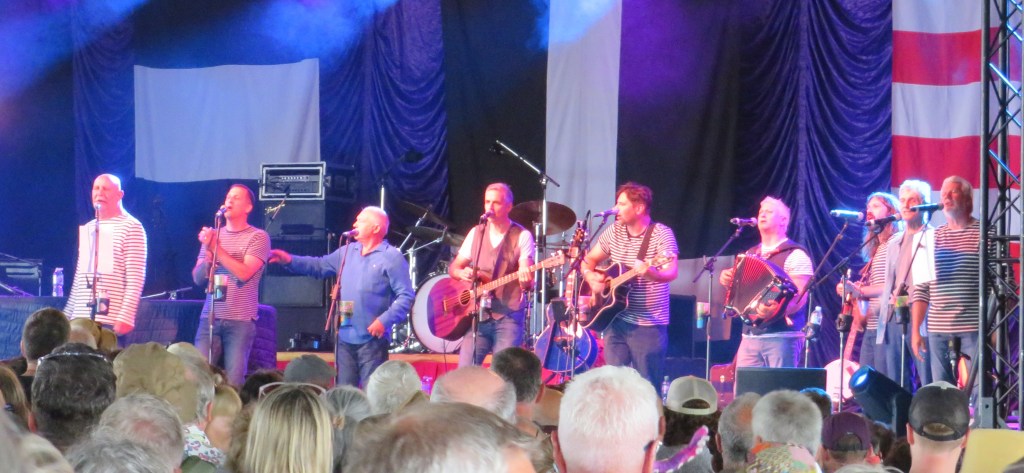
The site was surprisingly quiet last night and the gentle hum of the nearby generator wasn’t a problem. We listen to the ‘Ahoy Rise and Shine’ session, intended for children. This was led by Rob Punder of Entertainingly Different and was actually a good example of what it was. It brought back memories of summers on the beach when my children were small and being entertained by United Beach Missions. This is the first festival that I’ve been to since I was seventeen. I channel my inner flower power generation self and relive my youth by buying clothes that I would have worn then – 70 is the new 17 right? I do (just) resist the temptation of a felt pixie hat complete with toadstool and oak leaf decorations. The acts begin in the main marquee at midday with a set from the Fisherman’s Friends. Mindful of our senior status, we take chairs. This does mean that we are behind those with the stamina to stand, so it is a case of hearing the acts rather than seeing them.
Porthleven Town Band bring back more memories of summer weekends, this time watching the girls playing in a brass band. The band also has some excellent singers and their rendition of Cornwall my Home, with a male voice choir vibe, was incredibly powerful and moved many people to tears. You can listen online but it doesn’t fully convey the highly charged atmosphere in the tent. Definitely one of the stand out performances of the weekend for me. Bear in mind they are a band not a choir. Next up, The Longest Johns of the viral weatherman song fame, Irish singer Sharon Shannon and then Seth Lakeman. We returned to the van to eat, finding the Fisherman’s Friends film was on television. Then it was back to the marquee for headliner Jules Holland. We didn’t stay too long, just enough to say we’d seen him. Thick fog had descended with the darkness again.
Sunday 14 May 2026
We went to support the children’s entertainment again. This put us in the right place to see Fisherman’s Friends member Marcus Bonfanti, with a blues set; he was accompanied by his daughter Isabella for a couple of numbers. We were in time for the second half of the Splann ceilidh band in the main arena and managed a Gay Gordons and a mammoth set of Strip the Willow without too many ill effects. They were followed by the Cornish choir the Oggymen, who were up there with our favourite acts. Peat and Diesel followed, excellent musicians but a bit too heavy metal for us. Another highlight was Skippinish and I splashed out on a CD, which I got signed. The evening was Kate Rusby from Barnsley and then an hour to wait for Fisherman’s Friends. We’d decided that we would stand, so that we could at least see the band. The crowds formed straight after Kate finished and we found ourselves four rows from the front. This worked well in the beginning. Unlike a theatre, you could sing along at full volume and not be heard and jig about a bit. It was certainly a great atmosphere. This was however the day that the heatwave finally reached Cornwall and half way through I’d already been standing for two hours. I had to bail out to the side of the arena where I could sit down and fell some fresh air. Nonetheless, it was a great weekend. The following day, we left early to avoid the Bank Holiday traffic and heat and were home by 10am. Would we do it again, on balance, yes I think we would if we could.