Day 8
There’s a light drizzle so we opt for what we expect to be the most indoorsy of the two options left on our itinerary for this part of the trip and head for Walmer Castle. The importance of coastal defences became even more crucial after the Reformation, which motivated Catholic countries, such as France and Spain, to attack England, with the blessing of the Pope. Three castles were constructed in close proximity at Walmer, Deal and Sandown. Originally, these castles, just a mile or two apart, were linked by ditches and bulwarks in between but these have not survived.
We drive through Dover in the mist and murk to arrive at Walmer. Unfortunately, the indoor portion of the castle is closed pending refurbishment. Constructed in 1539-1540, Walmer consists of a round keep and four surrounding round bastions, protected by a dry moat. Walmer Castle was traditionally the home of the Warden of the Cinque Ports. The original Cinque Ports, Hastings, Hythe, New Romney, Dover and Sandwich, were established before the Norman Conquest by Edward the Confessor. The settlements were self-governing and were exempt from taxes in exchange for providing crewed ships for the defence of the realm, on this strategic part of the coast, at a time before there was a permanent navy. Other towns such as Winchelsea and Rye were later added before the ports declined in importance with the establishment of the Royal Navy. The role of Warden, is now a symbolic one.
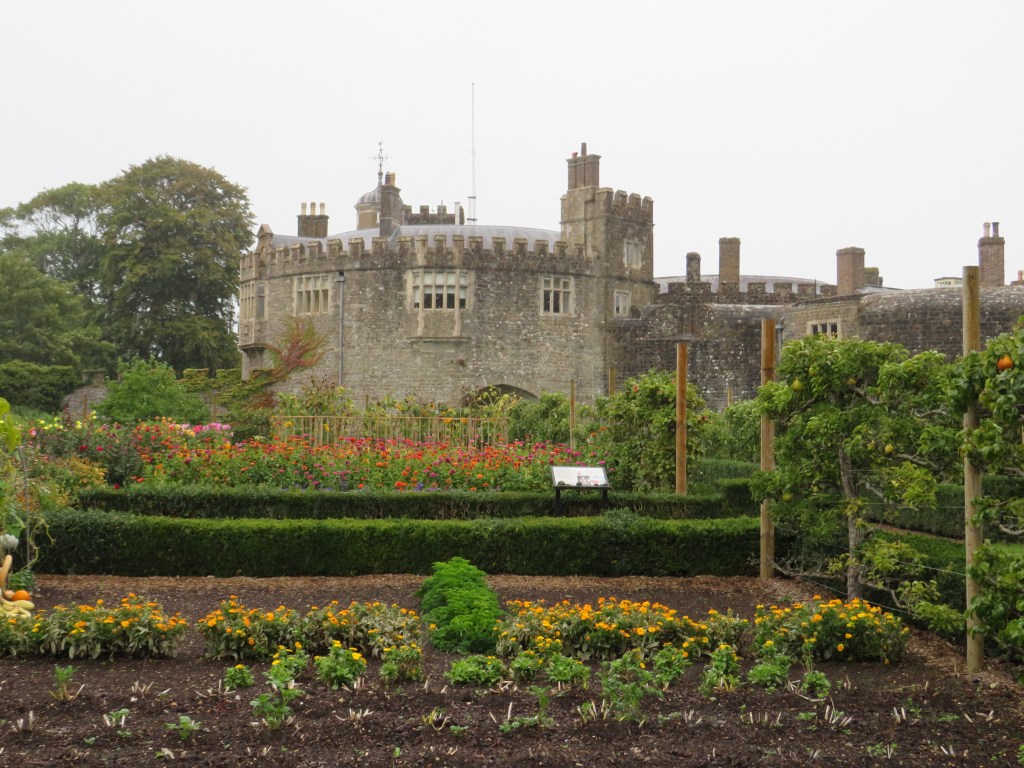
During the Napoleonic Wars, Prime Minister William Pitt the Younger held the post of Warden. Debts led Pitt to sell his home nearer to London in Bromley and make Walmer his principal home. He established the gardens and these were completed by his successor, Lord Liverpool. Later notable Wardens have included the Duke of Wellington, Winston Churchill, William Henry Smith, of W. H. Smith’s fame and the Queen Mother. We can view the gardens. The dry moat is now part of the gardens and the bastions have acted as a walled garden with some huge ferns and fig trees growing. The gardens are indeed impressive and include pumpkins being grown across a frame in an unusual manner but it is getting increasingly soggy and it isn’t long before my feet are a trifle damp. We cut our loses and head for the café. Having travelled about thirty miles to not view Walmer Castle’s interior, we decided to move a mile or two up the road to the second castle of the day at Deal.
Deal Castle was another Henrician fort, built in 1540. Over succeeding years, the settlement grew up around it, with a naval supply yard established in the 1600s. Deal Castle was captured by Royalist troops in 1648 and was besieged by the Parliamentarians for three months. Successive captains of Deal Castle, were answerable to the Warden of the Cinque Ports and the captain at Deal was senior to his fellow captains at Walmer and Sandown. Although the Captaincy was bestowed as a reward for service to the state, the captains were expected to be working captains and were not allowed to ‘lie out of the castle’ for eight nights in any month without obtaining a licence from the king. From the 1700s, by which time the settlement had developed in to a busy port, the castle’s main function was as a residence, rather than a fortress. The eighteenth century residential wing, was indictive of the lessening of the military function of the castle and by the nineteenth century, the role of captain was a purely ceremonial.
Deal has the advantage of some indoor space that we can view, although, by this time, the weather has improved. There is a central keep with six semi-circular bastions and then an outer curtain wall of six more bastions, surrounded by a dry moat. We tour the interlocking corridors and rooms of the castle, which is spread over three floors. I even conquer the spiral staircase, which has a rope bannister, such that when someone else pulls on it, your hand gets crushed against the stone.
We finish our trip to Deal with a fishing boat fix for the fisherman of my acquaintance.
Day 9
Fortunately, the weather has improved today, so we head out along the A259, which has been a bit of a feature of this trip and which could take us all the way back to Brighton. We are however not that lost and we drive through Dymchurch and Romney to Dungeness in search of the RSPB reserve. We had intended to explore this stretch of coast on the Romney, Hythe and Dymchurch preserved railway but a combination of the cost and the timetable, made us opt for driving. We find ourselves by the nuclear power station and lighthouses, of which there are two. The first lighthouse was built here in 1615. Changes in the coastline, meant that a new lighthouse had to be erected nearer the sea just twenty years later and then it was moved again in 1792. The current lighthouse was built in 1901. There is an opportunity to climb 169 spiral steps to admire the view from the top of the lighthouse. For once, I don’t forget that this really isn’t my thing and our feet remain firmly at ground level.
For this part of our trip we are on the edges of the 100 square miles of wetland that make up Romney Marsh, notorious for its sheep and smuggling history and ingrained in my childhood memories for my much loved Malcolm Saville and Monica Edwards books. Romney is one of England’s three great marshland areas, the others being the Fens and the Somerset Levels. The landscape here was significantly changed by a huge storm in 1287. This altered the course of the River Rother, silted up the harbour at New Romney and towns that had been coastal were left inland. Martello Towers pepper the coastline and in 1809, the Royal Military Canal was constructed as part of the defences of the south-east coast during the Napoleonic wars. Even with today’s sunshine, the landscape is desolate. We can see the traditional wooden, black shacks that are dotted across the marsh, some made from old railway carriages.
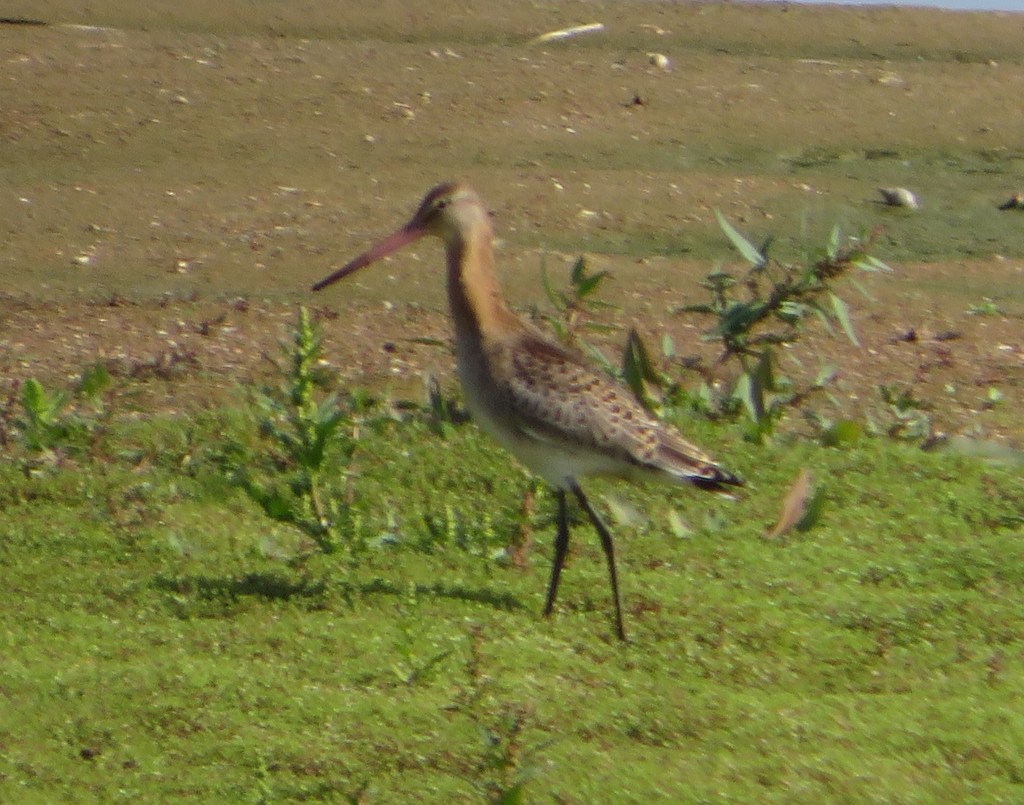
Where we are hoping to be, is the Dungeness RSPB nature reserve and we clearly aren’t quite in the right place. The Ordnance Survey Map is silent on exactly where the Visitors’ Centre is. Fortunately, there is a ‘you are here’ type map that helps and we are able to drive round to the reserve. There are plenty of birds to try and photograph on full zoom from a very long way away. I was particularly pleased to spot a black-tailed godwit. Full disclosure. I had no clue that I was looking at a black-tailed godwit. It was identified later from my slightly blurry photograph, in my defence, I was about 150 metres away. For the benefit of those who are interested in what could be seen, the full list includes: stonechats, black-headed gull, great egret, Egyptian goose, coots, graylag geese, Canada geese, avocet, great crested grebe, marsh harrier, sand martin, swift, heron, mute swan, cormorants, mallards, skylarks, magpies, little egret and a black-backed gull of uncertain size. We also hear a robin and a chiff chaff (yes, Merlin again), heard marsh frogs and saw numerous dragonflies and butterflies, including clouded yellow butterflies that are found in this part of the country.