It always feels strange posting about trips away when I am safely back home but I don’t normally post in real time. This was the day that the sat-nav decided not to work; this was apparently my fault. Never fear, I can do old school with my trusty ordnance survey map. I could locate the day’s National Trust property of choice, in this case Croft Castle, although it was a little difficult to work out on which side of the large estate the entrance lay. We overshot it at the first attempt, as we were expecting a useful brown sign. It turned out there was a very small brown sign, totally obliterated from our first approaching direction due to an overgrown tree.
We’ve been really fortunate that, throughout our visit to Herefordshire, the weather has been a lot less rainy than forecast, so we decided to risk one of the parkland trails. Not wishing to push our staying dry luck or our stamina we opted for the shortest, brown trail labelled Fishpool Dingle ‘Picturesque’ Walk. We wondered if ‘picturesque’ was going to be doing some heavy lifting here. Apparently, the eighteenth century ‘picturesque’ movement was a contrast to the pastoral naturalisation beloved of Capability Brown. This ‘gothic paradise’, complete with grotto viewpoint, was created in the Fishpool Valley in the late eighteenth century. It was a very pleasant woodland stroll, where we could see some industrial heritage include a restored medieval dam, a lime kiln and the ‘gothic’ pump house, dating from about 1800, which housed the water wheel and pump that provided the castle with water. There was also the remains of a charcoal burning platform; the charcoal was then used to fire the limekiln. There was a profusion of blackberries and elderberries as well as some birds including blackbirds, robins, great tits, a wren and woodpigeons. According to Merlin, we could hear a goldcrest, a chiff chaff (one I can actually just about recognise for myself) and a greater spotted woodpecker.
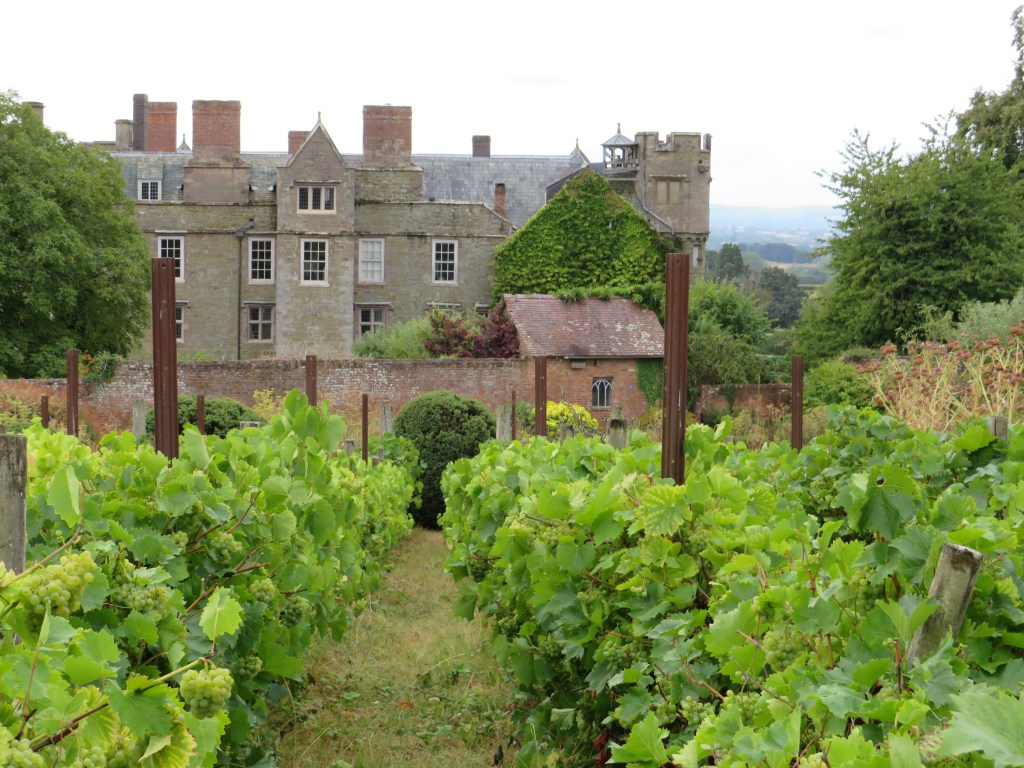
A brief pause for refreshment next and as none of the cake on offer appealed, today we were ’forced’ to consume caramel Magnums instead, no hardship there. Continuing to ride our ‘it is still dry’ luck we next explored the walled garden. The walls round the two acre plot were built in 1801; there were plenty of grapevines in evidence. The whole garden covers nine acres. This is managed by just two paid gardeners, supported by volunteers. Whilst most of the gardens and woodland looked positively autumnal, there were carpets of miniature cyclamen outside the walled garden, which I would normally expect to see in early spring.
We then looked at St. Michael and All Angels Church, which was the Croft family’s chapel but was also open to parishioners. This was built in the mid-fourteenth century, extended early in the sixteenth century and re-dedicated in 1515. There was a partial rebuilding in the early seventeenth century. The church includes Sir Richard Croft’s ornate tomb, which dates from the fifteenth century, Sir Richard fought on the side of the Yorkists in the wars of the Roses and was the treasurer for the household of Henry VII.
The Croft estate was founded about 1055 and a motte an bailey castle was erected by Bernard de Croft aka Bernard the Beaded, who was a Norman who had arrived in the reign of Edward the Confessor. Croft was part of the chain of Norman castles intended to protect the Welsh-English border. The fifteenth century Crofts descended from Owen Glyndower. In 1544, Sir James Croft was one of the leaders of the Wyatt Rebellion, which was a protest against Mary Tudor’s proposed marriage to Philip of Spain. Croft was pardoned, served Elizabeth I as Comptroller of the Royal Household and was buried in Westminster Abbey. James’ son, Edward, was accused of casting spells to bring about the death of Elizabeth I’s favourite, Dudley, in 1588. Royalist, Sir William Croft was killed during the English Civil War. The then Castle was deliberately demolished so it could not become a Parliamentarian stronghold. His brother, Herbert Bishop of Hereford, rebuilt the castle as a home, rather than a defensive structure. It was sold to the Johnes family in 1746 and they did further alterations. In 1780, Thomas Johnes II inherited both Croft and Hafod, which is an estate near Aberystwyth. He spent a fortune on Hafod and had to sell Croft in 1799 to pay his debts. Further remodelling took place in the 1910s, when the Kevill-Davies family owned the Castle, which was at that time tenanted. In 1923, after an absence of over 170 years, the Croft family bought the Castle back.
The increasing efforts by the National Trust to be both family friendly and inclusive were in evidence. Here there were 3d printed ‘touchable’ objects and there was a Wyvern trail to follow. There were several objects that particularly appealed including a wall hanging made by staff, volunteers and visitors in 2018 to commemorate the Representation of the People Act, which gave women the vote; a slice from the tree under which Sir William Croft was killed at the Battle of Stokesay in 1645; some 1760 fireplace tiles by Sadler and Green; a seventeenth century stump-work box; a small fabric collage of the castle and an inlaid table displaying many semi-precious stones.
The return journey was relatively uneventful, although we did overshoot the final turning. We should have been alerted by the pervading smell of guano, as farmers near the site have been spreading fertilizer over the past few days.
After a resounding early morning thunderstorm, we utilised our National Trust membership as usual and paid a visit to Berrington Hall near Leominster, pronounced Leminster. The rain had died down to an occasional drizzle by the time we arrived. We began by looking at the house. Co-incidentally, one of the volunteers was a former vicar of a parish near home.
Thomas Harley, the fourth son of the Earl of Oxford was a London wine merchant, an MP and the Lord Mayor of London in 1767. Wanting a country residence, in 1775, he acquired the Berrington estate and Henry Holland designed the Georgian mansion that now stands. Holland’s detailed estimate, dated 1778, survives and he quoted a total price of £14.500. The house was finished in 1783. Inevitably, it went over budget and expensive structural repairs were soon needed. Berrington’s landscaped gardens were the final project of Lancelot ‘Capability’ Brown and in 1775, the five daughters of Thomas Harley each planted a plane tree, one of which still survives.
After Thomas Harley’s death in 1804, his daughter, Ann and her husband George Rodney, inherited Berrington. Their descendants lived there until the depletion of their fortunes and in 1901, the estate was sold to MP and Manchester cotton merchant, Frederick Cawley. The house was used as a convalescent home for wounded soldiers in World War II. In 1957, Frederick’s grandson gave Berrington to the National Trust on the condition that his grandmother, Frederick’s wife, the dowager Lady Vivienne, could remain living there until her death. Lady Vivienne lived to the age of 101 and was still inhabiting Berrington twenty years later. The family were keen horse owners and horse trials were held at Berrington until into the twenty-first century.
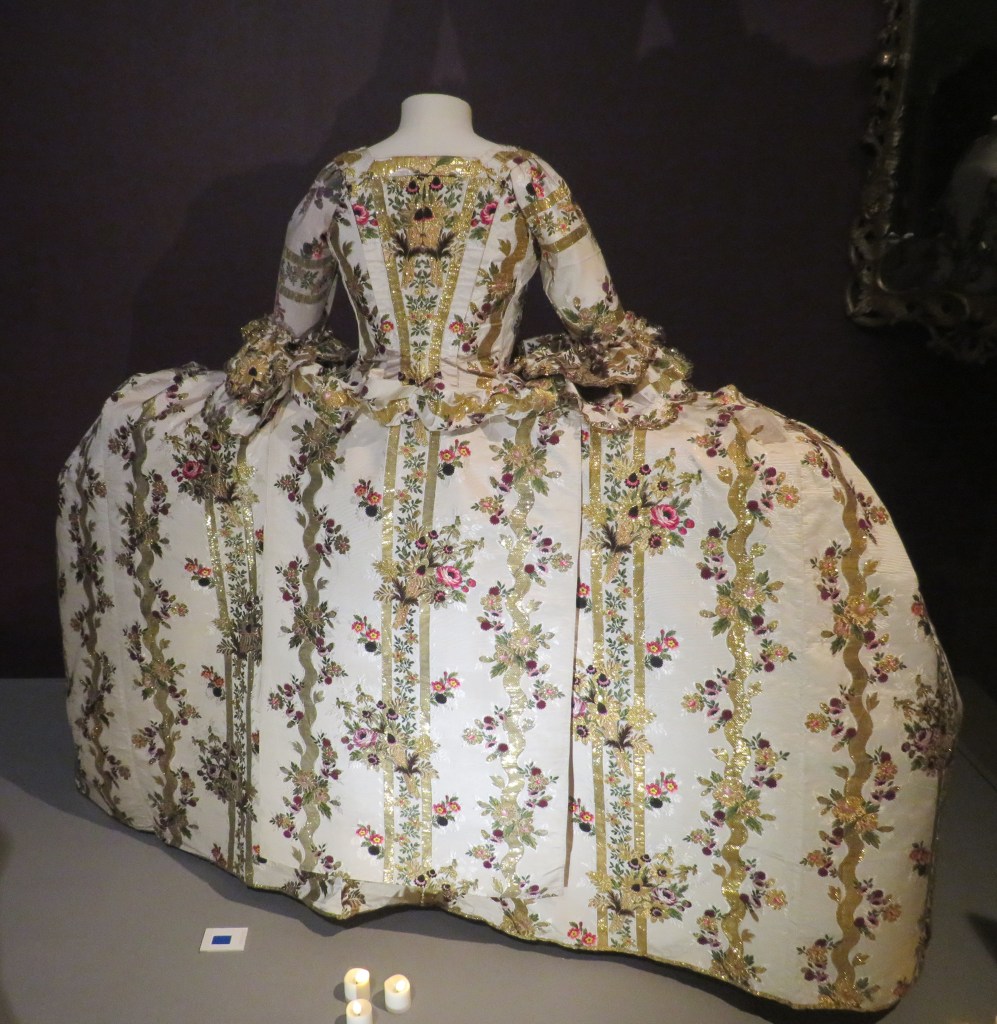
Furnishings are sparse at Berrington but the downstairs ceilings are spectacular and their USP is the display of costumes, many of which are handmade by the volunteer sewing team. I particularly liked a display of replica pockets and reticules, a miniature labourer’s smock and a wig made from crepe paper. We couldn’t resist dressing up; my dress was incredibly heavy. There were also several displays relating to conservation and cleaning. Currently on view was the widest dress owned by the National Trust; it is often not appreciated that the Trust is responsible for the conservation of 40,000 items of clothing. The dress in question is a court mantua, worn by Ann, wife of Thomas Harley, just once, in 1760, at the court of George III. There is four metres of material in the skirt alone and a further three metres in the train. Ninety percent of what was on display was original; when found stored in a box, the dress was missing a left sleeve and a stomacher. The dress is due to be removed from display in November, while a more suitable case for it is made. Today’s cake of choice was orange and poppy seed; not quite up to yesterday’s standard. We had a quick look round the walled garden but the weather was a deterrent. It was lovely to see the names of all Berrington’s former and current gardeners inscribed on the beams of the potting shed.
Still with an eye on the weather forecast, we decided to go to Goodrich Castle on what was predicted to be the least worst day we had left. As things turned out, after some light drizzle first thing, the day was hot and sunny. Possibly a little too hot to be ideal and certainly humid but we counted this as a win. My inspirational, lower high school history teacher was a Mrs Goodrich, so even the castle’s name had positive connotations. We began with a recce of the shop and were pleased to learn of new a English Heritage initiative, which gives members discounts in the shop and café. It was also good to see the child-friendly free activities on offer. I was vaguely amused by the placement of an advert for English Heritage membership outside the toilets that read ‘Members go Free’.
We availed ourselves of an audio guide, which wasn’t the greatest success. Firstly, it read two different explanations simultaneously and then, even on full volume, it was ridiculously quiet, even for those of our party (that would be me) with good hearing. So this is what I gleaned from interpretation boards, with the usual proviso that none of this is checked for accuracy.
Godric Mappeson, for whom Goodrich is named, built the first castle on this site in about 1100 but none of this early castle still stands. The keep, that is the earliest part of the existing castle, was built by Richard de Clare about 1150. In the early years of the thirteenth century, William Marshall owned Goodrich, amongst many other properties. By the end of that century, Henry III had granted the rights to the castle to his half-brother William de Valence. French nobleman, de Valence, who was thus uncle to Edward I, built much of what remains today. Regarded as a foreign upstart by his neighbours, he set out to build an impressive and intimidating edifice, yet Goodrich did not have to defend itself against enemies until the seventeenth century. Instead, the castle functioned as a domestic residence, although most of its owners had properties elsewhere, so were not permanent residents. Unusually, the castle has stained glass windows, which reflect its domestic function. By 1326, the castle had passed into the hands of the Talbot family who were still in residence at the end of the sixteenth century. They were responsible for extending and improving the castle. Royalist, Sir Henry Lingen, held the castle during the English Civil War when the Parliamentarians held it under siege. The Parliamentarians had a special large mortar cast, ‘Roaring Meg’, which could fire 200lb shells and destroyed part of the castle, then the remainder was further demolished to ensure that it was beyond repair.
The approach to the castle is via two drawbridges; the first, at right angles to the moat, leads to the barbican. This was modelled on Edward I’s barbican at the Tower of London and is a D shape. The second drawbridge leads across the moat, which never had water in. As the latrines exited directly into the moat, the lack of water may have been an issue. Here at Goodrich, one of only a few portcullis mechanisms remains.
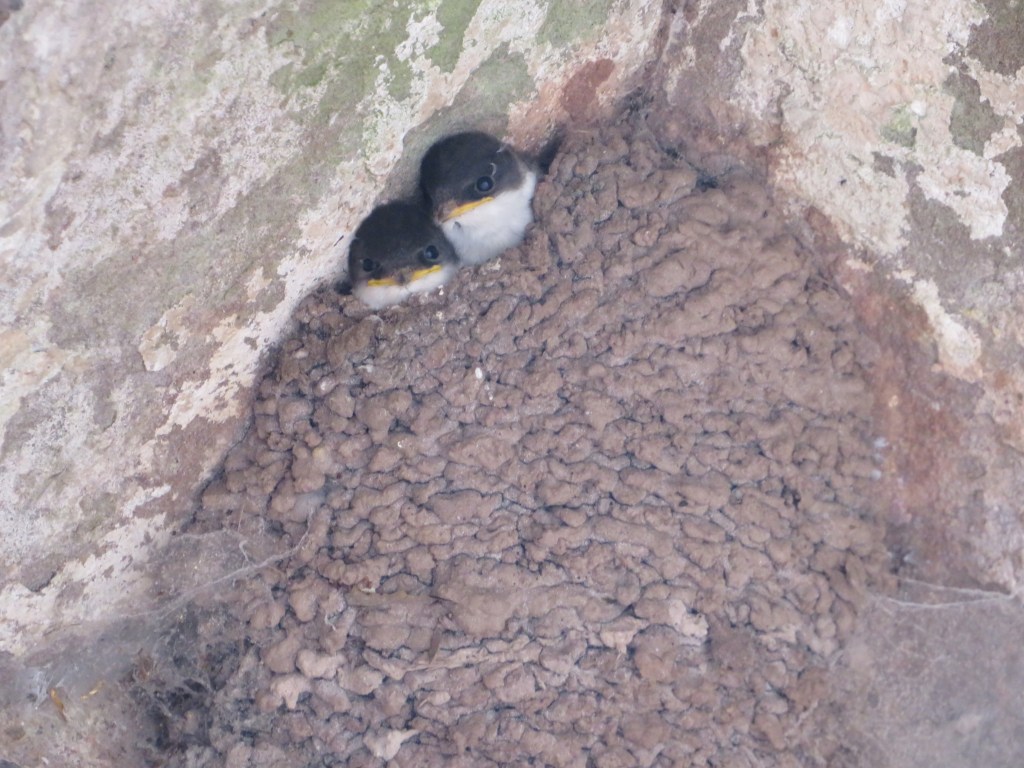
We stopped to admire the red stone castle and watch the many swallows and martins wheeling and diving, some still with young in their nests, constructed in out of the way nooks in the castle. Once inside, we found a way to reach the battlements that didn’t involve a perilous spiral staircase and were rewarded with lovely views across the Wye Valley.
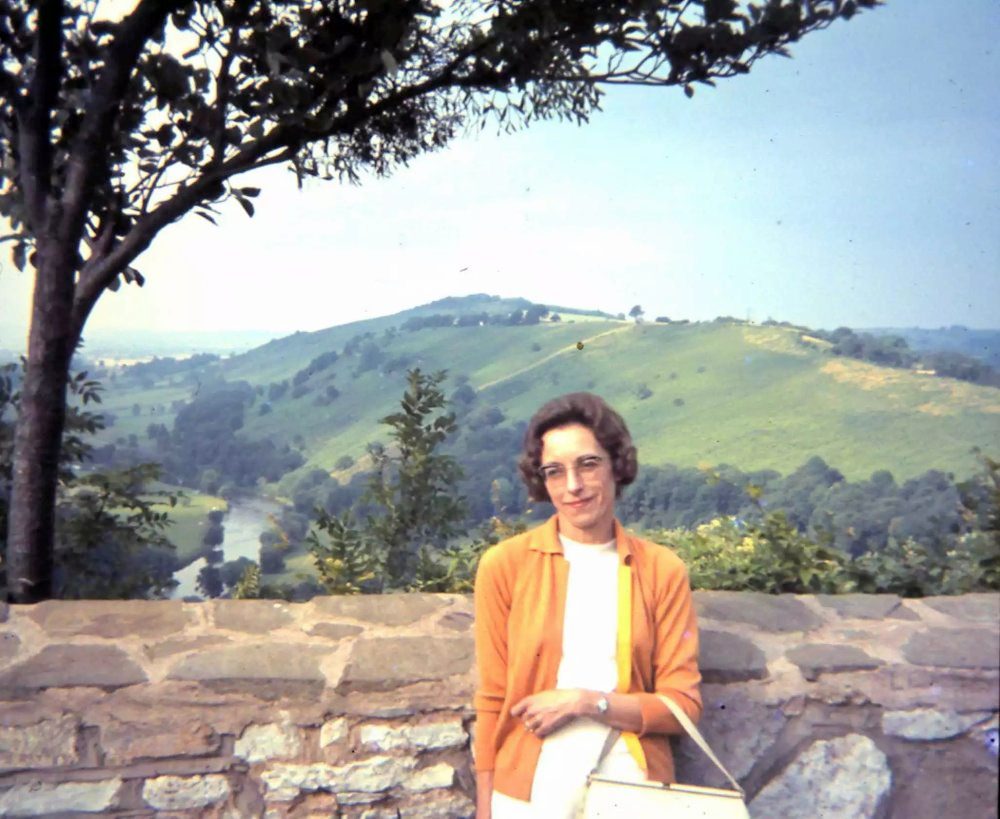
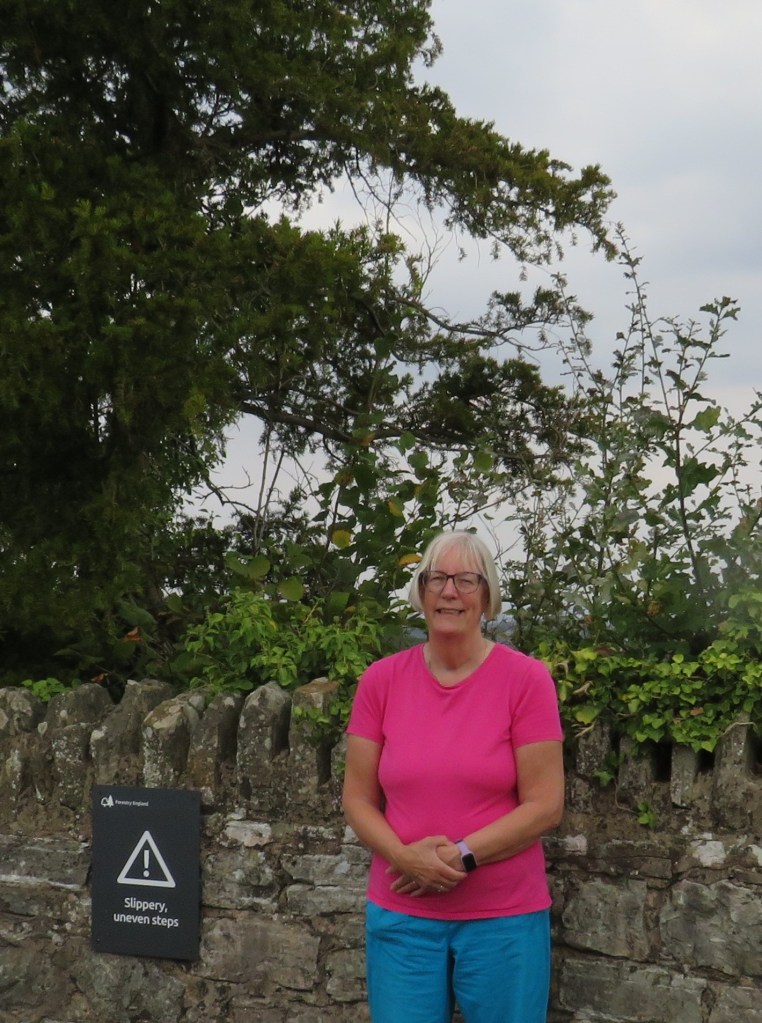
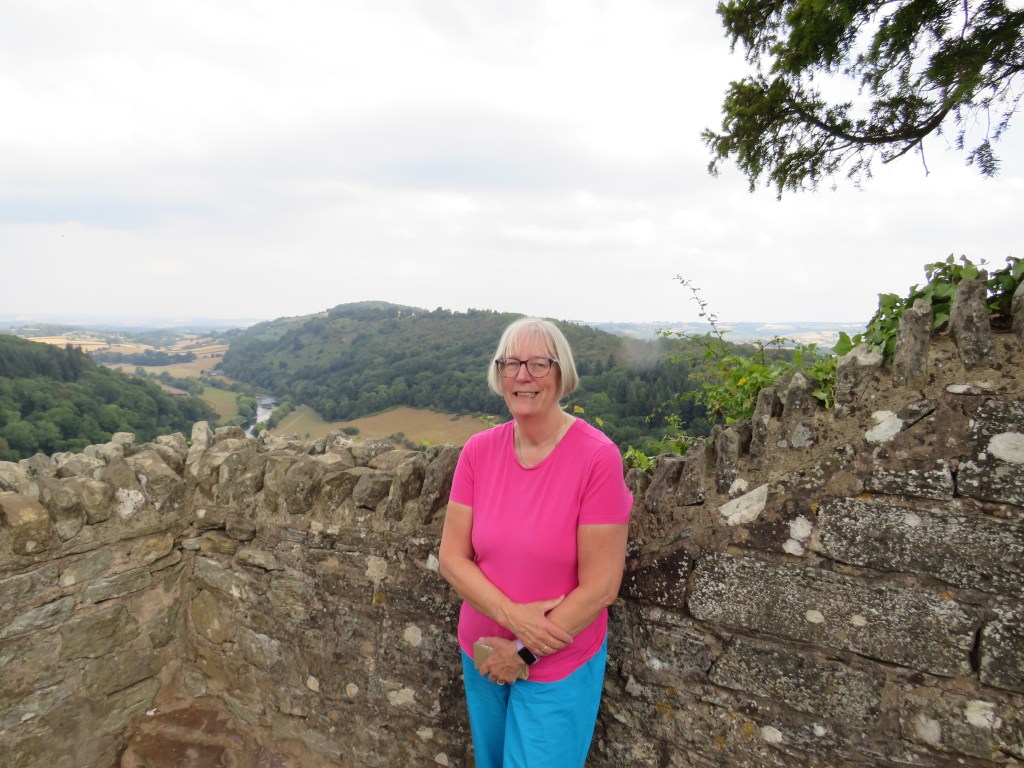
After some sustaining and very tasty passionfruit and lime cake we set off for nearby Symonds Yat. I had been here once before as a child, in 1968 and the only real memory was sparked by a photo of my mum taken at the time. I was hoping to be able to find the spot where it was taken. It seemed that the wall that she was standing by had been raised and vegetation growth meant that, what I think was the exact spot, no longer had a view but we took a photo anyway and also one a little further along, where you could see the view. Symonds Yat is the site of an Iron Age fort, built about 2500 years ago. It is thought to have fallen into disuse in the hundred years before the Roman invasion. It really was too hot to walk along any of the paths in the area, so we returned home via a supermarket stop.
There was a half hour delay through Hereford due to roadworks/volume of traffic and probably an accident, as three ambulances squeezed through the traffic to pass us. It got to 29 degrees in the car, which was less than pleasant. In the evening, we set off to meet a school friend at nearby Tillington. We went a fairly strange route as I had inadvertently put the wrong postcode in the sat nav but thanks to my map reading ‘skills’ we found the venue without much trouble. It is always lovely to catch up with people you haven’t seen for many years, in this case we think twenty-five and find we still have plenty to talk about.
You would think that there would have been little time for family history with all this gadding about hither and yon in recent weeks. After all, I’ve been away every month for the last five months and there are at least three more trips planned for this year. Time away from family history? Not a bit of it. There have been a lot of historical goings on lately. I’ve been giving talks as usual. It was a little while ago now but what a privilege to be part of the Society of Genealogists’ Mental Health day. I managed to find some fascinating case studies of those who spent time in an asylum. I was able to listen to some of the other excellent presentations but I must single out Dai Davies’ Remembering ourAncestors who died by Suicide . Do try to catch this if you can. They are presenting it again for the Pharos Anniversary Webinar week and I will be up again then on the topic of marginalised ancestors. I don’t think I’ve mentioned that I’ve been chatting to Andrew Martin as part of his Family Histories Podcast, talking about by straw plaiting ancestress and an elusive 3x great grandmother. You can listen in; I am part of series 11 along with some other great guests.
I host Zooms for more than one organisation and if I’m honest, not all the presentations hold my interest but there have been some fascinating ones amongst those I’ve heard recently. I particularly enjoyed ‘At Home in History – reflections on writing the history of domestic life’ from Jane Hamlett and Pam Vass’ ‘Kernow to the Crystal Palace. The Remarkable Ramblings of a Cornish Fishwife: Mary Kelynack and the Great Exhibition’. There are also some more potentially excellent talks to listen to in the diary .
Currently, I am coming to the end of leading my Pharos course on researching female ancestors, whilst at the same time, feeding back on students’ family histories that they have written as part of my writing your family history course; we’ve had stories of Irish brickmakers, handloom weavers and much more. I’ve been putting the final touches to my own biography (it has only taken fourteen years) and am enjoying supporting my new cohort of autobiography writers in the Society of Genealogists’ write your Life Story Club.
I am very excited that both Mistress Agnes and I will be contributing to this year’s All About That Place event. Then I’ve been submitting my proposals for Rootstech 2027, personning a local history exhibition and uploading some more stories of fatherless girls for A Few Forgotten Women. It is my turn to write the sample story for the next Forgotten Women Friday communal research day. I chose someone with a family name and managed to weave an account out of very few documentary appearances. Watch this space for the call for volunteers for that one. And there’s more, as one of my friends would say. I’ve been helping to get a co-authored book ready for publication and continuing preparations for the Devon Family History Society 50th anniversary conference, which is now a scarily short three months away.
Add to this the job we must not mention and I’m living my best history/family history life. Not roses but I do still have time to smell the flowers.
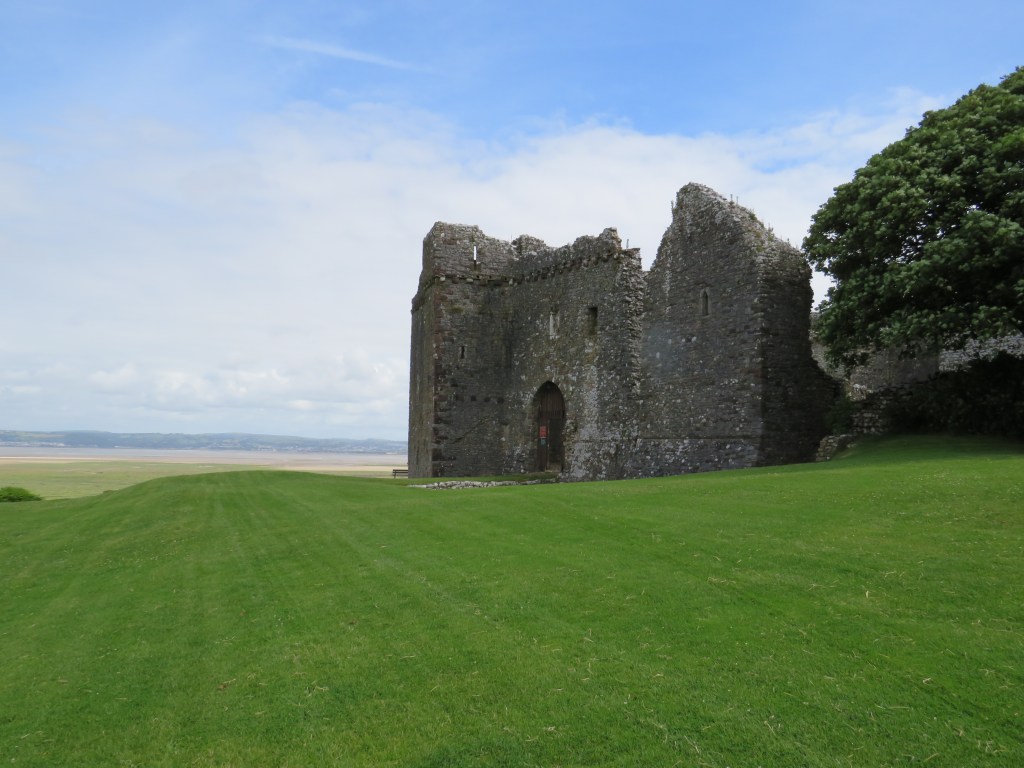
The weather forecast insists it will be 19 degrees and cloudy. We dress accordingly and set off for Weobley Castle. Oddly the sat nav thinks this is in two different places about half a mile apart and although I am enjoying following along on my OS map, it is hard to see where the entrance might be. Inevitably, we have opted for the wrong sat nav possibility and here we are in a farm. Destination recalculated and we arrive. There are some lovely views but to be frank, the possibilities for exploration here are a little limited. My travelling companion is fascinated by the remote lawn mower and is blocking it’s path with abandoned short scaffolding poles to confuse it. It would be harsh to say that this was the most interesting part of the visit and there is some historical information imparted, which I share with you now, with the usual proviso that this is what I gleaned and I can’t vouch for its accuracy. Regarded as a fortified manor, part of a series of Norman castles on the Gower peninsula, Weobley was described as ‘new’ castle in 1306, when it was held by the del la Bere family. A century later during a revolt on the Gower as a result of Owain Glyndŵr’s activities, Weobley suffered damage; the Welsh claimed to have ‘destroyed’ it. By the late fifteenth century, it was in the hands of Sir Rhys ap Thomas, who had been granted the overlordship of several castle as a result of his support for Henry VII during Henry’s efforts to claim the English throne. He instituted many improvements but the castle reverted to the crown when Rhys’ grandson was executed for treason under Henry VIII. It was then leased out as a farmhouse. In 1666, it was bought by Sir Edward Mansel and then passed to the Talbot family, being given into state ownership in 1911.
Weobley Castle’s possibilities exhausted, we decide to explore the south coast of the Gower and wonder if we can also take in Oxwich Castle. We can’t, it is shut. By this time the temperature has risen to the mid-twenties, the sun is beating down, we are ‘cosy’ and fairly in need of a drink and more urgently some ‘facilities’. Oxwich itself is heaving, with queues to get in the car park. We decide to try nearby Horton. All the coastal villages round here are approached via twisty, single-track roads, with occasional passing places. We are used to this. Not so other road users who clearly think their Nissan Micra is the width of a pantechnicon and has no reverse gear. Horton is equally lacking in options. Plan c is Porth Eynon. Car park located and himself heads off to pay for the parking ticket. This is always a technological challenge, involving reading things without the aid of reading glasses and potentially downloading apps. Ah no! This machine takes real money. The snag is that it doesn’t provide the necessary ticket in exchange. Never fear it takes cards. Having thus paid twice to park and ‘facilities’ availed of, we eat an ice cream and look at the beach. Our verdict on both – all very lovely but not a patch on what is 400 yards from my home. The drive back to the van is scenic, especially the road through Reynoldston. On the way, we pass a Harvester restaurant that would have been considerably more convenient than our Friday choice. Annoying that that eluded me when I asked Google for the nearest one to Llanelli. This is followed by another restful afternoon back on site, watching the swallows feeding their babies on the wing.
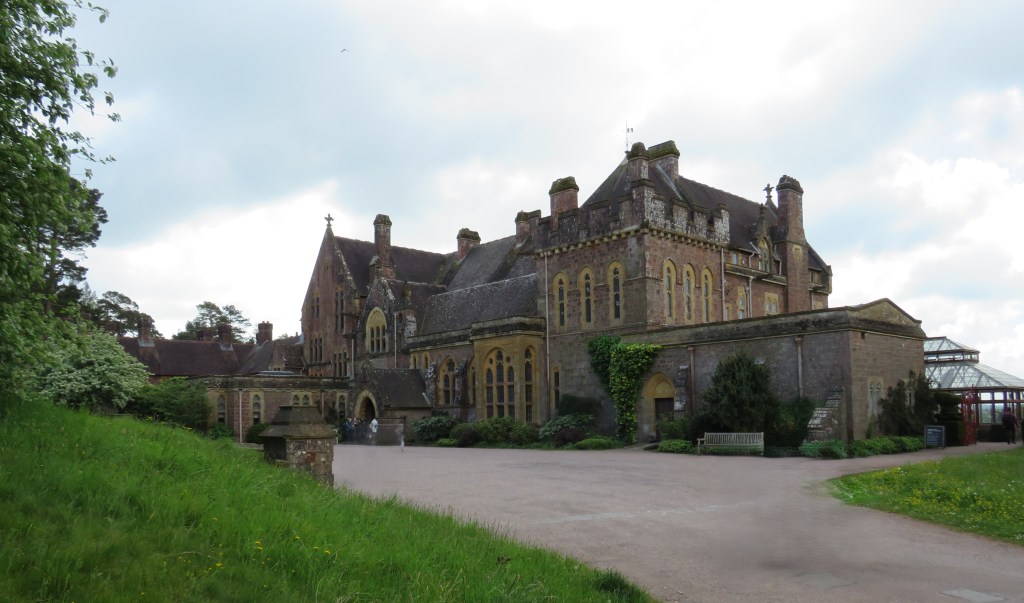
Each year since the 1980s, the first May Bank Holiday weekend has been the time for members of the extended Braund family to reunite in North Devon. This year we had visitors from Australian and New Zealand, as well as those joining in from the USA on zoom. This occasions are always an opportunity for eating far too much but we also try to see some of Devon’s historic sites. This year’s offerings included a guided walk round Bideford, which has a fascinating history and an outing to Knightshayes Court. Knightshayes was the home of the Heathcot-Amory family from 1872-1997. The family’s fortune was due to the bobinet lace making machine invented by John Heathcote. This made the process much quicker and therefore more profitable but was very unpopular as it required less labour, so put people out of work. Forced to move from his native Midlands, John Heathcote took over a disused woollen mill in Tiverton and located his lace-making factory there. The factory still exists but has passed into other ownership. It was his grandson, Sir John Heathcote-Amory, MP for Tiverton and later a baronet, who used his grandfather’s fortune to commission Knightshayes in order to demonstrate the family’s wealth and status. William Burges was appointed to be the architect of this Gothic Revival style stately home but when his ideas proved to be too extreme, he was replaced by John Dibblee Crace, whose designs were out of fashion before they were finished. Various features were dismantled and stored by the family and the National Trust have been able to restore some of this to reflect Crace’s vision. The house was requisitioned as a hospital for the wounded during both world wars.
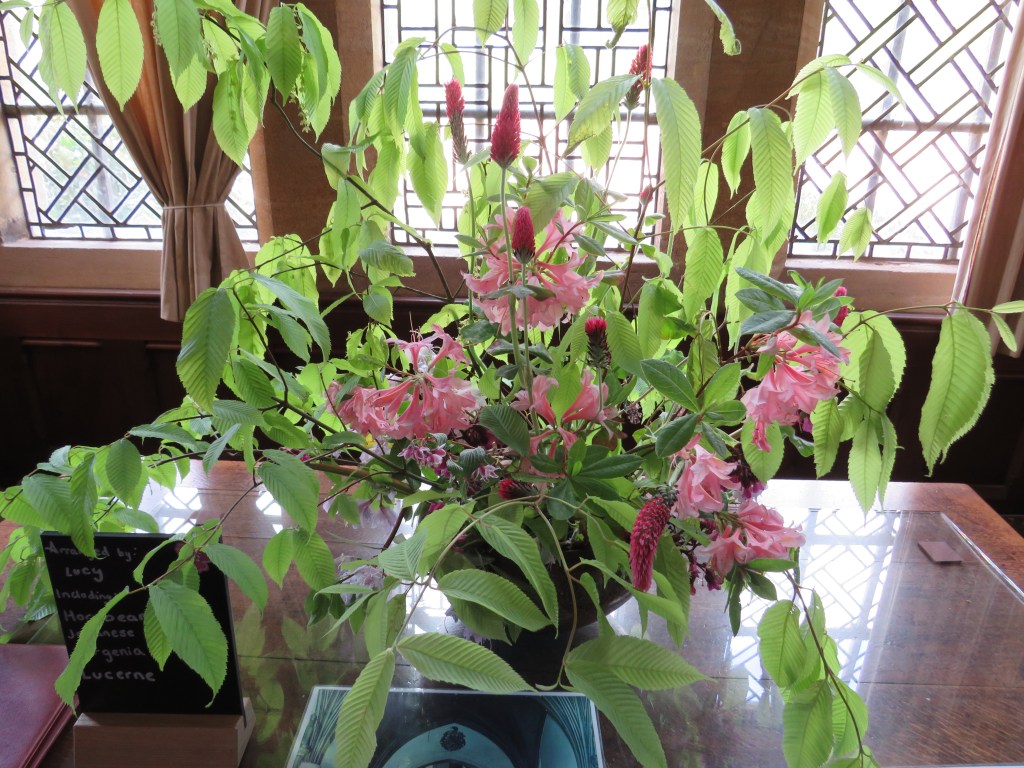
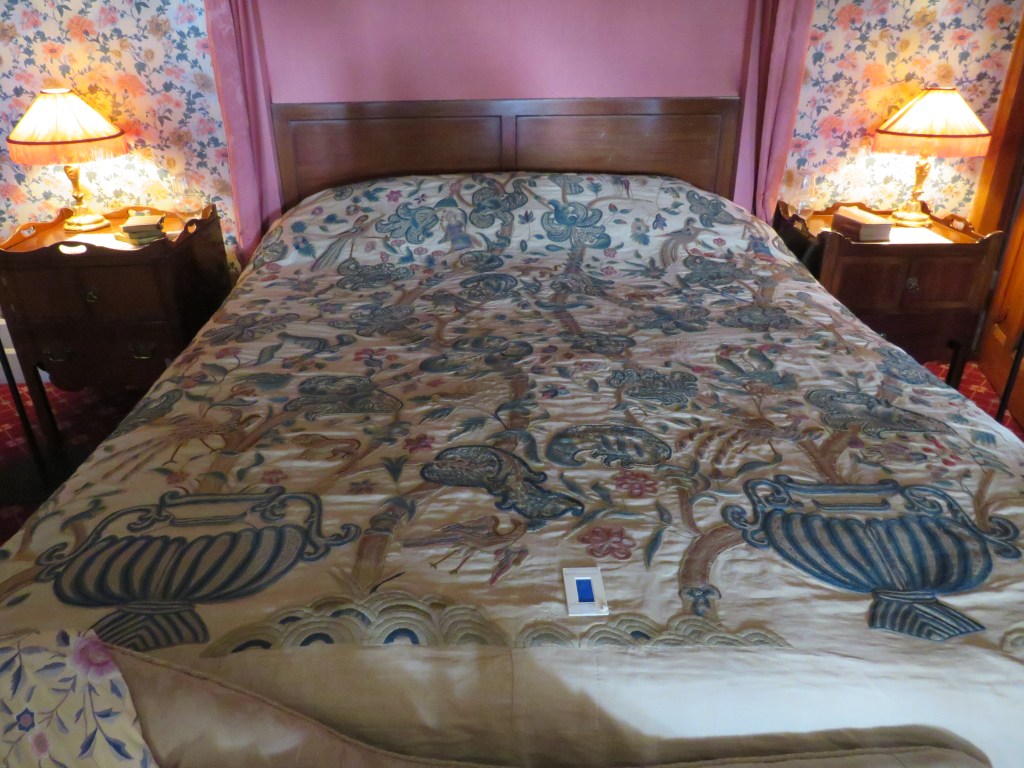
Flowers picked from the gardens and grounds appear in most of the rooms, together with details of the flowers that have been used and the name of the volunteer who arranged them. A beautiful crewelwork bedspread was worked on by Lady Heathcot-Amory, who invited her guests to add a few stitches. There was an exhibition dedicated to Joyce Heathcot-Amory née Wethered, who was a well-known championship golfer, renowned for her swing. She turned professional and was inducted into the World Golf Hall of Fame.
We will do it all again next year by which time I may have lost the weight that I put on this year.
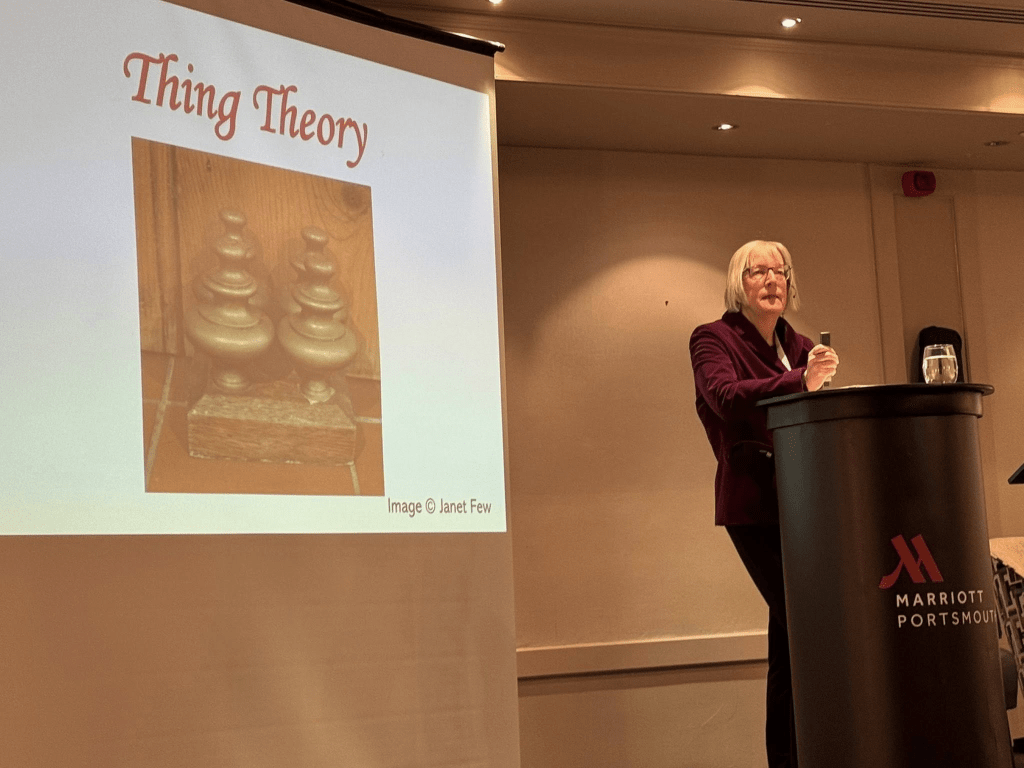
A distinct downside of the Rookesbury Park caravan site is the one bar of wifi and zero phone signal. This meant that, on arrival at the Marriott Hotel, venue for the 47th Guild of One-Name Studies conference, I needed to upload two photobooks for printing before my pre-paid vouchers ran out. This had to be carefully timed so the resulting books didn’t arrive while I wasn’t at home, so I couldn’t do it earlier. This and the fact that I was ostensibly ‘helping’ meant that I missed Brian Swann’s opening presentation about resources for Portsmouth Shipping.
I was glad to be able to listed to Frances Hurd’s ‘Sex, Violence and Alcohol: after effects of the Great War’. I hadn’t realised that then a shell-shock diagnosis relied on physical, rather than psychological, symptoms. This was followed by a fascinating presentation from graphic designer Sarah Houghton, ‘Representing the People: envisioning the hidden history of the Portsmouth suffragist movement’. This was fascinating. Sarah has created wonderful animations about the march of the suffragists from Portsmouth to London and has also recreated some of the banners that they carried. Do check out her website.
I started day two with one of the fringe talks, Valerie Brenton on finding teachers’ records. This was a good summary and deserved a wider audience. Next up was Paul Carter with ‘Making your Research Manageable’, whose verdict on AI was that it was useful as a clerk but dangerous as a judge. Continuing the AI theme, was John Thew, who illustrated what might happen when someone tried to use AI to do their family history, particularly if that person wasn’t very skilled in providing suitable AI prompts. The take away was that humans are still significantly better at making genealogical connections than AI.
Nick Barrett held the after lunch spot, providing hints for Medieval and early modern resources. One of my favourite presentations was Sally Gardiner’s ‘Who was Ann Elizabeth Epitaux’. Sally had purchased a sampler at auction and her U3A group had worked collectively to trace the ancestry of the person who was named on it. Considering that Ann Elizabeth had ancestors who were Jones from Wales, they did remarkably well. I was then part of a panel fielding questions about the future of family history. There was plenty about AI, which is clearly the hot topic.
The Gala Dinner followed. By the time I had joined the drinks reception queue, they’d run out of orange juice. I asked the staff member, who looked about twelve, who said he would bring it to my table. This did not materialise so I asked another waiter – possibly thirteen this one, who asked if I wanted it in a glass. Well yes, not sure swigging out of bottles is the done thing at a gala dinner. He then produced a jug of orange juice for two of us but still no glasses. The after dinner speaker was Harry Rothery about the Mary Rose. I’ve heard talks about the Mary Rose before but probably so long ago that Harry wasn’t born. It is fascinating what has been done recently. I may put Portsmouth Dockyard down for a revisit.
Then it was Sunday. After an ecumenical service, it was my turn with a new presentation ‘Preserving the Past for the Future’. I was pleased with how it went and the resulting book sales. Then I listened to Daris Williams’ presentation, entitled ‘Is AI the new Snake Oil?’, with a very balanced view of the pros and cons. He said that the hope is that all the records on Family Search will be searchable via the full text option by the end of the year.
A break from the focus on technology was Howard Benbrook’s talk on the Hampshire Swing Riots, although, as he pointed out, there are parallels to be drawn between reactions to threshing machine’s and to AI. A useful website that he recommended is www.theenglishprojectcaptainswing.org. Back to technology for the afternoon with ‘Navigating Modern DNA techniques’ from Donna Rutherford and Sophie Kay describing the open source software Gephi. This enables you to visualise your DNA matches but could also be used for other kinds of networks.
Then it was all over. We said our goodbyes and look forward to reuniting next year, when the conference will once again be in Portsmouth.
You must be wondering of I have a home to go to because, although I am safely home now, I’ve been away again, this time with a family history slant.
We set off through slowish traffic to take the caravan to Ferry Meadows site on the edge of Nene Valley Country Park, somewhere we’ve been several times before. Fortuitously, this was the day the fish and chip van visited the site. It would have been rude not to partake.
With our Devon Family History Society hats on, we personned a stand at the East Anglian Really Useful Family History Show. It seemed quite busy and it was good to chat to so many people that we knew. We collected items for the October conference goody bags and realised that this meant we would now have to drive round with a car full of heavy books for more than a week. There were some fears for the suspension.
The next day was meant to be a restful day, so I looked for something nearby to do, ideally something we hadn’t done before. I happened upon Longthorpe Tower. As it really was just over there. I was surprised we hadn’t been before, perhaps because it is only open at weekends. We booked a 12 o’clock tour. It says you have to pre-book but some people did turn up on spec. There is however a maximum capacity of twelve, so you’d risk being disappointed. As it looked so close, just the other side of the adjacent country park, we set out to walk. We called in at the park’s
visitors’ centre on the way to enquire about a route, which according to Google maps was a walkable 1.7 miles. The person we asked said that it was an unspecified ‘long way’ and advised us to take the car. To be fair there was open water and a motorway to negotiate but it did look as if there was a path and bridge. Maybe his advice was based on our decrepit looking appearance.
We returned for the car 3.7 miles by road, spotting a pair of red kites on the way. Of course this meant we were nearly an hour early. This didn’t seem to matter as the 11am tour was just starting, so we joined that. The tour was built in 1290 by lawyer Robert Thorpe as an extension to his adjacent fortified manor house, to showcase his wealth and status. Robert and his son, also Robert, were both stewards of Peterborough Abbey and it is thought that one or other of them commissioned the monks who were painting the abbey walls to also work on the tower. The Thorpes were to serve both Edward II and Edward III, Robert junior becoming Lord Chamberlain. The manor house is in private hands but the top two stories of the three that make up the tower itself are in the care of English Heritage. The solar, the lower of the two floors that can be viewed, boasts Medieval wall and ceiling paintings that are the best to survive, in a domestic setting, in the whole of Europe. Fashion and the style of the royal arms that are depicted, date the paintings to between 1320 and 1340. The fleurs de lys that Edward III added to the royal arms in 1340, when he was laying claim to France, are not shown.
Although Robert had two sons, the family line died out with his grandchildren, so the estate passed to a distant relative whose main residence was elsewhere and it gradually fell into disrepair. The paintings were whitewashed over, probably during the Reformation. It was used by the Home Guard during the war and it was only when an attempt was made to clean up the tower after they left, using labour from the nearby Italian prisoner of war camp, that the paintings were rediscovered. Clive Rouse was called in to preserve the paintings. He made paintings, rather than taking photographs, of what could then be seen, which was more than has survived the intervening seven decades. Unfortunately, he used beeswax to preserve the paintings, which was then then approved method but in the damp tower this did more harm than good and it had to be removed. Preservation is now in the hands of the Courtauld Institute but the decision has been taken to just attempt to halt further deterioration in a sustainable way and not to restore.
The paintings depict a variety of scenes. Two large figures are thought to be Aristotle and Alexander the Great, above them are depictions of farming tasks across the twelve months of the year. On another wall are the eleven apostles (minus Judas), a nativity scene and the seven ages of man. Opposite Aristotle is one of only three surviving depictions of the wheel of the five senses, the other two being in Italy and Germany. On the final wall is a king and a number of animals and birds, as well as a painted geometrical tapestry. The animals include the mythical Bonnacon, who attacks it’s enemies by expelling flame throwing poo.
The top floor was accessed by my favourite thing (not) a spiral staircase. Wondering if ascending was going to be one of those ‘seemed like a good idea at the time’ things, I cautiously began to climb. There was a rope handrail, which meant that, as the person behind you pulled on the rail, the rope tightened and your hand was trapped between the rope on the stone wall. Nonetheless, apart from a few grazed knuckles, I made it up and down and was able to observe the fourteenth century toilet seat. The top floor was probably a bedroom; the Thorpes must have been jolly nimble to trip up and down those stairs every day.
In order to access the top two floors of the tower, whilst still allowing the ground floor to be used by the manor house, what was a window has been turned in to a door, accessed by outside steps.
After a pause for lunch we strolled round the lake at Nene Valley Country Park.
A tedious journey south to a new caravan site at Rookesbury Park near Fareham. Although we’ve definitely stayed here before, neither of us have any recollection of the site. Mind you, our most recent visit was probably twenty years ago. This should have been a three hour drive but road works and heavy traffic meant that it took nearly four. We discovered that the bungee cord that stops the caravan electric cable dragging on the ground when we travel, had come undone. This means we now have bald looking cable and are in need of insulating tape.
As part of my 70th birthday commemorations I am attempt to catch up with as many people on my Christmas card list as possible. I am then taking photos and plan to make it in to an album. I thought this may take more than a year, so I started last year and I suspect I will continue into next year before I get as many as I think I am likely to. As I travel about for other reasons, I am therefore checking the address book and seeing who is within striking distance.
Today was an opportunity for one such catch up and we had a lovely lunch in Chandlers Ford. Feeling very full, we retired to the van, via purchasing the required insulating cable. Having been directed along the M27 on our outward journey, it was very pleasant to find that the satnav decided to avoid the motorway take us through several pretty Hampshire villages, of which Wickham was one, on the way home.
We decided to exploit the English Heritage Life Membership again and take a look at Porchester Castle. On the way, we passed Fort Nelson and paused to photograph THE Nelson’s column. This is ninety-two foot ten and a half inches high and was built in 1807-8, paid for by those who were involved in the battle of Trafalgar donating two day’s pay, as well as naval prize money. What can been seen now is largely an 1899 rebuild; with only the bust at the top being original.
In glorious sunshine but a biting wind, we moved on to Porchester Castle. We had pay to park, although I feel we might have avoided this if we’d approached from a different direction. The situation is strategically important, both for protection from a possible invasion and to use as a gathering point prior to attempting to invade France. I struggled with a barely audible audio guide and tried to avoid a somewhat garrulous volunteer who clearly wanted to chat.
The earliest fortification on the site was probably Roman and was erected in the third century to counteract the threat of a Saxon raiders. By the early tenth century, the threat was from the Vikings and the fort was given to the then king, Edward the elder, by the Bishop of Winchester. Portchester became a burh, a fortified settlement. As well as a wooden building, a stone tower was built.
After the Norman Conquest, Portchester was given to one of William’s followers, William Maudit, later passing to another Norman knight, William Pont de l’Arche who founded an Augustinian Priory that was housed within the fort in 1128. This later moved to nearby Southwick. In 1101, Robert Curthose, Duke of Normandy invaded at Portsmouth, intending to take England from his brother Henry I. Henry managed to persuade Robert to retreat and later Henry invaded Normandy and imprisoned Robert, blinding him first, nice lot the Normans.
The castle was rebuilt in stone in the early twelfth century, including the first of three stages of the keep. By 1154, Portchester was in royal hands and Henry II and later monarchs used it when they were on their way to France. In the 1390s, Richard II built an small palace next to the keep. It’s position overlooking the channel and the important harbour at Portsmouth, meant that Porchester was better maintained than some castles. It was Charles I who sold the castle to the Uvedale family, whose descendants still own it.
At various times in its history, Porchester has been used to house prisoners of war. In the 1660s, when England was fighting the Dutch, the government rented it to house Dutch prisoners. In the eighteenth and nineteenth centuries, French prisoners were held at Porchester, most notably during the Napoleonic Wars, when the prisoners had a theatre in one of the chambers. In 1819, the owners, by then called Thistlethwayte, took back the Castle, created a pleasure garden and used it to entertain guests. Unfortunately, the steps to the upper floors of the keep are not in use at the moment, so we couldn’t explore that part.
On returning to the van, I sampled a double gold caramel magnum. I may be forced to sample this delight again, just to check that it really was as delicious as I thought the first time.
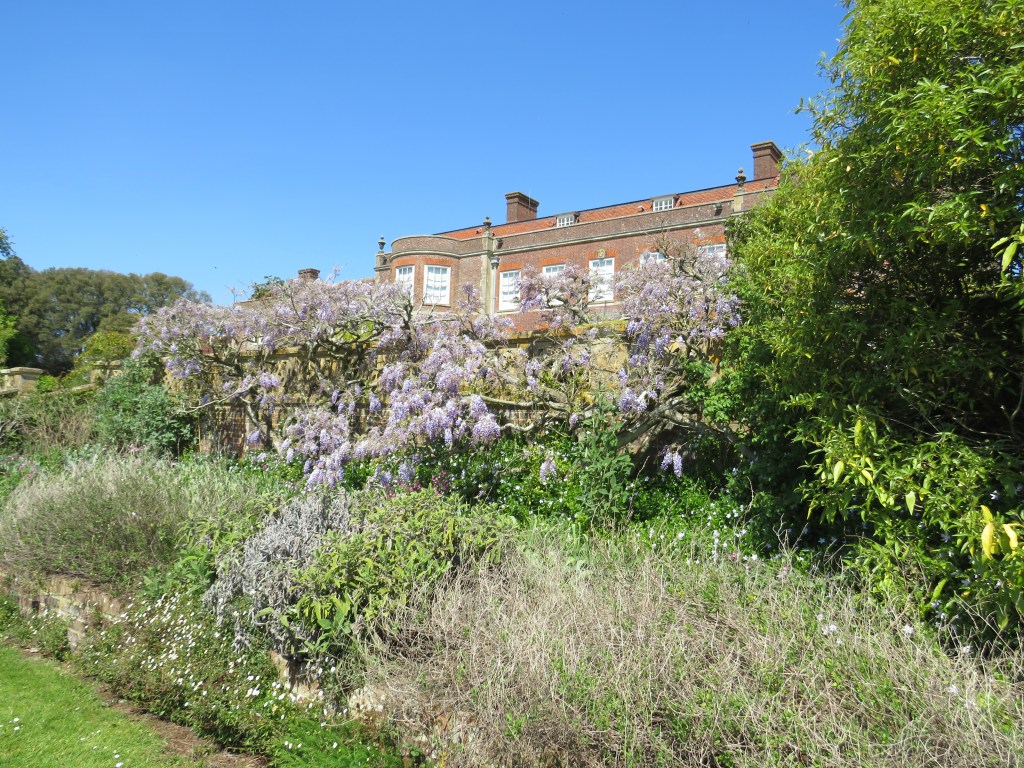
Another day, another place to visit, this time via a caravan spares shop to get a vital part for the van that seems reluctant to provide us with water from the taps. Today’s tourist attraction of choice was the National Trust’s house and garden at Hinton Ampner. There was a Tudor manor house on this site, owned by the Stewekely family. In 1793, the Bilson-Legge’s demolished and rebuilt the house. This was inherited by a daughter who married into the Dutton family. Ralph Dutton inherited in 1935 and was responsible for remodelling the house in keeping with a Georgian revivalist style. A fire that started in the library in 1960, meant that much of the remodelling had to be done twice and 2000 books had to be replaced. I always wonder, in libraries like these, how many of the books actually got read.
The house is home to one of the largest collections of hardstone inlaid furniture in the National Trust. As usual, I looked for quirky pieces that caught my eye, including a stunning Blue John vase and rather strange origami-like constructions that were used instead of holly or pine cones to deter visitors for sitting on the chairs. Pupils from Portsmouth High school were evacuated to Hinton Ampner House in the Second World War. Lacking any children, nieces or nephews, Ralph Dutton donated the estate to the National Trust. My only niggle about the property was that those requiring disabled access to the house were invited to ring the doorbell for assistance, yet said bell was up the entrance steps, which rather defeated the object.
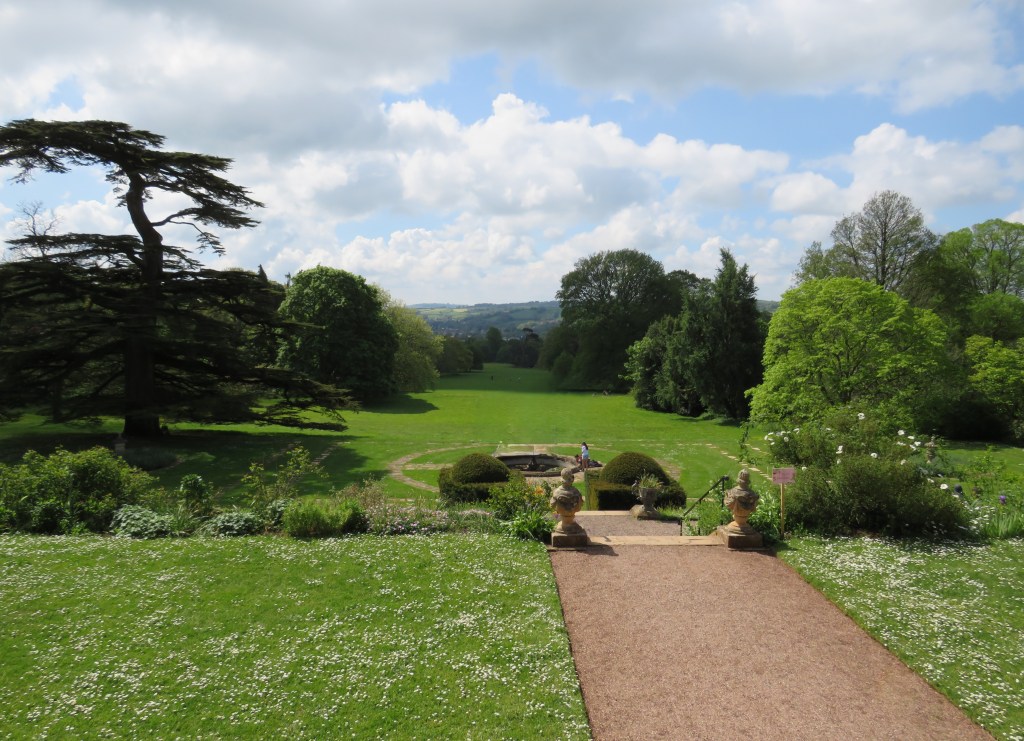
It was a beautifully sunny spring day for exploring the gardens, with slightly less wind than at Porchester. There were far-reaching views across the South Downs and I was excited to spot but not very successfully photograph, a red kite. The Saxon, flint church in the grounds was also interesting and had some impressive 1970s stained glass.
Despite having sampled some National Trust cake, in holiday mode, I decided that I had to try another caramel magnum. I am wondering if I really need more before coming to a decision.
We’ve just returned from a few days in Shrewsbury. We were staying on a very posh-for-us caravan site because the same complex also had ‘barns’ where caravan-less members of the family could stay. I was a fail at this kind of location from the start. We checked in and were given a card to access the site barrier, no problem, we were used to these. I was also given two ribbon like bracelets to indicate that we were paid up residents. For safe-keeping, I hurriedly put both on my wrist, one for me and one for the fisherman of my acquaintance. Caravan pitched I attempted to pass his to him. Ah. This was the problem. I had tightened the bracelets to ensure I didn’t lose them by sliding a plastic ring up each ribbon. It turned out that these were one way fastenings, a little like cable ties – hindsight and all that. I managed to wriggle my way out of one bracelet but the other was firmly affixed. Not wanting a bracelet on day and night for four days, I had to return to reception and ask to be cut out and have a new one, which I made sure was looser.
The barn, for younger members of the family, came with a firepit and hot tub, both of which had to be fully explored.
The weather was kinder to us than the forecast promised and we explored the delights of Blists Hill Victorian Village. Obtaining advance passes online was an intellectual challenge in itself but we managed it. The Ironbridge complex is due to be taken over by the National Trust, which caused a hiatus in the booking system at precisely the wrong time. It was interesting to chat to the various shopkeepers and tradespeople ad to spend the ‘old’ money that we had exchanged in the bank. Mind you, the existence of a bank seems to be something that is now consigned to history. The traditional fish and chips, fried using beef lard were probably not the best thing for our arteries but were delicious.
The next day was a Shrewsbury Trail, or at least part of it before it got too much for some of our party. The first challenge here was ensuring that both cars were parked in the same place (they weren’t) and then finding our way out of the shopping centre adjacent to the carpark we ended up in. We did manage a quick game of rockets and meteors (like snakes and ladders) in the shopping centre first.
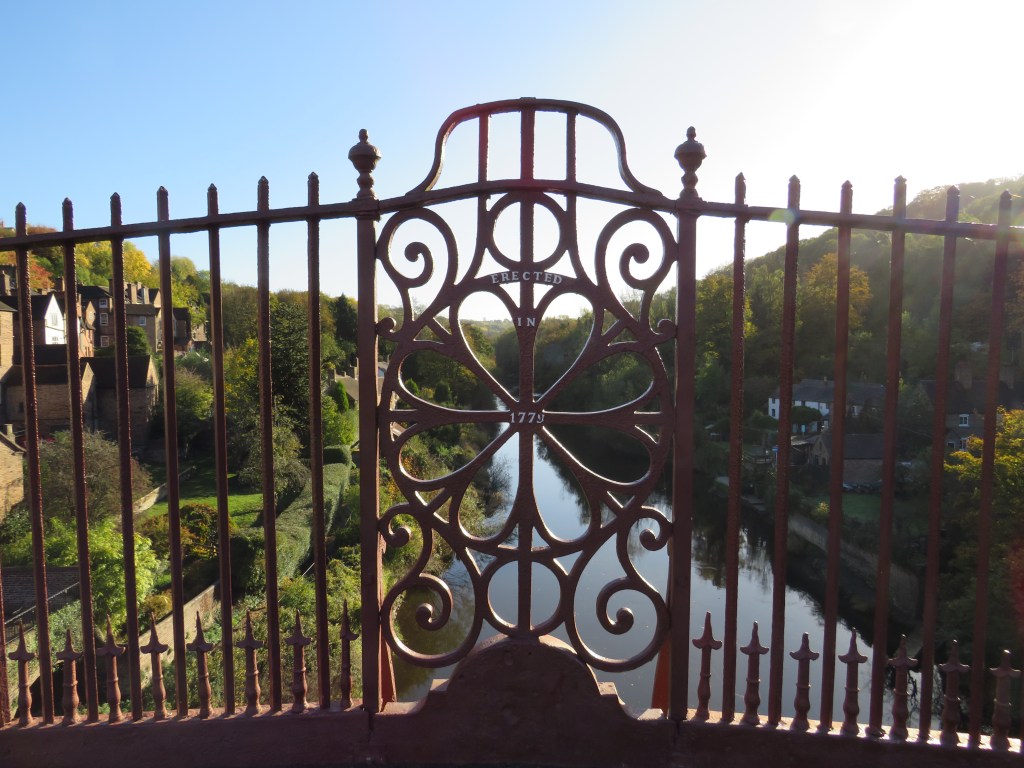
Then a visit to see the Ironbridge in glorious autumn sunshine; the first iron bridge to be constructed in the world, in 1779. This is now a world heritage site. We moved on to Enginuity Science Museum, where we virtually made pig iron, moved locomotives using levers, solved (or didn’t) puzzles and other excitements. There were plenty of other museums in the Ironbridge family for those with more stamina but we decided to quit while we were ahead,
Now we are back home for what might laughingly be called a rest.
I deliberately don’t post about politics because I don’t like confrontation but remaining completely silent makes me part of the problem. I don’t have allegiance to a particular political party, although there is currently one that I would never vote for. This is not a political post but it certainly touches on current affairs. When I was interviewed for college, part of the interview process was to write an essay on ‘why study history?’. I don’t really remember what I wrote; it was the 1970s, I know I mentioned the Irish troubles. We need to understand history because we need to learn from it. It is no coincidence that George Santayana’s quote, ‘Those who cannot remember the past are condemned to fulfil it’, is on my home page. History is getting increasingly squeezed from the school curriculum. It is seen as being more relevant in today’s world to study computing, business studies, robotics and other subjects that were unimaginable in my school days. Don’t get me wrong, that knowledge is important but so is having a world in which to utilise that knowledge.
The human race seems to be rapidly losing the critical thinking skills that come with studying history properly. We need to be able to seek out proper evidence, we need to understand the role of propaganda and the power and danger of the megalomaniac. We need to be able to sift the truth from the distortions of the truth and downright lies that abound. There has always been propaganda and misinformation but in today’s digital world, that spreads so much faster and so much further than ever before. People believe what they read in the biased popular press and on social media. They fail to realise that some news output is not balanced and impartial but is presenting a partisan and misleading view that suits a particular political purpose. Whereas, in a pre-digital age, people were only likely to pass this rhetoric on by word of mouth, now mis-information can be passed on to thousands at the click of a button.
There are unthinking family historians following the shaky green leaves and believing impossible relationships, which they graft on to their family trees. These family trees get copied and replicated and before long, the weight of ‘evidence’ is in favour of something nonsensical. This is non-evidence; where is the source of that information? In the great scheme of things, if someone gets their family tree wrong, that does not have serious consequences. Believing other kinds of mis-information is potentially much more serious and downright dangerous. Daily, I hear or read friends and acquaintances spout or write ‘facts’ that two minutes checking would prove to be false, even if their common sense has failed to ring warning bells. The keyboard warriors don’t bother to fact check, ten, a hundred, a thousand, ten thousand people believe this, so it must be so. At a time when information has never been more accessible, we are nonetheless drowning in a sea of ignorance.
The world is currently a terrifying place. I hate watching or reading the news because I, like many, am fearful, not just for myself but for my family, my friends and a world that seems to be rapidly slipping from our hands. We seem to be rapidly evolving into a society where humans are no longer humane. What has happened to that sane world, where the majority of people are kind, are caring, are empathetic. I am not a psychologist, although I did study psychology as part of my undergraduate degree. I have however spent more than fifty years studying the people of the past, trying to understand their behaviour, their motivations and why they made the life decisions that they did. One thing that studying history has taught me is that there have always been periods of crisis or near crisis. There have always been threats to democracy and to the status quo. There have always been individuals who have risen up to take advantage of people’s fears and who have the personality to gather followers around them, largely by latching on to one or two issues that chime with certain sections of that community in fear.
By studying history, I have observed how humans behave when they are under threat. That might be a threat of conflict from an ‘enemy’ (real or perceived), a threat of poverty at a time of dwindling resources, a threat of epidemic, of famine or of natural disaster. Humans find it difficult to cope with threats and the stress that it causes, particularly if it is unremitting, ongoing stress. Studies of those who, for example, have suffered from long term domestic abuse, or who have spent prolonged periods in a combat zone, have discovered how detrimental that stress can be both physically and mentally. As a species, we cope best with stress if we can identify the cause and lay the blame for that stress with an outsider. If the threat is perceived to come from someone not like us, it is easier to cope with than a threat from within. Who the people ‘not like us’ are has varied over the centuries. We blame the people not like us even if all logic suggests it cannot be so. In 1348, in England, Jews were blamed for the plague. It was obvious that these people not like us were poisoning the water. Except of course the Jews had been expelled from this country in 1290. We are still guilty of applying such warped ‘logic’ in order to blame people not like us for the things that we fear today.
This is not a political post because I am not brave enough. I have friends and acquaintances who do not think as I do and I am not robust enough to engage in acrimonious debate. I am selfishly wanting peace and quiet in a world where there is no peace and quiet. I am cheered by the knowledge that there are those who do sift the evidence and seek the truth and many of you reading this will be amongst them but we tend to be the quiet ones. I watch people being drawn in by bombast and rhetoric and ‘information’ that has no foundation. I see people following leaders because one aspect of what that leader spouts feeds into their fears. They do not look beyond the loud headlines and the single issues to wonder about the polices that might underline those particular political stances. They do not think of the practicalities involved, of how what is being spouted might be achieved, if indeed there is a coherent, workable plan. They do not consider how what results from these viewpoints might impact on other aspects of all our daily lives.
Many of my followers are family historians or authors who carefully research their books. Some of you are here because I occasionally post about travel, about gardening, or special needs. Whoever you are and whyever you are here, please, please for the sake of us all, try to persuade those around you to look beyond the bombast and the catch all headlines, to look beyond the appeal to their underlying fears and analyse what is being said. To look beyond the propaganda to seek the facts. Think about what some of these policies will mean, both for us and for the people not like us. If we are the strong, we need to stand up for the weak, for those who have no voice. Let us work towards returning to a world where empathy and compassion, for each other and for people not like us, are no longer derided but are seen as core human values to be sought after and lauded. If that makes me woke, or whatever the current derisory term is, then I am very proud to be so.
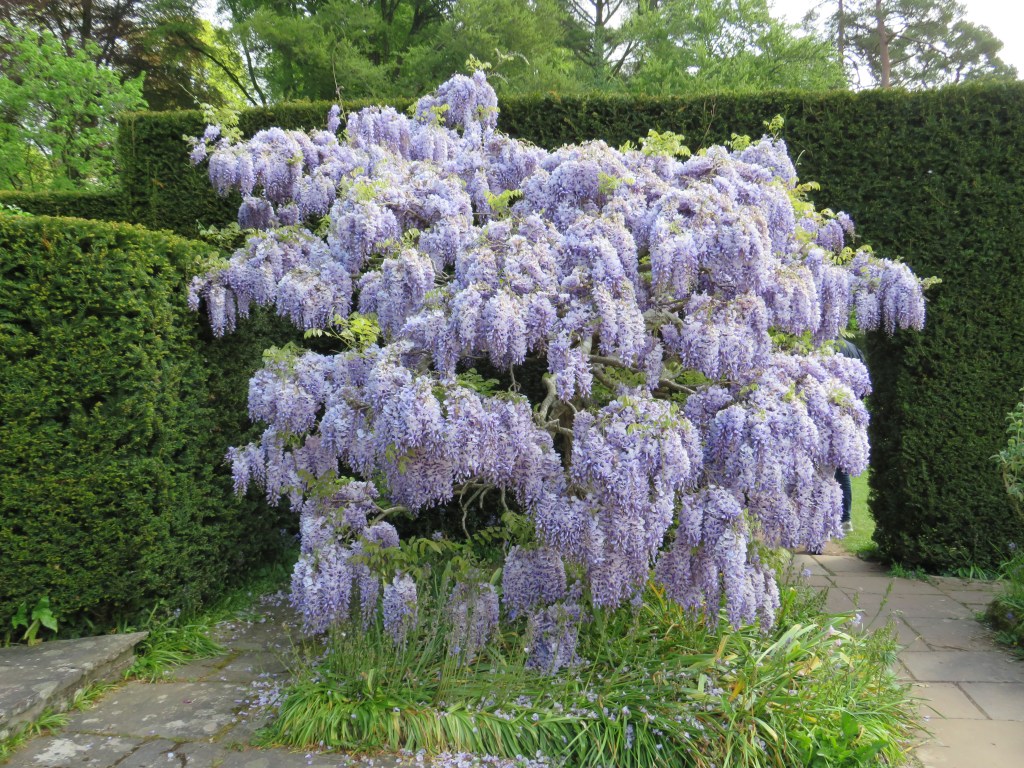
Normal service, with posts in a lighter vein, will resume shortly, as long as there’s a world that will continue to allow me to do so. I’ve included a picture to lighten your day.