It always feels strange posting about trips away when I am safely back home but I don’t normally post in real time. This was the day that the sat-nav decided not to work; this was apparently my fault. Never fear, I can do old school with my trusty ordnance survey map. I could locate the day’s National Trust property of choice, in this case Croft Castle, although it was a little difficult to work out on which side of the large estate the entrance lay. We overshot it at the first attempt, as we were expecting a useful brown sign. It turned out there was a very small brown sign, totally obliterated from our first approaching direction due to an overgrown tree.
We’ve been really fortunate that, throughout our visit to Herefordshire, the weather has been a lot less rainy than forecast, so we decided to risk one of the parkland trails. Not wishing to push our staying dry luck or our stamina we opted for the shortest, brown trail labelled Fishpool Dingle ‘Picturesque’ Walk. We wondered if ‘picturesque’ was going to be doing some heavy lifting here. Apparently, the eighteenth century ‘picturesque’ movement was a contrast to the pastoral naturalisation beloved of Capability Brown. This ‘gothic paradise’, complete with grotto viewpoint, was created in the Fishpool Valley in the late eighteenth century. It was a very pleasant woodland stroll, where we could see some industrial heritage include a restored medieval dam, a lime kiln and the ‘gothic’ pump house, dating from about 1800, which housed the water wheel and pump that provided the castle with water. There was also the remains of a charcoal burning platform; the charcoal was then used to fire the limekiln. There was a profusion of blackberries and elderberries as well as some birds including blackbirds, robins, great tits, a wren and woodpigeons. According to Merlin, we could hear a goldcrest, a chiff chaff (one I can actually just about recognise for myself) and a greater spotted woodpecker.
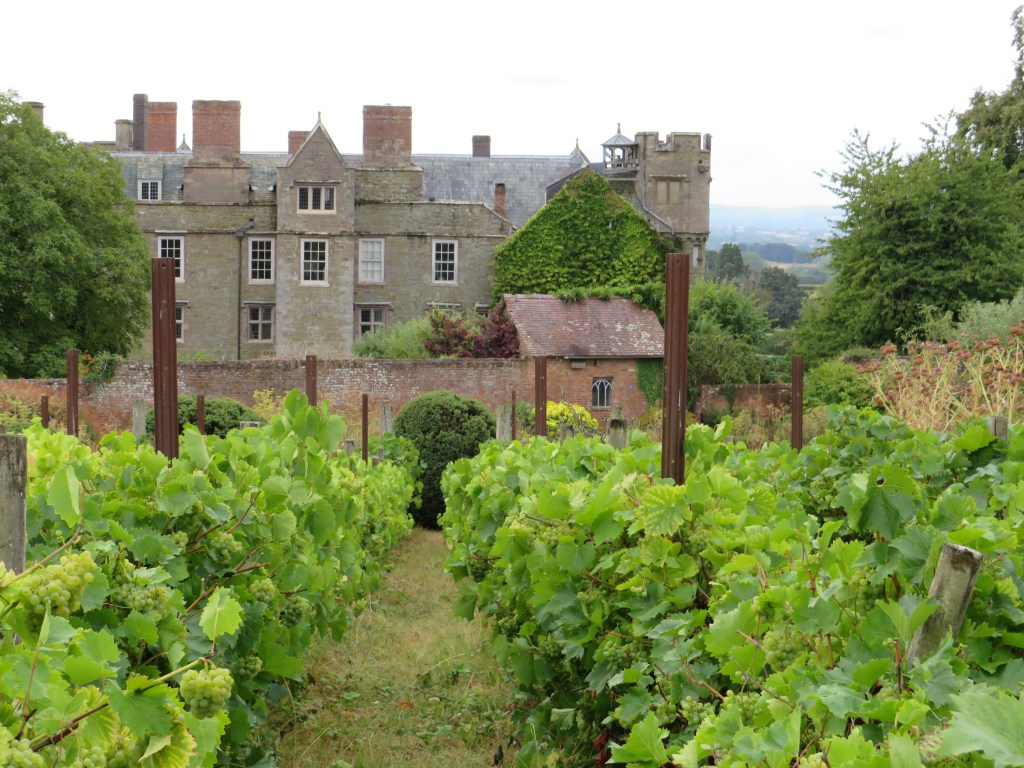
A brief pause for refreshment next and as none of the cake on offer appealed, today we were ’forced’ to consume caramel Magnums instead, no hardship there. Continuing to ride our ‘it is still dry’ luck we next explored the walled garden. The walls round the two acre plot were built in 1801; there were plenty of grapevines in evidence. The whole garden covers nine acres. This is managed by just two paid gardeners, supported by volunteers. Whilst most of the gardens and woodland looked positively autumnal, there were carpets of miniature cyclamen outside the walled garden, which I would normally expect to see in early spring.
We then looked at St. Michael and All Angels Church, which was the Croft family’s chapel but was also open to parishioners. This was built in the mid-fourteenth century, extended early in the sixteenth century and re-dedicated in 1515. There was a partial rebuilding in the early seventeenth century. The church includes Sir Richard Croft’s ornate tomb, which dates from the fifteenth century, Sir Richard fought on the side of the Yorkists in the wars of the Roses and was the treasurer for the household of Henry VII.
The Croft estate was founded about 1055 and a motte an bailey castle was erected by Bernard de Croft aka Bernard the Beaded, who was a Norman who had arrived in the reign of Edward the Confessor. Croft was part of the chain of Norman castles intended to protect the Welsh-English border. The fifteenth century Crofts descended from Owen Glyndower. In 1544, Sir James Croft was one of the leaders of the Wyatt Rebellion, which was a protest against Mary Tudor’s proposed marriage to Philip of Spain. Croft was pardoned, served Elizabeth I as Comptroller of the Royal Household and was buried in Westminster Abbey. James’ son, Edward, was accused of casting spells to bring about the death of Elizabeth I’s favourite, Dudley, in 1588. Royalist, Sir William Croft was killed during the English Civil War. The then Castle was deliberately demolished so it could not become a Parliamentarian stronghold. His brother, Herbert Bishop of Hereford, rebuilt the castle as a home, rather than a defensive structure. It was sold to the Johnes family in 1746 and they did further alterations. In 1780, Thomas Johnes II inherited both Croft and Hafod, which is an estate near Aberystwyth. He spent a fortune on Hafod and had to sell Croft in 1799 to pay his debts. Further remodelling took place in the 1910s, when the Kevill-Davies family owned the Castle, which was at that time tenanted. In 1923, after an absence of over 170 years, the Croft family bought the Castle back.
The increasing efforts by the National Trust to be both family friendly and inclusive were in evidence. Here there were 3d printed ‘touchable’ objects and there was a Wyvern trail to follow. There were several objects that particularly appealed including a wall hanging made by staff, volunteers and visitors in 2018 to commemorate the Representation of the People Act, which gave women the vote; a slice from the tree under which Sir William Croft was killed at the Battle of Stokesay in 1645; some 1760 fireplace tiles by Sadler and Green; a seventeenth century stump-work box; a small fabric collage of the castle and an inlaid table displaying many semi-precious stones.
The return journey was relatively uneventful, although we did overshoot the final turning. We should have been alerted by the pervading smell of guano, as farmers near the site have been spreading fertilizer over the past few days.