Day 10
It is moving on day again, this time to our final site for this trip, just outside Maidstone at Bearstead. This time, I manage to put the right destination in the satnav. It is a tricky one this; we have to be off our current site by 12 and can’t access the new one before 1pm but it is a journey of under an hour. We try to solve this issue by going via a supermarket near us to purchase bread and milk. The snag with going via a supermarket with a caravan on the back is of course parking and it only works if there is the option to drive through and occupy two spaces. There isn’t. We end up up a dead end in the car park, where there is only room to turn round by dint of high level towing skills and the lack of a barrier pole that had been flattened by another driver. I rush into the shop to make our purchases, whilst Chris circles the car park. Both shop and carpark are huge. I end up chasing after the retreating van to try to catch up with it as it circles past me. The site is almost full but we secure another corner site with a WiFi signal and an adequate television signal if you aren’t to fussy about what channel you watch.
Day 11
The day did not start well. The satnav insisted on adding twelve miles to our journey and taking us to our destination along the M20 and M25. There is a much shorter route along the A20, albeit admittedly one minute longer. No amount of persuasion would persuade the satnav to take us via this route. No problem, I have a map. The A20 runs very close to the site, we follow the signs to the A20. As we progress I am puzzled by the lack of settlements we should be passing according to the map. We have gone rather further than ideal before I realise the issue. A20 yes, right direction no. We turn around where possible and eventually arrive at our destination about forty minutes later and rather a lot of miles further than intended. In retrospect, we should have gone with the satnav, hindsight and all that. Then there was the issue of finding somewhere to park. The nearest car park to our destination was full of cars bringing young footballers in for a tournament. Luckily, someone was just leaving and we were able to acquire their space in the overflow car park. A bonus was that weekend parking was free.
Today’s National Trust property of choice is Quebec House. When planning this itinerary, this was the only day when we were in the area that the house was open and fortuitously, there’s a special event on. I have brought my notebook but somehow have neglected to equip myself with a writing implement. I have to rely on memory and photographs of interpretation boards. Quebec House itself was the childhood home of Major General James Wolfe. Typically, the National Trust have to have a ‘hook’ for a property and here, much is made of the Wolfe connection, even though the family only rented the property for a few years from 1725 to 1738, leaving when Wolfe was eleven. A successful career soldier, Wolfe helped to put down the 1745 Jacobite Rebellion and later enhanced his career during the Seven Years War 1756-1763 between Britain and her allies against France and hers. His role in the taking of Quebec, which facilitated the end of French rule in North America, made him a hero after he lost his life at the Battle of the Plains of Abraham. His body was brought back to England, By this time the corpse was not in a sufficient state for a death mask to be made, so a servant was used as a model for a bronze bust that was created. Chris uses his knowledge of musketry to explain the workings of a flintlock musket to a fellow visitor.
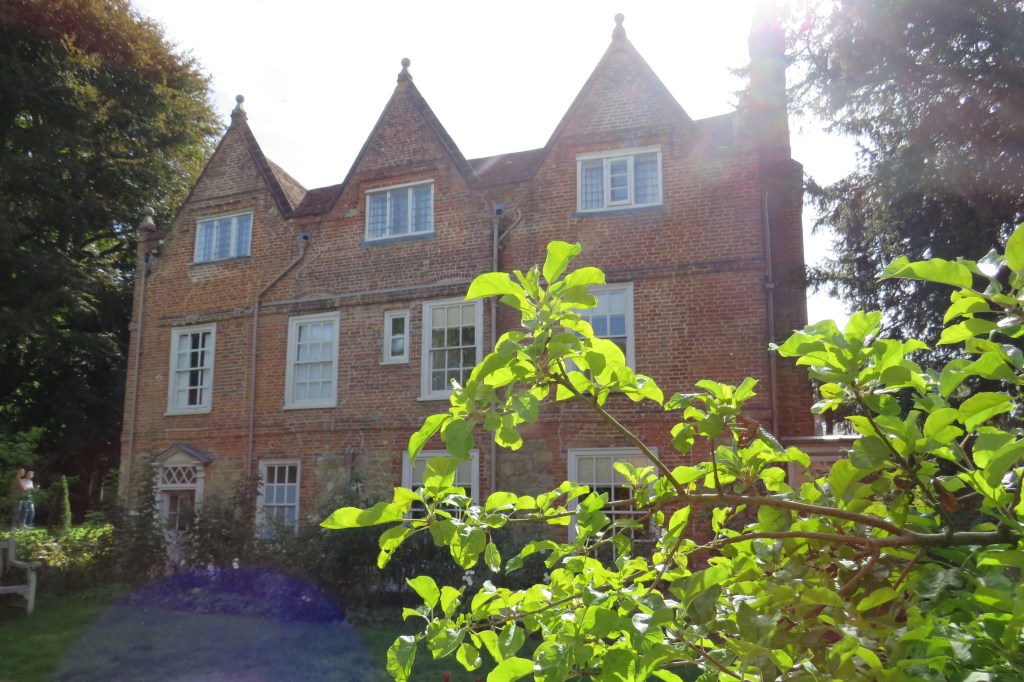
The special event and the other focus of the property really celebrates not Quebec House but nearby Chartwell. Although, in 1760, both properties were owned by Thomas Ellison; at this point Quebec House was called Spiers. After London Foundling Hospital was established by Thomas Coram in 1739, it soon became obvious that the number of children needing care exceeded the capacity of the London home. A satellite home was established in Westerham, at a house called Wellstreet, in 1760. This is the property now known as Chartwell. Detailed records survive and 469 children were cared for at Wellstreet. Present at Quebec House today is Mrs Wadham, the first Matron of the Westerham annexe when it opened in 1760. Mrs Wadham is full of ‘useful’ remedies to cure the children of all ills. Mistress Agnes would have enjoyed meeting her. When a child entered the hospital, their name was stripped from them and they were given a number. On display are representations of the tokens that were left with foundling children, so that they could be identified should their parents come back to claim them. Although receipts replaced tokens before the Westerham branch opened, some mothers still provided them. There is plenty of information available about life at Wellstreet, which functioned for nine years. There were twelve dormitories and three children shared each bed, which was four foot two inches wide and five feet six inches long.
There is also a FindmyPast demonstration on a large screen and a National Trust volunteer is attempting to help a visitor. I can’t stomach listening to the misinformation for more than a few minutes. I manage to acquire a pencil for future notes.
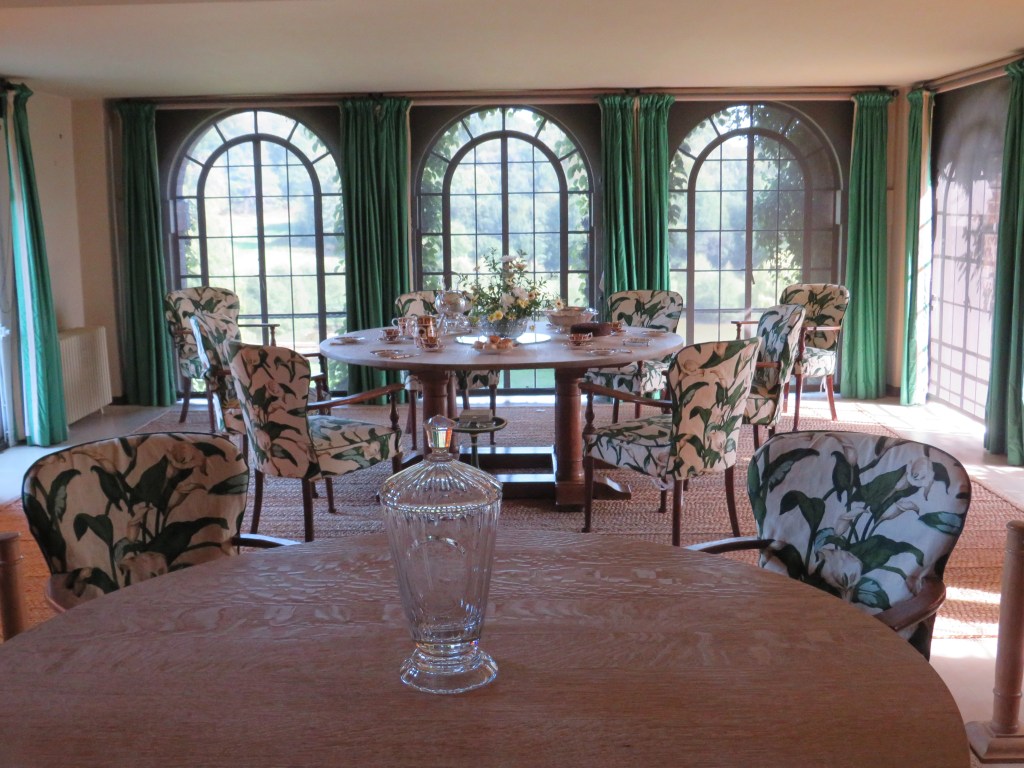
An off the cuff change to itinerary, which we had already adapted, took us to nearby Chartwell, formerly not just Wellstreet foundling hospital annexe but more famously the home of Winston Churchill. Again, parking spaces are in short supply. First stop the café, where today’s cake of choice is iced cherry cake. The property had been empty for a few years when the Churchill’s purchased it, in 1922, for £5000, having knocked £500 off the purchase price. It cost another £20,000 to refurbish it. We are aware of the connections between Clementine Churchill and Bucks Mills, as well as the links to the Mitford family and there were Mitford signatures in the visitors’ book that was on display. We are given a timed ‘invitation’ to visit the house. We have been allocated am persona of a genuine visitor. I am Churchill’s daughter, Sarah and Chris is Professor F A Lindemann, no me neither. It seems he was a physicist and became Churchill’s scientific advisor. Some of the rooms were dressed as they would have been when the Churchills were in residence, I particularly liked the dining room and the library. Other rooms were exhibition spaces, which I found less appealing, They told the story of Churchill as an artist, an author and a wartime leader. The grounds were impressive and the views were glorious. We walked round the huge walled garden, so large that you couldn’t help wondering if the effect of being walled was largely lost.
For the homeward journey, we let the satnav take the strain and after forty minutes on the motorway, we were back. A much less stressful and less time consuming, if not very inspiring, journey.

