Day 12
This morning, it is time for the trip I’ve been looking forward to the most. I’ve wanted to go to Ightham Mote for nearly sixty years, since I first read Anya Seton’s Green Darkness in which the Mote figures prominently. My first problem is the pronunciation. In my head I’ve always pronounced it Igg-ham Mott but no and I can see it now, it is Itum Moat, who knew – not sure I can undo decades of mis-pronunciation. This time, we trust the satnav and have an uneventful and speedy journey.
It is a beautiful day and the moated Medieval manor house is looking impressive. It was built in the 1320s and is the most complete surviving moated manor house in the country, having narrowly escaped demolition in the 1950s, when it was rescued by American, Henry Robinson. We have a short wait for an introductory talk, so look at the lovely walled garden, which contains many, now rather past it, sunflowers and the sit in the sun. The manor grew up here because of the nearby stream and a mill with five mill ponds was sold with the estate just before the current manor was built. The first known owner was Sir Thomas Cawne from Staffordshire who purchased it in the 1360s with profits he had accrued from the French wars. His son was imprisoned for throwing his wife down a well. In the 1400s, the Hawte or Haute family owned the manor, following a Hawte/Cawne marriage. Richard Hawte inherited in 1462. His connection with the Woodville family, saw his social standing rise and the Mote was enhanced to become a fashionable home. The moat was constructed as a fashion statement and to assist with the disposal of sewage, rather than as a defensive mechanism.
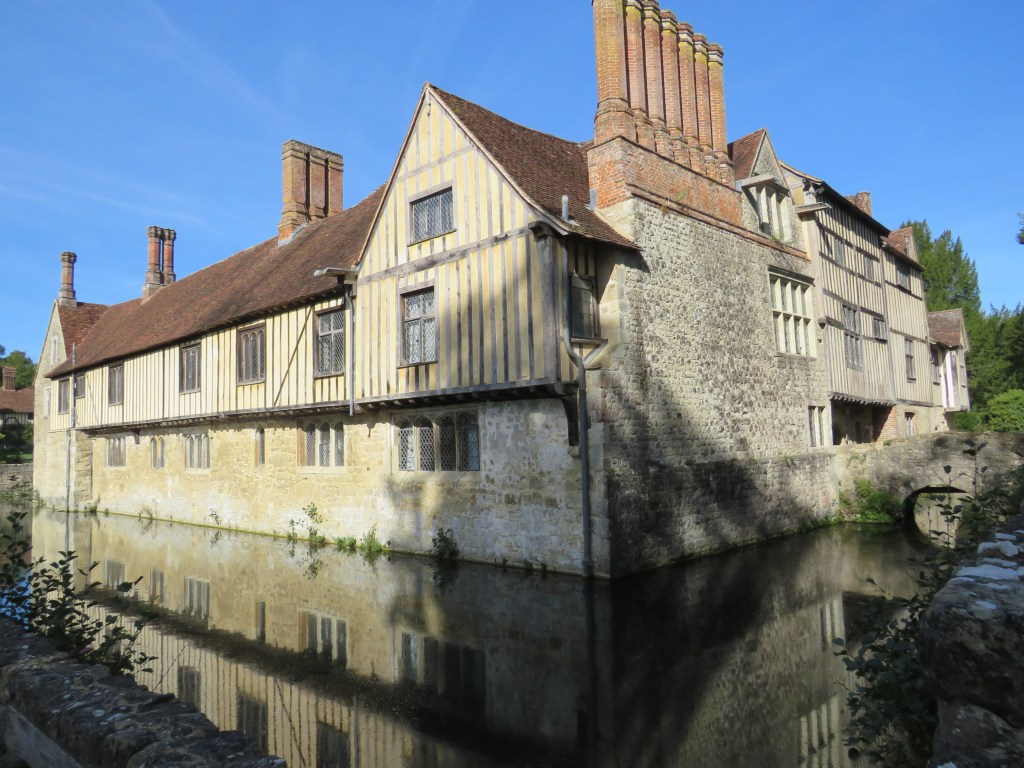
In 1521, Richard Clement bought the estate. Clement had been a page to Henry VII and worked his way up. He built the tower at Knole and added various Tudor embellishments. Then the Selby family from Northumberland held the estate for three hundred years. They ordered a huge fireplace surround that didn’t fit in the room, so they raised the ceiling. In the late nineteenth century, Sir Thomas Colyer-Ferguson bought Ightham Mote; his wife was a descendant of the earlier owners the Hawtes. No buyer could be found for the Mote when it went up for sale in 1951 but it was rescued by three local businessmen to prevent its demolition. They were able to sell it on to Henry Robinson two years later. Robinson was on board ship, back to America and was planning to change his mind about the purchase but the letter was never delivered. The differing sale prices over the centuries are interesting, The house and land sold for £400 in 1521, £4000 in the late sixteenth century and £35,000 in the late nineteenth century. The 1951 sale price was just £5000. It was given to the National Trust in 1985 and the Trust had to spend £10 million on conservation, which was not completed until 2004.
Things of note were a grade 1 listed dog kennel, witchmarks over the fireplace, tiles, some eighteenth century wallpaper, a tavern clock, an unusual painted ceiling, a sampler collection, photographs of the twentieth century staff, and a distinct ‘atmosphere’ in the crypt.
Not fancying any of the offerings in Ightham’s café, we move on to nearby Knole and start our visit in the café there . In 1783, the owners, the Sackvilles, had their servants painted and reproductions of the portraits are on display in the café.
Originally a typical Medieval manor, there have been numerous upgrades and alterations at Knole. From 1456, it was the official palace of successive Archbishops of Canterbury. After the Reformation, it passed into the ownership of the king, Henry VIII, who seized it from Thomas Cranmer. He expanded the park and used Knole, which is still famous for its deer, as a hunting lodge. We do see some deer. Elizabeth I gave it to her favourite, Robert Dudley but he returned it saying it was too large. The estate was purchased from the crown by Thomas Sackville, 1st Earl of Dorset in 1604. Thomas’ fortune was amassed as he was Elizabeth I’s Lord Treasurer and he was able to rebuild and decorate Knole lavishly, with the aid of royal craftsmen. Charles, the 6th earl, was the royal chamberlain and acquired cast off furniture from royal palaces. This is another property with a literary connection; Vita Sackville-West spent her childhood at Knole. In another cross over, Lionel Sackville was Lord Warden of the Cinque Ports three times. It is a substantial property with, we are told, seven acres of roof. The Sackvilles started showing Knole to visitors from the 1700s. At Knole, as a Petworth, there is an extensive art collection but it is not so overpowering here. I was particularly taken with a portrait of Sir Theodore de Mayerne, seventeenth century Huguenot and royal physician. I noted some interesting lead downpipes, seventeenth century blackjacks and an enormous dish about two feet in diameter.
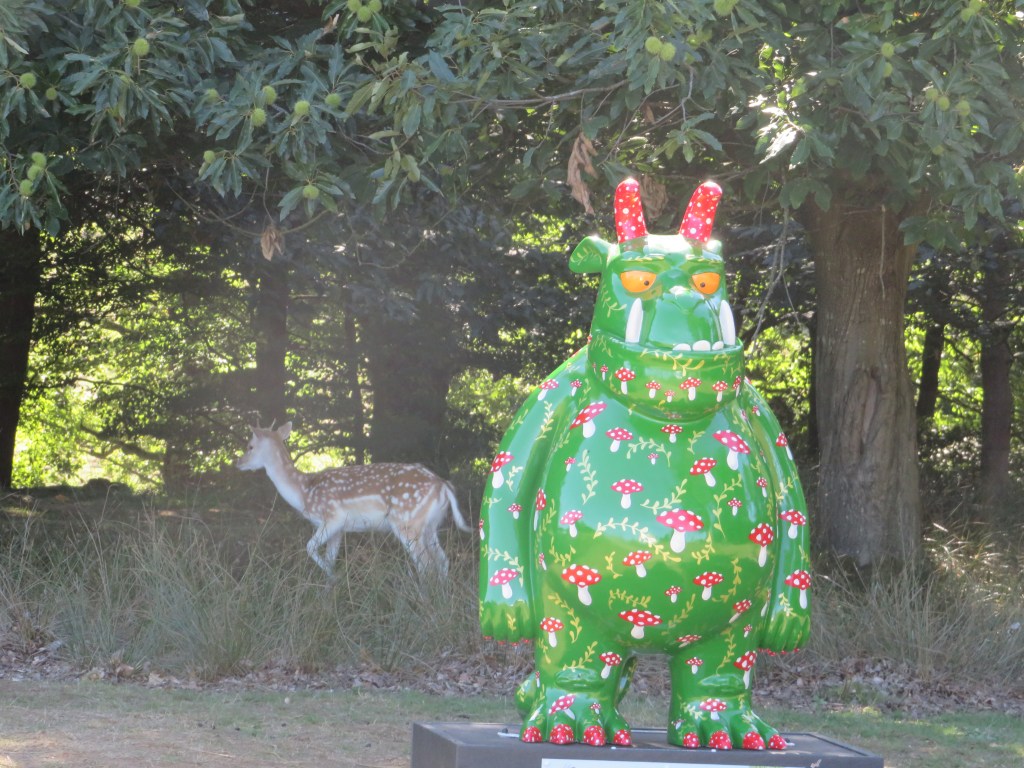
There is a bonus at Knole, a Gruffalo Trail. This is clearly not aimed at our demographic but I manage to capture most of the fibreglass, decorated Gruffali (?) in the grounds.
Day 13
Today’s destination was not originally on our itinerary but we made room for it by doing two things in one day earlier in the week. One advantage of this for our last day is that it is only six miles from our site, so not too much driving before tomorrow’s long journey. We are a little apprehensive on two counts. Firstly, the tickets are on a pdf on my phone. Normally I would be belt and braces and have printed them off but we only booked them two days ago, so, as we don’t tend to carry a printer on our travels, that was not possible. I am fully competent at displaying a pdf ticket on my phone, I am just always worried that my fully charged battery will somehow have diminished to nothing, or there will be no phone signal. I am sure this is quite ridiculous but nonetheless, I do take the precaution of writing down the ticket numbers.
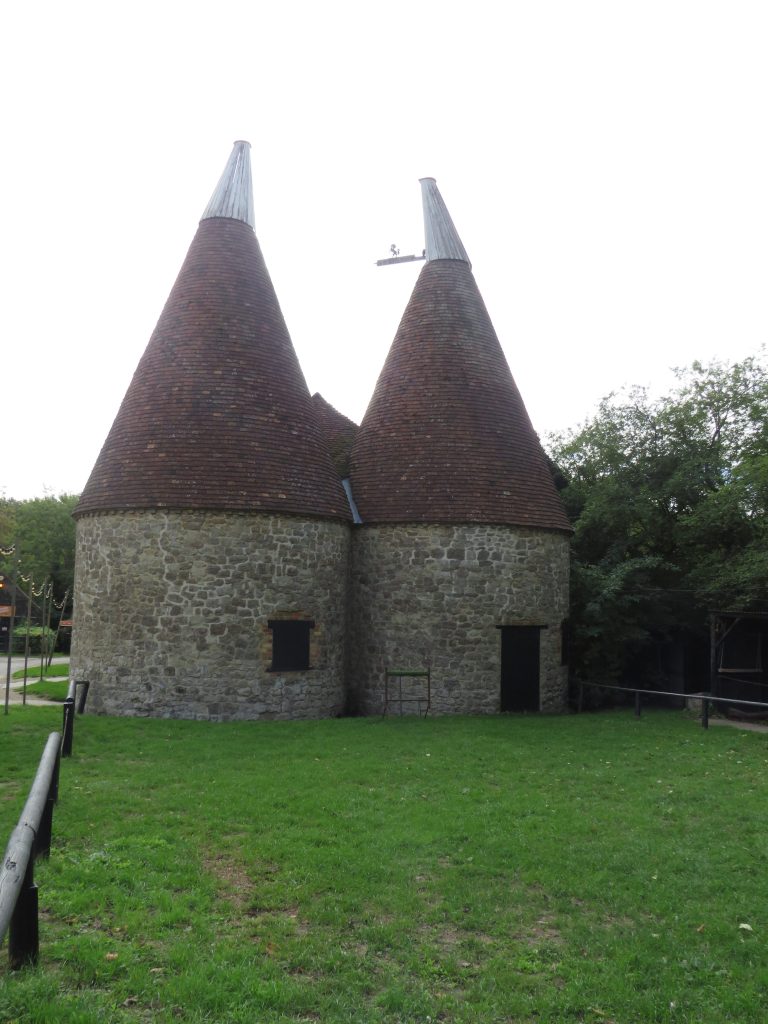
Today we are at Kent Life Heritage Farm Park and our second concern is that its focus is on family fun and we don’t have any spare six year olds with us. Although their main target audience is clearly somewhat younger than us, as is evidenced by the school parties of five year olds on site, there are some preserved historic buildings that we want to see. We don’t mind cooing over the odd farm animal, so here we are. Understandably, much is made of Kent’s hopping industry, which goes back for at least 500 years. The iconic, coal-fired oast houses are a feature of the Kent landscape. The hops were dried here for about eight hours before being sold to the brewers. Until the mid-twentieth century, droves of workers from the East End of London would spend a few weeks in Kent each summer, living in tiny tin shacks, or hastily constructed hovels, to pick the hops. This was always a family affair and the East Enders viewed it as a holiday, returning to the same shacks year after year. The locals benefitted from selling to the hop pickers but ‘strangers’ were viewed with suspicion. The coming of the railway facilitated the influx of pickers but they were certainly making the journey from at least the 1750s. Even in the 1900s, some pickers walked, to save the train fair, taking their belongings in a cart or pram. The crowded, poorly built shelters harboured disease, giving the locals another reason to resent the incomers.
We enjoy looking round the buildings, most of which were originally sited elsewhere and had been reconstructed on this site. There are oast houses, a chapel, a village hall and a row of World War 2 cottages, as well as hoppers huts from different time periods. The chapel includes a war memorial that was rediscovered in 2010. One of the farm houses is set up as a 1950s kitchen, although I spot that the brownie uniform hanging on the washing line is one from 1967 onwards. Another farmhouse, that has been styled as it would have been in the 1930s, was built on its current site in 1555 and was let to tenant farmers for centuries. Some areas, such as the herb garden, do look a little neglected. This garden is supposed to represent four different eras, with culinary, aromatic and medicinal herbs.
All in all, we enjoyed our visit and it didn’t diminish any of our other outings to make time for it. We return to the van via the supermarket and have a lazy afternoon in the sunny caravan site.
Day 14
Time for the long journey home, via numerous motorways. This is uneventful, although there were some holdups at the beginning due to traffic coming from the continent. We enjoyed our visit and were able to see plenty. It somehow didn’t seem as restful as some holidays, probably because we crammed in two visits on several days, when normally we would go for one, followed by a relaxing afternoon. Stand by, in less than a month’s time we will be adventuring again.

