After a resounding early morning thunderstorm, we utilised our National Trust membership as usual and paid a visit to Berrington Hall near Leominster, pronounced Leminster. The rain had died down to an occasional drizzle by the time we arrived. We began by looking at the house. Co-incidentally, one of the volunteers was a former vicar of a parish near home.
Thomas Harley, the fourth son of the Earl of Oxford was a London wine merchant, an MP and the Lord Mayor of London in 1767. Wanting a country residence, in 1775, he acquired the Berrington estate and Henry Holland designed the Georgian mansion that now stands. Holland’s detailed estimate, dated 1778, survives and he quoted a total price of £14.500. The house was finished in 1783. Inevitably, it went over budget and expensive structural repairs were soon needed. Berrington’s landscaped gardens were the final project of Lancelot ‘Capability’ Brown and in 1775, the five daughters of Thomas Harley each planted a plane tree, one of which still survives.
After Thomas Harley’s death in 1804, his daughter, Ann and her husband George Rodney, inherited Berrington. Their descendants lived there until the depletion of their fortunes and in 1901, the estate was sold to MP and Manchester cotton merchant, Frederick Cawley. The house was used as a convalescent home for wounded soldiers in World War II. In 1957, Frederick’s grandson gave Berrington to the National Trust on the condition that his grandmother, Frederick’s wife, the dowager Lady Vivienne, could remain living there until her death. Lady Vivienne lived to the age of 101 and was still inhabiting Berrington twenty years later. The family were keen horse owners and horse trials were held at Berrington until into the twenty-first century.
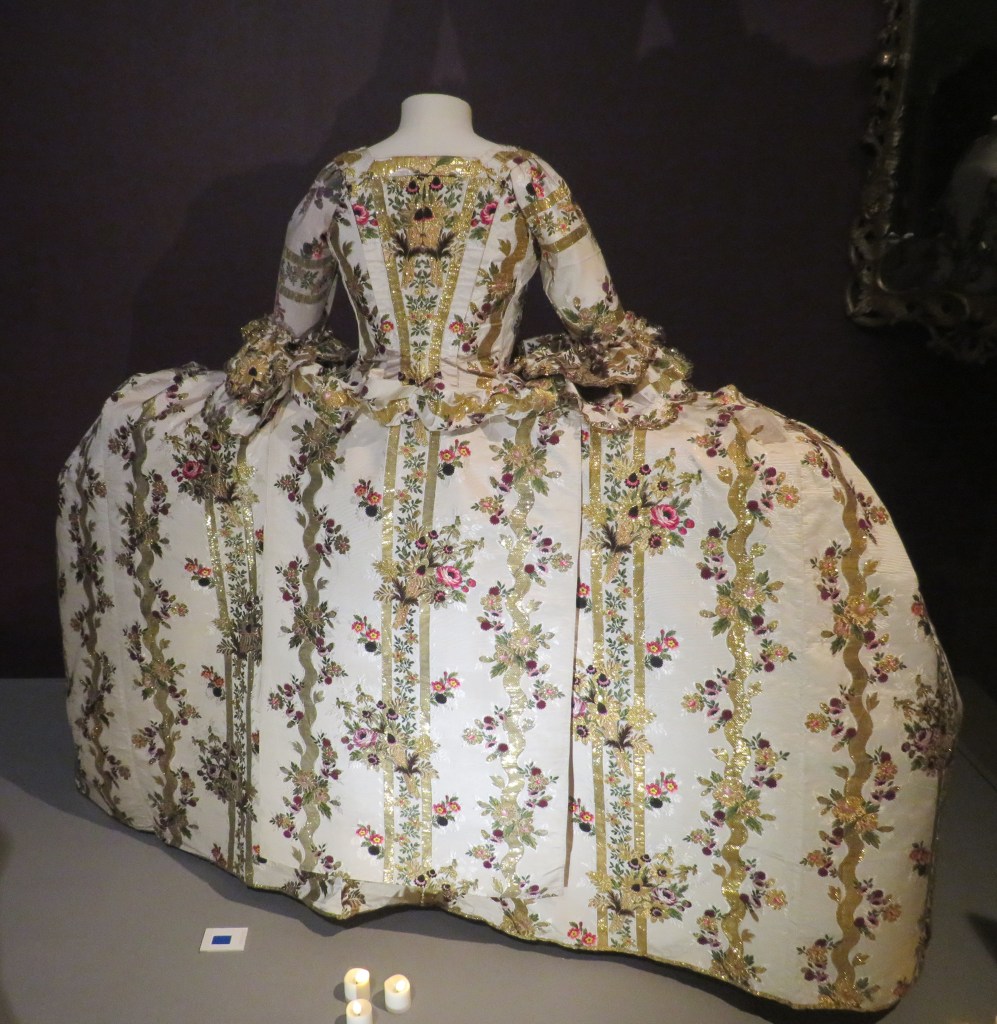
Furnishings are sparse at Berrington but the downstairs ceilings are spectacular and their USP is the display of costumes, many of which are handmade by the volunteer sewing team. I particularly liked a display of replica pockets and reticules, a miniature labourer’s smock and a wig made from crepe paper. We couldn’t resist dressing up; my dress was incredibly heavy. There were also several displays relating to conservation and cleaning. Currently on view was the widest dress owned by the National Trust; it is often not appreciated that the Trust is responsible for the conservation of 40,000 items of clothing. The dress in question is a court mantua, worn by Ann, wife of Thomas Harley, just once, in 1760, at the court of George III. There is four metres of material in the skirt alone and a further three metres in the train. Ninety percent of what was on display was original; when found stored in a box, the dress was missing a left sleeve and a stomacher. The dress is due to be removed from display in November, while a more suitable case for it is made. Today’s cake of choice was orange and poppy seed; not quite up to yesterday’s standard. We had a quick look round the walled garden but the weather was a deterrent. It was lovely to see the names of all Berrington’s former and current gardeners inscribed on the beams of the potting shed.