Yes, we’ve been away again, this time to Sussex and Kent. These are both counties I’ve visited before but extended visits were in childhood, so it was time for a return as part of the ‘Let’s visit every county in England’ campaign, to which I’ve now added and visit at least one National Trust property and one English Heritage property in each, meaning that I may just have to revisit one or two. You’ve had to wait for me to be back in the land of decentish WiFi for me to post this, so, as ever, these are not real time adventures.
Day 1
Having already cut two days off our holiday to accommodate the fitting of a smart meter at the home of the fisherman of my acquaintance, we knew that we were unable to leave as early as we might have liked. This smart meter has been somewhat of a bone of contention. Having been pestered to have one and refusing for many years, this has now become a necessity in order to benefit from the feed-in tariff from his newly installed solar panels. He’s been trying to get an appointment since April. Having muttered the word Ombudsman, an appointment was finally arranged for what should have been two days into our latest trip. Fortunately, it was the sort of trip where two days fewer was a possibility and as the appointment was for ‘between 8 and 12’, we could get to our destination afterwards, or so we thought. They also promised to message half an hour before arrival. At 11.45, with no sign of said message, we ring to be told that they are unable to guarantee that they will come at all today.
After a great deal of gnashing of teeth, we set off at 1.45pm, with still not a meter man in sight. By this time, it is touch and go whether we will arrive at our chosen site in time to get a pitch before they close at 8pm. Fortunately, this is a site where there is an area where late night arrivals can pitch but this might mean we can’t get onsite until 1pm tomorrow, which would impact on going out for the day. As we leave, the sat-nav, which knows we are towing a caravan, thus limiting our speed on motorways to 60mph, reads 7.22 as an arrival time. The route means encountering the car park known as the M25 at rush hour. There is also the issue of whether we can do a five and a half hour journey without a comfort stop. A 7.22 arrival was always going to be a big ask.
Given the nature of the journey, we do well. There are some sections where we can make up time, which compensate for the parts where we are delayed. The last few miles, through the centre of Brighton, take a disproportionately long time; there are an awful lot of traffic lights in Brighton. We managed to avoid stopping for fuel or comfort and arrive at 7.25. Very hungry and in need of said comfort but in time.
Our site at East Brighton Park is, as the name suggests, on the eastern edge of Brighton and nestled in the shadow of the South Downs. It must be popular as we are allocated the last vacant pitch, fortunately, it seems to have a WiFi signal, so I am happy.
Day 2
We are blessed with a lovely sunny day and set off for Petworth House, today’s National Trust property of choice. I follow along on the map as usual, as we enjoy the views over the downs and travel up the Adur Valley. Here, we are close to the ancestral villages of Steyning and Henfield but I’ve visited before, so have put family history to one side for this holiday.
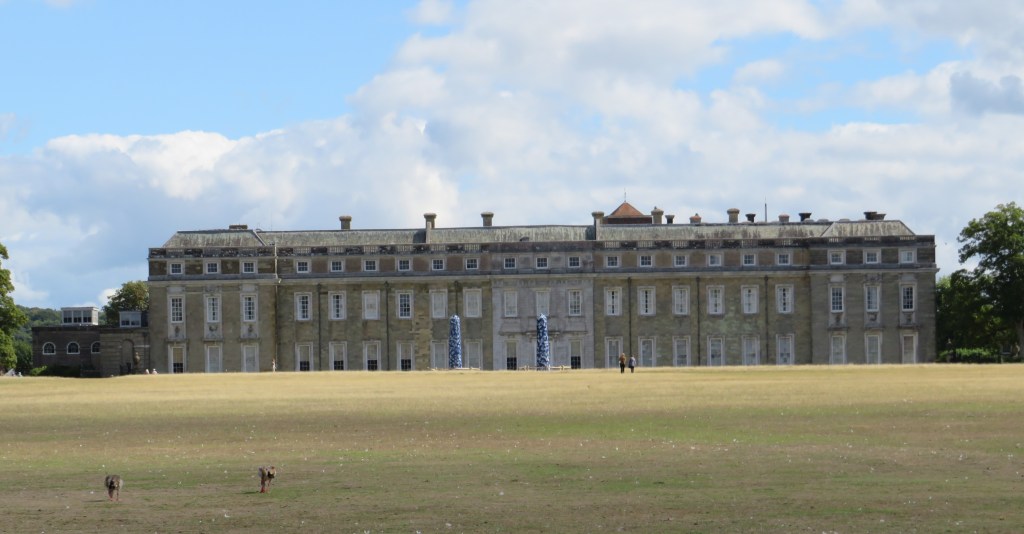
It is difficult to describe my reaction to Petworth House. It is still a private residence and the portion that is open to the public was built as a Baroque show-home in 1688, designed to impress visitors and house an extensive art collection, rather than to be lived in. Impressive yes, overwhelming yes and definitely over the top. It was interesting but I am not especially fascinated by works of art, even though these include those by Lely, Van Dyke, Turner, Reynolds, Gainsborough and Titan. There are also nearly a hundred marble sculptures, most of which are huge. We also see a temporary exhibition ‘Expressions in Blue’ with more massive, mostly blue, modern pieces, by English artist Felicity Aylieff, inspired by Petworth but made in Chinese porcelain factories. These include two in the grounds that are about five metres tall. Petworth’s incredibly high ceilings, almost all of which are undecorated, help to accommodate all the large-scale artwork. My preference is for more homely properties. So in summary, yes I’m glad we went but it wouldn’t be high on my list for a revisit; others will feel differently of course.
As the focus is on the art collection, trying to find out more about the history of the building itself and its owners is quite difficult. The site has 900 years of history and the current building replaced a fortified manor house. There are traces of earlier building, notably the fourteenth century chapel, with heraldry abounding. The estate was given to Joscelin of Louvain in the twelfth century by his sister Adeliza, consort of Henry I. Louvain married a Percy heiress and took her name. They were the progenitors of the Earls of Northumberland, who held Petworth as their seat in the south for centuries. The Percy family’s Catholicism was unpopular during the Reformation and its aftermath. The 7th Earl, Thomas Percy, did not exactly endear himself to Elizabeth I when he sided with Mary Queen of Scots and led the Northern Rebellion, which aimed to replace Elizabeth with her Catholic cousin Mary. Understandably, Thomas was executed, although Elizabeth I agreed that his brother, Henry, could inherit as long as he stayed in the south at Petworth, where she could keep an eye on him.
In 1670, the 11th Earl, Josceline Percy, died without a male heir, so the estate passed to his daughter, Elizabeth. Elizabeth, although only sixteen, had already been widowed twice and her third husband was Charles Seymour, 6th Duke of Somerset. It was they who built the current house in 1688, although there were some alterations in the 1870s, overseen by the architect Salvin. In 1750, the estate passed to the Wyndham family.
As ever, it is the quirky bits that catch my eye, so pottery dating from 420BCE; what is thought to be the earliest English terrestrial globe, made by Molyneaux in 1592 and believed to have been given to Henry Percy by Walter Raleigh; an ornate screen; Grinling Gibbons carvings; a portrait of Ralph Hopton, prominent in the Battle of Torrington story; a whole row of (probably replica) fire backs; some unusual chairs; an organ set in a door and some seventeenth century door handles, which I neglect to photograph. We also look at the kitchen block, , which is more to my taste, where there is an eighteenth century fridge and some incredibly heavy copper pans.
The 700 acre estate and deer park were landscaped by Lancelot ‘Capability’ Brown. We investigate the deer park. We see no deer but there are large numbers of Canada Geese and a few Egyptian Geese by a lake. The grounds also include many enormous sweet chestnut trees, an Ionic rotunda and a Doric temple but no Corinthian anything.
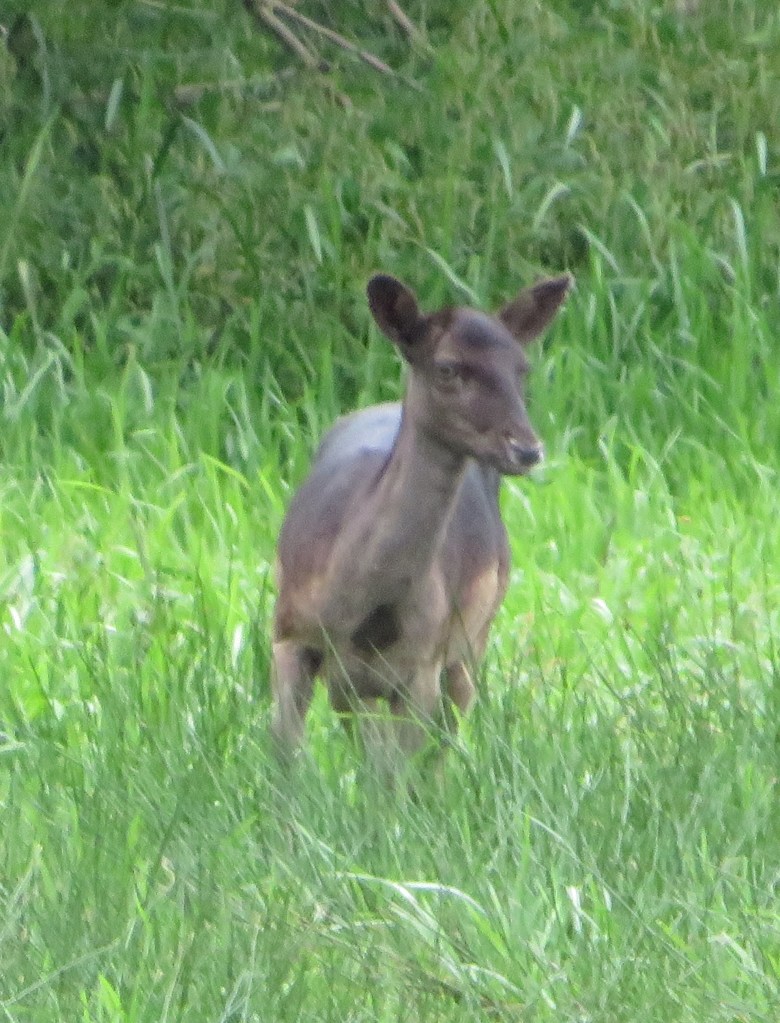
We had planned to visit Pulborough Brooks RSPB Nature Reserve on a different day but we had passed this on the way to Petworth, so it seemed sensible to call in on this day, as we had time, rather than come this way again. This is a good decision as we have plenty of time to see all that Pulborough has to offer. Unfortunately, they have run out of maps and I am never very good at working with photographed options. There is a distinct lack of signage and we could do with maps at strategic points but no. Nonetheless, we manage to find our way to the hide overlooking the not so wetlands. It is our usual kiss of death wildlife wise, not helped by some very loud chain-sawing in the vicinity. We see great tits, wood pigeons, many Canada Geese and a single heron and hear a wren (thank you Merlin app). Here though are the fallow deer that were conspicuous by their absence at Petworth. Some of these are the more unusual melanistic deer, with black coats. Recently re-introduced white-tailed eagles have been seen in the area and I do spot a couple of birds of prey that may or may not have been white-tailed eagles. Then it is back to the van via a fuel and shop stop at Brighton Marina, where we see the many windfarms out to sea.
 The History Interpreter - Janet Few