South-eastern Sojourn Part 3

Day 5

Having already done the activity planned for today, we decide to drive through Brighton to Shoreham and look at the nature reserve there. We manage to find a very reasonably priced car park and start to walk along the shoreline. This involves ploughing through ankle-threatening shingle, plus it is drizzling  and blowing a gale, so we decide to cut our losses had have a quiet day in the van to regather our energy after three full on days, in preparation for what is to come.

Day 6

It is moving on day. I am responsible for the satnav and I enter the postcode for the site. The itinerary suggested that the journey time might be about two and a half hours, so we leave at an appropriate time to arrive when the new site opens at one. Oddly, the satnav thinks we might arrive considerably earlier than that. We remark that it isn’t taking us the way we might expect, as we drive through Brighton and head north. Perhaps, we think, this is what accounts for the earlier arrival time. After about ten miles, I look at our upcoming itinerary and realise that although I have programmed in A caravan site, it isn’t THE caravan site. I have inadvertently input the detail for the final site of the trip. The blessing is that these two sites are only thirty miles apart, so we haven’t gone too far out of our way. We end up arriving exactly as the site opens and we secure a lovely corner pitch, which has the advantage of a half decent television and Wifi signal.

Day 7

There have been a couple of very loud bangs seemingly coming from the caravan over the past few days. Chris thinks we need a part. Caravan supplies outlet duly identified we set off. Fortunately this isn’t too far away. Said part acquired, we head for Battle Abbey. I have purchased two maps for this stage in our trip but inevitably, I still don’t have one showing the site, which is just off the edge. This becomes an issue when we  encounter a diversion and the satnav just wants us to ‘turn around when possible’. We see Rye from the car on the way.

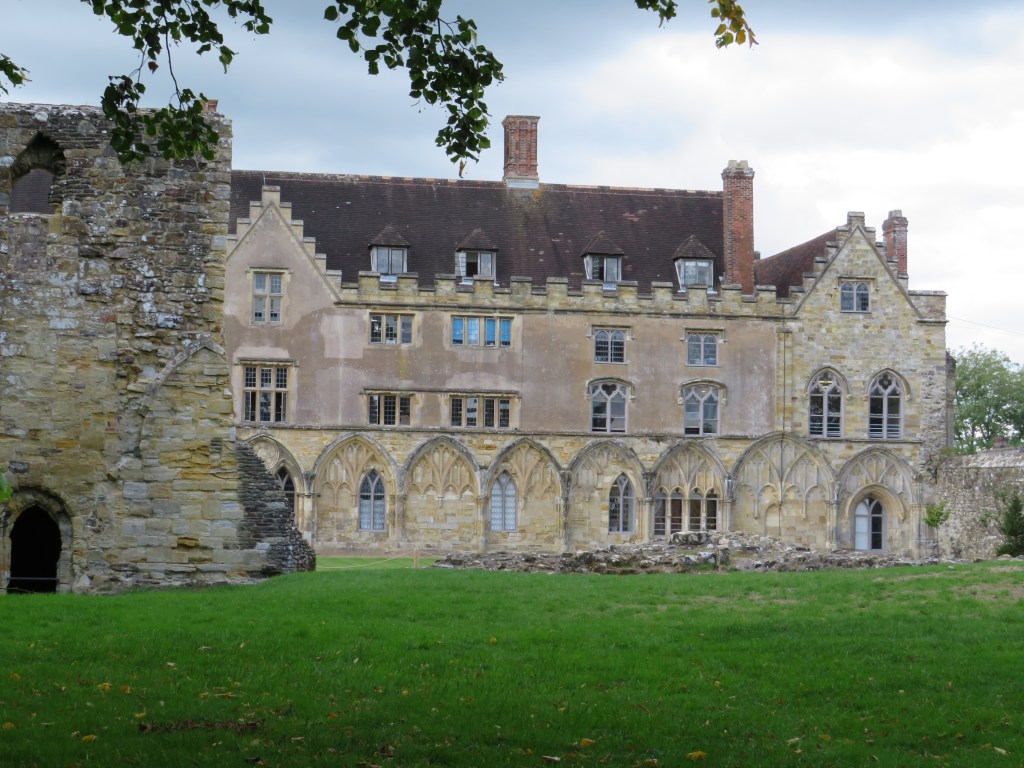
We arrive at Battle Abbey, just as Robert is starting his tour. This is all very well but we could have done with a ‘comfort stop’ first, especially is it turns out that the tour is nearly two hours long. It is thought that the Benedictine Abbey was sited here as the result of a penance by William I, who agreed to establish a religious foundation to atone for the Christian blood that he had shed during the battle. Its impressive appearance did also make a statement about Norman power and authority.

The battle for England, that took place on 14 October 1066, probably involved about 12,000 men, 7,000 of whom were supporting Harold Godwinson against the Norman invaders. There is something very atmospheric about standing on Senlac Hill. This would have been a heavily wooded site in 1066. The area where the fighting took place may have been cleared deliberately, as the English engineered this as the battle site; alternatively it may have already been cleared for cultivation. Identifying this spot as the location of the battle is based on contemporary chronicles and the fact that this is where William built his abbey. The high altar was allegedly positioned to be at the place where Harold Godwinson fell. We stop by the gatehouse, whose façade would originally have been painted and gilded. What is visible now was built in 1338. The Abbey’s wealth came from its land and also it’s exploitation of the 174 relics that it held. Only the most important guests and pilgrims could view the relics themselves. Others had to make do with paying for a ‘contact relic’, usually a metal disc, that had been touched on the relic.

After the Dissolution of the Monasteries, Henry VIII gave Battle to  Sir Anthony Browne, his Commander of Horse and the guardian of his daughter, the future Elizabeth I. Browne demolished the abbey church and sold off the stone to pay for a three story mansion in which he intended to care for Princess Elizabeth. Browne died shortly afterwards and the future queen never came to live at Battle. The Abbey was sold to the Webster family in 1721 and then was purchased by the Duke and Duchess of Cleveland. In 1922, Battle Abbey School leased the former abbot’s house.

I know the battle story well. Our guide debates whether Harold Godwinson’s tired men would have marched south after defeating his brother Tostig and Norwegian king Harald Hardrada at Stamford Bridge. Would they have taken the easier option of travelling by sea? After all, Hardrada had arrived by boat and after the battle, Hardrada’s depleted troops did not need all the vessels to return home.

Although Godwinson’s troops did a great job of defending the hill with their shield wall, the Normans were better trained and their huge advantage was the cavalry. They probably had about 500 warhorses, who had recovered from the sea crossing having spent two weeks in Pevensey, where the Normans had erected what GCSE students usually refer to as ‘flat-pack’ castles. Sir Walter Gifford and three others were sent out from the Norman lines, to particularly target Godwinson. Was he shot through the eye? This too is up for debate. Chronicles suggest that his end was rather more gruesome. To be blinded was the normal punishment for perjury which Godwinson was considered to have committed, as he reneged on his holy oath to support William’s claim to the throne. The depiction of the arrow in the eye on the Bayeux Tapestry could therefore be symbolic.

Today’s cake of choice is a particularly yummy passionfruit and lime. We drive home through Winchelsea and are at least on an available map when we encounter yet another diversion.
Cornish Castles

If you ever decide to visit Launceston Castle, there are a few things to be aware of. The English Heritage website says you don’t need to book, we didn’t, that wasn’t a problem. The site also says that booking ‘does not guarantee a car parking space’. This is on a webpage headed ‘Launceston Castle’. If you saw this, dear reader, would you or would you not assume that there was a car park for the castle? Hindsight, which as we all know is a wonderful thing, reveals that this is generic wording and that, contrary to popular belief, there is no castle car park but before we arrived at this momentous revelation, we fruitlessly tried to follow the sat-nav to what we fondly believed would be the car park. With shades of Fowey, this involved some narrowish twisting and turning and one-way systems and not a little going round in circles as we missed what appeared to be the vital turning. ‘It is no through road’, observes the trusty chauffeur’. ‘Well’, says I, ‘if it leads to a car park, it will be.’ Except it didn’t lead to a car park. Cue the need for a great deal of skilful reversing then more circuitous routes round Launceston to find an actual carpark. Then of course it was find the castle time. If you’ve ever been to Launceston, the castle is on a massive hill, looming over the town. You’d think it would be visible from anywhere. Another rash assumption. We parked the car began to walk towards the castle and then totally lost sight of it.

After all this, the castle needed to be good to make it worthwhile. To be honest, as castles go, it was a little underwhelming. It consists of a round stone tower on top of a very steep mound. The stone tower inside a shell keep was built by Richard, Earl of Cornwall, or rather by hapless local peasants, for Richard Earl of Cornwall, in the thirteenth century. I am also not sure what a great idea it was to climb up an extremely steep hill to look at the, albeit impressive, views from a great height, when I am not even keen on standing on a chair. I made it up and I made it down nonetheless.

A quick sit in the sun and then we strolled along the coastal path towards Boscastle, which was less steep and less wet than our foray in the opposite direction. There were also a pair of stonechats posing almost long enough for the camera.

The next day we drove to nearby Tintagel and walked up to the castle. They have built a notorious bridge since our last visit but I decide that could be a bridge (ha) too far so we ask to approach the castle by an alternative route. This alternative appeared to involve going in the official exit and at each stage of the contra-flow we had to explain to staff why I am too much of a woose to cross the bridge. Actually having seen it in the flesh, I think it would have been wide enough for me to walk across without being able to see the dizzying depths below, so perhaps another time I might brave it. The alternative is no walk in the park either, with precarious steps up the side of the wind-blown cliffs.

The castle was another possession of Richard, the thirteenth century Earl of Cornwall but is also the site of remains of much older dwellings. It is likely that there was a settlement here more than 1500 years ago. Until the twentieth century, Tintagel referred to the castle only and the hamlet was called Trevena, meaning ‘farmstead on the hillside’. It was Tennyson who drew attention to the castle, with its Arthurian associations and it became a focus for visitors. Having sampled yet more ice cream, honeycomb this time, we struggled through the wind, down the hill and then back up to the village.

We had limited time in the car park but managed to fit in a quick trip to Tintagel Old Post Office as well. Although this was a little rushed, it turns out that this was just the amount of time allowed to us before it began to rain. The Post Office was the previous commercial use for this six hundred year old former farmhouse. Originally a through-passage, single-story dwelling, there were modifications in the sixteenth and seventeenth centuries and there is a lovely collection of samplers on the wall, as well as an attractive cottage garden.

More Westward Wanderings

With the forecast heavy rain very much in evidence it seemed sensible to head for somewhere with a modicum of ‘indoors’, so it was off to Trerice, a manor house built by John Arundell in 1570. Inside there is a striking 576 pane window, predominantly made up of C16th and C17th glass. There are also numerous portraits, include some by Kneller. A 1950s wing replaces the former north wing. In the grounds there is an Elizabethan knot garden, given over largely to lavender and also an impressive potager full of vegetable and salad produce. If there were 100 hours in every day I’d want my garden to look like this. There are several mown mazes in the grounds, one being based on the maze at Troy Town on Scilly, which is known as the three circuit maze and was used by Scandinavian fishermen to trap bad spirits. I managed to escape.

Trerice is lovely but there isn’t really the scope for an all day excursion. The weather had improved so we decided to move on to Trengwainton Gardens, getting yet more value form the National Trust life membership. Here the rhododendrons were in full bloom. There is always something soothing about being in a garden and this one has the bonus of overlooking the River Fal. We walked down to where the King Harry chain ferry takes vehicles and passengers across the river. A steam ferry first crossed the river in 1888. It is one of only five chain ferries in England.

Next day and I was awake early to watch the misty dawn break over the sea, all accomplished without getting out of bed! The first stop of a busy day was Restormel Castle, which was built for the Earl of Cornwall, in good defensive position, overlooking River Fowey. It was originally used as a hunting lodge and was set in the largest hunting park in Cornwall. The park was also home to several hermits who were expected to pray for the souls of the castle’s owners. The remains are thirteenth century and the castle was owned by the Black Prince in the fourteenth century. After a skirmish during the English Civil war the castle fell into disrepair and was not deemed to be of sufficient use to maintain. English Heritage are now putting the headings of their interpretation boards in Cornish as well as English, A great first step but it is a pity that the text isn’t in Cornish too.

It doesn’t take too long to exhaust the possibilities of Restormel, so we move on to Lanhydrock House. The volunteer asks if I have visited before. I reply that I have but it was ‘a long time ago’. Do I remember the kitchen? I am asked, perhaps I should have explained that ‘a long time ago’, was about 39 years! The house was the home of the Robartes family, which I’ve always pronounced Row-bar-tes but, according to the information video is Row-barts. In April 1881 Lanhydrock was severely damaged by fire and the then owners died shortly afterwards, leaving the next generation of Agar-Robertes to take over. Ahead of her time, in 1894, the then Lady Robartes opened Lanhydrock to the public and establish a ‘bazaar’ there to raise funds in what seems to have been a glorified jumble sale. Her terse instruction cards to visitors have been replicated.

As always, I am attracted to the huge library, whose collection includes twenty five incunables. I had no idea what that meant either but just so that every day is a school day for you too (unless you already knew of course), these are books printed before 1501. There was also a fascinating and enormous steam jack in the kitchen. The National Trust seem to have developed an unfortunate trend for printing interpretation comments on the soft furnishings, which seriously spoils the authentic look of the rooms. I guess someone decided that it appealed to the visitors – not to this one though. We heard the story of how all the house’s laundry was sent to St Faith’s, a home for fallen women in Lostwithiel; I immediately wanted to scramble for census returns. Lanydrock’s gardens are extensive, with more rhododendrons in evidence. I would think that this is the best time of year for the gardens. I suspect they will be less impressive in a few month’s’ time.

Lanhydrock

On to Fowey and first the challenge of finding a car park. We located one at the top of the town but allegedly there could be one nearer to the church, where we want to be, so we decided to keep searching. Fowey is a tortuous warren of narrow, steep, winding streets. We do narrow, steep and winding but this is something else. Some vehicles were pulling in their wing mirrors to negotiate parts of the one-way system. Just because we were enjoying it so much (not), we completed the circuit several times before ending up in the car park where we first started and getting the town bus down the street. This doesn’t run after 5pm but the driver was able to tell us the best way to get back up the hill to the car park. I thought this might have been a first outing for my newly-acquired bus pass but the service was run by a private company and I didn’t like to ask if passes applied.

Fowey has been an established harbour for over 2000 years, exporting fish, wool and tin and being a point of departure for pilgrims to Spain. The returning vessels brought back with them wine, salt and iron. Fowey is noted for being the home of Daphne Du Maurier and we are here for a concert that is part of the Arts and Literary Festival that formerly bore Du Maurier’s name. There is little left of traditional Fowey, which now clearly caters for the yachting fraternity. Most of the food options were of the two peas and a bit of drizzle for £30 variety. We finally found The Lugger, which was more suitable to the sizes of both our pockets and stomachs.

The day finished with a Fisherman’s Friends concert in the local church. I was able to admire the heraldry round the church and practice my extremely rusty blazoning skills, while I was waiting for the concert to start. The downside was the less than comfortable pews. The evening was a sell out and was excellent, as we expected it to be. Even better, there was a community bus, with just two spaces, waiting to take us a ridiculously long way round to the top of the hill car park.

Sheep and Other Adventures

Another day of indifferent weather and we mop up (no pun intended) a few more ancestral locations, although sadly these churches are all locked. We also have a wander round Morpeth and manage to visit the destinations we abandoned due to the road closure two days ago. I am still working on these Northumbrian ancestors during our time back in the van and I am wondering if I should ‘ink in’ the next generation or not. At the moment I am erring on the side of caution and looking for additional evidence. They may make a blog post of their own when I am a bit more sorted.

In torrential rain we drive through floods, creating flume-like effects and make our way to Belsay. The site has been home to the Middleton family since at least 1270, when Richard de Middleton of ‘Belshou’ was Lord Chancellor to Henry III. The tour begins in the most recent home of the family on this site, Belsay Hall. This was built in 1817, using plans drawn up by the owner, Sir Charles Monck. He changed his name in order to inherit some other property; later generations reverted to Middleton. Sir Charles was obsessed with Greek architecture and the Hall reflects this. It was designed for effect, not practicality and contains some design flaws, including very steep steps to the entrance and a lack of guttering and downpipes. The latter has led to some serious water damage, which is having to be addressed by English Heritage. There are two high-ceilinged floors to the main house but the same height accommodates five floors on the north side, which were the servants’ quarters. Our tour has to omit the cellars due to flooding. Monck demolished the existing village and a chapel because he did not want the villagers too close to his home. In his defence, he did rebuild cottages further away and these too have signs of classical influences.

155 28 May 2019 Belsay Hall

The military took over the Hall in the Second World War and the building deteriorated rapidly afterwards, with the family leaving in the 1960s. It then stood empty for a further two years. Strangely, a condition of giving custodianship to English Heritage was that it would remain unfurnished. There are still remnants of William Morris wallpaper and a large library with 19 bookcases that might just accommodate my current book collection, which was culled by 50% when I left the Isle of Wight.

139 28 May 2019 Belsay Hall

149 28 May 2019 William Morris wallpaper Belsay Hall

The highlight of the Hall tour was observing a sheep-related incident. Whist admiring the rhododenrons, we notice that a sheep has got its head stuck through a fence that is protecting a sapling. Our guide radios for assistance. Simon the sheep rescuer comes to the aid of the stricken sheep. We watch from the window as he leaps into the rain-soaked ha-ha. As he approaches the sheep, which has been struggling for 10-15 minutes, miraculously, the sheep frees itself. Cue resounding applause for Simon.

153 28 May 2019 Rhododendrons Belsay Hall

The rain eased up sufficiently to allow us to paddle through the rhododenrons in the dramatic quarry garden and reach the castle. The castle is a traditional fortified peel house, designed to repel border raiders. A Jacobean manor was attached in 1614. This was abandoned two hundred years later, when the family moved into the hall. Sir Richard and his squire are bravely conducting some living history in the officially freezing castle. I feel quite sorry that the weather has kept visitors away but a few children are listening to the legend of the Lambton Worm and we discuss armour cleaning techniques.

Another ancestral location stop and then it is back to the van. And so the holiday draws to its close, leaving us with memories of bluebells and birdlife, the smell of guano and of wild garlic that shrouded each time we left the campsite and some ancestral adventures. I have somehow managed to successfully conduct three chat sessions for my Pharos Writing and Telling your Family History students, each one from a different field and now it is home for a week before we will be heading north again, this time for THE Genealogy Show.