Extreme Decorating and Other Domestic Issues

Just before leaving for our recent trip, the oven decided not to work. The minimum call out repair charge wasn’t much less than a new oven, so, on our return, I was all set to invest in a replacement. I checked the website of the fairly nearby shop that had received several recommendations and ascertained how much they were charging for what I wanted. I was passing the even more local Bideford Appliance Store, so called in there first, quite prepared to buy a whole new oven, if they could offer me a better price. It turned out that they could but ten out of ten for Bideford Appliance Store, they talked themselves out of an oven sale by suggesting that I may just need new knobs and that turned out to be the case, a considerable saving. Not many stores would have done that. Now we don’t have to live on a diet of things that can be cooked on a hob, in a microwave or slow cooker. We do have use of an air fryer but it has to be used in the conservatory as it sets the smoke alarm into aggressive mode that no amount of tea towel flapping or open front door wafting will pacify.

That brings me on to the conservatory. Arriving home from a fortnight away, we have just over two weeks before 150 people descend for a residential conference and I am heading up the organising team. I am well aware of this as I have what my granddaughter calls the ‘posh end’ of the garage crammed full of conference stuff. I have two lots of visitors to my tiny home in the interim. What dear readers, possessed me to think that now was a good time to decorate the conservatory? Having ordered flooring and what is know as a ‘banquette’ with delivery dates, there was no turning back. Stage one, two people in their eighth decade, both with minor health issues, decide to dump a six foot long bed settee. Never fear we have a trailer in which to take this to the recycling centre aka the tip. Said trailer is errrr six foot long. First of all, why am I always going backwards when carrying things? We did manage to unscrew the metal bed part of the settee from the rest which made life easier and heaved it into the trailer. Heaving it out was slightly harder and tip staff are not allowed to help until you have items out of your vehicle/trailer but mission accomplished.

Decorating day was two days ago. First to empty two large pieces of furniture so that they could be moved away from the walls to paint behind. Given the volumes of conference stuff there was absolutely nowhere sensible to put the contents, so I then had a living room that you could barely walk across. General mank that was lurking behind the pieces of moved furniture removed, I then started painting. Let’s just say it was slightly harder work than anticipated considering that the room is mostly glass not wall. Hindsight, always a wonderful thing, says that I should probably have taken the shelves off the wall and not tried to paint round six brackets and I probably needed a paint pad that was younger than fifty years old. And no I shouldn’t have left painting under the radiator (which  involved lying on the floor) until last. To add insult to injury, mid paint my fitness watch (sadly the wearing of which does not make me fitter) claimed I’d been sitting still for an hour! Painting finished, I hadn’t looked at the time on said fitness watch but estimated it must be about 3.30pm – I was surprised to see it was only 12.30 – it just felt like I’d been painting for five hours not two. All that paint pad swirling and you’d think that my arms might ache but they aren’t too bad. I know I don’t have stairs anymore to practice going up and down but really there was very little getting up and down steps involved however inexplicably, my legs have ceased to work. Yesterday I had to go up and down flights of stairs when out and down was next to impossible.

Next step, we have to empty the furniture a second time and find room for not just the contents but the furniture itself in order for the new floor to be fitted, fortunately the conference and its associated stuff, which includes over 450 give away books, will be no more. As for the legs, I need to get them back in some semblance of working order ready for my dawn walk in aid of the Samaritans. Dawn is no problem – walk needs some work at the moment. Common sense says I should do this on Monday 12th October not Friday 9th (which is day one of the conference) but it will be that weekend. Many thanks to those who have very generously sponsored me. If anyone else can spare something for this good cause the link is https://dawnwalk.samaritans.org/fundraising/janets-dawn-walk

Now I am off to collect yet more conference stuff, oh and still more stuff is being delivered today – will my teeny tiny house for one ever reemerge?
South-eastern Sojourn Part 6

Day 12

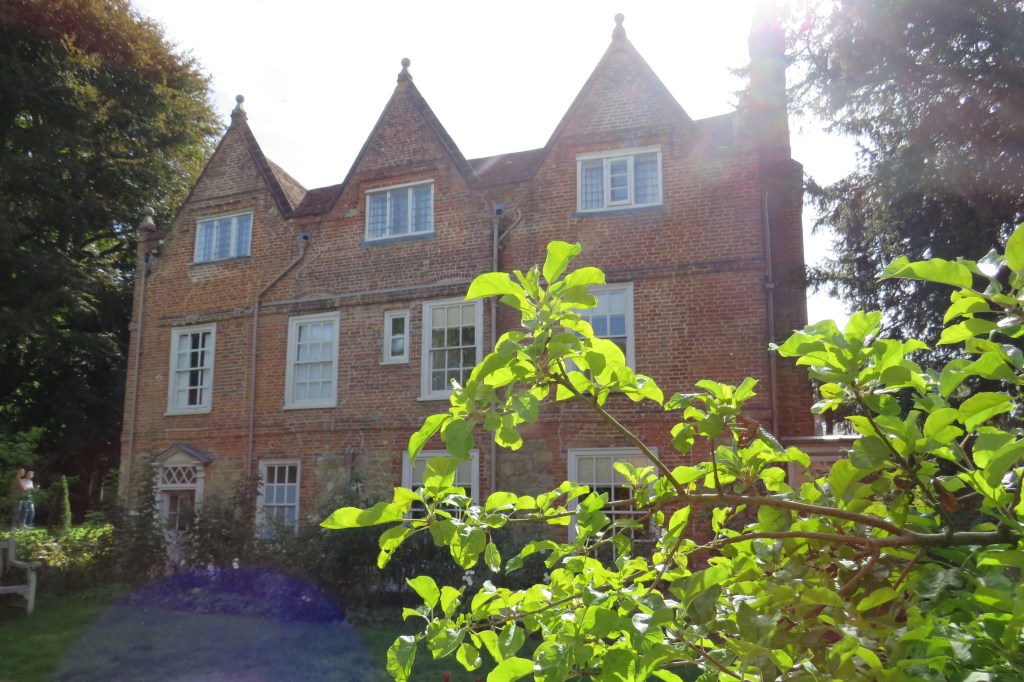
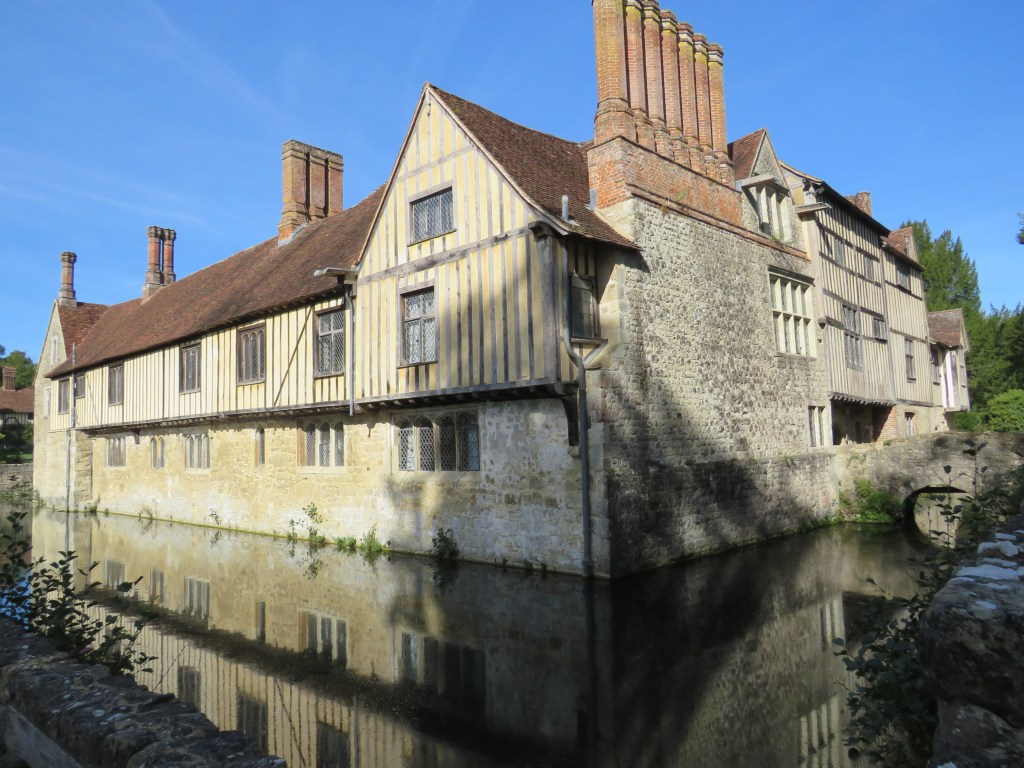
This morning, it is time for the trip I’ve been looking forward to the most. I’ve wanted to go to Ightham Mote for nearly sixty years, since I first read Anya Seton’s Green Darkness in which the Mote figures prominently. My first problem is the pronunciation. In my head I’ve always pronounced it Igg-ham Mott but no and I can see it now, it is Itum Moat, who knew – not sure I can undo decades of mis-pronunciation. This time, we trust the satnav and have an uneventful and speedy journey.

It is a beautiful day and the moated Medieval manor house is looking impressive. It was built in the 1320s and is the most complete surviving moated manor house in the country, having narrowly escaped demolition in the 1950s, when it was rescued by American, Henry Robinson. We have a short wait for an introductory talk, so look at the lovely walled garden, which contains many, now rather past it, sunflowers and the sit in the sun. The manor grew up here because of the nearby stream and a mill with five mill ponds was sold with the estate just before the current manor was built. The first known owner was Sir Thomas Cawne from Staffordshire who purchased it in the 1360s with profits he had accrued from the French wars. His son was imprisoned for throwing his wife down a well. In the 1400s, the Hawte or Haute family owned the manor, following a Hawte/Cawne marriage. Richard Hawte inherited in 1462. His connection with the Woodville family, saw his social standing rise and the Mote was enhanced to become a fashionable home. The moat was constructed as a fashion statement and to assist with the disposal of sewage, rather than as a defensive mechanism.

In 1521, Richard Clement bought the estate. Clement had been a page to Henry VII and worked his way up. He built the tower at Knole and added various Tudor embellishments. Then the Selby family from Northumberland held the estate for three hundred years. They ordered a huge fireplace surround that didn’t fit in the room, so they raised the ceiling. In the late nineteenth century, Sir Thomas Colyer-Ferguson bought Ightham Mote; his wife was a descendant of the earlier owners the Hawtes. No buyer could be found for the Mote when it went up for sale in 1951 but it was rescued by three local businessmen to prevent its demolition. They were able to sell it on to Henry Robinson two years later. Robinson was on board ship, back to America and was planning to change his mind about the purchase but the letter was never delivered. The differing sale prices over the centuries are interesting, The house and land sold for £400 in 1521, £4000 in the late sixteenth century and £35,000 in the late nineteenth century. The 1951 sale price was just £5000. It was given to the National Trust in 1985 and the Trust had to spend £10 million on conservation, which was not completed until 2004.

Things of note were a grade 1 listed dog kennel, witchmarks over the fireplace, tiles, some eighteenth century wallpaper, a tavern clock, an unusual painted ceiling, a sampler collection, photographs of the twentieth century staff, and a distinct ‘atmosphere’ in the crypt.

Not fancying any of the offerings in Ightham’s café, we move on to nearby Knole and start our visit in the café there . In 1783, the owners, the Sackvilles, had their servants painted and reproductions of the portraits are on display in the café.

Originally a typical Medieval manor, there have been numerous upgrades and alterations at Knole. From 1456, it was the official palace of successive Archbishops of Canterbury. After the Reformation, it passed into the ownership of the king, Henry VIII, who seized it from Thomas Cranmer. He expanded the park and used Knole, which is still famous for its deer, as a hunting lodge. We do see some deer. Elizabeth I gave it to her favourite, Robert Dudley but he returned it saying it was too large. The estate was purchased from the crown by Thomas Sackville, 1st Earl of Dorset in 1604. Thomas’ fortune was amassed as he was Elizabeth I’s Lord Treasurer and he was able to rebuild and decorate Knole lavishly, with the aid of royal craftsmen. Charles, the 6th earl, was the royal chamberlain and acquired cast off furniture from royal palaces. This is another property with a literary connection; Vita Sackville-West spent her childhood at Knole. In another cross over, Lionel Sackville was Lord Warden of the Cinque Ports three times. It is a substantial property with, we are told, seven acres of roof. The Sackvilles started showing Knole to visitors from the 1700s. At Knole, as a Petworth, there is an extensive art collection but it is not so overpowering here. I was particularly taken with a portrait of Sir Theodore de Mayerne, seventeenth century Huguenot and royal physician. I noted some interesting lead downpipes, seventeenth century blackjacks and an enormous dish about two feet in diameter.

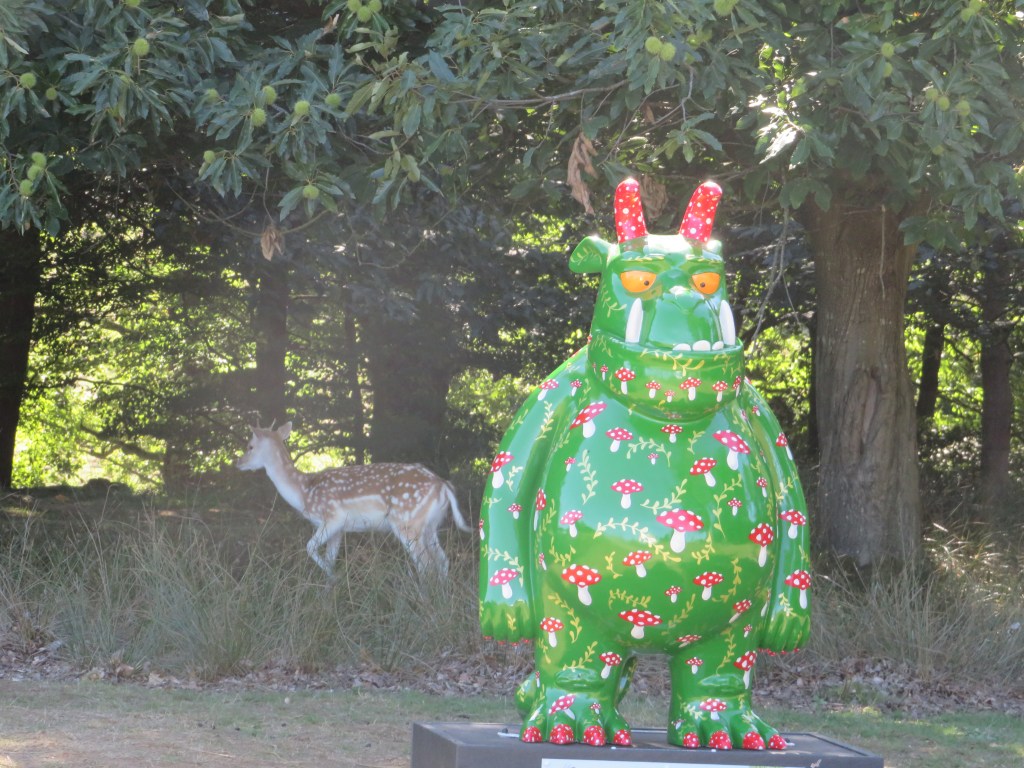
There is a bonus at Knole, a Gruffalo Trail. This is clearly not aimed at our demographic but I manage to capture most of the fibreglass, decorated Gruffali (?) in the grounds.

Day 13

Today’s destination was not originally on our itinerary but we made room for it by doing two things in one day earlier in the week. One advantage of this for our last day is that it is only six miles from our site, so not too much driving before tomorrow’s long journey. We are a little apprehensive on two  counts. Firstly, the tickets are on a pdf on my phone. Normally I would be belt and braces and have printed them off but we only booked them two days ago, so, as we don’t tend to carry a printer on our travels, that was not possible. I am fully competent at displaying a pdf ticket on my phone, I am just always worried that my fully charged battery will somehow have diminished to nothing, or there will be no phone signal. I am sure this is quite ridiculous but nonetheless, I do take the precaution of writing down the ticket numbers.

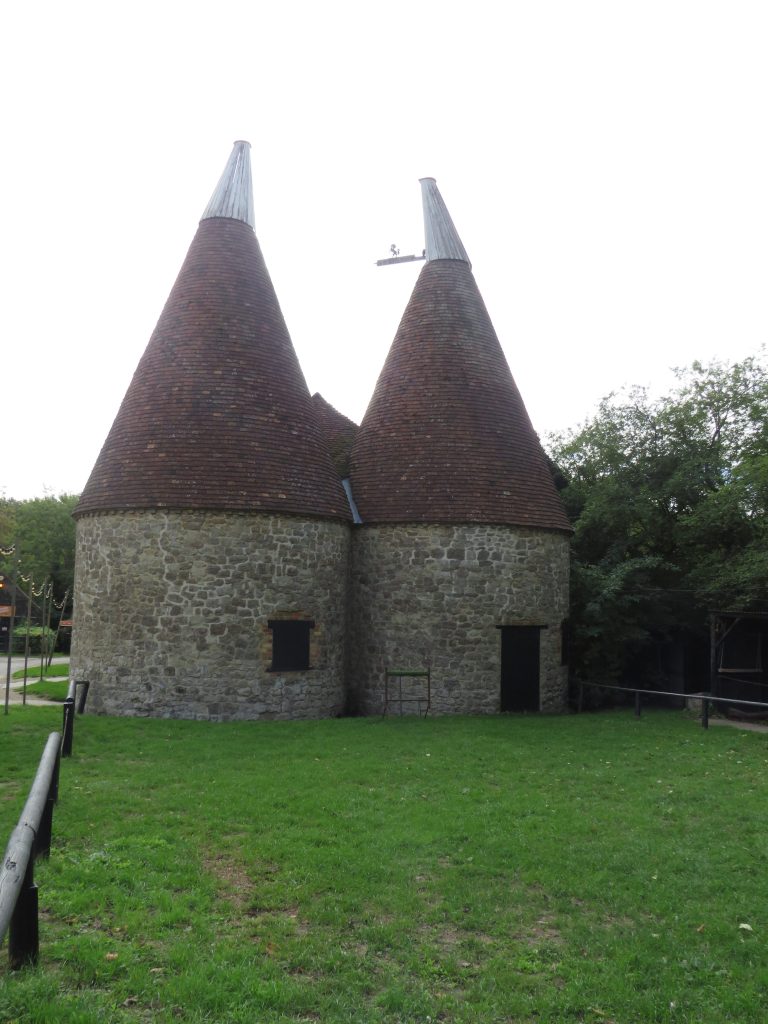
Today we are at Kent Life Heritage Farm Park and our second concern is that its focus is on family fun and we don’t have any spare six year olds with us. Although their main target audience is clearly somewhat younger than us, as is evidenced by the school parties of five year olds on site, there are some preserved historic buildings that we want to see. We don’t mind cooing over the odd farm animal, so here we are.  Understandably, much is made of Kent’s hopping industry, which goes back for at least 500 years. The iconic, coal-fired oast houses are a feature of the Kent  landscape. The hops were dried here for about eight hours before being sold to the brewers. Until the mid-twentieth century, droves of workers from the East End of London would spend a few weeks in Kent each summer, living in tiny tin shacks, or hastily constructed hovels, to pick the hops. This was always a family affair and the East Enders viewed it as a holiday, returning to the same shacks year after year. The locals benefitted from selling to the hop pickers but ‘strangers’ were viewed with suspicion. The coming of the railway facilitated the influx of pickers but they were certainly making the journey from at least the 1750s. Even in the 1900s, some pickers walked, to save the train fair, taking their belongings in a cart or pram. The crowded, poorly built shelters harboured disease, giving the locals another reason to resent the incomers.

We enjoy looking round the buildings, most of which were originally sited elsewhere and had been reconstructed on this site. There are oast houses, a chapel, a village hall and a row of World War 2 cottages, as well as hoppers huts from different time periods. The chapel includes a war memorial that was rediscovered in 2010. One of the farm houses is set up as a 1950s kitchen, although I spot that the brownie uniform hanging on the washing line is one from 1967 onwards. Another farmhouse, that has been styled as it would have been in the 1930s, was built on its current site in 1555 and was let to tenant farmers for centuries. Some areas, such as the herb garden, do look a little neglected. This garden is supposed to represent four different eras, with culinary, aromatic and medicinal herbs.

All in all, we enjoyed our visit and it didn’t diminish any of our other outings to make time for it. We return to the van via the supermarket and have a lazy afternoon in the sunny caravan site.

Day 14

Time for the long journey home, via numerous motorways. This is uneventful, although there were some holdups at the beginning due to traffic coming from the continent. We enjoyed our visit and were able to see plenty. It somehow didn’t seem as restful as some holidays, probably because we crammed in two visits on several days, when normally we would go for one, followed by a relaxing afternoon. Stand by, in less than a month’s time we will be adventuring again.

South-eastern Sojourn Part 5

Day 10

It is moving on day again, this time to our final site for this trip, just outside Maidstone at Bearstead. This time, I manage to put the right destination in the satnav. It is a tricky one this; we have to be off our current site by 12 and can’t access the new one before 1pm but it is a journey of under an hour. We try to solve this issue by going via a supermarket near us to purchase bread and milk. The snag with going via a supermarket with a caravan on the back is of course parking and it only works if there is the option to drive through and occupy two spaces. There isn’t. We end up up a dead end in the car park, where there is only room to turn round by dint of high level towing skills and the lack of a barrier pole that had been flattened by another driver. I rush into the shop to make our purchases, whilst Chris circles the car park. Both shop and carpark are huge. I end up chasing after the retreating van to try to catch up with it as it circles past me. The site is almost full but we secure another corner site with a WiFi signal and an adequate television signal if you aren’t to fussy about what channel you watch.

Day 11

The day did not start well. The satnav insisted on adding twelve miles to our journey and taking us to our destination along the M20 and M25. There is a much shorter route along the A20, albeit admittedly one minute longer. No amount of persuasion would persuade the satnav to take us via this route. No problem, I have a map. The A20 runs very close to the site, we follow the signs to the A20. As we progress I am puzzled by the lack of settlements we should be passing according to the map. We have gone rather further than ideal before I realise the issue. A20 yes, right direction no. We turn around where possible and eventually arrive at our destination about forty minutes later and rather a lot of miles further than intended. In retrospect, we should have gone with the satnav, hindsight and all that. Then there was the issue of finding somewhere to park. The nearest car park to our destination was full of cars bringing young footballers in for a tournament. Luckily, someone was just leaving and we were able to acquire their space in the overflow car park. A bonus was that weekend parking was free.

Today’s National Trust property of choice is Quebec House. When planning this itinerary, this was the only day when we were in the area that the house was open and fortuitously, there’s a special event on. I have brought my notebook but somehow have neglected to equip myself with a writing implement. I have to rely on memory and photographs of interpretation boards. Quebec House itself was the childhood home of Major General James Wolfe. Typically, the National Trust have to have a ‘hook’ for a property and here, much is made of the Wolfe connection, even though the family only rented the property for a few years from 1725 to 1738, leaving when Wolfe was eleven.  A successful career soldier, Wolfe helped to put down the 1745 Jacobite Rebellion and later enhanced his career during the Seven Years War 1756-1763 between Britain and her allies against France and hers. His role in the taking of Quebec, which facilitated the end of French rule in North America, made him a hero after he lost his life at the Battle of the Plains of Abraham. His body was brought back to England, By this time the corpse was not in a sufficient state for a death mask to be made, so a servant was used as a model for a bronze bust that was created. Chris uses his knowledge of musketry to explain the workings of a flintlock musket to a fellow visitor.

The special event and the other focus of the property really celebrates not Quebec House but nearby Chartwell. Although, in 1760, both properties were owned by Thomas Ellison; at this point Quebec House was called Spiers. After London Foundling Hospital was established by Thomas Coram in 1739, it soon became obvious that the number of children needing care exceeded the capacity of the London home. A satellite home was established in Westerham, at a house called Wellstreet, in 1760. This is the property now known as Chartwell. Detailed records survive and 469 children were cared for at Wellstreet. Present at Quebec House today is Mrs Wadham, the first Matron of the Westerham annexe when it opened in 1760. Mrs Wadham is full of ‘useful’ remedies to cure the children of all ills. Mistress Agnes would have enjoyed meeting her. When a child entered the hospital, their name was stripped from them and they were given a number. On display are representations of the tokens that were left with foundling children, so that they could be identified should their parents come back to claim them. Although receipts replaced tokens before the Westerham branch opened, some mothers still provided them. There is plenty of information available about life at Wellstreet, which functioned for nine years. There were twelve dormitories and three children shared each bed, which was four foot two inches wide and five feet six inches long.

There is also a FindmyPast demonstration on a large screen and a National Trust volunteer is attempting to help a visitor. I can’t stomach listening to the misinformation for more than a few minutes. I manage to acquire a pencil for future notes.

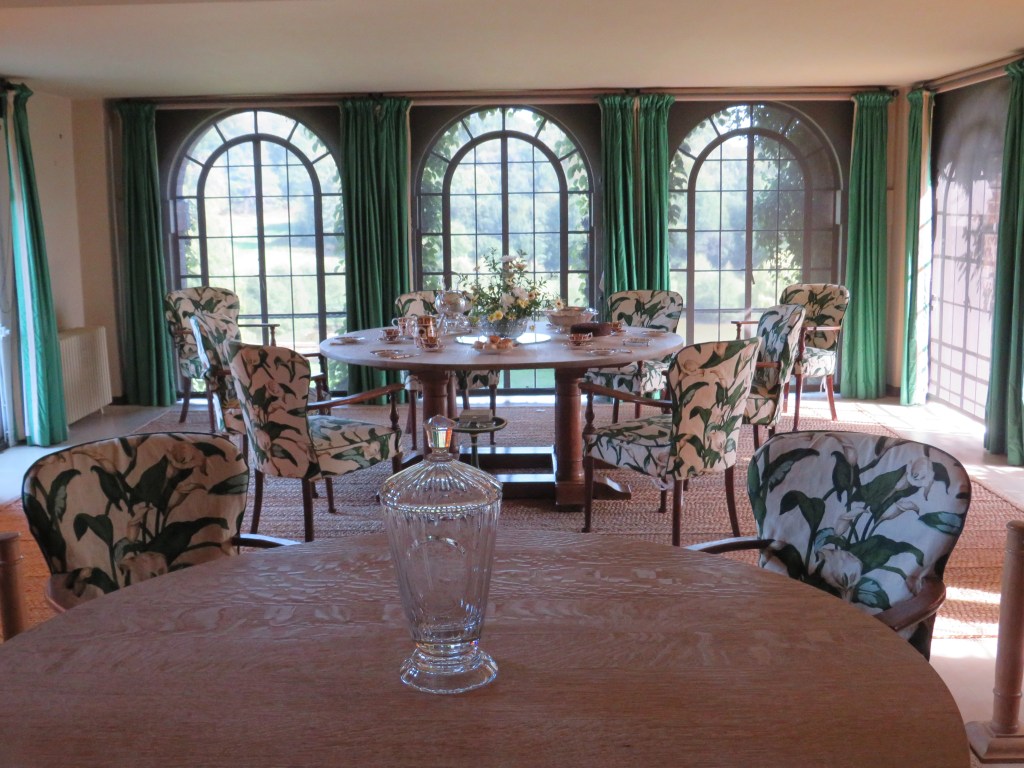
An off the cuff change to itinerary, which we had already adapted, took us to nearby Chartwell, formerly not just Wellstreet foundling hospital annexe but more famously the home of Winston Churchill. Again, parking spaces are in short supply. First stop the café, where today’s cake of choice is iced cherry cake. The property had been empty for a few years when the Churchill’s purchased it, in 1922, for £5000, having knocked £500 off the purchase price. It cost another £20,000 to refurbish it. We are aware of the connections between Clementine Churchill and Bucks Mills, as well as the links to the Mitford family and there were Mitford signatures in the visitors’ book that was on display. We are given a timed ‘invitation’ to visit the house. We have been allocated am persona of a genuine visitor. I am Churchill’s daughter, Sarah and Chris is Professor F A Lindemann, no me neither.  It seems he was a physicist and became Churchill’s scientific advisor. Some of the rooms were dressed as they would have been when the Churchills were in residence, I particularly liked the dining room and the library. Other rooms were exhibition spaces, which I found less appealing, They told the story of Churchill as an artist, an author and a wartime leader. The grounds were impressive and the views were glorious. We walked round the huge walled garden, so large that you couldn’t help wondering if the effect of being walled was largely lost.

For the homeward journey, we let the satnav take the strain and after forty minutes on the motorway, we were back. A much less stressful and less time consuming, if not very inspiring, journey.

South-eastern Sojourn Part 4

Day 8

There’s a light drizzle so we opt for what we expect to be the most indoorsy of the two options left on our itinerary for this part of the trip and head for Walmer Castle. The importance of coastal defences became even more crucial after the Reformation, which motivated Catholic countries, such as France and Spain, to attack England, with the blessing of the Pope. Three castles were constructed in close proximity at Walmer, Deal and Sandown. Originally, these castles, just a mile or two apart, were linked by ditches and bulwarks in between but these have not survived.

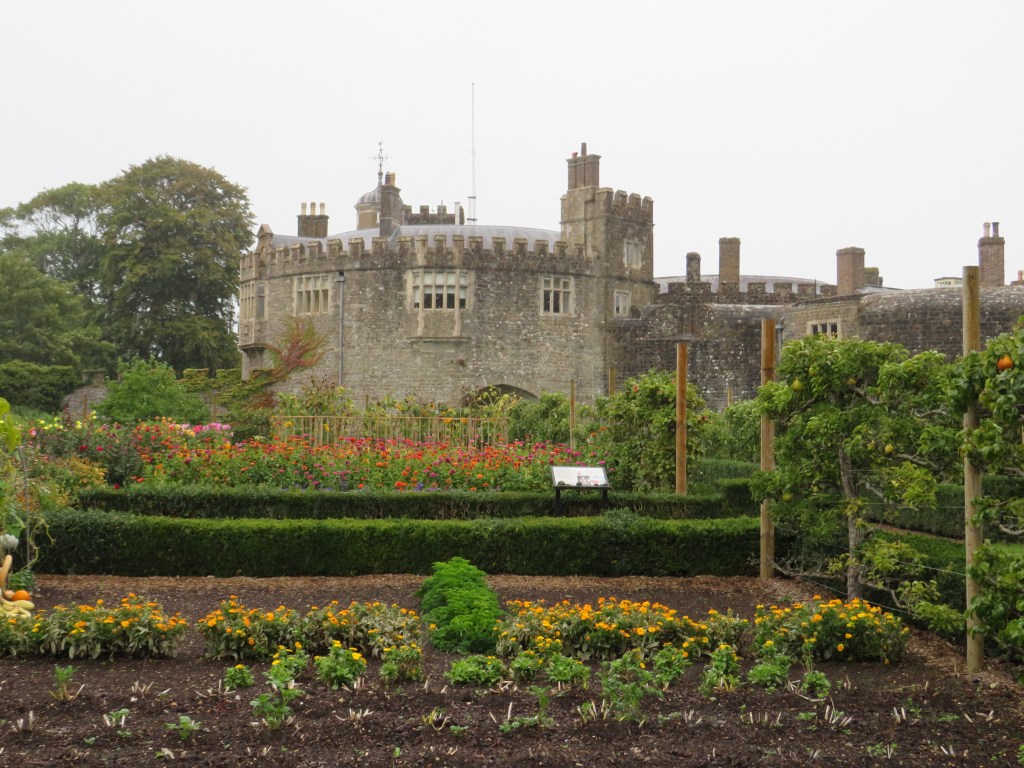
We drive through Dover in the mist and murk to arrive at Walmer. Unfortunately, the indoor portion of the castle is closed pending refurbishment. Constructed in 1539-1540, Walmer consists of a round keep and four surrounding round bastions, protected by a dry moat. Walmer Castle was traditionally the home of the Warden of the Cinque Ports. The original Cinque Ports, Hastings, Hythe, New Romney, Dover and Sandwich, were established before the Norman Conquest by Edward the Confessor. The settlements were self-governing and were exempt from taxes in exchange for providing crewed ships for the defence of the realm, on this strategic part of the coast, at a time before there was a permanent navy. Other towns such as Winchelsea and Rye were later added before the ports declined in importance with the establishment of the Royal Navy. The role of Warden, is now a symbolic one.

During the Napoleonic Wars, Prime Minister William Pitt the Younger held the post of Warden. Debts led Pitt to sell his home nearer to London in Bromley and make Walmer his principal home.  He established the gardens and these were completed by his successor, Lord Liverpool. Later notable Wardens have included the Duke of Wellington, Winston Churchill, William Henry Smith, of W. H. Smith’s fame and the Queen Mother.  We can view the gardens. The dry moat is now part of the gardens and the bastions have acted as a walled garden with some huge ferns and fig trees growing. The gardens are indeed impressive and include pumpkins being grown across a frame in an unusual manner but it is getting increasingly soggy and it isn’t long before my feet are a trifle damp. We cut our loses and head for the café. Having travelled about thirty miles to not view Walmer Castle’s interior, we decided to move a mile or two up the road to the second castle of the day at Deal.

Deal Castle was another Henrician fort, built in 1540. Over succeeding years, the settlement grew up around it, with a naval supply yard established in the 1600s. Deal Castle was captured by Royalist troops in 1648 and was besieged by the Parliamentarians for three months. Successive captains of Deal Castle, were answerable to the Warden of the Cinque Ports and the captain at Deal was senior to his fellow captains at Walmer and Sandown. Although the Captaincy was bestowed as a reward for service to the state, the captains were expected to be working captains and were not allowed to ‘lie out of the castle’ for eight nights in any month without obtaining a licence from the king. From the 1700s, by which time the settlement had developed in to a busy port, the castle’s main function was as a residence, rather than a fortress. The eighteenth century residential wing, was indictive of the lessening of the military function of the castle and by the nineteenth century, the role of captain was a purely ceremonial.

Deal has the advantage of some indoor space that we can view, although, by this time, the weather has improved. There is a central keep with six semi-circular bastions and then an outer curtain wall of six more bastions, surrounded by a dry moat. We tour the interlocking corridors and rooms of the castle, which is spread over three floors. I even conquer the spiral staircase, which has a rope bannister, such that when someone else pulls on it, your hand gets crushed against the stone.

We finish our trip to Deal with a fishing boat fix for the fisherman of my acquaintance.

Day 9

Fortunately, the weather has improved today, so we head out along the A259, which has been a bit of a feature of this trip and which could take us all the way back to  Brighton. We are however not that lost and we drive through Dymchurch and Romney to Dungeness in search of the RSPB reserve. We had intended to explore this stretch of coast on the Romney, Hythe and Dymchurch preserved railway but a combination of the cost and the timetable, made us opt for driving. We find ourselves by the nuclear power station and lighthouses, of which there are two. The first lighthouse was built here in 1615. Changes in the coastline, meant that a new lighthouse had to be erected nearer the sea just twenty years later and then it was moved again in 1792. The current lighthouse was built in 1901. There is an opportunity to climb 169 spiral steps to admire the view from the top of the lighthouse. For once, I don’t forget that this really isn’t my thing and our feet remain firmly at ground level.

For this part of our trip we are on the edges of the 100 square miles of wetland that make up Romney Marsh, notorious for its sheep and smuggling history and ingrained in my childhood memories for my much loved Malcolm Saville and Monica Edwards books. Romney is one of England’s three great marshland areas, the others being the Fens and the Somerset Levels. The landscape here was significantly changed by a huge storm in 1287. This altered the course of the River Rother, silted up the harbour at New Romney and towns that had been coastal were left inland. Martello Towers pepper the coastline and in 1809, the Royal Military Canal was constructed as part of the defences of the south-east coast during the Napoleonic wars. Even with today’s sunshine, the landscape is desolate. We can see the traditional wooden, black shacks that are dotted across the marsh, some made from old railway carriages.

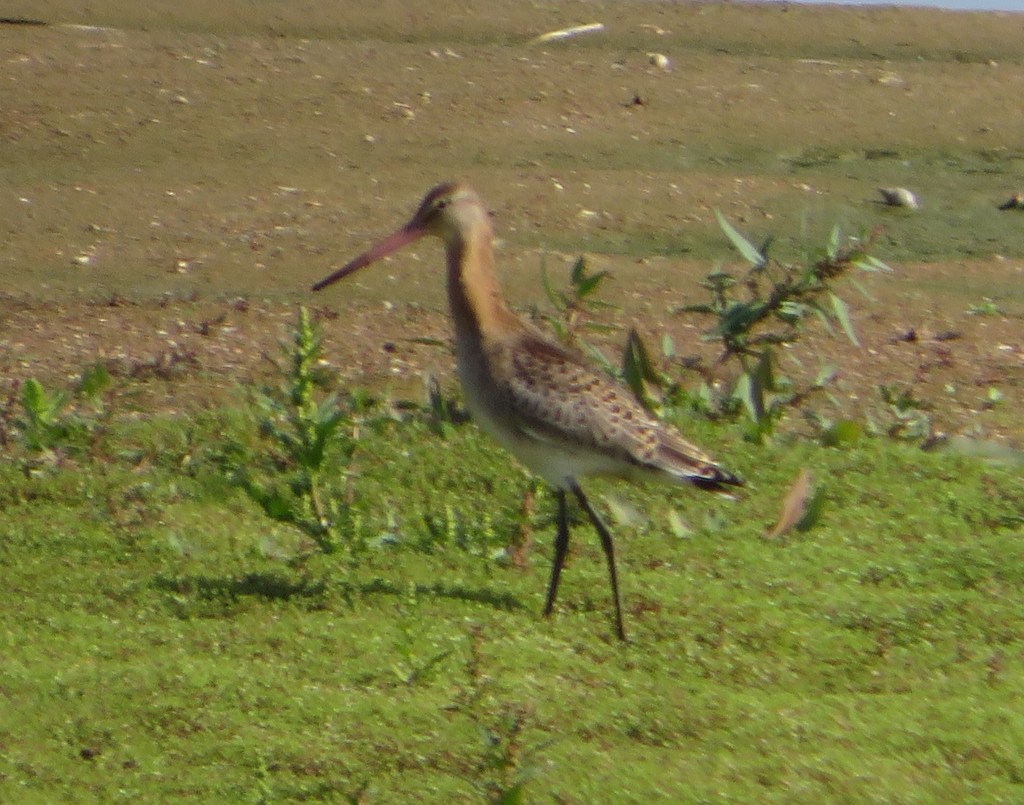
Where we are hoping to be, is the Dungeness RSPB nature reserve and we clearly aren’t quite in the right place. The Ordnance Survey Map is silent on exactly where the Visitors’ Centre is. Fortunately, there is a ‘you are here’ type map that helps and we are able to drive round to the reserve. There are plenty of birds to try and photograph on full zoom from a very long way away. I was particularly pleased to spot a black-tailed godwit. Full disclosure. I had no clue that I was looking at a black-tailed godwit. It was identified later from my slightly blurry photograph, in my defence, I was about 150 metres away. For the benefit of those who are interested in what could be seen, the full list includes: stonechats, black-headed gull, great egret, Egyptian goose, coots, graylag geese, Canada geese, avocet, great crested grebe, marsh harrier, sand martin, swift, heron, mute swan, cormorants, mallards, skylarks, magpies, little egret and a black-backed gull of uncertain size. We also hear a robin and a chiff chaff (yes, Merlin again), heard marsh frogs and saw numerous dragonflies and butterflies, including clouded yellow butterflies that are found in this part of the country.

South-eastern Sojourn Part 3

Day 5

Having already done the activity planned for today, we decide to drive through Brighton to Shoreham and look at the nature reserve there. We manage to find a very reasonably priced car park and start to walk along the shoreline. This involves ploughing through ankle-threatening shingle, plus it is drizzling  and blowing a gale, so we decide to cut our losses had have a quiet day in the van to regather our energy after three full on days, in preparation for what is to come.

Day 6

It is moving on day. I am responsible for the satnav and I enter the postcode for the site. The itinerary suggested that the journey time might be about two and a half hours, so we leave at an appropriate time to arrive when the new site opens at one. Oddly, the satnav thinks we might arrive considerably earlier than that. We remark that it isn’t taking us the way we might expect, as we drive through Brighton and head north. Perhaps, we think, this is what accounts for the earlier arrival time. After about ten miles, I look at our upcoming itinerary and realise that although I have programmed in A caravan site, it isn’t THE caravan site. I have inadvertently input the detail for the final site of the trip. The blessing is that these two sites are only thirty miles apart, so we haven’t gone too far out of our way. We end up arriving exactly as the site opens and we secure a lovely corner pitch, which has the advantage of a half decent television and Wifi signal.

Day 7

There have been a couple of very loud bangs seemingly coming from the caravan over the past few days. Chris thinks we need a part. Caravan supplies outlet duly identified we set off. Fortunately this isn’t too far away. Said part acquired, we head for Battle Abbey. I have purchased two maps for this stage in our trip but inevitably, I still don’t have one showing the site, which is just off the edge. This becomes an issue when we  encounter a diversion and the satnav just wants us to ‘turn around when possible’. We see Rye from the car on the way.

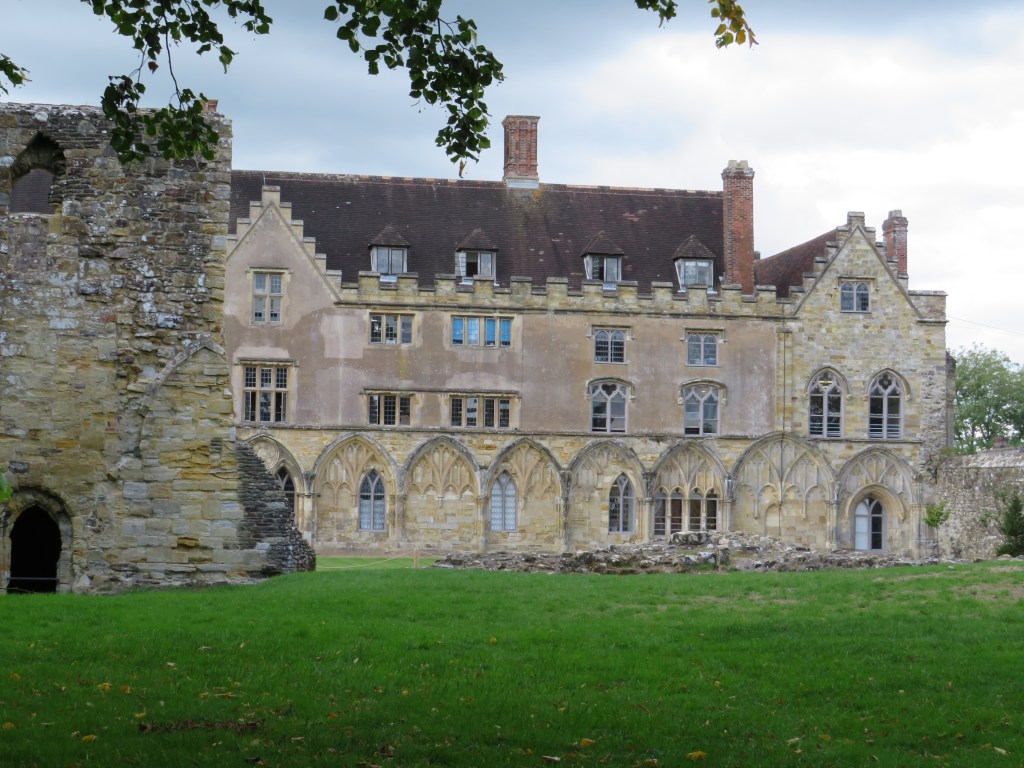
We arrive at Battle Abbey, just as Robert is starting his tour. This is all very well but we could have done with a ‘comfort stop’ first, especially is it turns out that the tour is nearly two hours long. It is thought that the Benedictine Abbey was sited here as the result of a penance by William I, who agreed to establish a religious foundation to atone for the Christian blood that he had shed during the battle. Its impressive appearance did also make a statement about Norman power and authority.

The battle for England, that took place on 14 October 1066, probably involved about 12,000 men, 7,000 of whom were supporting Harold Godwinson against the Norman invaders. There is something very atmospheric about standing on Senlac Hill. This would have been a heavily wooded site in 1066. The area where the fighting took place may have been cleared deliberately, as the English engineered this as the battle site; alternatively it may have already been cleared for cultivation. Identifying this spot as the location of the battle is based on contemporary chronicles and the fact that this is where William built his abbey. The high altar was allegedly positioned to be at the place where Harold Godwinson fell. We stop by the gatehouse, whose façade would originally have been painted and gilded. What is visible now was built in 1338. The Abbey’s wealth came from its land and also it’s exploitation of the 174 relics that it held. Only the most important guests and pilgrims could view the relics themselves. Others had to make do with paying for a ‘contact relic’, usually a metal disc, that had been touched on the relic.

After the Dissolution of the Monasteries, Henry VIII gave Battle to  Sir Anthony Browne, his Commander of Horse and the guardian of his daughter, the future Elizabeth I. Browne demolished the abbey church and sold off the stone to pay for a three story mansion in which he intended to care for Princess Elizabeth. Browne died shortly afterwards and the future queen never came to live at Battle. The Abbey was sold to the Webster family in 1721 and then was purchased by the Duke and Duchess of Cleveland. In 1922, Battle Abbey School leased the former abbot’s house.

I know the battle story well. Our guide debates whether Harold Godwinson’s tired men would have marched south after defeating his brother Tostig and Norwegian king Harald Hardrada at Stamford Bridge. Would they have taken the easier option of travelling by sea? After all, Hardrada had arrived by boat and after the battle, Hardrada’s depleted troops did not need all the vessels to return home.

Although Godwinson’s troops did a great job of defending the hill with their shield wall, the Normans were better trained and their huge advantage was the cavalry. They probably had about 500 warhorses, who had recovered from the sea crossing having spent two weeks in Pevensey, where the Normans had erected what GCSE students usually refer to as ‘flat-pack’ castles. Sir Walter Gifford and three others were sent out from the Norman lines, to particularly target Godwinson. Was he shot through the eye? This too is up for debate. Chronicles suggest that his end was rather more gruesome. To be blinded was the normal punishment for perjury which Godwinson was considered to have committed, as he reneged on his holy oath to support William’s claim to the throne. The depiction of the arrow in the eye on the Bayeux Tapestry could therefore be symbolic.

Today’s cake of choice is a particularly yummy passionfruit and lime. We drive home through Winchelsea and are at least on an available map when we encounter yet another diversion.

South-eastern Sojourn Part 2

Day 3

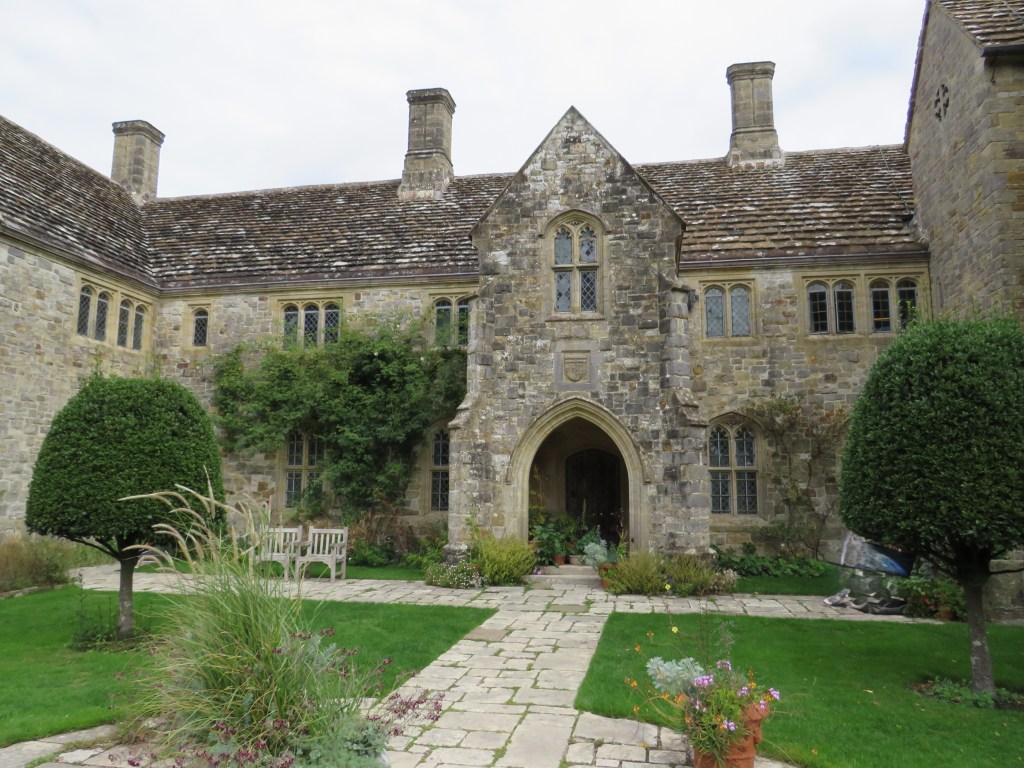
We arrive at Nymans in time for a tour by garden guide Rob. We’ve learned that tours are a good thing if you want additional information. Rob does not disappoint, although the tour does eat into rather more of our time available than was ideal. The estate itself dates back to at least the fourteenth century and the attraction of the area was probably the iron mining potential. Early owner, Philip Nynian, gave his name to the estate. For three centuries it was owned by the Gatland family and then several nineteenth century owners added to the estate, extensively adapting the medieval house in 1839. The major changes came under the ownership of German-born Ludwig Messel, who paid £20,000 for Nymans in the 1870s. He remodelled the house using plans drawn up by his brother, who was an architect and the finished house had a Germanic style. Ludwig was a collector of exotic plants and exploited the good growing soil at Nymans to house many rare plants and trees from across the world. James Comber served as head gardener for fifty eight years from 1895.

Ludwig’s son, Leonard, inherited in 1915 and his wife, Maud, prompted a remodelling of the house, so that the Germanic influences, unpopular in the wake of the First World War, were eradicated. The work was carried out in the 1920s and at Maud’s request, the result resembled a medieval manor house, with ecclesiastical influences.

The Pinetum is impressive and despite losing 400 trees in the 1987 storm, the estate has approaching 100 ‘Champion Trees’, those that are the tallest, or have the greatest girth for their species. As we tour round the grounds near the house itself, a blackcap is singing loudly (thanks again Merlin).

Nymans ranks eighth for footfall amongst National Trust properties; the numbers are swelled today as entrance is free for Heritage Weekend. I am surprised to find that the house itself is quite small and is partly in ruins. It was destroyed by fire in the big freeze of 1947 when they tried to unfreeze the pipes in the roof using a blow torch. A stray spark caused the fire, exacerbated by the oil that had been put on the timbers to deter woodworm. Leonard’s children included Oliver Messel, a notable costume designer; his work is celebrated at Nymans. Leonard’s daughter. Ann, was mother of Lord Snowdon and she lived in the partly restored Nymans until 1992. As we have a guide with us, we are able to view the ruins, which have been repurposed as an outdoor garden.

There is just time for a refreshment break before we head to Lewes to collect a friend from my college days; we haven’t met for about twenty five years. Together, we tour Monk’s House, the country retreat of Virginia and Leonard Woolf, who bought Monk’s House in 1919 for £700. The seventeenth century property was once three separate workers’ cottages, home at various times to the Cleere, Glazebrook and Verrall families. When the Woolf’s London property was bombed, they made Monk’s House their permanent home. It became a centre for the Bloomesbury Set and there were several paintings by Virginia’s sister, Vanessa Bell. We viewed the extension, built so that Virginia could have her own space and we see her writing lodge in the attractive gardens.

Day 4

Another day and yes, another National Trust property, this time Batemans, the former home of Rudyard Kipling and his American wife, Caroline. Like Nymans, the attraction of the area was the iron mining, which was centred in Sussex before the industrial revolution. The property itself dates from 1634 and the Kiplings aimed to enhance its seventeenth century heritage after they purchased it and thirty surrounding acres in 1902, for £9200. Items of note include wall coverings made from calves’ leather, which was made in the early eighteenth century and purchased by the Kiplings for 100 guineas. There was also a clock dating from the 1630s, an Eddison cylinder phonograph, whose volume control is the origin of the phrase ‘put a sock in it’. Also on display were some modern Jungle Book illustrations by Gruffalo illustrator Axel Scheffler. Other things that caught my eye were a Tiffany inkwell, a botanical crockery set, some tiles, miniature globes made in 1756, a paper model of Batemans, created out of pages covered in Kipling’s tiny handwriting and an alphabet necklace, based on Kipling’s Just So Story How the Alphabet was Made.

We look round the gardens and the overshot water mill, Park Mill, built in 1750; although there has been milling here since the thirteenth century. This visit was enhanced by meeting my friend and also my second cousin, who by a chain of co-incidence know each other and we spend ages chatting in the café.

South-eastern Sojourn Part 1

Yes, we’ve been away again, this time to Sussex and Kent. These are both counties I’ve visited before but extended visits were in childhood, so it was time for a return as part of the ‘Let’s visit every county in England’ campaign, to which I’ve now added and visit at least one National Trust property and one English Heritage property in each, meaning that I may just have to revisit one or two. You’ve had to wait for me to be back in the land of decentish WiFi for me to post this, so, as ever, these are not real time adventures.

Day 1

Having already cut two days off our holiday to accommodate the fitting of a smart meter at the home of the fisherman of my acquaintance, we knew that we were unable to leave as early as we might have liked. This smart meter has been somewhat of a bone of contention. Having been pestered to have one and refusing for many years, this has now become a necessity in order to benefit from the feed-in tariff from his newly installed solar panels. He’s been trying to get an appointment since April. Having muttered the word Ombudsman, an appointment  was finally arranged for what should have been two days into our latest trip. Fortunately, it was the sort of trip where two days fewer was a possibility and as the appointment was for ‘between 8 and 12’, we could get to our destination afterwards, or so we thought. They also promised to message half an hour before arrival. At 11.45, with no sign of said message, we ring to be told that they are unable to guarantee that they will come at all today.

After a great deal of gnashing of teeth, we set off at 1.45pm, with still not a meter man in sight. By this time, it is touch and go whether we will arrive at our chosen site in time to get a pitch before they close at 8pm. Fortunately, this is a site where there is an area where late night arrivals can pitch but this might mean we can’t get onsite until 1pm tomorrow, which would impact on going out for the day. As we leave, the sat-nav, which knows we are towing a caravan, thus limiting our speed on motorways to 60mph, reads 7.22 as an arrival time. The route means encountering the car park known as the M25 at rush hour. There is also the issue of whether we can do a five and a half hour journey without a comfort stop. A 7.22 arrival was always going to be a big ask.

Given the nature of the journey, we do well. There are some sections where we can make up time, which compensate for the parts where we are delayed. The last few miles, through the centre of Brighton, take a disproportionately long time; there are an awful lot of traffic lights in Brighton. We managed to avoid stopping for fuel or comfort and arrive at 7.25. Very hungry and in need of said comfort but in time.

Our site at East Brighton Park is, as the name suggests, on the eastern edge of Brighton and nestled in the shadow of the South Downs. It must be popular as we are allocated the last vacant pitch, fortunately, it seems to have a WiFi signal, so I am happy.

Day 2

We are blessed with a lovely sunny day and set off for Petworth House, today’s National Trust property of choice. I follow along on the map as usual, as we enjoy the views over the downs and travel up the Adur Valley. Here, we are close to the ancestral villages of Steyning and Henfield but I’ve visited before, so have put family history to one side for this holiday.

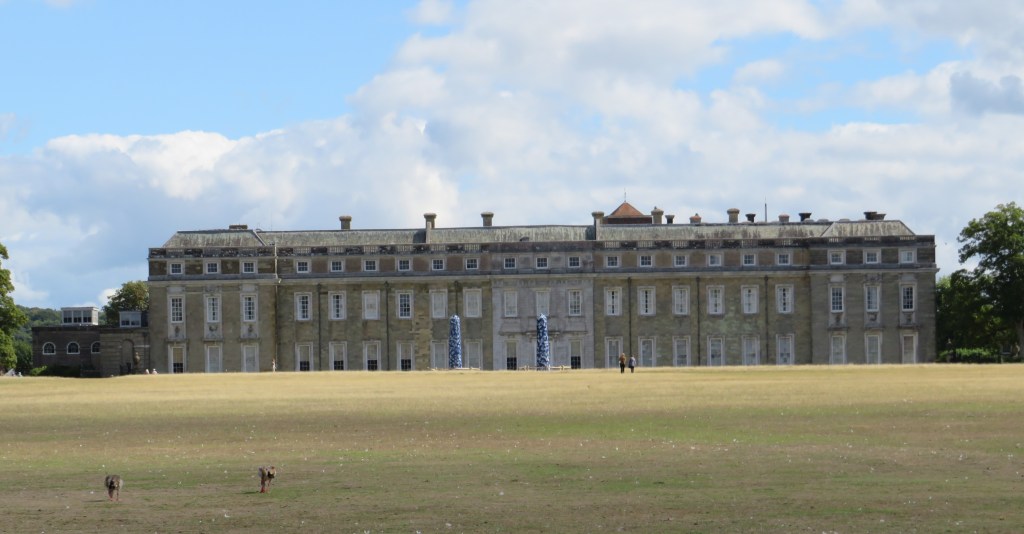
It is difficult to describe my reaction to  Petworth House. It is still a private residence and the portion that is open to the public was built as a Baroque show-home in 1688, designed to impress visitors and house an extensive art collection, rather than to be lived in. Impressive yes, overwhelming yes and definitely over the top. It was interesting but I am not especially fascinated by works of art, even though these include those by Lely, Van Dyke, Turner, Reynolds, Gainsborough and Titan. There are also nearly a hundred marble sculptures, most of which are huge. We also see a temporary exhibition ‘Expressions in Blue’ with more massive, mostly blue, modern pieces, by English artist Felicity Aylieff, inspired by Petworth but made in Chinese porcelain factories. These include two in the grounds that are about five metres tall. Petworth’s incredibly high ceilings, almost all of which are undecorated, help to accommodate all the large-scale artwork. My preference is for more homely properties. So in summary, yes I’m glad we went but it wouldn’t be high on my list for a revisit; others will feel differently of course.

As the focus is on the art collection, trying to find out more about the history of the building itself and its owners is quite difficult. The site has 900 years of history and the current building replaced a fortified manor house. There are traces of earlier building, notably the fourteenth century chapel, with heraldry abounding. The estate was given to Joscelin of Louvain in the twelfth century by his sister Adeliza, consort of Henry I. Louvain married a Percy heiress and took her name. They were the progenitors of the Earls of Northumberland, who held Petworth as their seat in the south for centuries. The Percy family’s Catholicism was unpopular during the Reformation and its aftermath. The 7th Earl, Thomas Percy, did not exactly endear himself to Elizabeth I when he sided with Mary Queen of Scots and led the Northern Rebellion, which aimed to replace Elizabeth with her Catholic cousin Mary. Understandably, Thomas was executed, although Elizabeth I agreed that his brother, Henry, could inherit as long as he stayed in the south at Petworth, where she could keep an eye on him.

In 1670, the 11th Earl, Josceline Percy, died without a male heir, so the estate passed to his daughter, Elizabeth. Elizabeth, although only sixteen, had already been widowed twice and her third husband was Charles Seymour, 6th Duke of Somerset. It was they who built the current house in 1688, although there were some alterations in the 1870s, overseen by the architect Salvin.  In 1750, the estate passed to the Wyndham family.

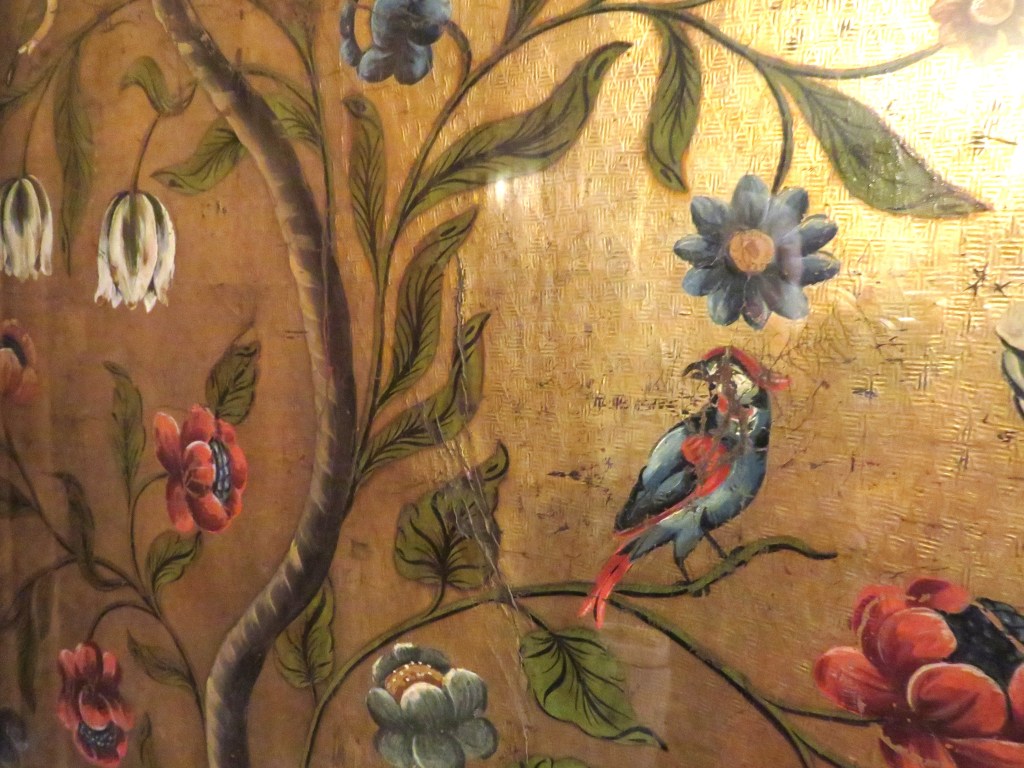
As ever, it is the quirky bits that catch my eye, so pottery dating from 420BCE; what is thought to be the earliest English terrestrial globe, made by Molyneaux in 1592 and believed to have been given to Henry Percy by Walter Raleigh; an ornate screen; Grinling Gibbons carvings; a portrait of Ralph Hopton, prominent in the Battle of Torrington story; a whole row of (probably replica) fire backs; some unusual chairs; an organ set in a door and some seventeenth century door handles, which I neglect to photograph. We also look at the kitchen block, , which is more to my taste, where there is an eighteenth century fridge and some incredibly heavy copper pans.

The 700 acre estate and deer park were landscaped by Lancelot ‘Capability’ Brown. We investigate the deer park. We see no deer but there are large numbers of Canada Geese and a few Egyptian Geese by a lake. The grounds also include many enormous sweet chestnut trees, an Ionic rotunda and a Doric temple but no Corinthian anything.

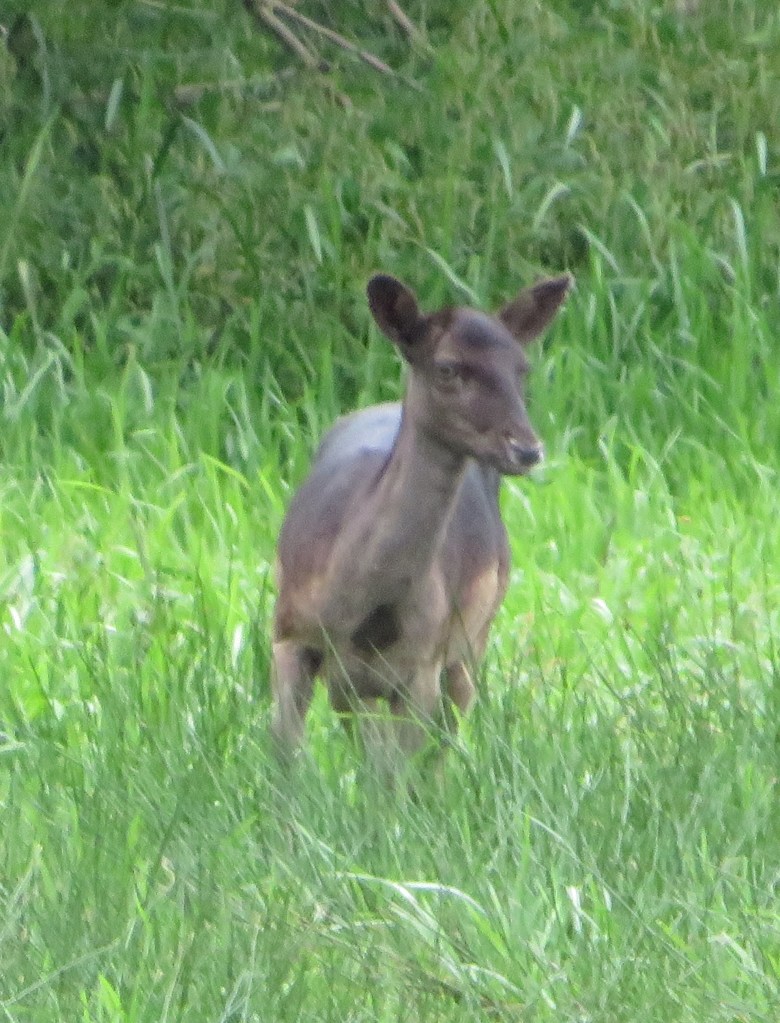
We had planned to visit Pulborough Brooks RSPB Nature Reserve on a different day but we had passed this on the way to Petworth, so it seemed sensible to call in on this day, as we had time, rather than come this way again. This is a good decision as we have plenty of time to see all that Pulborough has to offer. Unfortunately, they have run out of maps and I am never very good at working with photographed options. There is a distinct lack of signage and we could do with maps at strategic points but no. Nonetheless, we manage to find our way to the hide overlooking the not so wetlands. It is our usual kiss of death wildlife wise, not helped by some very loud chain-sawing in the vicinity. We see great tits, wood pigeons, many Canada Geese and a single heron and hear a wren (thank you Merlin app). Here though are the fallow deer that were conspicuous by their absence at Petworth. Some of these are the more unusual melanistic deer, with black coats. Recently re-introduced white-tailed eagles have been seen in the area and I do spot a couple of birds of prey that may or may not have been white-tailed eagles. Then it is back to the van via a fuel and shop stop at Brighton Marina, where we see the many windfarms out to sea.

What is on the Horizon?

Looming large, is the Devon Family History Society’s 50th birthday, sell-out, residential conference. My house is now crammed with goody bag items, raffle prizes and other paraphernalia. There is also the excitement of All About that Place, a ten-day, free, online event, when you can listen to nearly two hundred ten minute local and family history related talks. There’s one from me on Writing Women’s Stories, sponsored by Pharos Tutors. You can already here me chatting about researching women on the Journeys into Genealogy Podcast with Emma Cox. There is also one from Mistress Agnes, where she shares some of her medical advice from the seventeenth century. That one is sponsored by A Few Forgotten Women.

Then, because I am officially bonkers, at dawn on the day I am supposed to be starting to lead the team running the conference, I am doing a sponsored walk in aid of the Samaritans. Not bonkers to support such a great cause but the timing could have been better. If you can spare a few pennies in support of what is sadly a much needed service, you can Donate to Janet’s Dawn Walk here. Call 116123 if you are struggling.

Amidst all this there will be much welcome overseas visitors and more travel hither and yon. Watch this space.

Holidaying in Herefordshire Part 5

Today was the day that our luck with both the weather and the wifi signal in the van deserted us. Fortunately, the sat-nav had recovered from its hissy fit and was now working, This was just as well as we had to negotiate the city centre and my attempts to download a map were foiled by the demise of the wifi signal. I was not relishing using my phone as Google Maps and I are not friends.

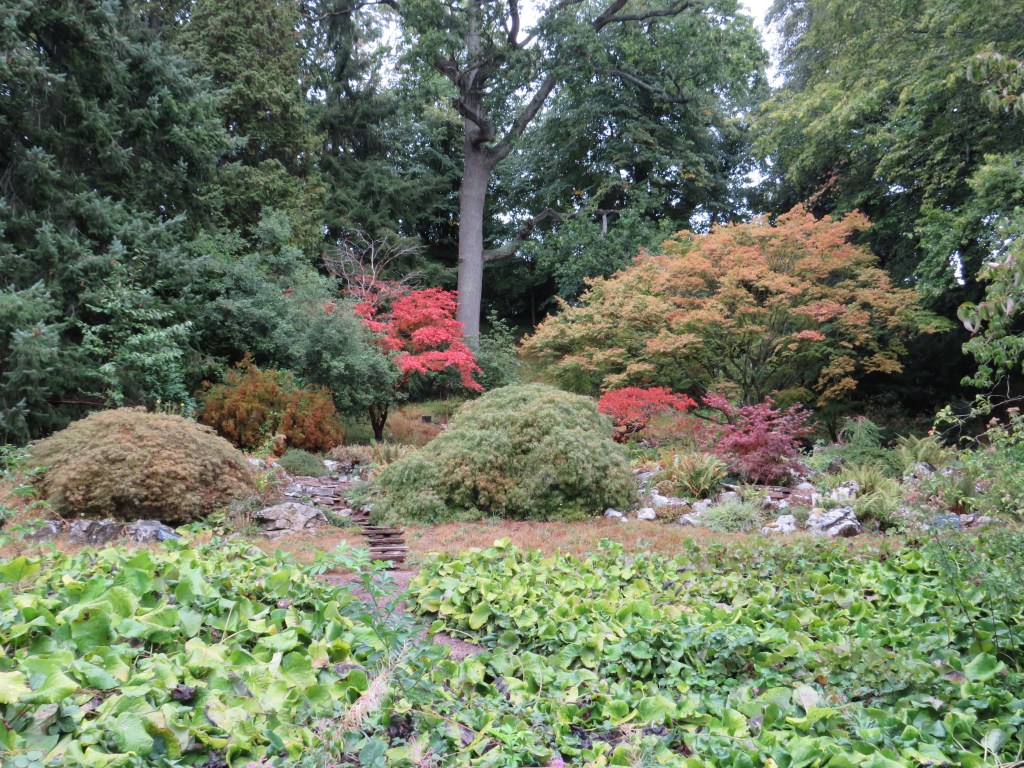
We waited until afternoon, so were able to look round the Weir Garden at Swainshill, on the road to Hereford, in just a light drizzle rather than a downpour. The first record of this riverside, woodland gardens was in 1673 but Roman remains have been discovered on the site, including an octagonal cistern, thought to be a shrine to water nymphs. Given the scale of these remains, it is thought that this was probably just a bath house, rather than a dwelling. In the eighteenth century, a typical ‘picturesque’ garden was designed, in consultation with Humphrey Repton. As well as the woodland walk, there was a walled garden to explore, which dates from this period. This part of the garden is walled on only three sides to maximise the sun.

Part of the reason for why Herefordshire? Why now? Was a Fisherman’s Fiends concert, which was being held at the Amp, in the car park of an arts venue called the Courtyard. This is basically a huge circus tent, with massive tent pegs driven into the car park’s tarmac. Given that the venue now had no car park of its own, we’d been directed to a nearby public car park. I’d received numerous emails about arriving early and with a sell out 1400 capacity venue, I was concerned about securing a parking space in the designated car park. Our plan was to get ahead of the rush by driving in early, securing a parking space and then find somewhere to eat before the show. Finding the car park was not the issue, it was right by the football stadium and you are going to be ahead of me here, therein lay the problem. I still think it is ridiculous that the football season starts in August but we made the mistake of arriving before the home game had finished. The car park was rammed, with cars parked in ridiculous places as well as in actual spaces. We retreated gracefully.

Plan b was to drive a little way out of the city and find a pub with a car park that served food all day, as it was 4pm, so not traditional food serving time. Just to the north, we came upon the Swan at Aylestone and were able to consume vegetarian lasagne and toffee sundae (me) and scampi followed by apple pie (Chris). We headed back to the car park as the football fans were leaving, somewhat disgruntled as their team had lost. Apart from a bit of a wait for a gap in those leaving the car park to enable us to get in, there were no problems.

Once at the venue, the predicted long queues for security were non-existent, ok so we were still VERY early. The only issue with the venue was the not very comfortable chairs and the humidity. Fisherman’s Friends were their usual brilliant selves. Then it started raining. We had noticed that it was quite damp underfoot but by the interval, it was clear that some sections of the audience were being rained on. The fact that the leaks were perilously close to lighting rigs was a little disconcerting. We were thankful not to be positioned under one of the leaks but it seems that people behind us a few rows back were and the car park on which the marquee was erected was on a slope. There was a veritable river rushing past our feet for most of the second half but it did at least seem to lessen the humidity.

Then, the following day, it was back home to ten days of mayhem before heading off on more adventures, so watch this space. Just whose idea was it to be away from three weeks in the six preceding a conference, when I am heading up the organising team?

Holidaying in Herefordshire Part 4

It always feels strange posting about trips away when I am safely back home but I don’t normally post in real time. This was the day that the sat-nav decided not to work; this was apparently my fault. Never fear, I can do old school with my trusty ordnance survey map. I could locate the day’s National Trust property of choice, in this case Croft Castle, although it was a little difficult to work out on which side of the large estate the entrance lay. We overshot it at the first attempt, as we were expecting a useful brown sign. It turned out there was a very small brown sign, totally obliterated from our first approaching direction due to an overgrown tree.

We’ve been really fortunate that, throughout our visit to Herefordshire, the weather has been a lot less rainy than forecast, so we decided to risk one of the parkland trails. Not wishing to push our staying dry luck or our stamina we opted for the shortest, brown trail labelled Fishpool Dingle ‘Picturesque’ Walk. We wondered if ‘picturesque’ was going to be doing some heavy lifting here. Apparently, the eighteenth century ‘picturesque’ movement was a contrast to the pastoral naturalisation beloved of Capability Brown. This ‘gothic paradise’, complete with grotto viewpoint, was created in the Fishpool Valley in the late eighteenth century. It was a very pleasant woodland stroll, where we could see some industrial heritage include a restored medieval dam, a lime kiln and the ‘gothic’ pump house, dating from about 1800, which housed the water wheel and pump that provided the castle with water. There was also the remains of a charcoal burning platform; the charcoal was then used to fire the limekiln. There was a profusion of blackberries and elderberries as well as some birds including blackbirds, robins, great tits, a wren and woodpigeons. According to Merlin, we could hear a goldcrest, a chiff chaff (one I can actually just about recognise for myself) and a greater spotted woodpecker.

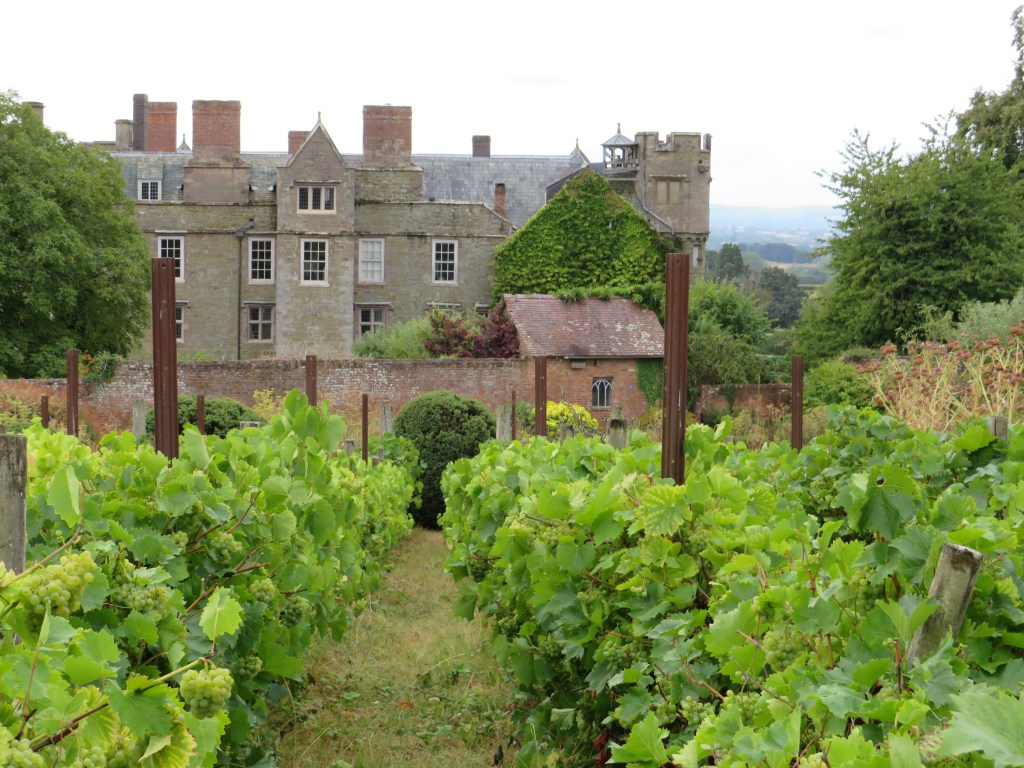
A brief pause for refreshment next and as none of the cake on offer appealed, today we were ’forced’ to consume caramel Magnums instead, no hardship there. Continuing to ride our ‘it is still dry’ luck we next explored the walled garden. The walls round the two acre plot were built in 1801; there were plenty of grapevines in evidence. The whole garden covers nine acres. This is managed by just two paid gardeners, supported by volunteers. Whilst most of the gardens and woodland looked positively autumnal, there were carpets of miniature cyclamen outside the walled garden, which I would normally expect to see in early spring.

We then looked at St. Michael and All Angels Church, which was the Croft family’s chapel but was also open to parishioners. This was built in the mid-fourteenth century, extended early in the sixteenth century and re-dedicated in 1515. There was a partial rebuilding in the early seventeenth century. The church includes Sir Richard Croft’s ornate tomb, which dates from the fifteenth century, Sir Richard fought on the side of the Yorkists in the wars of the Roses and was the treasurer for the household of Henry VII.

The Croft estate was founded about 1055 and a motte an bailey castle was erected by Bernard de Croft aka Bernard the Beaded, who was a Norman who had arrived in the reign of Edward the Confessor. Croft was part of the chain of Norman castles intended to protect the Welsh-English border. The fifteenth century Crofts descended from Owen Glyndower. In 1544, Sir James Croft was one of the leaders of the Wyatt Rebellion, which was a protest against Mary Tudor’s proposed marriage to Philip of Spain. Croft was pardoned, served Elizabeth I as Comptroller of the Royal Household and was buried in Westminster Abbey. James’ son, Edward, was accused of casting spells to bring about the death of Elizabeth I’s favourite, Dudley, in 1588. Royalist, Sir William Croft was killed during the English Civil War. The then Castle was deliberately demolished so it could not become a Parliamentarian stronghold. His brother, Herbert Bishop of Hereford, rebuilt the castle as a home, rather than a defensive structure.  It was sold to the Johnes family in 1746 and they did further alterations. In 1780, Thomas Johnes II inherited both Croft and Hafod, which is an estate near Aberystwyth. He spent a fortune on Hafod and had to sell Croft in 1799 to pay his debts. Further remodelling took place in the 1910s, when the Kevill-Davies family owned the Castle, which was at that time tenanted. In 1923, after an absence of over 170 years, the Croft family bought the Castle back.

The increasing efforts by the National Trust to be both family friendly and inclusive were in evidence. Here there were 3d printed ‘touchable’ objects and there was a Wyvern trail to follow. There were several objects that particularly appealed including a wall hanging made by staff, volunteers and visitors in 2018 to commemorate the Representation of the People Act, which gave women the vote; a slice from the tree under which Sir William Croft was killed at the Battle of Stokesay in 1645; some 1760 fireplace tiles by Sadler and Green; a seventeenth century stump-work box; a small fabric collage of the castle and an inlaid table displaying many semi-precious stones.

The return journey was relatively uneventful, although we did overshoot the final turning. We should have been alerted by the pervading smell of guano, as farmers near the site have been spreading fertilizer over the past few days.