South-eastern Sojourn Part 1

Yes, we’ve been away again, this time to Sussex and Kent. These are both counties I’ve visited before but extended visits were in childhood, so it was time for a return as part of the ‘Let’s visit every county in England’ campaign, to which I’ve now added and visit at least one National Trust property and one English Heritage property in each, meaning that I may just have to revisit one or two. You’ve had to wait for me to be back in the land of decentish WiFi for me to post this, so, as ever, these are not real time adventures.

Day 1

Having already cut two days off our holiday to accommodate the fitting of a smart meter at the home of the fisherman of my acquaintance, we knew that we were unable to leave as early as we might have liked. This smart meter has been somewhat of a bone of contention. Having been pestered to have one and refusing for many years, this has now become a necessity in order to benefit from the feed-in tariff from his newly installed solar panels. He’s been trying to get an appointment since April. Having muttered the word Ombudsman, an appointment  was finally arranged for what should have been two days into our latest trip. Fortunately, it was the sort of trip where two days fewer was a possibility and as the appointment was for ‘between 8 and 12’, we could get to our destination afterwards, or so we thought. They also promised to message half an hour before arrival. At 11.45, with no sign of said message, we ring to be told that they are unable to guarantee that they will come at all today.

After a great deal of gnashing of teeth, we set off at 1.45pm, with still not a meter man in sight. By this time, it is touch and go whether we will arrive at our chosen site in time to get a pitch before they close at 8pm. Fortunately, this is a site where there is an area where late night arrivals can pitch but this might mean we can’t get onsite until 1pm tomorrow, which would impact on going out for the day. As we leave, the sat-nav, which knows we are towing a caravan, thus limiting our speed on motorways to 60mph, reads 7.22 as an arrival time. The route means encountering the car park known as the M25 at rush hour. There is also the issue of whether we can do a five and a half hour journey without a comfort stop. A 7.22 arrival was always going to be a big ask.

Given the nature of the journey, we do well. There are some sections where we can make up time, which compensate for the parts where we are delayed. The last few miles, through the centre of Brighton, take a disproportionately long time; there are an awful lot of traffic lights in Brighton. We managed to avoid stopping for fuel or comfort and arrive at 7.25. Very hungry and in need of said comfort but in time.

Our site at East Brighton Park is, as the name suggests, on the eastern edge of Brighton and nestled in the shadow of the South Downs. It must be popular as we are allocated the last vacant pitch, fortunately, it seems to have a WiFi signal, so I am happy.

Day 2

We are blessed with a lovely sunny day and set off for Petworth House, today’s National Trust property of choice. I follow along on the map as usual, as we enjoy the views over the downs and travel up the Adur Valley. Here, we are close to the ancestral villages of Steyning and Henfield but I’ve visited before, so have put family history to one side for this holiday.
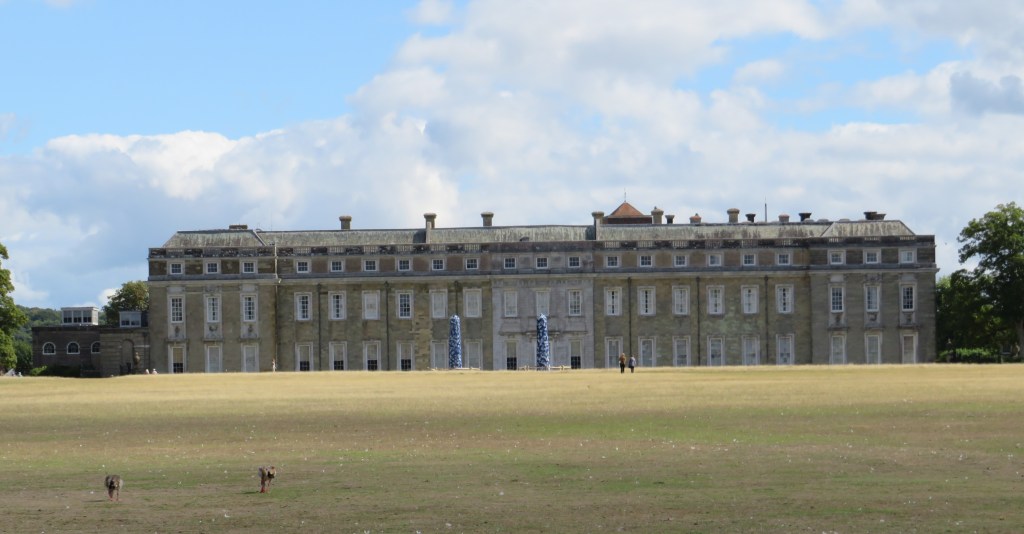
It is difficult to describe my reaction to  Petworth House. It is still a private residence and the portion that is open to the public was built as a Baroque show-home in 1688, designed to impress visitors and house an extensive art collection, rather than to be lived in. Impressive yes, overwhelming yes and definitely over the top. It was interesting but I am not especially fascinated by works of art, even though these include those by Lely, Van Dyke, Turner, Reynolds, Gainsborough and Titan. There are also nearly a hundred marble sculptures, most of which are huge. We also see a temporary exhibition ‘Expressions in Blue’ with more massive, mostly blue, modern pieces, by English artist Felicity Aylieff, inspired by Petworth but made in Chinese porcelain factories. These include two in the grounds that are about five metres tall. Petworth’s incredibly high ceilings, almost all of which are undecorated, help to accommodate all the large-scale artwork. My preference is for more homely properties. So in summary, yes I’m glad we went but it wouldn’t be high on my list for a revisit; others will feel differently of course.

As the focus is on the art collection, trying to find out more about the history of the building itself and its owners is quite difficult. The site has 900 years of history and the current building replaced a fortified manor house. There are traces of earlier building, notably the fourteenth century chapel, with heraldry abounding. The estate was given to Joscelin of Louvain in the twelfth century by his sister Adeliza, consort of Henry I. Louvain married a Percy heiress and took her name. They were the progenitors of the Earls of Northumberland, who held Petworth as their seat in the south for centuries. The Percy family’s Catholicism was unpopular during the Reformation and its aftermath. The 7th Earl, Thomas Percy, did not exactly endear himself to Elizabeth I when he sided with Mary Queen of Scots and led the Northern Rebellion, which aimed to replace Elizabeth with her Catholic cousin Mary. Understandably, Thomas was executed, although Elizabeth I agreed that his brother, Henry, could inherit as long as he stayed in the south at Petworth, where she could keep an eye on him.

In 1670, the 11th Earl, Josceline Percy, died without a male heir, so the estate passed to his daughter, Elizabeth. Elizabeth, although only sixteen, had already been widowed twice and her third husband was Charles Seymour, 6th Duke of Somerset. It was they who built the current house in 1688, although there were some alterations in the 1870s, overseen by the architect Salvin.  In 1750, the estate passed to the Wyndham family.

As ever, it is the quirky bits that catch my eye, so pottery dating from 420BCE; what is thought to be the earliest English terrestrial globe, made by Molyneaux in 1592 and believed to have been given to Henry Percy by Walter Raleigh; an ornate screen; Grinling Gibbons carvings; a portrait of Ralph Hopton, prominent in the Battle of Torrington story; a whole row of (probably replica) fire backs; some unusual chairs; an organ set in a door and some seventeenth century door handles, which I neglect to photograph. We also look at the kitchen block, , which is more to my taste, where there is an eighteenth century fridge and some incredibly heavy copper pans.

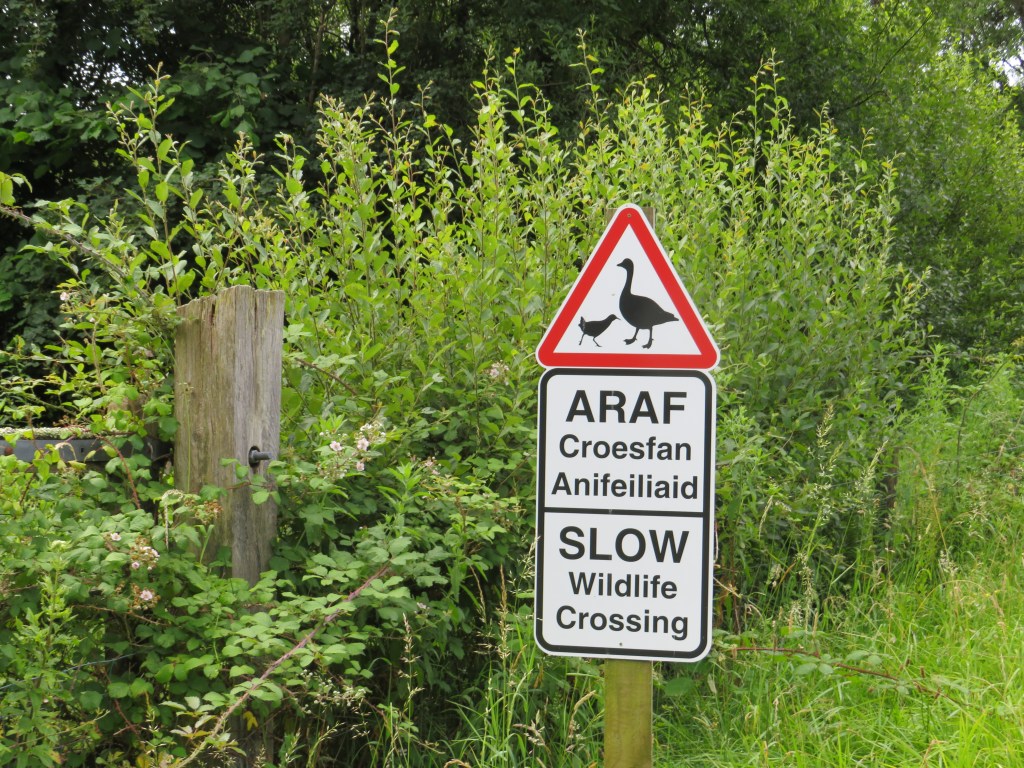
The 700 acre estate and deer park were landscaped by Lancelot ‘Capability’ Brown. We investigate the deer park. We see no deer but there are large numbers of Canada Geese and a few Egyptian Geese by a lake. The grounds also include many enormous sweet chestnut trees, an Ionic rotunda and a Doric temple but no Corinthian anything.

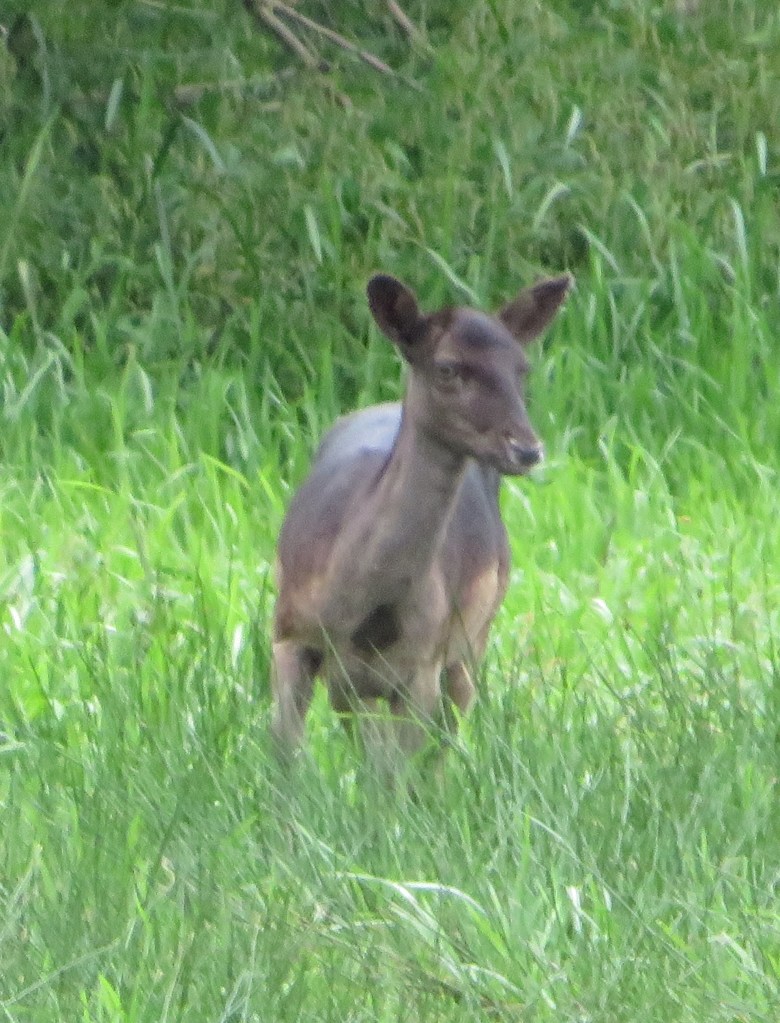
We had planned to visit Pulborough Brooks RSPB Nature Reserve on a different day but we had passed this on the way to Petworth, so it seemed sensible to call in on this day, as we had time, rather than come this way again. This is a good decision as we have plenty of time to see all that Pulborough has to offer. Unfortunately, they have run out of maps and I am never very good at working with photographed options. There is a distinct lack of signage and we could do with maps at strategic points but no. Nonetheless, we manage to find our way to the hide overlooking the not so wetlands. It is our usual kiss of death wildlife wise, not helped by some very loud chain-sawing in the vicinity. We see great tits, wood pigeons, many Canada Geese and a single heron and hear a wren (thank you Merlin app). Here though are the fallow deer that were conspicuous by their absence at Petworth. Some of these are the more unusual melanistic deer, with black coats. Recently re-introduced white-tailed eagles have been seen in the area and I do spot a couple of birds of prey that may or may not have been white-tailed eagles. Then it is back to the van via a fuel and shop stop at Brighton Marina, where we see the many windfarms out to sea.
Holidaying in Herefordshire Part 1

Day 1

Another month and another recent short trip away in the pursuit of our aim to stay in every English county. The county of choice this time was Herefordshire. In the hope of dodging the rush hour traffic, I left earlier than I needed to join Chris and the caravan. Dodge the traffic I did but instead I had to cope with blinding early morning sun for much of my journey. That accomplished, after a short wait so we didn’t arrive before check in time, we were on our way. Somehow along the way my phone screen went black. The phone was working as I could ring myself up using Chris’ phone but a blank screen. Apart from a few slow patches, the journey was uneventful and we arrived just as the site was open for new arrivals. We were staying about eight miles north west of Hereford. I had cunningly noted which pitches had the best wifi coverage but unfortunately these were not the sort of pitch that we had booked and I anticipated the need to stand on one leg under a tree to get reception.

Once on site there was good news. Once I was in the shade, I could just faintly see my phone well enough to increase the brightness and all was well. There was also one bar of wifi from the van so I was content. Not that I wanted to spend all day online but I did have the job I must not mention to do, as well as a conference to organise. Once set up, we sat in the sun and read (me) or fell asleep (Chris). I was determined to get to the end of Philippa Gregory’s Normal Women at the second attempt. It is excellent but huge and as an inveterate footnote reader, I am mildly irritated by the fact that the footnotes are only available online. I do appreciate that the book is on the cusp of too many pages without its fifty-four pages of footnotes but still.

Day 2

I was torn between wanting it to be dry, at least during the day, while we were away and wanting it to rain at home to keep my plants alive. Of course it could do both but that might be too much to hope for. As it was, the forecast for Hereford was decidedly wet for the rest of the week, so in a hurried rearrangement of our itinerary, we opted for the most outdoorsy option and headed to Bodenham Lakes nature reserve. As usual, I followed our route on my ordnance survey map. Predictably, the land was parched as it was at home and there were signs of autumn, with ripe blackberries, rosehips and falling leaves. This part of the county contains several orchards and there was soft fruit growing in evidence, as well as Hereford cattle and traditional timber-framed buildings. The precise location of the reserve is not marked, so we were relying on the sat nav, which can be notoriously unreliable with rural postcodes. Spying a blackberrying local, we asked for directions. It turned out we were almost there and said helpful local advised us to park by the church to avoid having to pay to park. Despite feeling that we should probably make a contribution via our car parking fee, we did park by the church, which means we could see the interesting remains of the market cross and the cross well.

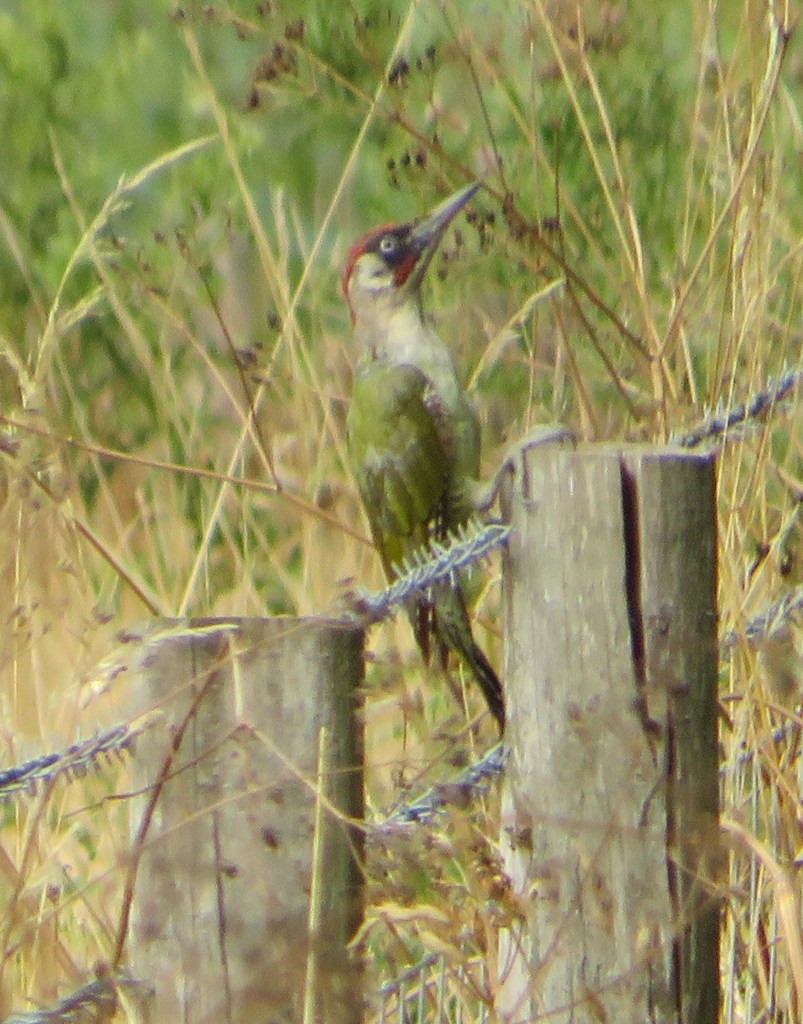
It is an interesting reserve and having been directed by another helpful local, we paused in a couple of hides. For those who are interested in birding, our observations were: Canada geese, Egyptian geese, Greylag geese, mute swans, coots, a wood duck, mallards, a moorhen, cormorants, grey herons, little egrets and a great-crested grebe.  Away from the lakes, we spotted woodpigeons, crows, a magpie and a green woodpecker who posed for a photo, although was a long way away, so I had to use full zoom. Thanks to the Merlin app, I also heard dunnock, robins, blue tits, great tits and long-tailed tits.

On the way back to the car, we did have a quick look inside the church. Judging by the fact that everything was draped in cloths, they have bats in residence. Back to the van to avail ourselves of the facilities, have lunch and a quick sit in the sun. Once it got a little cooler, we headed to nearby Staunton on Wye, planning a short stroll along the  Wye Valley Walk, which shares its course with the Three Rivers Ride. Normally, having already walked round the reserve, we’d have done this on a different day but mindful of the weather forecast, this was the day. Staunton on Wye is a bit of a misnomer as it is at least two miles away from the river. The Wye Valley Walk is also some way from the river bank. Having looked at the map, this wasn’t a surprise but I was hoping for more than one very brief glimpse of the river. We did hear a woodpecker, both on our outward and return walks but failed to spot this one.

We called in at Oakhurst Fam Shop, that was en-route, looking at ‘the taste of Herefordshire’ and other goodies that were on offer. I am sure this was all very good quality and there were some lovely non-food items but the prices were eye-watering. The wifi had deserted the site at lunchtime but the one bar returned by evening.

Green woodpecker taken on full Zoom from 200 yards away.

Llanelli Wetlands – so good we went there twice

There were plans for three out of the four days of our stay, so a decision had to be made about what to do with the spare day. We are aware that there are parts of the country we’ve never been, so places have to be particularly special for us to be thinking of a return visit. With that in mind, we are unlikely to stay in this area again, so I chose a return visit to the wetlands to see the section we didn’t have the energy for last time. Today we are exploring the Millenium Wetlands, totally different from what we have already seen. This section is almost devoid of people and we pop in and out of various hides to see what we can see. I am making full use of the Merlin app, which tells me what I can hear, so I am counting those on my list. Excited to have very nearly but sadly not quite, been quick enough to photograph a chiffchaff, of which, Merlin tells me there are a great many, chiffing and chaffing away. List below for bird fans as usual.

The café was an obligation of course and then a hunting for something even more elusive than a rare bird, the lesser spotted and endangered species that is a bank of a specific variety. We establish the address and ask Sally the sat nav to take us to the nearest car park. Just a shame this car park is no longer operational. We find on-street parking, for one hour only, the bank, says Google maps on my phone, which has very little battery due to all the bird identifying, is a seven minute walk away and we safely locate it. This branch of this bank is due to close in a couple of months due to ‘nobody using it in the afternoons’. It is afternoon. We spend 40 minutes there during which time two harassed staff try to cope with at least two dozen nobodies, all with less than straightforward queries. In the end we give up waiting and rush back to the car just as our allotted hour expires.

The afternoon is spent using the one bar of wifi to try to uncover the story of a bigamist. Yes I know I said this was, unusually, a no family history trip but I fell over this in the process of solving a totally different query that popped into my inbox.

Birds seen: Goldfinch, Chiffchaff, Blackcap, Egret, Moorhen, Mallard, Blackbird, Jackdaw, Wood Pigeon, Great Tit, Black-backed Gull, Shelduck, Yellow-billed Duck, Re-breasted Goose, White-winged Wood Duck, Bufflehead, Snow Goose, a Puss Moth caterpillar and a Slow Worm (yes, I know the last two aren’t birds).

Llanelli Wetland Centre

A short drive along the northern shores of the River Lougher and we are at the Llanelli Wetland Centre. We have a lovely wander round, popping in and out of various hides and unlike many of our forays to see wildlife, we do see a wide variety of wildfowl. The list is below if anyone is interested. There is also a distinct and pervading smell of cannabis at one point, although no other people are in view; very strange. Although much cooler than of late, it is a little on the cosy side and we repair to the café – hurray, coffee in sensible shaped mugs again. I was a bit disappointed to realise that we had actually only seen half of what was on offer but it really was too hot to walk another three miles or so round the other paths. The only negative was that they no longer supply paper maps. I do understand the need to save trees but I really can’t be doing with following a map on my phone. If it is big enough to read then I can’t see enough of it to work out where to go next. It would have helped if there were more copies of the map in places around the site. Note to self to print the map in advance if we ever come again to do the other half.

Then it is back to the van for a lazy afternoon. The adjacent Country Park is hosting Armed Forces Day, so we can hear military bands and World War 2 songs in the distance.

In the evening, we stroll towards the Country Park. This was formerly the site of a munitions factory. In 1881, the Explosives Company, based in Stowmarket, Suffolk, dredged the harbour, which allowed ships to bring in necessary construction materials. There were several tragedies, including an explosion in 1882, that killed seven workers, the youngest being thirteen and a fire the following year. There were further fatal explosions in 1917, 1920 and 1922. In 1914, a Glasgow Company set up a TNT factory on the site. At its height, during the First World War, there were over 6000 employees in the two factories, the majority of whom were female. Although munitions production closed in 1935, with a convalescent home utilising the buildings and the land becoming a camp for the children of unemployed miners, as the Second World War dawned, production restarted and more fatalities ensued. The factory finally closed in 1963, with the Park opening in 1980.

Rook, Mallard, Mute Swan, Black-backed Gull, Black-headed Gull, Coscoroba Swan, Australian Wood Duck, Blackbird, Wood Pigeon. Shelduck, Crow, Barnacle Goose, Chestnut Teal, Graylag Goose, Canada Goose. Moorhen, Magpie, Red-breasted Goose, Scaup, Snow Goose, Black-necked Swan, Sedge Warbler. The last one was heard only and I’ll fess up I can’t tell a sedge warbler from any other kind of small brown bird and in this case, we only heard it. I’m hopeless at birdsong too but this identification came aid of an app.

Up the Garden Path 17

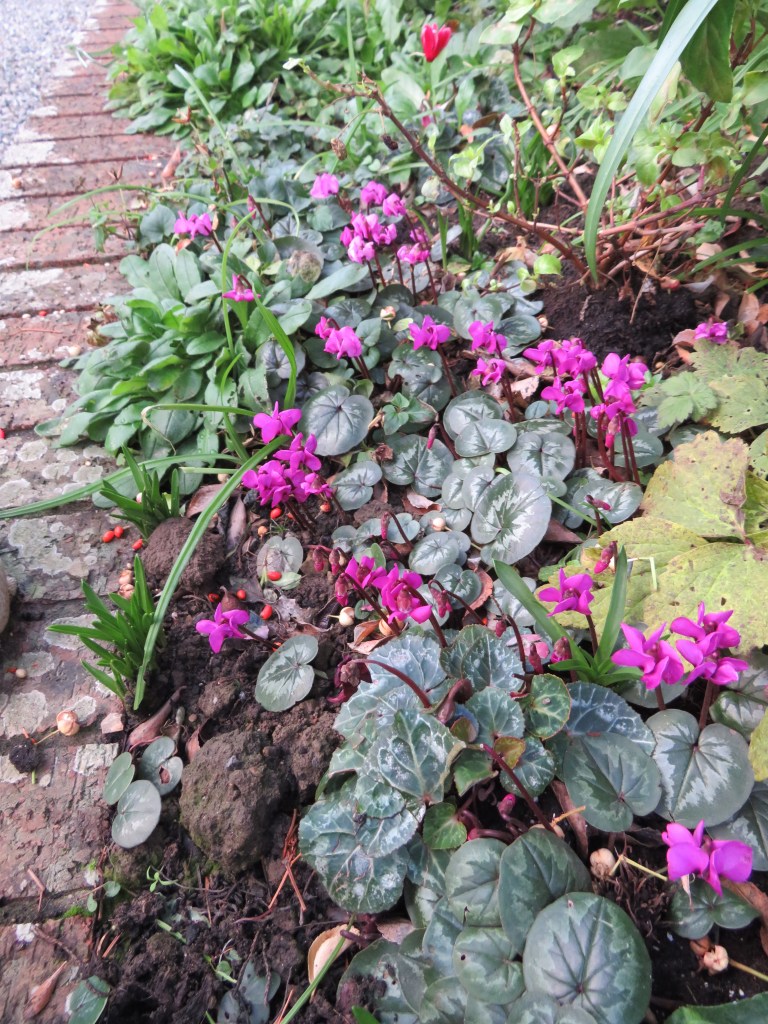
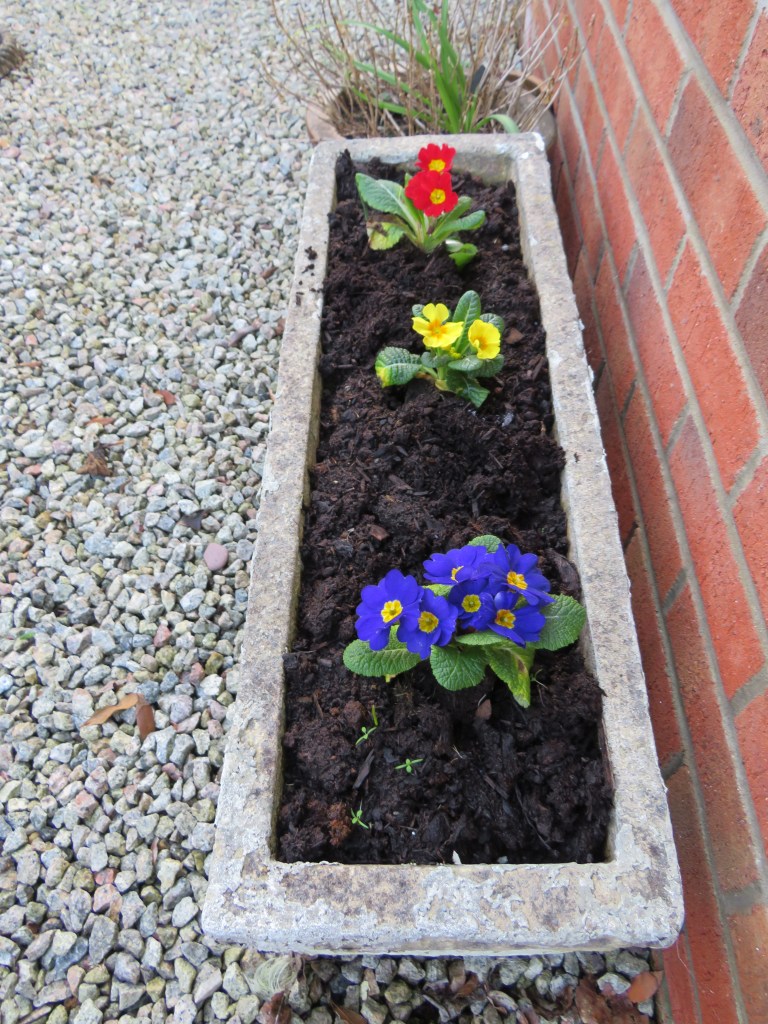
We’ve not been up the garden path for a while because it has been winter and I am not a winter gardener. There have been some minor changes. I’ve planted some bulbs in troughs. I was a bit late doing this and they aren’t showing yet, although others in the garden are coming through. I’ve tried yet again with snowdrops and ended up buying some already in flower. The jury is out on whether they will reappear next year. The bulbless troughs looked a bit bare, so I’ve popped some bright primulas in as well. Otherwise it has mostly been a case of syphoning out the ’pond’ (aka old Belfast sink) when it gets overfull and on a couple of occasions, breaking ice on the bird bath.

The birds get fed regularly and I have glimpsed blue tits again a couple of times, after an absence of several months. In the hope of enticing them back, I’ve got a new bird feeder that allows small birds in and keeps the bullies out. Sadly, the garden has its far share of large birds, with magpies, woodpigeons and jackdaws being daily visitors with herring gulls and rooks joining the party. Don’t get me wrong, I like to see any kind of birds but some more smaller ones would be lovely. Sparrows nest in the hedge and there’s been a wren bobbing about, as well as blackbirds, although I am missing the robin who hasn’t been seen for a while. As soon as temperatures reach double figures on a day when it isn’t raining, I will be out tackling the weeds. There are a great many growing in the cracks between the patio paving stones. I don’t want to repoint the gaps as then there’s nowhere for the rain to drain away.

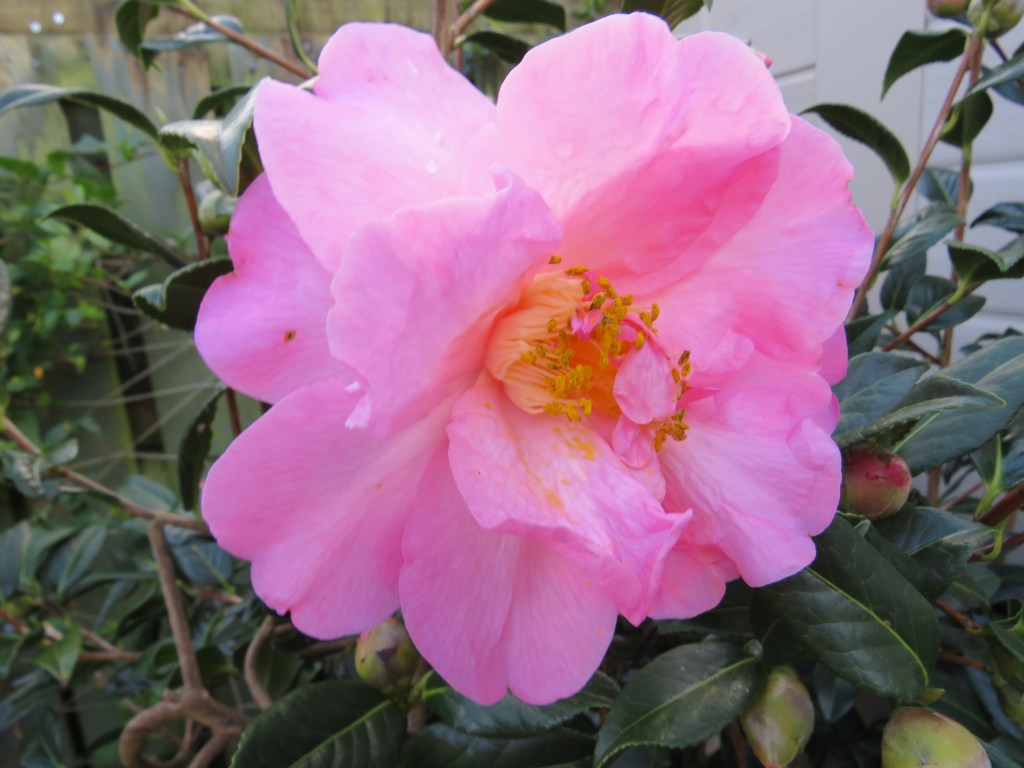
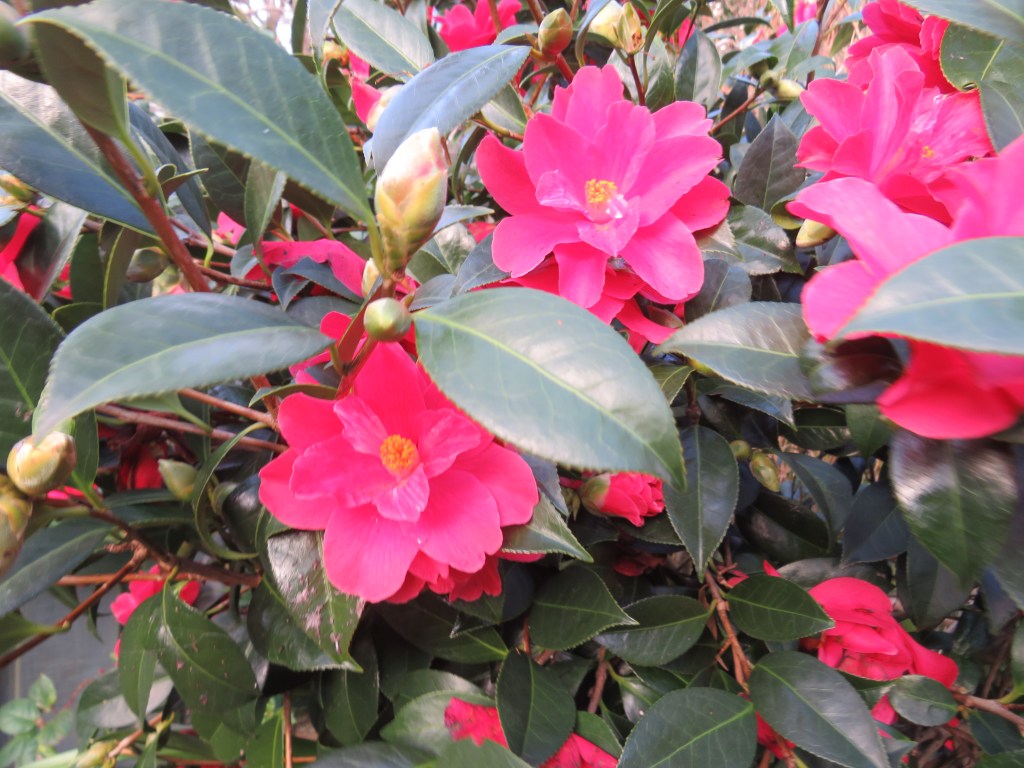
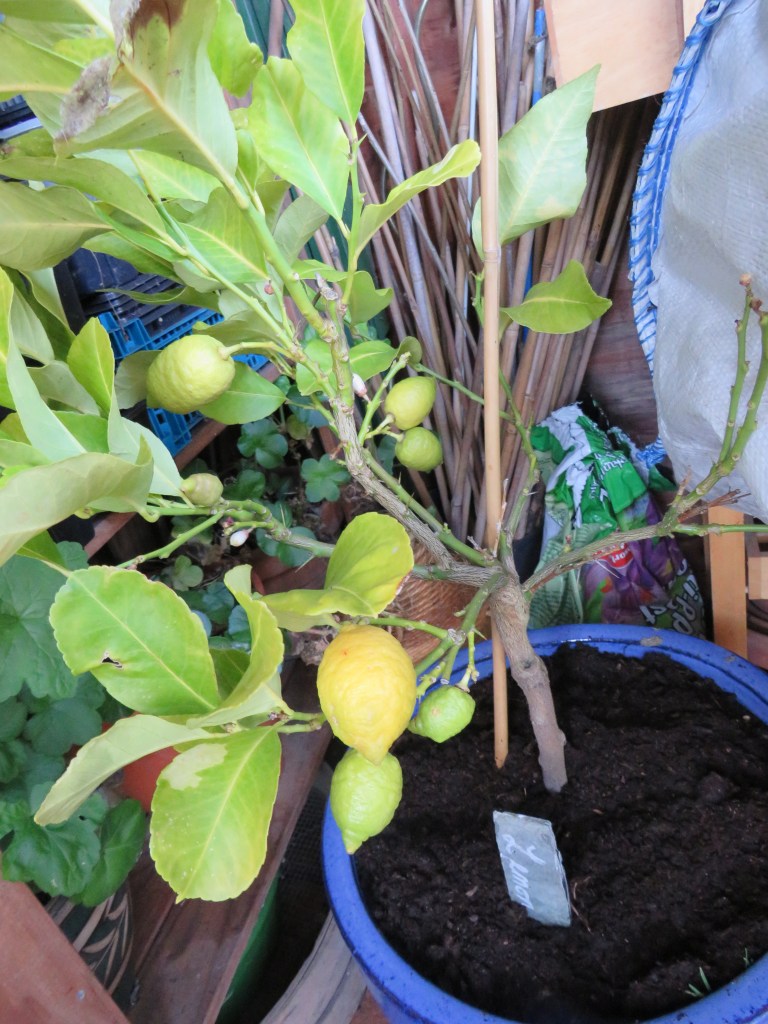
One good thing about this garden is that there is something in flower all the year round. At the moment, it is the Camellias that are the showstoppers, although there are a few other things as a supporting act. The lemon tree has been popped in the shed for the duration as advised. Roll on spring!

Up the Garden Path 2

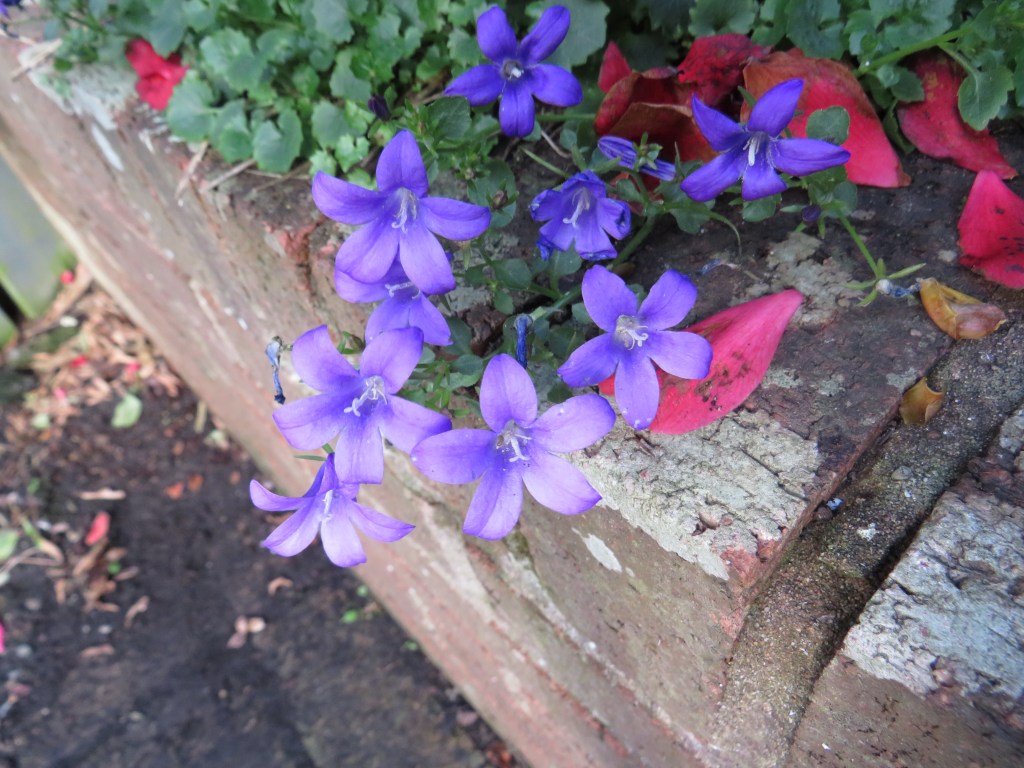
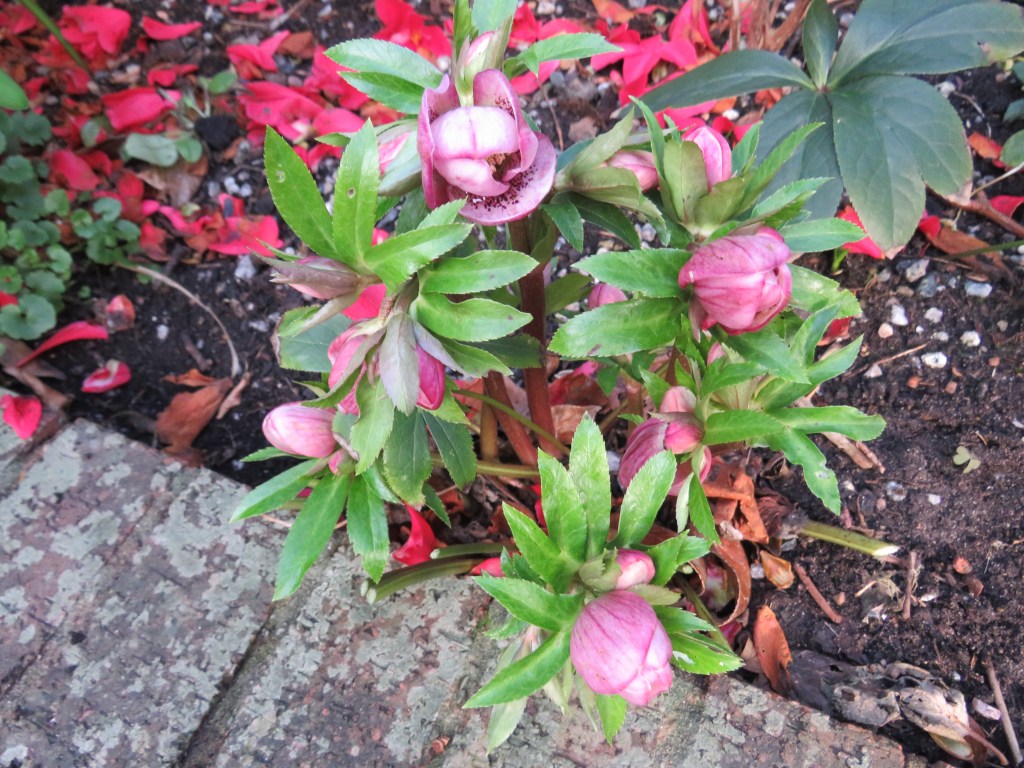
To be honest, it hasn’t really been the weather for fair-weather gardeners like me, or indeed any sort of gardener but yesterday the sun came out and the temperature was in double figures, so I ventured forth. The previous owner of my garden had left me numerous pots containing plants in various stages of liveliness and an eclectic selection of garden ornaments. I decided to triage these into ‘will keep’, ‘will humanely dispose of’ and ‘not sure yet’. Plant wise, there are more exciting finds as the year moves on; today’s included hellebores and miniature daffodils.

We began to trim back the winter jasmine, which is rapidly taking over the one flower bed. Other tasks for the afternoon were to deal with my many troughs of geranium cuttings which have been keeping warm in the summer house. Obviously not warm enough as about half are dead, or covered in what Mr Google tells me is powdery mildew. Sick plants were removed and what remained were rationalised into fewer troughs.

Next came the task of measuring the garden, in preparation for trying to draw up a plan. I decided to go for feet and inches, rather than anything metric as I still have to ‘translate’ metric measurements in my head. This was a test of my mathematical skills as my trusty assistant kept calling out the measurements in feet and inches, rather than just inches, which us what I wanted. Good job I know my twelve times table. The whole measuring thing was definitely not easy as I can’t actually reach some of my boundaries due to shrubbery and the many sheds. Added to that, the plot isn’t even remotely rectangular. Not only are there some funny angles created by the perimeter fencing but the garage and sheds are also not all set square. I have a load of scribbles and numbers but whether I will stand any chance of making it into a coherent drawing whose edges join up remains to be seen.

For those who are interested, very roughly, the plot is 35 feet wide by 22 feet deep, minus the space taken up by the conservatory and plus the extra space along the side between the bungalow and the house. One pretty much counteracts the other space wise. Note for some of my overseas readers, in the UK, a bungalow is a single story dwelling not a shack. If my maths is right, I have about 70 square yards, not, of course, at all the same as 70 yards squared! For those of you in foreign, about 58 square metres, which, unbelievably because it seems really tiny to me, is classed as a medium sized garden by the RSPB (Royal Society for Protection of Birds) when you submit your results for their great garden bird watch. By UK standards, particularly with a newer built property (mine was built in 2000), small gardens are the norm. On the subject of birds, I was concerned that this would be one thing I’d lack when I moved but I’ve seen eleven different varieties of bird in the garden (or viewed from the garden on neighbouring roofs or trees) so far in February, a similar number to the old garden, although very different regular visitors. Not bad considering the property had been empty for a fair while before I moved in, so, despite the bird table that was left behind, I doubt the birds had been fed here for over a year. The bird bath, another legacy from the previous owner, is very popular and that will definitely be staying.

This is a long-term project. Don’t expect swift progress!