Still with an eye on the weather forecast, we decided to go to Goodrich Castle on what was predicted to be the least worst day we had left. As things turned out, after some light drizzle first thing, the day was hot and sunny. Possibly a little too hot to be ideal and certainly humid but we counted this as a win. My inspirational, lower high school history teacher was a Mrs Goodrich, so even the castle’s name had positive connotations. We began with a recce of the shop and were pleased to learn of new a English Heritage initiative, which gives members discounts in the shop and café. It was also good to see the child-friendly free activities on offer. I was vaguely amused by the placement of an advert for English Heritage membership outside the toilets that read ‘Members go Free’.
We availed ourselves of an audio guide, which wasn’t the greatest success. Firstly, it read two different explanations simultaneously and then, even on full volume, it was ridiculously quiet, even for those of our party (that would be me) with good hearing. So this is what I gleaned from interpretation boards, with the usual proviso that none of this is checked for accuracy.
Godric Mappeson, for whom Goodrich is named, built the first castle on this site in about 1100 but none of this early castle still stands. The keep, that is the earliest part of the existing castle, was built by Richard de Clare about 1150. In the early years of the thirteenth century, William Marshall owned Goodrich, amongst many other properties. By the end of that century, Henry III had granted the rights to the castle to his half-brother William de Valence. French nobleman, de Valence, who was thus uncle to Edward I, built much of what remains today. Regarded as a foreign upstart by his neighbours, he set out to build an impressive and intimidating edifice, yet Goodrich did not have to defend itself against enemies until the seventeenth century. Instead, the castle functioned as a domestic residence, although most of its owners had properties elsewhere, so were not permanent residents. Unusually, the castle has stained glass windows, which reflect its domestic function. By 1326, the castle had passed into the hands of the Talbot family who were still in residence at the end of the sixteenth century. They were responsible for extending and improving the castle. Royalist, Sir Henry Lingen, held the castle during the English Civil War when the Parliamentarians held it under siege. The Parliamentarians had a special large mortar cast, ‘Roaring Meg’, which could fire 200lb shells and destroyed part of the castle, then the remainder was further demolished to ensure that it was beyond repair.
The approach to the castle is via two drawbridges; the first, at right angles to the moat, leads to the barbican. This was modelled on Edward I’s barbican at the Tower of London and is a D shape. The second drawbridge leads across the moat, which never had water in. As the latrines exited directly into the moat, the lack of water may have been an issue. Here at Goodrich, one of only a few portcullis mechanisms remains.
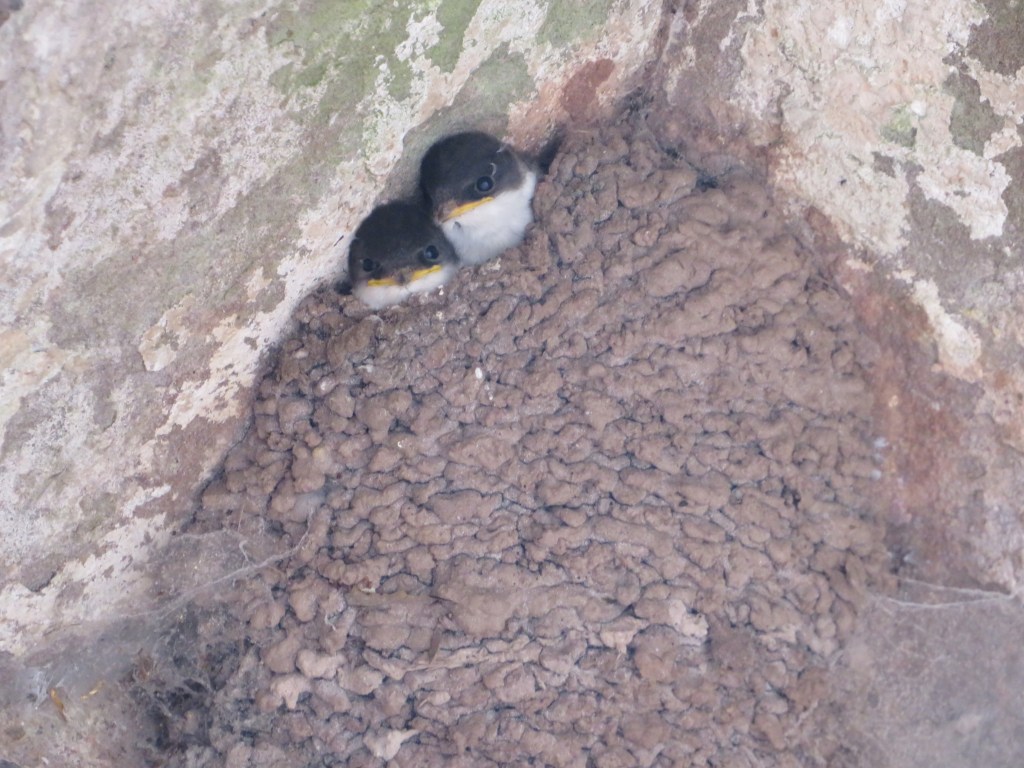
We stopped to admire the red stone castle and watch the many swallows and martins wheeling and diving, some still with young in their nests, constructed in out of the way nooks in the castle. Once inside, we found a way to reach the battlements that didn’t involve a perilous spiral staircase and were rewarded with lovely views across the Wye Valley.
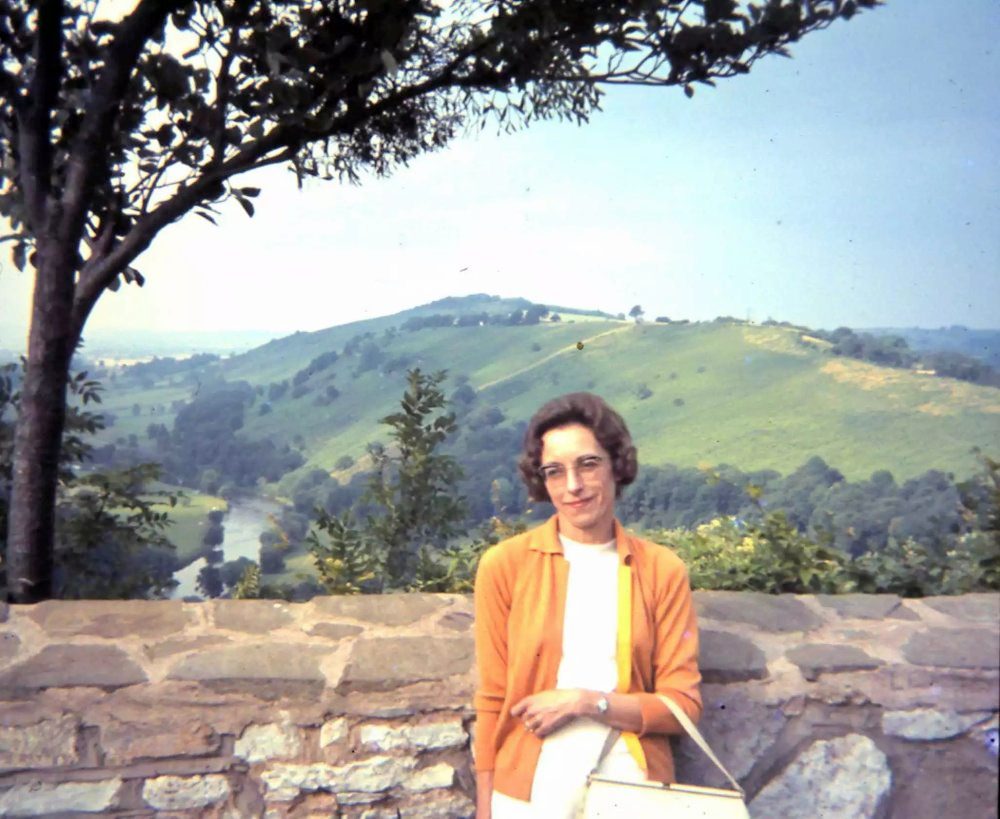
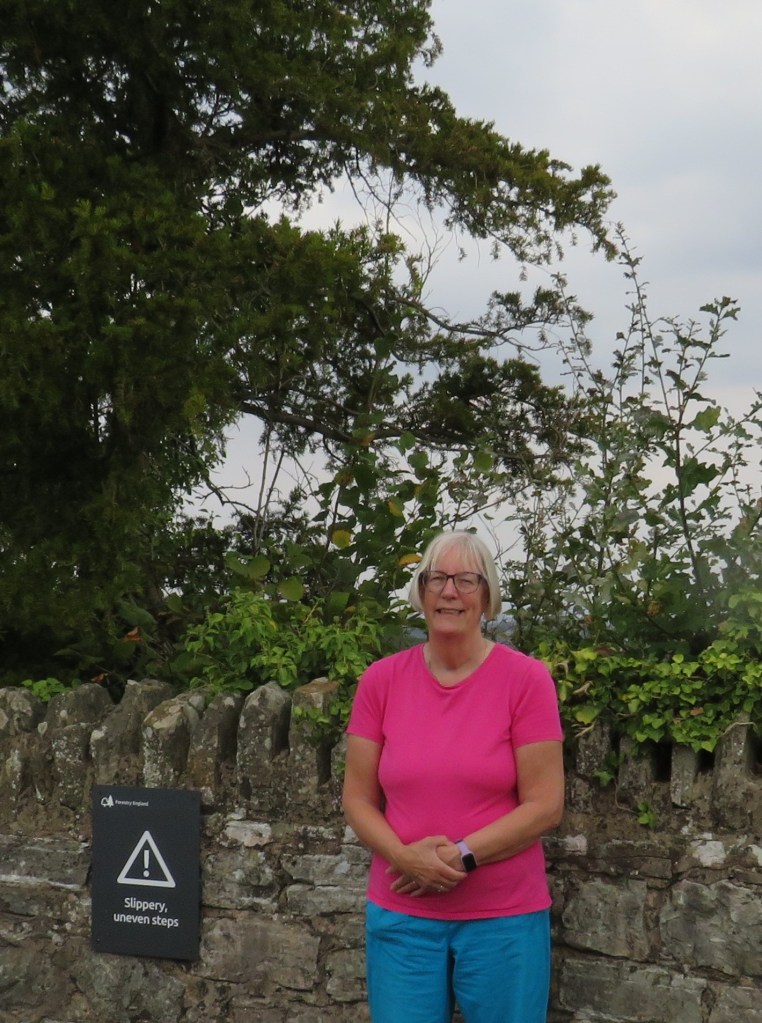
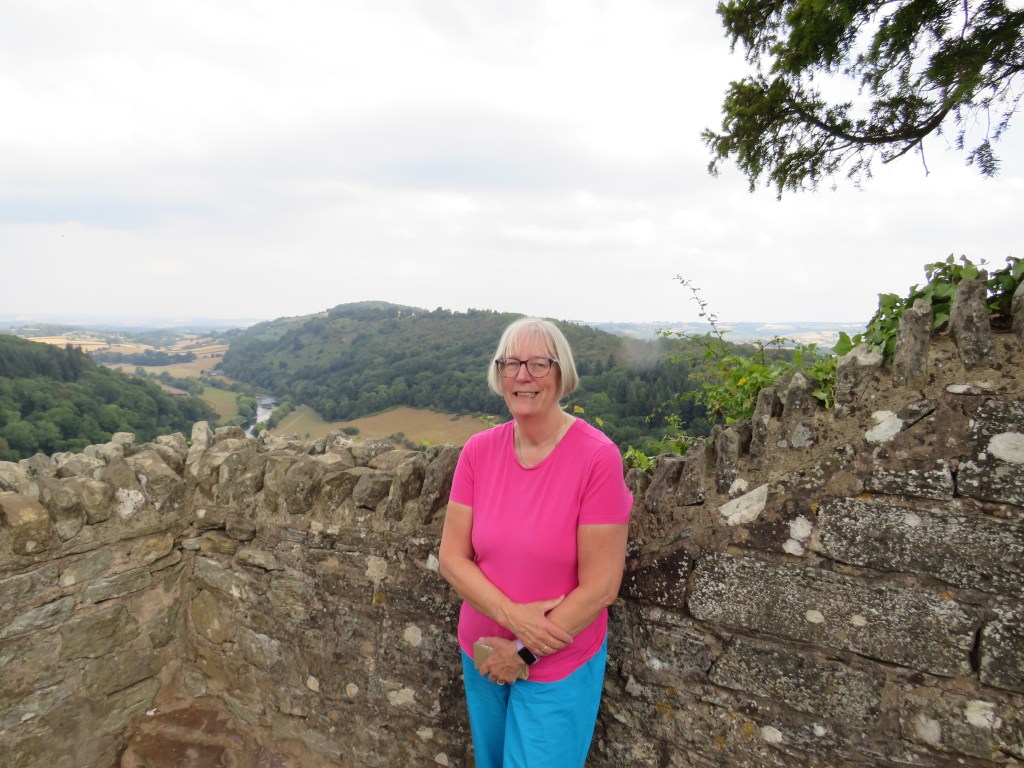
After some sustaining and very tasty passionfruit and lime cake we set off for nearby Symonds Yat. I had been here once before as a child, in 1968 and the only real memory was sparked by a photo of my mum taken at the time. I was hoping to be able to find the spot where it was taken. It seemed that the wall that she was standing by had been raised and vegetation growth meant that, what I think was the exact spot, no longer had a view but we took a photo anyway and also one a little further along, where you could see the view. Symonds Yat is the site of an Iron Age fort, built about 2500 years ago. It is thought to have fallen into disuse in the hundred years before the Roman invasion. It really was too hot to walk along any of the paths in the area, so we returned home via a supermarket stop.
There was a half hour delay through Hereford due to roadworks/volume of traffic and probably an accident, as three ambulances squeezed through the traffic to pass us. It got to 29 degrees in the car, which was less than pleasant. In the evening, we set off to meet a school friend at nearby Tillington. We went a fairly strange route as I had inadvertently put the wrong postcode in the sat nav but thanks to my map reading ‘skills’ we found the venue without much trouble. It is always lovely to catch up with people you haven’t seen for many years, in this case we think twenty-five and find we still have plenty to talk about.
 The History Interpreter - Janet Few