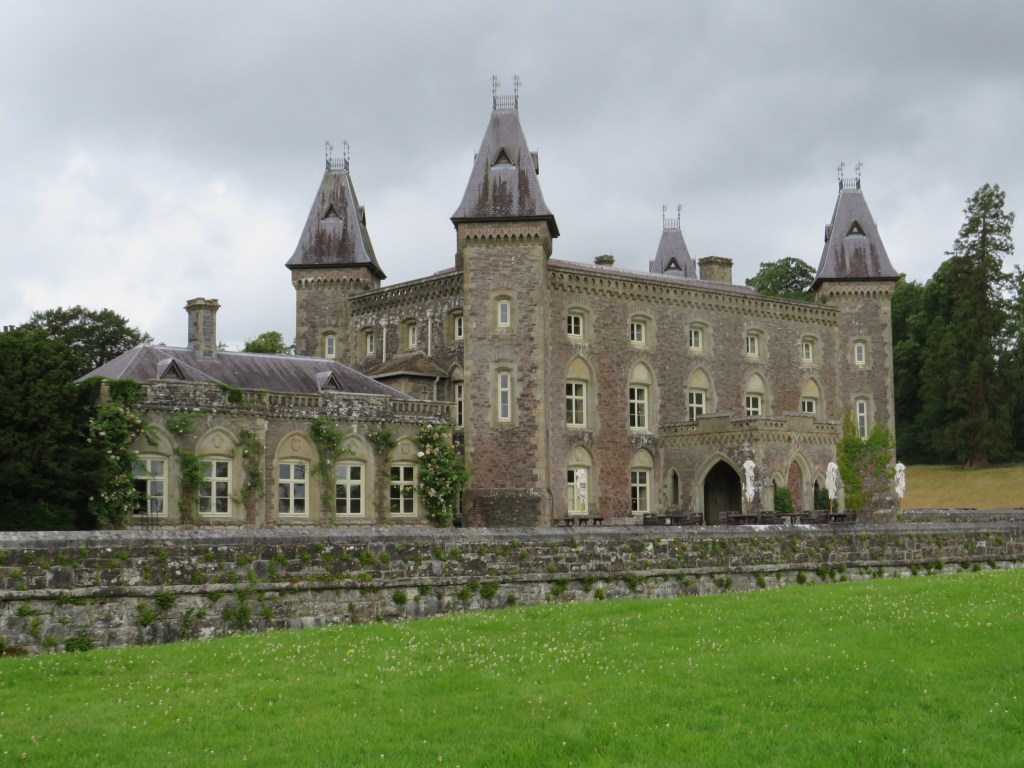
It always feels odd uploading holiday posts once I am safely back home but here is our final day in Wales. Today is our last day and we head north to Newton House, to tick the ‘National Trust property in Carmarthenshire’ box. We found this property a bit ‘alternative’. It is used more as a community space than as a way to share an historical narrative. Today the mothers and toddlers are meeting here and there’s a Disney film showing in the basement with a bed for viewers to lounge on. There is plenty of modern art work on display. This is in keeping with the ethos of the last owner Richard Rhys, who inherited the estate in the 1960s and turned it into a ‘castle for the arts’, holding festivals to showcase, music, art and craft. It also became a base for the National Theatre. The property was acquired by the Trust with no accompanying legacy for preservation or re-furnishing and it seem not a great deal is known about its history.
The current house was built in 1660 by Edward Rice on the site of a former Tudor hunting lodge and the Rice/Rhys family held it until it was given to the Trust. George Rice-Trevor, the 4th Baron Dynevor, was involved in trying to supress the Rebecca Riots, when rioters burned crops on the estate. These disturbances were similar to the south of England’s Swing Riots and took place between 1839 and 1843 as protesters objected high levels of taxation and the tolls that were levied on turnpike roads. Things that catch my eye include a mummified cat, allegedly hidden under the floor boards for luck, samples of old wallpaper and plaster, an elaborate papier mache ceiling and the mini biographies of former servants. There are also a couple of intriguing paintings. In one, the sitter ages by thirty years depending on which angle it is viewed from and another, of three children, seems to include ‘ghost children’. It seems this is not an overpainting. Officially, the guides have been told to say it is a trick of the light.
The landscape was designed by Lady Cecil Rice née Talbot in the mid eighteenth century and the park is a grade 1 site of special scientific interest and national nature reserve because of the lichens and fungi found here. The extensive Dinefwr estate is famous for White Park Cattle. We don’t see any but there are some deer in the misty distance.
Persistent drizzle dissuades us from exploring or walking a mile each way to view the twelfth century Dinefwr Castle, which was in the hands of the Rhys family for eight centuries. The original castle, which was captured by Lord Rhys in about 1165, was built in the nineth century, who then had the current castle built. So it is back to the van for a final lazy afternoon before an uneventful trip home.
There were plans for three out of the four days of our stay, so a decision had to be made about what to do with the spare day. We are aware that there are parts of the country we’ve never been, so places have to be particularly special for us to be thinking of a return visit. With that in mind, we are unlikely to stay in this area again, so I chose a return visit to the wetlands to see the section we didn’t have the energy for last time. Today we are exploring the Millenium Wetlands, totally different from what we have already seen. This section is almost devoid of people and we pop in and out of various hides to see what we can see. I am making full use of the Merlin app, which tells me what I can hear, so I am counting those on my list. Excited to have very nearly but sadly not quite, been quick enough to photograph a chiffchaff, of which, Merlin tells me there are a great many, chiffing and chaffing away. List below for bird fans as usual.
The café was an obligation of course and then a hunting for something even more elusive than a rare bird, the lesser spotted and endangered species that is a bank of a specific variety. We establish the address and ask Sally the sat nav to take us to the nearest car park. Just a shame this car park is no longer operational. We find on-street parking, for one hour only, the bank, says Google maps on my phone, which has very little battery due to all the bird identifying, is a seven minute walk away and we safely locate it. This branch of this bank is due to close in a couple of months due to ‘nobody using it in the afternoons’. It is afternoon. We spend 40 minutes there during which time two harassed staff try to cope with at least two dozen nobodies, all with less than straightforward queries. In the end we give up waiting and rush back to the car just as our allotted hour expires.
The afternoon is spent using the one bar of wifi to try to uncover the story of a bigamist. Yes I know I said this was, unusually, a no family history trip but I fell over this in the process of solving a totally different query that popped into my inbox.
Birds seen: Goldfinch, Chiffchaff, Blackcap, Egret, Moorhen, Mallard, Blackbird, Jackdaw, Wood Pigeon, Great Tit, Black-backed Gull, Shelduck, Yellow-billed Duck, Re-breasted Goose, White-winged Wood Duck, Bufflehead, Snow Goose, a Puss Moth caterpillar and a Slow Worm (yes, I know the last two aren’t birds).
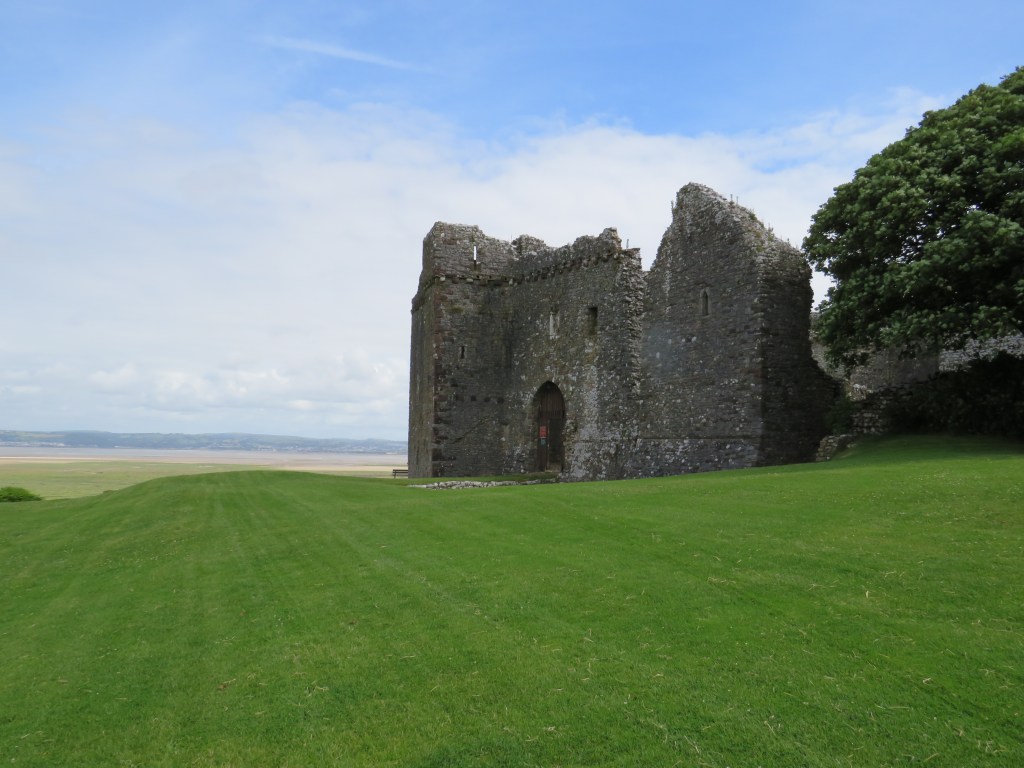
The weather forecast insists it will be 19 degrees and cloudy. We dress accordingly and set off for Weobley Castle. Oddly the sat nav thinks this is in two different places about half a mile apart and although I am enjoying following along on my OS map, it is hard to see where the entrance might be. Inevitably, we have opted for the wrong sat nav possibility and here we are in a farm. Destination recalculated and we arrive. There are some lovely views but to be frank, the possibilities for exploration here are a little limited. My travelling companion is fascinated by the remote lawn mower and is blocking it’s path with abandoned short scaffolding poles to confuse it. It would be harsh to say that this was the most interesting part of the visit and there is some historical information imparted, which I share with you now, with the usual proviso that this is what I gleaned and I can’t vouch for its accuracy. Regarded as a fortified manor, part of a series of Norman castles on the Gower peninsula, Weobley was described as ‘new’ castle in 1306, when it was held by the del la Bere family. A century later during a revolt on the Gower as a result of Owain Glyndŵr’s activities, Weobley suffered damage; the Welsh claimed to have ‘destroyed’ it. By the late fifteenth century, it was in the hands of Sir Rhys ap Thomas, who had been granted the overlordship of several castle as a result of his support for Henry VII during Henry’s efforts to claim the English throne. He instituted many improvements but the castle reverted to the crown when Rhys’ grandson was executed for treason under Henry VIII. It was then leased out as a farmhouse. In 1666, it was bought by Sir Edward Mansel and then passed to the Talbot family, being given into state ownership in 1911.
Weobley Castle’s possibilities exhausted, we decide to explore the south coast of the Gower and wonder if we can also take in Oxwich Castle. We can’t, it is shut. By this time the temperature has risen to the mid-twenties, the sun is beating down, we are ‘cosy’ and fairly in need of a drink and more urgently some ‘facilities’. Oxwich itself is heaving, with queues to get in the car park. We decide to try nearby Horton. All the coastal villages round here are approached via twisty, single-track roads, with occasional passing places. We are used to this. Not so other road users who clearly think their Nissan Micra is the width of a pantechnicon and has no reverse gear. Horton is equally lacking in options. Plan c is Porth Eynon. Car park located and himself heads off to pay for the parking ticket. This is always a technological challenge, involving reading things without the aid of reading glasses and potentially downloading apps. Ah no! This machine takes real money. The snag is that it doesn’t provide the necessary ticket in exchange. Never fear it takes cards. Having thus paid twice to park and ‘facilities’ availed of, we eat an ice cream and look at the beach. Our verdict on both – all very lovely but not a patch on what is 400 yards from my home. The drive back to the van is scenic, especially the road through Reynoldston. On the way, we pass a Harvester restaurant that would have been considerably more convenient than our Friday choice. Annoying that that eluded me when I asked Google for the nearest one to Llanelli. This is followed by another restful afternoon back on site, watching the swallows feeding their babies on the wing.
A short drive along the northern shores of the River Lougher and we are at the Llanelli Wetland Centre. We have a lovely wander round, popping in and out of various hides and unlike many of our forays to see wildlife, we do see a wide variety of wildfowl. The list is below if anyone is interested. There is also a distinct and pervading smell of cannabis at one point, although no other people are in view; very strange. Although much cooler than of late, it is a little on the cosy side and we repair to the café – hurray, coffee in sensible shaped mugs again. I was a bit disappointed to realise that we had actually only seen half of what was on offer but it really was too hot to walk another three miles or so round the other paths. The only negative was that they no longer supply paper maps. I do understand the need to save trees but I really can’t be doing with following a map on my phone. If it is big enough to read then I can’t see enough of it to work out where to go next. It would have helped if there were more copies of the map in places around the site. Note to self to print the map in advance if we ever come again to do the other half.
Then it is back to the van for a lazy afternoon. The adjacent Country Park is hosting Armed Forces Day, so we can hear military bands and World War 2 songs in the distance.
In the evening, we stroll towards the Country Park. This was formerly the site of a munitions factory. In 1881, the Explosives Company, based in Stowmarket, Suffolk, dredged the harbour, which allowed ships to bring in necessary construction materials. There were several tragedies, including an explosion in 1882, that killed seven workers, the youngest being thirteen and a fire the following year. There were further fatal explosions in 1917, 1920 and 1922. In 1914, a Glasgow Company set up a TNT factory on the site. At its height, during the First World War, there were over 6000 employees in the two factories, the majority of whom were female. Although munitions production closed in 1935, with a convalescent home utilising the buildings and the land becoming a camp for the children of unemployed miners, as the Second World War dawned, production restarted and more fatalities ensued. The factory finally closed in 1963, with the Park opening in 1980.
Rook, Mallard, Mute Swan, Black-backed Gull, Black-headed Gull, Coscoroba Swan, Australian Wood Duck, Blackbird, Wood Pigeon. Shelduck, Crow, Barnacle Goose, Chestnut Teal, Graylag Goose, Canada Goose. Moorhen, Magpie, Red-breasted Goose, Scaup, Snow Goose, Black-necked Swan, Sedge Warbler. The last one was heard only and I’ll fess up I can’t tell a sedge warbler from any other kind of small brown bird and in this case, we only heard it. I’m hopeless at birdsong too but this identification came aid of an app.
As caravan club frequent flyers, we are offered three night’s stay for the price of two. Always a sucker for a special offer, we look to see if, between the two of us, there is a gap in the diary. Fortuitously, there are a few days when we are both free, almost unheard of, especially at the time of the year but an opportunity not to be missed. A very short break in South Wales is planned. For once, this trip will have no family history connections at all. We are due to leave on what was the hottest day of the year, the hottest day ever in our part of the world and at our destination. Providence has it that we are delayed due to an urgent appointment, so our day of departure is due to be cooler, at least until the forecast changes and the view is that there will be another day of ridiculous hotness.
The job we must not mention firmly under control, thanks to a 4.45am start. By 8.30am, armed with plenty of water, we set off. This is as early as we can, given that the campsite has an earliest check in time of 1pm. I should say that a 4.45am start isn’t too far off normal for me, especially at this time of year and given that, after a stupidly hot night, I was not asleep anyway. As it was already 22 degrees, why not work? For my down-under friends who think our mid 30s temperatures are nothing to write home about, please remember that our houses rarely have air-con.
With the temperature in the car rising steadily, I enquire of the driver if the car has air con. I am reassured that it does but that he doesn’t know how it works. By this time, we are bowling along the M4 and it is 30 degrees. I consult the manual, handily stowed in the glove compartment. I fix the aircon, which now has the insurmountable task of cooling down what is a very hot car. We have a sat nav but it seems that while I was sorting air conditioning out I should have been navigating – who knew? A slight detour ensues. After a while, the air con makes a dent in the temperature but then we are stuck in traffic and from Port Talbot onwards, are crawling along at about 10mph for the next hour. As the traffic starts flowing, the outside temperature drops to a blissful 19 degrees.
The site is lovely, on the edge of a country park, close to the beach and with swallows swooping and diving. I have already sussed out which pitches have the chance of a wifi signal and despite the traffic delay, we are early enough to secure one before the site fills up tonight. Next, coffee and what passes for lunch, eight hours after breakfast. A robin pops in the van to say hello.
Lured by a 40% off main meals offer (cheapskates again you see) the plan was to head to the not actually very nearby Harvester in Swansea for an evening meal. Initially, we were going to go in early and look round but a combination of the extended journey time to get here and us just wanting to chill means we leave early, being aware of rush hour traffic but not early enough to look round. This Harvester is situated in a huge retail park. We are well aware just how huge, as it takes half an hour of driving round and judicious use of Google maps to locate the Harvester, which is well hidden behind trees. The sat nav just took us to the retail park, which appears to all share the same postcode. I thought afterwards that I should have gone for What Three Words – hindsight and all that. Good job we left early. We eat far too much. It is free dessert Friday but sadly we can’t avail ourselves of that offer and the 40% off. I never thought that mini desserts would be on my radar but with your mini dessert you get coffee as well and bonus points for Harvester as it is served in a proper shaped mug, not one of those wide cups where the coffee loses heat and which is hard to balance, even though I have no trouble at all with my grip.
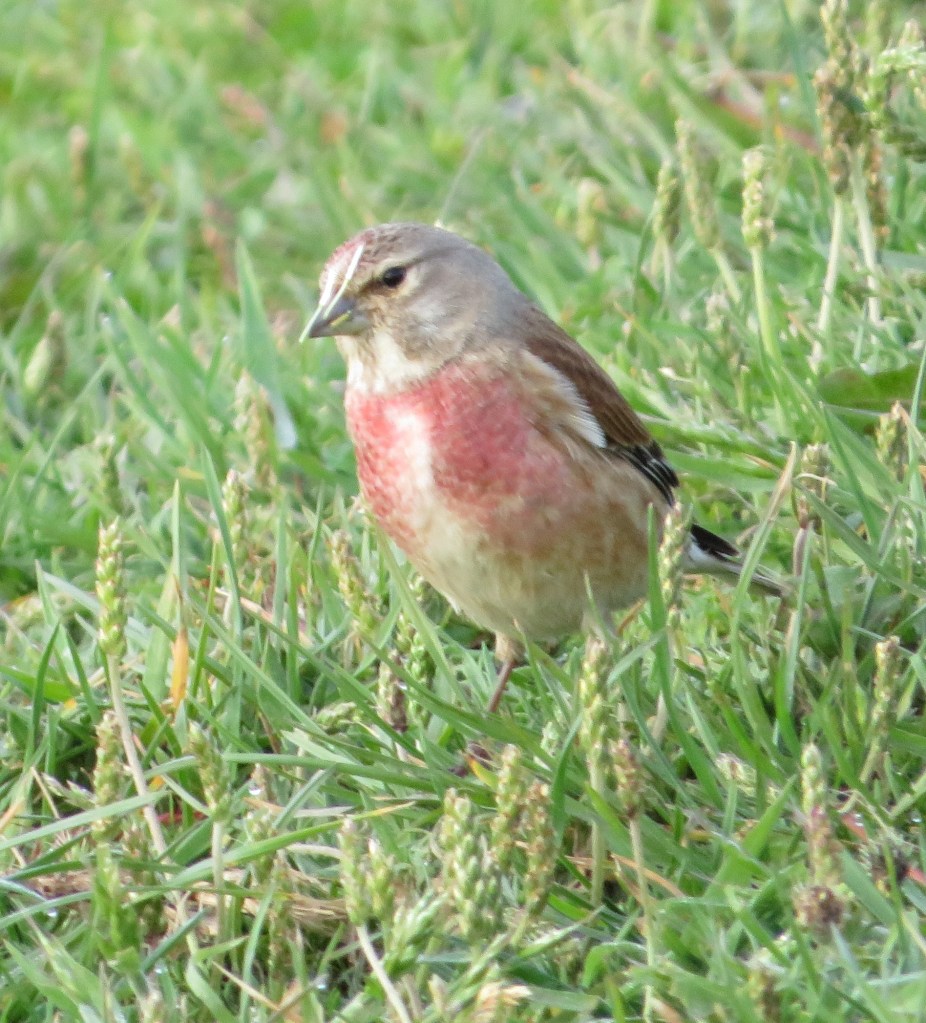
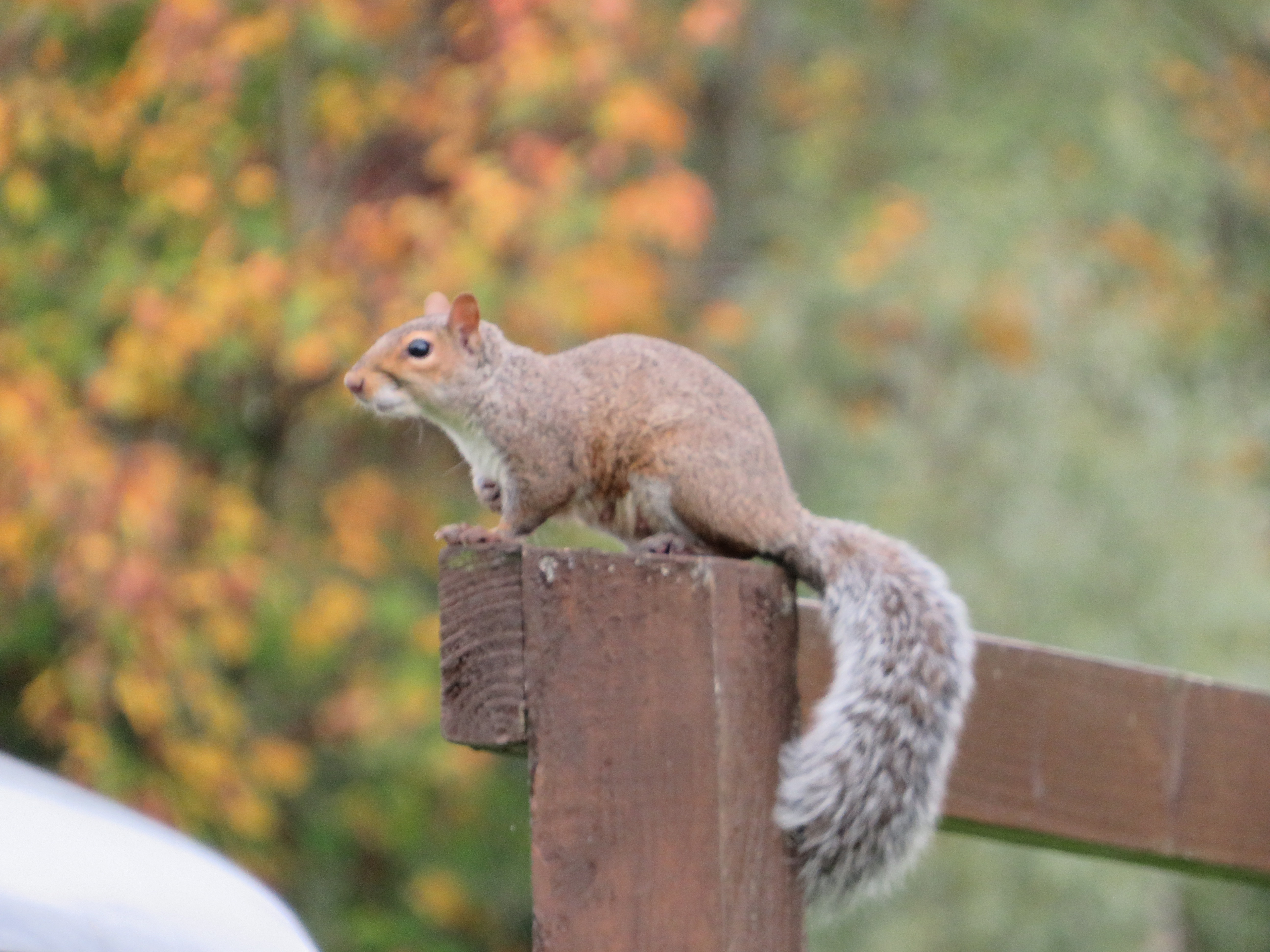
No pictures were taken on this day so here is a bonus bird picture taken 2 years ago.
After an uneventful journey, we arrived at the caravan site in Newport in beautiful autumn sunshine. We were just in time to explore neighbouring Tredegar House. I had even remembered my National Trust passport. Unfortunately, I had forgotten my membership card. By the magic of technology, I was located on the data base and we gained entry. There was only time for a quick look round this substantial seventeenth century house, home to the Morgan family. It was built on the site of a previous house by William Morgan, with the dowry received for his first wife and cousin Blanche. William’s second wife trued to murder him. The Morgans were substantial land owners
The estate’s downfall came in the 1920s when the then owner lived an extravagant lifestyle as a ‘Bright Young Thing’. He was also involved in the occult. During the Second World War he worked for M18 using carrier pigeons to bring information from Europe. Evan was court martialled for divulging the information to some Girl Guides. The house was sold as as school in 1951 and was acquire dby the council in 1974. It has been run by the National Trust since 2012
On a beautiful autumn day, we set off for St. Fagans. There was a slight issue paying to park as the instructions were in Welsh but English instructions were accessed and entrance to St. Fagans was free. We had been before but there have been many changes since. We began to explore the reconstructed houses, everything from an iron age round house to a pre-fab. The round house was particularly superior, consisting of two circular structures. Unfortunately, the guide was outside enjoying the sun so I could only photograph half of it. The circular pig sty was interesting, circular as pigs are more likely to escape from rectangular structures. There was a urinal, reminding patrons to adjust their clothing before leaving, several farmhouses, Pen-rhiw Unitarian Chapel and St Teilo’s Church with impressive reconstructed wall paintings. There was also a terrace of houses, each one decorated in a different period style. The civil war battle of St Fagans was the largest on Welsh soil and ended in a decisive victory for the Parliamentarians.
Before leaving Wales we popped back to Tredegar Gardens whose points of interest include a forty two foot long shovelboard in the orangery; allegedly the longest oak plank table in Britain.
The final instalment chronicling our adventures in Wales and beyond.
Day 7 Blaenavon Ironworks
We set off for our pre-booked entry at Blaenavon Ironworks. This time the sat-nav, not only gets us to the right place but takes us past some stunning scenery on the way. Blaenavon Ironworks is a fascinating site. We get in free because Cadw, who run the site, have a reciprocal arrangement with English Heritage. The ironworks were established here in the 1780s and the finished products were shipped out by canal. It was at Blaenavon that Sidney Gilchrist Thomas discovered a way to remove phosphorus from iron ore, which was significant for the steel industry. An impressive digital display gave some idea of the noise and heat that was part of the working environment. It was somehow more impactful because part of the commentary was in Welsh. I am drawn to ruined industrial landscapes and this is on par with the Cornish tin mining sites. Here the jackdaws and the feral pigeons have made their home.
A series of workers’ cottages on the site have been furnished to represent different eras from the 1780s to the 1960s, the life of the ironworks. Covid restrictions mean that we can only look in these cottages, rather than enter them but they are still a highlight of the site. Instinctively, I wanted to look them up in the census returns and mentally put real people in them. This is just the sort of site that anyone with ironworking ancestors should visit. An interesting fact that I gleaned was that, in 1851, there were more industrial workers in Wales than agricultural, allowing Wales to claim to be the first industrialised nation in the world.
We went for a short uninspiring walk from close to the car park then headed off home, planning to stop to take photographs of the view on the way. We hadn’t done so on our outward journey as we were keen not to miss our entry timeslot. Strangely, the sat-nav decided to return us to Brecon via a completely different route. Although a circular route has the advantage of exposing us to more of the country, we are disappointed to miss the views. Just as we are lamenting this, the landscape opens up and the vista is amazing. Squelchy bog prevents me getting a great camera angle and views always seem less impressive in photographs, so I will have to rely on memories. The mid-Welsh landscape seems to be darker green than many areas and fields tend to be small and hedged, despite the availability of stone for walls.
On the way home we are reminded that the Brecon Beacons have their fair share of ******* drivers. We reach a bridge that it not only described as weak but is barely wider than the car. This in itself is not a problem but like many Welsh roads, it is not straight and at the point at which you join the bridge you cannot see the end of it. An illuminated sign warns us that there is a vehicle on the bridge. A vehicle emerges the sign goes out and a green light comes on. We launch into the unknown, only to find, as we turn the corner, that someone is coming in the other direction, presumably having ignored the sign at his end. My gallant chauffeur had to reverse 100 yards round corners, with unforgiving walls no more than six inches from the wing mirrors on either side.
Day 8 Thursday Brecon Canal
Today it is sunny, so we decide to walk from the caravan site, down the canal towpath to Brecon. This involves taking our lives in our hands to cross two dual carriageways first but we survive. This is a pleasant walk and we are rewarded by a grey heron allowing us to get to within five yards before flying off. There are more signs of industrial heritage here, with the remains of the limekilns that were in operation in the early nineteenth century. The canal linked Brecon with the industrialised areas in south Wales.
After a short rest we decide to explore more byways of Wales by car. We drive out to Craig-y-nos Country Park but by the time we arrive, dark clouds are looming and as we have already had our walking ration for the day, we return to the van.
Day 9 Friday To Cheltenham (yes, I know this isn’t in Wales)
It is time to move nearer to home and take up residence at the caravan site on Cheltenham Racecourse. We have stayed on racecourses before and although we have views across what is probably the Malvern Hills, I have to say that it isn’t the most picturesque site we’ve been to. Cheltenham too is unexpected, much larger than I was anticipating. In my head I was thinking smallish, Georgian grandeur, maybe a bit like Buxton but it seems not, or not in the part we travelled through.
I hadn’t planned an activity for the afternoon so time to Google for an outside space. I lied when I said that the wifi on the previous site was the slowest in the world, that honour belongs to the Cheltenham Racecourse wifi, which is not the Caravan Club system, for which I have an annual subscription but free Jockey Club wifi. I guess there isn’t much call for surfing the internet when hurtling over jumps on the back of a horse. An additional issue is that we have the ‘delights’ of a ‘Fun Weekend’ event on the racecourse this weekend – deep joy. This appears to involve a fun fair. Peaceful it may not be.
We opt for Beckford Nature Reserve. This comes very close to being another addition to our ‘nature reserves we didn’t find’ list but no, here it is, unsigned until you get to a small gateway hidden in a hedge. A path winds round an algae covered lake. There’s not much sign of wildlife apart from some baby coots, which I am surprised to see have orangy-coloured heads. Despite two perambulations of the lake, I am still 1500 steps short of my target. Time for some jogging up and down on the spot outside the van. This is followed by the Wimbledon men’s singles semi-finals.
Day 10 Forest of Dean
It wouldn’t be a holiday without some family history, so today it is off to the Forest of Dean, the haunt of some of my children’s ancestors. This lot even rate some gravestones, though many were in poor condition. Trailing from churchyard to churchyard is often circumscribed by bladder capacity, because small villages rarely rate toilets but hurrah, today two of the churches on our itinerary had toilets, so we could happily spend hours peering at semi-legible gravestones.
One of our stops is at St. Briavels. St. Briavels Castle, now run as a Youth Hostel, is closed to the public. It was built as a royal hunting lodge in the twelfth century. It became an important centre for the making of cross bows, using iron from the Forest of Dean.
Having got suitably soggy feet from traipsing through grassy graveyards, we take a short walk along a forest path to keep the step count up. Then it is back to the van, where the wifi oscillates from intermittent to non-existent. I hurriedly identify today’s photographs. In the past, I have been known to end up with numerous church photos and not be quite sure which is which.
Day 11 Slimbridge
We have saved the best until last. Today is our pre-booked visit to the Wildfowl and Wetlands Trust centre at Slimbridge, established by Sir Peter Scott seventy five years ago. Last time I visited it was in the spring so there are different things to see today and the opportunity to feed birds is confined to a small area. My favourite part is the new estuary aviary with avocets, oystercatchers, black-tailed godwits, ringed plovers and spoonbills, amongst others. I manage to get a few half-decent photos, despite every bird assiduously going into a preening frenzy at my approach, so that their head are hidden from view.
Now I am back home and no longer in the land of steam driven wifi, I can continue the story of our Welsh adventures.
Day 4 Ynys-hir Reserve
This is a day to make use of my RSPB life member status and we visit the reserve at Ynys-hir. The reserve is a pleasant setting but notable for its lack of wildlife. Tally, one robin, one thrush, a few squirrels and an unidentifiable, distant bird of prey. In the absence of my own coat, which is sitting on the peg at home, I have appropriated a waterproof coat from the caravan. One of those two words, waterproof and coat, accurately describes this garment. Half way round the second of two trails the heavens open, mostly it seems on my head. We squelch back to the car and call it a day.
Day 5 To Brecon and Llangorse Wildflower Meadows
Time to journey 60 miles down the A470, back towards home and move to a new site at Brecon. This has the advantage of us being able to access more than three TV channels and it has wifi that reaches to the van. Ok, so it is officially the slowest wifi in the world but it beats sitting in a car park. We arrive by lunchtime and decide to explore the nearby wildflower meadows at Llangorse. ‘Park by the common’, it says. First problem, identify the common. It turns out that it wasn’t the tiny, scrubby piece of grass where we leave the car. We do find the enormous common on foot but I am not convinced that we reached the wildflower meadow, unless it was an area of unmown grass with some clover growing on it, not quite the poppies, cornflowers and ox-eye daisies that I was expecting. We did find a Crannog, an ancient lake dwelling familiar from our trip to Scotland and plenty of ducks. If you are wondering why we didn’t use a map, there is a bit of a map issue for this part of the trip. As usual, I made sure I purchased an OS map before leaving home. This is the Brecon Beacons, surely I need a map called Brecon Beacons? No. It turns out that there are three that cover this area and I have chosen the wrong one. Map of the western half of the Brecon Beacons anyone?
Sad to see Emma Raducanu’s enforced retirement from her Wimbledon match on our return to the van.
Day 6 National Botanic Garden of Wales
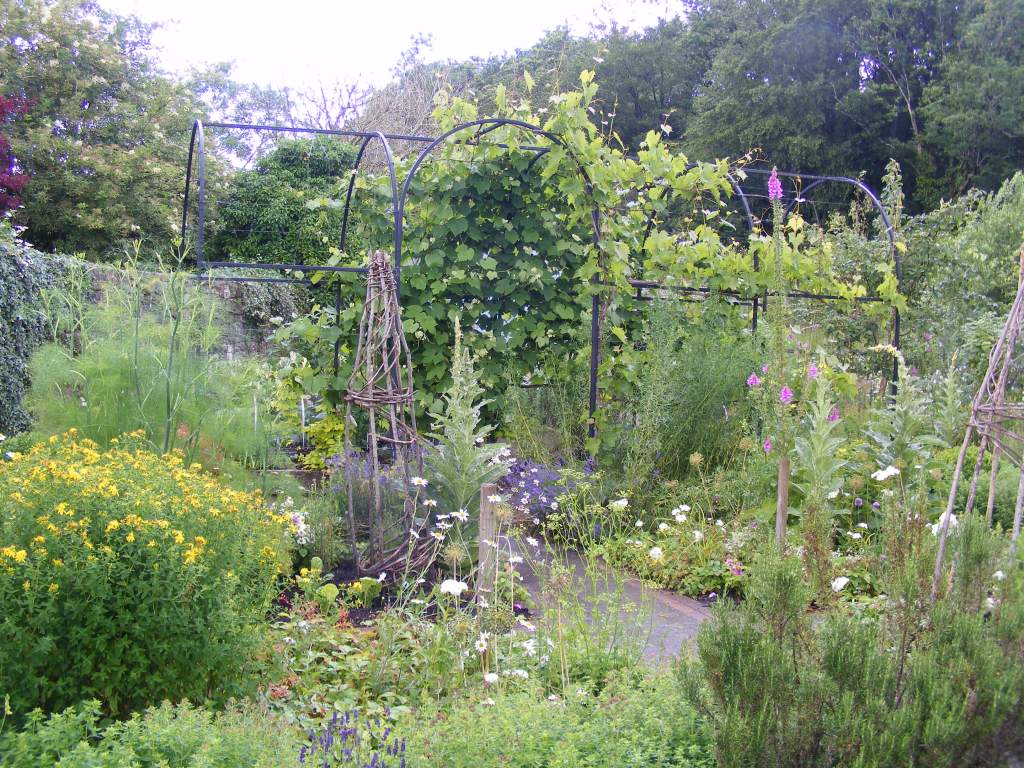
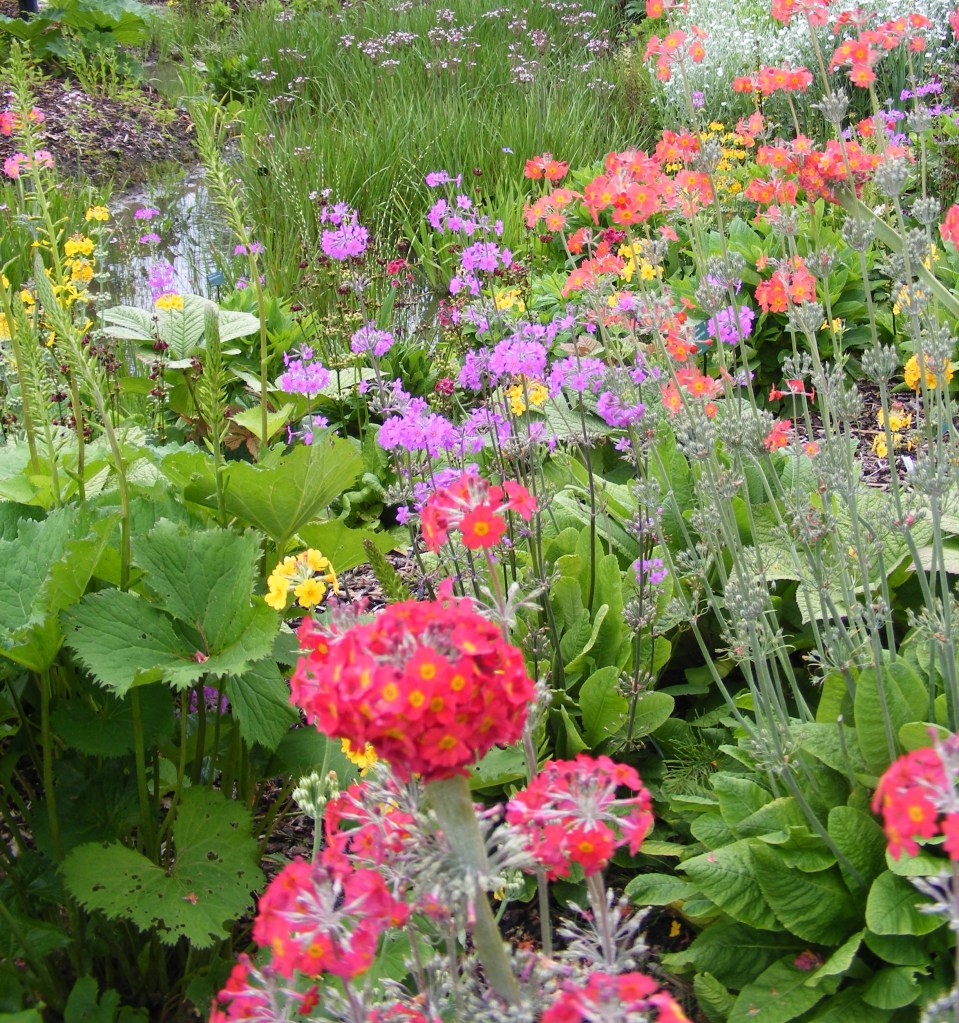
The National Botanical Garden of Wales is on the itinerary today and this is the furthest we plan to go from a site. Today we have our fair share of road re-surfacers again but all the roads that aren’t being re-surfaced are having their verges/hedges cut, so the stop-go board count rises even further. The sat-nav insists that we have reached our destination. We haven’t. We drive round the block a bit in search of helpful brown signs. After a few miles we pick these up and discover that we should have turned left when the sat-nav insisted on us going right. The gardens were definitely worth the drive and the effort. There is plenty to see, including an Eden Project style biome and a bird of prey centre. Inevitably my favourite parts were the less formal apothecary’s garden and the allotments. There is a display associated with medicinal plants and some beautiful quilt panels depicting herbs. I also learn about the physicians of Myddfai, whose story began with Rhiwallon who was the thirteenth century court physician to the Prince of Deheubarth, Rhys Grug. Their tradition continued until 1739 and the Red Book of Hergest, which records their remedies, is held out to be one of the most important Welsh manuscripts from the Medieval period. I couldn’t resist looking for an English translation.
We return via a local supermarket of our choice. This is the second time I have been in a shop since March 2020. I still have 1000 steps to hit my daily target, which I’ve maintained all year. It is now raining persistently. My options are to circle the site in the rain or to make myself look like an idiot jumping up and down by the cold counter in M********* whilst my companion loads up the yoghurt and milk. I’ve tried getting soaking wet doing laps of a caravan site before. Fun it is not. I go for surreptitious jogging as I examine tins of beans and load the bag at the checkout. Yay 1000 steps accomplished.