Still with an eye on the weather forecast, we decided to go to Goodrich Castle on what was predicted to be the least worst day we had left. As things turned out, after some light drizzle first thing, the day was hot and sunny. Possibly a little too hot to be ideal and certainly humid but we counted this as a win. My inspirational, lower high school history teacher was a Mrs Goodrich, so even the castle’s name had positive connotations. We began with a recce of the shop and were pleased to learn of new a English Heritage initiative, which gives members discounts in the shop and café. It was also good to see the child-friendly free activities on offer. I was vaguely amused by the placement of an advert for English Heritage membership outside the toilets that read ‘Members go Free’.
We availed ourselves of an audio guide, which wasn’t the greatest success. Firstly, it read two different explanations simultaneously and then, even on full volume, it was ridiculously quiet, even for those of our party (that would be me) with good hearing. So this is what I gleaned from interpretation boards, with the usual proviso that none of this is checked for accuracy.
Godric Mappeson, for whom Goodrich is named, built the first castle on this site in about 1100 but none of this early castle still stands. The keep, that is the earliest part of the existing castle, was built by Richard de Clare about 1150. In the early years of the thirteenth century, William Marshall owned Goodrich, amongst many other properties. By the end of that century, Henry III had granted the rights to the castle to his half-brother William de Valence. French nobleman, de Valence, who was thus uncle to Edward I, built much of what remains today. Regarded as a foreign upstart by his neighbours, he set out to build an impressive and intimidating edifice, yet Goodrich did not have to defend itself against enemies until the seventeenth century. Instead, the castle functioned as a domestic residence, although most of its owners had properties elsewhere, so were not permanent residents. Unusually, the castle has stained glass windows, which reflect its domestic function. By 1326, the castle had passed into the hands of the Talbot family who were still in residence at the end of the sixteenth century. They were responsible for extending and improving the castle. Royalist, Sir Henry Lingen, held the castle during the English Civil War when the Parliamentarians held it under siege. The Parliamentarians had a special large mortar cast, ‘Roaring Meg’, which could fire 200lb shells and destroyed part of the castle, then the remainder was further demolished to ensure that it was beyond repair.
The approach to the castle is via two drawbridges; the first, at right angles to the moat, leads to the barbican. This was modelled on Edward I’s barbican at the Tower of London and is a D shape. The second drawbridge leads across the moat, which never had water in. As the latrines exited directly into the moat, the lack of water may have been an issue. Here at Goodrich, one of only a few portcullis mechanisms remains.
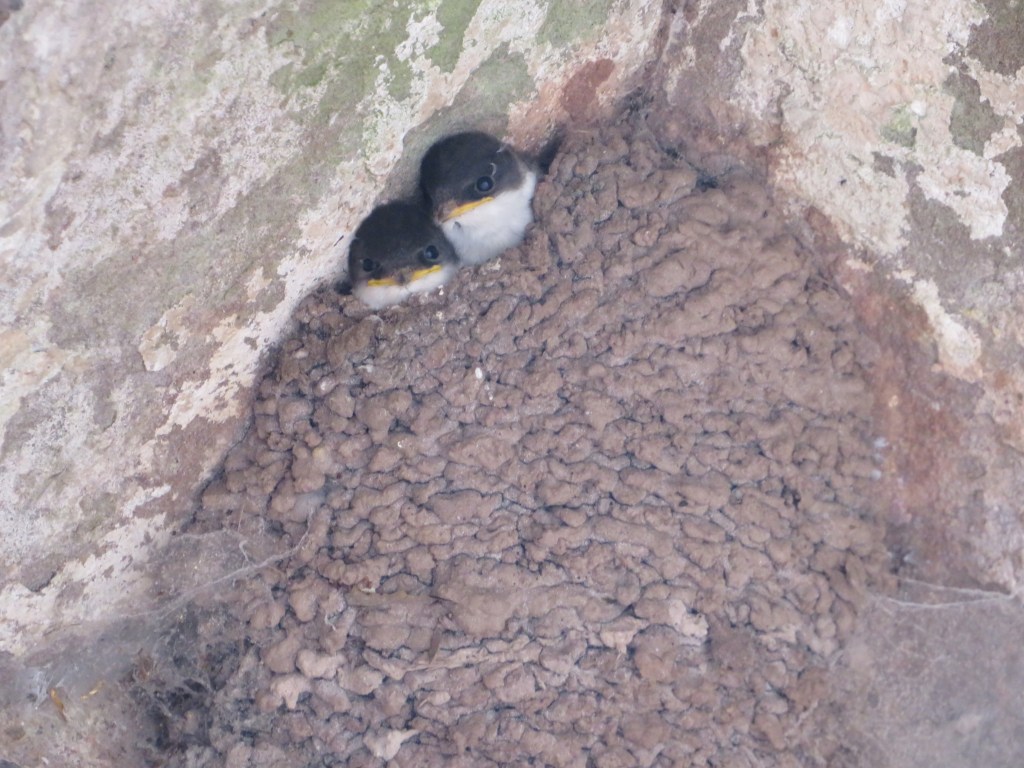
We stopped to admire the red stone castle and watch the many swallows and martins wheeling and diving, some still with young in their nests, constructed in out of the way nooks in the castle. Once inside, we found a way to reach the battlements that didn’t involve a perilous spiral staircase and were rewarded with lovely views across the Wye Valley.
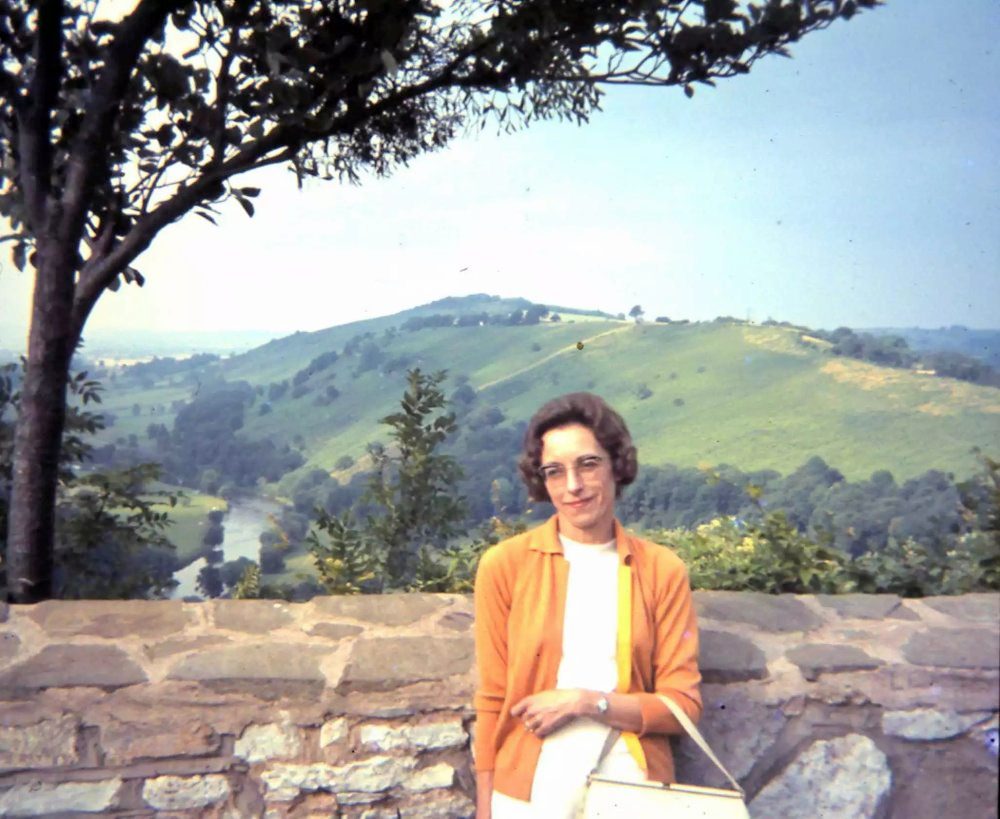
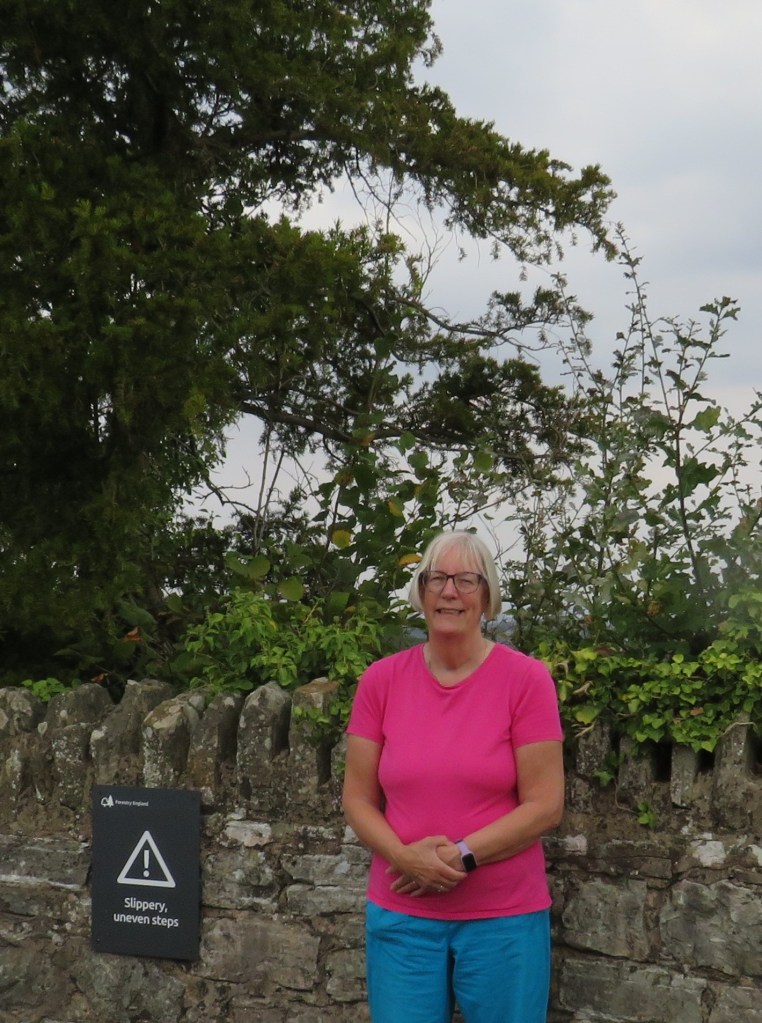
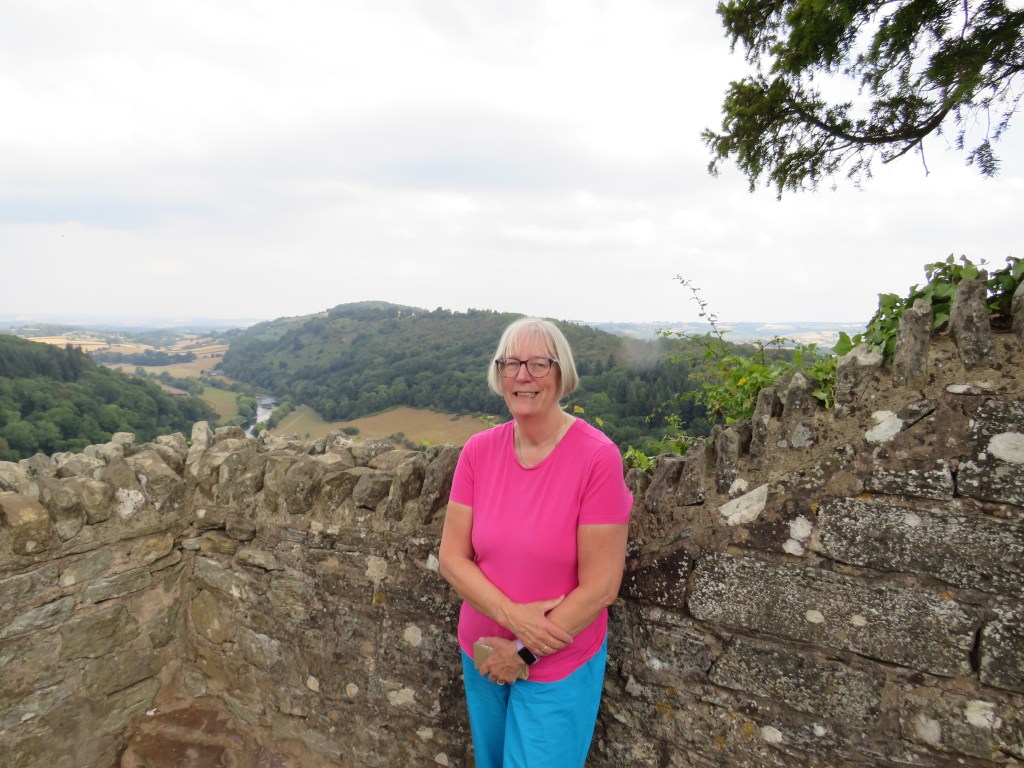
After some sustaining and very tasty passionfruit and lime cake we set off for nearby Symonds Yat. I had been here once before as a child, in 1968 and the only real memory was sparked by a photo of my mum taken at the time. I was hoping to be able to find the spot where it was taken. It seemed that the wall that she was standing by had been raised and vegetation growth meant that, what I think was the exact spot, no longer had a view but we took a photo anyway and also one a little further along, where you could see the view. Symonds Yat is the site of an Iron Age fort, built about 2500 years ago. It is thought to have fallen into disuse in the hundred years before the Roman invasion. It really was too hot to walk along any of the paths in the area, so we returned home via a supermarket stop.
There was a half hour delay through Hereford due to roadworks/volume of traffic and probably an accident, as three ambulances squeezed through the traffic to pass us. It got to 29 degrees in the car, which was less than pleasant. In the evening, we set off to meet a school friend at nearby Tillington. We went a fairly strange route as I had inadvertently put the wrong postcode in the sat nav but thanks to my map reading ‘skills’ we found the venue without much trouble. It is always lovely to catch up with people you haven’t seen for many years, in this case we think twenty-five and find we still have plenty to talk about.
You must be wondering of I have a home to go to because, although I am safely home now, I’ve been away again, this time with a family history slant.
We set off through slowish traffic to take the caravan to Ferry Meadows site on the edge of Nene Valley Country Park, somewhere we’ve been several times before. Fortuitously, this was the day the fish and chip van visited the site. It would have been rude not to partake.
With our Devon Family History Society hats on, we personned a stand at the East Anglian Really Useful Family History Show. It seemed quite busy and it was good to chat to so many people that we knew. We collected items for the October conference goody bags and realised that this meant we would now have to drive round with a car full of heavy books for more than a week. There were some fears for the suspension.
The next day was meant to be a restful day, so I looked for something nearby to do, ideally something we hadn’t done before. I happened upon Longthorpe Tower. As it really was just over there. I was surprised we hadn’t been before, perhaps because it is only open at weekends. We booked a 12 o’clock tour. It says you have to pre-book but some people did turn up on spec. There is however a maximum capacity of twelve, so you’d risk being disappointed. As it looked so close, just the other side of the adjacent country park, we set out to walk. We called in at the park’s
visitors’ centre on the way to enquire about a route, which according to Google maps was a walkable 1.7 miles. The person we asked said that it was an unspecified ‘long way’ and advised us to take the car. To be fair there was open water and a motorway to negotiate but it did look as if there was a path and bridge. Maybe his advice was based on our decrepit looking appearance.
We returned for the car 3.7 miles by road, spotting a pair of red kites on the way. Of course this meant we were nearly an hour early. This didn’t seem to matter as the 11am tour was just starting, so we joined that. The tour was built in 1290 by lawyer Robert Thorpe as an extension to his adjacent fortified manor house, to showcase his wealth and status. Robert and his son, also Robert, were both stewards of Peterborough Abbey and it is thought that one or other of them commissioned the monks who were painting the abbey walls to also work on the tower. The Thorpes were to serve both Edward II and Edward III, Robert junior becoming Lord Chamberlain. The manor house is in private hands but the top two stories of the three that make up the tower itself are in the care of English Heritage. The solar, the lower of the two floors that can be viewed, boasts Medieval wall and ceiling paintings that are the best to survive, in a domestic setting, in the whole of Europe. Fashion and the style of the royal arms that are depicted, date the paintings to between 1320 and 1340. The fleurs de lys that Edward III added to the royal arms in 1340, when he was laying claim to France, are not shown.
Although Robert had two sons, the family line died out with his grandchildren, so the estate passed to a distant relative whose main residence was elsewhere and it gradually fell into disrepair. The paintings were whitewashed over, probably during the Reformation. It was used by the Home Guard during the war and it was only when an attempt was made to clean up the tower after they left, using labour from the nearby Italian prisoner of war camp, that the paintings were rediscovered. Clive Rouse was called in to preserve the paintings. He made paintings, rather than taking photographs, of what could then be seen, which was more than has survived the intervening seven decades. Unfortunately, he used beeswax to preserve the paintings, which was then then approved method but in the damp tower this did more harm than good and it had to be removed. Preservation is now in the hands of the Courtauld Institute but the decision has been taken to just attempt to halt further deterioration in a sustainable way and not to restore.
The paintings depict a variety of scenes. Two large figures are thought to be Aristotle and Alexander the Great, above them are depictions of farming tasks across the twelve months of the year. On another wall are the eleven apostles (minus Judas), a nativity scene and the seven ages of man. Opposite Aristotle is one of only three surviving depictions of the wheel of the five senses, the other two being in Italy and Germany. On the final wall is a king and a number of animals and birds, as well as a painted geometrical tapestry. The animals include the mythical Bonnacon, who attacks it’s enemies by expelling flame throwing poo.
The top floor was accessed by my favourite thing (not) a spiral staircase. Wondering if ascending was going to be one of those ‘seemed like a good idea at the time’ things, I cautiously began to climb. There was a rope handrail, which meant that, as the person behind you pulled on the rail, the rope tightened and your hand was trapped between the rope on the stone wall. Nonetheless, apart from a few grazed knuckles, I made it up and down and was able to observe the fourteenth century toilet seat. The top floor was probably a bedroom; the Thorpes must have been jolly nimble to trip up and down those stairs every day.
In order to access the top two floors of the tower, whilst still allowing the ground floor to be used by the manor house, what was a window has been turned in to a door, accessed by outside steps.
After a pause for lunch we strolled round the lake at Nene Valley Country Park.
A tedious journey south to a new caravan site at Rookesbury Park near Fareham. Although we’ve definitely stayed here before, neither of us have any recollection of the site. Mind you, our most recent visit was probably twenty years ago. This should have been a three hour drive but road works and heavy traffic meant that it took nearly four. We discovered that the bungee cord that stops the caravan electric cable dragging on the ground when we travel, had come undone. This means we now have bald looking cable and are in need of insulating tape.
As part of my 70th birthday commemorations I am attempt to catch up with as many people on my Christmas card list as possible. I am then taking photos and plan to make it in to an album. I thought this may take more than a year, so I started last year and I suspect I will continue into next year before I get as many as I think I am likely to. As I travel about for other reasons, I am therefore checking the address book and seeing who is within striking distance.
Today was an opportunity for one such catch up and we had a lovely lunch in Chandlers Ford. Feeling very full, we retired to the van, via purchasing the required insulating cable. Having been directed along the M27 on our outward journey, it was very pleasant to find that the satnav decided to avoid the motorway take us through several pretty Hampshire villages, of which Wickham was one, on the way home.
We decided to exploit the English Heritage Life Membership again and take a look at Porchester Castle. On the way, we passed Fort Nelson and paused to photograph THE Nelson’s column. This is ninety-two foot ten and a half inches high and was built in 1807-8, paid for by those who were involved in the battle of Trafalgar donating two day’s pay, as well as naval prize money. What can been seen now is largely an 1899 rebuild; with only the bust at the top being original.
In glorious sunshine but a biting wind, we moved on to Porchester Castle. We had pay to park, although I feel we might have avoided this if we’d approached from a different direction. The situation is strategically important, both for protection from a possible invasion and to use as a gathering point prior to attempting to invade France. I struggled with a barely audible audio guide and tried to avoid a somewhat garrulous volunteer who clearly wanted to chat.
The earliest fortification on the site was probably Roman and was erected in the third century to counteract the threat of a Saxon raiders. By the early tenth century, the threat was from the Vikings and the fort was given to the then king, Edward the elder, by the Bishop of Winchester. Portchester became a burh, a fortified settlement. As well as a wooden building, a stone tower was built.
After the Norman Conquest, Portchester was given to one of William’s followers, William Maudit, later passing to another Norman knight, William Pont de l’Arche who founded an Augustinian Priory that was housed within the fort in 1128. This later moved to nearby Southwick. In 1101, Robert Curthose, Duke of Normandy invaded at Portsmouth, intending to take England from his brother Henry I. Henry managed to persuade Robert to retreat and later Henry invaded Normandy and imprisoned Robert, blinding him first, nice lot the Normans.
The castle was rebuilt in stone in the early twelfth century, including the first of three stages of the keep. By 1154, Portchester was in royal hands and Henry II and later monarchs used it when they were on their way to France. In the 1390s, Richard II built an small palace next to the keep. It’s position overlooking the channel and the important harbour at Portsmouth, meant that Porchester was better maintained than some castles. It was Charles I who sold the castle to the Uvedale family, whose descendants still own it.
At various times in its history, Porchester has been used to house prisoners of war. In the 1660s, when England was fighting the Dutch, the government rented it to house Dutch prisoners. In the eighteenth and nineteenth centuries, French prisoners were held at Porchester, most notably during the Napoleonic Wars, when the prisoners had a theatre in one of the chambers. In 1819, the owners, by then called Thistlethwayte, took back the Castle, created a pleasure garden and used it to entertain guests. Unfortunately, the steps to the upper floors of the keep are not in use at the moment, so we couldn’t explore that part.
On returning to the van, I sampled a double gold caramel magnum. I may be forced to sample this delight again, just to check that it really was as delicious as I thought the first time.
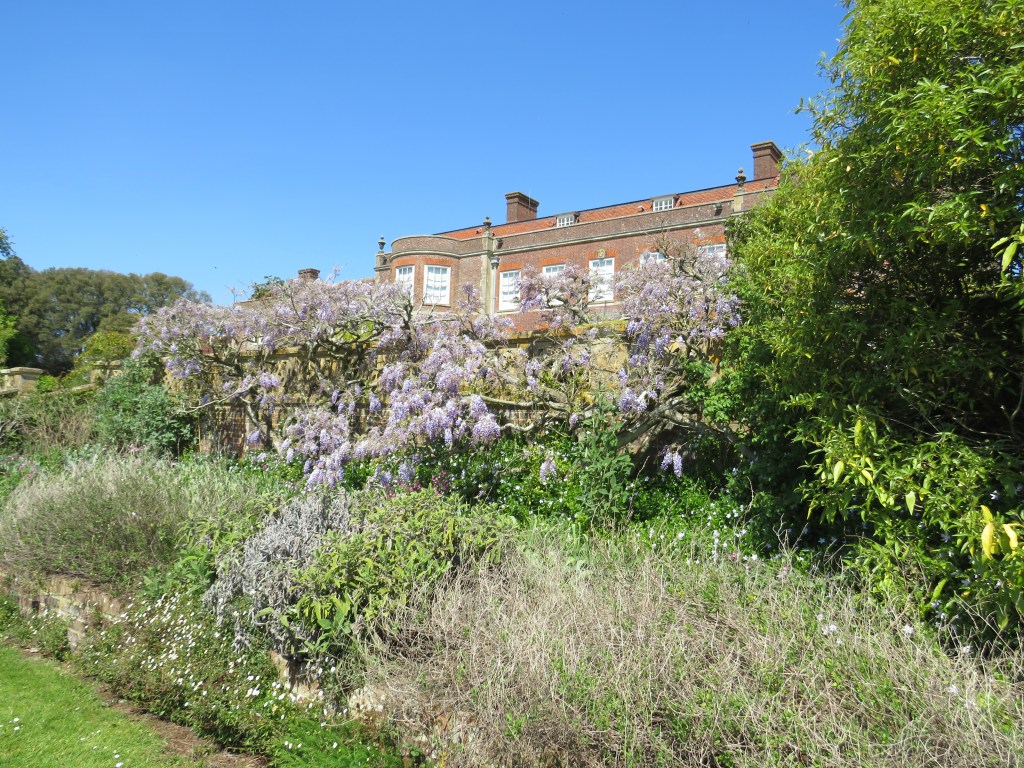
Another day, another place to visit, this time via a caravan spares shop to get a vital part for the van that seems reluctant to provide us with water from the taps. Today’s tourist attraction of choice was the National Trust’s house and garden at Hinton Ampner. There was a Tudor manor house on this site, owned by the Stewekely family. In 1793, the Bilson-Legge’s demolished and rebuilt the house. This was inherited by a daughter who married into the Dutton family. Ralph Dutton inherited in 1935 and was responsible for remodelling the house in keeping with a Georgian revivalist style. A fire that started in the library in 1960, meant that much of the remodelling had to be done twice and 2000 books had to be replaced. I always wonder, in libraries like these, how many of the books actually got read.
The house is home to one of the largest collections of hardstone inlaid furniture in the National Trust. As usual, I looked for quirky pieces that caught my eye, including a stunning Blue John vase and rather strange origami-like constructions that were used instead of holly or pine cones to deter visitors for sitting on the chairs. Pupils from Portsmouth High school were evacuated to Hinton Ampner House in the Second World War. Lacking any children, nieces or nephews, Ralph Dutton donated the estate to the National Trust. My only niggle about the property was that those requiring disabled access to the house were invited to ring the doorbell for assistance, yet said bell was up the entrance steps, which rather defeated the object.
It was a beautifully sunny spring day for exploring the gardens, with slightly less wind than at Porchester. There were far-reaching views across the South Downs and I was excited to spot but not very successfully photograph, a red kite. The Saxon, flint church in the grounds was also interesting and had some impressive 1970s stained glass.
Despite having sampled some National Trust cake, in holiday mode, I decided that I had to try another caramel magnum. I am wondering if I really need more before coming to a decision.
Having been to the crannogless crannog centre it was time for the ospreyless Osprey Haven. This was not a surprise, as it is late in the year for osprey and there have been no young at the nest at Loch of the Lowes this year, following the death of the male in the spring. The regular female does seem to have formed a new bond and they have been protecting the nest so there is hope for next year.
This is not the sort of reserve where you go for a walk. There are two hides and there’s also a large window where you can watch a wide variety of small birds at the feeders. There are beaver at work on the loch but you only get to see them first thing in the morning and in the evening. There was no sign of the resident red squirrels either. Despite this, it was good to visit and the journey itself was scenic.
Next, we went in to Aberfeldy for a drink and some cake. The local cinema allows non-customers to use their toilets, which then has the desired effect, as we stayed to use their café. We also managed to stock up on food at the local Co-op. We were a little concerned about our booking at the next caravan site as we hadn’t received an acknowledgement or reminder. We telephoned to check, thinking that if something was awry it was easier to search for an alternative using a laptop and the, albeit very weak, site wifi than it would be on a phone when we got there. It turns out that they had no record of our booking but there was space so we booked by phone.
By this point we had been away for a while. Time for the feat of contortion that is changing a duvet cover in a caravan. You’ve probably tried this in a house but accomplishing the task in a 7 foot by 14 foot caravan takes it to a whole new level. Then there is the ‘getting the fitted sheet on the mattress when you can only reach one of the four sides’ challenge to add to the fun.
On a beautiful autumn morning, with sunshine, heavy dew and fog on the Tay, we took the high road (well the A827 followed by the A9 and A95) north. The first twenty-five miles or so of our journey was on a road full of twists and turns, with no duelling (as in road lanes, not the waving pistols or swords about sort). We were towing a caravan. We were not swift. This kind of journey is also known as how many drivers can you **** off in a very short space of time? Not many as it turns out. The road was quite quiet and we pull over to let speedier stuff pass whenever we can, despite very few acknowledging us. As we got to the A9 and A95 we were in whisky distilling country. There was a ‘whisky trail’ indicated on the road signs, illustrated by a symbol that looks a bit like a witch’s hat. I can’t work out what it is meant to represent that has any connection with whisky.
We arrived at Huntly Castle Caravan Site, not without issues as the satnav insists it is where it isn’t, down a dead end with little caravan turning potential. Fortunately, just in the nick of time, I recalled our being led astray in this fashion on our previous visit and we were able to avoid a repeat of the million point turn that following the satnav necessitates. Strangely it turns out, on arrival, we still didn’t have a booking, despite yesterday’s telephone conversation but that was soon remedied.
We have setting up the caravan off to a fine art, so were soon ready to explore the castle from which the site takes its name. Should we partake of refreshments before heading off to the castle? We decided to treat ourselves at the castle refreshment rooms when we get there. Mistake. The castle has no refreshment rooms; rookie error. Here we benefited from the reciprocal arrangement that Historic Environment Scotland has with English Heritage, so entrance was free. There has been a castle on the site since the 12th century. The earth motte is all that remains as evidence of the original timber castle, which belonged to Duncan Earl of Fife. In 1307, Robert the Bruce came to recuperate in the castle. By the 14th century the Gordon family were in residence and remained so until the 1640s. The palatial stone castle was begun in the mid-fifteenth century and then later remodelled with a nod to the influences of France.
Mary of Guise, widow of James V and mother of Mary Queen of Scots, was entertained at Huntly by Gordon, in 1556. She was treated so lavishly that she felt that he was becoming too powerful. Mary Queen of Scots later defeated the Earl in battle and confiscated goods for the crown. The fifth earl collapsed during a game of football and died in 1576. This would presumably have been the more aggressive form of football, known as campball, with an infinite number of players and goalposts that might be at opposite ends of the village.
For some reason, James VI had the castle blown up in 1594 but it is unclear how much damage this caused. In 1599, George Gordon became a marquis. In order to advertise his new elevated status, he commissioned an elaborate carving to be added to the front of the palace. Carved symbols advertised their Catholicism; these were defaced when Presbyterian Covenanters occupied the Castle in the 1640s. Seventeenth century tenants’ rents in kind provided the household with foodstuff including 167 cattle, 700 chickens, 40 barrels of salmon and 5284 eggs each year. As ardent Catholics, they suffered during the English Civil War, with George, the second Marquis, being executed in 1650 for his support of Charles I.
An inventory of 1648 gives an impression of how luxurious the furnishings were at the end of the Gordon’s ownership. Tapestries, paintings and a map of the world could be found and there was also an organ. The castle also houses the oldest wooden toilet seat in the country. The castle came into the care of the state in 1923.
If you ever decide to visit Launceston Castle, there are a few things to be aware of. The English Heritage website says you don’t need to book, we didn’t, that wasn’t a problem. The site also says that booking ‘does not guarantee a car parking space’. This is on a webpage headed ‘Launceston Castle’. If you saw this, dear reader, would you or would you not assume that there was a car park for the castle? Hindsight, which as we all know is a wonderful thing, reveals that this is generic wording and that, contrary to popular belief, there is no castle car park but before we arrived at this momentous revelation, we fruitlessly tried to follow the sat-nav to what we fondly believed would be the car park. With shades of Fowey, this involved some narrowish twisting and turning and one-way systems and not a little going round in circles as we missed what appeared to be the vital turning. ‘It is no through road’, observes the trusty chauffeur’. ‘Well’, says I, ‘if it leads to a car park, it will be.’ Except it didn’t lead to a car park. Cue the need for a great deal of skilful reversing then more circuitous routes round Launceston to find an actual carpark. Then of course it was find the castle time. If you’ve ever been to Launceston, the castle is on a massive hill, looming over the town. You’d think it would be visible from anywhere. Another rash assumption. We parked the car began to walk towards the castle and then totally lost sight of it.
After all this, the castle needed to be good to make it worthwhile. To be honest, as castles go, it was a little underwhelming. It consists of a round stone tower on top of a very steep mound. The stone tower inside a shell keep was built by Richard, Earl of Cornwall, or rather by hapless local peasants, for Richard Earl of Cornwall, in the thirteenth century. I am also not sure what a great idea it was to climb up an extremely steep hill to look at the, albeit impressive, views from a great height, when I am not even keen on standing on a chair. I made it up and I made it down nonetheless.
A quick sit in the sun and then we strolled along the coastal path towards Boscastle, which was less steep and less wet than our foray in the opposite direction. There were also a pair of stonechats posing almost long enough for the camera.
The next day we drove to nearby Tintagel and walked up to the castle. They have built a notorious bridge since our last visit but I decide that could be a bridge (ha) too far so we ask to approach the castle by an alternative route. This alternative appeared to involve going in the official exit and at each stage of the contra-flow we had to explain to staff why I am too much of a woose to cross the bridge. Actually having seen it in the flesh, I think it would have been wide enough for me to walk across without being able to see the dizzying depths below, so perhaps another time I might brave it. The alternative is no walk in the park either, with precarious steps up the side of the wind-blown cliffs.
The castle was another possession of Richard, the thirteenth century Earl of Cornwall but is also the site of remains of much older dwellings. It is likely that there was a settlement here more than 1500 years ago. Until the twentieth century, Tintagel referred to the castle only and the hamlet was called Trevena, meaning ‘farmstead on the hillside’. It was Tennyson who drew attention to the castle, with its Arthurian associations and it became a focus for visitors. Having sampled yet more ice cream, honeycomb this time, we struggled through the wind, down the hill and then back up to the village.
We had limited time in the car park but managed to fit in a quick trip to Tintagel Old Post Office as well. Although this was a little rushed, it turns out that this was just the amount of time allowed to us before it began to rain. The Post Office was the previous commercial use for this six hundred year old former farmhouse. Originally a through-passage, single-story dwelling, there were modifications in the sixteenth and seventeenth centuries and there is a lovely collection of samplers on the wall, as well as an attractive cottage garden.