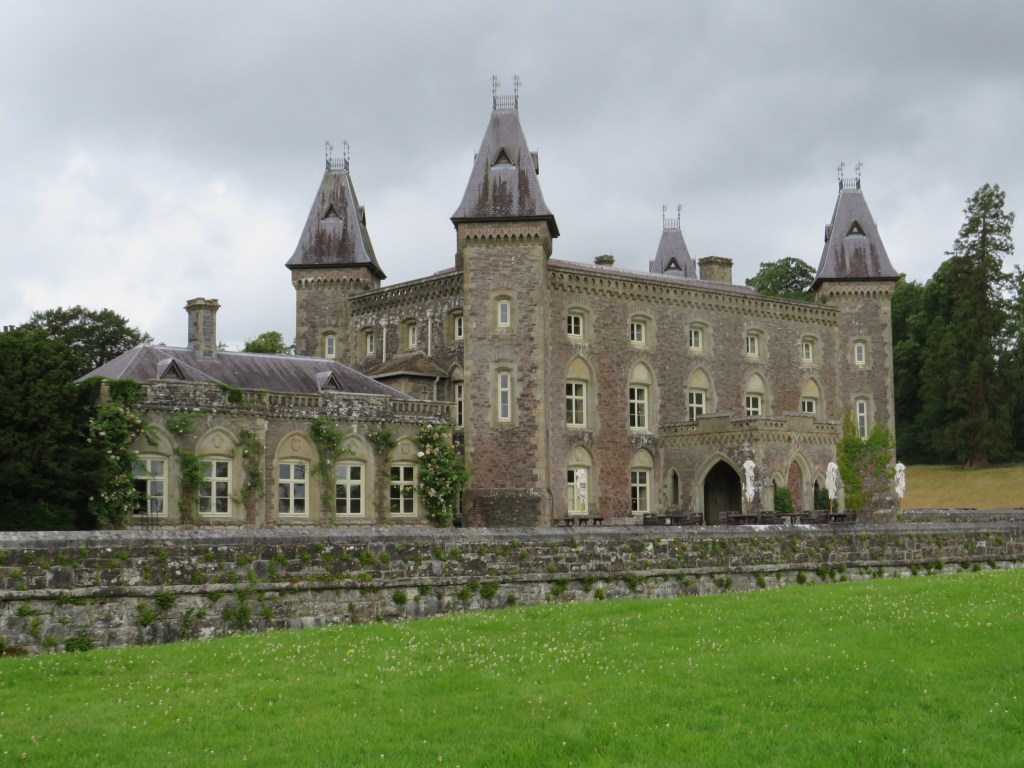
It always feels odd uploading holiday posts once I am safely back home but here is our final day in Wales. Today is our last day and we head north to Newton House, to tick the ‘National Trust property in Carmarthenshire’ box. We found this property a bit ‘alternative’. It is used more as a community space than as a way to share an historical narrative. Today the mothers and toddlers are meeting here and there’s a Disney film showing in the basement with a bed for viewers to lounge on. There is plenty of modern art work on display. This is in keeping with the ethos of the last owner Richard Rhys, who inherited the estate in the 1960s and turned it into a ‘castle for the arts’, holding festivals to showcase, music, art and craft. It also became a base for the National Theatre. The property was acquired by the Trust with no accompanying legacy for preservation or re-furnishing and it seem not a great deal is known about its history.
The current house was built in 1660 by Edward Rice on the site of a former Tudor hunting lodge and the Rice/Rhys family held it until it was given to the Trust. George Rice-Trevor, the 4th Baron Dynevor, was involved in trying to supress the Rebecca Riots, when rioters burned crops on the estate. These disturbances were similar to the south of England’s Swing Riots and took place between 1839 and 1843 as protesters objected high levels of taxation and the tolls that were levied on turnpike roads. Things that catch my eye include a mummified cat, allegedly hidden under the floor boards for luck, samples of old wallpaper and plaster, an elaborate papier mache ceiling and the mini biographies of former servants. There are also a couple of intriguing paintings. In one, the sitter ages by thirty years depending on which angle it is viewed from and another, of three children, seems to include ‘ghost children’. It seems this is not an overpainting. Officially, the guides have been told to say it is a trick of the light.
The landscape was designed by Lady Cecil Rice née Talbot in the mid eighteenth century and the park is a grade 1 site of special scientific interest and national nature reserve because of the lichens and fungi found here. The extensive Dinefwr estate is famous for White Park Cattle. We don’t see any but there are some deer in the misty distance.
Persistent drizzle dissuades us from exploring or walking a mile each way to view the twelfth century Dinefwr Castle, which was in the hands of the Rhys family for eight centuries. The original castle, which was captured by Lord Rhys in about 1165, was built in the nineth century, who then had the current castle built. So it is back to the van for a final lazy afternoon before an uneventful trip home.