Day 5
Having already done the activity planned for today, we decide to drive through Brighton to Shoreham and look at the nature reserve there. We manage to find a very reasonably priced car park and start to walk along the shoreline. This involves ploughing through ankle-threatening shingle, plus it is drizzling and blowing a gale, so we decide to cut our losses had have a quiet day in the van to regather our energy after three full on days, in preparation for what is to come.
Day 6
It is moving on day. I am responsible for the satnav and I enter the postcode for the site. The itinerary suggested that the journey time might be about two and a half hours, so we leave at an appropriate time to arrive when the new site opens at one. Oddly, the satnav thinks we might arrive considerably earlier than that. We remark that it isn’t taking us the way we might expect, as we drive through Brighton and head north. Perhaps, we think, this is what accounts for the earlier arrival time. After about ten miles, I look at our upcoming itinerary and realise that although I have programmed in A caravan site, it isn’t THE caravan site. I have inadvertently input the detail for the final site of the trip. The blessing is that these two sites are only thirty miles apart, so we haven’t gone too far out of our way. We end up arriving exactly as the site opens and we secure a lovely corner pitch, which has the advantage of a half decent television and Wifi signal.
Day 7
There have been a couple of very loud bangs seemingly coming from the caravan over the past few days. Chris thinks we need a part. Caravan supplies outlet duly identified we set off. Fortunately this isn’t too far away. Said part acquired, we head for Battle Abbey. I have purchased two maps for this stage in our trip but inevitably, I still don’t have one showing the site, which is just off the edge. This becomes an issue when we encounter a diversion and the satnav just wants us to ‘turn around when possible’. We see Rye from the car on the way.
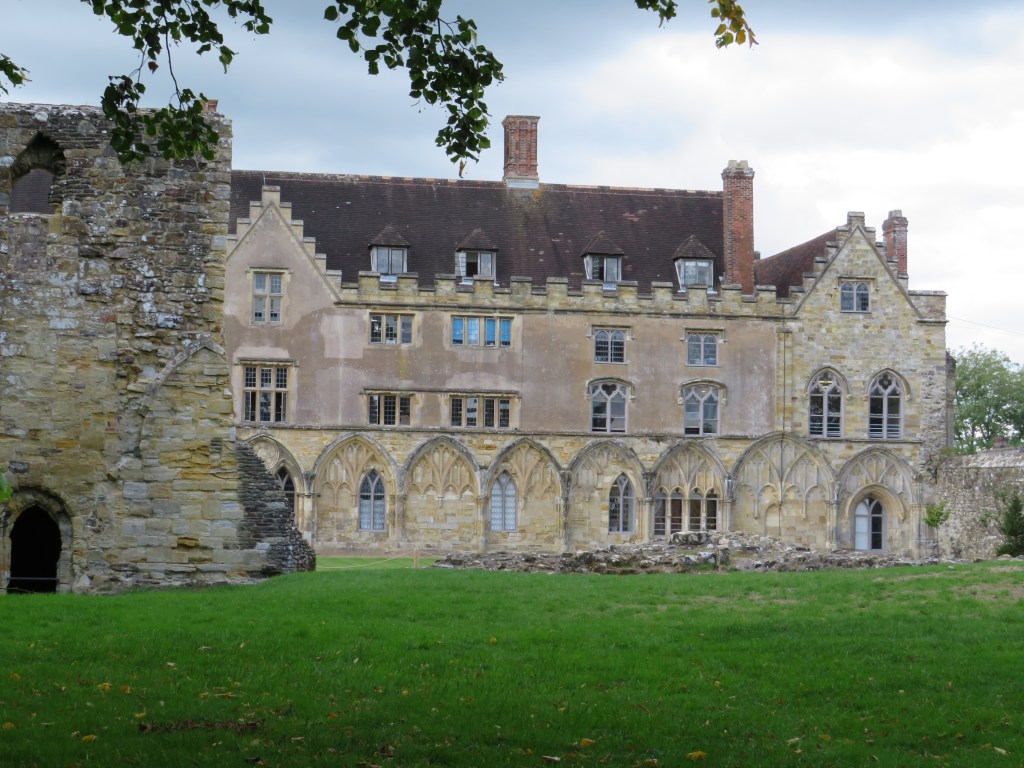
We arrive at Battle Abbey, just as Robert is starting his tour. This is all very well but we could have done with a ‘comfort stop’ first, especially is it turns out that the tour is nearly two hours long. It is thought that the Benedictine Abbey was sited here as the result of a penance by William I, who agreed to establish a religious foundation to atone for the Christian blood that he had shed during the battle. Its impressive appearance did also make a statement about Norman power and authority.
The battle for England, that took place on 14 October 1066, probably involved about 12,000 men, 7,000 of whom were supporting Harold Godwinson against the Norman invaders. There is something very atmospheric about standing on Senlac Hill. This would have been a heavily wooded site in 1066. The area where the fighting took place may have been cleared deliberately, as the English engineered this as the battle site; alternatively it may have already been cleared for cultivation. Identifying this spot as the location of the battle is based on contemporary chronicles and the fact that this is where William built his abbey. The high altar was allegedly positioned to be at the place where Harold Godwinson fell. We stop by the gatehouse, whose façade would originally have been painted and gilded. What is visible now was built in 1338. The Abbey’s wealth came from its land and also it’s exploitation of the 174 relics that it held. Only the most important guests and pilgrims could view the relics themselves. Others had to make do with paying for a ‘contact relic’, usually a metal disc, that had been touched on the relic.
After the Dissolution of the Monasteries, Henry VIII gave Battle to Sir Anthony Browne, his Commander of Horse and the guardian of his daughter, the future Elizabeth I. Browne demolished the abbey church and sold off the stone to pay for a three story mansion in which he intended to care for Princess Elizabeth. Browne died shortly afterwards and the future queen never came to live at Battle. The Abbey was sold to the Webster family in 1721 and then was purchased by the Duke and Duchess of Cleveland. In 1922, Battle Abbey School leased the former abbot’s house.
I know the battle story well. Our guide debates whether Harold Godwinson’s tired men would have marched south after defeating his brother Tostig and Norwegian king Harald Hardrada at Stamford Bridge. Would they have taken the easier option of travelling by sea? After all, Hardrada had arrived by boat and after the battle, Hardrada’s depleted troops did not need all the vessels to return home.
Although Godwinson’s troops did a great job of defending the hill with their shield wall, the Normans were better trained and their huge advantage was the cavalry. They probably had about 500 warhorses, who had recovered from the sea crossing having spent two weeks in Pevensey, where the Normans had erected what GCSE students usually refer to as ‘flat-pack’ castles. Sir Walter Gifford and three others were sent out from the Norman lines, to particularly target Godwinson. Was he shot through the eye? This too is up for debate. Chronicles suggest that his end was rather more gruesome. To be blinded was the normal punishment for perjury which Godwinson was considered to have committed, as he reneged on his holy oath to support William’s claim to the throne. The depiction of the arrow in the eye on the Bayeux Tapestry could therefore be symbolic.
Today’s cake of choice is a particularly yummy passionfruit and lime. We drive home through Winchelsea and are at least on an available map when we encounter yet another diversion.