The Experimental Archaeology Adventure Part 10: the end of the adventure, or just the beginning

It has been a long time since I wrote about my experimental archaeology adventures, partly because I have been having fun completing the final assignment but also because anything involving technology has been hampered by the long and sorry lack of a laptop saga. I won’t bore you further with that but in summary, after nearly seven weeks of inadequate computing, making everything take twice as long as it should, the issue was finally resolved. This involved buying a replacement machine, which I could have done in the first place, hindsight and all that.

Back to the experimental archaeology. The final trimester of my course was entitled Crafts, Making and Storytelling, which, as the name suggests, involved actually making something. Having received very pleasing and unexpected grades for my second trimester assignments, I began the new module full of enthusiasm. In April, I began to consider what I could make for the assignment. Initially, I had contemplated something fishing related, which would be appropriate for my coastal connections and build on my assignment for module one. Having dismissed the idea of a coracle as being too impractical, I wondered whether a traditional withy lobster-pot might be an alternative. A willow-weaving workshop made me flirt with the idea of basketry.

As a family historian, I wanted to experience an activity that would have been familiar to my ancestors, which led me to straw-plaiting. My great great grandmother, Ann Stratford and many of her immediate family were straw-plaiters. I already had an affinity with this lady, as I spent three years living in her home county of Buckinghamshire in the 1980s, before I knew I had ancestral connections to the area. It was only after I left that I discovered I had been living not just in the county or village of her birth but in the road in which Ann had been born.

I began to research the history and craft of straw-plaiting, discovering that it is on the red list of endangered heritage crafts, with fewer than twenty crafts-persons plaiting on a professional or amateur basis. I wasn’t anticipating becoming an accomplished practitioner but the prospect of trying something unusual appealed. My decision was made.

That was the easy part. Then craftsperson’s block set in. Whilst my colleagues were off casting bronze, building cloam ovens and shooting beavers to make robes (this last in the US I should add), I retreated into my comfort zone and spent ages on the storytelling element, revisiting my research into the life of great great granny and the craft of straw-plaiting, There were a variety of plaiting techniques of differing complexity. I learned about plain, pearl and brilliant designs and read of the possibilities of enhancing the plait with coloured straws, or using two straws together to improve the plait. I found illustrations of satin box, middle, wagon wheel and feather edge plaits. Finally, after a reinvigorating Zoom chat with fellow students, I realised that this was a making project and something needed to be produced. I sourced and ordered some straw, which then sat on my kitchen table for two weeks before I could bring myself to open the package. I moved on to researching straw-plaiting but I still wasn’t making anything. I am not by nature a quitter so eventually I made a start.

I decided to keep it simple and use a basic seven-strand plait. I had done this before as a child but had no recollection of how it was achieved. Online illustrations revealed that the plaiters’ rhyme, ‘under one, over two, pull it tight and that will do’, told you all that you needed to know. Unwilling to waste straws, I began by practicing with string. It didn’t take long to get into the rhythm but I only managed to avoid confusing the strands by lying them on a flat surface and securing the knotted end at the bottom with Sellotape. If I stopped and walked away, despite carefully laying out the strands, it was difficult to pick up where I left off. It was also very slow. I manage to produce something passable, if short and a little uneven. Even though straw has very different qualities to string it was difficult to imagine how plaiting could be done by holding seven straws in the air, let alone using thumbs and middle fingers, which was the approved technique.

As straw-plaiting was a family activity, with ten-year-olds allegedly being as proficient as adults, I practiced string plaiting with some of my descendants. They all mastered the technique quickly. My adult daughter produced a neat plait. The eight-year-old had trouble pulling it taught but realised her deficiency and declared hers to be widdle-waddle (the plaiters’ term for a child’s unsaleable plait). I don’t think either of the children thought it would be much fun as a long-term activity.

It was time to try using straw. I cut the ends off with a knife and tried splitting the straw but either my straw was thinner than nineteenth century straw or I lacked a sufficiently steady hand, as all I produced were small slivers of straw. I had read that ‘early home-made hats were crude and bulky’ and would have used un-split straw. This sounded like a description of something that I might produce, so I decided that I would use whole straws. I was not going to attempt the bleaching or dying parts of the process, which, in any case, would not have been universal. I ‘milled’ the full length of the straw with my rolling pin. Next came the soaking. The fifteen inch lengths fitted in my sink but straw floats, so I weighted it down with a knife.

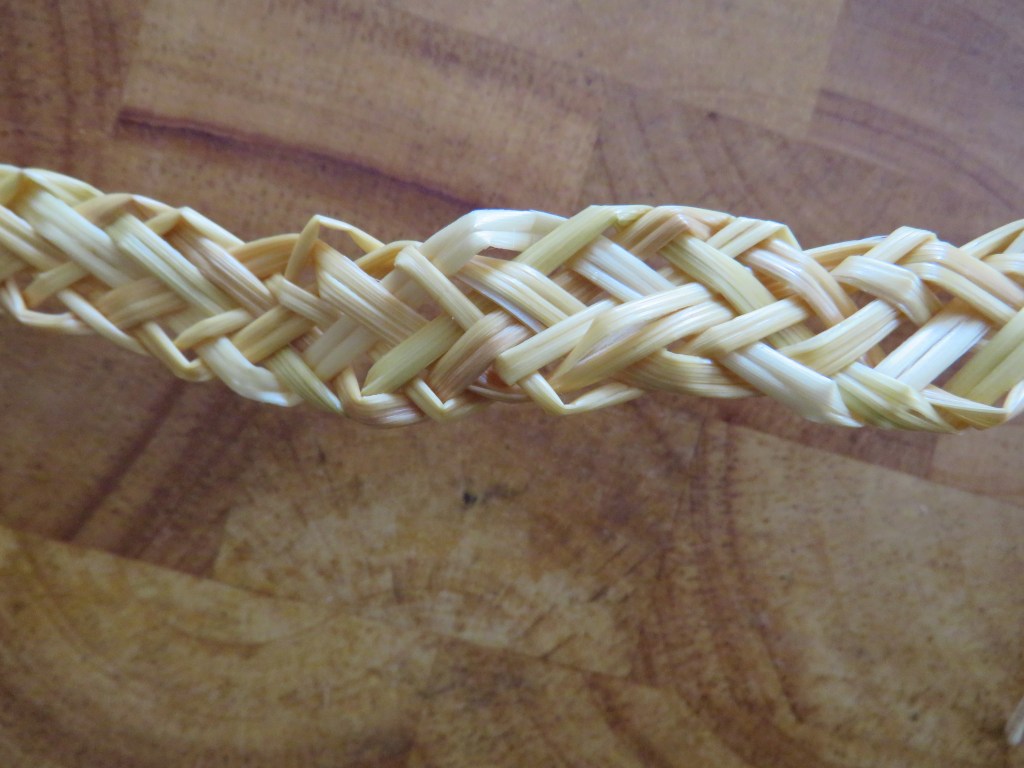
I chose seven straws, tied the ends together with yarn and began to plait. The approved method of using my thumbs and middle fingers to plait and my forefingers to turn splits, or in my case, straws, sounded rather like patting one’s head and rubbing ones stomach but I started slowly. I began by laying the straw on a flat surface, as I had with the string. This went well until I reached the end of the straws; all seven ran out at the same time. I made a terrible mess of trying to join in new straws. With hindsight maybe I should have started with straws of different lengths. As I progressed joining new straws became a little easier, as only one or two needed replacing at the same time. I gradually progress from the table to holding the straws in my hands but had to recite the ‘over one under two’ rhyme to keep me in rhythm. After an hour of plaiting, I had produced thirty inches of plait. The literature is contradictory about likely output but opinions ranged from ten to twenty-seven yards per day; I clearly had a long way to go.

My next plaiting session, I tried a different method of joining on new straws, slotting the hollow end of the new straw over the narrow end of the previous one. This wasn’t always successful as sometimes the end of the new straw split but it was an improvement. I was finding the straw more difficult to manage and realised I had forgotten the milling stage. This resulted in a much less neat plait but did mean I had preserved the hollow ends, thus enabling me to join straws using these. I resolved in future to mill but not to continue this to the very end, so that I could still slide one straw over another and avoid so many loose ends. Still chanting the rhyme, I achieved a similar output to the previous session.

By the third attempt, I was getting quicker but certainly not neater. After an hour and a half I had another ninety inches of plait. I had expected to find working the straw rough to the touch but this wasn’t the case. Keeping the straw wet meant that my fingers were continually damp and having plaited for longer, my right arm and shoulder were aching. By now, visions of plaiting were appearing before my eyes when I closed them.

Fortuitously, at this point, BBC2 re-screened a programme about the Luton hat trade. This revealed several useful pieces of information. Firstly, I had been using my straw splitter incorrectly. I was trying to score the straw with the point but it seems that the point needed to be inserted in the end of a straw and pulled down. I tried this technique but the results were little better than those achieved using my method. Alarmingly, I learned that 4000 straws were required to make a hat. I am glad I didn’t know this beforehand as I would not have contemplated investing £240 on straw. More encouragingly, the narrator went on to say that nine yards of plait could make a hat. I already had nearly five yards having used about fifty straws so something wasn’t computing here.

By day four I was getting both fast and neater, achieving 1·5 yards in twenty minutes.  Joining in new straws was still not very tidy but in general, the finished plait looked less messy than my first attempts, partly because I wasn’t plaiting to the thinnest end of the straws. I still wasn’t able to use my fingers in the approved manner. The discomfort in my right arm and shoulder continued and I still needed to recite the rhyme as I plaited but it was definitely becoming more instinctive. I did try putting the straws in my mouth, as Victorian plaiters would have done but I failed to see how the whole straw could be kept damp in this way.

At this point, I was excited to discover that great great granny, at the age of twelve, had won a prize for her plaiting. I am not sure those particular skills have passed to me. I began writing the final assignment, concentrating on describing the craft and telling the story.

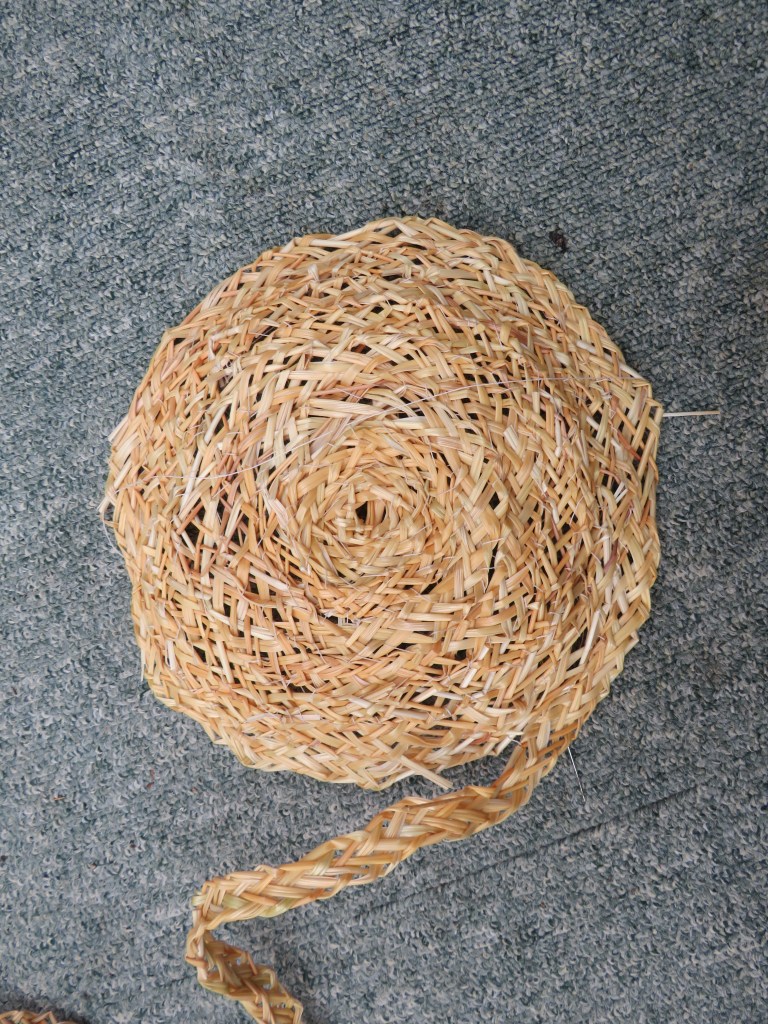
Three more plaiting sessions and I thought I might have enough to make a hat. I started in the centre and began to pull the braid into a spiral, working in an anti-clockwise direction; this may be because I am naturally left-handed. This was a more uncomfortable process, with the rough straw scraping at the skin on the backs of my fingers. It was also difficult to keep the plait damp. I decided not to overlap the braid in the English fashion as that would require more plait. I didn’t really have much idea how to create a hat shape and wondered if I would end up with a flat circle. Professional hat-makers would have used a head-shaped block and steamed the straw into shape. I didn’t have the wherewithal to do this. In the end the shape evolved of its own accord as I continued to sew. I was concerned that it might be difficult to finish off the ends but this was relatively simple as the ends of unplaited straw could be tucked into the weave.

The finished object resembled a pudding basin or lampshade, rather than a hat and certainly wasn’t neat and stylish. The underside of the straw is very scratchy, making it uncomfortable to wear. I did try tying it on as an alternative way to wear it.

Whilst I was pleased to have created a finished product, I was a little disappointed not to have made something that I could actually wear in public, even if only when I am living in the seventeenth century. I am not a natural crafts-person and I am also a perfectionist. What I produced was far from perfect but I enjoyed the process. The repetitive action of the plaiting was therapeutic but I certainly wouldn’t want to spend my working life as a plaiter of straw. I particularly valued the chance to step into my ancestor’s shoes and feel an even closer connection to Ann as a result of this project. Highly recommended for all family historians. Would I try this again? My heart says yes but my head knows that there isn’t room in my life to pursue craft activities with much rigor. I can see myself demonstrating the plaiting technique if the occasion arises. I have revisited my research into Ann’s family, with particular emphasis on the social context and the role that straw-plaiting played in the community and her life; I feel that I can now do so with greater insight. Watch this space for a post about Ann.

The course has been a great experience. I have learned a great deal about experimental archaeology and still more about material culture. I have climbed some technological hills and crafting mountains. I have met some hugely talented, diverse fellow students and we plan to keep in touch. So what next? There are plans. It may be that there will be an online MA on offer, which is tempting, further study does appeal. I am however mindful of how many things I still want to achieve and maybe I need to start prioritising as tempus is fugitting away like mad (it is still May isn’t it?). There is an exciting potential project in the offing with my coven lovely group of ladies. I have a non-fiction book to finish writing. I really want to focus on telling more stories from my own family history and as a result of this course, focussing on some of the family heirlooms and telling their stories before they are lost. I do still hanker after learning Cornish, remember I got as far as buying the books in lockdown?

Ann Palmer’s Story

Please be aware that this post contains information about an historic child murder and mental distress.

I am still fighting the not-quite-working computer issues but I have paused the list of 101 things to do before September (err that would be tomorrow – oops) to share the story of Ann Palmer.

I first came across Ann when researching for a talk and book chapter about investigating the stories of our ancestors in asylums. This led me to a class of records that are at The National Archives but also online at Ancestry. The Criminal Lunatic Asylum Registers, kept by the National Lunatic Asylum and county and metropolitan asylums, are in class HO20 and cover the period 1800-1843. These contain a wealth of detail about those who had been convicted of criminal offences but were deemed to be insane. I could have spent hours looking at the detailed accounts of these tragic situations but one in particular caught my eye. This was the entry for Ann Palmer, from Dagenham, Essex, who was convicted of murder at Chelmsford Assizes in 1823. It read:

‘The jury having found that she was insane at the time of the commission of the offence declare that she was acquitted by them on account of such insanity. From Dagenham, Essex.

Previous to Commitment. About 25 years since she partially cut her throat while she lived servant at Newington. Is said to have been a good and affectionate mother. Was married to a very afflicted man who kept a small public house at Marks Gate, Padnell Corner, Dagenham and became much afflicted in her mind at her husband’s death, which happened a short time before her commitment in consequence of her being informed that his body had been stolen from the grave.

Conduct in goal since. Decidedly insane, sometimes violent, at others dull and moody but not dangerous to those about her.

Thos. Cawkivell Goaler, Jas. Hutchinson Chaplain.

The state of her bodily health varied much during the period of her confinement but more particularly since the time of her trial. She was at one time reduced to so feeble a state that considerable apprehensions were entertained of her probable dissolution but she has within the last 10 or 12 days become more tranquil and has appeared gradually to acquire a strength insomuch that I have no hesitation in pronouncing her capable of safe removal to any place which may be appointed for her. 14 August 1823 G A Gepp Surgeon.’

The record also revealed that Ann was 43 years old and died on 23February 1824.

I had a quick look for Ann in the newspaper archive but failed to find anything and Palmer was a common name, so I wasn’t getting anywhere and in any case, I had other things on the urgent list.

Every couple of weeks I get together with a lovely group of ladies to chat about family history; we enjoy encouraging each other and sharing our successes, failures and tips. I brought Ann’s case to the group. Collectively we found not one but two newspaper reports. The first, in the Public Ledger and Daily Advertiser of the 21st of July 1823 gave details of Ann’s crime.

            ‘Chelmsford July 17. Ann Palmer was indicted for the murder of her infant son, at Romford. This case excited considerable interest, and sensibly affected a very crowded auditory. The wretched prisoner, a poor widow with nine children, was place at the bar in a state of mental stupor, and it was with difficulty she was made to understand the arraignment. She, however, pleaded not guilty, and the trial proceeded.

Ann Savell deposed that she had known the prisoner about three months. On the 23rd of May the prisoner’s eldest daughter called witness into the prisoner’s house, when she saw the deceased, who was only eleven months old, stretched lifeless upon a bed, but the body was still warm. The prisoner was in the room, and witness said to her, “the dear baby is no more, but you must reconcile yourself to the event. The Lord’s will be done, not ours.” She replied, “the Lord had nothing to do with it; I killed my baby.” She seemed then much agitated, and witness left the house horror-struck at the circumstance.

Mary Palmer, the prisoner’s eldest daughter, deposed that her father had been dead about four months. Her mother was quite overpowered with grief at his loss. There was a rumour that his body had been disturbed in the grave, which very much increased her grief. Indeed she was quite distracted with sorrow, and at times did not know what she said or did. She was a woman of very acute feelings, and was doatingly attached to her husband and children. She had suckled the deceased baby herself, and was passionately fond of him. She had often sat whole days since her husband’s death, weeping over the baby. She had often said she would kill herself, Before this time she had frequently said, laughing wildly, that the baby was dead and gone to heaven. On the 24th May she called to witness, and told her the baby was dead. She was then crying bitterly and wringing her hands. There was a small black mark on the left temple.

A Constable of Romford deposed that he saw the prisoner some time after the child was found dead. She was then violently beating her head, weeping and wringing her hands. She said, distractedly, “Hell! Hell, hell! I have murdered my baby. I meant the blow or myself, but it fell upon the baby. The beetle with which I did it stands behind the door. I have murder in my heart, and have carried a razor about me this fortnight.” She appeared quite wild and distracted.

Mr Curruthers, a surgeon, deposed that he examined the body often child. Its death was occasioned by a blow to the back of the head. It might have been with such an instrument as a beetle or mallet.

This was the case for the prosecution; upon which Mr Baron Graham intonated, that he thought it unnecessary to call upon the prisoner for her defence. It was quite obvious that poverty and grief had overpowered the better affections of the heart, and had bereft the prisoner of her reason. If the Jury were of this opinion, they would find the prisoner not guilty upon that ground.

The Jury immediately found the prisoner Not Guilty, on the ground that she was insane at the time she committed the fatal act.

The prisoner was then ordered to be detained in custody.”

The Cambridge Chronicle and Journal of 25 July 1823 carries and almost identical report but adds that the child’s name was Thomas and the National Burial Index lists the burial of a Thomas Palmer in Romford on 27 May 1823.

Burning some midnight oil we found more entries in the online indexes to Essex parish registers, including the burial of a Joseph Palmer on 13 March 1823 ‘of Dagenham’ at Stapleford Abbotts. There are baptisms of several children of Joseph and Ann. Some of the children seem to have been baptised more than once, including in January 1824, in Dagenham, which seems odd, as Joseph would have been dead by then. The Dagenham baptisms do state that Joseph was a publican.

Next step, to persuade the member of our group who lives closest to take a look at the original records.

No appropriate image, so some flowers for Ann and her family.

Sources

Cambridge Chronicle and Journal 25 July 1823 p. 4 col. c.

Public Ledger and Daily Advertiser 21 of July 1823 p. 4 col. a.

Online indexes to Essex parish registers via www.findmypast.co.uk

The Criminal Lunatic Asylum Registers at The National Archives HO20/13, accessed via www.ancestry.co.uk

A Trip to the Commonwealth Games: or how to worry about 95 things at once

Having enjoyed the 2012 Olympics and 2014 Commonwealth Games in Glasgow, the 2022 Commonwealth Games have been in my diary since the venue was announced. The Birmingham caravan site was booked as soon as I was able for the duration of the games, whilst I waited to see what tickets I could get and how long we would actually need to stay. I duly applied to spend a small fortune on tickets and secured two athletics sessions fairly swiftly. Something that looked like tickets arrived by email. A few weeks ago, I managed to buy tickets for an additional session. This time the ’ticket’ looked different and I realised that the first two did not include seat numbers, whereas the later ones did. Panic one – had I missed an email with actual tickets in? I used the contact us facility on the website and waited and waited and waited some more and heard precisely nothing. Would we not be able to go after all? Finally after a great deal of poking around on the website, I found that I could access actual tickets and download them that way. This was not without incident but was accomplished.

Panic two – how were we going to get from the caravan site to the venue, which was on the other side of Birmingham? To be honest I’d assumed we’d use public transport. Further investigation revealed train stations near the site and the venue but the need for two trains and a walk to get from one to the other and a warning that the last train left the venue before the end of the evening session! Well, that’s helpful (or similar) thought I. We were warned that there was no parking at the venue. Could we perhaps drive to a station and then pick up public transport? That of course didn’t solve the trains not running late enough issue. Could we park in the road anywhere up to a couple of miles away and walk in? Possibly but panic three would these roads be residents only parking? It seemed that it was possible to book a spot at a park and ride at significant cost. The most convenient one was already fully booked but I managed to get three spots at a further distant park and ride. More ticket downloading to negotiate. Said tickets and the website warned that we must arrive in out allotted time slot or risk not being allowed to park.

I checked the what you are allowed to take into the venue regulations carefully. Then I noticed something to engender panic four. If you downloaded your tickets more than once only the most recent one would be valid as a new barcode would be generated each time. I wasn’t convinced that this would actually be the case but supposing it was? Supposing I hadn’t printed the latest version. Maybe I should download them again. Oh dear, there were warnings that if you repeatedly tried to download it wouldn’t work. Nonetheless, I decided to risk downloading again. By this time, my computer had died a sad and stress inducing death and I was working on a combination of two replacement machines. These are a borrowed laptop that I could use to access websites, as I could persuade it to remember my passwords but it had all the wrong software and didn’t connect to my printer and a tiny broken netbook with no memory (so won’t update) but does at least have the right software even though it doesn’t use the same browser. Undaunted by swapping from machine to machine I reprinted the tickets, making sure I saved the originals ‘just in case’.

The journey to Birmingham was uneventful  but the caravan site is entered and exited via a charged barrier card. We have to be at the park and ride between 6.45am and 7.00am. It is forty minutes away. In my language this means we leave at 5.30am. Panic five, what happens if the card hasn’t been charged properly and we can’t get out? I am persuaded, against my better judgement that this won’t happen.  It doesn’t, so next day and we set off for the park and ride. I try to put the postcode into the sat-nav. The postcode does not exist. I put the street address in instead. That leads us to a residential road with no multi-storey car-park in sight. See, I knew we needed to allow extra time. What to do now? Fortuitously, I had for some random reason downloaded what-three-words on my phone. I have the car-park’s three words. After a couple of false starts I make this work. Inevitably, we are still too early but we are allowed to wait and park at 6.45am. We walk round to the shuttle bus. Panic six – we will be in this car park all day. Technically our first ticket is for 6.45-3.00 and the next for 3.30-11.45. It did say we could stay all day and I have had both tickets scanned so let’s hope we don’t come back to find ourselves clamped. The bus to the stadium is uneventful. We have seats that are rather higher up than is comfortable for someone who doesn’t even like standing on chairs but we have a good view of the finish line.  We see some heptathlon events, with three English competitors including Katerina Johnson-Thompson and women’s 800m heats with Laura Muir, men’s long jump qualifying, then rather a lot of men’s 100m heats and women’s T37/38 heats with Sophie Hahn.

Weirdly, the food outlets close before the end of the morning session and we have to leave the stadium. We elect to sit on a random piece of grass for four hours and eat the food we have brought with us. In the evening, we are high up again at the opposite end of the stadium. This gives us a good view of the women’s pole vault. There is more heptathlon, men’s 400m hurdles rounds, the men’s T45/47 100m final, women’s T37/38 100m final, the men’s 110m hurdles rounds, the women’s discus final, the women’s T33/34 100m with Hannah Cockcroft and the men’s 10,000m final. It seems that the British Virgin Island team is pretty much all the same family, with five siblings, including two sets of twins, competing. We are at the furthest point from the shuttle buses but panic seven (that we might miss the last shuttle bus) is unfounded. Even more peculiar that the closing of the food outlets is the closing of all the toilets before the spectators leave the stadium. It seems that buses have been bussed in from across the country and we board a Trumpington park and ride bus. All is well and we retrieve the car, which hasn’t been clamped.

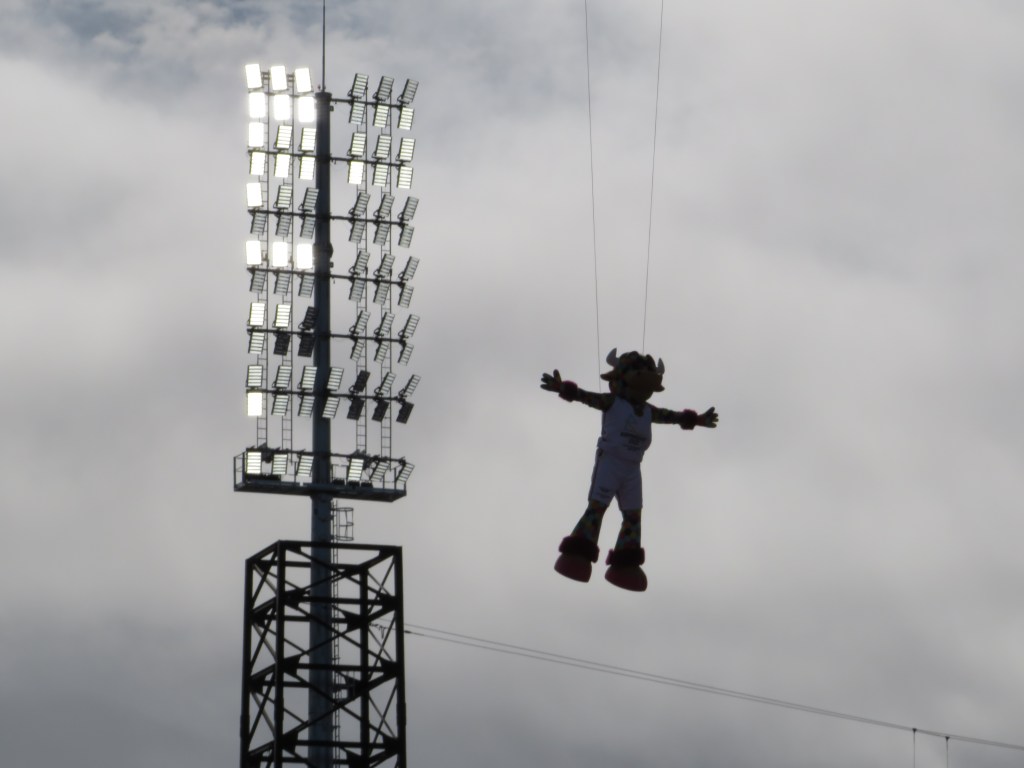
We decide we can safely leave half an hour later for our second morning session. We are still just a little early so hide in a side road and turn up at exactly 6.45am to be told that they are not letting anyone in until 7.15am. I point out that our ticket says be there between 6.45am and 7.00am on pain of death to no avail. We park at 7.15am and are in the stadium in plenty of time. I enjoy watching the pre-event preparations. Radzi and Ewan Thomas are doing a good job of hosting. There are pyrotechnics and the games mascot, Perry the bull, flies in. This time we are much lower down, so we are nearer the action but we don’t get the bird’s eye view of the finish. Fortunately it is mostly 400m and 800m, rounds, as well as more heptathlon. It did get quite hot but I was prepared with my 2012 baseball cap (not worn since 2012). The person sitting next to me is also wearing 2012 merchandise.

Was it worth it? Yes, although I must learn to panic less before I try this again.

How attempting to be in two places at once nearly led to being nowhere at all – or the day technology died

You can probably tell from the paucity of posts that life has been busy lately. Last night I was triple booked. Reluctantly, I had to miss hosting an excellent Devon Family History Society Zoom talk. This at least was one that I could leave in the hands of my competent colleagues. Next, to work out how to host the Zoom element of our hybrid local history group meeting and be giving a talk elsewhere myself. This is something I have accomplished before. I open the meeting pass the hosting to an able assistant and go off and give my talk. Simple. Until yesterday morning my laptop flashes up a message reading ‘Locked’ and turns itself off.  Said laptop turns back on but I spot that the battery is perilously low and although it reads ‘plugged in’, ominously it does not say ‘plugged in charging’. That would be because it wasn’t charging. Result one dead battery and a laptop that won’t turn on.

The computer shop can get me a new battery – hurrah – but it will take a few days. The current non-battery is only three months old so hopefully under warranty, which means I don’t have the option of trying to source one elsewhere. In any case ‘elsewhere’ is at least 16 miles away.

As 9% battery life became 8% I rapidly pulled off the things on the desk top that I might need and hadn’t quite got round to backing up and watched the gradual demise of the remaining battery. Good news, I have a plan B option in the form of the laptop of the fisherman of my acquaintance. Better news, this machine is in my house ready for being in two places at once later in the day. Not all good news though, it has different versions of the key programmes that I use.

I spend a while tweaking the presentation I am due to give in the evening his free version of powerpoint has different fonts, which has messed up my text. I then realise that I can’t access all my emails on this machine without possibly making life difficult for its owner and the link to join tonight’s meeting is inaccessible. This year however is the year I learnt to use my phone. I use the phone to email the link to the borrowed laptop’s owner – sorted. Next to access the software for the job we must not mention. My own element of this is over for now but I still have to supervise others. This is not an easy process and involves several levels of security, passwords etc.. passwords that are stored …… on the other computer. I manage to use the guest facility to convince the borrow laptop to remember some saved passwords. I even manage to convince the dying battery on my own machine to yield a document I had forgotten to copy that helps me with other passwords. I do have this backed up elsewhere but didn’t want to have to faff about with external hard drives on a day that was already rapidly slipping away.

After about two and a half hours of trying to set the borrowed machine up so I could actually do something, I tell the tale of woe to my daughter. She informs me that if I remove the dead battery from my own machine and plug it in it will stop trying to charge the unchargeable and – work. It seems this is so – yipee. By this time I have totally lost the will to do anything I should be doing – life seems to have been a bit like that lately.

Come the evening. My companion is ready and waiting to host the hybrid local history meeting. I click to join the meeting where I am the speaker. It turns out that I am not the only person whose day has not gone to plan. The host’s modem had died. The substitute host was in the midst of a powercut and running the meeting using her phone as a hotspot. Good job I am not required to do this, my newfound phone proficiency would not extend that far, not to mention my meagre data allowance. Though I do confess to having recently upped the allowance in order to rush round the country catching Pokémon. I am still claiming that this is solely to interact with the grandchildren. My story, I’m sticking to it.

The saga is not yet over. While waiting to start my talk there is a knock on the door. It is the host of the physical element of the hybrid meeting, which takes place next door, to whom I have errrr somehow neglected to send the link. Fortunately there is still time to email this before I have to start speaking.

Well despite the technology gods being against us, somehow three meetings seems to take place without further incident. I would say today can only get better but I am not willing to tempt fate.

Image by Peggy und Marco Lachmann-Anke from Pixabay free to use

Of Procrastination and Potash Makers

Where have you been? I hear you cry. Actually, I suspect that you never noticed that this is probably my longest gap between posts ever. My recent adventures have included a lovely week on the Isle of Wight with some of my descendants, frantically trying to keep up with the grandchildren on Pokémon Go and some uplifting walks along the beach in the early morning. I have also been able to meet more than one set of old friends who have been holidaying in the area. It is a wonderful feeling when you get together with people you haven’t seen for twenty years and you can’t believe that you didn’t last chat a few weeks ago. There was also the chance to meet much newer online friends in person.

Mistress Agnes has ventured into a school for the first time since lockdown, you really can’t keep that good woman down. She is now frantically concocting herbal cures for some aggressive bites, acquired when standing in a field whilst her colleague shot a few people. There have been talks to give to audiences across the world, sadly only a virtual trip to Australia this time and courses to prepare. Next up is my five week online course for Pharos Tutoring and Teaching that focuses on researching family and local history in the first half of the twentieth century, with a whole new section to write on the 1921 census. Still space for you to enrol if you want to join in the fun on this one. As I was reviewing the course, I decided to go through it myself and add to the biography of my grandmother, which is making very slow progress.

The next non-fiction book now has nearly three chapters done, the latest has seen me researching a fascinating family from the Romani community, which includes the notorious ‘Gypsy King’, Wisdom Smith. The final term of my post-grad course has begun and with it the incentive to focus on a great great grandmother’s story but more of that in a separate post.

I have also done a fair bit of procrastinating and doing things that aren’t even on the frighteningly long to do list. I can’t even remember why I thought I’d do this but I took a look at how many direct ancestors I have discovered in 45 years of research. To save you the maths, if you go back to your 6x great grandparents, who, if you are my generation, were probably born in the first half of the eighteenth century, there are a potential 510 direct ancestors. I have full names for 203 of them, approximately 40%. I don’t count the ones where I don’t have the woman’s maiden name. I do have the names of more distant ancestors but after the 6x great grandparents the numbers are frightening and the success rate dwindles significantly, so I stopped at this point. My percentage found is probably not bad for someone with English ancestry; these ancestors come from nine English counties. One quarter of my ancestry suffers from pedigree collapse, as first cousins marry in two successive generations. This probably explains a lot but also means that one set of 4x great grandparents appear in my direct ancestry three times.

I decided I would put off doing what I should be doing and see how evenly spread these ancestors were across different branches of my family. To explain what I mean: I looked at each of my eight great grandparents in turn and calculated how many of their direct ancestors I had found in the preceding five generations; there are potentially 62 for each great grandparent. The greatest success is with my direct paternal, west country, line. I can identify 40/62 of great grandfather William James Braund’s ancestors, closely followed by 35/62 ancestors for his wife Fanny Thomasine Bishop. In fact, my father’s family holds third place too, with 33/62 ancestors of Caroline Howe on the tree. We will draw a veil over the 9/62 for great grandfather John Hogg. In my defence I am 95% sure of some of the missing ones. I just feel that I need one more piece of supporting evidence to ink in several generations of John Hogg’s Northumbrian ancestry. The statistics on my mother’s side are hampered by those pesky repeated 4x great grandparents who create a brick wall in three places, although again, I have my suspicions of who fits in the gaps.

The upshot of all this is that I tried to boost the numbers by looking again at a brick wall that I hadn’t investigated much before. Oh boy this looked interesting, potash makers, gentlemen, a chap who endorsed a quack doctor, claiming to have his hearing restored, in a newspaper advert of 1785 – great stuff. Slight side-track while I check exactly what potash makers did and add the newspaper advert to my history of medicine course. This branch was not a straightforward family to trace, due to their use of a very limited range of Christian names and the fact that they come from a county whose parish registers are only online in indexed form. Ooh look though, they left wills and I could obtain these from a very efficient record office within twenty four hours. This would be just the final confirmatory piece of the jigsaw I needed, then I too could follow the lead of the umpteen online trees who joined the potash maker (he of the miracle cure) and the gentleman to my tree. Except I can’t. A great will, mentioning five generations of the testator’s family, which clearly none of those online tree compilers have read. Back to the drawing board and I feel a mini one-name study coming on, when I should of course be doing something else entirely. Is the potash maker mine or not? Watch this space.

To add to the fun, the job I must not mention has now arrived with a vengeance but I may post here as light relief.

And the Holiday Ends

A chance remark from fellow tourists who we encountered at the Vale of Avalon induced us to visit a tourist attraction that we have to pay for. We duly set of for the Hidden Valley, near Launceston. Despite many trips to Cornwall, this was a new one on us. It is a glorified, mostly outdoor, escape room and there were plenty of earnest adults taking it extremely seriously. I am not sure we are the target demographic but it was great fun, even though the puzzles were a bit beyond us. We started indoors in the Forbidden Mansion where the puzzle involved quick reactions and flashing lights. The tricky part was working out exactly what you were supposed to do. We didn’t realise that we were only going to get one attempt at this. In fact, we were entitled to a card each but had gone for sharing. I think I accomplished three of the tasks. There were also twenty things to spot as you went round. These were well hidden and it took us two circuits to get nineteen of them.

Outside next and the beech maze was a fail; we ended up coming out the way we went in. We decided we’d set the bar low and followed the rope trail to find ten labels, each with a number to add and a letter to create an anagram to unscramble; an activity that was aimed at the pre-school children. Even this took two attempts and I failed to identify some of the more modern cartoon characters. We kept encountering the same families looking equally confused. The twenty-something childfree couples rushed round, heads-down doing hugely complicated things, aided by phone apps, which I think were ‘cheats’, on the ‘Big Blimp’ challenge. We did have a go at ‘Little Blimp’, where the puzzles were at least intelligible and achieved 13/15 of these.

This was all set in very attractive and well maintained grounds and we were surprised to find that the attraction had been open since the 1990s, as it didn’t look in the least bit tired. There was the opportunity to ride on a mini-train but this was very popular so we allowed smaller persons to take up the few available seats. There was also a model train running round part of the gardens. The site is still being developed and an impressive looking adventure playground-type feature was being constructed, with plans for this to be open by the summer. Despite the feeling of total inadequacy that the visit engendered, we had an enjoyable day.

We drove to Padstow, now commercialised by the Rick Stein effect. It is still a working harbour, so boats for the fisherman of my acquaintance to look at. We walked up the hill towards the lower beach. Deciding not to pay inflated Padstow refreshment prices, we repaired to a garden centre that we’d spotted on the way, intending to have a drink. They were still serving carvery lunches and although they were quite willing for us just to have a drink, we could hardly pass up the opportunity. So a lovely, expansive carvery lunch for only twice what it would have cost to have a coffee and cake in Padstow. Sizeable desserts were on offer too. Consuming massive portions of Eton Mess, on top of a carvery where you could have as much veg as you liked is always one of those seems like a good idea at the time things and it was lovely but it did mean that we didn’t want to do much afterwards.

So the end of the holiday and we managed to only get wet once – result! Slightly fuzzy photo as the light was poor.

Cornish Castles

If you ever decide to visit Launceston Castle, there are a few things to be aware of. The English Heritage website says you don’t need to book, we didn’t, that wasn’t a problem. The site also says that booking ‘does not guarantee a car parking space’. This is on a webpage headed ‘Launceston Castle’. If you saw this, dear reader, would you or would you not assume that there was a car park for the castle? Hindsight, which as we all know is a wonderful thing, reveals that this is generic wording and that, contrary to popular belief, there is no castle car park but before we arrived at this momentous revelation, we fruitlessly tried to follow the sat-nav to what we fondly believed would be the car park. With shades of Fowey, this involved some narrowish twisting and turning and one-way systems and not a little going round in circles as we missed what appeared to be the vital turning. ‘It is no through road’, observes the trusty chauffeur’. ‘Well’, says I, ‘if it leads to a car park, it will be.’ Except it didn’t lead to a car park. Cue the need for a great deal of skilful reversing then more circuitous routes round Launceston to find an actual carpark. Then of course it was find the castle time. If you’ve ever been to Launceston, the castle is on a massive hill, looming over the town. You’d think it would be visible from anywhere. Another rash assumption. We parked the car began to walk towards the castle and then totally lost sight of it.

After all this, the castle needed to be good to make it worthwhile. To be honest, as castles go, it was a little underwhelming. It consists of a round stone tower on top of a very steep mound. The stone tower inside a shell keep was built by Richard, Earl of Cornwall, or rather by hapless local peasants, for Richard Earl of Cornwall, in the thirteenth century. I am also not sure what a great idea it was to climb up an extremely steep hill to look at the, albeit impressive, views from a great height, when I am not even keen on standing on a chair. I made it up and I made it down nonetheless.

A quick sit in the sun and then we strolled along the coastal path towards Boscastle, which was less steep and less wet than our foray in the opposite direction. There were also a pair of stonechats posing almost long enough for the camera.

The next day we drove to nearby Tintagel and walked up to the castle. They have built a notorious bridge since our last visit but I decide that could be a bridge (ha) too far so we ask to approach the castle by an alternative route. This alternative appeared to involve going in the official exit and at each stage of the contra-flow we had to explain to staff why I am too much of a woose to cross the bridge. Actually having seen it in the flesh, I think it would have been wide enough for me to walk across without being able to see the dizzying depths below, so perhaps another time I might brave it. The alternative is no walk in the park either, with precarious steps up the side of the wind-blown cliffs.

The castle was another possession of Richard, the thirteenth century Earl of Cornwall but is also the site of remains of much older dwellings. It is likely that there was a settlement here more than 1500 years ago. Until the twentieth century, Tintagel referred to the castle only and the hamlet was called Trevena, meaning ‘farmstead on the hillside’. It was Tennyson who drew attention to the castle, with its Arthurian associations and it became a focus for visitors. Having sampled yet more ice cream, honeycomb this time, we struggled through the wind, down the hill and then back up to the village.

We had limited time in the car park but managed to fit in a quick trip to Tintagel Old Post Office as well. Although this was a little rushed, it turns out that this was just the amount of time allowed to us before it began to rain. The Post Office was the previous commercial use for this six hundred year old former farmhouse. Originally a through-passage, single-story dwelling, there were modifications in the sixteenth and seventeenth centuries and there is a lovely collection of samplers on the wall, as well as an attractive cottage garden.

More Belated Cornish News

Sorry to leave you in Cornish limbo but the wifi went from bad to ridiculous and the chances of posting were less than. So, from the comfort of my home wifi, here is what happened next.

We waited for the rain to pass over and then drove in to Portreath. The town looked a bit dilapidated and seemed to have escaped the overwhelming second-home incursion of other coastal communities. There is an interesting industrial heritage. Copper was exported from the harbour and Welsh coal was brought in. It was also centre for shipbuilding. A tramway was constructed in 1809. After a ‘bracing’ walk across the headland, we drove back to Chapel Porth. More obligatory ice cream sampling, chocolate fudge for me and a Chapel Porth speciality ‘Hedgehog’ for my companion. No small mammals are harmed in the construction of this ice cream. It includes vanilla ice cream, clotted cream and plenty of nuts and proves quite difficult to consume. Hedgehogs dispatched, we stroll along the beach past numerous caves, interesting rock formations and thousands of mussels clinging to the rocks.

The next day was the day for moving sites and heading back towards home. It was only about an hour’s drive to the site near Tintagel. In theory, there should have been more lovely views through the driving rain. Having set up the van we took advantage of the sun coming out to admire said views and set off to walk a short way along the coastal path which runs by the site. The wind was on the invigorating side and the path typically ‘undulating’ aka lots of steep clambering up and down. Not shingle this time just slate. ‘Good job it isn’t raining or this would be very slippery’, I occasioned to remark. One thing with invigorating wind is that it blows the clouds away swiftly. Sadly, it also works in reverse and twenty minutes into the walk we were caught by lashing rain. I wasn’t wrong about the slippery slate. We were now clinging to ice-like narrow ledges on the side of towering cliffs, with a sheer drop to one side, in a howling gale. I normally have issues with walking in varifocals on rough ground. I need not have bothered about the usual difficultly, judging how steep steps are, as the rain meant I couldn’t see the steps anyway. Add to that a no-longer waterproof poncho flapping all over the place and we decided we needed to squelch back to the van. Fun it was not. We could not have been wetter if we’d jumped in a swimming pool.

Still feeling the after-effects of the previous day’s expedition, we opted for a gentler day. Annoyingly, two of the places we wanted to go were temporarily closed so we chose the nearby Vale of Avalon at the gruesomely named Slaughter Bridge, held out to be the site of King Arthur’s last battle against Mordred; well, spearheads have been found locally. Allegedly, Arthur was the first leader in Western Britain to use cavalry, which gave him an advantage over the Saxons. It is also one of the longest-standing tourist attractions in the country, as John Leland visited in 1534. Another battle is record in the Anglo-Saxon Chronicle as having taken place here in 823, when the Saxons, led by Egbert, beat the Celts, many of whom fled to Brittany.

We weren’t sure what to expect but for the princely sum of £3 for ancient types, it seemed a bargain. This was a lovely wooded site that exploits the local Arthurian connections. It is also a site of both archaeological and special scientific interest. It did look a little tired in places but definitely worth a visit and the refreshments were highly recommended with coffee in sensible shaped cups; why is coffee always served in ridiculous wide cups so that it loses its heat quickly? ‘A coffee’ was a cafetiere that filled the cup three times and ‘a tea’ was a large pot containing four cups; the cake was good too.

We tied a thread to the cloughtie (rag) tree and made a wish. We were able to see the remains of the thirteenth century longhouse, part of the abandoned Melorn Village, which has been excavated, along with a cider press that may be a similar age. There were some trees growing though the decking, reminiscent of New Zealand. Lady Charlotte Falmouth, whose dower house was neighbouring Worthyvale Manor, laid out a garden here in the 1740s and this has been reconstructed, although I think Lady F is sorely in need of a gardener, as it was very overgrown. The nine foot long, moss-covered, ‘Arthur’s stone’ can be viewed from above; it has been dated to 540. It is just possible to see signs of the inscription, which is in Latin. There are several interpretations of what the inscription, written in an Irish runic script known as Ogham, says. One interpretation is, ‘Latinus lies here, the son of Magarius’. Others interpret the end to read Mag Uri or Great Arthur.

Arthur’s Stone

We followed this trip up with a walk round Boscastle. The evening was spent trying to get the allegedly half-decent wifi, which so wasn’t, to allow me to start a meeting and then remain in it! Probably not helped by the site being full and everyone trying to stream the evening’s soap operas. Mission was just about accomplished.

Continuing the Cornish Adventures

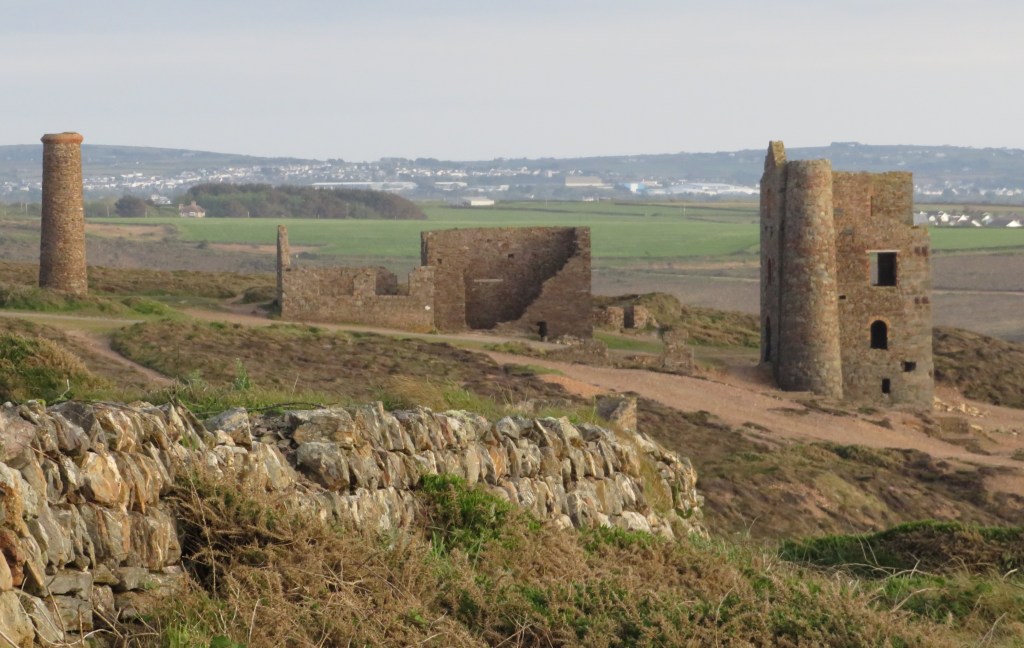
We needed to return home for the day and thought it was about time we refuelled the car. The chauffeur of my acquaintance had neglected to bring his wallet. I believe that a newly installed app on my phone might have been a satisfactory substitute but needless to say, despite my increasing proficiency with the phone over the past weeks (to the extent that I have exceeded my, albeit meagre, data allowance), this was a step too far. Fear not, my bank card is in the rucksack. Ah that would not be the rucksack we have with us but the one that is ……. in the caravan. Fortunately, we made it home and were able to retrieve alternative means of paying. Then it was back to the van. The A30 on a Friday rush hour is never a great idea, so the return journey was a little on the slow side but we were back in time for the mobile fish and chip van’s visit to the site and even managed a walk out to Wheal Coates to try to counteract the ill effects of said fish and chips, or in my case, fishcake and chips, in the evening.

Wheal Coates

Further westward the following day and a trip to Newlyn. We overshot the entrance to the car park and before we had a chance to turn round saw several parked cars with a space for us. We looked carefully for notices that said that parking was restricted, or for permits in the windows of the other cars. A nearby gardener assured us that parking there was fine. I was a little less confident as this lay-by appeared to be a bus stop. Could the other half a dozen cars and the gardener be wrong? I left the decision to the car’s owner and we stayed put. A quick trip to a nearby boatyard so the fisherman of my acquaintance could chat boats, then we walked on to Mousehole where I had the drippiest ice cream cone I have ever encountered. Interesting to see that black-backed gulls seem to be outnumbering herring gulls. No sign of any clamp or parking ticket on the car so we returned to the van via a mercy dash to a supermarket near us to get yoghurt, which we should have brought back from my home fridge yesterday but we failed to do. A late afternoon relax in the sun followed.

Another day and back to the south coast for a visit to St. Michael’s Mount. We’d timed the trip so we could walk out across the causeway. I even managed to show evidence of my booking on my phone, which was an achievement in itself. It is quite a climb up to the castle, so not ideal for anyone with mobility problems but the views over Mounts Bay are impressive.

The Cornish name for the island is Karrek Loos yn Koos, or the grey rock in the woods, which may date from the time 4000 years ago when the mount was not cut off by the tide but was surrounded by woods. The remains of tree trunks are still occasionally seen at very low tides. In 2009, a bronze age hoard was discovered by one of the gardeners, suggesting that, 3000 years ago, the mount was a trading centre. It is thought that Edward the Confessor granted the island to Benedictine monks from Mont St Michel in Normandy and established a chapel there. The mount became a place of pilgrimage but also a focus for conflict. In 1193 it was seized by Henry de la Pomeray, who had disguised his men as pilgrims in order to gain control on behalf of Prince John. John was attempting to stage a coup and take advantage of his brother Richard I’s absence on Crusade. Much of the current building dates from the fourteenth century, with substantial later additions. The dissolution of the monasteries was late to reach the far south west, so the religious community survived until 1548. The following year the mount was seized by those involved in the Prayer Book Rebellion. It became a Royalist stronghold during the Civil War but surrendered to Parliament, with Colonel John St Aubyn as the captain. St Aubyn purchased the castle in 1660 and it has been the home of the St Aubyn family since then.

Several myths and legends are attached to the island. The discovery of a seven foot skeleton on the island, buried vertically, fuelled the legend of ‘Jack the giant killer’; allegedly Jack from Marazion killed Cormoran the giant who built the mount and terrorised locals. Visitors can view the giant’s well and a tiny heart-shaped stone in the cobbles is labelled as the giant’s heart. Some features that caught my eye included the stained glass in the chapel, seventeenth century tiles and the ceremonial barge, that took part in the Queen’s diamond jubilee pageant. This is one of the oldest working boats in the country, having been constructed using wood felled on the St Aubyn estates in 1750. A collection of postcards of the Mount over the decades were cleverly displayed so that you could see both sides. There was also a model of the castle made from champagne corks by the butler. Two observations here, they must have drunk an awful lot of champagne and the butler really needed to get a life.

We wandered back into Marazion, where I felt obliged to sample yet another ice cream flavour, gingerbread this time. Then we beat the rain back to the van.

More Westward Wanderings

With the forecast heavy rain very much in evidence it seemed sensible to head for somewhere with a modicum of ‘indoors’, so it was off to Trerice, a manor house built by John Arundell in 1570. Inside there is a striking 576 pane window, predominantly made up of C16th and C17th glass. There are also numerous portraits, include some by Kneller. A 1950s wing replaces the former north wing. In the grounds there is an Elizabethan knot garden, given over largely to lavender and also an impressive potager full of vegetable and salad produce. If there were 100 hours in every day I’d want my garden to look like this. There are several mown mazes in the grounds, one being based on the maze at Troy Town on Scilly, which is known as the three circuit maze and was used by Scandinavian fishermen to trap bad spirits. I managed to escape.

Trerice is lovely but there isn’t really the scope for an all day excursion. The weather had improved so we decided to move on to Trengwainton Gardens, getting yet more value form the National Trust life membership. Here the rhododendrons were in full bloom. There is always something soothing about being in a garden and this one has the bonus of overlooking the River Fal. We walked down to where the King Harry chain ferry takes vehicles and passengers across the river. A steam ferry first crossed the river in 1888. It is one of only five chain ferries in England.

Next day and I was awake early to watch the misty dawn break over the sea, all accomplished without getting out of bed! The first stop of a busy day was Restormel Castle, which was built for the Earl of Cornwall, in good defensive position, overlooking River Fowey. It was originally used as a hunting lodge and was set in the largest hunting park in Cornwall. The park was also home to several hermits who were expected to pray for the souls of the castle’s owners. The remains are thirteenth century and the castle was owned by the Black Prince in the fourteenth century. After a skirmish during the English Civil war the castle fell into disrepair and was not deemed to be of sufficient use to maintain. English Heritage are now putting the headings of their interpretation boards in Cornish as well as English, A great first step but it is a pity that the text isn’t in Cornish too.

It doesn’t take too long to exhaust the possibilities of Restormel, so we move on to Lanhydrock House. The volunteer asks if I have visited before. I reply that I have but it was ‘a long time ago’. Do I remember the kitchen? I am asked, perhaps I should have explained that ‘a long time ago’, was about 39 years! The house was the home of the Robartes family, which I’ve always pronounced Row-bar-tes but, according to the information video is Row-barts. In April 1881 Lanhydrock was severely damaged by fire and the then owners died shortly afterwards, leaving the next generation of Agar-Robertes to take over. Ahead of her time, in 1894, the then Lady Robartes opened Lanhydrock to the public and establish a ‘bazaar’ there to raise funds in what seems to have been a glorified jumble sale. Her terse instruction cards to visitors have been replicated.

As always, I am attracted to the huge library, whose collection includes twenty five incunables. I had no idea what that meant either but just so that every day is a school day for you too (unless you already knew of course), these are books printed before 1501. There was also a fascinating and enormous steam jack in the kitchen. The National Trust seem to have developed an unfortunate trend for printing interpretation comments on the soft furnishings, which seriously spoils the authentic look of the rooms. I guess someone decided that it appealed to the visitors – not to this one though. We heard the story of how all the house’s laundry was sent to St Faith’s, a home for fallen women in Lostwithiel; I immediately wanted to scramble for census returns. Lanydrock’s gardens are extensive, with more rhododendrons in evidence. I would think that this is the best time of year for the gardens. I suspect they will be less impressive in a few month’s’ time.

Lanhydrock

On to Fowey and first the challenge of finding a car park. We located one at the top of the town but allegedly there could be one nearer to the church, where we want to be, so we decided to keep searching. Fowey is a tortuous warren of narrow, steep, winding streets. We do narrow, steep and winding but this is something else. Some vehicles were pulling in their wing mirrors to negotiate parts of the one-way system. Just because we were enjoying it so much (not), we completed the circuit several times before ending up in the car park where we first started and getting the town bus down the street. This doesn’t run after 5pm but the driver was able to tell us the best way to get back up the hill to the car park. I thought this might have been a first outing for my newly-acquired bus pass but the service was run by a private company and I didn’t like to ask if passes applied.

Fowey has been an established harbour for over 2000 years, exporting fish, wool and tin and being a point of departure for pilgrims to Spain. The returning vessels brought back with them wine, salt and iron. Fowey is noted for being the home of Daphne Du Maurier and we are here for a concert that is part of the Arts and Literary Festival that formerly bore Du Maurier’s name. There is little left of traditional Fowey, which now clearly caters for the yachting fraternity. Most of the food options were of the two peas and a bit of drizzle for £30 variety. We finally found The Lugger, which was more suitable to the sizes of both our pockets and stomachs.

The day finished with a Fisherman’s Friends concert in the local church. I was able to admire the heraldry round the church and practice my extremely rusty blazoning skills, while I was waiting for the concert to start. The downside was the less than comfortable pews. The evening was a sell out and was excellent, as we expected it to be. Even better, there was a community bus, with just two spaces, waiting to take us a ridiculously long way round to the top of the hill car park.