If you’ve just arrived here, it may be that you’ve missed the questions for the a Family History Quiz. If you want to participate, stop reading now, or you will find the answers to rounds 5 & 6 below. Just go to round 1 and return here when you’ve done those questions.
Just some answers for you today then.
Researching Women
When was the married women’s property act passed? 1882
Which women were given the vote by the UK legislation of 1918? Women over 30 who were householders or wives of householders.
What was the minimum legal age for the marriage of girls, with parental consent, in England and Wales in 1928? 12, although the age of consent had been 16 since 1885.
In what decade did Marie Stopes open her first birth control clinic? 1920s
In what decade did The Sex Discrimination Act remove restrictions on women’s financial rights, making it illegal for employers, banks, financial institutions and landlords to discriminate against women? 1970s.
All the answers in the above round come from my Putting your Female Ancestors into Context online course, If you want to focus on your female ancestors, the next presentation of this course starts in February. You can sign up here.
What do these abbreviations stand for?
b.o.t.p Both of this Parish
GRO General Register Office (I should disallow General Registry Office but hey it’s Christmas).
PRONI Public Record Office of Northern Ireland
d.s.p decessit sine prole (died without issue). You can have a mark without the Latin.
FWK framework knitter.
This may be the final blog for 2025, so Season’s Greetings to all and special thoughts for those who find this time of year difficult.
You’ve arrived on day 4, the final day, of a Family History Quiz. If you want to participate in earlier rounds, stop reading now, or you will find the answers to rounds 3 & 4 below. Just go to round 1 and return here when you’ve done those questions.
Here are the final quiz rounds
Round 5Researching Women
When was the married women’s property act passed?
Which women were given the vote by the UK legislation of 1918?
What was the minimum legal age for the marriage of girls, with parental consent, in England and Wales in 1928?
In what decade did Marie Stopes open her first birth control clinic?
In what decade did The Sex Discrimination Act remove restrictions on women’s financial rights, making it illegal for employers, banks, financial institutions and landlords to discriminate against women.
Round 6 What do these abbreviations stand for?
b.o.t.p
GRO
PRONI
d.s.p.
FWK
Now for the answers to rounds 3 & 4. All the answers to round 4 come from my Discovering more about your Agricultural Labouring Ancestors online course, There’s a chance to brush up on your ag. lab. knowledge in the New Year. You can sign up here.
Round 3 Old Occupations
What did the following do?
Pindar – looked after the pound
Fletcher – one who put feathers on the ends of arrows
Chapman – a merchant
Cordwainer – shoemaker – originally one who used leather from Cordoba
Badger – an itinerant seller of foodstuffs
Round 4 Agricultural Labourers
What was the name of the mythical person who was associated with a series of protests in the 1830s, that were directed at the introduction of threshing machines? These riots were predominantly conducted in East Anglia and the South East of England. Captain Swing
What is the name of the series of county by county books, published by the Board of Agriculture between 1790 and 1820, that provide background information for those with rural ancestors? The General View of Agriculture
What laws were repealed in 1846, reinstating a free market for grain in Britain? The Corn Laws
Where can you consult the National Farm Survey for England and Wales? National Archives Kew
Which English and Welsh census was the first to list the acreages of farms and the number of employees? 1851
You’ve arrived on day 3 of a Family History Quiz. If you want to participate in earlier rounds, stop reading now, or you will find the answers to round 2 below. Just go to round 1 and return here when you’ve done those questions.
Round 3 Old Occupations
What did the following do?
Pindar
Fletcher
Chapman
Cordwainer
Badger
Round 4 Agricultural Labourers
What was the name of the mythical person who was associated with a series of protests in the 1830s, that were directed at the introduction of threshing machines? These riots were predominantly conducted in East Anglia and the South East of England.
What is the name of the series of county by county books, published by the Board of Agriculture between 1790 and 1820, that provide background information for those with rural ancestors?
What laws were repealed in 1846, reinstating a free market for grain in Britain?
Where can you consult the National Farm Survey for England and Wales?
Which English and Welsh census was the first to list the acreages of farms and the number of employees?
Now for the answers to yesterday’s round 2. Incidentally, all the round 2 questions were taken from my stage 2 family history course, which Devon Family History Society are running online in the New Year. If you think you need to brush up on your knowledge, head to the website as there are a three places left.
Round 2 answers
What is a Glebe Terrier? Maps and descriptions of church-owned land—mostly C17th & C18th. Tenants often named and those owning neighbouring land may be referred to.
In what century were the Protestation Returns and the Heath Tax created. Seventeenth century (half marks if you put 1600s).
What kind of records will you find in class WO97 at the National Archives? Service Records of Soldiers discharged to a pension.
Which data providing platform gives access to the 1910 Valuation Office Records (Lloyd George’s Domesday)? The Genealogist.
Name 3 ways in which you could gain settlement, according to the 1662 Act. Birth; Marriage (for women) – kept when widowed; · Renting property worth £10 p.a. or more; Completing an apprenticeship in the parish; Working for a year under a settled master; Paying parish or poor rates; Serving as a parish official.
What is a nuncupative will? An oral will made in presence of 4 witnesses – could be used until 1838. From 1677 had to be written up by someone and signed by testator unless physically incapable. Should begin ‘Memorandum Quod..…’
Name four groups of people who were not able to make wills, under the terms of the 1540 Statute of Wills. Child (under marriageable age), lunatic, heretic, apostate, slave, prisoner, married woman (until Married Woman’s Property Act of 1882) unless she had been given property of her own under terms of a marriage settlement, or unless she had permission of her husband.
On which Repository’s website will you find the Manorial Documents’ Register. The National Archives as part of the Discovery Catalogue.
Define a journeyman. Half a mark for someone who has completed an apprenticeship. Another half mark if you said they worked by the day (from the French journee – daytime). They may have travelled about but no marks for ‘being on a journey’.
What is a sojourner? Someone who is not settled in the parish. Half a mark for ‘not a permanent resident’ although they may been there for decades and just not done anything to become settled in the parish (see question 5).
You’ve arrived on day 2 of a Family History Quiz. If you want to participate in round 1, stop reading now, or you will find the answers! Just go to round 1 and return here when you’ve done those questions.
Here are today’s questions, perhaps a little harder than yesterday’s.
Round 2
What is a Glebe Terrier?
In what century were the Protestation Returns and the Heath Tax created.
What kind of records will you find in class WO97 at the National Archives?
Which data providing platform gives access to the 1910 Valuation Office Records (Lloyd George’s Domesday)?
Name 3 ways in which you could gain settlement, according to the 1662 Act.
What is a nuncupative will?
Name four groups of people who were not able to make wills, under the terms of the 1540 Statute of Wills.
On which Repository’s website will you find the Manorial Documents’ Register
Define a journeyman.
What is a sojourner?
LOOK OUT ANSWERS TO ROUND ONE BELOW
Round One
Which of the two English/Welsh censuses, that are open for public view, were taken in June? 1841 and 1921.
Which English/Welsh census provides information about how long a couple have been married? 1911.
Jane and Jack share one set of great-grandparents but no grandparents. How are Jane and Jack related to each other? Second cousins.
At what repository are the wills that were proved in the Prerogative Court of York held? The Borthwick Institute.
What does a time in the ‘where & when born’ column of an English or Welsh birth certificate usually indicate? A multiple birth.
From what date were printed marriage registers, containing standard information, introduced in England and Wales. 1754.. I will accept 1753, as that is when the act was passed.
What, in a genealogical context, is meant by the Commonwealth Gap? The hiatus in parish registers from 1653-1660 under Oliver Cromwell.
Jane Brown was baptised on 2 February 1751, her brother William was baptised on 8 September 1752, both events took place in London. What is wrong with that statement? Neither of those dates existed due to the change from the Julian to the Gregorian calendar.
Surnames derive from one of main four roots. What are they? Patronymics (from the father’s christian name), occupational surnames, locative surnames and surnames taken from personal characteristics or physical appearance.
Who doesn’t love a quiz at Christmas time? I’ve already done dismally badly at two I’ve attended but it is the taking part that counts. Annually, most of my family participate in Gordon Gray’s charity Christmas Puzzle, even the grandchildren join in now, although I don’t think I’ve ever got it all right. Do give it a go if you like something cryptic. Other quizzes come and go. In an effort to find a quiz where I would get the answers right (I hope!), I’ve created my own.
This is just for a bit of fun. No prizes and definitely no arguing with the quizmistress. There will be forty points up for grabs over the next few days, all based on British (largely English/Welsh family history. Entirely up to you if you look answers up or not. Personally, I think it is good to see how you can do without resorting to search engines first but your quiz, do what is fun for you. Round 2 and the he answers to round 1 tomorrow.
Round One
Which of the two English/Welsh censuses, that are open for public view, were taken in June?
Which English/Welsh census provides information about how long a couple have been married?
Jane and Jack share a set of great-grandparents but do not share grandparents. How are Jane and Jack related to each other?
At what repository are the wills that were proved in the Prerogative Court of York held?
What does a time in the ‘where & when born’ column of an English or Welsh birth certificate usually indicate?
From what date were printed marriage registers, containing standard information, introduced in England and Wales.
What, in a genealogical context, is meant by the Commonwealth Gap?
“Jane Brown was baptised on 2 February 1751, her brother William was baptised on 8 September 1752, both events took place in London.” What is wrong with that statement?
Surnames derive from one of main four roots. What are they?
Today may or may not be Black Friday. I can confirm it is a Friday for all you retired types who aren’t quite sure. Black Friday now seems to last several weeks so if it is THE Black Friday is debatable. It is something that has spread from America and in the interests of imparting some history, it seems that the term originated in September 1869, when James Fisk, a railway magnate and Jay Gould, a financier and railway speculator, together with Abel Corbin, brother in law of US President Ulysses S Grant, forced up the price of gold by cornering the market. This was followed by a slump and panic in the gold market, with many people losing money. The US economy was already under pressure following the cost of the Civil War and the gold crash led to financial chaos.
There is another, largely discredited, theory that Black Friday referred to days when enslaved people were sold for a reduced price. This clearly has nothing to do with every retailer offering us deals in the run up to Christmas, so when did that start? In the 1960s, the police in Philadelphia used the phrase ‘Black Friday’ to refer to the increase in crime and social disorder during the pre-Thanksgiving holiday shopping rush. It seems to have been the 1980s when US retailers began using ‘Black Friday’ to refer to slashing prices and the UK followed suit. Now Black Friday seems last for weeks and to morph into January sales, which of course start on Boxing Day.
I am rubbish at marketing but I thought I’d point out a few Black Friday family history related offers that I am involved in. Pharos Teaching and Tutoring are offering 15% off all their online courses this weekend. Two of mine which are very popular start in the new year, Discovering more about your Agricultural Labouring Ancestors and Putting your Female Ancestors into Context. There are others later in 2026 that you can book now and claim the discount. These include Are you Sitting Comfortably: writing and telling your family history in April; First Steps to a One-place Study in September and In Sickness and in Death; researching the ill health and death of your ancestors in October. There are a load of great offerings from my colleagues too.
Pen and Sword have 30% off their prices, again this weekend only. Here you can buy my Women’s Work book or Marginalised Ancestors. I am offering Coffers, Clysters, Comfrey and Coifs: the lives of our seventeenth century ancestors for £5 plus postage to a UK address. From now until 8 December, you can have Remember Then Women’s Memories of 1946-1969 and how to write your own for £8 plus postage. Both of these have a cover price of £12.95. If you prefer fiction, then Sins as Red as Scarlet is on offer for £8 plus postage (cover price £9.99) for the next week too. There is more about the books on my website. Contact me using the box on the home page for details if you want any of these. If you don’t fancy any of this for yourself, they are also gift giving opportunities. Advert over.
So the day began with attempting to download my long awaited copy of Nathan Dylan Goodwin’s latest Morton book to my Kindle (other ereaders are available). Not totally straightforward as I deliberately purchased it in a new way, thus avoiding too many profits going to large online retailers and also meaning that got it earlier. This seemed to involve teaching my Kindle a new email address. Took a bit of Googling to work out how to do that but we got there.
Then it was on with the big girls pants and the ‘joy’ of installing a new router. This has all come about because my broadband contract was up for renewal. I stuck with the same company when I moved thinking that it had been fine in the middle of nowhere in a house with two foot think walls, so surely it would work well in a modern bungalow, in a much larger settlement. Not so. It dips alarmingly and with no warning, meaning that I have had to do some presentations from my bed. Open Reach, in their wisdom, installed the router connection thingy on the corner nearest the road, which means that the router is in my bedroom. Firstly, this means, I have a permanent bright green light in my bedroom, which for me isn’t the problem it might be for some, as I inevitably fall asleep when reading, so the light is on anyway. It is however as far away as possible from where I’d normally be using wifi. I should note that ‘as far away as possible’ isn’t actually very far, as it is a tiny bungalow and certainly I could get wifi in any room in my old house and in the garden without issue.
I debated changing companies but that would probably be a frying-pan – fire scenario and as renewal coincided with Black Friday (which weirdly seems to last several weeks), my existing company offered me a 900mbps package for the price of my old 57mbps. I don’t really understand all this mbps stuff but that certainly seemed like an improvement but it meant a new router. Said router arrived. The email said ‘install an app’. I am reasonably adept on a laptop, a phone, not so much – too small, too fiddly etc. etc.. Said app however duly installed. ‘Scan the QR code on the box to get the installation instructions’. Nope that just wasn’t going to happen. All I got was offers of expensive QR code reading apps. I’d been assured that it was going to be a case of unplug the old router, plug in the new one, so I ventured forth instructionless. I opened the box to find printed instructions. I didn’t need the app anyway.
Plugging in involved lying on the floor and delving in a rather dusty corner but that was accomplished. Next put in the new password. In days gone by this used to be three words that you stood a chance of remembering – in fact, I can still remember the last two three word passwords I had. This jumble of upper and lower case and digits is a bit of a nightmare but also accomplished. One laptop and one phone connected. The whole process had taken about fifteen minutes. Feeling quite smug, I moved on to reattaching the printer, or in my case, not reattaching the printer. I tried going via settings, I tried via the printer app. It kept telling me the printer wasn’t turned on when clearly it was. Every time I tried, the ‘not on’ printer wasted another tree by spitting out a one time passcode. I then made the big mistake of uninstalling the printer. That, dear readers, was a mistake. I have tried everything, Youtube videos, the printer company’s useless bot, turning everything off and on again, the lot. The printer is out of guarantee so I can pay £9.99 to speak to an ‘expert’, nope not going there. Nest step, maybe I should connect the printer with a wired connection. Cue emptying out a very large drawer of ‘may come in useful’ wires. Not one will fit up the backside of my printer. I thought these things were pretty standard but it seems not. I have, for now, given up. I have to return the old router, ‘print out this label’. Errrrrr. And as I write this I realise that I now have two televisions to reconnect. I think a nice calming image is in order.
Traditionally in my house stir-up whatever day of the week it is is in October half-term. This year was no exception and I was joined on Zoom by some descendants for synchronised cake making. Said descendants don’t make pudding, so I was on my own for that one. Last year, the first attempt at cakes was a total disaster but puddings were a great success. Newly lacking a Rayburn, I decided to try cooking them in a slow cooker, which worked really well. I should explain that I always make three Christmas puddings. This year there will be five of Christmas lunch, some of whom don’t like Christmas pudding but often there’s only two; yet I’ve ‘always’ made three Christmas puddings, so three it is. The recipe makes three and although I am perfectly capable of scaling the quantities down (my cooking may be dodgy but my maths is ok), I don’t. I’d arranged to borrow another slow cooker, so that I could cook more than one at a time. Imagine my surprise, when looking in the cupboard that is really only opened once a year for my annual foray into cooking, to find not one but two slow cookers already there. Thinking I must have borrowed one from the fisherman of my acquaintance last year and not returned it and not being in the slightest surprised that he had just deposited another one for me to use this year (nothing that ‘might come in useful’ is ever thrown away), my reaction was merely – oh good I can cook all three at once. All three puddings duly spent the day in their slow cookers, although I did notice the water in one evaporated quite quickly and had to be topped up. They turned out looking good and I went to wash up the ‘slow cookers’, only to find that one had been cooked in a rarely used and clearly unrecognised, rice cooker instead! For more random Christmas memories see here.
Bathroom next. I have more bathroom space in this tiny bungalow that I had in my five bedroomed house. I use my lovely en-suite and the, similar sized, bathroom is really only used for guests. It was a not-so-delightful salmon pink, with dark mahogany and gold embellishments. For some reason the previous owner had stuck mirror tiles round the bath, which meant you really didn’t want to look in the wrong direction when sat on the loo. A year ago I decided it had to go. It has been a long wait but last week it was my turn to reach the top of the plumber’s list, either that or he was heartily sick of being phoned up to ask exactly which spring he was going to do this by. Still a way to go but he’s really cracking on now and the salmon pink is no more. Firstly, please can someone explain why, when I am having the bathroom done and said bathroom contains only one piece of furniture, why five other rooms (pretty much the whole house) have been impacted and now contain ‘stuff’? To be fair, I have moved the precious china cupboard in the hall to allow for free passage of the ex-bathroom to the van, so that accounts for some of it. Secondly, why is it that, as soon as the water is turned off (despite being warned), you need to use it. I’ve been feeding the Christmas cakes and in the absence of a working tap, I was forced to lick excess brandy off my fingers afterwards. The plumber may have wondered why the house and I, smelt of brandy at 9.30am.
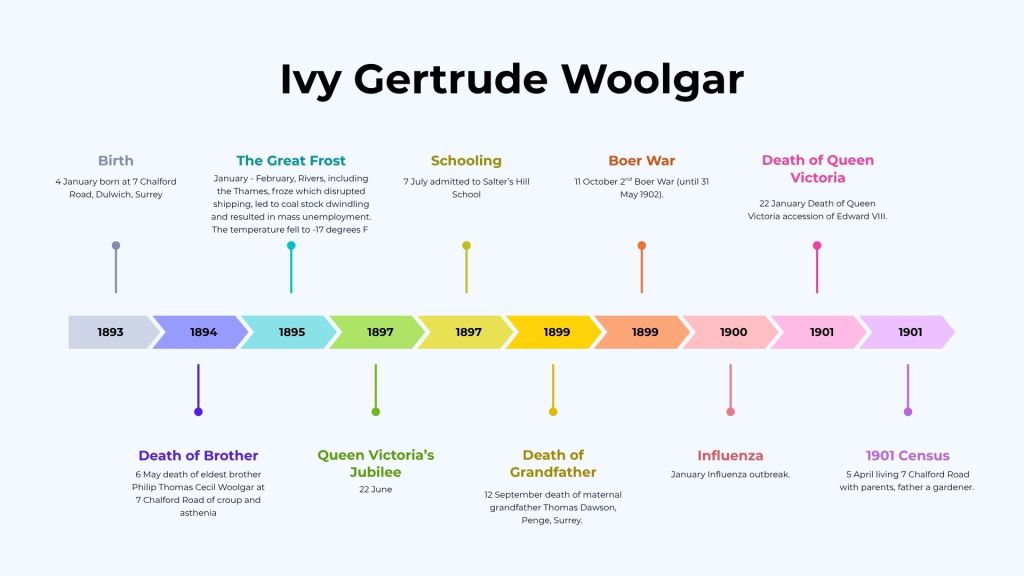
I did promise you some family history and yes there’s been some. Prompted by the upcoming Forgotten Women Friday collaborative research, I remembered that I had a post office worker in my own family. I’ve therefore been writing about my grandmother’s cousin Kathleen. As she was someone with no descendants, if I don’t tell her story no one will. It seems that she was among the first women to qualify for the civil service and subsequently worked in the savings bank department. I’ve also been preparing my Timelines talk, which will be recorded for Rootstech. I’ve got a live one to do as well but that’s for another day. In order to create illustrations for the talk, I used the free version of Canva to produce a timeline for a small section of my grandmother’s life. Very fiddly and not scope for a huge amount of detail but decorative. In other news, a chapter of the next book is finally done. This is definitely a don’t hold your breath thing, as progress is a lot slower than I’d like. This part involved case studies of asylum patients and there were some fascinating but very sad stories. I am also in full-on Pharos course mode, with the one-place studies course drawing to a close – and what a lot of fascination studies are in the offing from the students. Starting on Monday is ‘Elusive Ancestor’, where we look at ancestors who can’t be found where they should be, almost certainly because they’ve changed location. I’ll be readying my sledge hammer to hopefully make some dents in a few brick walls. Feel feel to join us, there still some spaces.
We’ve just returned from a few days in Shrewsbury. We were staying on a very posh-for-us caravan site because the same complex also had ‘barns’ where caravan-less members of the family could stay. I was a fail at this kind of location from the start. We checked in and were given a card to access the site barrier, no problem, we were used to these. I was also given two ribbon like bracelets to indicate that we were paid up residents. For safe-keeping, I hurriedly put both on my wrist, one for me and one for the fisherman of my acquaintance. Caravan pitched I attempted to pass his to him. Ah. This was the problem. I had tightened the bracelets to ensure I didn’t lose them by sliding a plastic ring up each ribbon. It turned out that these were one way fastenings, a little like cable ties – hindsight and all that. I managed to wriggle my way out of one bracelet but the other was firmly affixed. Not wanting a bracelet on day and night for four days, I had to return to reception and ask to be cut out and have a new one, which I made sure was looser.
The barn, for younger members of the family, came with a firepit and hot tub, both of which had to be fully explored.
The weather was kinder to us than the forecast promised and we explored the delights of Blists Hill Victorian Village. Obtaining advance passes online was an intellectual challenge in itself but we managed it. The Ironbridge complex is due to be taken over by the National Trust, which caused a hiatus in the booking system at precisely the wrong time. It was interesting to chat to the various shopkeepers and tradespeople ad to spend the ‘old’ money that we had exchanged in the bank. Mind you, the existence of a bank seems to be something that is now consigned to history. The traditional fish and chips, fried using beef lard were probably not the best thing for our arteries but were delicious.
The next day was a Shrewsbury Trail, or at least part of it before it got too much for some of our party. The first challenge here was ensuring that both cars were parked in the same place (they weren’t) and then finding our way out of the shopping centre adjacent to the carpark we ended up in. We did manage a quick game of rockets and meteors (like snakes and ladders) in the shopping centre first.
Then a visit to see the Ironbridge in glorious autumn sunshine; the first iron bridge to be constructed in the world, in 1779. This is now a world heritage site. We moved on to Enginuity Science Museum, where we virtually made pig iron, moved locomotives using levers, solved (or didn’t) puzzles and other excitements. There were plenty of other museums in the Ironbridge family for those with more stamina but we decided to quit while we were ahead,
Now we are back home for what might laughingly be called a rest.
It has been a while since I did a round up of my ridiculous busyness so here is what my life has looked like since visiting four counties in four weekends in September. Take a deep breath and dive on in.
First, a lovely chat with my Few Good Women family, with one of us practicing an (excellent) talk. Next, because exercise seems to have slipped from the agenda, a bird-watching stroll on the nearby country park, organised by the rangers. Then the first zoom chat for my Pharos Putting your Female Ancestors into Context course. Away from family history, it was time for the annual flu jab. I returned at 10.30am to a series of urgent messages asking if I could fill in for a speaker in 4 1/2 hours’ time at Devon FHS after AGM talk. Fallen Women filled the void. October’s Society of Genealogists‘ Biography Club topic was toys and childhood and we had fun reminiscing. I have even done some work on my own and I am pretty much still on track to be finished in time for next year’s big birthday. Then a two talks Tuesday; Marginalised Ancestors in the morning and Barefoot on the Cobbles live in the evening. Copies of my Barefoot novel are now almost sold out.
In no particular order, there has also been another Pharos chat, a talk about prostitution (the history of) then a 6am start to speak to the Genealogical Society of Queensland on seventeenth century crime and punishment. This was International Day of the Girl but the Few Forgotten Women had already sorted their online offerings so nothing was needed for the day. Plenty of socialising and eating with visiting friends this week amidst finally doing some work on what is planned to be my next book; some excellent case studies are emerging. I took part in the Society of Genealogist’s Devon research showcase. This should be freely available on the SOG YouTube channel shortly. I’ve been virtually in Oxfordshire to talk about home industries and then in Buckinghamshire for the Impoverished and Insane. Listening to a talk for once on Wednesday then a two talks Thursday, Forgotten Women and the 1838 Fishing Disaster this time. Yesterday was Forgotten Women Friday, having fun researching women who worked in the Ulster linen industry.
Then it was now and yes things will soon start to get a little less hectic as family time beckons, though I am not entirely sure that time with my lovely family isn’t equally exhausting but in a rather different way.
Today’s picture is of County Down, in honour of yesterday’s Forgotten Women research.