Day 10 Alta
We sail into Alta first thing in the morning. Here, we are 240 miles north of the Arctic Circle on the 69th parallel, similar to Alaska and Siberia. Alta was the location of Germany’s largest World War 2 naval base outside Germany. With the exception of one church, the Germans burned Alta to the ground in 1944 and the population were relocated. In 1973, prehistoric carvings were discovered, which are 2000-6200 years old. These are protected by the snow but can be damaged by ice. Arrow heads have been found that show that the area was settled 10,000 years ago, just after the last ice age. Alta is renowned for its salmon fishing and slate production, which began in the 1860s. The Alta river is one of the five best salmon fishing rivers in the world. You have to pay to enter a raffle for a fishing permit and then, if successful, are charged a hefty sum to be allowed to fish for just sixteen hours. Alta is a centre for Arctic research and the home of the longest dog sledding race, which lasts from five to eight days. Alta’s Northern Lights cathedral is the most northerly in Europe.
Possible outings included husky and reindeer sledding and Sami experiences, all of which we did in Finland, so we opted for alternatives. Alta is officially the City of the Northern Lights and this year and last are at the eleven-year peak for Aurora activity and the equinox, which is this weekend, should be a particularly good day for the Aurora but the weather forecast is for cloud. Our evening trip is in group 15A is with Virginie, who is from Belgium. This is a posher coach than others we have been on, with phone charging points. We learn more factoids. As I report these from our various tours, I always wonder how accurate they are. The coast of Norway, with all its fjords, covers a similar distance as going twice round the world. The foundation stone of the cathedral was laid on 1 January 2000, the day that Alta was officially declared a city. The cathedral wasn’t finished until 2013. We are travelling on the E45, a 5000km road that could take us to southern Italy.
The KP Index, which measures Aurora activity, is favourable and we are hopeful as we head to Pæskatun Slate Quarry, which is situated above the Alta Valley on Mount Pæska. Pæskatun is a family-run slate quarry and museum of slate mining. The mountain is full of Alta Quartzite Slate, known for its high quality and is arguably the best slate in the world. It is exported worldwide. Once at the quarry, we are able to look in various huts, which replicate those of the slate quarry workers. The Germans built an airport at Alta during the Second World War but it was destroyed by their scorched earth policy as they retreated. One cabin is built from timber from the old airport. The huts, with no electricity or running water, were home to the workers during the week. The outside temperature could drop to as low as minus 40, which meant that the huts were also used as workshops. Cutting the slate inside the cottages, rather than outside, caused harmful dust. There is also a Sami lavvu and an igloo with Northern Lights and reindeer carvings. Apart from the igloo, all the indoor spaces are very hot and we are ridiculously overdressed for what is an unusually mild March in Finnmark, the province where we currently are. It should be between minus 10 and minus 15 but we are in positive digits. Finnmark is Norway’s most northerly province and the most sparsely populated. There are about 76,000 people and twice as many reindeer.
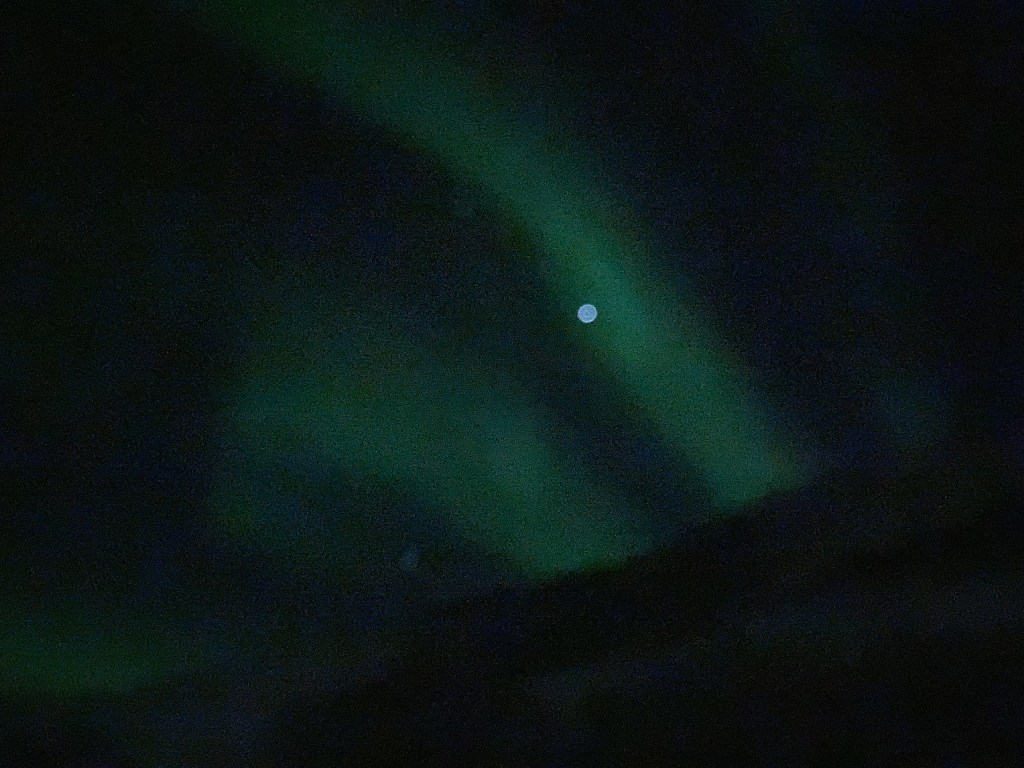
The Northern Lights appear and are active for over an hour. Intellectually, we know that what you see with the naked eye is not what you see in amazing photographs but the actuality is maybe a little underwhelming. Most of our group are getting some fabulous photographs. We are equipped with two phones and what should be a half decent camera, none of which, it turns out, can take Aurora photographs. I end up with many black rectangles, some pictures of my thumb and one or two with a vaguely green blur. I resolve to pinch some that others have taken from the cruise Facebook page. There is a short Northern Lights presentation, emphasising just how frightening this phenomenon must have been in the past, with the lights looking like faces in the sky on occasions. The lights we are seeing are the result of sunspot activity but in two days more sightings are likely, this time due to a coronal hole. I am very glad that I can finally say that I’ve seen the Northern Lights, although disappointed that I wasn’t able to take stunning pictures for myself.
This is the best of mine, with what I think is Jupiter.