So what is Rootstech all about? How to win a free ticket

So Rootstech is coming to the UK. Unless you are involved in the international family history world you may not be aware of Rootstech. Or you may have heard of it and are wondering what it is all about. If you are trying to decide if this event is for you, then read on. Even if you are a die-hard Rootstech attendee and have already purchased your ticket, read on, as here is an opportunity to get a refund on your ticket price.

Rootstech, hosted by Family Search, is quite simply the biggest genealogical event in the world. It has been running for several years in the US and is getting bigger and better each year. From 24-26 October Rootstech will be in London. There will be some modifications to the US model to suit a British, or as they hope European, audience but do not expect this to be in the same mode as national events you may have attended in the UK. There will be some similarities but it will be unique is several respects. For a start, the US and the UK are two nations divided by the same language and you will need to familiarise yourself with some different terminology. What we would call lectures, or presentations, are ‘classes’. Don’t be put off by this, you won’t be going back to school but there will certainly be an abundance of learning opportunities.

With the exception of the keynote sessions (of which more later) there are ten, yes ten, sessions, sorry ‘classes’ to choose from at any one time. You will find classes by presenters who are well-known in the UK alongside names that will almost certainly be new to you. The important thing to note is that there is no additional charge for any of these. Once you have paid for your ticket (oops, must remember to call it a ‘pass’) everything, including the keynote sessions, is open to you at no further cost. This means that it is an ideal opportunity for you to try out speakers whose names you do not recognise, as well as your ‘must see’ favourites. I shall certainly be going along to some of the classes on more niche topics; maybe those that I don’t feel will be directly related to my research but nonetheless sound fascinating. I will be speaking on Thursday 24th on Remember Then: memories of 1946-1969 and how to write your own. If you think you’ve heard me give this talk before – you haven’t. This will be a different version, more directly related to compiling your own reminiscences.

There is no booking system for the talks. I am assured that the area set aside for the keynotes will fit in everyone who has a pass for the day but the rest will be first come first served. The excellent and varied programme – or schedule – is already available, although do check back nearer the time for any minor amendments or additions. With ten sessions running simultaneously, I think we can expect smaller arenas than we might be used to at UK national events, so it might be a good idea to choose a reserve, when planning which sessions you will attend, in case your first choice is full. There will be an app available to help you organise your visit but as regular readers will know, I scarcely recognise an app when it bites me on the nose. As an aside, I am still congratulating myself for managing (at the fourth attempt) to top up my pay-as-you-go mobile (that’s a cell phone to US readers) with credit. It has taken me 13 years to use £25 worth!

Back to the translations. You many find handouts referred to as ‘the syllabus’ or ‘speaker notes’. The concept of keynote speakers seems to be something that some of the UK potential audience are finding it difficult to get their heads around. We are used to these sessions being the opportunity to bring out the genealogical heavyweights. Not so at Rootstech. They embrace the cult of celebrity and choose keynotes who will provide inspiration and motivation, as well as embodying family values. Another reason for choosing non-genealogical keynotes is to encourage attendance from fans who might not otherwise come along. So far, Donny Osmond has been announced as a keynote. He has spoken at the US version of the event and was very well received. So, if you were one of the sceptics, keep an open mind on this one. There will be more razzamataz than we Brits are used to but that’s not necessarily a bad thing.

There will be ‘booths’ – think ‘stands’ or ‘exhibitors’. These have not yet been announced but there will be a mixture of commercial vendors selling products of interest to family historians and societies offering advice and services. The balance between these will become clearer nearer the time. There will be plenty of chance to visit the booths in the ‘vendors’ area’, as a time is set aside each day when there are no classes scheduled. Oh and a word about timing. The first classes start at 9am. Believe it or not, that is later than at the US equivalent. So be prepared for some early starts as you will need to allow time to register on arrival, in the same way as you might expect at a conference – another difference. Just think of all that extra family history time each day.

Now the price; currently, early bird passes are £49. This may seem more than we are used to in the UK but remember this is an all-in payment for all events on that day. Once you walk through those doors, you only need to spend money on refreshments or purchases from the stands. If you are the sort of person who thinks twice about a 30 mile journey and a £15-£20 spend (and that includes your lunch) for your county family history society day conference, why not embrace a different mind-set and make Rootstech your big genealogical adventure. What you glean from those classes or learn from the stall-holders could break down those brick walls and save you time and your research budget. If travel to London really is not for you, keep an eye out for the virtual passes, as some sessions will be being recorded and will be available to you at home.

So how can you avoid paying altogether? Over the next few weeks, Rootstech Ambassadors, myself included, will be offering the chance to win one three-day free pass (full-price value £149). This includes access to any virtual sessions that you may have missed during the three days. If the winner has already purchased a ticket, then they will get a full refund. For my give-away, there is a little more involved than just jumping up and down and saying ‘Me! Me!’ as I know how many people follow this blog and I don’t want a trillion emails. To enter please contact me janetfew @ hotmail.com (without the spaces) with the answers to these five questions all of which can be found on the Rootstech website or on my own webpages (not including the blog posts) or both. I am accepting one entry only from each email address and it must be sent to the email address on the above link, not to any of my other manifestations. The winner will be drawn at random from all correct entries at 12.00 midday British Summer Time on Monday 12 August 2019. The decision is final and I will not enter into any discussion about the competition – though I will try to remember to tell you the answers to the questions! Good luck!

  1. What is the venue for Rootstech London 2019?
  2. I am giving a talk with the same title as my Rootstech session (although it is a different talk) at another venue in the next year. What group am I giving this talk to? (At the moment there is only one answer to this question – if I get another booking there may be more than one – any will be accepted)
  3. The blurb to my novel Barefoot on the Cobbles begins ‘In the euphoria of the armistice a young woman lay dying.’ What eight words follow this? Hint this phrase is obviously on the book itself but is also used elsewhere to advertise the book, including on this website – it is the same 8 words.
  4. What time will the Expo Hall open on Thursday 24 October? (it seems that there have been two advertised times in different places – I will accept either)
  5. What is airport is the nearest to the London Rootstech venue?

Capture

Challenged by Inanimate Objects and a little about Selling Books

They say things come in threes and this week I have been challenged by three inanimate objects. First to turn up its toes was the washing machine. This actually occurred before I went away but this was the first chance to tackle the problem. Turn it on and not a whimper, not a light, nothing. I am quite handy in my own way, so I try fuse changing, a different plug socket, putting a different appliance in that socket, all seems fine but still no response from the machine. The next steps required dragging the machine out; although I would normally tackle this, my back was twinging so I summoned assistance. Randomly, by the time he arrived the ‘dead’ machine had woken up and every available light was flashing wildly but not a button had any effect. The only way to stop the light-show was to unplug it. We de-fuzzed the thingy, we checked the pipe wasn’t blocked, we consulted You-tube, we chatted to ‘Toby’ online. At Toby’s suggestion, we held down buttons for 30 seconds to reset it – zilch. Today the ‘not-actually-going-to-repair-it’ man arrived and pronounced the condition terminal. I have already done one load of washing by hand and the weather isn’t conducive to getting non-spun washing dry, so if I appear in strange garb you will know why.

Next, the car. I arrive back from THE Genealogy Show with the caravan and go to drive my own car home from where the caravan lives and where the car has been parked whilst I have been away. I press the button to open the door – no response. I try the key. The door unlocks and then instantly relocks. The only way I can gain entry is to open the passenger door using the key and then climb across. This isn’t exactly easy, as it is a very small car. I drive home with the window open, just in case none of the doors open when I arrive. To add to this problem, I normally park my car up a drive, which means I need to put the passenger door hard against a hedge. This clearly isn’t an option when the passenger door is the only way in and out. A garage agrees to take a look. I have four days to get a very long ‘to-do’ list done, or it won’t be done until mid-July. I can ill-afford time to go to the garage half an hour away but needs must. Unfortunately, an accident has closed the main road. Even more unfortunately, the alternative route involves two sets of roadworks. It takes 1½ hours to drive 12 miles. The repair is going to take longer than I have, so it is home via a tortuous route, which is marginally quicker than the advised diversion and then repeat in reverse three hours later to collect the car, which is (sort of) fixable – ‘it may not last long you probably need a new something or other’.

I am due to spend a day selling books. At the NEC my gadget for taking card payments let me down. I need this to work. Again I try the online chat; this one is ‘Sabina’. Sabina suggests I ring what is probably a ridiculously expensive premium rate number. Half an hour later a very patient ‘Andrew’ has talked me through what is required. He must be dining out on our conversation along the lines of , ‘you will not believe this thick woman I had on the line today….’ The process involved the use of a mobile phone. As you know, mobile phones and I are not friends. Even if we were before we certainly aren’t now. ‘Is Bluetooth on?’ asks Andrew. Now I am not a complete dinosaur, I know what Bluetooth is, turning it on is another matter. ‘Ah, the app has been updated’, says Andrew. ‘Just delete it and re-install it.’ ‘Just’ is a funny old word isn’t it? It seems ‘Just’ can take a very long time and it doesn’t necessarily mean that’s the end of the adventure. What followed ‘Just’ necessitated me punching in a sequence of eight numbers very quickly; not quickly enough it seems. ‘Faster,’ urges Andrew as I make my nth attempt. Finally, it is accomplished.

Next day and I am ensconced in the Visitors’ Centre in Clovelly, hoping to persuade attendees at the Charles Kingsley anniversary commemorations to part with money in return for one of my books. I am stationed by a stand that sells inspirational ‘soothing’ CDs. I quickly work out that I can change the CD, so I can lose the whale music. The bad news is that virtually every track involves the sound of running water, with the inevitable effect. I am also forced to try to avoid looking at an apostrophic howler all day. I do suppress the urge to go and correct the notice! Nonetheless it is an enjoyable day, chatting to visitors and an unbelievable number of dogs and even selling some books as well.

DSCF1442

THE Genealogy Show

We set off early to beat both rain and traffic and accomplish this successfully. In the absence of shuttle buses from South Car Park we walk down to Hall 2 at the NEC. There was a happy, gentle atmosphere with a real international vibe. It was lovely to meet several world-renowned genealogists who had only been virtual friends until now. Unfortunately, I had places to be and people to see, so I was unable to spend more than a few minutes in the ever-widening circle of heavyweight genealogical chat that continued in the meeting area throughout the two days of the show.

As a show speaker, I was given two tickets to talks of my choice and I had opted for those by genealogical crime writer, Nathan Dylan Goodwin. His first session described how he researches and writes his books. Very interesting and I appropriated a few ideas. Next, I was acting as a ‘wizard’ attempting to help show-goers with their problems and brick walls. Unfortunately, I was not provided with the required magic wand but I hope I that most people left with a few things they could try. There did seem to be a preponderance of people with Suffolk queries. I coped with foundlings and German ancestry but was a little bemused by the client who spent the twenty minute slot showing me forty or so documents but despite my repeated ‘how can I help?’ comments, didn’t actually appear to have a question or problem. I was reduced to ‘mmm lovely’, as yet another document was whisked past my nose. If you plan to take the opportunity of seeking expert advice in the genealogical equivalent of speed dating, please do come prepared and come with a succinct limited question, or indeed I’d settle for any sort of question!!

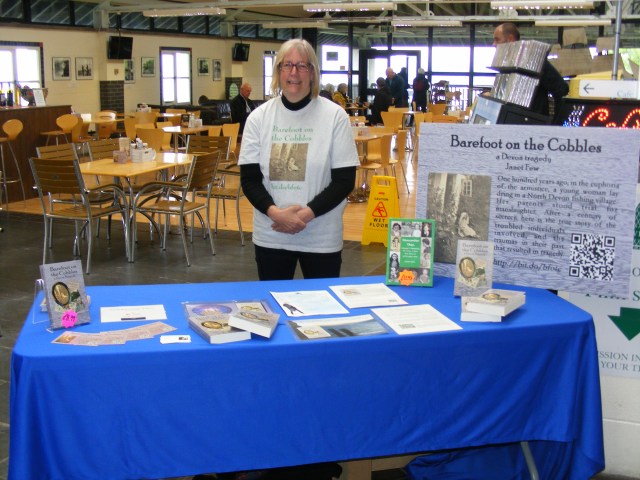
Then my allocated two hours on the stall of the Society for One-place Studies, to which I drifted back and forth throughout the day. We had a steady stream of enquiries and a pleasing number of people decided to take up the one-place challenge. The thought of taking on a new, tiny, place did cross my brain, like I have so much spare time! I sold almost all my stock of Putting your Ancestors in their Place and a few other books, despite having issues with the credit card machine. On the downside, my voice was beginning to disappear – cue the Strepsil overdose.

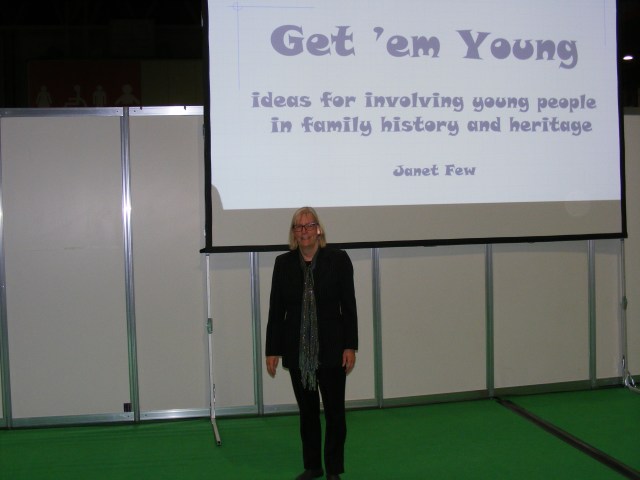
Day two and this time there was no avoiding the rain. Be-decked in waterproof trousers, wielding an umbrella and with spare socks and shoes in my bag, we set forth into the downpour. On arrival, we advise the security staff on tracing ancestry in India. This was more along the lines of ‘we know a man/woman who does.’ My talk was up first. Let us just say the audience was more noted for its quality than quantity. Judging by the ‘I wanted to hear your talk but …’ comments that I received later in the day, a significant reason for this was because I was scheduled half an hour after the show began. At this point, folk were still shaking raindrops from coats and getting their bearings. The real shame was not for me but for the missed opportunity. I was speaking about ideas for engaging young people in history and heritage. This is a crucial topic. On an almost daily basis, I hear people moan that younger generations are not interested in their genealogical research, yet often they are not willing to make any efforts to spark that interest.

DSCF1437.JPG

A quick gap and then I was part of a three-woman panel chatting about surname studies, to a larger audience this time. At least my voice held out. Then back to more wizardry, fielding questions about dancing masters and apprentices amongst other things. The event ended as it had begun, with another talk from Nathan Dylan Goodwin, this time a fascinating account of his own family history research. All too soon, it seemed to be over. I really wish I had had more time to network with people. I had brief chats with so many friends. It is great to be at an event like this, when you know almost every other person. There were evening get-togethers but evenings and I do not get on. Next year and there is to be a next year, I will make more effort to stay awake beyond 6pm and join the fun. The next big genealogical event is Rootstech, of which more later.

Speaker

The job we must not mention is about to hit the fan so there may be radio silence for a few weeks but I will do my best to keep in touch.

Pillories and Preparations

In the brief week at home, idleness has not been an option. Firstly, my home village staged a re-enactment to commemorate the 200th anniversary of the arrival of Methodism in the village. William Reed and Samuel Thorne chose the day of the revels to preach on the village green, were duly arrested and fined. I have to admit that being part of the action, exactly 200 years later, was a ‘hairs standing up on the neck’ moment. Mistress Agnes was present in Victorian guise and a few reprobates were pilloried in the newly acquired community pillory – every home should have one. There was also a truly spectacular flower festival. As someone whose idea of successful flower arranging is remembering to put water in the vase, I was in awe.

1 June 2019 William Reed Commemorations (4)1 June 2019 William Reed Commemorations (6)

I did briefly get back to writing novel number two, after a gap of a few weeks. This has necessitated me buying a book. Thanks to Martha’s research, I did get it half price but it is still the most expensive book I have ever purchased. Then, with assistance, I tried to rediscover my garden. The grass had to be scythed and the weeds still have to be tamed.

Then it was onward and upwards and back ‘up north’ to THE Genealogy Show. Yesterday was spent setting up and greeting friends from across the world, some of whom I have only previously ‘met’ online. My two (well one and a third) presentations are tomorrow so today will be more relaxing. A talk to hear, some brick-wall bashing for attendees who have booked appointments with an expert (a few of them have got me – oh well) and helping out on the Society for One-place Studies stall in between. It is going to be a good day.

TheGenShow

Sheep and Other Adventures

Another day of indifferent weather and we mop up (no pun intended) a few more ancestral locations, although sadly these churches are all locked. We also have a wander round Morpeth and manage to visit the destinations we abandoned due to the road closure two days ago. I am still working on these Northumbrian ancestors during our time back in the van and I am wondering if I should ‘ink in’ the next generation or not. At the moment I am erring on the side of caution and looking for additional evidence. They may make a blog post of their own when I am a bit more sorted.

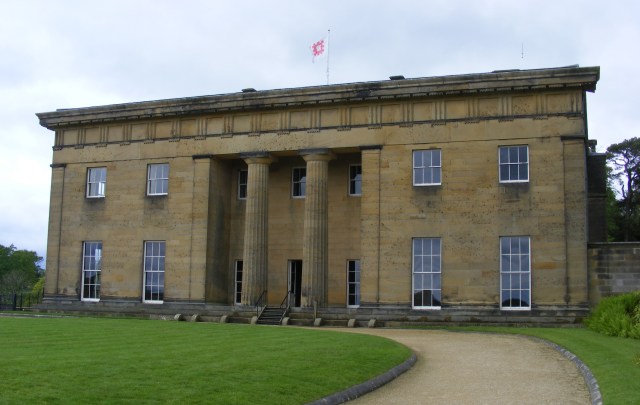
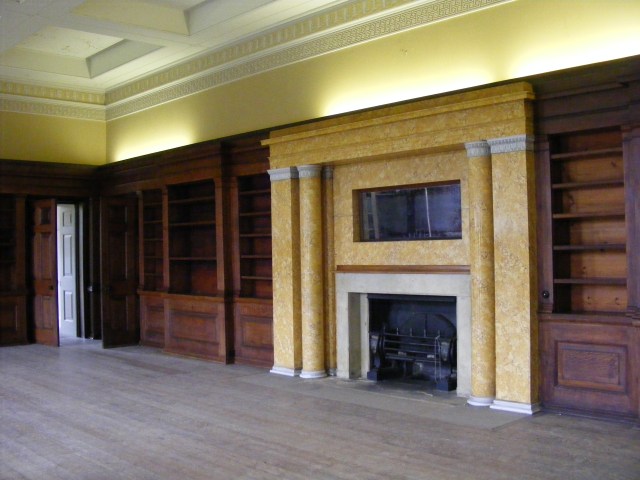
In torrential rain we drive through floods, creating flume-like effects and make our way to Belsay. The site has been home to the Middleton family since at least 1270, when Richard de Middleton of ‘Belshou’ was Lord Chancellor to Henry III. The tour begins in the most recent home of the family on this site, Belsay Hall. This was built in 1817, using plans drawn up by the owner, Sir Charles Monck. He changed his name in order to inherit some other property; later generations reverted to Middleton. Sir Charles was obsessed with Greek architecture and the Hall reflects this. It was designed for effect, not practicality and contains some design flaws, including very steep steps to the entrance and a lack of guttering and downpipes. The latter has led to some serious water damage, which is having to be addressed by English Heritage. There are two high-ceilinged floors to the main house but the same height accommodates five floors on the north side, which were the servants’ quarters. Our tour has to omit the cellars due to flooding. Monck demolished the existing village and a chapel because he did not want the villagers too close to his home. In his defence, he did rebuild cottages further away and these too have signs of classical influences.

155 28 May 2019 Belsay Hall

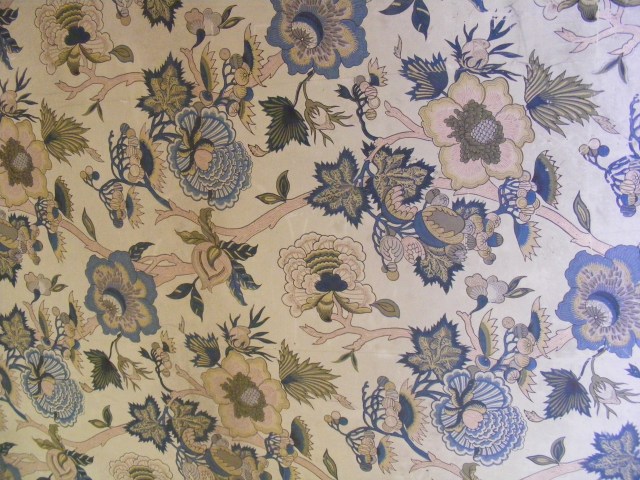
The military took over the Hall in the Second World War and the building deteriorated rapidly afterwards, with the family leaving in the 1960s. It then stood empty for a further two years. Strangely, a condition of giving custodianship to English Heritage was that it would remain unfurnished. There are still remnants of William Morris wallpaper and a large library with 19 bookcases that might just accommodate my current book collection, which was culled by 50% when I left the Isle of Wight.

139 28 May 2019 Belsay Hall

149 28 May 2019 William Morris wallpaper Belsay Hall

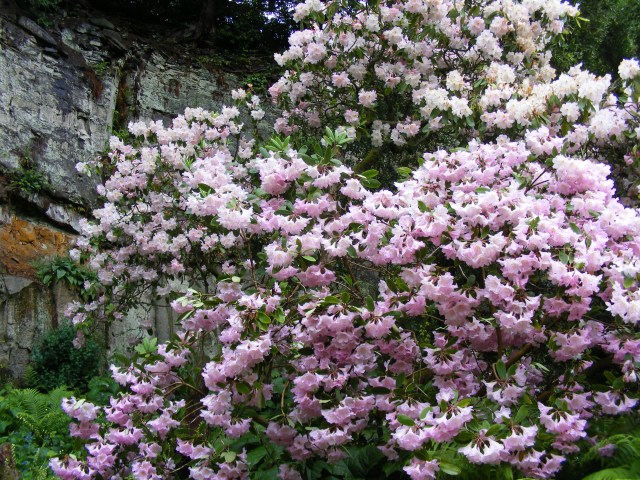
The highlight of the Hall tour was observing a sheep-related incident. Whist admiring the rhododenrons, we notice that a sheep has got its head stuck through a fence that is protecting a sapling. Our guide radios for assistance. Simon the sheep rescuer comes to the aid of the stricken sheep. We watch from the window as he leaps into the rain-soaked ha-ha. As he approaches the sheep, which has been struggling for 10-15 minutes, miraculously, the sheep frees itself. Cue resounding applause for Simon.

153 28 May 2019 Rhododendrons Belsay Hall

The rain eased up sufficiently to allow us to paddle through the rhododenrons in the dramatic quarry garden and reach the castle. The castle is a traditional fortified peel house, designed to repel border raiders. A Jacobean manor was attached in 1614. This was abandoned two hundred years later, when the family moved into the hall. Sir Richard and his squire are bravely conducting some living history in the officially freezing castle. I feel quite sorry that the weather has kept visitors away but a few children are listening to the legend of the Lambton Worm and we discuss armour cleaning techniques.

Another ancestral location stop and then it is back to the van. And so the holiday draws to its close, leaving us with memories of bluebells and birdlife, the smell of guano and of wild garlic that shrouded each time we left the campsite and some ancestral adventures. I have somehow managed to successfully conduct three chat sessions for my Pharos Writing and Telling your Family History students, each one from a different field and now it is home for a week before we will be heading north again, this time for THE Genealogy Show.

Hearse Houses, Herons and Hauberks

On a day ear-marked for treading in my ancestors’ footsteps we set off round numerous villages and hamlets across the wilds of Northumberland. Great great grandfather, John Hogg, led an itinerant life, so we had a long list of places to cover. Chollerton was first on the list. This small village is sited on the ‘Corn Road’ from Hexham to Alnmouth, which opened in 1753, enabling produce to be shipped to London. Outside the church was a ‘hearse house’ used, as the name suggests, to store the village hearse and to provide stabling for the vicar and others coming to church. It now contains a small, unmanned museum. Interestingly, the font at Chollerton church has been created from a former Roman altar.

Amongst other stops, we go to Thockrington, officially one of my favourite places in the world. Believe me, it is not a place you are likely to encounter unless you make a deliberate effort but the awe-inspiring landscape is worth the effort. We called at Great Bavington, Mitford and Netherwitton, with a supermarket stop in Morpeth in between. The main road north of Morpeth was closed due to an accident and fortunately we noticed this as we approached and whilst we still had time to take avoiding action. This sent the sat-nav into ‘turn around where possible’ mode, so it was back to the trusty map. I actually really enjoy tracking journeys on OS maps. It doesn’t seem to make me feel as unpleasantly unwell as it used to do. Unfortunately, this did mean we had to miss out three of our intended destinations.

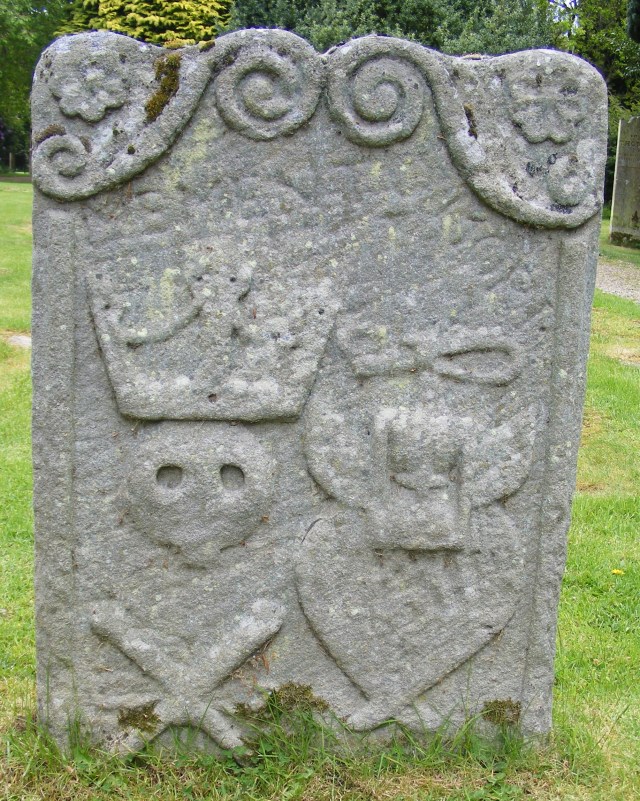
130 25 May 2019 Gravestone St. Mary Magdalene, Mitford

Not one of my ancestors! Reverse says John Pots (sic) d. 1724 age 30 Mitford, Northumberland

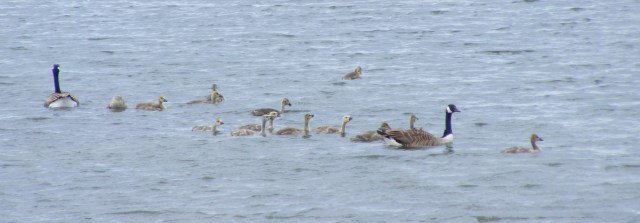
Ten out of ten for Hauxley Wildlife Discovery Centre today. The forecast was a little uncertain but indications were that the early rain would pass over, so we ventured out and were very glad that we did. This coastal nature reserve is run by the Northumberland Wildlife Trust and is excellent. The only charge is a donation towards the car parking. The 1km walk round the lake gave access to several bird hides and I don’t think I have ever seen so many different birds at one location. I believe the lake has been created from a landscape that was a legacy from open cast mining. To top it off, the café, with its views of the lake was lovely too. If you are interested in this sort of thing here are the birds and wild flowers that we encountered:- great tit, robin, black-headed gull, mallard and ducklings, magpie, Canada geese and goslings, grey heron, oyster catcher, house martin, barnacle geese, greylag geese, lapwing, mute swan, moorhen, goldfinch, crow, blackbird, jackdaw, shelduck, little grebe, cormorant, house sparrow, wood pigeon, blue tit, pheasant, tufted duck, gadwall, shoveler. Red campion, primroses, dandelion, buttercup, daisy, iris, bluebells, hawthorn, cleavers, gorse, cowslip, violet, stitchwort, white clover, speedwell, bird’s foot trefoil, red clover, stinging nettle, broom, dog rose.

132 26 May 2019 Hauxley Nature reserve Canada geese and goslings

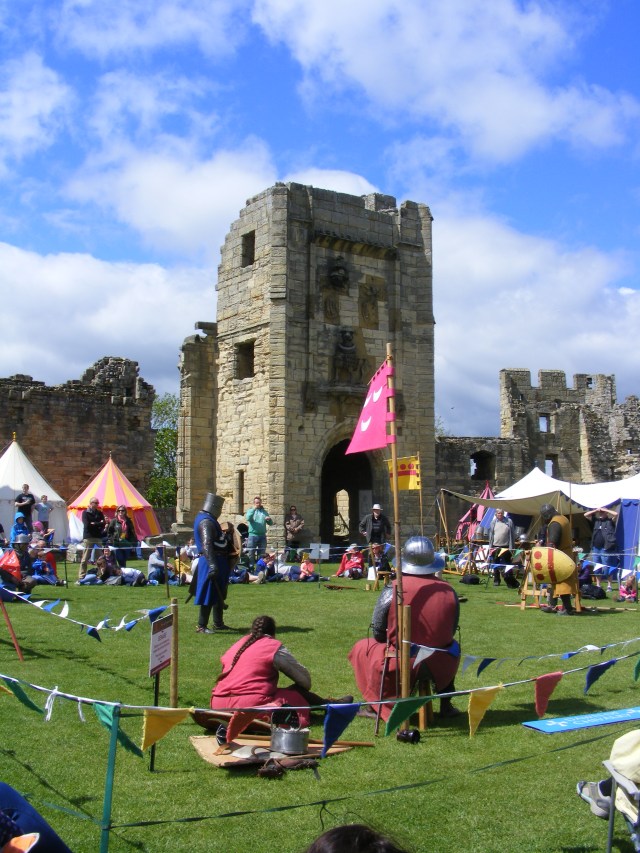
We debated whether to go straight back to the van but decide to call in at nearby Warkworth Castle on the way and again this was the good choice. We hadn’t realized there was going to be a fifteenth century living history event underway. This was a real bonus and we enjoyed chatting to armourers, bow-makers, shoemakers, stained glass artists, candlemakers, rope-makers and potters. We watched dancing and combat and listen to music. I was amused that the compere attempted to disguise his anachronistic microphone by covering it with hessian. All in all, two great destinations today.

133 26 May 2019 Warkworth Castle

Gardens, Books, Chips and a few other things

The day begins with a look at Longframlington Gardens. These are clearly a labour of love for the owner, who we chat to. There is a strong commitment to environmental principles and we wander through the arboretum and wild meadow. The gardens also boasts rope sculptures, including a swing, which I road test until Chris points out that one of the uprights looks decidedly unstable. We attempt the garden maze quiz, where correct answers to gardening questions lead you successfully out of the maze. We escaped but probably not solely due to our gardening knowledge. We also look at the attached garden centre, well it would be rude not to and I succumb to purchasing a mock orange (Philadephus). Now we are back to impersonating Burnham Wood.

We travel on to Alnwick (pronounced Annick), where we fail to find our supermarket of choice, despite having what was, allegedly, its exact address. We did find a substitute supermarket and also paid the obligatory visit to Barter Books. This is a second-hand book shop on steroids, set in a former station and complete with electric train running above the bookshelves. Refreshments and comfy chairs are available as well as a vast array of books. I purchase a map to help with locating ancestral villages, which are annoyingly and probably inevitably, centred on an area that is on the edges of four separate maps, of which I now possess two. Then it is back to the van to deposit the supermarket haul.

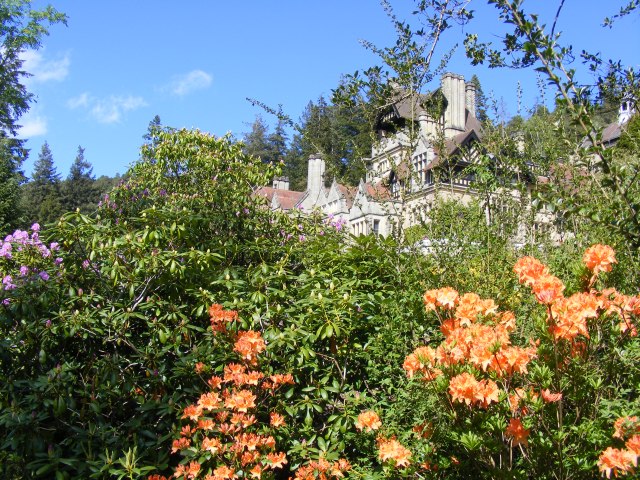
We decided to pay repeat visit to Cragside, rather than stay in the van for the afternoon. Cragside is an impressive Victorian edifice; the former home of Lord William Armstrong who was a notable engineer and pioneer in the field of electricity. Cragside was the first home in the world to be lit using hydroelectricity. Armstrong installed a lift, a water powered jack to turn the roasting spit and a Turkish bath. There is real cooking going on in the kitchen and we sample Earl Grey cake; fortunately, the Earl Grey is not discernible. There is also brass cleaning in progress. Here, pine cones discourage visitors from sitting on the chairs. I suppose that is one up on the holly at Seaton Delaval. The gardens are impressive and are famed for their rhododendrons. These are already beautiful but look set to be even more spectacular in a few weeks’ time. We drive along the five mile ‘carriage drive’ round the grounds. As we pass through Powburn, fortuitously, the mobile fish and chip van is in situ – no brainer.

122 24 May 2019 Cragside

Off to the Farne Islands

Today is a special day and the weather is glorious as we head to Seahouses for our trip to the Farne Islands with Billy Shiel’s fleet. I don’t know why I didn’t think of this option sooner, instead of being fixated on going to the Isle of May. Seahouses’ harbour is undergoing restoration and we have been warned that the harbour car parks are closed and we may need to arrive early to secure parking in town. We can do ‘arriving early’. It also gives a fisherman of my acquaintance the chance to get his fishing boat fix.

The St Cuthbert III is running slightly behind schedule and is full for our trip. We don’t manage to secure a seat on the edge of the boat but that doesn’t matter too much. We set out for the Farne Islands, which are in two groups, the Inner and Outer Farnes. There are 28 islands at low water but only 14 at high tide. Like many islands in the area, the Farnes were a monastic settlement and St Cuthbert died here in the seventh century. We circle the Outer Farnes and view the cliff-side nests and the Atlantic grey seals; there are 3000-4000 of these in the area. We pass the Longstone Lighthouse, of Grace Darling fame, which was built 1825, at a cost of £3000 and was manned until 1919. Grace and her father are notorious for their 1838 rescue of nine survivors from the Forfarshire.

The islands are home to 80,000 puffins or ‘Tommy Noddies’ as they are known locally. They live up to thirty years and mate for life, returning to the same burrows each summer. They spend the winter at sea, not touching land until the following spring. What I hadn’t realised was that they lose their iconic bills in the winter, when the bills are black. The orange colour is generated from their sand eel diet. The more sand eels they eat, the brighter the bill. Natural selection means that the brighter bills, in other words those who are the most efficient providers of food, are the most attractive. Apart from the puffins, there are also 50,000 guillemots nesting on the islands. The smell of guano is powerful and all-pervading.

We disembark on Inner Farne, are greeted by the rangers and run the gauntlet of the dive-bombing, nesting terns. We listen to a short talk by the ranger. We are unable to go in St Cuthbert’s chapel as terns are nesting in the entrance. In fact, birds are everywhere. Even with my not very wonderful, under £100, camera I manage some half decent photographs.

106 23 May 2019 Puffin Farne Islands

So today the wildlife haul included: black-headed gulls, black-backed gulls, herring gulls, eider ducks, lapwing, feral pigeons, house sparrows, starlings, jackdaw, swallows, mallard, cormorants, guillemots, common terns, razor bills, shags, oyster catcher, Atlantic grey seals, a  rabbit and the iconic puffins. The wildflowers are also at their best at this time of year, with red campion, stitchwort, sea campion, poppies, broom and bluebells being prolific. What is really sad is that so many people would struggle to name the wonderful flora and fauna that surround us. It is our planet, we need to take an interest in it, nurture it, celebrate it, protect it and share our love of the beautiful landscapes we encounter.

Highs, Lows and Hingin Lums

After our busy day yesterday, we take a short walk into the village to take a look at Dochart Falls. Then we drive up to the nearby Ben Lawers nature reserve. There is a car park but no visitors’ centre. Do we pay to park? No. Do we turn round and retrace our steps? Again no. Do we press upwards and onwards along a single-track road with a precipitous drop on the passenger side; a road that we are not convinced actually leads anywhere? Yep. That would be the one. Ben Lawers is 1214 metres above sea level and the tenth highest Munro in Scotland. We drive pretty near to the top and I can tell it is higher than I should be venturing, as I experience some of the effects of altitude that curtailed our Peru trip. Fortunately, this time we can get ourselves back down to lower levels without too much trouble. Well eventually we can. All the sat-nav can offer is ‘turn round where possible’. Turning around on a road barely wider than the car is not going to work. I take a look at our not very detailed map. Reassuringly, this does indicate that there is a way out and indeed, eventually, this proves to be so. The scenery is ruggedly spectacular and we are certainly seeing parts of Scotland other holidays might not reach.

On the way back we take a look at the outside of the Moirlanich Longhouse, which is very close to the site and which we have failed to investigate on previous visits. It is open twice a week but not today, so we shall just have to pay a return visit to Killin, no hardship there then. An interpretation board tells me that the longhouse was inhabited by the Robertson family. Were we able to get inside, we would be able to see a  hanging lum, also knows as a hingin lum, which is, the board says, a paper lined wooden canopy to funnel smoke away from fireplace. This sounds a bit of a fire hazard to me but here is some more about them from a website that I use and recommend often.

077 21 May 2019 Moirlanich Longhouse, Killin


It is time for us to return to England and we pass the Kelpies at Falkirk, 30 metre high, steel horse-head sculptures. Or possibly 60 metres high, if some websites are to be believed – big anyway. They are very impressive but difficult to detour with a caravan on the back and I was not ready with the camera.

We wend our way to one of our favourite sites near Alnwick via a supermarket stop. A quick walk round the site’s nature trail and then a lazy afternoon.

Back to the Iron Age and various Wildlife Encounters

We are booked on a forest safari with Highland Safaris first thing, so it is up at the crack of dawn. I’ll admit that it was slightly earlier than strictly necessary but we are able to lurk in the car park waiting for them to open. We have been on an excursion with this company before but have decided to do another short trip because we enjoyed it so much the first time. We find our way to the safari centre in the village of Dull without incident. I was amused to learn, on our last visit, that Dull was twinned with a town called Boring in Oregon. Apparently, it is now also paired with Bland in New South Wales! Dull is in fact a corruption of the Gaelic for ‘raised meadow’ and was a seventh century monastic settlement. Our tour guide is Dave and we are accompanied in our land rover by a family with a small boy. Again, I am impressed that a family is introducing their offspring to wildlife. We drive through the beech, birch and larch forest, many people don’t realise that the latter are a needle shedding pine. There are also introduced species of pine and the broom is in full flower.

As usual, we are a kiss of death when it comes to wildlife spotting and red squirrels and red deer are both conspicuous by their absence. We don’t see pine marten either. They are much more elusive, so that would have been less likely; although I have seen one on a previous trip to Scotland. We learn that pine marten are useful because they will predate on the grey squirrels but not on the red. There are awe-inspiring views of the Tay valley and we see patches of snow on the heights. Although there are longer rivers, the volume of water in the Tay is greater than any other British river. The first bridge across the Tay was part of General Wade’s bridge and road building scheme, which aided troop movements when he was tasked with suppressing the 1745 Jacobite Rebellion. The town of Aberfeldy grew up round this bridge. It is thought that the Gallic sounding nearby Coshieville may have been so named because the French POWs used by Wade on his road building projects were billeted there.

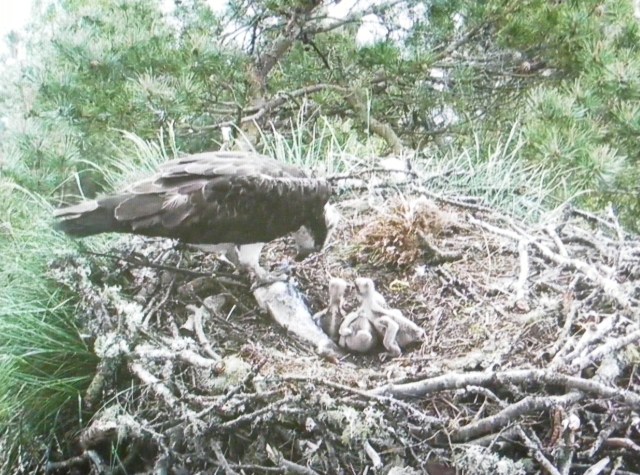
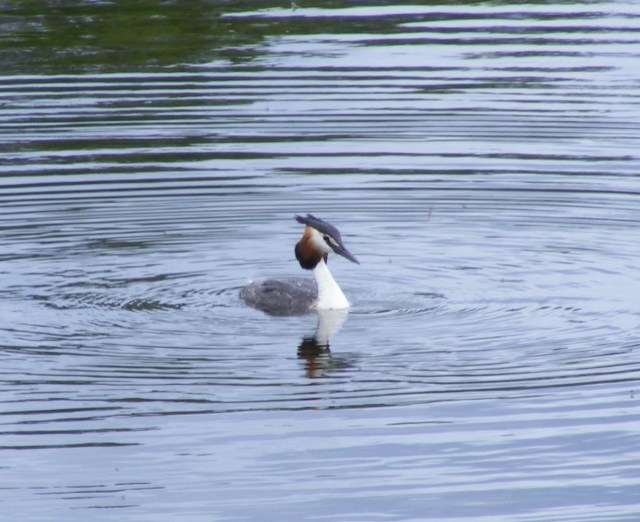
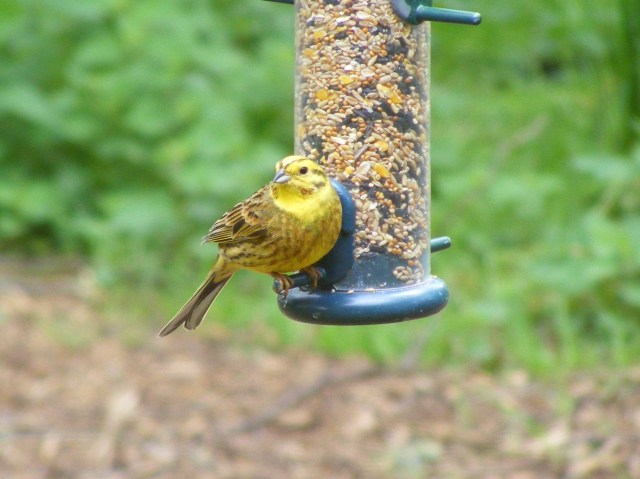
To make up for the lack of wildlife on the nonetheless awesome safari we do see a hare as we leave the site. We head to Osprey Haven at Loch of the Lowes via a slight detour round the golf club courtesy of our sat-nav. We are in luck here as three osprey chicks have hatched this week, the youngest is just four days old. We watch the nest from the hides and via the web-cam, seeing both parents on the nest feeding the chicks. We also see another osprey circling, which caused the staff some concern as it could be a threat to these chicks. I do love the ospreys but watching the birds on the loch and at the feeders is just as good, although again the red squirrels elude us. We get a great view of a pair of great-crested grebes and there are yellowhammers and randomly, a mandarin duck on the feeders. The latter has been visiting for several years and is thought to be an escapee from a private collection.

053 20 May 2019 Osprey nest Loch of the Lowes

049 20 May 2019 Great Crested Grebe Loch of the Lowes

063 20 May 2019 Yellowhammer Loch of the LowesDave from Highland Safaris has recommended a visit to the Crannog Centre, which does not feature in the guidebooks or on any leaflets we’ve seen. We don’t have a great deal of time and we wonder if it is worth paying the entrance money. It so was worth it – an amazing reconstruction of an iron age structure complete with a variety of historical interpreters spinning, dyeing, cooking, boat making and creating an enormous set of bellows. With our own ‘neo-building’ experience, this is particularly interesting to us. The whole thing was fascinating, highly recommended.

I will pass on the snippets that we gleaned during our visit. A Crannog is an artificially created island and although there were earlier examples, nine were constructed on the loch between 600 and 400 BC, including the one on which this reconstruction is based. ‘Cran’ means branch and ‘og’ means young. Strictly ‘cran’ is ‘a branch shaped like a pregnant woman’. This led to the, now discredited, theory that these structures were birthing chambers. The word is medieval, not iron age like the islands and may refer to the shape of branches used. Not actually sure I quite buy this explanation. The original would have had a roof of bracken and heather, rather than reed but the charity cannot afford to replace the roof every two years, which would be necessary if bracken had been used and reed is not out of place for iron age structures. Each crannog would house fifteen to twenty people. The last inhabited crannog, lived in by nuns, was abandoned in 1740.

The experimental archaeologists tried several methods of erecting the main piles for the crannog. They discovered that trying to float them out in log boats is a fail, as you can’t stand up in a log boat without it rolling – result – a number of wet archaeologists! They ended up using a jetty instead. The walls are made from two layers of hurdles with bracken in between. Daub is impractical because of the weight. The structure would have been built in a single season and would last about eighty years, although they would begin to decay after about fifty years, with the piles rotting and the floors needing repair. Despite the lack of pollution in this area, piles now need replacing four times more often that they did in the iron age, due to the effects of the poorer water quality of the twenty first century.

There is a central stone fireplace but no hole in the roof. Instead, the smoke lines the underside of the roof, helping with the waterproofing. The excavations suggest that the crannog dwellers had a largely vegetarian diet, although animals were kept for dairying and wool. The animals would have been wintered inside part of the crannog. Meadowsweet was used to separate the curds and whey. Surprisingly there is no evidence here, or at crannogs elsewhere, that fish were eaten. This seems very odd. The theory is that those who lived on crannogs were of higher status and that they may have had a spiritual significance, perhaps acting as intermediaries between the land dwellers and the loch deities. Maybe taking fish from the loch was deemed inappropriate on religious grounds. What seems certain is that the crannogs had no defensive function and weapons have not been found, suggesting that this was a time of peace.

Loch Tay, in the centre of Scotland, was in an important trading position and perhaps 10,000 people lived round the loch, on land and sea, in the iron age. It is thought that the crannogs may have been built to save land that could be used for farming but this seems unlikely to me. Apparently the archaeologists found a collection of Mesolithic arrow heads that it seems a crannog dweller had collected and displayed. The crannog also contains an anachronistic eel trap, left by a basket weaver in residence. Health and safety means that the crannog is fully equipped with smoke alarms. I am not sure how this works when they light the fire.

All in all, a special day, with three highly recommended activities and it was topped off by being able to watch The Generation Frame, a Scottish genealogy programme, with people I know featured amongst the experts.