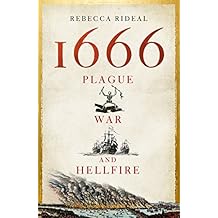
 A much more recently written offering behind today’s advent window: Rebecca Ridal’s 1666: plague, war and hellfire, which was published last year. This might be viewed as a history, rather than a social history but there is so much about everyday life in this volume, that I feel justified in including it. Although the title is 1666, the book starts with an account of the plague of the preceding year. Skillful use of contemporary sources introduces us to a turbulent eighteen months in London’s history and events that reverberated around the country. The account is presented from the viewpoint of key characters, the well-known and the less well-known. We meet Nell Gwynn, Samuel Pepys, Charles II, Christopher Wren and Isaac Newton, all names that evoke the atmosphere of the age. Others who walk across the pages of the book may not be household names, unless you have studied the history of the period. For example: Aphra Behn, playwright and spy; Cornelius Tromp, Dutch naval commander; Nathaniel Hodges, a physician and Thomas Vincent, who provides a Puritan perspective.
Most of us are familiar with plague and fire from our schooldays. The book also covers the Dutch Wars and the dawning of the scientific age. The fears of a still largely suspicious populous as they faced these disasters, disasters that most believed to be punishments from God, are portrayed well. The style is accessible and the book can be read as you would a novel. I could imagine myself walking through London’s streets as I read. Living as I do in the seventeenth century, I found this book fascinating. I wish this had been published when I was researching my own seventeenth century social history, Coffers, Clysters, Comfrey and Coifs, as there is an extensive bibliography, together with the endnotes, providing plenty of leads to follow up. There are also some attractive coloured plates and three maps in the printed version.
Yesterday I spent a slightly chilly day, with other authors, attempting to sell books to the local populace. I did duck out for fifteen minutes to take a look at an early twentieth century Magistrate’s Court record that was written in the most appalling handwriting I have seen – think the stereotypical prescription scrawl. If I say that it made my handwriting seem legible you may get the idea. Sadly the case I was looking for for Barefoot on the Cobbles was not recorded at all. Very strange, considering that it was heavily reported in the press. Today I have my non-conformist history hat on as I am off to address the Exeter group of Devon Family History Society about ‘Toleration or Turmoil?: English non-conformity and our ancestors’. This may not be quite what the audience are expecting but I hope they enjoy it. I am told there will be posh biscuits in honour of the festive season – great!
 With some technical wizardry, this post should appear at a time when I am languishing in a local shopping centre hoping to sell my books to unsuspecting passers-by. I have a small share in a stall, along with other local authors. No idea how successful it will be but I will try anything once.
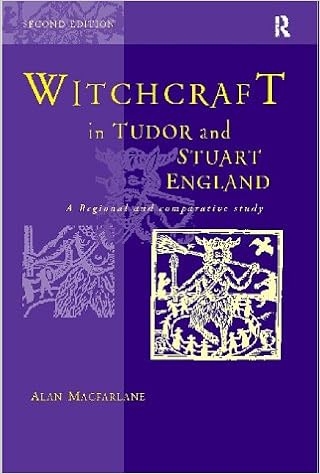 Today though belongs to MacFarlane’s work. This is not just an account of the witchcraft trials of the period. He discusses the sources that can be used, the social background and the conditions that contributed to an increase in accusations. He also looks at the various ways in which people attempted to counter-act witchcraft. The emphasis is on the notorious trials in Essex but these are set in a wider context and the background is applicable elsewhere. I am fascinated by the psychology behind witchcraft accusations and its similarities to today’s culture of bullying. I strive to understand what made people of the past act in a particular way under certain circumstances, so I found the section on the ideology of witchcraft and the anthropological interpretations a particularly valuable addition. There are maps, tables and black and white illustrations throughout the book.
 Today I would like to reveal a book that I found especially useful when I was writing up the more recent part of my family history. Angus Calder’s
 Remember Then: women’s memories of 1946-1969 and how to write your own
 I did have some problems. The cards, are printed on paper and laminated as my printer won’t take card. This is not ideal and you can see through the backs of the cards but this doesn’t matter because of the way that the game is played. The cards are also a bit of a strange shape and it was incredibly difficult to get them all exactly the same size. It probably took me best part of a day to produce two sets. Yes, I could have gone to a pound shop and bought sets of Top Trumps but that would not be the same on so many levels.
 From my bookshelf today I offer you Sara Read’s
 Today’s offering is Kate Adie’s
 Today’s offering is Dorothy Hartley’s
 The first draft of the cover for Barefoot on the Cobbles aka #Daisy has been done. It isn’t quite ready to meet its public yet but I am very pleased with it – thank you

