Over the last few weeks I have been hither and yon, speaking at a variety of venues and having the opportunity to learn at the same time. Firstly, the annual conference for the Society for One-place Studies. This was held in Manchester. I end up in Manchester more often than I’d like. Please don’t take this personally Manchester, you are bigger than a very small market town – too big. The Friday afternoon was to be spent on a guided tour of Manchester’s religious heritage. To begin with we did get a tad lost leaving the car park. Said car park cost more than I had earned that week but hey. The instructions were to ‘meet under the map’ at Manchester Victoria station. Map? What map? We wandered high, we wandered low, scanning the concourse for something that resembled a map. We asked a handy charity promoter who claimed he’d been there all week but had no knowledge of a map. Just as we were wondering if we were even at the right station we spotted the map. Clearly we weren’t wandering high enough. The map is set in tiles by the entrance and is of seriously impressive proportions. In our defence it is considerably above the eye-line but 0/10 for observation skills. Considering that this was Manchester and the last weekend in October, the weather was uncharacteristically kind. It didn’t rain and there was even a hint of sunshine. The tour itself was excellent and it was a pleasure to learn something about the city from an expert. This just highlights how much you miss just wandering around on your own (maps for example).
The next day was the non-conformity themed conference, with several thought-provoking presentations. Owen Roberts from Methodist Heritage did us proud, explaining the various resources they and their family of websites can offer. We heard about the impact of non-conformity on World-war 1 conscription and about Huguenot resources. The round-table discussion was very valuable and a chance to learn about the latest mapping opportunities. I finished off the day with my presentation about the impact of non-conformity on communities and their inhabitants. As a speaker, there are always talks you particularly like giving and others that, when they are requested, make you wish that you had taken them off the list. This non-conformity one is new for this year and when I was first asked to do it I wondered if I could really make something of it. At first I couldn’t. Then I realised that I didn’t need to talk about sources for non-conformist research at all. Light bulb moment! Shove all that boring stuff in a handout the size of War and Peace (abridged version) and talk about what really interests me: people. So this is a talk about how having options for worship makes a difference to people and places. At the moment I am quite liking this one.

Gratuitous picture from the early C20th – just because I can!
This was also my last conference as chair of the society. I really needed to step back from a few things to make time to do the other things properly. I felt that it was time to let someone else take the helm. I shall still be very much involved in one-place studies, an area of research that I am committed to and I wish the new committee well. Next on the one-place agenda is a presentation of my online Discovering Your British Family and Local Community in the early 20th Century course for Pharos tutoring. This starts in January. Put it on your Christmas list why don’t you?
Home from Manchester to some more local presentations, mostly in Mistress Agnes mode. Then it was down to the soft south of the county for a Guild of One-Name Studies’ seminar about west country migration. We were rather cosily crammed into a conveniently located venue but this was another excellent day, with a programme of experts on various aspects of the subject. I always enjoy being part of a conference or seminar as this has the bonus value of being able to learn from others. What was particularly pleasing about this day, was the way in which our presentations dovetailed together, without any prior consultation. My contribution was about motivations for migration from north Devon. This is an old favourite and I have given it many times, although I vary the case studies.
Just four more talks to give before the Christmas break then, after that, it will be the mayhem of 2018 with 30 events booked already. To say nothing of Daisy. There are some very exciting Daisy developments, which I hope to reveal very soon. She also has some more finished chapters, which will probably be as much of a relief to Blue Poppy Publishing as it is to me. This week has seen me describe Victorian privvies, research C19th Methodist Sunday School songs and wallow in the horrors of a WW1 trench. Writing is never dull!
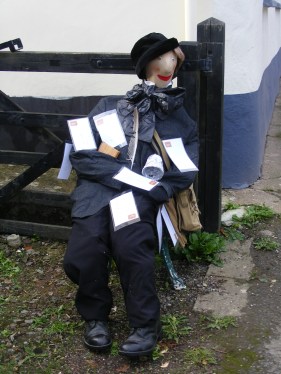 This year, some bright spark (could be a potential pun in there somewhere) decided that the village would have a guy competition, with each organisation creating an appropriate effigy, which was then to be displayed in the run up to bonfire night. After a bit of discussion, the history group chose local postman poet Edward Capern. I was proud that the letters he was holding were addressed to genuine village residents of the 1860s but I am getting ahead of myself. First, imagine the scene. Four ladies of a certain age attempting to stuff a pair of trousers with empty lemonade bottles (whose idea was it to create his limbs from bottles?) with slightly inappropriate results. We were a little early to put our creation in situ, so he sat in my kitchen for a week. No matter how many times I mentally warned myself that he was there, I never failed to jump in surprise when I saw him sitting in the rocking chair. Next was the hilarious attempt to install him in my neighbours’ garden. We accomplished a smooth lift from kitchen chair to garden chair (I’ve watched Casualty I know how these things work). Ok, so getting him out of the house was more of a challenge; his legs only fell off twice in the process. In the interests of the environment he is not being burned (too much plastic) so, now the day is passed, he will be dismantled into his constituent parts. Will all his limbs fit in my recycling box?
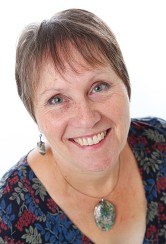
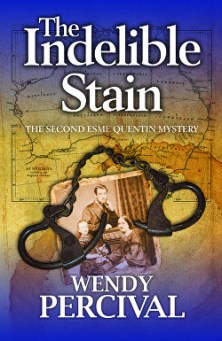 As for the other books, the South West Coast is magical and having lived here for so many years now, I wanted to embrace it for its drama and atmosphere, so it was the perfect setting for the second story,
 I finally reacquainted myself with my house for a couple of days. During which time I viewed some very interesting local history documents, chatted to my
 ‘Is being a Rockstar like winning the Piston Cup Granny?’ asks the non-resident 3½ year old. Those who are unfamiliar with the Piston Cup have either not spent five seconds in Edward’s company, or the modern world of Disney has passed you by. I tell Edward that it is probably just as exciting, although I don’t see myself as Lightning McQueen.
 Back to day 4. When you are 3½ travelling on a train is fun. You don’t actually have to go anywhere. Thanks go to the train driver who waved to a small boy making him very happy. We travelled up the line, we travelled down, we stopped to watch hovercrafts and I explained that the train was even older than Granny – hard to believe I know. Then for some reason best know to herself my daughter decided to relive her youth and swim in the sea at Sandown beach. This is England. This is October. She did have a wetsuit but there was incipient storm Brian and rain to contend with. Small person Edward contented himself with a swift paddle. We did however pass the house where Mummy grew up and the building site that used to be the hotel where Granny once worked, all reminders that there is a past.
 Next stop, the beach for a bit of beachcoming and hunting for fossils and dinosaur remnants. The only discoveries were in Edward’s imagination. It is our turn to host the extended family travelling toy, Captain James, knitted to represent a nineteenth century family member. He has been round the world several times, in the company of various hosts. This responsibility involves posing him in various locations and reporting back for the benefit of
 You can see how stressful all this holidaying with 3½ year olds is – this ended up as a webpage instead of a blog post – now in its proper place! Today the delights of
 So, apart from yet more dinosaur conversations, with dodos thrown in, how did we relate this to history? Well, we spent the day taking photos that replicate those of earlier generations taken in similar positions. Unfortunately I only have the modern ones here, so you can’t get the full effect but believe me we have a whole series of ‘my children sat on toadstools’ photos, to which I am now adding ‘my grandchildren sat on toadstools’ images. I also have a picture of me aged three holding a cuddly toy and this is, I believe, the same spot although the gnomes have now been replaced by a dinosaur.
 After a quick trip to see friends, we drove to the Dinosaur Museum, where we were met by the newly arrived Martha, Rob & Edward. We headed off to see bits of dinosaurs, models of dinosaurs and other fossily bits. Cue explanation of how dinosaurs were real once but aren’t now, as opposed to things like Gruffaloes (Gruffalos ?), which are pretend. Slight niggle at the back of the brain that maybe Gruffaloes could be viewed as a form of dinosaur but I let that pass. Edward has fun ‘excavating’ bits of dinosaur and enjoying the interactive exhibits.
 Initially, the vote was designed to help conference programme organisers to ascertain which worldwide speakers were likely to be popular and it does fulfill that function. Each year, despite John’s best efforts, the poll leads to some criticism. Complaints usually run along the following lines: Are those who do well really ‘the best’, or are they just those who are most active on social media? Or, worse still, are the medalists merely those who are able to command hosts of non-genealogist mates to blindly cast votes in their favour? As regards the first, I would argue and I think that John would agree, that being active on social media in this field is part of the criteria for rockstardom. John has done his best to reduce the second problem of block voting but the best way to ensure that the ‘right’ people do well is to cast your vote for those that you feel are most deserving. To make the poll truly valid more people need to vote. Each year, by far the greatest number of votes come from the US. That’s great America, please keep voting but the rest of the world need to take part in greater numbers. By casting your vote, or votes, you are helping to ensure that the genuine rockstars reach the top of the national and international lists. I could choose not to mention the poll because, let’s be honest, it does smack a little of electioneering but I risk that criticism because I want to spread the word that this competition exists, so that the result fairly reflect the opinions of the greatest number of people. Those who need to vote are people who have a genuine interest in and knowledge of family, local or social history. Obviously I would love it if you felt that I was deserving of one of your votes, it would be disingenuous if I tried to imply otherwise but genuinely, what is most important is that you vote for someone who is worthy of genealogical rockstardom. The voting window is now open and is very short. You only have until Saturday 21st October.

