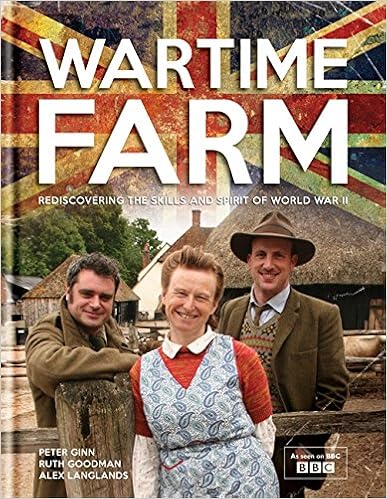
 I could not compile a list of social history books and omit the ‘Farm’ series. They have already warranted a couple of passing references in other posts but today’s belongs solely to them. Many people, especially in Britain, are family with BBC TV’s living history series Victorian Farm/Edwardian Farm/Tudor Monastery Farm/Wartime Farm. All of these are now available on DVD and are a wonderful insight into rural life in the period specified. What is less well known is that each series also has an accompanying book; I have them all. These are ‘coffee table’ books: beautifully produced hardbacks with lavish coloured illustrations. There are contemporary illustrations as well as scenes from the programme. I have no idea how well this translates to the e-reader editions. The books are nonetheless well researched and the insight into the experimental archaeology carried out by the authors, Peter Ginn, Ruth Goodman and Alex Langlands, is invaluable. For those who are unfamiliar with the series, three historians/archaeologists spent a year recreating life in a farm of a particular period. The books describe the highs and lows of their experiences.
I have decided to focus on Wartime Farm. The war referred to in the title is the Second World War, so this volume features the struggle to increase production during the conflict and the on-going tussles with officialdom, in the shape of the ‘War-Ag’. The book goes beyond the difficulties of the small-scale mixed farmer to describe the role of the farmer’s wife, giving and added female perspective. There are sections devoted to rationing, machinery, evacuees, home defence, labour, digging for victory and making do and mending, along with many others. The book does talk about the making of the series and this aspect may be less relevant to some. There are however ‘how to’ sections; so between the pages you will find a recipe for plum duff, instructions for making a mop, details of how to dance the foxtrot and how to make shampoo. In summary then, a good, general introduction to life on the wartime farm, well written and beautifully produced. Insider tip – there was a low-key, forerunner to these programmes, Tales from the Green Valley, focusing on the seventeenth century. I think this is the best of the lot. There is no book for this one but you can still get it on DVD, either as a stand alone or, at very little extra cost, as a companion with Victorian Farm and yes, I have that too.
 Now for the second offering from Sara Read, this one co-authored by Jennifer Evans. I would like to introduce you to
 Behind today’s advent ‘window’ is a true social history by Ruth Goodman, of Victorian/Edwardian/Wartime etc. Farm fame. In
 Yesterday I managed to complete a very harrowing chapter of
 Another one for those interested in agricultural history today and it is a whole series of books, rather than just one. Most family historians I speak to have agricultural labourers hidden somewhere in the boughs of their family tree. What we need to realise is that these are not some amorphous group whose experiences were all very similar. Farming practices differ according to soil, terrain and climate. The
 As I sit down, having just finished the washing up and sticking what may well turn out to be onion-flavoured marzipan on my Christmas cakes (short but sad story), what better than to introduce you to a book about housework. Caroline Davidson’s
 This comprehensive account was first published in 1919 and was written by Alice Clark, of the Quaker shoemaking family. Clark (1874-1934) herself is an interesting character, rising to become a director of the family firm in an era when this would have been very unusual. Her
 This one is for all those family historians with agricultural labouring ancestors and for writers of historical fiction who are using a nineteenth century rural setting. The lavish production and copious illustrations also make it ideal for history lovers in general to browse. Henry Stephens’

