The arrival of the huge pile small number of death certificates following my ‘beat the price rise’ ordering fest has focussed my mind on various branches of my family tree. I had fun investigating the ‘crushed by a train’ death. Safe to say, considerably more fun than was had by the poor victim at any rate. I have, after more than four decades of researching, begun to put some of my family history narratives online. I have to stress from the outset that these are not beautifully written stories. Instead, they are working documents, intended to set out all the known facts on a particular family, together with the sources for each piece of information. Some do have smatterings of local and social historical context added. So, if you are related to the Dawsons of Essex, the Bulleys of Norfolk, The Oughs of Cornwall, the Pepperells of Devon, the Hoggs of Northumberland, the Meads of Yorkshire, the Seears of London or several other related families, there is something there for you and more will, eventually, follow. Do take a look at the many other surnames of interest that are listed, who knows, we may be related.

My regional breakdown based on the documentary evidence
At Christmas, I persuaded Martha to take a DNA test. I was pretty convinced she hadn’t been swapped at birth, so I was certain who her parents were but I was interested in the profile for the ancestry that we do not share. We chose to go for Living DNA as I had been impressed by how accurately my own regional breakdown that they had provided matched the documentary evidence. I wrote about this here. Finding matches was not a priority. I must stress that I am a DNA dabbler and am by no means an expert. I do however understand a few basic principles (I think). I know that we inherit exactly half our DNA from each of our parents (except when it seems we don’t – see below). It is a random half, which is why siblings differ (unless they are identical twins) so in theory it would be possible to inherit nothing from one grandparent (although this would be very unlikely) and the further back you go, the likelihood that no DNA has come down from a particular ancestor increases greatly. I also know that if I am 20% Cornish, Martha will not necessarily be 10% Cornish. She may have inherited more or less than 10% of my Cornish DNA, or indeed none at all. I also understand a little about migration and population movements. You often see posts on online forums complaining that such and such a DNA company hasn’t shown any of granny’s Irish ancestry. This is ignoring the fact that many Irish families were Scottish or English in the sixteenth and seventeenth centuries. It also ignores the fact that these ethnicity estimates are just that, estimates. This is an emerging science and should really only be regarded as a bit of fun.

Martha’s Living DNA regional breakdown
Nonetheless, when Martha’s regional breakdown arrived it was, to put it mildly, weird. She is now wearing lederhosen and eating sauerkraut. These are my thoughts, maybe my DNA expert friends will chip in and find holes in this argument. If half Martha’s DNA is mine, I am interested in the other half. It has been very easy to identify the majority of this. Martha shows as being 34.6% Germanic; I have none. She also has 5% more Scandinavian ancestry than I have, 4.5% more from South Central England and 0.2% more from Northumberland. That adds up to a whopping 44.3% that we do not share, which, as I understand it must represent what she inherits from her father. From whom, I am reasoning, she has also inherited 5.7% of something I can’t identify because it overlaps with mine. I have been following the documentary trail since before Martha was born and I am a reasonable way back on all lines.
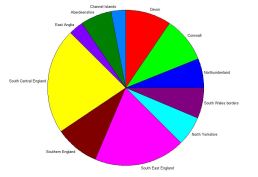
Martha’a regional breakdown based on the documentary evidence
This ethnicity profile in no way reflects what I know of her father’s ancestry, which I would expect to reflect elements from the Channel Islands and Scotland as well as a significant portion from Gloucestershire. The latter came from the Forest of Dean, which is known as historically being a remote community, very unlikely to have been influenced by European in-migration within the genealogical time-frame and beyond. Martha’s paternal aunt has tested with Ancestry and her ethnicity estimate more closely reflects the documentary trail, with nothing Germanic at all.
We have been eagerly awaiting Martha’s matches to appear and today they arrived. It may be a relief for her to know that she is who she thinks she is as she matches both me and her aunt, who uploaded her Ancestry results to Living DNA, with the expected relationship. I still don’t understand why, according to Living DNA Martha and I share 47.72% of our DNA and not 50% but I have a great deal to learn about DNA.
For those of you who have taken an interest in our BeingEdward story. I am pleased to report that the number who have read my original post has now reached four figures; so thank you so much to all who read and shared. This week, Martha has posted some insights into what life with BeingEdward means.
Oh and if you were wondering about the progress of the ‘spring’ cleaning, it may be better not to enquire. I have however now discovered that I have enough candles to survive any post-apocalyptic catastrophe, providing I can work out how to run the laptop using candle power.


 Your website is called The Glorious Outsider, can you say a little more about why you chose that name?
 What have you written that you are most proud of?
 Life has gone on in the midst of this media storm. I am ridiculously excited to have received a
 The recent official diagnosis confirmed what his close family have known for some time but it has involved focusing very much on what he can’t do, not on all the many things that he can. So I wanted to celebrate all the joy he brings to those around him. I want you to know about the time he spent talking to the men at the Isle of Wight dinosaur museum (to whom I shall be eternally grateful for their patience), when he asked about every single artefact they had in their workshop. I want to share his excitement when he rode his home-made soap box and to recall how he repeated to his parents exactly what I had told him about how to approach the miniature ponies so they wouldn’t be scared. I need to tell you about the emotion on a rare family get together (Edward finds dealing with more than one person at a time difficult) when I had to hold back the tears as he spent an afternoon holding his younger cousin’s hand, instead of pushing him over in frustration because his cousin was too small to play in quite the desired fashion.
 After a lovely time with two fifths of my descendants, I used the lacunae between Christmas and New Year to cough a great deal and revisit some family history. This was partly inspired by a recent meeting with the full range of my second cousins at the funeral of the last of my mother’s cousins. This officially makes me the oldest generation now, that is a sobering thought. I was also motivated to look at my daughters’ ancestors, in preparation for LivingDNA results for one of them. I found my own regional profile that I received from LivingDNA closely matched the documentary evidence and I have already
 In the course of working out what I was expecting, I also calculated how many of my direct ancestors I have discovered in forty two years of research. Not a bad haul for someone whose grandparents were born in the 1880s and 1890s, especially as I am 95% sure who the missing 3 3x great-grandparents are, which has a knock on effect on the totals in earlier generations. Whether I shall ever be confident enough to ‘ink these in’ is another matter.

 When tackling the horrors of the Western Front, I chose Abraham Tuke as my ‘point of view’ character. Research into his background revealed that he had been the editor of his college magazine. I decided that, like others involved in the Great War, he might relieve the stress of being in a combat zone by writing poetry. I re-read the classic World War One poets, Wilfred Owen, Siegfried Sasson, Rupert Brooke, Lawrence Binyon and other well known names. I was also fortunate to have access to a collection of works by poets who are not household names and whose work is a little less polished,

