It has been a while since I did a round up of my ridiculous busyness so here is what my life has looked like since visiting four counties in four weekends in September. Take a deep breath and dive on in.
First, a lovely chat with my Few Good Women family, with one of us practicing an (excellent) talk. Next, because exercise seems to have slipped from the agenda, a bird-watching stroll on the nearby country park, organised by the rangers. Then the first zoom chat for my Pharos Putting your Female Ancestors into Context course. Away from family history, it was time for the annual flu jab. I returned at 10.30am to a series of urgent messages asking if I could fill in for a speaker in 4 1/2 hours’ time at Devon FHS after AGM talk. Fallen Women filled the void. October’s Society of Genealogists‘ Biography Club topic was toys and childhood and we had fun reminiscing. I have even done some work on my own and I am pretty much still on track to be finished in time for next year’s big birthday. Then a two talks Tuesday; Marginalised Ancestors in the morning and Barefoot on the Cobbles live in the evening. Copies of my Barefoot novel are now almost sold out.
In no particular order, there has also been another Pharos chat, a talk about prostitution (the history of) then a 6am start to speak to the Genealogical Society of Queensland on seventeenth century crime and punishment. This was International Day of the Girl but the Few Forgotten Women had already sorted their online offerings so nothing was needed for the day. Plenty of socialising and eating with visiting friends this week amidst finally doing some work on what is planned to be my next book; some excellent case studies are emerging. I took part in the Society of Genealogist’s Devon research showcase. This should be freely available on the SOG YouTube channel shortly. I’ve been virtually in Oxfordshire to talk about home industries and then in Buckinghamshire for the Impoverished and Insane. Listening to a talk for once on Wednesday then a two talks Thursday, Forgotten Women and the 1838 Fishing Disaster this time. Yesterday was Forgotten Women Friday, having fun researching women who worked in the Ulster linen industry.
Then it was now and yes things will soon start to get a little less hectic as family time beckons, though I am not entirely sure that time with my lovely family isn’t equally exhausting but in a rather different way.
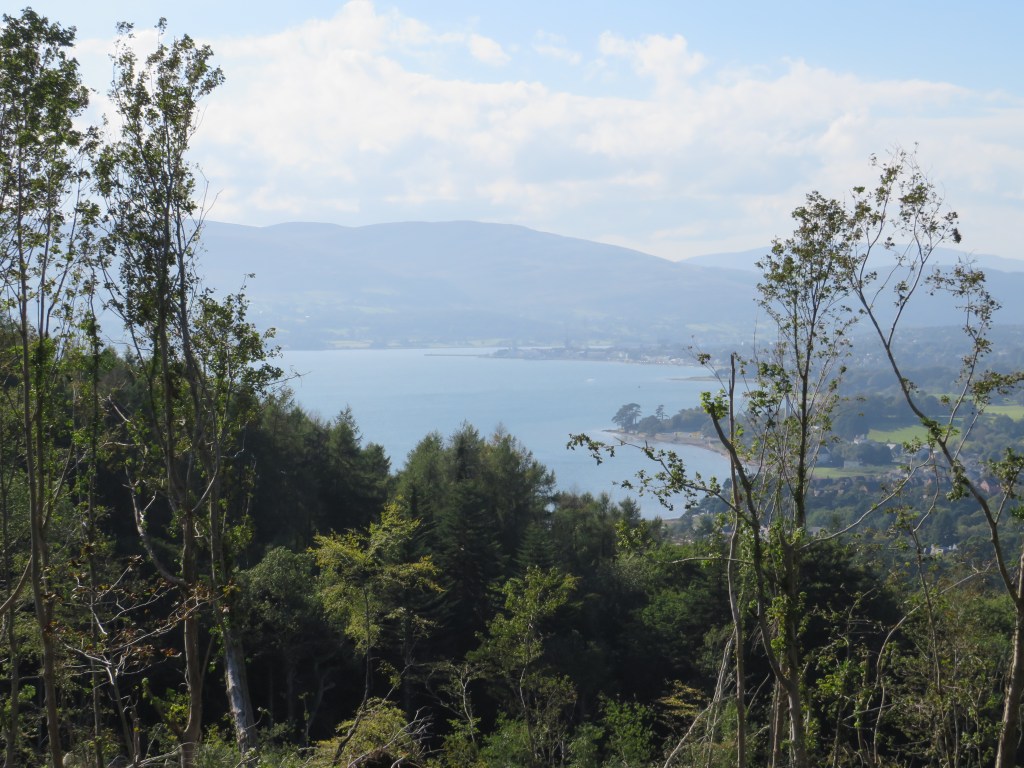
Today’s picture is of County Down, in honour of yesterday’s Forgotten Women research.
I deliberately don’t post about politics because I don’t like confrontation but remaining completely silent makes me part of the problem. I don’t have allegiance to a particular political party, although there is currently one that I would never vote for. This is not a political post but it certainly touches on current affairs. When I was interviewed for college, part of the interview process was to write an essay on ‘why study history?’. I don’t really remember what I wrote; it was the 1970s, I know I mentioned the Irish troubles. We need to understand history because we need to learn from it. It is no coincidence that George Santayana’s quote, ‘Those who cannot remember the past are condemned to fulfil it’, is on my home page. History is getting increasingly squeezed from the school curriculum. It is seen as being more relevant in today’s world to study computing, business studies, robotics and other subjects that were unimaginable in my school days. Don’t get me wrong, that knowledge is important but so is having a world in which to utilise that knowledge.
The human race seems to be rapidly losing the critical thinking skills that come with studying history properly. We need to be able to seek out proper evidence, we need to understand the role of propaganda and the power and danger of the megalomaniac. We need to be able to sift the truth from the distortions of the truth and downright lies that abound. There has always been propaganda and misinformation but in today’s digital world, that spreads so much faster and so much further than ever before. People believe what they read in the biased popular press and on social media. They fail to realise that some news output is not balanced and impartial but is presenting a partisan and misleading view that suits a particular political purpose. Whereas, in a pre-digital age, people were only likely to pass this rhetoric on by word of mouth, now mis-information can be passed on to thousands at the click of a button.
There are unthinking family historians following the shaky green leaves and believing impossible relationships, which they graft on to their family trees. These family trees get copied and replicated and before long, the weight of ‘evidence’ is in favour of something nonsensical. This is non-evidence; where is the source of that information? In the great scheme of things, if someone gets their family tree wrong, that does not have serious consequences. Believing other kinds of mis-information is potentially much more serious and downright dangerous. Daily, I hear or read friends and acquaintances spout or write ‘facts’ that two minutes checking would prove to be false, even if their common sense has failed to ring warning bells. The keyboard warriors don’t bother to fact check, ten, a hundred, a thousand, ten thousand people believe this, so it must be so. At a time when information has never been more accessible, we are nonetheless drowning in a sea of ignorance.
The world is currently a terrifying place. I hate watching or reading the news because I, like many, am fearful, not just for myself but for my family, my friends and a world that seems to be rapidly slipping from our hands. We seem to be rapidly evolving into a society where humans are no longer humane. What has happened to that sane world, where the majority of people are kind, are caring, are empathetic. I am not a psychologist, although I did study psychology as part of my undergraduate degree. I have however spent more than fifty years studying the people of the past, trying to understand their behaviour, their motivations and why they made the life decisions that they did. One thing that studying history has taught me is that there have always been periods of crisis or near crisis. There have always been threats to democracy and to the status quo. There have always been individuals who have risen up to take advantage of people’s fears and who have the personality to gather followers around them, largely by latching on to one or two issues that chime with certain sections of that community in fear.
By studying history, I have observed how humans behave when they are under threat. That might be a threat of conflict from an ‘enemy’ (real or perceived), a threat of poverty at a time of dwindling resources, a threat of epidemic, of famine or of natural disaster. Humans find it difficult to cope with threats and the stress that it causes, particularly if it is unremitting, ongoing stress. Studies of those who, for example, have suffered from long term domestic abuse, or who have spent prolonged periods in a combat zone, have discovered how detrimental that stress can be both physically and mentally. As a species, we cope best with stress if we can identify the cause and lay the blame for that stress with an outsider. If the threat is perceived to come from someone not like us, it is easier to cope with than a threat from within. Who the people ‘not like us’ are has varied over the centuries. We blame the people not like us even if all logic suggests it cannot be so. In 1348, in England, Jews were blamed for the plague. It was obvious that these people not like us were poisoning the water. Except of course the Jews had been expelled from this country in 1290. We are still guilty of applying such warped ‘logic’ in order to blame people not like us for the things that we fear today.
This is not a political post because I am not brave enough. I have friends and acquaintances who do not think as I do and I am not robust enough to engage in acrimonious debate. I am selfishly wanting peace and quiet in a world where there is no peace and quiet. I am cheered by the knowledge that there are those who do sift the evidence and seek the truth and many of you reading this will be amongst them but we tend to be the quiet ones. I watch people being drawn in by bombast and rhetoric and ‘information’ that has no foundation. I see people following leaders because one aspect of what that leader spouts feeds into their fears. They do not look beyond the loud headlines and the single issues to wonder about the polices that might underline those particular political stances. They do not think of the practicalities involved, of how what is being spouted might be achieved, if indeed there is a coherent, workable plan. They do not consider how what results from these viewpoints might impact on other aspects of all our daily lives.
Many of my followers are family historians or authors who carefully research their books. Some of you are here because I occasionally post about travel, about gardening, or special needs. Whoever you are and whyever you are here, please, please for the sake of us all, try to persuade those around you to look beyond the bombast and the catch all headlines, to look beyond the appeal to their underlying fears and analyse what is being said. To look beyond the propaganda to seek the facts. Think about what some of these policies will mean, both for us and for the people not like us. If we are the strong, we need to stand up for the weak, for those who have no voice. Let us work towards returning to a world where empathy and compassion, for each other and for people not like us, are no longer derided but are seen as core human values to be sought after and lauded. If that makes me woke, or whatever the current derisory term is, then I am very proud to be so.
Normal service, with posts in a lighter vein, will resume shortly, as long as there’s a world that will continue to allow me to do so. I’ve included a picture to lighten your day.
This was the weekend of the Secrets and Lies conference run by the Halstead Trust. I’ve been to a good many of these residential family history conferences over the years (and I do mean years, my first was over forty years ago) and this rated as one of the best. We’d travelled up to Peterborough the previous day and were ensconced in a caravan site half a mile away from the conference venue. Half a mile that is if you were prepared to cross a river and a railway line; it was actually two miles away by road. We were there for everything except bed and breakfast however so weren’t going to miss out.
Having had a quick recce in the morning, we arrived at the venue in the early afternoon to meet many friends. This was our first post-covid residential conference, so this was a first meeting in person for several years for some of us. It was also lovely to meet people who I was used to seeing in a rectangular box on a screen and discover how tall they were! There were also several of our lovely A Few Forgotten Women volunteers present; most appropriate given the conference theme of secrets and lies.
Lectures kicked off with Maggie Gaffney talking about a transportee, followed by Paul Blake illustrating just how the visual image, or our perception of that image, can lie. We were then treated to tales of bigamy and adulterine births in Scotland by Stewart Stevenson. The evening meal followed and Else Churchill rounded off the day with post watershed accounts of the bawdy courts.
Saturday dawned and I was first up, chatting about prostitution. I was glad that both my sessions were early on in the day as my capacity for being alert for a whole day at events like this is clearly waning. There was a choice of talks for Saturday’s lectures, so sadly I had to miss some I’d would have liked to hear. My first choice was Margaret’s ’Auntie Jo’s lost on the Family Tree’, which included the fascinating story of Agnes Beckwith’s life of secrets and lies, alongside a notable swimming career. After a buffet lunch of sandwiches and chips, which struck me as a rather odd but most acceptable combination I went to help Chris, who had been personning my bookstall all day. One of the advantages of in-person talks is that you do tend to sell a few books.
My choices for the afternoon were Alan Moorhouse’s tales of bigamy, Donna Rutherford’s detective story, cracking a coded message on the back of a postcard and Sarah Wise, with an account of her research into those incarcerated under the 1913 Mental Deficiency Act. Then a quick trip back to the caravan to get what passes for glammed up in our world. I was proud to receive a certificate of achievement from the Society of Genealogists. I’d actually been awarded this during Covid but this was the first opportunity for it to be handed over. Then to the food, to be frank, we aren’t a great fan of gala dinner food, preferring hearty platefuls of plainer fare over artfully arranged sprigs of not much surrounded by bits of drizzle. It is often a case of choosing the least worst menu options. This was not too bad by comparison. The soup was tasty, my aubergine something or other and Chris’ chicken something else were acceptable and puddings always go down well. A word about the dining room staff, who were just incredible in their efficiency. The woman in charge was managing them with a series of hand signals that made her look like she was a race-course bookie. She really should be in a top-class restaurant not a motel on a roundabout.
Then Sunday and by this time, I am realising that it takes stamina I am not sure I have to get through these events intact. The first talk by Calista Williams about the staff in Cottage Homes dovetailed well with the premier of my talk on Fallen Women. Judie McCourt then told us about Emma Costello’s life and divorce, including an encounter with a mystery Italian on a sofa. After more sandwiches and chips for lunch, Debbie Kennet treated us to a DNA case study, uncovering a paternity mystery.
Then it was all over. I know from experience just how difficult and exhausting these conferences are to organise and the team did a great job. I don’t know how many crises they were fielding under the surface, I am sure there were some but it didn’t show. I think I have persuaded a few people to come to our conference next year and I have a lot to live up to but I am confident of our excellent programme and beautiful location, so we do it all again then, although I have another bite of the conference cherry in between at the Guild of One-Name Studies conference in April and stand by for more family history next weekend.
Post conference, we arrived back at the van to find that it was three foot further back than we’d left it. Next door but one with huge new-to-them caravan and an automatic Volvo had been trying to move off site to go home. They’d left the motor movers on (which move the van into place a bit like a remote control car). Husband driving leaves engine running and car in drive mode and gets out to turn said motor movers off, as they are acting as a break. He turns them off – car then takes off on its own with the caravan, heading for our van. Wife in the passenger seat tries to steer car away from our van. Guy in nearby camper van tries to push their van away from ours and gets knocked down. At least this is the rather garbled story we came back to. Minor cosmetic damage to the tow hitch of our van and two broken feet where it was pushed back a metre. Site owners had been trying to ring but we had turned phones off in the conference. We were met by very apologetic damage-causers who were clearly still in shock five hours later. We ran checks to ensure we could still wind our legs up (that’s the caravan’s legs – not so sure about our own) and connect the car to the van, which were the concerns. Then to recover from the weekend.
Before we get to weekend three of family history this month, I ought to report back on last Saturday, weekend two. We headed across the border to Bridgerule. I say across the border but the River Tamar divides Bridgerule, so some parts are in Devon and some in Cornwall. We were heading for the church, where there was to be a local history display and we were booked to give family history advice. We had a postcode. The sat-nav didn’t recognise the postcode. Never fear thinks I, we will get to Bridgerule and if we can’t see the church, we will use What Three Words, which I also have. Bridgerule is tiny but there was no obvious church. Sadly there was no obvious phone signal either so the what three words option was out. We found the community shop and asked for directions. In fact we asked for directions twice more after that. It seems that some people can’t distinguish between a parish church and a non-conformist church. Eventually we find the church and the organisers had put on a great display, with equally great cake on offer.
I’ll be honest, in a place the size of Bridgerule, we were expecting one man and a dog if we were lucky but no. There was a steady stream of visitors and they didn’t just glance and pass by, they stayed and engaged. There was someone sat at our stall, asking for family history advice almost all day. In all, we fielded seventeen detailed enquiries. Partly I think because most of the visitors weren’t experienced family historians, we were able to help every single one. They all left with new information and delighted smiles. It is a long time since I have felt quite so much like a magician.
There was an interesting incident with Amazon in the middle of trying to record a talk ready for next month. Not sure if it was just because the order included an electrical item but I was asked for a tracking number. Unfortunately the driver’s only two words of English appeared to be ‘tracking number’. Where was this tracking number? I always delete all the emails that say ‘your order is out for delivery’ his engine is running while I look through the 200 or so delete emails of the past two or three days (searching didn’t seem to work, nothing in junk). Then he finds the third word in his English vocabulary ‘app’, nope, no app; I do all my stuff on the laptop not the phone. Finally found a teeny tiny tracking number when I went to the Amazon website. The whole palaver must have taken about fifteen minutes all told. By the time we’d finished, the noise of the pouring rain on the conservatory roof made recording tricky.
What else has been going on? A meeting with a new family member for Chris, who also has a Buckland Brewer connection and an excuse to eat cake. A talk to give and some work on a Cornish family. I’ve also been giving my talks for the coming weekend a final once-over. One was a little lacking in illustrations, as everything I wanted to use was copyright. As a consequence, I’ve been having a play with ChatGPT. I don’t have a paid account so there’s only so much you can do each day. Nonetheless, it has livened up the presentation. Really looking forward to chatting about the history of prostitution and fallen women this weekend, as you do – well, as I do anyway.
It has taken all the time I could spare and some that I couldn’t, for the past seven weeks but the seafarers and shoemakers story of some of my children’s ancestors is finished. In the end there were sone coopers, a baker and a housemaid thrown in for good measure. It covers sixteen couples or individuals and eight generations. There’s 16,000 words, 62 pages and 160 footnotes and at times I really wished I could stop finding new people to add. I can’t imagine anyone will want to read it but it is at least preserved for posterity. Just in case anyone reading this is connected to the same Hampshire families, the surnames are: Sweetingham, Denham, Emery, Fox, Grace, Hooker, Markes, Newman, Renouf, Strugnell and Wade and you can download the pdf over on my Granny’s Taleswebsite.
Now I need to turn my attention to the things that I should have been doing. Mind you, it may well be that my planned archive trip next week will open up a whole new avenue for research, as if there aren’t enough families still to write about anyway.
I thought that it was about time I wrote something, so that people didn’t start enquiring after my welfare. It’s been the season for the descendants to descend; typically, they were here during the few days of less good weather. Plenty of board game opportunities, with Taverns of Tiefenthal being the current favourite, alongside the obligatory visits to the pick and mix sweet shop, the ice-cream shop, the rock pools and the playground. We also watched people attempting to paddle cardboard boats across the river and some of us acted like ninjas (best not to ask) and that was summer fun done for another year. There then followed what passes for a spring clean, as I removed buckets of sand from various corners of the house, washed a million sheets and towels and returned things to their rightful places. Though, to be fair, the visitors were pretty good and setting things to rights.
Now it is back to the computer, interspersed with occasional paddles and even a very quick swim. A quiet month for talks this month but I am gearing up for a hectic September. I’ve done some brick wall busting. Well more of a chipping away, as Devon FHS members have got too good at solving their own, so we tend to only get almost impossible ones sent in now. I have practiced my ag labs workshop for the end of the month and am very excited to launch that on the unsuspecting public at the end of a whole day of exploring agricultural labouring ancestors.
Biography club was concentrating on household tasks this month. This must be at least the eighth time I’ve run courses to help people write their life stories and this time (like all the other times) I am determined to keep up with the participants and finish mine. On the strength of having done quite a bit already, I am just about on schedule. The plan is to finish in time for next year’s ‘big’ birthday. No one will want to read it of course but it is fun to write, if an exercise in self-indulgence. Seriously though, everyone has a story to tell and everyone’s story is important. Of the planned fourteen chapters, eight are done, two are almost done and four are figments of my imagination. One of these will be about voluntary work and that’s going to take some time. I’ve got as far as making a list and have come up with twenty different things I’ve done over the past fifty-five years that come under this category. Some were short-lived, most were fun and almost all are chocked full of memories. The trouble is that voluntary work and hobbies, another chapter that is as yet a blank page, overlap so I am going to need to distinguish between then somehow. The first three chapters alone are 40,000 words and run to 145 pages including illustrations. I told you it was self-indulgent – I may not be printing this out! The expurgated versions of some of the chapters are over on Granny’s Tales, just in case anyone is curious.
Related to all this looking back, I’ve been preparing a talk for the 40th anniversary of Isle of Wight Family History Society, which is one of three big live performances scheduled for next month. As well as what I hope will be some thought-provoking comments on the family history community’s past and future, there’s plenty more self-indulgence in the shape of ‘do you remember?’s. Family history has been and still is an enormous part of 70% of my life. Most of my friends are those I’ve made through family history. It has been a blast and it isn’t over yet.
In between all this, I am still plugging away at my seafarers and shoemakers in Southampton – see I didn’t even have to try to create the alliteration. This too is growing like topsy. What I should be doing is more to the next book. It is on the, rather dauntingly long, to do list! By way of encouragement, reviews have been coming in for Women’s Work. I am particularly chuffed with Julia Packman’s review in this month’s, Who Do You Think You Are? Magazine ‘a creation to be reckoned with’. Oh and it is currently on offer at 30% off from Pen & Sword, that’s a hardback at paperback price (ebooks also available). So if you want a creation to be reckoned with you know where to go.
The title of this blog illustrates the wonderful variety that is family history, also known as, how many rabbit warrens can you plunge down head-first in a short space of time? Some lovely news first. I have had the huge honour of being made an honorary life member of the Society for One-Place Studies. I am always very unsure what I’ve done when these tributes come my way, except for having been around for a very long time but I am very grateful. I will continue to champion the cause of one-place studies, as there is so much that you can learn by focusing in on a small area and for family historians, it is important to understand the environment in which they lived.
I’ve also had great fun creating an interactive workshop about researching rural communities and their workers. This is due for its premier on 30 August and you can book for a whole day of fascinating presentations with an agricultural history theme here. I shall be persuading some friends to practice this workshop first but I think we are going to enjoy ourselves.
I’ve decided to take a step across to look again at a branch of my children’s ancestry, which is also the family for which I have an, admittedly pretty much dormant, one-name study. So a few days have been spent with the Sweetingham family who include generations of seafarers and shoemakers who settled in the Hamble estuary near Southampton. An area with an interesting history, ripe for a one-place study I’d say but emphatically not undertaken by me. Repeats to self ‘you do not need any more projects’. Once you untangle the Hughs who like to call themselves Luke and the Henrys who call themselves Hugh, because they can, you are on a roll with this lot, helped by several wills. Mind you, two family members were in court for destroying a will but the odd criminal adds to the story. Although I set up Granny’s Tales for my own ancestry, I am tempted to start uploading stories of ‘the other side’ because they too need preserving. The Sweetinghams are currently a series of notes so don’t hold your breath.
I’ve also been sent a book by a fellow genealogist from the US, Cheri Hudson Passey. This is on the important topic of tracing forward and finding living relatives; what Cheri calls ‘Genealogy in Reverse’. This has always been a key part of family history research; who knows what nuggets of information, memorabilia or photographs those distant cousins may have? With the advent of DNA testing, we have another reason to trace forwards to try to identify those DNA matches that come our way, or maybe to find people to persuade to test. Although we live in an era when there is a whole plethora of documentation about every individual, it is also a world of privacy laws, mobile populations and an awful lot of people. Tracking down distant living relatives, especially those who want to remain hidden, is an art. Although Cheri’s slim volume (54 pages), entitled Genealogy in Reverse: finding the living, is written for the US market, much of it is applicable across the English-speaking world and in any case, some of our living relatives may well be outside the UK. I don’t have a price but it is obtainable from the Genealogical Publishing Company in Baltimore, Maryland, if you are interested.
Another picture to remind you that I live somewhere beautiful.
The busyness has continued this month. For some reason best known only to myself, it seemed like a good idea to open bookings for Devon Family History Society’s 50th anniversary residential conference during my most hectic week with the job we must not mention. As I am the person who processes these bookings and they went slightly crazy, it was all a tad overwhelming. We’d done our research into the numbers of attendees at similar conferences in recent years, we’d added 20% because it is in beautiful North Devon, we’d added some more because the programme is something special and we were optimists and that was our predicted audience. Bookings opened and we filled half the rooms within 48 hours. There followed an anxious wait for an appointment with the venue’s events manager and finally more rooms were secured. Even with additional rooms, we are two thirds full. If you want to come along, don’t delay.
It is going to be a hectic year next year, as I am also running ‘how to’ family history courses, and a couple of workshops, as well as my usual programme of online courses and presentations. Oh and then there’s holidays, with a couple of special trips planned and before we know it, it will be 2027!
There has been more family history, this time delving in to my children’s Hampshire ancestry; seafarers and shoemakers along the Hamble Estuary. There have been outings with friends and now it is time for family school summer holiday visits, cue excitement and exhaustion in equal measure.
There are home improvements to add to the mix. I’ve had solar panels installed. I had them previously, so was already a convert. All very efficiently installed and I have a mound of certificates, warranty documents and the like. I am now just waiting for a magic number so I can start to sell excess power back to the grid, on top of lowering my own electricity bill. Next stop, a replacement for the ‘interesting’ salmon pink bathroom suite. At the moment I have one large shower en-suite and a bath in the bathroom. I’ve decided to go for a second shower, as opposed to replacing the bath, as that suits me better and any future owner desperate for a bath could always swap it back.
There’s been more research into fallen women, because, well, why not and it is one of my subjects for September’s Secrets and Lies conference (another event that’s proved very popular). A bit of a foray into nunneries, that’s for a book chapter and a day researching women born in 1819 (the same year as Queen Victoria) for A Few Forgotten Women. Now, apart from Biography Club, I have a lull in presentations until September and yes I am still (yet again) trying to keep up with biography club so my own is finally finished, at least as regards what’s happened so far! Not sure I will make it but that’s the aim. Come September, it is full-on round the country talks again, as well as a chance to catch up with friends.
This post should have gone live on 1 June, the 217th anniversary of the death of Mary Hogg née Newlands. It has taken four solid days to put together (much longer than I anticipated), so it is late – sorry Mary but better late than never. For nearly five decades, the earliest ancestor in my grandmother’s Northumbrian paternal line has been great great grandfather John Hogg. For almost as long, I have been fairly sure that I know who John’s parents are but I have been waiting for an additional piece of evidence before ‘inking them in’. All brick walls are annoying but this is definitely in my top three that I really want to crack, not least because I love the area where I believe they came from; so much so that I embarked on a one-place study of the parish.
Here is a brief summary of the in-depth research that I have done to try to confirm John Hogg’s parentage. I should say at the outset, that this is the only branch of the family that come from anywhere near the north of England, next best are the Bulleys from Norfolk.
The story starts with my great grandfather, also John Hogg. I have his original 1885 marriage certificate, to Caroline Howe, naming his father as John Hogg, a gardener. The marriage took place in south London but census returns for my grandmother, Elizabeth Ann Hogg and her parents, confirm that great grandfather John junior was born in Morpeth, Northumberland. Family stories linked the Hoggs to Morpeth and to Russell ‘cousins’. I have a card that Elizabeth Ann wrote but never posted, addressed to Mr B. Russell, 3 Dacre Street, Morpeth. She referred to him as ‘Bertie’ and signed herself ‘Cousin Bessie’.
From census returns, we can deduce that John Hogg knew where he was born (Morpeth) but was a little vague as to when (April 1855 – March 1858). He was 28 when he married in 1885, so that fits within that date range. John’s death certificate shows that he died, in December 1926, at 3 Dacre Street and the informant was Bertie Russell ‘nephew’. John’s age was 71 (so born between December 1854 and December 1855). The births of four John Hoggs were registered in Morpeth registration district between 1853 and 1859 inclusive. There were no ‘male’ (i.e. no forename) Hoggs registered in Morpeth in this period. I followed up all four. Only one fitted the criteria of being born in Morpeth itself, having a father called John and not having a future that precluded him from being my ancestor. In addition, this family had a daughter who was the mother of Bertie Russell of Dacre Street.
Fully satisfied with my proof argument thus far, I turned to my great great grandfather John senior. He made life difficult by providing three different birthplaces in the census returns, being vague about his age and on one occasion, calling himself George instead of John. Over many years, I obtained copies of every document that I could and built up a detailed timeline of this man’s life, his two wives and nine children. It seemed clear that he was called John; there is just one census return where he is George. He was born somewhere between 1799 and 1809, probably in Bavington or adjacent Kirkheaton, which are about twenty miles west of Morpeth; although one census says Kirknewton, which is on the Scottish borders. He was an agricultural labourer, for the most part specifically a shepherd and he made many short-distance moves in the area during his life.
John’s first wife was buried in 1849, although no death certificate has been found. His first, apparently legitimate, child by his second wife Elizabeth Pearson, my great great grandmother, was in 1854. I could find no marriage either side of the English/Scottish border, within or outwith that date span, using every spelling variant of the names. This was particularly frustrating as a certificate would hopefully have included a father’s name. Comparatively recently, a newspaper announcement came to light, which revealed that they married, in 1853, at Lamberton Toll, a venue for clandestine marriages that is less well-known than Gretna Green. No records survive for this date.
I followed up all John and George Hoggs born 1797-1808 in Northumberland who appear in the 1851 census and looked for them in both the 1841 and succeeding censuses, to see which one could be the ‘George’ Hogg in Newgate Street, Morpeth in 1861 and John Hogg of Well Way, Morpeth in 1871. It was clear by the family members that these two were one and the same. After a great deal of careful research, I came to the conclusion that my great great grandfather John Hogg was almost certainly the son of Robert and Mary Hogg of Hallington, St. John’s Lee and that he was born in 1804 and baptised in Thockrington, which was adjacent to St. John’s Lee. This was the only baptism in the area around the birthplaces that John/George gave in the census and I could find no plausible alternative future for the John baptised at Thockrington, unless he became my great great grandfather.
I was so nearly there but still I hesitated to add Robert and Mary to my family tree. I was after that elusive ‘one more piece of evidence’. I investigated Robert and Mary’s families to see if this might support my hypothesis. Initially, the Hogg family were not very forthcoming. Robert and Mary only had three children and two died without issue, so there was no hope of tracing descendants for a possible DNA match. Going back yet one more generation, was a bit of a stretch but I tried anyway. This didn’t seem helpful. This family were rural agricultural labourers. They do not appear in the newspapers (as per the British Newspaper Library index). There are no surviving poor law records for the relevant parishes at the appropriate times. They do not appear to have owned land or left wills (Northumberland Archives, Prerogative Court of York and The National Archives indexes checked, as well as the excellent North East Inheritance Database). They do not feature in electoral rolls, nor did they serve in the army or navy. There is nothing in the catalogue at Northumberland Archives that relates to the family, leaving me with very little to go on.
I turned to the brides. Robert’s wife had been Mary Newlands; was she my 3x great grandmother?
The Newlands family, despite their reluctance to baptise children in churches or chapels whose records survive, had more potential. Robert Hogg died in 1805 and his wife Mary née Newlands, just three years later. This would have left John and his surviving sister, Mary, orphaned at a very young age, which might account for John’s later confusion regarding his place and date of birth. There is no age at burial for Robert or Mary Hogg ‘relict of Robt’. Mary and Robert were married in 1799, in Chollerton about five miles west of where their children were baptised. A family of Newlands emerged in Elsdon, some ten miles to the north. In 1773, a Mary Newlins had been baptised in Falstone, the daughter of John Newlins, or Newlands, whose wife was an Ann, or Nanny, née Corbitt. The Corbitts were a little more obliging, with a couple of useful wills and some gravestones. I began to build up a picture of the Corbett and Newlands families but were they my ancestors?
I was contacted by a descendant of Sarah Milburn née Newlands, believed to be Mary’s sister. I’ll call the contact SS. If our trees were right we would be fifth cousins once removed. I am used to playing with very small DNA matches. Yes, I know all the caveats but to put this in perspective, I only have a total of thirty matches that are 40cM or higher and anything over 20cM is ‘high’ by my standards. I do treat these with extreme caution but it is all I have. As fifth cousins once removed there was no certainty that SS and I would match and we don’t. This led me to look again at the matches that I do have. It turned out that, although we don’t match each other, SS and I had at least four shared, albeit very tiny, matches, all of whom descended from Sarah Milburn née Newlands. Two were my fifth cousins once removed, one a fifth cousin three times removed and I am unsure of the exact relationship of the fourth. The largest of these is a new match that arrived this week, leading to more delay in getting this posted.
Twenty year old Mary Hogg, almost certainly Robert and Mary’s daughter, died at Smiddywell Ridge, in the parish of Bellingham. in 1827. This was the home of SS’s ancestor, Sarah Milburn née Newlands. My John Hogg married in Netherwitton, the home of another Newlands sister. Were John and Mary each brought up by a different aunt?
In addition, I have an almost respectable 22cM match to a Corbitt descendant. She would be my sixth cousin once removed and yes I have checked that we don’t appear to share any other ancestry.
I am now going to claim Mary Newlands as my 3x great grandmother. To be clear, the weight of the evidence lies in my 48 years of exhaustive research. What I have outlined here barely scratches the surface. I am not basing this on DNA connections that all the DNA experts would tell me are too small to be significant. Every genealogist has to make decisions about how much evidence is enough. For me, I was 97% there with the documentary evidence, the DNA was just a final pieces of a very large jigsaw. If you want to read a fifteen page proof argument, describing in detail why I believe Mary Newlands is my three time great grandmother, you can access it through my Granny’s Tales page. All serious family historians should be setting out why x is the parent of y for all generations of their family tree (and no of course I haven’t done this for all lines yet but I can aim – how long do I have?).
Next step, who were the parents of John Newlands? This is particularly exciting as it will take my direct ancestry out of England for the first time and yes there is one of those tiny DNA matches to the Newlands of Kelso, who are almost certainly John’s family – the question is which John is which?
The view from the churchyard where Mary is buried and one of my favourite places in the world
As usual, you are not getting these reports in real time but I’ll catch up eventually.
Day 1
Having spent the past days soaking my garden plants with water and moving most of what turned out to be nearly fifty plant pots to the shady part of the garden, I felt relatively ready to go away. Turns out there were to be a few hitches. I arrived at Chris’ to be told that he was waiting for roadside recovery as the caravan-towing car wouldn’t start. Fortunately, this was speedily resolved. By this time, I was starting to remember the things that I had forgotten. The list included a belt and the trousers I was wearing were the sort that descend, taking one’s knickers with them. I was able to borrow a belt from the fisherman of my acquaintance. Even better, it looked like I’d borrowed it before, as it had had a me sized hole added to it.
My travelling companion had to stand in for a holidaying churchwarden but I decided to forsake the church with the second most uncomfortable pews in the world and walk down Clovelly High Street instead. I was hoping to get some photos suitable for advertising next year’s Devon Family History Society conference but scaffolding and a dull day put paid to that. I am sure the street is steeper than it used to be; despite not going right down to the harbour, the slog back to the top was a bit of an effort.
We were finally on our way just after midday. I then realised that I hadn’t brought the maps with me. These weren’t needed for finding our way (or so I thought – see below) but I do like to follow along on a map. We arrived at our site not far from Helston, Cornwall. We were the only van on site, with rabbits for company and horses from the neighbouring field and the farm’s resident dog coming to say hello. This was meant to be a restful holiday, so we did just that.
Day 2 Kynance Cove
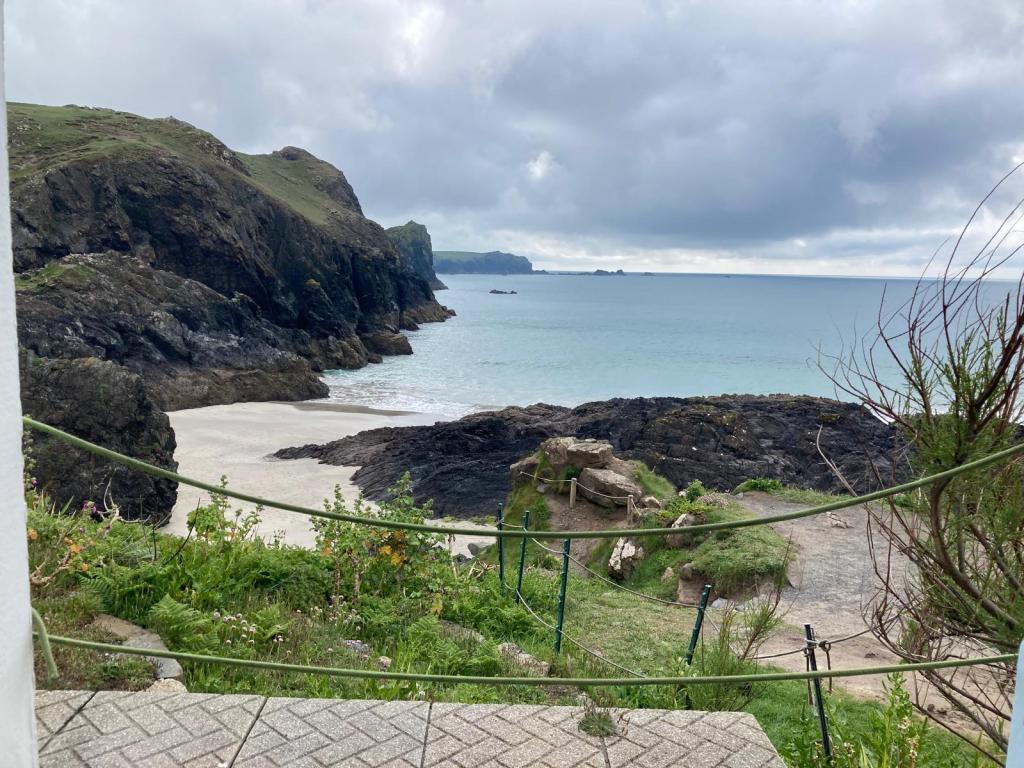
After a short drive, we availed ourselves of the free members’ parking at the National Trust car park and prepared for a short walk along part of the south-west coastal footpath near Kynance Cove. We have previously walked the whole of the Cornish section of this long-distance path but it was soon obvious that we are not as young or fit as we were. If this section of the path isn’t described in the book, which I have also forgotten, as strenuous, then it should be. We scrambled down the cliff side, wandered across the sand at Kynance Cove then struggled back up the other side. One excitement was not only hearing but seeing a cuckoo; I’ve never seen one before. Sadly, I wasn’t swift enough with the camera.
We went a little further on then, being well aware that every step further on also meant an additional step to retrace, we turned round. We treated ourselves to a drink at the café on the way back and I felt that it would be rude to refuse the carrot cake.
Back in the car, we took a short journey to Landewednack to look at the new Lifeboat Station which seems to have some kind of life down to the shore and then for good measure, the old Lifeboat Station at Church Cove. This involved parking under a very noisy rookery and hoping that the car wouldn’t need too much of a clean afterwards. That being enough exercise for one day, we went back to the caravan, where we lazed the rest of the day away.
Day 3 Godolphin
Another short drive, this time to visit the National Trust property, Godolphin. We knew the house itself wouldn’t be open but planned to explore the estate. I cleverly, or so I thought, photographed the map of the various coloured footpaths before we started. I did this on my camera; fail. I should, of course, have photographed it on my phone so that it could be enlarged. We completed most of the not terribly inspiring yellow route through fields and woods, alongside the River Hayle. The plan was to transfer to a short part of the pink route to the house, garden and café. Somehow we ended up on the purple route. Nonetheless, I was pretty sure which way we needed to go. It turned out that I was right. Unfortunately, I decided I should check the map. Finding a landmark on the opposite side of the road to the one I expected, we turned round and walked and walked some more. If only we had a proper map. Never fear we had phones with apps including Google maps and what the family call the spooky stalking app. What we didn’t have was anything resembling a phone signal. We approached a small settlement that boasted a post office, hurrah someone we could ask for directions. Said post office was only open one day a week, inevitably not the day we were there. Finally a passer-by. Better still, one who used to work for the National Trust. She set us on our way, retracing many steps. This also involved scaling walls using a strange for of style, some of which had ‘steps’ that were a very long way apart. She did also admit that the map left much to be desired and it appears that the key landmark was indicated on the wrong side of the road.
We finally approached the house/café/toilets (in reverse order of importance). We felt that we had earned our orange cake and lemon meringue donut. We looked at the C17th exterior of the house, which apparently has a colonnade that is unique in the country. The house and estate were developed by the prestigious Godolgun (later Godolphin) family, who acquired it in the C12th. They made their fortune from mining copper and tin. The mining landscape in the area is a UNESCO World Heritage site. The farm buildings are particularly superior and were built with stone from a former house. There was an interesting film show about dairying in the dairy.
We looked round the grounds and spotted what looked like a water trough. It had inexplicable notches of different depths, set at irregular intervals round the edge. We speculated what it might be used for. Enter stage left my former colleagues on the experimental archaeology course. Something very similar on the continent is described as a Roman olive mill. Another suggestion is that it was used by a blacksmith and cooling irons could be rested in the notches. The jury is still out; further suggestions welcome – answers on a postcard.