On the Hunt for Third Cousins and the Nineteenth Historical Novelist

I’ve been continuing to recheck the paper trail to identify as many of my third cousins as possible (people with whom I share a great great grandparent), prior to receiving my Family Finder DNA results in January. When a couple marry in 1863 and have eight children, you would expect that, more than 150 years later, there would be descendants scattered far and wide, well I would. This is my family we are talking about – not so. Today’s third cousin hunt centres on the descendants of my direct male line, great great grandparents William Braund aka Jeffery and Isabella Jane née Nicholls. They had six sons and two daughters. I concentrated on trying to establish how many of these siblings produced descendants in my generation i.e. my third cousins. I have rigorously researched this line in the past and today’s re-check confirmed that I have found all those who are there to be found (barring any illegitimate offspring who were a very well kept secret).

The boys were particularly easy to follow up: one died as a child, three never married, one had two sons but no grandchildren and the other was my own ancestor who produced me and only me, in my generation. That left the two daughters, one of whom died as a teenager. From the other there are just six third cousins, I have been in contact with the father of four of them for many years (my second cousin once removed) and I have found two of them on Facebook but not taken the plunge and made contact yet. It seems strange that so many branches of my family have shrunk and I have fewer third cousins than most people have first cousins. I guess it makes tracing them a more practical proposition.I’d be really interested in anyone else’s third cousin count.
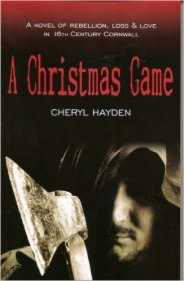
51grexi7ktl-_sx324_bo1204203200_We are in sixteenth century Cornwall with today’s historical novelist, Cheryl Hayden. Her story is based on the Prayer Book Rebellion, which is not one of the well known events of history but had a huge impact on the far south-west. It features the Winslade family, who were large landowners in Cornwall and in parts of Devon including the north-west, where I now live. There is romance and adventure bound up in the plot, which falls into the category of ‘faction’. Cheryl has a background in journalism, so her meticulously researched and well written account is not a surprise. The Cornish setting is particularly well drawn, with believable phrases and dialect. This is especially praiseworthy as the author is an Australian. She is also an academic historian and the Winslade family form part of her doctoral research. Academics are normally very reluctant to praise popular writing in their field, let alone fiction and the fact that this novel has attracted very positive comments from professors of Cornish Studies is a testament to Cheryl’s work. Reading this book immediately made me want to find out more about the events that form the backdrop to the story. I understand that there may be a second novel featuring the Winslades in the future; another for my wanted list.

Day 18 – more from Loftgate and another Genealogical Sleuth to Unwrap

Chuffed to find that my In-depth Genealogists’ blog post about twentieth century research was picked up as a favourite read of the week in the ‘writing’ category by the Family Locket blog. Yesterday was the annual Devon Family History Society (North Devon group) quiz. Six teams fought it out in rounds about Devon, Families, History and Societies, as well as identifying some of the many celebrities who have died during 2016. Proud to announce that my team were victorious, although I am not sure how valuable my contribution was.

Part of the loft clearing exercise has unearthed my untouched-for-ten-years teaching materials. In the unlikely event that I am ever called upon to teach GCSE history, geography or law (yes really, law – and no, I have no idea how that happened) again, the syllabuses will have changed beyond recognition, so it was time for a serious cull. There were twelve lever arch files rammed full of plastic wallet encased paper. I decided that, in the interests of the environment, the paper should be recycled and in the interests of economy, I should reuse the plastic wallets. I therefore enlisted the services of a trusty assistant and we began to extract paper from plastic wallets. If you think you know how long it takes to take paper from 1000+ (at a conservative estimate) plastic wallets you are wrong, it takes much longer. It is also a surprise how much room all those empty plastic wallets take up. I now have several lifetimes’ supply. Then there is the task of recycling the paper. Our weekly collection consists of whatever I can fit into a small plastic sack (not much). I have a cubic metre of the stuff. Simples, you might be thinking (if you are a meerkat) take it to the recycling centre, upend the large boxes into the appropriate skip and drive off into the distance. Ah, not so. All paper has to enter a skip through a slit the size of a large letter box. It is enough  to put anyone off being green.

4599573761_146x229We are in Devon again for today’s historical novelist and the final genealogical sleuth of the advent calendar (there are others but there weren’t enough days). Wendy Percival has created a female genealogist in the shape of Esme Quentin, a thoroughly believable character who I hope will have a long career. The first book, Blood Tied, begins with the murder of an unidentified victim and unravels a sixty year old family mystery. The Indelible Stain takes us from a dying woman on a North Devon beach, to the story of a young girl’s transportation to Australia. Although Wendy has changed the names of her locations, they are recognisable to lovers of the North-west  Devon coastline. What pleases me is that the genealogical methodology is believable. I don’t find myself screaming, ‘Why don’t you look at (insert a common record source here)’, as I do with some other authors of similar works. This is not surprising as Wendy is a keen family historian herself but the same can be said of other creators of fictional genealogists, whose careers and research techniques are much less believable. Highly recommended for lovers of mystery stories or family history. If, like me, you are a fan of both, you are on to a winning series.
DNA, Twentieth Century Ancestors and Historical Novelist Number 17

Excited to report that my DNA sample is now residing in a lab in America awaiting processing. The results are due in a month’s time. My blog post that I wrote for the In-depth Genealogist, that I mentioned yesterday, led Morag from the Shetland Island of Unst to take up the twentieth century ancestors challenge that I set. It will be a task for students on my Twentieth Century Family History course too.

My pre-DNA results investigations, to make sure I have done my best to document all my third cousins, continues with a recent break through on one line. This quest does involve plenty of twentieth century research so ties in nicely with my course writing activities. On the potential third cousins front, I have looked again at the descendants of my great great grandparents Thomas and Mary Archer Dawson née Bowyer of Essex. They had six children, three of whom I am certain have no living descendants and therefore no third cousins for me. One of the others is my own great grandmother and I am in contact with my only second cousins (six) who descend from her. This left me with two possible sources of third cousins on this line. One of these stems I have investigated fully and I know that this produced five and only five, third cousins. I have tried to make contact but they did not respond; I may give it another go. Coincidentally, although both families had moved a few miles from the ancestral area by then, I was in the same primary school class as one of these third cousins; we had no idea that we were related at the time.

The final child of Thomas and Mary Archer Dawson gave me more third cousin potential as she had seven children. I have made extensive efforts to extend her descendants down to my own generation and only by revisiting this branch of the family have I made progress on one that I know emigrated to Canada in 1912. New online searches showed that they lived in the same Toronto suburbs as some friends of mine. This led to a series of very helpful people identifying a third cousin and I am hoping to be put in contact. With my paucity of relatives, third cousins count as close family for me, so this is especially exciting. There is still more work to do on this stem but I have already encountered a casualty of the Somme and and American architect who may still be alive. I will report back with news of any progress.

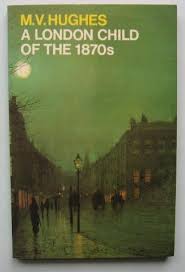
indexToday I offer you M V Hughes as my historical novelist. I am stretching the definition of the genre a little here as the books in her London series (yes, another series) are semi-autobiographical, despite the preface which claims that the characters are fictional. This tell the story of a late Victorian middle class family, who nonetheless have struggles of their own. Through A London Child of the 1870s, A London Girl of the 1880s, A London Home in the 1890s and finally, A London Family between the Wars, we become immersed in the life of the fictionalised recreation of Hughes’ own family. Molly Hughes was herself well educated, having attended Miss Buss’ North London Collegiate School, trained as a teacher and been awarded a BA, at a time when serious education for women was unusual. London Girl, in particular, provides a very interesting insight into girls’ education of the time. I read this series of four books, which were first published in the 1930s but were reprinted in the 1970s, before becoming aware that there was an earlier book Vivians. This was re-printed after the other four, so for me it was a prequel, even though it was originally published first. I actually think that reading it after the other four is the best order. This tells the story of Molly’s mother’s Cornish mining family and explains the background to the London novels, the first three of which are available as an omnibus volume. I found this excellent commentary about her work, which tells you more. By now you will probably have realised that I enjoy books that have carefully recreated settings, in this case London and Cornwall and well researched history. There was no need for Hughes to research her history as she was writing from personal experience, bringing a veracity to her stories. These books are of their time and are simply but well written. Do not expect sex, violence or adventure, respectable romance does feature but it is the account of everyday life that is the strength of these novels.

Writing and Reading of an Historical Nature

I am still busy getting on top of writing tasks before the festive season really strikes. Writing is also a great excuse as to why I am not excavating boxes that are residing in the office, having been designated as belonging on the ‘do I really want that?’ pile. Turns out that, in some cases, I do. Yesterday I uncovered Ordnance Survey map symbol flash cards – believe me these are more exciting than you think and date from the days when I was a geography teacher by mistake (long story). What will future forays into the unknown reveal? Most of yesterday was spent on the final edits of week four (of five) of my forthcoming online course on twentieth century family/community history. This is shaping up to be particularly appropriate for one-place studiers and those who feel that they should revisit the more recent branches of their family tree. In a timely manner, a blog post that I wrote for the In-depth Genealogist on the value of researching into the twentieth century has just appeared, do click through and take a look. Today’s writing choices include the final edits of week five of the course, an article about straw plaiters or the biography of a world war one servicemen. Variety is the spice of life and all that.

Oh, and for those of you wondering about the DNA, my kit still hasn’t been flagged up on the website as having been received and awaiting lab results. I am hoping that they are just slow to update the status of my sample, rather than an indication that my swabs are lingering in some sorting office in the back of beyond. There is progress on the third cousin tracing front but more of that another time.

indexAnother day, another historical novelist and again a writer based in Devon. Ruth Downie’s books have plenty to spark my interest. They are historical – set in Roman Britain (with side trips to the wider Roman Empire), they are crime stories and the main protagonist is a Medicus, so I get the history of medicine thrown in. Oh, and it is a series so I needn’t be disappointed when I finish the first adventure. So far there are seven books about Gaius Petreius Ruso and his wife Tilla and the reader can follow along as their lives unfold. Beware, as the first books have been reissued with Latin, instead of English, titles, so sadly there are fewer books than you may think.  These are fast paced plots, with characters that you can get to know and love, wrapped up in a well researched historical setting. There will be another writer of similarly themed books later in the calendar and Ruth Downie’s books definitely deserve to be as well known as hers.
Historical Novelist Number 15

You will notice that today I am not writing about lofts, boxes of junk or excessively heavy weights. That is probably because I am suffering from a surfeit of the same. Normal service may or may not resume when my weakened body returns to what passes for normal.

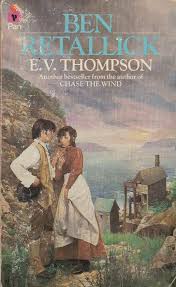
indexToday’s historical novelist is one who held the rank of ‘favourite’ for many years and I eagerly awaited each new offering. E V Thompson released at least one book every year from his first Chase the Wind, in 1977 until his death in 2012 and I have all but the final half a dozen. Most of his books are set in Cornwall, although he does make use of his experiences in Africa to move to that continent for some of his books, notably those of his most famous Retallick saga. I can’t understand how this series has been overlooked by the makers of costume dramas. My liking for these books stems more from their geographical context than their historical background, which is predominantly Victorian. The reason that I abandoned the later books is because they were becoming a little formulaic with boy choosing between rich girl and poor girl in many of them. This makes them sound like romances and I don’t think that is a fair description. Some are fast paced adventure stories with a love interest thrown in.
The setting is always clearly drawn, be it the Cornish coast, mining towns, the Bristol slums or the wilds of what was then Rhodesia and I think that this is Thompson’s strength. If you love the west country you will enjoy his Cornish novels. Apart from the long running story of the Retallick’s, which spans several generations, there are other mini series amongst Thompson’s output, such as those featuring Amos Hawke or the Jago family. I am a sucker for a saga so these appeal but I was also fascinated by The Dream Traders, which taught me about the Opium Wars, The Music Makers, set during the Irish Potato famine and Seek a New Dawn, which begins in Cornwall but moves to the copper mines of South Australia.

Another historical novelist will be pulled from the advent box tomorrow.

Technological Challenges and the Historical Novel Advent Continues

Apart from moving a few boxes from one pile to another, yesterday was a rest day loft-wise. Time instead to catch up with writing tasks and finish the Christmas cards. In the evening, I was to lead a Hangout-on-air for the Society for One-Place Studies. This was to launch our joint project for 2017, which is to be about faith in the communities that we are studying. Just as I finished my introduction and the general discussion was beginning, something dire happened to my internet connection, basically there wasn’t one. After attempts to reconnect failed, in desperation, I restarted the computer, watching the minutes tick by and realising with sinking heart that I also needed to restart the router. This is no small task as it involves crawling on my stomach and encountering the wasteland that is ‘under the spare bed’. During loftgate this would have been impossible as the entire spare bedroom was packed to the gunnels with boxes but fortunately I had cleared sufficient space to enable me to drag myself forward on my elbows and reach the plug. I managed to rejoin the discussion after the slight hiatus and later repaired to my neighbours’ house where mulled cider was being served to chilly carol singers. Despite my slightly flustered under the bed crawling appearance, I managed to pose as a carol singer with conviction. Any rumours to the effect that my absence from the hangout was due to imbibing mulled cider have been grossly exaggerated.

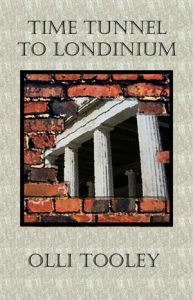
tttlcoversmall-193x300Another Devonian author for today’s offering and this time we are in the first century BC as history and fantasy combine in Children of the Wise Oak, a tale of Celts and Romans by Oliver Tooley. Although the history is well researched, you do need to be prepared for dragons rubbing shoulder with druids and Romans but that is all part of the fun. This is to be the first of a series and I am sure that many readers are eagerly awaiting volume 2. Tooley is also the author of the Time Tunnel series, in the first two of which ten year old David finds himself in Roman London. In Time Tunnel at the Seaside the background moves to a Devon location during World War II. Time Tunnel to West Leighton combines an Anglo-Saxon backdrop with an exploration of Autistic Spectrum Disorders and bullying. In theory, these books are for children and young adults but don’t let that put you off. They are also a great gift idea for any young people in your family who you would like to lead gently into the realms of the past.

Lofty Ideals and Genealogical Mystery Writing

So yesterday I am up early, assisted by my partner in crime, ready to empty the second half of the loft in preparation for the arrival of the loft insulating men the following day. We are just about to open the loft hatch when the phone rings. It is the loft insulating men who are parked nearby looking for the house. I can verify that a nearly seventy year old and a not much younger female with a heart condition can empty half a very full loft in less than an hour. What they feel like afterwards is another story.

I have promised to meet my friend to check a local graveyard for new memorials that have been erected since we indexed the churchyard a few years ago. The loft insulating van is parked right next to my front gate and insulating material is being pumped from it into my loft. I cannot get out of the gate. I do not have a back gate. In fact my house doesn’t have a back at all. Well, that is nonsense of course, it does have a back, I just can’t access it. Hmmm. My only method of escape is to clamber over a wall that divides my garden from my neighbours’ drive. I heave myself on to the top of the wall. Inevitably it has been raining. Sitting on a wet wall is not the most comfortable thing I have ever done. I leap into the unknown before the dampness can penetrate too far. I have had help getting on to the wall, I haven’t worked out how to accomplish the return journey.

After a day of ‘Why on earth am I keeping that?’ my evening was spent talking to a small but perfectly formed local history group. I always like December slots as they usually involve festive fare and sure enough there was restorative mulled wine on offer. I was talking about Remember Then: memories of 1946-1969 and the audience had brought in a lovely array of period toys for display. I also managed to sell books to 40% of the audience, even better!

Another genealogical mystery writer out of the advent box today. Again of course the books are set in the present but hark back to the past. So, let me introduce Steve Robinson. His anti-hero is American genealogist Jefferson Tayte, whose bumbling attempts at relationships echo through the series of books. I have to say that if genealogy was as dangerous a career as these books imply no one would be advised to take it up. Almost every one of Tayte’s cases results in threats to his life. Mind you, the phenomenal sums he seems to be paid may make up for this. Although there are unrealistic aspects to Tayte’s working life, this doesn’t matter. A ‘true’ account would not make good fiction. The first book In the Blood is set in Cornwall; Tayte’s enviable casebook takes him all over the world. A centuries old murder is solved thanks to his efforts. To the Grave sees Tayte in England again, unraveling a secret that has been kept since the days of World War II. In The Last Queen of England, fact and fiction are intertwined as Tayte solves a puzzle, set by members of The Royal Society, relating to the rightful heir to the throne. Then another change of time period, as, in The Lost Empress, he focuses on a 1914 shipwreck that has remained relatively unknown in the shadow of the Titanic and Lusitania. Kindred returns to a World War II backdrop and here we learn more of Tayte’s own search for his family, a thread that runs through all the books. I am eagerly awaiting the sixth book in the series, which is due out in May.
Christingles, Radio Interviews and Historical Novelists

Yesterday was the local Christingle Service. In our church, we are provided with the raw ingredients and we make our own during the service. If you have ever tried inserting a candle into an orange without the aid of a useful implement, you will know that it can’t be done. I have been caught like this before. In my pocket is a potato peeler/apple corer. I ponder whether carrying a potentially offensive weapon such as a potato peeler might be illegal but I am not arrested so it must be okay.

My interview for Tiverton Radio is now live. I have, it seems, acquired a new alias in the process. I wasn’t prepared for the photo, thinking, as it was radio, what I looked like wouldn’t matter – epic fail in this respect then. I do seem to say ‘Yes’ rather a lot. So if you want to hear me rabbiting on imparting words of wisdom and saying ‘Yes’ do click through to the above link.

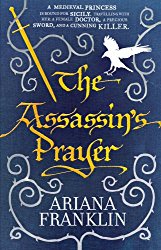
511TFTy83xL._UY250_.jpgI need to be brief, lofts to empty, writing deadlines looming but I need to do justice to today’s historical novelist – Ariana Franklin and her Mistress of the Art of Death series. The heroine is Medieval anatomist Adelia Aguilar so another history/crime combination. To be an anatomist in the 1100s is unusual, to also be a female, adopted into a particularly free thinking family and hobnobbing with royalty does require a stretch of the imagination but not one that detracted from my enjoyment. Some anachronisms do creep into the twelfth century setting. This would normally annoy me beyond measure. The fact that it does not is a reflection of the other qualities of the writing. In The Death Maze Adelia becomes embroiled in royal intrigue as she investigates the poisoning of Henry II’s mistress Rosamund Clifford. The Assassin’s Prayer recounts another royal commission as she accompanies Princess Joanna on her way to a dynastic marriage in Sicily. Relics of the Dead sees Adelia trying to establish whether human remains are indeed those of King Arthur There are four books in the series, the last published posthumously and I am sad that there will be no more.

Ferry Christmas and a Happy 11th Historical Novelist

I think the stress of the pending loft insulation is getting to me. My daughter telephoned the other day. I am one of those dinosaurs who has a land line. The phone resides in the kitchen; this makes all those unsolicited calls truly cold, as I have to leave the warmth of the wood-burner. Next to the phone is the kettle. As the phone rang, I found myself picking up the kettle and wondering why I could still hear ringing. Fortunately, the kettle was not full of boiling water at the time.

We have just returned from a few days on an offshore island. How reassuring that the sat-nav warned us that our route involved a ferry crossing, then told us to take the ferry. Like swimming was an alternative! The ferrymen are obliged to wear hard hats. On this occasion they were sporting seasonal hats perched on the top. I am all for festive spirit but it seems that these employees were all nearing retirement and were not the most cheery looking bunch. The elf ears were therefore somewhat incongruous.

Whilst away we popped in to an out-of-town supermarket for a coffee. I am not sure the staff were keen as they were heard to mutter, ‘Why do they all come here when there are cafés they could go to?’ Well possibly because the nearest one is over a mile away. The system seemed to be that you served yourself coffee from a machine or, in the case of tea, you added hot water to a teabag residing ready in a teapot. Pointing out that there were actually no teabags in the pots resulted in a handful being thrown at us. That’s teabags not teapots – teapots would be dangerous. Then we had the audacity to ask for cups! We were clearly now being quite ridiculous. Sigh.

Today’s historical novelist is fellow North Devonian Susan Hughes whose debut novel A Kiss from France has been very well received. The book is set during the First World War and its aftermath. The principal characters all work in a munitions factory in London’s East End and the tragedy of their intertwined lives makes for compelling reading. The story brings home the appalling impact of the conflict. Susan has another novel in preparation and I am sure it will be included on many people’s ‘must read’ list.

And for my Tenth Historical Novelist ……

the bitter trade piers alexanderOk, so I am going to cheat a little here. Give me a break it is hard working keeping this up on a daily basis in the season of good cheer pre-Christmas rush. I would like to feature Piers Alexander today. I have already reviewed his excellent book, set in the seventeenth century, so all I need to do is direct you to the link. It is really worth the click – it is an exciting plot accompanied by beautiful writing.