Guest Blogging – historical fiction

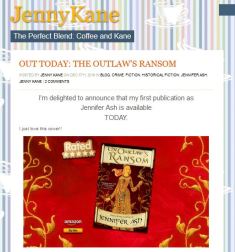
captureToday I should be making a guest appearance on the blog of author Jenny Kane. I am probably lost in the wilds of the land of no internet so, if this link doesn’t work, it is because I am having to schedule this post in advance and I’m not able to check it as it isn’t live at the time of writing. If there is a problem I will correct it when I can, so do look back and try again.

As Jenny also doubles as historical novelist Jennifer Ash, I have deliberately chosen her for today’s advent offering. Jennifer writes Medieval crime with, as she says, ‘a side order of romance’. The Outlaw’s Ransom is so new (it was published this week) that I haven’t had a chance to read it yet, although it did have a previous incarnation, in an abridged form, as part of another work. It is described as a ‘novella’ but if you enjoy it, there is a full length sequel on its way. Jenny is one of several Devon authors who are part of my advent collection. Why should there be such a wealth of talented novelists, many of whom are historical novelists, in Devon? Maybe it is the pace of life; maybe we are just behind the times down here in the bottom left hand corner of the country. It is a privilege to have met, either virtually or literally, many of those I am listing.

Tales from Boxland and the next bout of Historical Fiction

the-scolds-bridle

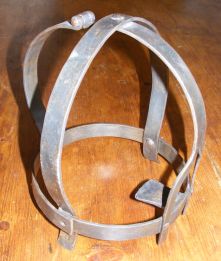
A short post today as I dodge boxes and debris that have been inhabiting my loft and are now impeding everyday progress almost anywhere. Why am I keeping all this? To be fair, a great deal of it is really useful stuff, sets of armour, instruments of torture and so on, that I use in the course of Swording and Spindling. Talking of instruments of torture, I am just about to regal the good folk of Barnstaple with the crimes of the seventeenth century; good job I have my scold’s bridle to hand. Then there is grandchildren appropriate gear: fireguards, highchairs, potties, as well as toys and books that are awaiting their ‘growing into’ – the current toys live in the ‘playroom’ aka conservatory. I have a lifetime’s supply of bubble wrap for dispatching books to my eager readers. There are also though potentially useful empty boxes – because you never have one when you need one, vinal records but no record player, the printer before last etc. etc.. I feel a cull coming on.

Out of the ‘hat’ today is historical novelist Norah Lofts, another who was beloved in my teenage years and is still occasionally re-read. Most of her books are set in fictional parts of Suffolk and I enjoy the fact that the heroes of one novel sometimes make their appearance as minor characters in another. It is a bit like looking for the Gruffalo in other books by Julia Donaldson. I need to make it clear to the uninitiated that, great though her books are, Julia Donaldson is not an historical novelist. If you have no contact with anyone under five you will probably be mystified, so give her a Google (other search engines are available). Back to Norah Lofts. She is probably best know for her ‘House Trilogy’ of novels about the house at Old Vine, which span the centuries in a way that appeals to me. Others that are based on the story of a property are Bless This House and Gad’s Hall. It is very difficult to pick a favourite, although those I have already mentioned have to be amongst the nominations. The task is made harder because my books are currently inaccessible behind piles of loft tat, so I can’t flick through them. Actually, that is probably just as well as it might take all morning!

Box Seven of the Historical Novelist Advent Calendar and How many Boxes can you Fit…..?

Well, the contents of half of my loft is no longer in the loft. I can report that I am still able to squeeze my way from bedroom to bathroom when needed. I am a little concerned about where the other half might go but that is a problem for next week. I am also just about still standing after hefting boxes. The tree, with new lights, is decorated. The old lights cost £12.99 from Woolworths in the late 1970s – that is more than we paid for the new ones! Local radio had a phone-in about old Christmas tree decorations yesterday. The ones that were cited were mere babies compared to some of mine.

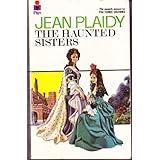
Product DetailsA round up of historical novelists wouldn’t be complete without mentioning Jean Plaidy. Jean Plaidy’s novels formed a backdrop to my late teens as I read my way from her Norman saga to the Victorians, by way of the Plantagenets, Tudors, Stuarts and Georgians. I do still have my near complete collection of Plaidy books; they take up several feet of precious bookshelf. They are amongst the very few books that I still have that I will probably not re-read but I somehow can’t bring myself to part with them. Although I read each one several times when I was younger, I feel I have somehow outgrown them. Tales of the royals don’t hold my interest in they way that those focusing on more lowly characters do. Having said that, I do have to credit Jean Plaidy with giving me a far better grounding in British historical chronology than I could have acquired any other way. They are still in print, with jazzier covers than the ones I have and have now lost out to a certain extent to those by Phillipa Gregory but they still hold a special place in my heart.

In a P.S. to my 2nd December entry. Liz Shakespeare’s forthcoming book about Edward Capern is to be accompanied by a CD of his poems, set to music by Nick Wyke and Becki Driscoll. This is the CD that also has spoken poems on it, narrated by a fisherman of my acquaintance. A seasonal musical track is already available online.


Of Lofts and Lunches, with an historical novelist advent reveal thrown in

A little late in the day for the advent box today as I have been ‘after lunch’ speaking about Christmas traditions. The great thing about this is that a) you get to eat as a bonus and b) with a bit of luck half the audience have been imbibing with their meal so aren’t concentrating on what you are saying. It was a bit of a challenge as the acoustics in the room weren’t of the best and as I began to speak I realised that the winter lurgy had stolen the fortissimo range of my voice and I was without amplification. I managed to sound deep and interesting for the duration and it seemed to go well.

Morian Helmet.JPGYes I know that it is now several hours after lunch. I have been succumbing to sales patter. I am officially barmy. I seem to have let myself in for helping a friend move house at the weekend and then emptying my loft between now and Tuesday in order to have it insulated. My loft contains more than my house, much of this is items like suits of armour that you can hardly pile on top of each other, oh and did I say I am not supposed to lift anything. I have a bad feeling that this could all go horribly wrong.

Today’s historical author is Susanna Gregory. She is responsible for two series of books. Strangely it is not her seventeenth century Thomas Chaloner mystery books to which I am drawn but those set in fourteenth century Cambridge. These feature doctor and university lecturer Matthew Bartholomew who, together with his sidekick Brother Michael, solves crimes in and around Cambridge. A quick word of warning, if you get hooked on this series, there are already more than twenty that will find their way on to your ‘to be read‘ list. Many of the characters actually lived in Medieval Cambridge, although often little is known about them and Gregory has been liberal with their exact dates. The university setting and the medical slant to the Matthew Bartholomew books appeal to me and I am a sucker for a series that I can get my teeth into. If you enjoy a book it is always good to know that there are twenty more in the pipeline. Unlike some authors, this prodigious output has not become formulaic. Although you are pretty sure that at least one and probably several, people are going to have died in mysterious circumstances and that Matthew is going to fail to get the girl AGAIN each book has its unique flavour. Susanna also writes, together with Beau Riffenburgh, as Simon Beaufort.

Christmas Preparations, DNA Progress and another Historical Novelist

Yesterday’s festive disaster was the failure of the Christmas tree lights and yes I do always check them before I put them away. They worked perfectly in January. How can thing ‘unwork’ whilst lying calmly in  box? At a conservative estimate these lights are 35 years old. The price on the box is in ‘new’ money so they must be post 1971 but probably not by much. Scarily, this means they have been on my Christmas tree for more than half my lifetime. I guess this means they don’t owe me anything. Having laboriously checked each of the 40 bulbs, the wiring and the fuse, I concluded that there must be a break in the wire somewhere and conceded defeat. I am now awaiting the arrival of my personal shopper who has been given detailed instructions and I hope will have purchased the ‘right sort of lights’. As the lights have to be on the tree before further decorating can commence, the ornaments remain strewn across the living room floor awaiting their month of glory.

My DNA kit is still somewhere mid Altlantic. I am eagerly checking the company’s website, awaiting its move from ‘Pending Shipment to the lab’ to ‘Pending Lab Results’. In the meantime, I am still re-visiting the paper trail to identify my meagre collection of potential third cousins. My great great grandparents John and Elizabeth Hogg née Pearson’s descendants are noted for their quality rather than quantity. Well certainly they failed on the quantity front so I made up the quality bit! They had four children. One died unmarried and I am the only descendant of another. One of the others provided me with five third cousins, who fortunately have a very unusual double-barrelled surname, so I was able to make contact with one of them. The final daughter had one son. No help from an unusual surname here. I have tracked down three people in my father’s generation who potentially could have produced children to become my third cousins. So, at a guess, between 5 and 15 third cousins on this branch.

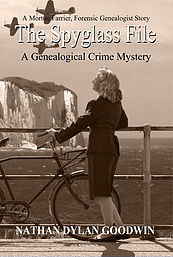
f927db_aa32dccb9ddd43cab3a17d5b08480124mv2It would be strange if my advent historical novelists’ list did not contain several who have a genealogist as their protagonist. You might argue that these are not precisely historical novels and you would be right, as they are largely set in the present. They are however so bound up with the past that I am counting them – my advent ‘calendar’ my rules. These tend to combine an historical slant with crime, another of my favourite genres, so for me it is a two for the price of one scenario. The first for me to ‘unwrap’ is Nathan Dylan Goodwin. These feature the casebook of forensic genealogist Moreton Farrier. I cringe a little at the phrase ‘forensic genealogist’, as to me forensic genealogy is just ‘proper’ genealogy but we won’t go there now and it doesn’t detract from my enjoyment of the books. The first book, Hiding the Past, has an unexpected twist in its tale as Moreton strives to uncover a family secret, with the aid of his police officer girlfriend. The Lost Ancestor slips between the present day investigations and Edwardian Britain, in a case that proves hazardous for Farrier. The third in the series The American Ground is based on a real incident and reflects Goodwin’s other writing, which focuses on the local history of his home town of Hastings. The Battle of Britain forms the background to The Spyglass File,, which has only recently been released and is still on my ’to be read’ pile. A continuing thread throughout the books is Farrier’s search for his own biological family and this, as well as the fast paced writing, makes me eagerly wait the next installment. These are undemanding holiday reads, which is why I still haven’t got to the latest one. That is not meant to be a derogatory comment, they are well researched and the genealogical methodology is accurate and interesting. Once you start one of Goodwin’s books you can’t wait to turn the next page, so not to be begun unless you have time to get to the end, which you will probably want to do in one sitting. A great one for family historians everywhere.

Drawing another Historical Novelist from the Advent Box

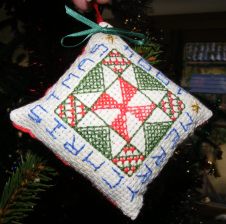
DSCF1180A shorter post today, trees to decorate, cards to write, as the time of year catches up with me. We have just been to get the Christmas Tree. This is a hugely important activity. It has to be the right tree; I have been known to take one back! Based on my guiding principle that if it fits in the room it is too small, this one is probably too small but it makes up for the fact that there is at least six inches between the top of the tree and the ceiling by its bushiness. The tree came from a nearby farm where you can stomp your way through mud and fallen apples to select your own, which is then cut to order. Now Christmas begins. My Christmas decorating policy would have interiors experts cringing as colour co-ordinated it is not but each decoration has its own significance. I wrote about this three years ago. We even have a plan to keep three small persons and the tree at a respectful distance. I do want to share it with them but it would be preferable if the ornaments survived to be shared again next year.

For today’s advent author, I have drawn from the box one who resounds with my seventeenth century self. Let me introduce Adrian Tinniswood. Adrian is known primarily as an architectural and social historian and most of his books reflect this but he has also written novels. Like a number of my favourite historical fiction writers, his family sagas are based on real people. The Rainborowes tells the story of this family as they travel back and forth across the Atlantic with surprising regularity, during the political upheavals of the seventeenth century, in which members of the family played a significant part. Although political machinations form part of the plot, it is moves way beyond this. The setting for part of the story in Wapping in London’s East End and that is particularly well drawn. It also provides a vivid account of life in the early decades of the New World. Tinniswood’s other seventeenth century offering is The Verneys: a  true story of love, war and madness in seventeenth century England surely a novel that has it all. Research for this was aided by the copious correspondence that survives for this Buckinghamshire family. We encounter Barbary pirates, civil war battles and family struggles in an account that gives the women prominence as well as the men. As you might expect from someone who is an historian as well as a novelist, the research is precise and detailed. The atmosphere of the seventeenth century is given definition and a piercing clarity.

Christmas Trees, Christmas Markets and day three of the Historical Novel Advent Calendar

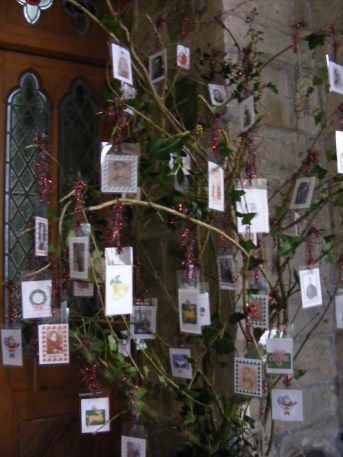
christmas-tree-2016-1This month, our village is staging a Christmas Tree exhibition. Local groups and associations were challenged to decorate a tree that reflected their activities. Never one to resist a challenge, the history group set out to create something that would be representative of what we do. We debated using vintage tree decorations, which I have but they are too precious to leave unattended and anyway they would be inhabiting my own tree. In the end, our tree became a real joint effort as two members were charged with sourcing a natural ‘tree’ aka suitably shaped branches and greenery. Another member was to provide sand to secure the ‘tree’ in its pot. We did have difficulties with this as an unseasonable three day freeze meant that the sand pile was impenetrably solid. A gravel substitute was found. My contribution was the decorations. For these, we printed out small portraits of former residents, taken from our photograph collection, within seasonal frames. We abandoned the initial idea of putting the names on the reverse side as we feared that the stability of the tree would not withstand viewers trying to access the names. Instead, we provided a key to the identities of those on our ‘decorations’ to put beside the tree and instead put seasonal images on the reverse of the laminated ‘ornaments’. Glittery ties and ivy in lieu of tinsel finished off our entry. It has already attracted favourable comments and now we await the result of the vote for the ‘best tree’ in the New Year.

Now I must stop writing this and venture out to set up the history group stall at the Christmas Market. Fortunately, I only have to move our historical books to the chapel next door and it will be fun to mingle with my neighbours for the day, looking at the produce on the other craft and food stalls and generally starting to feel Christmassy – a season that I love, even though I am not a fan of the weather that accompanies it. Having said that, I don’t think I could get my head round Christmas in blazing sunshine on the beach along with my down-under friends.

For today’s historical novel advent box I would like to open the novels of Anya Seton. She was the first adult historical novel writer I read, having, at the age of eleven, just watched a television adaptation of her Dragonwyck. During my early teenage years I eagerly worked my way through her whole output. An American author, Seton’s works are nonetheless often set in England and stretch from Roman Britain (Mistletoe and Sword) to the Victorian Era. I still re-read her books, admire her careful research and enjoy the slightly mystical slant that some of the novels have. Green Darkness is one such, time slipping between the sixteenth century and the present. This is one of my favourites and her teenage novel Smouldering Fires adopts a similar approach. Several of her novels are based on real characters; for example The Winthrop Woman tells of early emigrants to America and Devil Water is set at the time of the Jacobite Rebellion. The latter instilled in me a great love of Northumberland decades before I was able to visit that county. Seton may now be considered old fashioned but I can still get lost in her narrative. Who will I draw from the ‘box’ tomorrow?

The Midnight Adventures of an Historian. Latest DNA news and the contents of my second advent box are revealed

You may remember that, last year, I inadvertently applied to present webinars for Ontario Genealogy Society and failed to correctly assess the impact of the time difference. This saw me – yes, the me who is normally asleep by 10pm and never sees midnight, even on New Year’s Eve, presenting to a Canadian audience beginning at what was midnight my time. Last night I got to do this again. This time, not only was it midnight but the temperatures outside were doing a good job of replicating those experienced by my audience. In order to get the maximum bandwidth I am not in my cosy wood-burner heated living room, nor still in my relatively balmy bedroom but in the arctic spare bedroom. I suppose the upside of this was that the temperature helped to keep me awake. My session on historic causes of death seemed to go well – if you can judge how well you are doing when you can neither hear nor see your audience. At any rate, there were plenty of questions and some lovely comments at the end. In a peculiar brand of masochism I have agreed to present a webinar for next year’s series too!

Yesterday I posted my DNA kit. Thanks to a helpful suggestion, I opted for ‘genealogy kit’ on the customs form. It turns out, had I listened to the instructional video, that would have made a similar suggestion. Instructional video? I thought I had done well getting someone else to check the written instructions. I had to persuade the young man in our Greendalesque mobile post van that I actually needed a customs form. ‘It is quite small you won’t need one’. Really? No way was I having my DNA end up on one of those border force TV programmes, so I insisted on having a form, which he struggled to locate. Perhaps that was why he had suggested not bothering.

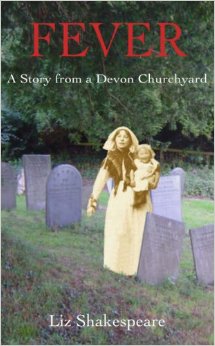
51amm97hjtl-_sy344_bo1204203200_The historical novels out of my advent box today are the books of my friend, local author Liz Shakespeare. Liz writes evocative stories set in Victorian North Devon. These take their inspiration from real characters and are meticulously researched. Fever: a story from a Devon churchyard recounts the anguish of the families in my neighbouring parish of Littleham, as the community is overwhelmed by an epidemic. A gripping story and plenty of social historical context, with a health history aspect that appeals to my interests. Another novel that recreates the era and the locality in striking detail is The Turning of the Tide, which is set in Clovelly and Bideford. It follows the life of Selina Burman who is rescued from the workhouse by a local doctor with an unusually modern outlook. Liz has also written a beautiful set of short stories All Around the Year, inspired by the Devon landscape. Her oral history of Littleham The Memory be Green was garnered whilst she had the opportunity to speak to those who remembered the early years of the twentieth century in her home parish. Not only is this a fascinating account but it could be replicated in other communities. Liz is currently taking pre-publication orders for her forthcoming novel The Postman Poet. This tells the story of Edward Capern, who walked from Bideford to Buckland Brewer on his daily round, resting in my house before making the return journey and penning poetry whilst he did so. My account of Liz’s re-enactment of Capern’s journey can be found here.

My DNA Adventure and I open the first of my advent boxes


dscf3504I was finally enticed by FamilyTreeDNA’s seasonal sale and purchased myself a family finder DNA kit. I am still not quite sure why I have done this but I never can resist a bargain. This morning, I was up early to provide my sample. The company advises doing this before you put in your dentures. That’s no problem, hopefully it will be a number of years before I will be inserting any dentures. It is also though supposed to be before breakfast. I am not much use before breakfast but I am very law abiding so taking the test has to be done very early, so I can eat. It is the first duty of the day, well after checking social media that is. I enlist assistance as I am notorious for not reading instructions. My assistant does not have his reading glasses with him – this is going well. I begin scraping away at my cheek with vigour whilst my assistant times the required 30-60 seconds. My jaw is unnaturally locked in an open position and it is really difficult to do this without dribbling. No one tells you that, or is it just me? About twenty seconds in I realise that I am using the flat side of the implement instead of the scrapy side. I fail to communicate this to my assistant by means of strange gurgling sounds (I am still scrapping and he is wondering why I haven’t stopped when the suggested number of seconds is up.) Sample safely ejected into phial provided, I start again with the other cheek.

dscf3505The waste bits of the scraper look like they have potential for turning in to instruments of witchcraft torture – excellent just what we need. No, seriously, this is not a joke. Deed done. Dilemma. How should I fill out the customs declaration? I am dubious about the etiquette associated with sending bodily fluids through the post. Can I legitimately classify it as a ‘gift’?

I have thought long and hard about who this ’family finder’ might find; the possibilities are limited. It is really designed to link you with 3rd-4th cousins, or closer relatives. Ok, who is that likely to be? I have no siblings, no first cousins and only six second cousins (those with whom I share great-grandparents). These are all on the same side of the family and two of them are adopted, so from a genetic point of view that leave me with four people, whom I already know, to match with. I must not neglect the ‘removeds’. These four second cousins have between them six children (my second cousins once removed), all of whom I know of. I believe one or two of them have produced children (my second cousins twice removed) but these are babies and unlikely to be looking for DNA matches.

I track back to my third cousins (shared great great grandparents). There are eight possible couples who have produced remarkably few descendants who are my third cousins. We are now in the realms of cousins who I have only discovered through family history. Over the 39 years that I have been seriously tracing my family (yes I was an infant when I started) I have looked for, contacted, or become aware of, third cousins on all of these eight branches; watch this space to see if DNA can turn up any more. While I am waiting for the test results, I will try to go back over these eight sets of great great grandparents and their descendants, to see if there are any I have missed. For now I can tell you that Philip and Mary Woolgar née Cardell had four children and I believe I have brought all their descendants’ lines down to my own generation or beyond. This is the line where I have second cousins but we are the only ones in our generation, so there are no third cousins on this line at all.

scan0002I am hoping to open a history themed book on my ‘advent calendar’ (aka blog) for each day of advent. Some of them will be written by people I know so, to make it fair to my author friends, the order is being decided by drawing the names out of a hat. Today’s offering is The Cruel Mother by the late Sian Busby, which was recommended to me by our of the participants on my ‘Telling your Family’s Story’ course. Don’t be put off by the book’s title, which is taken from a folk song. It is a true story of the author’s great-grandmother, who drowned her infant twins during a bout of puerperal insanity. This may not sound like a laugh a minute and it isn’t meant to be. It is however a brilliant insight into early twentieth century attitudes to mental illness and the repercussions that this incident had down the generations. It also tells the story of Sian’s attempt to sift fact from rumour as she sought to understand more about her family’s secret past. If you are interested in human behaviour, social history, psychology or family history you will enjoy this book.
A World of Missing Things – or the latest episode in the diary of a scatty historian

Today a fisherman of my acquaintance requested help with collecting his car from the garage. Today was also the first frost of the year, that would be a very hard frost. I donned as many layers as possible, allowing for the fact that I had to be able to move my arms. I broke the ice on the muddy puddle that passes for a pond in case the resident frogs, Fred and Freda, were struggling to breathe. F & F were sensibly conspicuous by their absence.

074 23 January 2013 Me at Samiland 2

Not Actually Today But You Get The Idea

Inevitably, the car windscreen was iced up, although bizarrely this was on the inside not the outside. De-icer. De-icer, hmmm. I was car-less last winter. I haven’t needed de-icer for more than a year. It must be in the boot. Can I remember how to open the boot of this car? This is not as ridiculous as it sounds. Oh, ok, it is ridiculous but here is my excuse. I have to park with the back of my car hard up to a wall so there is no room open the boot. The back seat is my boot. The boot however does have things in – like de-icer. I debate prizing the parcel shelf off to gain access to the boot from inside, then opt for moving the car forward (despite not being able to see where I am going) in order to open the boot, which, it turns out, is accomplished by the conventional method of turning the key. No de-icer. Then it dawns on me that my de-icer is in a car graveyard somewhere on the south coast. I take out a second mortgage and burn up half a tank of petrol so I can leave the engine running while the windscreen gradually defrosts, aided by some judicious rubbing on my part. This leaves delightful smears through which I peer as I negotiate ice and blinding sunshine on my journey, the sun also creates migrane inducing flickering as I travel between the trees.

Other adventures today include becoming an Amazon seller. I have been heavily publicising my books in the hope that they will make suitable items for Santa to slip in stockings, not just of friends of friends but folk in the world beyond. I am therefore keen that my magnum opii should be available on the site of a well known online bookseller near you at the proper prices, not three figure sums. If you want a thing doing …….. so following a suggestion from a friend, I began the process of setting myself up as a seller. Step 451 ‘enter your passport number’. Sets off to get passport. No passport in the place where passports live in my house. Minor panic ensues. This rapidly develops into a major panic as I rifle through every folder in the box of official papers, tossing bills, bank statements and guarantees around with frenetic abandon. Stop to think – you know, that ‘When did you last have it?’ thing. Light-bulb moment, when I nearly used it to renew my driving licence online (gory details of this saga are available in an earlier post). This means my passport has not yet reached the top of the ‘to be filed’ pile upon which it was tossed after this abortive mission. Passport duly retrieved.

Several steps further on and an automated telephone call requires me to put the number I can see on my screen into my phone. I kid you not, this number begins 999 (quick translation for US readers – this is the equivalent of 911). Are they having a laugh? I do this and ‘verification has failed’. I am to try again or speak the number. There do not seem to be any blue flashing lights at my door but I opt for the latter and there I am, an Amazon seller. So you can now buy my books on Amazon at the prices that they are meant to be. Sales direct from me are still preferable but all sales are welcome. Did I mention that it is only 25 days to Christmas?