Travels with a Three Year Old – day minus 1 – getting there

I sometimes wonder why I have a house as I see so little of it. This week we are paying a visit to the Isle of Wight. Not so much a holiday but a chance to see friends and family as, this time, small person Edward is bringing his parents and will be joining us. Last night was a local pub quiz. In a needle final round my team, by judicious playing of our joker, scraped a victory. Who knew that we could summon up so much knowledge of the Bible? We will however draw a veil over our performance in the science and music rounds. We scored by having our very own Australian team member, who was able to share the vital information that wombats have square poo.

After the quiz, adrenaline was running high and I found it even more difficult than usual to sleep. Believe me it is pretty difficult for me to sleep worse than usual. I was due at Chris’ for departure in the caravan at 9.00am. Chris’ house is a 12 minute drive away. Regardless of what time I go to bed, or how well I sleep, my natural waking up time is 6.00am + or – half an hour. Maybe a dozen times a year I might still be asleep by 7.00am. The only time I ever set an alarm is when we are working in a school and need to leave home before 7.00am and then I am almost always awake long before the alarm goes off. This morning I woke up thinking it was probably about 7.00am, after all, I had had a late night. I turned on the computer to check my emails before I disappeared into an internet-less black hole. I peered at the clock in the corner, oh good it was only 6.37. ‘That’s funny,’ thinks I, ‘it seems to be quite light outside’. I peer more closely at the bottom right hand corner of my screen 8.37!!! 8.37?!!! I can’t remember ever being asleep at 8.36 (it takes a minute to turn the computer on). If I have ever slept at such a ridiculous hour it is definitely more than forty years ago.

I made it to Chris’ for 9.20 and we said goodbye to our house-sitting Australian friends. It was an uneventful drive to deliver pasties and birthday cards in Christchurch and we had made up for lost time. After that things went less well. What should have been a 45 minute drive to the ferry terminal took nearly twice as long due to roadworks and we arrived at check-in with only minutes to spare. That may sound like ‘in time’ but you are supposed to be there a hour before departure.

Janet on beachI am now snuggled in the caravan trying to conserve my energy levels ready for five days at Edward pace. I spent my first ever holiday on the Isle of Wight when I was three, so it will be exciting to share it with a three year old. For those who are familiar with my Harnessing the Facebook Generation booklet, I shall be trying to put some of my ideas for inspiring young people to take an interest in history and heritage into practice while I have access to a small person.

Presentations Past, Presentations Future and Presentations at Midnight

Forgive me if this post is a little garbled but sleep is sadly lacking at present. Each year, I am invited to apply to present a webinar to Ontario Genealogy Society members. Each year this seems like a brilliant idea. For the last three years I have been lucky enough to have been chosen as one of their team of twelve international presenters. Then the day looms on the horizon and I realise that in the intervening months since the previous webinar, I have totally forgotten how the technology works. Fortunately, I get the chance of a practice run. Then comes the difficultly of staying awake. The first time I did one of these webinars, I lulled myself into a deluded sense of security by miscalculating the time difference and thinking I was going live at a respectable 2.00pm. Not so, midnight! Is there such an hour? I think I am correct in saying that the last time I saw midnight was when I presented last year’s webinar. Give me 5am over midnight any day. Needless to say, what passes for my body clock insists that this morning it is still time to wake up at my normal 5-6am. It’s going to be an interesting day. Anyway, what makes it worthwhile is that I have already had some very positive feedback about my session in the wee small hours. It was about inspiring young people to become interested in history, family history and heritage; something that is vital not just for our hobby but for the greater good of those young people and the world in general.

CaptureFanfare alert. The really thrilling news is that I can finally announce that I am honoured to be the keynote speaker at next year’s New Zealand Society of Genealogists’ conference. This pretty much qualifies as THE dream gig. Not unsurprisingly, I have had several people suggest that they would make an invaluable prop for one of my sessions. I have been asked to do some of my favourite presentations and it is rumoured that Mistress Agnes and Master Christopher will be muscling in on the act. I keep telling them that they can’t come, as New Zealand has not been discovered in their time but it seems that their presence has been requested. I have, with great forbearance, been sitting on this secret for FIFTEEN MONTHS. I was allowed to quietly announce that I would be attending a few months ago but now the official press release has been issued, I can jump up and down like an excitable mad thing. Next year is certainly going to be as ridiculously busy as ever with another overseas trip as part of the Unlock the Past Alaska Cruise lecturing team.

Of course there are many bookings that are much nearer to home and I enjoy those just as much. After several forays to different parts of darkest Devon this month, I finish October by speaking about the impact of nonconformity on communities of the past at the conference of The Society for One-Place Studies in Manchester. I am also looking forward to ‘meeting’ the next cohort of students on my ‘Writing and Telling your Family’s Story’ course, which starts in ten days time. This one is online so no travelling involved this time; there are still a couple of spaces if you are interested.

Amidst all this mayhem, I have a novel to finish. I promise #Daisy is making progress; maybe more about this next time.

Day 17 The Botanic Gardens and Homeward Bound

117 Botanic Gardens 30 September 2017On our final day in the Channel Islands, we are packed up and ready to go a good three and a half hours, even by my estimate, before we need to check in for the ferry. This gives us time to look round the nearby Botanic Gardens and they were certainly worth a visit. We admire the Japanese Garden, not exactly our taste but beautiful none the less. The herb garden is more our sort of thing and Mistress Agnes can identify most of the contents. There are also 140 apple trees as cider is made here. The colombier, or dovecot, is believed to be Norman in origin and has nesting places for 500 doves. Again our timing is perfect, as we reach the on site Rural Life Museum and carriage collection just as the guided tour begins. Apparently the traditional Jersey cart has five panels but that in Guernsey only four. Some of the carts are ‘flat pack’ and can be taken apart when they are not needed, so they do not take up so much barn space.

At some time today we need to eat what passes for a meal. We weren’t very impressed by the ferry menu on our outward journey, so have resolved to eat before we leave. We have sussed that the Herb Café at the Botanic Garden will suit. Some of their offerings are a little more exotic than we would normally choose, so we were hoping for the Big Breakfast. Leaving it as late as we can, we rock up at 11.35am to find that breakfast is only served until 11.30am. Perhaps our good timing fairy has gone awol. The chef takes pity on us however and agrees that we can have ‘breakfast’. To be honest, I am a bit of a Philistine when it comes to food, preferring quantity over quality but even I could appreciate that these ingredients were a cut above the average. This is probably just as well as this is the sum total of our food for the day.

On returning to the laden car, we observe that a hub cap is bent and despite the application of a cable tie, is in danger of falling off and flapping loose. It just so happens that I have some string with me. This was in case I needed to construct a washing line at any point. By a strange coincidence, I also seem to have brought the kitchen scissors with me, as you do. Well, as you probably don’t but I’d already locked up when I realised that they were still in my hand, so they have accompanied us on our travels. There is, of course, a pair of scissors in the first aid kit but their ability to actually cut anything is in question.

We approach the ferry with trepidation. Bad weather is forecast tonight and we are wondering if we will be marooned on Jersey. Luck is with us this time and we set sail. The journey is much smoother than our outward trip and there are no signs of people being unwell. The weather hazards begin as we disembark. There is torrential rain, with plenty of surface water and debris falling from trees in the wind. This persists as we cross Dorset but finally, we return to God’s own county and our holiday is over.

Day 16 A Rainy Mont Orgueil Castle

We have earmarked today for a trip to Mont Orgueil (pronounced ur goye) Castle, overlooking Gorey Harbour. We arrive as the castle opens, so are in time for a free conducted tour. Our guide, Daniel, takes us up twisting slippery stairways, down and round through a maze of rooms. We are very glad that we joined this tour as we learn much that we would never have found on our own. I strongly suspect that we would also have missed several of the rooms, as the periodic redevelopments of the castle have left it with a tangle of intertwined corridors, staircases and chambers. Here are some random things that we were told. I am taking no responsibility for the accuracy of the same!

There has been occupation on this site since Neolithic times but what remains dates from the thirteenth century or later. In 1204, King John lost control of Normandy to Philip II of France. The Channel Islands, which were part of the Dukedom of Normandy and thus joined to England since the Norman Conquest, opted to remain with England rather than Normandy. This made them the frontier during conflicts between France and England and thus fortifications were needed. We examine the murther (or murder) holes over the portcullis. Traditionally, these would be used to drop anything from boiling oil to dead animals onto the invading enemy. Mont Orgueil’s situation gave its occupants another option, boiling up shellfish to make quicklime, which would burn when it came into contact with the sweaty bodies of those attempting to enter the castle. The only antidote was urine. In order to provide a well within the middle ward in case of siege, they had to dig through nineteen metres of granite.

Mont Orgueil’s role as a frontier fortress was particularly important during the 100 years’ war, which bizarrely didn’t last for 100 years at all but from 1337-1453. In 1461, Margaret of Anjou, wife of Henry VI, intrigued to return Jersey to the French but the French failed to capitalise on this and they were chased out in 1467. Henry Tudor was exiled to Jersey and spent time at Mount Orgueil, before his victory at Bosworth.

At various times in history, the castle has been the seat of island administration. In 1549, John Thynne was Captain of the castle and he oversaw many of the Tudor improvements. Thynne was also responsible for building Longleat House. Modifications to the castle kept in line with developments in weaponry. Lead from roofs of dissolved English monasteries, such as Glastonbury, were used in the castle. Henry Cornish was another captain during the time of an absentee governor. He was responsible for installing three breech loading cannons. By the end of the reign of Elizabeth I, the castle was deemed to be obsolete, as it was not suitable for defence against attack by cannon from the sea. It was to be demolished but Walter Raleigh persuaded Elizabeth I to leave it intact, whilst building Elizabeth Castle as an effective replacement for defensive purposes.

109 Gorey Bay from Mont Orgueil Castle 29 September 2017In 1634, the Puritan William Prynne had his ears cut off and was to be imprisoned for life for remarks that were deemed to be insulting to Queen Henrietta Maria. He was kept as a political prisoner at Mount Orgueil, where he was well treated by the governor Sir Philip Carteret. He was pardoned by Charles II. The castle was then used as a prison for three of those who had signed Charles I’s death warrant. Jersey was Royalist during the English Civil War and Jersey was the first place to proclaim Charles II as king in February 1648/9, just a month after his father was executed. Charles II rewarded leading family the Carterets, with land in the new world, now known as New Jersey. Three altar stones have been found at the castle. One is now in Trenton, New Jersey. Between 1562 and 1660 there were sixty six witchcraft trials on Jersey; half were put to death, mostly by hanging and strangling. I can’t quite work out how one can be both hanged and strangled but don’t shoot the messenger. During the Napoleonic era, Phillipe D’Auvergne used the castle as his headquarters for a spy network against France.

There are a number of fascinating art installations in the castle. One is a modern representation of the Medieval wounded man, which illustrated various possible battle wounds. In theory this was supposed to be encouraging, as the claim was that these wounds could be cured. I feel that this might be more off putting than encouraging but this was the era when John Bradmore successfully removed an arrow that had become embedded in the skull of the future Henry V. I guess they kept stressing the successes and conveniently ignored the failures. There is an unusual hologram of the queen, executed by artist Chris Levine in 2004 and an impressive sculpture showing the English and French Medieval Royal Families.

A very interesting historical interpreter is braving the rain and he tells us about Medieval weaponry, whilst undertaking his leather work. We are introduced to the Bec de Corbin (crow’s beak), a new one on us. This is a long metal pole with a spike and a multi-pronged hammer, designed for penetrating armour; you wouldn’t argue with someone wielding one of those. It was a shame about the drizzle, although my Niagara Falls poncho came into its own. The potential of a damp Mont Orgueil exhausted, we returned to the apartment to relax.

Day 15 The West, the North and not getting Lost

As the sun is shining, we take the opportunity to look at parts of the island that we have previously only seen shrouded in mist or rain. Our first stop is St Brelade’s Bay. St Mary’s Fisherman’s Chapel, next to the church, is well worth a visit. It was built in the eleventh century on the site of a sixth century monastic chapel. The impressive wall paintings date from the fourteenth century and unusually, the Virgin Mary is dressed in red. Around this date, the fishing guilds took on the responsibility for the maintenance of the chapel, hence its name.

103 Corbiere Lighthouse 28 September 2017Next stop is Corbiére Point, in the far south west of the island, overlooking the lighthouse. After a quick walk round, we drive on up the west coast and are very disappointed to find that the Wetlands Centre on the nature reserve closed for the winter last week and there is no opportunity for self-guided walks round the reserve. This is the second place we wanted to go to that had already finished its season, the other was the Living History Museum. We understand the need to have enough visitors to be profitable but this seems very short sighted as there are plenty of tourists about – us for example!

We try again to find Devil’s Hole on the north coast and approaching from the west seems to work as find it we do and we don’t go through St John’s once! We walk out to the coast and see the pool where the figurehead of La Josephine was found, washed up through a hole in the rock, following a wreck in 1851. Locals added limbs and horns and set the model up to represent the devil. This was in keeping with the name of the cove, Le Cruex de Vis, which was corrupted by the English to sound like devil. Having inspected the Hole and seeing the latest version of the devil, we continue our clockwise tour of the island and just because we didn’t get quite enough of it on Sunday, we do pass though St John’s. A provisions stop takes us back to the apartment and we make the most of our sunny balcony overlooking the sea.

Day 14 The Maritime Museum and other Watery Adventures

We decided to do some washing to ensure that, on our return, our respective laundry piles would be the size of a small hill, rather than a mountain. Despite our less than smooth attempts at laundry on Guernsey, this should have been straightforward, as the apartment has its own washing machine and tumble drier. Sadly, the washing machine use was not without issues and at one point, we did wonder if our clothes would be permanently encased in a watery grave. With some not-so-judicious jabbing at random buttons on the controls, we seemed to do something right and our undies were finally freed and not even a hint of a flood. Next, the learning curve that was the tumble drier. I can count the number of times I have used a tumble drier, if not on the fingers of one hand, at least without taking my socks off. We did make the mistake of putting our synthetics in as cottons and what I thought was degrees turned out to be minutes but once the machine was in action, I dared not risk trying to change things. I am just thankful that the drier seemed to start and stop in the right places. I was half expecting the clothes to be lacking in elastic or be of a size suitable for a toddler once they were released but they seemed to be unscathed.

095 Howard Davis Park St Helier 27 January 2017Another hike in to St Helier, this time to visit the Maritime Museum. Our now familiar route takes us through the attractive Howard Davis Park. This used to be a large residence and estate until it was purchased by Mr Davis. As a boy, he was caught scrumping and had been punished by the then owner. Young Davis had vowed that he would destroy the manor house and as an adult he was able to do just that once it came in to his possession.

The Maritime Museum is very well done, with plenty of automata and opportunities for interaction. This may be aimed at a rather different demographic than us but we set to to build a ship with gusto. Next is trying to rig and ballast a hull so that it will float; trickier job this one. Amongst other things, we find out about the legend of Lé Tchian du Bôulay, a cross between a man and a wolf who guards treasure and appears when a storm is brewing as a warning to fisherman. Tales of Lé Tchian also served to deter people from becoming too curious when smugglers were active.

In 1770, Customs’ Officers in Jersey strip-searched a woman who was suspected of smuggling stockings. This led to a public outcry and the officials were very wary of searching women too carefully after this. This gave women carte blanche to row out to meet incoming ships, don multiple layers of clothing and land back on Jersey unchallenged. Today’s historical interpreter is Sally Smuggler who illustrates this story and plays sea shanties, explaining that those of different tempos are designed to accompany different on board tasks.

There are several videos to watch, including one about the building of a replica of a small wooden boat called The Circassion. Later we see the boat in the Marina and talk to those who built her and who are now maintaining an old wooden lifeboat. It turns out that one of them knows people Chris knows – I thought I might escape that so far from home.

The Dunkirk evacuations are well known but after this heroic event, 200,000 allied troops still remained stranded in France. Operation Aerial saw the vast majority of these men successfully evacuated from ports such as Brest, St Malo and La Rochelle. A number of Jersey vessels were involved and the museum tells the story of one of them, The Diane.

We view the very impressive Occupation Tapestry, which was finished in 1995 to mark fifty years since liberation. There are twelve panels, one produced by each island parish. These depict various aspects of the occupation and parishes drew lots to decide which panel they would be working on. There were 233 embroiderers, who worked in groups in village halls. They had to produce a test piece before they were taken on a volunteers to ensure that the stitches would be even. There were also open days, during the construction period, when others could add a stitch making the total numbers involved far greater. In all, the project contains over 7½ million stitches and took nearly 30,000 hours. In 2015, an additional panel was made for the 70th liberation anniversary.

By the time we have walked back to the apartment, the weather is less certain, so we drive round the island again, catching up on a few bays that we missed on Sunday. Sure enough it begins to rain mid-afternoon.

Day 13 Elizabeth Castle

Having vowed not to drive into St Helier ever again, we walked the two miles or so from the apartment instead. We pass numerous early retired couples revolving street maps in their hands and looking puzzled. We’ve cracked St Helier on foot and manage to aid one couple, who were heading for the Botanic Gardens. At least, they were heading for the Botanic Gardens once we had turned them round. Our destination is Elizabeth Castle, on the western side of the harbour. This is only accessible on foot at low tide. It is high tide, so we have to take the amphibious duck ferry. This is quite fun and the safety video features soldiers in Napoleonic era costume. We were sad to learn that the Master Gunner was off sick, so there was to be no mid-day parade today. Master Christopher did offer his services but ……

080 Elizabeth Castle 26 September 2017I am about to relate what we learned whilst on the Castle but we did spot a few historical inaccuracies, so, if this is total rubbish, don’t blame me! The rock on which Elizabeth Castle now stands was first built on in 1155, when an abbey was founded here and named after the hermit, Helier, who inhabited an outer rock in the middle of the sixth century. Helier was allegedly decapitated by a pirate and was able to pick up his own severed head, walking 200 yards with it. Helier was later sanctified and gave the principal town of Jersey its name. The Medieval abbey was later reduced to a priory for half a dozen monks and had been abandoned before threats from France and Spain made it advisable to fortify the island. Engineer Paul Ivy was responsible for these early fortifications in the time of Queen Elizabeth I. Labourers came from the parishes, who had to provide men to work twelve hour shifts for three days a week, thus allowing them to work on their own land the rest of the week. The project was funded by taxing island residents. The Governor of Jersey in 1600 was Sir Walter Raleigh and he named the Castle after Elizabeth I, calling it Isabella Bellissima (Beautiful Elizabeth).

There were several additions to the fortifications on the island in the seventeenth century. Fort Charles was built in 1646-7. The then Jersey Governor, Sir Phillippe de Carteret, was staunchly Royalist but there was significant Parliamentarian support on the island. In 1645, Elizabeth Castle provided sanctuary for the young Prince Charles (later Charles II). He returned to the island, with his younger brother James (later James II) in 1649, whilst he was in exile. James remained on the island for a year. The following year, the Parliamentarians captured St Aubin’s Fort and Elizabeth Castle, where nearly 400 people were taking refuge, was besieged. About fifty were killed when a mortar fell on the powder store that was located in the old abbey. George Carteret was forced to surrender. In 1652, a fortified windmill was erected to support Fort Charles. There was also building on Hermitage Rock. This is up some very precarious and narrow steps. It is there, so it has to be conquered and I set off womanfully and unaccompanied to scale the rocky staircase to look in a not very exciting construction. My companion sensibly decided to remain at harbour level. Yes, inevitably, I had the wrong glasses on again but I survived.

By the eighteenth century, Elizabeth Castle was the main fortress on the island. At this time, remodelling was carried out by John Henry Bastide. Plans, in the 1870s, to build a large, two armed harbour stalled due to lack of funds following a banking scandal. The Elizabeth Castle arm remains and we were able to walk along it. The Jersey militia, which has a very long history, manned the castle during the First World War and one of the Castle’s museums tells their story. Not surprisingly, the Germans commandeered the Castle during the second world war and added to the fortifications during the occupation.

I was very exited to find a duck from The Little Yellow Duck project, whilst at the Castle. These are made by anyone who chooses to participate and left in public places to raise awareness of the need for organ donors.

There was plenty to see and discover, even without the gunner’s parade and it was several hours, we returned to the mainland, spotting oyster catchers and an egret on the way.

We wandered back through St Helier, which seems to consist largely of high-end jewellery shops, so not exactly our thing. By the time we got back, we had been on our feet for five of the preceding six hours and had climbed up and down numerous flights of steps, so time to rest.

Day 12 Neobuild Reunion

I had a meeting in St Helier at 9.30am in order to check my venue for the evening. We left in plenty of time. By 9.20am we were within 300 yards of where I needed to be and then the nightmare began. If you are ever contemplating driving in St Helier, don’t. Just don’t. Not ever, probably not even with the aid of a sat-nav. The one-way system was obviously designed by someone on magic mushrooms and the map only indicated some of the one-way streets and none of the pedestrianised ones. Then, just when we thought we had cracked it, there was a diversion. We managed to find our way out of town and tried approaching again, eventually arriving, very flustered at 10am. Needless to say, we overshot the only parking space and I bailed out leaving my hapless companion to attempt to drive ‘round the block’ without the aid of a navigator. I began to wonder if I would ever see him again. The car was necessary because we were carrying equipment and because we wanted to go on somewhere afterwards but it was a serious error of judgement. Never again. Well, actually, we did do it again later for me to give the talk but had it sussed by then and it was so easy when you knew how.

We drove north as our stress levels gradually subsided. Yet more diversions designed to confuse but I don’t think we actually got lost, or at least not much. I think there was only one three point turn when we missed the final junction. We were heading for ‘must see’ sight La Hougue Bie, which is allegedly one of the ten oldest man-made structures in the world, having been built long before the pyramids. La Hougue Bie is constructed on one of the highest points of Jersey (Hougue means mound in Jersey/Norman French, although the word is originally of Norse origin – sorry, no idea what Bie means). La Hougue Bie is a Neolithic passage grave; it was built some 5500-6000 years ago and was re-discovered in 1924.

The lady receptionist explains what there is to see. She adds that a reconstructed Neolithic house is currently being built on site. We have the ‘Neolithic house building’ tee-shirt and relate our experiences. In fact I do actually have the tee-shirt with me on the island but I am not wearing it today. It turns out that the project leader is Luke Winter, who also led our own Neo-building efforts (for full details of this experience and experience it certainly was, start reading here). We go to say hello to Luke and admire the start of a very impressive looking structure. He is only here one week in three, so we were lucky to catch him. Probably just as well I wasn’t wearing the tee-shirt as we work out that it was 4½ years ago that we were involved in our Old Sarum project. This actually makes the tee-shirt comparatively new in terms of my overall wardrobe but I expect it isn’t cool to admit that.

We look at the interesting museums. One relates stories of the archaeology of Jersey. We have already learned that, at low tide, the area of Jersey is 20% larger than at high tide and observations from our balcony confirm that the tide really does go out a very long way. Just popping out for a paddle at low tide is not recommended. Jersey’s archaeology is very diverse. In the nineteenth century, Jersey granite was used to build the Thames embankment. We also discovered that, in the eighteenth century, a passage grave from 4000-3250 BC was discovered at Le Mont de la Ville/Fort Regent and was presented to the then governor, General Conway. He took it apart and rebuilt it in Henley on Thames, where it still stands. Imagine trying to get away with this now; I am surprised Jersey hasn’t asked for it back!

The other museum was devoted to the story of the Jersey Horde. Initially, 12,000 coins were discovered in 1935. Then, in 2012, an enormous mass of coins were found by metal detectorists, in a field in a secret location in eastern Jersey. 66,898 coins (and counting), in a block weighing 1000kg have been excavated, along with gold torques and other jewellery. The torques were hollow to reduce the weight, an amazing feat of craftsmanship for something so ancient. The coins are about 2000 years old and are believed to have been buried by the Gaulish tribes from the St Malo area, fleeing from Julius Ceasar’s invasions. At this time, Jersey was controlled by Coriosolite tribe.
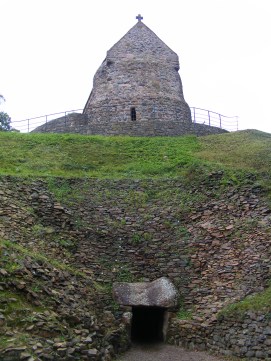
DSCF4057Next, to investigate the burial chamber itself. When it was constructed, the population of Jersey was likely to have been about 3000. The stone came from the eastern part of the island and some of the blocks weigh up to twenty tonnes. The chamber was covered by stones and then earth to form a cairn that is nine metres high and thirty six metres in diametre. The entrance to the burial chamber is a ten metre tunnel that is about three foot high. It is quite difficult to negotiate, especially as overnight rain has left puddles underfoot that need to be avoided but we accomplish this without injury. It was more than just a burial chamber and would have been used for various religious ceremonies. The entrance is aligned so that, on the equinox, the rising sun shines down the tunnel and illuminates the back wall of the chamber. The site was abandoned about 2500 BC and a belief grew up that it was home to a dragon. The legend goes that the Norman Seigneur of Hambye came to rid Jersey of the dragon but was himself slain by his own servant, who claimed the credit for killing the dragon and subsequently married the Seigneur’s widow. She discovered the truth, had the servant executed and a chapel erected in memory of her husband. An alternative story, told to us by the on site historical interpreter, is that it was a Viking pirate, rather than a dragon. Is this a case of make up any story for the tourists and they will believe it we wonder?

The first chapel, the Notre Dame de la Claté, is thought to date from 1155. It contains some Medieval wall paintings. These are very difficult to distinguish with the naked eye but the shape of an angel can just about been seen in the photograph that I took. The Dean of Jersey, Richard Mabon, was inspired to complete the second chapel in 1520, following a pilgrimage to Jerusalem. He staged fake miracles in the chapel to raise money from gullible visitors in order to pay his hefty tithes. The chapels were abandoned during the Reformation, after which Jersey adopted a Calvinistic stance. This led to the demolition of many chapels. At this time, there was a series of very severe winters to the benefit of the islanders’ knitting trade, much of which was exported to Iberia. The Calvinists however banned knitting in church and during the food and seaweed harvests. Knitting might be carried out as a communal activity and these were occasions for the singing and dancing frowned upon by the Calvinist church.

In 1792, Phillippe d’Auvergne acquired the chapel from his uncle, who owned the land at the time. He added a tower and converted it into a neo-gothic country residence known as the Prince’s Tower. It was derelict by 1821 and then became a tourist attraction. It was so popular that a small hotel was built on the site. The tower was finally demolished in the 1920s, to allow for the safe excavation of the remainder of the site. The Germans made use of the site during the occupation and the bunkers are now set up to commemorate the workers, of many nationalities, who lost their lives at that time.

We talk to the historical interpreter who is telling stories of the times of Dean Mabon. She tells us about the chapel and plays a recorder and a dulcimer using a goose quill. Well, obviously she doesn’t play the recorder with a goose quill; that would be weird and probably impossible. I decide that I’d really like a dulcimer and a goose quill, although I can actually play a recorder so maybe that would be a better option.

In the afternoon, we take a short stroll up the coast away from St Helier and then it is biting the bullet that is a return to St Helier by car. This time we know where we need to go but we do still have to circle the convoluted ‘block’, as the on road parking places are full and we need to return to the multi-story car park, which is fortunately free at this time of day. I give my talk to Channel Islands Family History Society. The topic is Writing up your Family History. This particular presentation is a bit full on but is well received. I am looking forward to running the full five week online version for Pharos in three week’s time, when I can go into a bit more detail. Join me, you know that you want to!

Day 11 The North, the West and some Lavender

066 Rozel Harbour 24 September 2017The weather forecast suggests that the rain will hold off until mid-afternoon, so we decide that we can choose an outdoor activity for today and opt for an exploration of the north coast, including a walk along some of the coastal footpath. We start to work our way up the east coast stopping at a few bays on the way, making the most of the fact that parking is free on a Sunday. We stop at Verulet Point and take a quick look at a small craft market. Then it is on to Rozel and Boulay Bays in the north east. At this point the direction finding gremlins strike again. I am sure St John’s village is very pleasant and all that but driving through it from different directions no fewer than five times might have been overkill. Just as we locate the proposed start of our walk and four hours before schedule, it begins to rain. We decide to drive along the coast instead, not that we can see much through the mist. Still, I guess we have been very lucky with the weather so far. A couple more passes through St John’s for luck and we appear to be heading westward.
We make an unscheduled stop at the Lavender Farm in the south-east of the island. We view the impressive herb garden in the rain. Even finding that from the reception was a challenge. ‘Turn left‘, the receptionist said. She must have as much difficulty distinguishing her left from her right as I do, as we nearly ended up in the café kitchen. Once we’d turned right we were on track. A video in the lavender distillery tells us that it requires a massive 100kg of lavender flowers to distil a litre of lavender oil. I have tried distilling herbs, seventeenth century fashion but if 100kg of flowers are needed, I don’t think I will be going into commercial production any time soon. Apparently this is the second oldest lavender farm in the British Isles. In the interests of trying local cuisine, I order some lavender and honey ice-cream. This is probably an acquired taste and one I haven’t quite acquired but it is not unpleasant and one can certainly detect the lavender.

We manage to navigate back to the apartment without incident and spot a red squirrel on the way. The rain sets in in earnest and the late afternoon is spent on catching up with paperwork.

Day 10 Triathlon

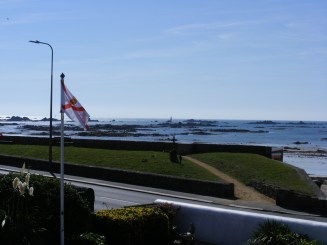
057 The view from Balcony Apartment 23 September 2017

The View from our Apartment

Time to move across to Jersey. We were obviously late for the ferry check-in as there were three vehicles ahead of us. The ferry left early. It doesn’t do to leave it to the last minute for boats round here. The voyage was uneventful and we disembarked to the challenge of finding our accommodation. Finding things has not gone well so far this holiday and I am panicking about the somewhat vague key collection instructions that we finally received after several requests to the agents. I have identified the road we need on the map. My companion is burbling on about Chinese restaurants. I think he has invented this but no. Sure enough, embedded in the small print (who reads small print?), are instructions to travel ¾ of a mile and look for a Chinese restaurant. What it fails to say is ¾ of a mile from where. Nonetheless, we find our way. We are too early and after a swift food shop in a nearby Co-op, drive along the coast to sit in the sun until it is time to collect our keys. The apartment is adjacent to the genial owner’s home and is on the sea front. We have a balcony from which we can admire the coast. Okay we can also admire the main road and the Chinese restaurant but there is, beyond doubt, a sea view and not just a glimpse of a distant ocean if one stands on one leg. The one bedroom apartment has no fewer than three televisions and our host is very apologetic that only one of them has Skye! No swimming pool here, so no obligation to freeze ourselves in order to get our money’s worth.

We unpack and ponder the mysterious disappearance of a packet of chocolate biscuits, which, to the best of our knowledge, have never been removed from the food parcel we brought with us. Tempting though it is to doze on the settee in front of the balcony, we decide to suss out St Helier. Parking is more of an issue on Jersey than it was on Guernsey and we have to guess how many hours we may possibly want to park somewhere in order to purchase scratch card ‘dials’. I can imaging that endevouring to not scratch off the wrong date might prove stressful.

The apartment is about 1½ miles from the centre of town and navigating on foot is slightly easier than by car, so we decide to walk. When I say slightly easier, I did have a near miss with a lamp post and late fell off a kerb that I didn’t notice as I was consulting the map but we did not get lost. St Helier itself is a little too large and city like for us. We found the tourist information bureau and spotted the venue for my talk on Monday and then went to find the location of the super league triathlon, which is being staged today.

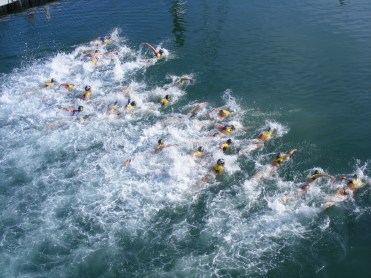
061 Jersey Triathlon 23 September 2017In England, an international event such as this would be advertised from several miles distant but the triathlon is a well kept secret until you reach the course itself. Nowhere is the route advertised, not even in the tourist information bureau. It is being staged in a move to increase interest in Triathlon, I think they may therefore have missed a bit of a trick here. We enquire of a policeman, who looks like an immature twelve year old and position ourselves for the start of the women’s elite race. This is not a traditional triathlon, all the stages are much shorter and are repeated three times with ten minute breaks between each round. It begins at 4.00pm, expect when it doesn’t. We are some twenty feet above a very murky looking marina where the swim is being held. During the twenty five minute wait for the start, I am feeling less and less comfortable gazing down from this dizzy height – I get uncomfortable standing on a chair. Finally, we see the women set off and then we are able to move round to get a clear view of the circuit where the cycling and running take place. I am a bit sorry that this isn’t the men’s race and that we are going to miss Johnny Brownlee but I am pleased to be part of the event.

We have acquired a slightly larger scale map from the tourist information bureau and manage to retrace our steps to the apartment in time for an evening of Strictly Come Dancing, as the sun sets over the bay.