Day 9 And now for the South Coast – a day of 3-point turns

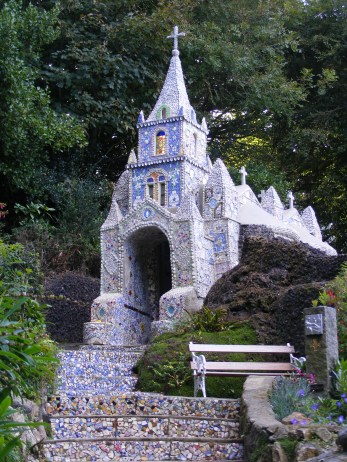
048 The Little Chapel 22 September 2017Today was our last day on Guernsey and we aimed for the south coast. On the way we called in at The Little Chapel. This is a fascinating grotto, decorated with millions of pieces of broken china. Low-key it’s not and probably not what you’d want in your back garden but well worth seeing. It was built in 1914 by Brother Deodat and was inspired by chapels at Lourdes.

We then tried and failed, to find the nursery from which Chris has ordered flowers over the years. We are certainly seeing the back lanes of Guernsey, many of them in both directions as we re-traced our steps more than once. I still haven’t really cracked navigating round the island. There seems to be a positive policy of not having road names and if there are road signs, they are so small that you can’t read them until you are too late to make the turning.

We did find our way to the Occupation Museum; it seemed important to respect this aspect of Guernsey’s history. This is a privately run labour of love and we learn about the five years of occupation – 1940-1945. Half of Guernsey’s population, including men of military age, were evacuated before the Germans took over. On Alderney only eleven islanders remained. The Germans changed the driving regulations, so that everyone had to drive on the right. This would not have affected the locals much as they were not allowed motorised transport. Cinemas remained open but showed German films. The islanders went round painting V for victory on stones and walls; anyone caught doing this would have been severely punished. The Germans painted laurel wreaths under the V signs, to indicate German supremacy.

Prisoners of War were brought in to construct fortifications round the coast, which was heavily mined, with over 66,000 devices. In 1942, all non-Guernsey born people were sent to internment camps. After D-Day the islands were effectively cut off and there were severe food shortages. By December 1944 the Red Cross began delivering food parcels and the island was finally liberated on 8 May 1945. The museum was full of poignant individual stories of both locals and occupiers.

There was a very amusing incident involving beige shorts (not mine) and missing melted chocolate peanuts but I have promised not to mention that so I will leave it to your imagination. There was, thankfully, very little work we must not mention today, so I took the opportunity to try to make sense of my family history notes from yesterday. The Huguenot connection looks even more interesting than I first thought and rapid contact with another researcher revealed why they were forced to flee from the Poitou region. One child had already been removed from the family as her parents had been married in a Protestant church, which was not legally valid. It is likely that they came to Guernsey in 1699-1700, when they realised that the wife was once again pregnant, leaving the oldest daughter with other family members in France.

Day 8 Family History – The French Connection

No one has been rash enough to make off with our clothing overnight, which is a relief. All week the forecasters have suggested that this would be our rainy day, so we had earmarked it as the one to be spent in the Priaulx Library researching my children’s Channel Island ancestry. I had done as much as possible in advance and wanted to verify entries that were sent to me decades ago by a local researcher. I knew that, at £2.50 a time, I wouldn’t be able to afford print outs of the 40 odd parish register entries for direct ancestors that I had identified (which is what I would normally do) but at least I felt that I could satisfy myself by seeing the entries. A new archive is always a challenge, no matter how experienced a researcher you are. The added hoop to jump through here was that the civil registration and parish register systems are slightly different. Most of what I wanted was pre civil registration so it was on to the parish registers.

Transcribers had been hard at work, which was just as well as I had great difficulty seeing the microfilm entries. I began with the families from Castel parish. The library keeps files of all the work that their researchers have done for enquirers and these too were a great help. I managed to confirm what I had and make a few additions. My only regret is that I don’t know anything about these individuals beyond their vital events. If you’ve never researched on the Channel Islands there are all sorts of bonuses. Marriages, even early marriages, often give fathers’ names, burials usually give the names of parents or spouses and women seem to be buried under their maiden names. Baptisms give godparents, who are often relatives. Sometimes it even tells you they are relatives. For example, I have a couple where the godparent is identified as the grandmother.

I then turned to the Town Church (St. Peter Port) families. I knew I had people buried at Town Church. Town Church’s graveyard is conspicuous by its absence. I had thought it a bit odd that the lady at the archives on Monday seemed vague when I asked where the burial ground is. It turns out it disappeared during a road widening/development scheme and reburials were made in other cemeteries. These are unmarked. Maybe the archivist thought I might be over sensitive and didn’t like to tell me they’d been reburied! Although the Town Church records have been indexed, unlike other parishes, they haven’t been fully transcribed, which made life a bit more difficult but here the work of the official researchers came into its own as a guide. Several of their files contained transcriptions of all entries for a particular surname. On extending the Jamouneau line another two generations I was very excited to discover that they were born in Poitou, France and were described in the register when their children were baptised as Protestant refugees. I always wanted to find a Huguenot connection. Now I want to pursue this but I have to come back to the apartment to the job we must not mention instead. I just hope I can make sense of my hurriedly scribbled notes when I do have time to get back to this, like in about 2025.

Day 7 Sark

As our parking place reconnoitres have been unsuccessful, we opt for walking to the ferry. We get up before dawn, rather more before dawn than necessary and reach the harbour just after sunrise. Even by my standards we have arrived early for our journey on MV Bon Marin de Serk. Finally aboard, we find that there are a few locals on the boat and a handful of tourists who, like us, thought it was worth getting up at silly o’clock to have two extra hours on the island, or, more to the point, saving £4 a head.

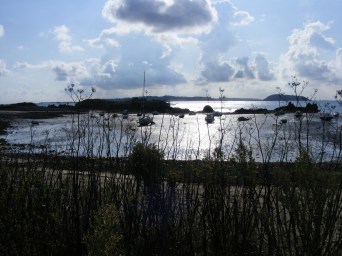
We arrive before Sark gets up but are first in the queue to book a two hour horse and cart tour of the island. We learn that we have narrowly missed Sark being inundated with cruise passengers. That is scheduled for tomorrow, as is rain and the residents are already girding their loins. I’ve never been sure quite how one accomplishes this (loin girding that is) but I am sure that that’s what they were doing. We take a stroll down the one proper street in Sark, The Avenue and see the golden post box associated with 2012 dressage gold medallist Carl Hester, who was born on Sark. Many of the businesses are empty and up for sale. We hear that the population has been falling rapidly and this is causing concerns about Sark’s economic viability. There are currently about 490 inhabitants, compared to 600 a few years ago. It is sad as it gives the island a run-down air.

We visit St Peter’s Church, built in 1820. Christianity came to Sark with St Magloire. Let it never be said that you don’t learn about obscure saints reading this blog. St Magloire is a sixth century Welsh saint who set up a monastery on Sark. Allegedly, he cured people of leprosy and deafness, miraculously saved a boatload of children and slayed a dragon on Jersey, obviously a multi-tasker. There are two special seats in the church reserved for prisoners. The current two-cell prison, built in 1856, is still used, although crime rates are very low.

We learn that Sark was first inhabited about 5000 years ago. The Black Death wiped out almost all of Sark’s population and it remained virtually uninhabited for two hundred years. The first Seigneur, Helier De Carteret, settled the island with thirty nine other men on behalf of Queen Elizabeth in 1565. Jersey legend says that the boat carrying the children of the first settlers was wrecked and that the cries of the children can still be heard when there’s a storm coming. Is this confusion with the St Magloire story one wonders? De Carteret also built the windmill in 1571. Its sails were removed during the German Occupation; we see what remains. Contrary to the evidence from Castle Cornet, information in the church tells us that Sark and Guernsey were Parliamentarian but Jersey was Royalist during the Civil War. Attempts at a Royalist invasion of Sark from Jersey was foiled. In 1833 there was a silver rush on Little Sark. The mines were short-lived, closing in 1847. Like Guernsey, Sark came under German occupation between 1940 and 1945. We also visit the archaeology room, which is sited in a restored sixteenth century cider press. Land use maps for Sark suggest that twenty-first century changes are causing concern and we find out that a recent unsuccessful attempt to introduce wine production to Sark has caused friction.

It is a shame that the timing of the carriage ride cuts across the day, so there isn’t enough time for a decent walk before or afterwards. We do take the opportunity for a short stroll and are waylaid by an eccentric local on the way. In general we have encountered many friendly people. We do almost make it to the coast, though somehow missed the Pilcher Monument that we were aiming for. Instead we round the Dixcart Valley, returning in time for an ice cream before our trip.
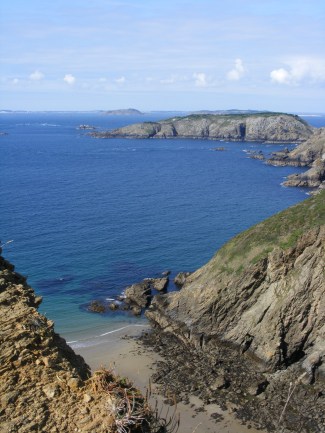
045 Sark 20 September 2017Our carriage ride leaves at 11.30am and we are with Winston aged seventeen (the horse) and Andrew aged sixty something (the guide). We spend a very pleasant two hours rambling round the island. Andrew, a native Sarkese, provides a commentary that needs, in places, to be taken with several large pinches of salt. He descends from one of the original forty 1565 settlers, although he keeps saying 1665. We stop at Banquette Landing in the north of the island to view an ‘Elizabethan’ gun. Said gun is inscribed GR but who’s to quibble; I am familiar with the concept of telling a good story to the tourists. Randomly, also at this location is a flock of emu; diversification rules I guess. There are two dairy herds on Sark and all have to be Guerseys. Sark dairy products resemble those from Guernsey but apparently the butter is different, I am not sure in what way. There are two levels of property prices on Sark and all property is leasehold. Those who have been resident for at least fifteen years pay about half the prices that incomers are charged. Planning permission is required for new builds and building is not allowed on the Cotil, or cliffs. Sark is independently governed and there is no income tax and only a small equivalent to council tax. This is offset by the need for hefty health insurance and private pensions as there is no state funded health or social service. Sark’s ambulance and fire engine are pulled by tractors and these are manned by volunteers. There is a private doctor and two nurses on the island.

After our ride we have some lunch and attempt to visit the museum, which is open between 2 and 4 pm, except when it isn’t, like today. We sit on the quay and relax in the sun. Some porpoises entertain us while we wait. Our ferry is early and although we were the first on the quay we fail to realise that the queue that is forming is for our ferry and not for one to France or Jersey. We hasten to the end of the long queue. The ferry is very full and the captain is gesturing that he will take no more passengers. This is the only timetabled ferry home. It is a long way to swim. Thankfully we are on the right side of the cut off point in the queue and our ferry, groaning with its full load, sets off twenty minutes before time. We do see a small boat heading out towards Sark so we assume that this has been sent to collect those who have been left behind.

We trudge back up the hill and I find a significant amount of the job we must not mention awaiting me, so much for relaxing. Whilst I am tackling this, I send a fisherman of my acquaintance to investigate the laundry in the main building attached to our apartments. He successfully negotiates the technicalities of the washing machine and then transfers our clothes to a dryer, as we have no access to a washing line. After an appropriate interval he returns to collect our clothes. The main building is locked. Efforts to break in via the fire escape fail and we are forced to leave our undies in the machine, hoping we can recover them in the morning.
Day 6 Castle Cornet

Today was a day for staying in St. Peter Port. We still needed to identify a 23 hour parking slot for tomorrow. We drove up the town, we drove down the town, we drove round the town. I can report that this quest was a total failure, so, instead, we sought out anywhere where we could park for more than two hours today but this too was fruitless. Finally, we secured what must have been the last parking place in St Peter Port, up a less than savoury back street and on a perilously steep hill. The road looked too narrow for passing traffic but we took comfort from the fact that surrounding cars were wider than ours and that Guernsey drivers do take to the pavements in these situations.

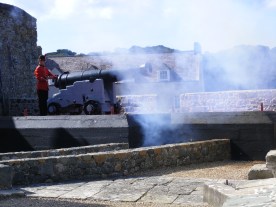
034 The 12 o'clock gun Castle Cornet 19 September 2017We walked out to Castle Cornet, which guards the harbour. The first Castle was built in the thirteenth century. Initially, it was only accessible on foot at certain very low tides or by boat. Fortunately, there is now a causeway so we don’t have to paddle. Although, in theory, we allowed plenty of time, all the not finding parking places made us wonder if we would arrive before the ‘twelve o’clock gun’, a ceremony when a cannon is fired but we are just in time. A costumed gentleman marches about and does the deed. We are told that today’s twelve o’clock gun was ‘louder than usual’, they are probably not wrong; it was very loud and we are used to musket fire. The historical interpreter invites members of the audience to pose with him for photographs. We aren’t particularly bothered about this ourselves but we do have with us Captain James, who is the travelling toy for members of the Braund family. On the grounds that I am the photographer, I delegate a fisherman of my acquaintance to request that the Napoleonic era soldier poses with a knitted doll. On balance, this may be preferable to some of the over excitable tourists and he agrees.
The gun firing is followed by a living history performance and we have chosen today to come because this is the day for a seventeenth century story. In 1672, ammunition stored in the donjon exploded during a thunderstorm. Seven were killed including the governor, Sir Christopher Hatton’s wife and mother. The island’s governor never lived at the Castle again. The story-teller, from Guernsey History in Action, does a very good job. http://www.ghiac.org/

The Castle is home to several excellent museums and I especially liked the fact that named individuals were mentioned in several contexts. Castle Cornet was the last stronghold to surrender to Parliament during the Civil War and we admire various seventeenth century exhibits. I was interested to learn of Parliamentarian General John Lambert’s imprisonment in the Castle as I had just been reading about him in connection with John Tradescant in Phillippa Gregory’s excellent Virgin Earth. The reconstructed herb garden and plaisance were very well done. The garrison was largely manned by English, rather than local, soldiers. For many years Invalid Regiments (ie those needing light duties) were stationed here. Under German Occupation Castle Cornet was known as Hafenschloss (Harbour Castle).

One museum was dedicated to 201 Squadron but we found the Maritime Museum the most interesting. Here we learn that Guernsey has only been an island for about 9000 years, since after the last Ice Age. It was settled in Neolithic Times and we see a video about the recovery of a Roman ship from the harbour. This was done by the same team who raised the Mary Rose. The boat, nicknamed Asterix, had had a fire on board, which melted the cargo of pitch and helped to preserve the wreck.

Having exhausted the possibilities of Castle Cornet we visit the historic shop that is reconstructed as it would have been c. 1900. It appears that we missed a harbour yesterday so it was home via a quick trip to St Sampson, which is very industrialised.

Day 5 Harbours North and East

Today was our day for the north coast and then as much of any other coasts that we could manage. We arrived at the quiet and attractive Bordeaux Harbour, the first of several, so the fisherpersons amongst us can admire boats. This is in the north east of the island and we have seen a good many island roads on the way, not all of them intentionally. Next, a hunt for another of the guide book’s ‘must sees’ – Dolmen le Déhus. This is a well kept Guernsey secret, so well kept in fact that it took us several attempts to find it. Then the only parking space within several hundred yards was taken by a hedge cutter’s van. Today was clearly national hedge cutting day on Guernsey as every hedge owing islander seemed to be out there with their clippers.

Dolmen le Déhus is a small burial chamber dating from between 2000 and 3500BC. Neolithic types were clearly short, or maybe it doesn’t matter if you are being buried but the roof height was about four foot and the ceiling was an unforgiving rock. It did not take long to exhaust the possibilities of this attraction. Having crawled right round and then exited without damage to our persons, I read the interpretation board outside and realised that I had missed some ‘remarkable carvings’. Supposedly, these look like a bearded man with a bow and arrow. My companion insists that I have seen them as he particularly put on the appropriate light. This escaped my notice so I insist that we re-enter. One of our party has clearly forgotten about the ceiling height issue but he seemed to survive. I look at the alleged carvings. I remain unconvinced. It just looks like a slightly uneven piece of rock to me.

026 St Bordeaux Harbour 18 September 2017We continue our drive along the north coast, stopping to look at various fishing boats at Grand Harve. Beyond Cobo Bay the coast is comparatively less attractive. On reaching the far north western corner, we start to head south. After a refreshment break at Pleinmont we rethink our plans to circumnavigate the island, as the south coast road is closed. I decide that this is a good opportunity to locate an ancestral church in an inland parish. Not helped by the fact that several roads are closed and the map has road names in English, when on the ground they are in French and vice versa, we eventually arrive at the very well kept twelfth century church at Castel. There are wonderful, commanding views across the island and you can understand why early settlers might have chosen this as a site for a place of worship.

We then go to purchase tickets for our trip to Sark later in the week. In order to save money, we book on the 8am boat. This means that we will need to find a parking space that allows us to stop for more than 10 hours. This is not as easy as it sounds. The ferry company direct us to ‘the eastern arm’ but this all seems to be 10 hours maximum. We give up circulating car parks looking for the magic ‘23 hours’ signs and call in on spec at the Guernsey Record Office, expecting to book an appointment for late in the week.

The record office is housed in a former church and it turns out that we can be accommodated today. The place is deserted and judging by the signing in book, our attendance has doubled the daily average for the past week. The adjectives ‘quaint’ and ‘Dickensian’ spring to mind and the lady who emerged from the bowels of the building did her best to help us. I was after records of the Town Hospital aka workhouse. My chap was in the indexes for four years and his death was recorded there but weirdly, the admissions and discharges book (which did include those who were discharged to the grave yard) only noted his admission. Looking at the records was not without difficulty as one of us had no reading glasses and some of the records were in French. Languages were never my forte but I could dredge up enough basic French to roughly work out what was going on. Interestingly, many inmates were discharged to go to Quebec and there’s a whole potential research project out there for someone, following these individuals up on the other side of the Atlantic. Sadly, there are too many things on the very long ‘to do’ list for the ‘someone’ to be me.

There is an outdoor swimming pool at our apartment. We are obviously paying for this facility within our ‘rent’ so our parsimonious nature dictates that we do actually have to use it. Over the past few days we have commented that no one stays in the ‘heated’ pool very long. We trip across the grass in a stiffish breeze. ‘Trip’ was nearly an appropriate term as I have neglected to bring my contact lenses so can barely see the pool at three paces. The water temperature is best described as ‘chill-off’. I brave it out for ten lengths and then hasten back indoors. We now know why there is a high turn over of pool inhabitants.

Unfortunately, the job that cannot be mentioned has tracked me across the seas, so that takes care of the evenings.

Day 4 Moulin Huet Bay and Sausmarez Sculpture Park

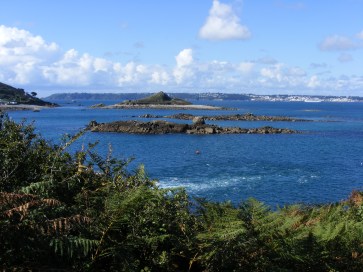
After overnight rain, it is a beautiful day so we decide to tick off one of our guide book’s ‘must see’ sights and visit Moulin Huet Bay. We drive to Jerbourg and start walking eastward so we can say we have been to the easternmost point of the island – St, Martin’s Point. Today we are better equipped for walking, although I still have the wrong glasses and the new boots are digging into my ankles, or rather one ankle, in a weird way. Easternmost point reached, we turn round and head off along the coast path in a westward direction. I was of the opinion that Moulin Huet meant windmill and Google Translate agrees (must be right then) but not a one in sight. What we do have is spectacular scenery and all the clichés about white sands and azure seas really do apply, although the photographs do not do them justice. Everything is newly washed from last night’s rain and again the butterflies are out in force. We also see birds of prey wheeling that we think are peregrine falcons.

The terrain and the many inlets make this a rather longer walk than I and my new boots had anticipated but we make it to Moulin Huet bay and stop at a very welcome café there. We scramble down the cliff path and across the rocks to the bay below. Apparently Renoir walked two miles from St Peter Port each day to paint here during his stay in 1883. Apart from a solitary swimmer, the bay is deserted and we rest on the rocks and ease our feet in the sea. In a similar way to Scotland, the weather changes quickly here and I am soon sheltering from a very short shower under my handy saved-from-the-Victoria-Falls plastic poncho. At this moment, a bride and groom are attempting to get atmospheric beach photos. The bride has taken the precaution of changing into flat shoes but she is still trying to surmount the rocks with a train and bouquet, whilst holding the wedding shoes. It is a shame that the rain, which lasted no more than five minutes, coincided with the photo call, especially as the wedding dress was silk. The rain and an incoming tide prompt us to start to retrace our steps. To the relief of my ankle, we find a short cut along the road and return to the car.

There were glimpses of fishing boats in the distance when we decided our feet needed us to turn round. This is a great temptation for a fisherman of my acquaintance and I attempt to navigate to the distant bay by road. At this point I should point out that the antiquated sat-nav we have in this car does not cover the Channel Islands so we have me instead. I was a girl guide. I am actually quite good at map reading, even though I do have the annoying habit of turning the map round the ‘right’ way. There are a couple of drawbacks. Even with the varifocals I am unable to read the map easily with my glasses on, so I take them off. This means that a) I can’t see where I am going and b) I can’t read the road signs. In addition, the most detailed map we have is forty years old and anyway I have left it in the apartment. We do make it to Saint’s Bay. It is a good job that we are used to very narrow, steep roads. There is allegedly no parking at Saint’s Bay but this is obviously to fool the tourists. There were a few local cars parked there. Obediently though, we just go down to the harbour in order to turn round. With a very quick glance at the boats, we drive back towards St Peter Port.

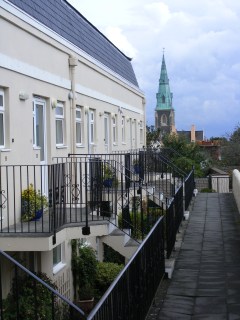
025 Sausmarez Sculpture Gardens 17 September 2017We stop at Sausmarez Manor and yes it really is spelt differently from where we went yesterday. The guide book tells us the manor house is open. It isn’t. The lovely wooded trail through the sculpture gardens is however. There are huge, impressive stands of bamboo and the trail reminds us of New Zealand. We are a bit ambivalent about the sculpture. Are we admitting to being Philistines when we say we don’t really ‘get’ some of it, despite it being worth, according to the catalogue, thousands of pounds a piece? Although there were some ‘organic’ (technical term alert – to try to sound like I know what I am talking about) pieces that I quite liked, in general, I preferred the pieces that actually looked like something. Randomly, one path labelled ‘Way out for Wheelchairs’ is barred by a pole stretched right across the path, some two foot six from the ground. Clearly all those pushing wheelchairs have to be limbo dancers.
Also onsite is a copper smith and we spend some time chatting about his trade. Like most people we have met, he is very friendly. He did a traditional apprenticeship in the 1970s, primarily to make traditional Guernsey cans. These originated in Normandy a thousand years ago and the cows were milked directly in to the larger sized ones. The design allows for the most efficient use of the metal, giving a maximum capacity per square foot. The shape also reduces the likelihood of loss by slopping. Sizes vary from half a pint to ten pints but the standard ‘pot’ contains four pints. The craftsman we were speaking to is now the only person on Guernsey who knows how to make these cans. He is passing the technique on to his sons. They will not be taking up the craft professionally but at least the knowledge will not die out.

There was a minor incident involving an invisible tree as we left the car park. I probably won’t get thanked for mentioning this but I wish to report that no back bumpers or trees were harmed in the process.

Day 3 Saumarez Park and Folk Museum

We headed north today, becoming increasingly aware of just how many cars there are per mile of Guernsey road space. Having said that, the drivers are very polite and we do our share of ‘filtering in turn’ across yellow road markings, which is reminiscent of New Zealand’s ‘make like a zip’ but is not an official system in England. There are heavy showers forecast again today and this time it looks like they might be right. We utilize our National Trust membership to gain free entrance to the Folk Museum at Saumarez Park. I was faintly amused that the girl on the entrance spent time looking for the expiry date on my life membership card. I felt like pointing out that, though I might not look very lively, I was indeed still above ground, so therefore it had not expired.

The Museum was small but interesting, although I did think it was a shame that many of the people in the dioramas were featureless shop dummies. We learned about the National Trust for Guernsey’s restoration of the fifteenth century Les Caches Farmhouse. We may add that to our list of places to visit. There was a display of Guernsey jumpers, showing the different family patterns. These could be used to help to identify drowned fishermen. I was also particularly taken with the traditional ‘Cobo Alice’ dolls. These were originally made in the 1870s by a lady called Alice from Cobo (obvious really). She used the old sails from her husband’s boat for the bodies. There were a number of recreated tradesmen’s workshops, which were stuffed full of old tools; handy for researching family history occupations. Last time I visited Guernsey, nearly forty years ago, I went on a tour of a tomato producing business and I was shocked to read, at the museum, that large scale commercial tomato growing collapsed in the early 1980s when a dockers’ strike made exporting virtually impossible. Later, we did see several derelict hothouses, which may well be the remnants of this industry.

We dodged the showers to visit the nearby walled garden, which is run by volunteers. Their herb collection was very impressive; Mistress Agnes was very envious. We then drove on to the north coast but the weather didn’t make strolling along the beach an appealing prospect so we returned to St. Peter Port. There may be a superfluity of cars on Guernsey but their parking system is good value for money. We have purchased an ‘everlasting’ disc for about £4 and that allows us to park in any designated car park or parking space for however long we choose, up to the maximum number of hours stated for that particular space. We park on the quay. My companion gets all the local fishing gossip from an unsuspecting passer by and we learn how salt used to be unloaded on this part of the quay. Fortunately, I managed to curtail the conversation before our designated two hours parking is up. We have parked here so that I can skulk in doorways taking sneaky photos of the houses where my children’s ancestors lived in the nineteenth century so next up is our walk round the back streets of St Peter Port to fulfill this mission. This went better than such ventures often do. I found all the properties on my list, although the photographs were somewhat spoiled by satellite dishes, cars and recycling bins.

012 Albany Apartments 16 Sept 2017

Albany Apartments

The final photograph on our list was nearer to where we are staying, at the top of the town and we walk along to secure that photograph before spending the rest of the afternoon relaxing in the apartment.

Day 2 Herm

Yesterday, the weather forecast suggested that today will be rainy. We therefore decided to do something under cover and dress appropriately. The evidence outside the window, backed up by Holly whatever-her-name-is on the TV, suggests otherwise. We hastily change our plans and decide that today we will go to the next nearest island of Herm. We embark on the Trident V. The name is probably a Neptunian reference but it is somewhat odd to be travelling on something called after a missile. After a twenty minute journey in beautiful sunshine we arrive on Herm. It is about half a mile long, covering an area of 1¼ square miles and has around sixty permanent inhabitants. In the second half of the twentieth century it was leased by the Wood family from New Zealand but a few years ago the lease was transferred to a foundation who are obliged to maintain it as a haven for visitors.

We set off to circumnavigate the island in a clockwise direction. If we had our time again, we would have opted for anti-clockwise, as our route means that the roughest, steepest terrain was at the end but hindsight is a wonderful thing and all that. Our last minute change of destination means that we are not fully prepared for more than a very brief stroll. We have had the foresight to don our walking boots and I am wearing in the recently purchased ‘girls’’ pair (see blog post for 30 August). Or should that be, they are wearing my feet in? I have the wrong trousers and the wrong glasses for walking. I normally go for non-varifocals (glasses not trousers) as then you can see where you are putting your feet. A good idea I find. My travelling companion is grumbling that he hasn’t got his larger rucksack and is wearing the wrong underpants (I would recommend not speculating on the latter.) To be fair, the rucksack is my fault. Relying on the weather forecast, I have a thin fleece and a thick fleece and a coat with me. Oh and a fetching plastic poncho but I won’t count that. It is pushing twenty degrees, my tee-shirt is sufficient when I’m walking. For the benefit of all the Australian readers that have been frequenting my website of late – yes, we do think that is pleasantly warm, if not positively hot. The superfluous layers are being crammed into my companion’s inadequate rucksack.

006 From Herm 15 Sept 2017Herm is beautiful and very peaceful. Cars and cycles are forbidden; motorised transport is limited to tractors and quad bikes. We see the remains of some Neolithic burials. There are plenty of butterflies and the sun continues to shine as we reach the white shell beach, which allegedly has fifty different kinds of shells. It is as well I am not visiting with my grandchildren. If they knew that, we would be unable to leave until we had found all fifty. We pause for an ice-cream and the obligatory paddle, in what is pretty jolly chilly water.

Our circumnavigation, with paddling and ice-cream break, has taken about three hours. We head inland to look at the small settlement on the island. The architecture bears the stamp of the Prussian prince, Gebhard Lebrecht Blucher von Wahlstatt, who leased the island from 1891 until the First World War, when his nationality made it necessary for him to leave. His renovations extended to St Tugual’s Chapel. Nope, me neither. St Tugual not being high on most people’s list of must know saints, I will enlighten you. He was a sixth century monk, who had connections in Brittany and in Wales. Merther Tydfyl may be so named because it is his burial place. There were certainly monks on neighbouring Sark (that’s neighbouring Herm not Merther Tydfyl) in the sixth century and they may have been responsible for the monastic settlement on Herm. The  chaepel’scurrent north aisle and the nave are a similar size, making it an unusual L shape; parts of the current building may date to the tenth century. It was used by the monks and friars until the sixteenth century. Von Wahlstatt had it renovated and reconsecrated and it has been in use ever since.

A couple of spots of rain, as we head to the pontoon for the ferry, are all we see of the forecast heavy showers. I try not to panic when the ferry is ten minutes late. We return to Guernsey and head for the supermarket for provisions. There are clearly too many cars on Guernsey and we begin to feel a bit guilty for having ignored the exhortations to leave ours at home. Many roads are one-way streets so our route is peppered with no right or no left turns. We have already discovered that driving in Guernsey means you have to go in the wrong direction in order to, hopefully, end up at your destination. Supplies secured, we return, via a circuitous route, to spend the evening in our apartment.

Day 1 Island Bound

Twenty four hours later than scheduled, we headed off on an uneventful journey to our overnight stop. Our ferry check-in is no later than 8.15am. We can check-in from 6.45am. Clearly then, in my view, we need to be at the terminal from about 5am. Being very restrained, the next day, we delay for a couple of hours and reach the terminal just after they begin the check-in. We seem destined to be at the back of the slowest queue at every stage. At one point we are surrounded by over height vehicles in the 4.1 metre high queue. Surely this cannot be right, we are in a Nissan Micra. Our queue is halted while a large campervan pulling a car on an oversized trailer is measured. There is a great deal of tutting and sighing. I suspect the owner had to pay extra. Three queues later and said camper van is failing to reverse up a 1:3 ramp on to the ferry. More delays. The ferry is at capacity to make up for yesterday’s non-sailing. It takes ‘about 250’ cars, we seem to be number 249. I am beginning to regret having had quite such a large glass of grapefruit juice at breakfast.

At last, we are on board. At the final stage of the loading process, I, as the passenger, am told to bail out so that the passenger door can be parked against a barrier. Chris and the car roar off into the bowels of the ferry leaving me to find my way to the passenger lounge. This I do and fortunately, we do find each other again. Our captain tells us that the crossing will be slower than normal as part of the engine is being run in. Well, that is true to form and inspires us all with confidence. We have been warned that this ferry a bit on the bouncy side and the weather is still lively. The woman across the aisle is revisiting her breakfast. In a domino rally like effect, it transpires that she is not to be the only one. We survive this challenge unscathed. Just as we near Guernsey, another announcement from the captain. Our bow-thruster is malfunctioning. You may not know what a bow-thruster does but it seems that it is essential to the docking process, there will be a delay. I pity the poor day passengers whose ‘day’ is now about three and a half hours long.

Inevitably, we are not the first to disembark, nor the second, nor the third…. We are not helped by a stupid driver who has failed to return to his car when requested. As we leave the ferry we are directed in a particular lane. Is it to be our bad luck to be hauled in by customs? It will be thin pickings as we have nothing to declare. Customs pass us by and karma is clearly in force as the chap who was late returning to his car is pulled over instead.

We drive a short way up the hill to find our apartment. One good aspect of all the delay is that we don’t have to wait to get our keys. The apartment is lovely, almost as large as my house and has twice as many toilets. After much needed refreshment we take a stroll down to the quay at St. Peter Port to get our bearings. I even manage to squeeze in a visit to a church that features in my children’s family history. You can’t have a holiday without family history.

The Weird and Wonderful World of the World Wide Web, with a bit about Travel

I don’t know. I spend my time blogging insightful comments on literature and dropping pearls of historical wisdom from every pore and by far the most popular post so far this year has been my rant about medical non-services! There is a lesson in this somewhere. Then, over the last few days, practically the whole of Australia has hit on my website for no apparent reason. They haven’t been directed there via another website, so have I been mentioned in a down-under talk or a magazine perhaps? These appeared to be genuine visitors and they are clicking through to the Amazon pages of my books and judging by the Amazon ratings, making purchases. I’d love to know who to thank. Answers on a postcard………

Actually, this is more of a blog about non-travel. This really should be a post about the first day of my holiday but no. There I was, two days ago, all set to be driven off in order to be near the terminal for an early morning ferry the following day. You know how it is, you’ve unplugged stuff, eaten a odd variety of food so that there are no left-overs, poured the last of the milk down the drain, put the bin out, just the lap top to shut down. In pops an email. They regret our ferry has been cancelled due to forecast bad weather, can we ring this number? We can and do and learn that we will have to wait to sail for an additional 24 hours, so that’s the first day of the holiday disappearing into oblivion. Magnanimously the ferry company tell us that they won’t charge us for changing our booking! Weirdly, the ferry company’s website still claims that a ship will sail for our destination at the later time of 11am but we are told that this is not the case. We now have to buy more milk, break out a new bin bag, raid the freezer for an evening meal and feel cross at the loss of a day of our holiday. We do try and put the latter in perspective. It does seem petty to be moaning about a curtailed holiday when the storms elsewhere have rendered hundreds homeless. Hopefully holiday posts will follow tomorrow.