Up the Garden Path 4

Having acquired some plants more than a fortnight ago, rain and a bad back stopped play, so I am only just getting round to planting them. I did go to a willow weaving course to make bird feeders. This was great fun but I am not convinced by the scale of some of the feeders that resulted. Unless you have fat balls the size of footballs, or ostriches visiting the garden, I  foresee a problem. They will find a place nonetheless.

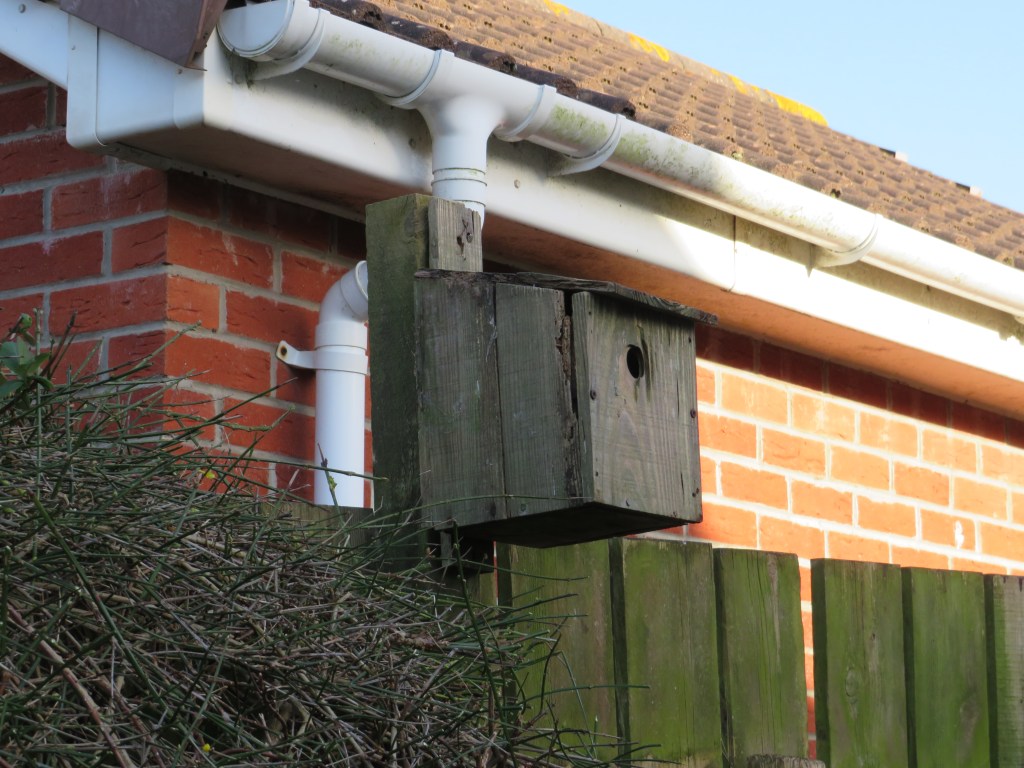
Before utilising said feeders, there was a plan to move the bird table. This was inherited and had been screwed to the wall that retains the raised bed. This is a good move, as a free standing bird table wouldn’t be standing for long when the Atlantic gales set in. Unfortunately, it was positioned so that the window frame blocked my view when sat comfortably on my settee. Not to worry, we can unscrew it and move it further along. Simples. Or not, as it turned out. Unscrewing was easily accomplished but the upright had been seriously chewed by insects. As of this moment, the bird table is lying on the ground awaiting repair and re-erection. We have put up two bird boxes that have seen better days. There isn’t much scope for birdbox positioning here  but I can hope.

I have joined the RHS and they have an app (it is probably an app) where you can add your garden plants and they you get ‘helpful’ reminders about all the million and one jobs that you should be doing each month. Gratifying that I can tick off ‘cut back winter jasmine’.

Yesterday was a glorious day so time to make more progress. The previous owners had put up a wire fence in front of the actual fence, which I think goes all the way along, we can’t get to the bit behind the ‘tin’ shed yet to check. This is all very well and great for growing climbers but it has been there for years, so some of the plants have grown round it and in a few cases the fence is firmly embedded in stems that have grown through it. This adds a whole new dimension to tackling the shrubbery. Nonetheless tackle it we did and another trailer load of winter jasmine is ready to go to the tip. Still not half way though.

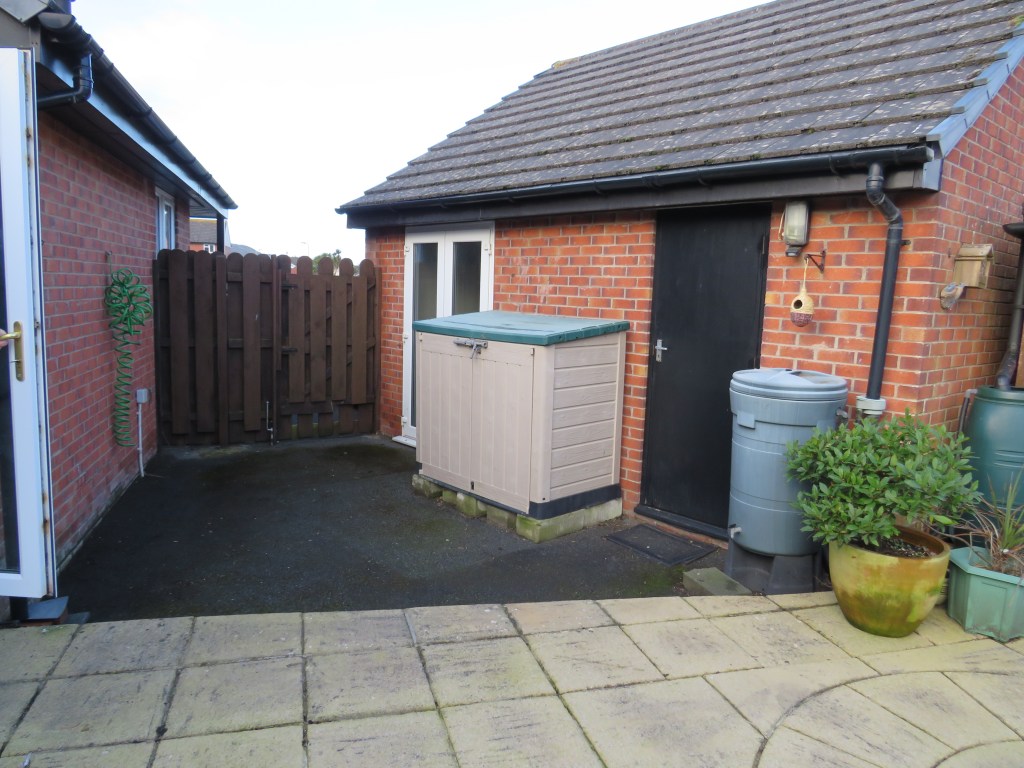
Things are about to get serious as operation shed has begun. With all the rain, I discovered that the tiny wooden, gutterless shed, which is very close to the house, was causing rain to run off on to the house wall. With the amount of rain we get, this is not a good thing, so shed removal, which was always on the cards, has moved up to the top of the priority list. So far, the wooden shed has been emptied ready for removal. The next step will be to move the ‘tin’ shed to take its place but a little further from the wall. This will free up the sunniest part of the garden and I can hopefully create a flower bed. This is particularly necessary as I seem to have purchased quite a few plants that like full sun. Not sure how they will go in a garden that is really not sunny but as my mum would say, they will have two chances.

I have also, whisper it quietly, broached the topic of reinstating some lawn. This was not universally well-received and I have had to undertake the cutting of said lawn. As it will only be about 4×2 metres I can cope. In the first garden I owned, we cut a lawn that size with shears for three years. Mind you I was nearly forty five years younger then. I am still tempted by a wild flower lawn that won’t need cutting at all but not sure that that isn’t a bridge too far and dubious about its success in the shade.

We’ve started the great shrubbery clearance at the shadiest end, so some of my purchases remain in pots until we reach the end where the sun does venture occasionally. I have planted some foxgloves and cyclamen and risked a lupin and a clematis. I’ve repurposed one of the willow ‘bird feeders’ as an obelisk for the clematis. A honeysuckle and campanula that I brought with me have also been transferred from pot to ground. Next step will be to call in the professionals to turn some of the paving in to lawn.

RootsTech Round-up Days 2 and 3

I didn’t get the chance to watch as many presentations as I’d like on Day 2, as life got in the way but I have reduced my playlist to something more realistic, partly because some of the talks I’d earmarked are not available virtually and were live at times when I wasn’t available, or was asleep. It is great that so many can be watch online, especially as they are free of charge. So this is my round up of Days 2 and 3. I enjoyed giving my own Marginalised Ancestors talk live but remotely and thankfully the technology behaved itself. This is one that is available for you to watch when you have an hour to spare. It was so difficult to decide what to miss out and I have fun varying the categories and case studies each time I give this talk.

I watched Liz Craig’s second One-Place Studies presentation on studying a street; a great introduction and Liz’s enthusiasm is infectious. I saw the Impact Forum live, with several presenters discussing the impact of family history on resilience, metal health and a sense of identity. Also on my watch list was ‘Reconstructing the Lives of our Female Irish Ancestors’ with Stephanie O’Connell. Plenty there for those with Irish ancestry and it was good to hear the emphasis on the importance of the social historical context. I have squeezed several short, Ancestry-sponsored, case studies from television programmes into odd moments. These included Every Family has a Secret and Finding your Roots.

With my Smith ancestors in mind, I watched Shaunese Luthy’s ‘Finding your Common Name Ancestor’. She utilised the F(riends) A(ssociates) and N(eighbours) principle in her case study of the Brown family. My interest in the history of medicine meant that ‘Diseases our Ancestors Faced and how those Illnesses Changed our World’ from Gregory C Gardner, was a must-watch. This is highly recommended and covered UK and US records. I am very envious of the US mortality schedules.

‘From Research to Draft: Rapidly Writing Your Ancestor’s Story’ by Devon Noel Lee contained some interesting ideas for turning basic facts into a narrative, although using AI for this doesn’t appeal to me personally. Her marking-up technique is similar to the work that I do with my writing your family history students and I am looking forward to leading a new cohort of Pharos students through the writing process in a couple of weeks. There is still time to join in on this one.

I have some great RootsTech talks still to watch, including Nick Barrett’s ‘Researching English Industrial Labourers’. I may even catch up on some that are lingering in the playlist from previous years.

RootsTech Round-up Day 1

Day One of Rootstech is over and I have a bulging playlist that I want to work through. Fortunately, there’s plenty of time. I have to admit I do still have a few lingering in my playlist from previous years. I have my usual mix of presentations by people I know, topics that appeal and a few random additions to take me out of my comfort zone. My aim is to keep on top of the playlist so that it doesn’t get longer and longer, as I add recommendations from others.

I began with Nicholas Dixon’s ‘Metropolitan Ancestors: finding families in Georgian and Victorian London’, which contained plenty of useful information on researching in the capital and sits well with my own ‘London Calling: websites for researching London ancestry’ short presentation, which is available on demand. Next up was ‘Who’s my Ancestor? tracing individuals with similar names’ by D. Joshua Taylor. As I‘ve spent three fruitless days trying to untangle numerous Josiah Lamballs, this was very timely, although my Josiah still remains elusive. I have ruled out one of the wrong ones; perhaps more about that another time. This was an excellent presentation, essential listening for anyone with a brick wall, which is anyone who does family history. Despite the examples being from the US, the techniques described are applicable elsewhere.

I then listened to the first of Liz Craig’s One Place Study presentations ‘studying a village’, a great introduction and I even got a couple of honourable mentions; her other talk is on the list. I followed this with’ Little Known Free Sites for English Research’ by Jenny Joyce, again some synergy with my London presentation. Next, ‘Researching Modern Ancestors: unlocking the life of an English Rose’, from Diane L. Richard, which told the story of her quest to fill out the life story of her English mother and encouraged us to research our more recent ancestors, such as our parents and grandparents

I usually watch some presentations that focus on engaging young people, so I viewed ‘Toddlers to Tweens – Who doesn’t like to climb trees!’ with Megan Heyl. This was interesting and the handout had some useful charts that are worth downloading. It was more applicable to those whose ancestry encompasses an immigration story, with identifiable ancestors from a variety of countries. Finally for day one was ‘No Death Certificate’, in which Helen Smith provided a range of options when looking for evidence of death in the absence of a death certificate.

Today I am presenting live but virtually, at 8.30pm GMT, chatting about Marginalised Ancestors. I am also out helping Mistress Agnes give a live presentation so I may not have time for much watching but will report back on what I choose. You can join in the fun, for free, from home here.

Commemorating the Marginalised

Rootstech is round the corner and with it the option to see if I am related to any of the many lovely fellow-attendee family historians that I have got to know over the decades, both in person and online. Along with thousands of others, I am attending the mega international conference virtually, from the comfort of home and I’m looking forward to learning new things. As well as the ‘Relatives at Rootstech’ fun, there are options to see if you are related to famous people. Allegedly I have connections to a few. Most of these relationships are based on some seriously speculative genealogy. So, although I probably am Winston Churchill’s tenth cousin three times removed, I have serious doubts that the late queen is my 14th cousin, at least not in the way that is suggested. I suppose it would be mildly interesting to find that ‘Gateway Ancestor’ that leads back into royalty but even though I am about to enter my 48th year of serious research I have never found that connection. Do I care? Not in the slightest. My interest is in all those ordinary ancestors whose stories will never be told unless I tell them.

I find marginalised ancestors the most fascinating of all. What circumstances led them to become stigmatised, or to find themselves on society’s fringes? Was this down to their own actions, or society’s attitudes? I love to find the lawbreakers, the sick, the poverty stricken and the ostracised on my family tree. Not in the slightest because I want to reveal their stories in some kind of version of the sensationalist press but because their lives are so caught up in the social history and mores of their times. They become much more ‘real’ as their lives are revealed and of course they may leave traces in the documentary record.

It was this interest in those that history forgets that led me to give talks on the subject and my Rootstech presentation this year is about just that. Entitled ‘Tracing your Marginalised Ancestors in Britain’, I will be delivering this remotely but live at 8.30pm GMT (London Time) on Friday 1 March. If you register you can listen for free from anywhere in the world. I believe the session may be available afterwards too but that is still to be confirmed.

A couple of years ago, as a result of a magazine article I wrote on the subject, I was delighted to be approached by Pen and Sword to write a book to help others trace their own marginalised family members. It seems like forever since I finished writing it last March but it now exists as an actual book and those who ordered pre-publication copies should be receiving them any day now. If you have ordered a copy, please do post a photo on social media when it arrives, as I love to see where in the world my books end up. I am supposed to take a photo of me with the book for publicity purposes. This endeavour is hampered by the fact that I am the least photogenic person in the world. To detract from unphotogenic me, I decided it would be a good idea to utilise some of the spectacular landscape that is on my doorstep. This of course means it needs to be dry and ideally sunny. The first attempt was Monday. Bright, rather than sunny but unfortunately also windy. My fine, baby soft hair looks windswept when the Beaufort Scale is at zero. Let’s just say this photo shoot was not a success. It may have to be the ubiquitous, in front of the library shelves shot. You can order copies directly from Pen and Sword.

On the upside though, I have just signed a contract to write another book that may be out next year, or the one after; the writing is well underway.

The study of the marginalised ties in very well with my work with the A Few Forgotten Women Team and I am looking forward to talking about Forgotten Women, in person this time, at the Alfred Gillette Trust in Street, Somerset, to celebrate International Women’s Day on 8 March. A Few Forgotten Women will also have a small exhibition, tickets are available here.

Up the Garden Path 3

A drizzly Sunday morning, what better than a gardening update? This week has seen a couple of days when it was neither raining nor cold and windy, so we’ve begun to excavate the raised bed that runs the full width of the garden. At present the garden is distinctly lacking in flower planting potential so it was important to dispense with things that were no longer capable of meaningful life. Three or four large dead shrubs were destined for the chain saw and much as I like winter jasmine, I really can’t have it taking up 30% of my growing space, so that is being drastically reduced. I have been personfully assisted by my partner in crime who has sustained a minor injury during a battle with a large dead bush when chain sawing. Fortunately, he didn’t chain saw himself, so he still has the full complement of fingers. My nose did also have an unfortunate encounter with a springy dead hydrangea branch but no one said gardening was not a hazardous activity, Two trailer loads have departed for the recycling centre and we are about a third of the way along the raised bed, with still the bed down the side, which is even more overgrown, to tackle. I am really cross that my ‘before’ photos didn’t include one that really shows the state of the raised bed but never mind. I’ve included the best of the before pictures below.

There have been more discoveries, including what my RHS app tells me is a quince blossoming away like mad. I am very excited by that. There is honeysuckle, which I do want, climbing all over unidentified definitely dead stuff, which I don’t; untangling the two won’t be easy. There is now space to plant some of the things on my ‘plants I want list’. Sadly, I am not sure that all of the things on the wanted list are going to fit but I am going to do my best. I did purchase half a dozen primulas this week. Two have been planted in a hedgehog (one of the many ornaments inherited from the previous owner – along with the elephant also pictured). The others are in a concrete planter – one of four left behind. I was going to move this to the front garden but it needs someone stronger than me on one end, as it is ridiculously heavy.

After a great deal of measuring, remeasuring and false starts, the plan I was attempting to draw is sort of done, not helped by the lack of right angles in the garden, nor me failing to realise at first that the bungalow is not set parallel to the back fence. At the very least the edges join up now. You can also totally ignore the dimensions in my previous post, where I was clearly so overwhelmed by too much gardening to be able to add up. The plot behind the house is now officially 22 feet deep and 60 feet wide, so twice the size I was claiming – 146 square yards or 120 square metres ish. You do still have to allow for the fact that the conservatory takes up a fair bit of space, compensated for by the weird shaped gap between the garage and the bungalow. Apart from a three foot deep bed long the 60 foot side and down one of the short sides, every last bit is currently paved.

Now I am excited to try to purchase some of the plants on my list to fill the spaces we’ve made. Plenty of fork wielding needed first as the soil is compacted and full of winter jasmine root. A few brave bulbs have been revealed, so I am waiting to see what they are.

A Bit about Grass but Nothing to do with Gardening

There is life beyond the garden. I am three talks in to an eight talks in eight days marathon. Why did this seem like a good idea at the time?

Then, last weekend, we braved drizzle and bracing winds to take part in a harvest mouse survey in the nearby country park. Given that I had barely moved further than from chair to bedroom since New Year (thanks Covid), we decided to drive to the car park rather than walk, as we normally would have done. We had studied the risk assessment – we were therefore aware that we night get hit by a golf ball (it is near the golf course), or get sand in our eyes, or get kicked by a horse, or get spiked by spiky grass. Spoiler alert, none of these calamities befell us. A couple of dozen intrepid volunteers set out to ferret around in clumps of grass, on muddy terrain, looking for last year’s abandoned nests. As you can see from the photograph, these are pretty jolly tricksy to spot, yet within about thirty seconds one was found. As usual our luck with wildlife, or even evidence of wildlife, was out so, although we didn’t find any, in all the team located ten, a significant increase from last year, which bodes well for the population of our second smallest native mammal. Having wandered a couple of miles across the country park in our quest, we were very glad we’d decided to take the car, especially as, by the time we’d finished, the drizzle was seriously persisting and the wind was positively howling.

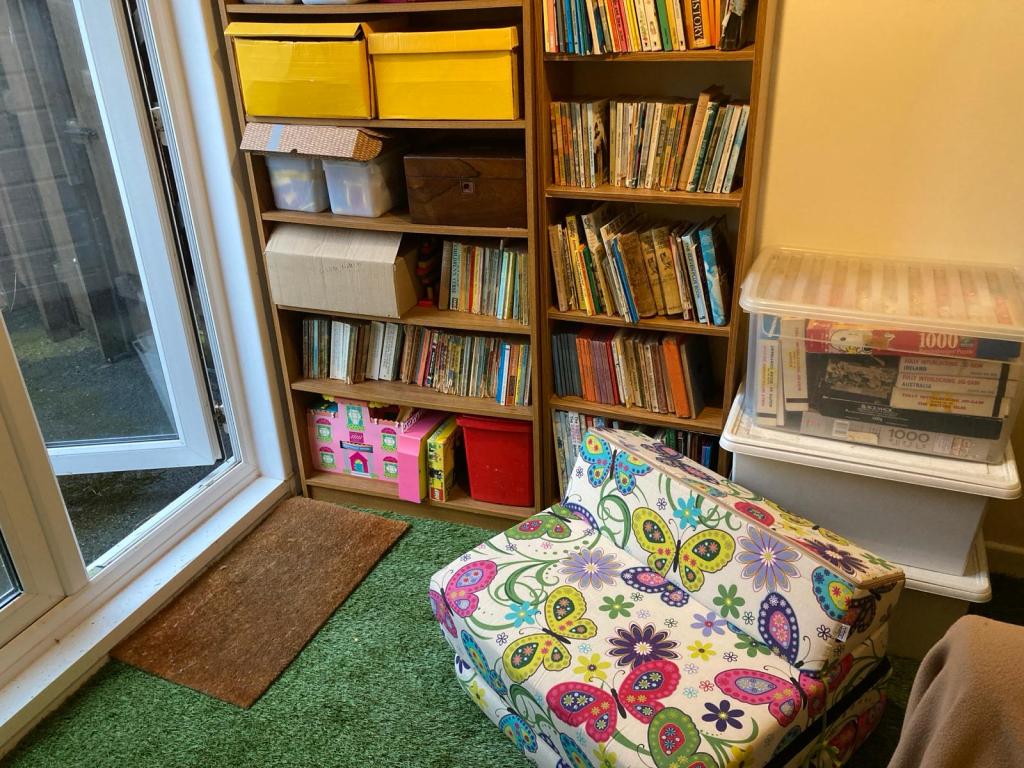
What’s this with the grass? You might well ask. Well, deep breath and bear with. In the new house the former garage has been converted into two rooms. What has become known as the ‘posh’ half has double glazed patio doors leading on to the garden and a smart light fitting. The un-posh aspect was the flooring, which was very bumpy, painted concrete and I clearly needed a floor covering. I wasn’t up for spending a fortune on a room that isn’t really part of the house, so I investigated the options. What might be described as a glorified shed really wasn’t suited to cream, deep-pile carpet, so I was looking for something rather more hard-wearing and dirt resistant. I headed off to the local carpet shop, thinking I might get some form of coir or jute matting. The first problem was that carpet tends to come in four metre widths. The room was 2.6 metres square, so I’d be paying for a lot that I wouldn’t be needing. They could order me the sort of thing I was thinking of but it would, at nearly £400, be a tad over budget. I looked at the remnants but again may of these were larger than I needed. Then my eye alerted upon a fake grass offcut. Hard wearing, cheap, fitting for what may become a garden room when it is no longer required for toy storage for visiting grandchildren.

I headed to the check out. Firstly my partner in crime asks if he qualifies for a staff discount. The assistant asks how long ago he worked for that establishment. He truthfully admits that it was fifty eight years, to be told his qualification for a staff discount must have expired the previous day! She tactfully describes my choice as ‘unusual’. I didn’t tell her that she was speaking to a woman who once papered a room with rolls of brown wrapping paper. A couple of days later the carpet was duly fitted and that’s another space almost sorted. The shelves still need to be arranged but I am pleased with the result. I’ll draw a veil over the condition of the adjoining half a garage, which currently contains everything that won’t fit in the roof or anywhere else.

Up the Garden Path 2

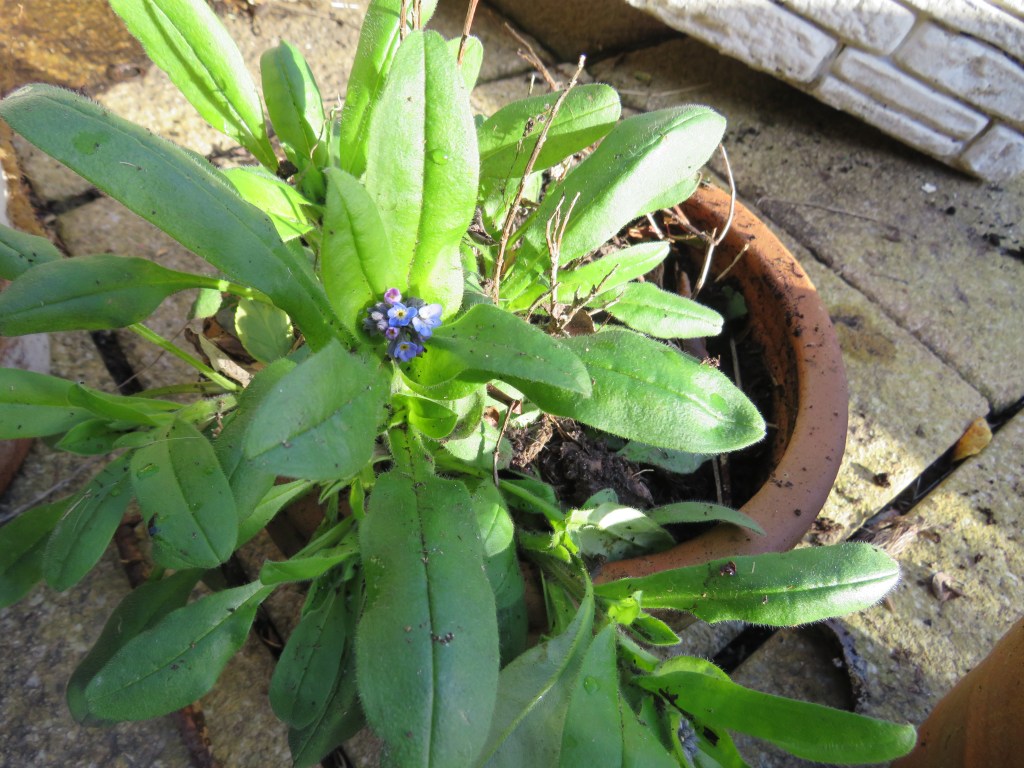
To be honest, it hasn’t really been the weather for fair-weather gardeners like me, or indeed any sort of gardener but yesterday the sun came out and the temperature was in double figures, so I ventured forth. The previous owner of my garden had left me numerous pots containing plants in various stages of liveliness and an eclectic selection of garden ornaments. I decided to triage these into ‘will keep’, ‘will humanely dispose of’ and ‘not sure yet’. Plant wise, there are more exciting finds as the year moves on; today’s included hellebores and miniature daffodils.

We began to trim back the winter jasmine, which is rapidly taking over the one flower bed. Other tasks for the afternoon were to deal with my many troughs of geranium cuttings which have been keeping warm in the summer house. Obviously not warm enough as about half are dead, or covered in what Mr Google tells me is powdery mildew. Sick plants were removed and what remained were rationalised into fewer troughs.

Next came the task of measuring the garden, in preparation for trying to draw up a plan. I decided to go for feet and inches, rather than anything metric as I still have to ‘translate’ metric measurements in my head. This was a test of my mathematical skills as my trusty assistant kept calling out the measurements in feet and inches, rather than just inches, which us what I wanted. Good job I know my twelve times table. The whole measuring thing was definitely not easy as I can’t actually reach some of my boundaries due to shrubbery and the many sheds. Added to that, the plot isn’t even remotely rectangular. Not only are there some funny angles created by the perimeter fencing but the garage and sheds are also not all set square. I have a load of scribbles and numbers but whether I will stand any chance of making it into a coherent drawing whose edges join up remains to be seen.

For those who are interested, very roughly, the plot is 35 feet wide by 22 feet deep, minus the space taken up by the conservatory and plus the extra space along the side between the bungalow and the house. One pretty much counteracts the other space wise. Note for some of my overseas readers, in the UK, a bungalow is a single story dwelling not a shack. If my maths is right, I have about 70 square yards, not, of course, at all the same as 70 yards squared! For those of you in foreign, about 58 square metres, which, unbelievably because it seems really tiny to me, is classed as a medium sized garden by the RSPB (Royal Society for Protection of Birds) when you submit your results for their great garden bird watch. By UK standards, particularly with a newer built property (mine was built in 2000), small gardens are the norm. On the subject of birds, I was concerned that this would be one thing I’d lack when I moved but I’ve seen eleven different varieties of bird in the garden (or viewed from the garden on neighbouring roofs or trees) so far in February, a similar number to the old garden, although very different regular visitors. Not bad considering the property had been empty for a fair while before I moved in, so, despite the bird table that was left behind, I doubt the birds had been fed here for over a year. The bird bath, another legacy from the previous owner, is very popular and that will definitely be staying.

This is a long-term project. Don’t expect swift progress!

Up the Garden Path 1

I can’t pretend other than that one of the downsides of the new house is the conglomeration of concrete and sheds that constitute the ‘garden’. In estate agent speak, it is more of a courtyard than a garden, or perhaps we just term it that valuable commodity ‘outside space’. Having left behind what I felt was an attractive cottage garden, a wildlife haven, I was aware that this was a compromise but assured myself that it could be improved. Having gone through some seriously stressful battles with the technology associated with the job I must not mention last year, I steeled myself not to walk away by promising that I would earmark the earnings to be the maximum budget for improvements to the new garden. A lesser known fact about me as that I did complete a garden design course a few years ago, so I am eager to get out the tape measure and graph paper. Caveat – I am not an avid gardener, I like to potter but gardening needs to be your main hobby and it isn’t mine. I do love to be surrounded by plants though, so a garden is a must have. Now the post-plague exhaustion is abating, I can make a start. An added advantage is that, at least today, it is a little warmer and not raining, mind you that’s not set to last.

I thought you might enjoy following along with the garden make-over journey. Here are some pictures of what I am dealing with. A long overgrown shrubbery, an eclectic selection of garden ornaments provided by the previous owner, a lot of concrete, three sheds, a summerhouse in need of tlc and a garage, all set on a very tiny east-facing plot. On the plus side it isn’t overlooked.

You are in at the beginning, as all I have done so far is add a stone seat in a random place (it won’t stay there it is just where the removal men dumped it) and twenty or so pots to those already here; mine mostly contain Mistress Agnes’ herbs. Oh and I’ve planted one white lilac that I bought before Christmas and felt would be happier in the ground.

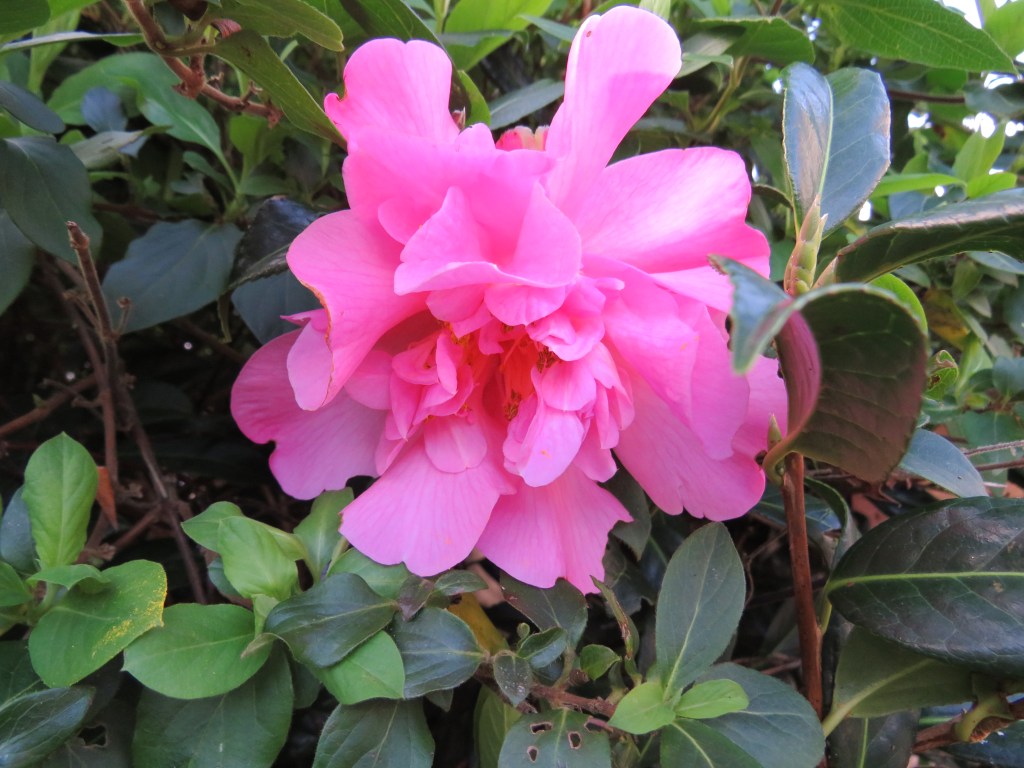
I have a list of ‘must have’ plants, the challenge will be where to put them. I am also adverse to pulling up existing plants in any great number, although a couple do look seriously deceased and I am aware that I may need to see the seasons round to know what is here already. There does seem to be colour for all seasons, with winter jasmine and three camellias, two of which are coming in to flower. Annoyingly, the sunniest corner of the garden, let’s be honest here, the only bit of garden that gets any sun at all this time of year, is currently occupied by the unsightly tin shed. I am reliably informed it is plastic not tin but it looks like tin and helps me distinguish it from the wooden shed and the blatantly obviously plastic shed. Not wishing to have to sit on the shed roof, the current thinking is that the wooden shed will be humanely disposed of and the ‘tin’ shed moved to take its place. Still not sure how two of us move a six foot square ‘tin’ shed but my unwilling partner in crime is of the opinion that it may come apart. The jury is out on whether or not it will go back together again – watch this space. This could rival the flat-pack furniture building scenario. The other debate is to reinstate some grass, or not to reinstate some grass. I am a fan of grass, both for the smell and the wildlife potential but grass has to be mown. Fine now but going forward this may mean I need help with the garden sooner that I would with a grassless plot. Does this matter? Probably not; decisions decisions.

Rootstech Ramblings – my pick from the live online schedule

So the Rootstech schedule is now available and the excitement is building as we can begin to plan our time for the three days of intensive family history fun from 29 February to 2 March. Do you need to head off to Salt Lake City? – no – although I am sure in-person attendance would be great. Do you need to part with large sums of hard earned cash? Again no, if you are attending virtually, as I am, absolutely free. If you haven’t registered yet you can do so here.

I’ve been trawling the schedule of online talks deciding how to spend my time. It has required tricky choices, as there are often clashes but here is what I’ve decided. Bear in mind that there are plenty of great sessions and because this is not geared to UK time, I have had to forego some presentations that really are in the middle of the night. You can make you own choices here.

These are my decisions, though I reserve the right to change my mind. I’ll be back to tell you about some of them after the event. Thursday first. I am going to kick off at 3pm UK time with Nicholas Dixon’s Metropolitan Ancestors: finding families in Georgian and Victorian London. This complements my own ten minute recorded session that you can view any time London Calling, listing some key online resources for London research. With Smith ancestors in London this one is a must. I’ll follow it with Who is my Ancestor? Tracing individuals with similar names by D Joshua Taylor. Although it is US based, I thought it might be fun. Then an evening session with Diane L Richard Researching Modern Ancestors: unlocking the life of an English Rose, focussing on twentieth century research. This takes me to past my bedtime, so I will call it a night.
Friday next. I thought I’d listen in to the Impact Forum about the impact of family history beyond the genealogy community. I’ve changed my mind several times about the 7pm session but have gone for Reconstructing the Lives of our Female Irish Ancestors by Stephanie O Connell. I don’t have any Irish ancestors of my own, although my grandchildren do but with Forgotten Women in mind, I thought it would be interesting. No choice for what follows as it is my own Marginalised Ancestors talk, so I guess I’d better be there. The talk is written but is a bit too long, so I will need to decide what to leave out. It is going to be a fun talk to do going forward, as I can swap the case studies in and out for variety. Just a heads up. I will be mentioning my Marginalised Ancestors book, which is due to be published on 29 February. At the moment, you can pre-order this at a reduced price from Pen and Sword here. I am not sure if this offer will still be available by 1 March, when I am giving the talk, so if you think you might want the book of the talk, now is the time.

On Saturday I am going for Finding your Common Name Ancestor, with Shaunese Luthy – those Smiths again. Then, with my interest in the history of medicine in mind, Diseases our Ancestors Faced and How those Illnesses Changed our World with Gregory C Gardner. I am going to finish my smorgasbord of in real time talks with Nick Barratt’s Researching English Industrial Labourers.

But there’s more – literally hundreds of recorded talks that I can pick and choose from over the coming weeks. I’ll be back to tell you about my choices from these another time.

Oooh and I’ve just spotted that these delivered live talks will also be available after the event. I’ll definitely be reviewing the schedule and adding more from those that clashed with my choices, or were at less favourable times.

Tales of sorting the garage/sheds and garden will resume shortly – P.S. 190 boxes.

Battling Storms and Other News

Having barely moved from my chair for three weeks, whilst desperately search for my energy and motivation, which have both gone awol post Covid, Sunday was a day to venture out. We’d booked to see a Fisherman’s Friends concert in Torquay, about 70 miles from home. Although driving back after the concert was an option, plan a was to take the caravan down overnight. Site duly booked, all was well until the prospect of Storm Isha loomed. ‘Keep clear of the coast’, they said. The theatre is right on the sea front. ‘Don’t drive unless you have to’, they said. Hmm. Having braved both Storm Agnes and Storm Gerrit with the caravan this season, the decision was made to think of a plan b. Driving back along country roads in the dark at the height of the storm wasn’t it. Because it was a last minute booking, we managed to secure a budget motel room at little more than the cost of the caravan site. This seemed like a win so far.

With wind freshening, we set off on Sunday afternoon. We even avoided the learning curve of struggling with the accommodation’s parking app, as there was a space in the road, which had the added advantage of being free. Next, a drive down to the seafront car park that is fairly close to the theatre and not too far from where we’d booked to eat. ‘Not too far’ when there’s a 70mph wind and rain is actually quite a long way. I know from my handy not actually very fit watch that it is 1100 steps, about half a mile. Still, getting as far as the restaurant wasn’t too bad, considering my step count had averaged under 300 a day for the last three weeks. The only casualty so far was my feet. I’d gone for comfortable shoes, which, it seems, have holes in the soles as I was now squelching along nicely.

Meal eaten, it was time for the return walk paddle to the theatre. We waited for a heavy hail shower to pass and set off in what was a light drizzle. As a bonus, the wind was behind us to begin with. Optimistically, I was heard to mutter, ‘I don’t want to speak too soon but this isn’t too bad.’ Dear reader, I spoke to soon. About half way along the sea front, with wind crashing in the masts of the moored yachts and Torquay’s palm trees struggling to stay upright, we turned a corner just as driving hail hit us straight in the face. We could see the theatre up ahead, we knew we were walking towards it but somehow it didn’t seem to get any nearer. By the time we reached it, everything from neck up and knees down was as if I’d been plunged in a bucket of water. I was also really noticing how I so hadn’t recovered from Covid. I went to ineffectively attempt to dry my hair under the hand dryer. Not helped by the fact that it cut out automatically after about five seconds. What was really weird was that people who arrived moments before and after us seemed to be completely dry. Women with beautifully coiffured hair surrounded my drowned rat look at every turn as we crowded into the foyer. The rain hadn’t stopped, how had they kept so dry? I’ll admit, the wait to be let in to the auditorium and thus gain access to the ability to sit down, was a struggle. Upright is not a position I’ve encountered much lately, especially not after fighting against wind and rain.

We gradually got our breath back and steamed our way through an excellent concert. Then it was back out into the elements to the car park. I sat dripping in the car whilst my brave companion queued in the rain to pay. We were very thankful to have a few minutes’ drive to the hotel, rather than best part of two hours to home.

Next up, breakfast. We’d opted not to pay £9.95 each for an all you can eat breakfast that we didn’t actually want. I am though really bad at missing some kind of breakfast. Not to worry, we had brought the ingredients with us. Granola, formerly frozen berries and yoghurt awaited. What, in our hurried change of plans, we’d neglected to do, is remember that a bowl and spoon would have been a good idea. We managed to improvise by using one of the ingredients’ containers as a bowl and appropriating the room’s tea spoon. Then it was time to return home, in conditions that were much calmer than the night before. Now we await storm Jocelyn.

In other news, box emptying is awaiting more energy and slightly warmer weather, as I am on to the rooms in the garage and the sheds now. Current total of emptied boxes is 189 and we are not quite done yet. I was also challenged to count my books. Despite several serious culls, 1145 remain, with the children’s books still to be counted. The next challenge is trying to fix heavy shelves to a cavity wall. This is not going to be easy folks.

Some fruits of research that I did last year can now be revealed. Back in the summer, I was contacted by a BBC researcher, in conjunction with Lucy Worsley’s Lady Killers podcast, which was due to feature a local murder. Could I identify the property involved in the story? With help from a friend, I located the ruins of said property and was able to report back to the production team, along with providing other information to help with the local background. I am not sure this quite came across in the finished episode but I did get an honourable mention. You can listen to Sarah Bird’s story here.