Today I am due to speak at an event in Gloucester. ‘Let’s go up a few days early’, we said, well I said, thinking that I could sneak a day at not too distant Worcester Archives and pick up some wills. First, I gave a talk to legacy webinars about marginalised ancestors, which you can listen to here if you are so inclined, no charge until 10 September. It was lovely to catch up with the lovely Fiona Brooker from New Zealand, who was my host, as I was part of the early, down-under shift. Then, in theory, we were off.
So leaving early entailed not leaving quite as early as we had intended, as the caravan-towing car randomly failed to start. By the time the recovery people had got it to go, it had been ‘diagnosed’ by the local garage and had been pronounced fit to travel, it was too late for us to reach our final destination in the Malvern Hills before curfew. The very helpful caravan site staff organised an overnight stop in Cheddar for us instead. Next day, when I was supposed to be at ‘The Hive’ in Worcester, we travelled on to Malvern. There was time for a visit to Witley Court in the afternoon. It turns out we had been before, so I won’t repeat the history but you can read about it here. Yesterday, we headed for The Hive. Unlike other archives that have morphed into community spaces, this one does still allow plenty of opportunities for researchers. It is an interesting building that reflects its name and the staff were super helpful. I’d done my best to do my homework before arriving and this mostly paid off.
I had a long list of wills and was directed to a microfilm machine where I could copy images directly to a memory stick. Someone or other’s law dictated that every image I sought was at the end of the film. Unfortunately, the rewind feature on the machine was faulty and many minutes were spent rewinding films by hand. As the archive is part of the library, research was accompanied by enthusiastic renditions of Grand Old Duke of York and Heads, Shoulders, Knees and Toes by a toddler group. I acquired several interesting inventories for ‘probably my ancestors’ but no earth-shattering revelations to convert them into actually my ancestors, not that I was expecting any. It turns out that I no longer have the stamina for all day visits to archives and much remains on the to do list.
It has taken all the time I could spare and some that I couldn’t, for the past seven weeks but the seafarers and shoemakers story of some of my children’s ancestors is finished. In the end there were sone coopers, a baker and a housemaid thrown in for good measure. It covers sixteen couples or individuals and eight generations. There’s 16,000 words, 62 pages and 160 footnotes and at times I really wished I could stop finding new people to add. I can’t imagine anyone will want to read it but it is at least preserved for posterity. Just in case anyone reading this is connected to the same Hampshire families, the surnames are: Sweetingham, Denham, Emery, Fox, Grace, Hooker, Markes, Newman, Renouf, Strugnell and Wade and you can download the pdf over on my Granny’s Taleswebsite.
Now I need to turn my attention to the things that I should have been doing. Mind you, it may well be that my planned archive trip next week will open up a whole new avenue for research, as if there aren’t enough families still to write about anyway.
Where I am at is 10,000 words, 40 pages and 100+ footnotes deep in my seamen and shoemakers, thinking it is almost done, only to find that I can take one twiglet back a further two, or three, or maybe more, generations. Great news in one way but instead of having two more couples to do, that gives me a whole load more folk to write about. This isn’t even on the (daunting) to do list, from which I have removed all the low hanging fruit, in the interests of deluding myself that there isn’t much left. Sadly, it is all the ‘this will take several days’ jobs not the ‘this will take ten minutes’ ones that are left.
Where I’ve been, includes a trip to Buckland Brewer to look at the VJ Day display and listen to a fascinating talk about the women of Appledore, including those who spent decades hauling limestone for the limekilns. Unusually, this required me to drive. It is August, the nights are drawing in (sorry but they are). I don’t do driving at night. Not so much fear of vampires but the inability to cope with other people’s headlights. Could I chair the meeting, skip the refreshments and get home before dark? It seems that after doing a Cinderella act and dashing out as the words of the last question were still dying on the audience’s lips, that I could. Why was I driving? Because himself has been involved in a week of street drama set in one of my one-places. For him, this mostly seems to involve helping to launch a boat off a tricky beach in the pitch dark and then get it safely back in after someone else has rowed it out and back. I am hoping to watch the whole presentation tonight.
In the past eight days, I’ve eaten cake at my favourite café. I’ve swum, yes actually swum, albeit only for about thirty seconds, in the sea. I’ve recreated a photograph from 1969 on the exact anniversary of the day it was taken. I’ve spent seven hours in A & E to be told, as usual, that I am not about to collapse and yes, I did the right thing coming in but no, they don’t know what is wrong with me, so as you were. I’ve had a chat with the lovely Helen Tovey of Family Tree Magazine about my presentations for the Secrets and Lies conference, along with two of the other presenters; I am so looking forward to this. I’ve led a brick wall busting session for Devon Family History Society and listened to an excellent Zoom talk about the occupants of a north Devon house.
Despite how the above sounds, August had been comparatively quiet but whoa September, I am looking at you. Before I even get there, there’s my workshop to give as part of a whole day of presentations on researching agricultural labourers and rural life bookings are open here. Then September hits like a train. Only six talks to give but unusually, four are in person. In addition, there is the second presentation of my ‘Putting your Female Ancestors into Context’ online course for Pharos. We had great fun the first time round and it is such an important topic. There are still spaces if you are interested.
As for where I will be, that revolves round the talks. First up will be the monthly Biography Club session for the Society of Genealogists, which I do from the comfort of my own home. I am clinging on by my fingernails attempting to keep pace with the group, in the hope of finally finishing mine by next year’s ‘big’ birthday. Then I am presenting a webinar for Legacy webinars on 3 September, also from home. It will be a version of my Ancestors on the Margins talk and you can book to listen here. Then I am off to Gloucester to give a talk there and staying a few days to allow me to pick up some wills relating to a family that I hope I can one day confirm is mine, as well as have a look round.
Next is the Secrets and Lies Conference in Peterborough followed by the 40th anniversary of the Isle of Wight Family History Society and boy have I got some memories to share. I am currently accepting financial inducements to delete parts of my text. Then summer will be over and where has this year gone?
I thought that it was about time I wrote something, so that people didn’t start enquiring after my welfare. It’s been the season for the descendants to descend; typically, they were here during the few days of less good weather. Plenty of board game opportunities, with Taverns of Tiefenthal being the current favourite, alongside the obligatory visits to the pick and mix sweet shop, the ice-cream shop, the rock pools and the playground. We also watched people attempting to paddle cardboard boats across the river and some of us acted like ninjas (best not to ask) and that was summer fun done for another year. There then followed what passes for a spring clean, as I removed buckets of sand from various corners of the house, washed a million sheets and towels and returned things to their rightful places. Though, to be fair, the visitors were pretty good and setting things to rights.
Now it is back to the computer, interspersed with occasional paddles and even a very quick swim. A quiet month for talks this month but I am gearing up for a hectic September. I’ve done some brick wall busting. Well more of a chipping away, as Devon FHS members have got too good at solving their own, so we tend to only get almost impossible ones sent in now. I have practiced my ag labs workshop for the end of the month and am very excited to launch that on the unsuspecting public at the end of a whole day of exploring agricultural labouring ancestors.
Biography club was concentrating on household tasks this month. This must be at least the eighth time I’ve run courses to help people write their life stories and this time (like all the other times) I am determined to keep up with the participants and finish mine. On the strength of having done quite a bit already, I am just about on schedule. The plan is to finish in time for next year’s ‘big’ birthday. No one will want to read it of course but it is fun to write, if an exercise in self-indulgence. Seriously though, everyone has a story to tell and everyone’s story is important. Of the planned fourteen chapters, eight are done, two are almost done and four are figments of my imagination. One of these will be about voluntary work and that’s going to take some time. I’ve got as far as making a list and have come up with twenty different things I’ve done over the past fifty-five years that come under this category. Some were short-lived, most were fun and almost all are chocked full of memories. The trouble is that voluntary work and hobbies, another chapter that is as yet a blank page, overlap so I am going to need to distinguish between then somehow. The first three chapters alone are 40,000 words and run to 145 pages including illustrations. I told you it was self-indulgent – I may not be printing this out! The expurgated versions of some of the chapters are over on Granny’s Tales, just in case anyone is curious.
Related to all this looking back, I’ve been preparing a talk for the 40th anniversary of Isle of Wight Family History Society, which is one of three big live performances scheduled for next month. As well as what I hope will be some thought-provoking comments on the family history community’s past and future, there’s plenty more self-indulgence in the shape of ‘do you remember?’s. Family history has been and still is an enormous part of 70% of my life. Most of my friends are those I’ve made through family history. It has been a blast and it isn’t over yet.
In between all this, I am still plugging away at my seafarers and shoemakers in Southampton – see I didn’t even have to try to create the alliteration. This too is growing like topsy. What I should be doing is more to the next book. It is on the, rather dauntingly long, to do list! By way of encouragement, reviews have been coming in for Women’s Work. I am particularly chuffed with Julia Packman’s review in this month’s, Who Do You Think You Are? Magazine ‘a creation to be reckoned with’. Oh and it is currently on offer at 30% off from Pen & Sword, that’s a hardback at paperback price (ebooks also available). So if you want a creation to be reckoned with you know where to go.
The title of this blog illustrates the wonderful variety that is family history, also known as, how many rabbit warrens can you plunge down head-first in a short space of time? Some lovely news first. I have had the huge honour of being made an honorary life member of the Society for One-Place Studies. I am always very unsure what I’ve done when these tributes come my way, except for having been around for a very long time but I am very grateful. I will continue to champion the cause of one-place studies, as there is so much that you can learn by focusing in on a small area and for family historians, it is important to understand the environment in which they lived.
I’ve also had great fun creating an interactive workshop about researching rural communities and their workers. This is due for its premier on 30 August and you can book for a whole day of fascinating presentations with an agricultural history theme here. I shall be persuading some friends to practice this workshop first but I think we are going to enjoy ourselves.
I’ve decided to take a step across to look again at a branch of my children’s ancestry, which is also the family for which I have an, admittedly pretty much dormant, one-name study. So a few days have been spent with the Sweetingham family who include generations of seafarers and shoemakers who settled in the Hamble estuary near Southampton. An area with an interesting history, ripe for a one-place study I’d say but emphatically not undertaken by me. Repeats to self ‘you do not need any more projects’. Once you untangle the Hughs who like to call themselves Luke and the Henrys who call themselves Hugh, because they can, you are on a roll with this lot, helped by several wills. Mind you, two family members were in court for destroying a will but the odd criminal adds to the story. Although I set up Granny’s Tales for my own ancestry, I am tempted to start uploading stories of ‘the other side’ because they too need preserving. The Sweetinghams are currently a series of notes so don’t hold your breath.
I’ve also been sent a book by a fellow genealogist from the US, Cheri Hudson Passey. This is on the important topic of tracing forward and finding living relatives; what Cheri calls ‘Genealogy in Reverse’. This has always been a key part of family history research; who knows what nuggets of information, memorabilia or photographs those distant cousins may have? With the advent of DNA testing, we have another reason to trace forwards to try to identify those DNA matches that come our way, or maybe to find people to persuade to test. Although we live in an era when there is a whole plethora of documentation about every individual, it is also a world of privacy laws, mobile populations and an awful lot of people. Tracking down distant living relatives, especially those who want to remain hidden, is an art. Although Cheri’s slim volume (54 pages), entitled Genealogy in Reverse: finding the living, is written for the US market, much of it is applicable across the English-speaking world and in any case, some of our living relatives may well be outside the UK. I don’t have a price but it is obtainable from the Genealogical Publishing Company in Baltimore, Maryland, if you are interested.
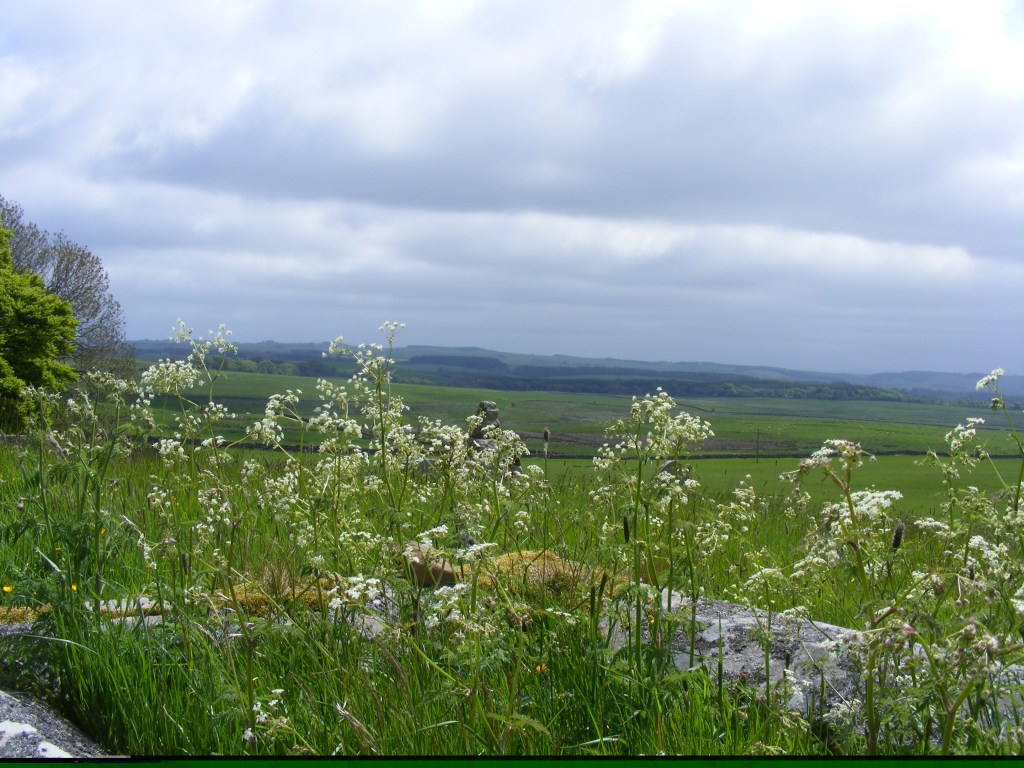
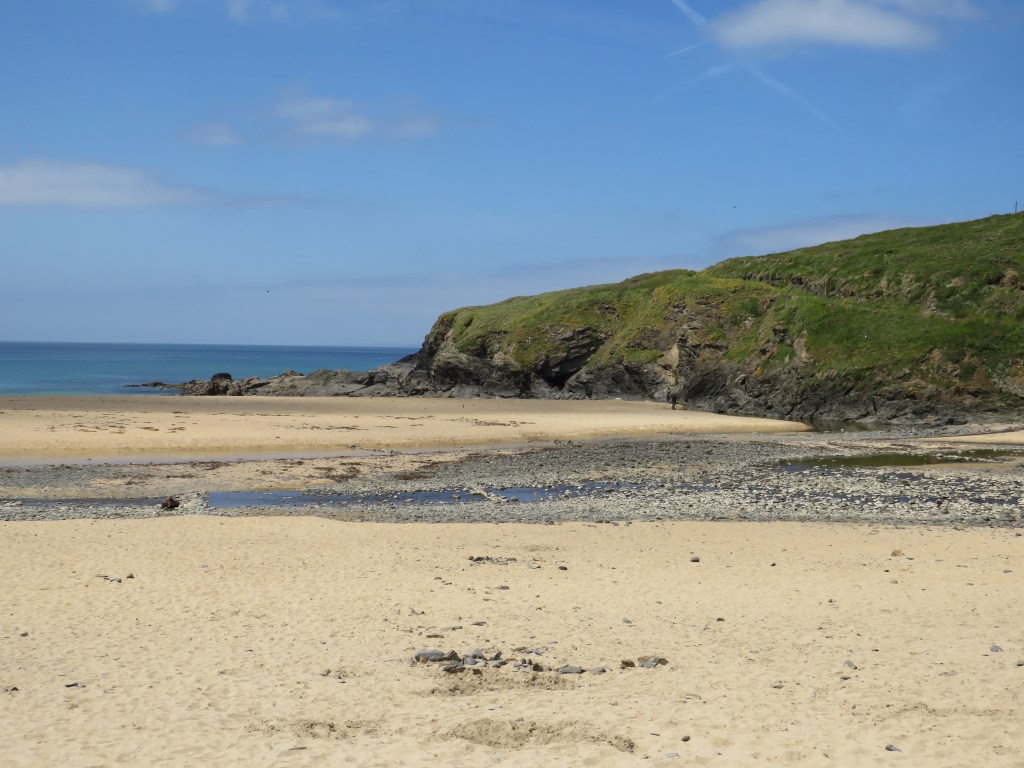
Another picture to remind you that I live somewhere beautiful.
The busyness has continued this month. For some reason best known only to myself, it seemed like a good idea to open bookings for Devon Family History Society’s 50th anniversary residential conference during my most hectic week with the job we must not mention. As I am the person who processes these bookings and they went slightly crazy, it was all a tad overwhelming. We’d done our research into the numbers of attendees at similar conferences in recent years, we’d added 20% because it is in beautiful North Devon, we’d added some more because the programme is something special and we were optimists and that was our predicted audience. Bookings opened and we filled half the rooms within 48 hours. There followed an anxious wait for an appointment with the venue’s events manager and finally more rooms were secured. Even with additional rooms, we are two thirds full. If you want to come along, don’t delay.
It is going to be a hectic year next year, as I am also running ‘how to’ family history courses, and a couple of workshops, as well as my usual programme of online courses and presentations. Oh and then there’s holidays, with a couple of special trips planned and before we know it, it will be 2027!
There has been more family history, this time delving in to my children’s Hampshire ancestry; seafarers and shoemakers along the Hamble Estuary. There have been outings with friends and now it is time for family school summer holiday visits, cue excitement and exhaustion in equal measure.
There are home improvements to add to the mix. I’ve had solar panels installed. I had them previously, so was already a convert. All very efficiently installed and I have a mound of certificates, warranty documents and the like. I am now just waiting for a magic number so I can start to sell excess power back to the grid, on top of lowering my own electricity bill. Next stop, a replacement for the ‘interesting’ salmon pink bathroom suite. At the moment I have one large shower en-suite and a bath in the bathroom. I’ve decided to go for a second shower, as opposed to replacing the bath, as that suits me better and any future owner desperate for a bath could always swap it back.
There’s been more research into fallen women, because, well, why not and it is one of my subjects for September’s Secrets and Lies conference (another event that’s proved very popular). A bit of a foray into nunneries, that’s for a book chapter and a day researching women born in 1819 (the same year as Queen Victoria) for A Few Forgotten Women. Now, apart from Biography Club, I have a lull in presentations until September and yes I am still (yet again) trying to keep up with biography club so my own is finally finished, at least as regards what’s happened so far! Not sure I will make it but that’s the aim. Come September, it is full-on round the country talks again, as well as a chance to catch up with friends.
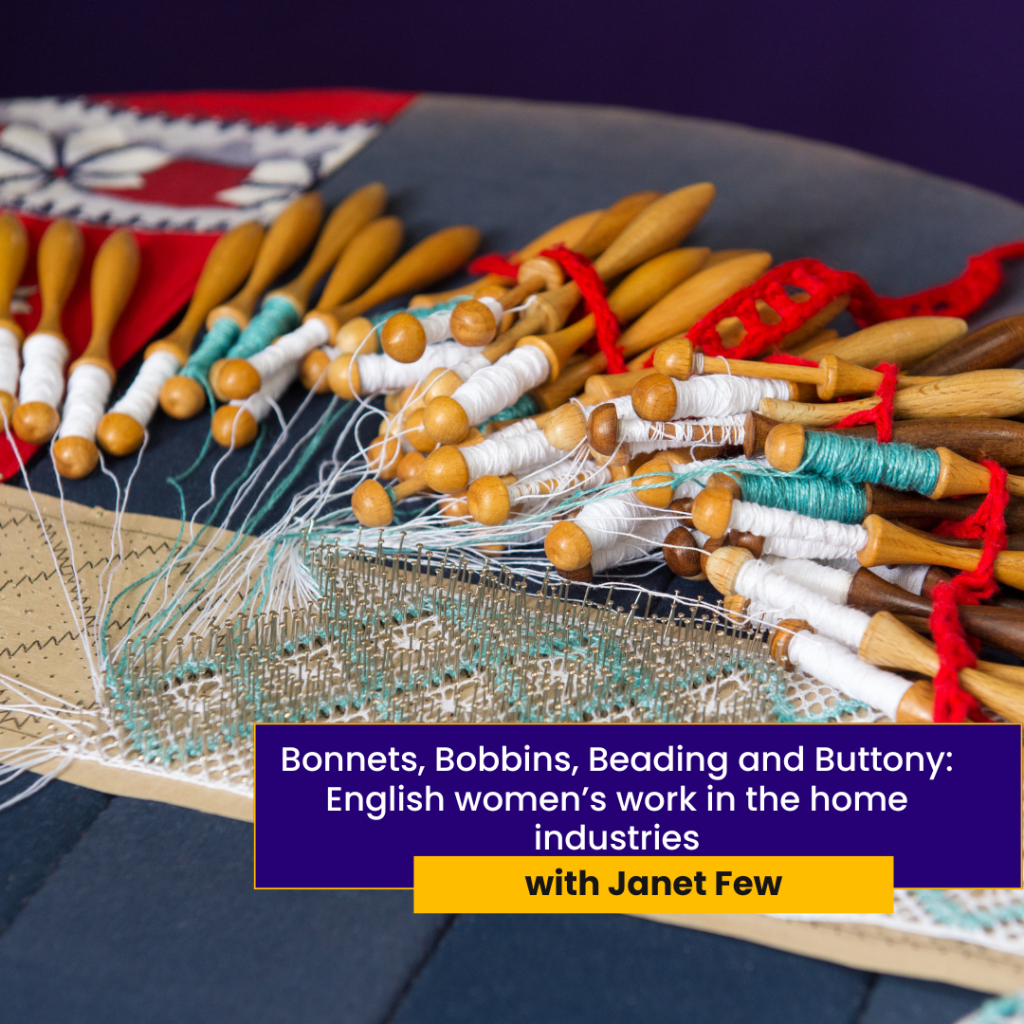
Time to take a deep breath as I launch in to the next few weeks. Not only is the job I must not mention about to hit with a vengeance but at some point long ago, I decided that it would be a good idea to cram the next few weeks full of presentations. So in the calendar for the next two weeks I have, Women’s Life on Farms, the story behind my novel Barefoot on the Cobbles, Mistress Agnes talking about life in the seventeenth century and Researching in the Twentieth Century, swiftly followed by looking at cottage industries. If you want to know more about straw-plaiting, lace-making, glove-making or button-making, as well as home working in general, you can book for that one here. All those topics get chapters of their own in my new book A History of Women’s Work and straw-plaiting and gloving are two of the sections that are accompanied by case studies. It is currently at its introductory price of 20% off, which means you can get a hardback for a paperback price and not have to wait two years for the paperback to be issue. The ebook will follow at the end of next month. I am humbled by the lovely reviews that have been coming in.
Today is also the final Zoom for my Pharos ‘Writing and Telling your Family History’ course. What a lovely cohort of students and such fascinating stories to be told. If you are sorry you missed it, it runs again in April, or you can sign up to research and tell the story of a female ancestor in September.
As this post in in danger of sounding like an advert, on to other things. In the interests of writing and telling my own family history I have been getting my pick axe out and working at my own genealogical brick walls. I have two stories to share with you when I get the time to draw breath and write them up for public consumption. Having decided that Mary Newlands is indeed my 3x great grandmother (see previous post), I am now pushing back to try to confirm that her family are of Scottish origin, as seems almost certain. So one brick wall crumbles and another looms.
News too on the second of my three ‘big’ brick walls. I’ve been working on the family of a different ‘almost certainly my 3x great grandmother’; oh wow, what a story. At the moment the ‘proof’ is based on rigorous documentary research but a missing baptism means two of the jigsaw pieces are DNA matches that are so small even I am reluctant to entertain them and hereditary large ears – yes, best not to ask. In a quest for more evidence, I launched into researching the wider family. I am back to the sixteenth century in Gloucester and Upton on Severn and have had plenty of palaeography practice. I do realise my missing link won’t be found in Tudor times but the rabbit warren (too big to be called a rabbit hole) sucked me in and there I was, head first in the throes of a virtual one-name study. It is an unusual name but beset with spelling variations and the use of contractions to add spice to my journey. There may be a connection to a seventeenth century barber surgeon. An added excitement is that my children also have paternal ancestry in Upton on Severn. I just may have to revisit that branch in search of a link. I am in the area in September. Do I wait patiently, or do I spend a small fortune ordering copies of wills? So many ancestors, so little time.
Sadly now back to the day job and three meetings Monday.
This post should have gone live on 1 June, the 217th anniversary of the death of Mary Hogg née Newlands. It has taken four solid days to put together (much longer than I anticipated), so it is late – sorry Mary but better late than never. For nearly five decades, the earliest ancestor in my grandmother’s Northumbrian paternal line has been great great grandfather John Hogg. For almost as long, I have been fairly sure that I know who John’s parents are but I have been waiting for an additional piece of evidence before ‘inking them in’. All brick walls are annoying but this is definitely in my top three that I really want to crack, not least because I love the area where I believe they came from; so much so that I embarked on a one-place study of the parish.
Here is a brief summary of the in-depth research that I have done to try to confirm John Hogg’s parentage. I should say at the outset, that this is the only branch of the family that come from anywhere near the north of England, next best are the Bulleys from Norfolk.
The story starts with my great grandfather, also John Hogg. I have his original 1885 marriage certificate, to Caroline Howe, naming his father as John Hogg, a gardener. The marriage took place in south London but census returns for my grandmother, Elizabeth Ann Hogg and her parents, confirm that great grandfather John junior was born in Morpeth, Northumberland. Family stories linked the Hoggs to Morpeth and to Russell ‘cousins’. I have a card that Elizabeth Ann wrote but never posted, addressed to Mr B. Russell, 3 Dacre Street, Morpeth. She referred to him as ‘Bertie’ and signed herself ‘Cousin Bessie’.
From census returns, we can deduce that John Hogg knew where he was born (Morpeth) but was a little vague as to when (April 1855 – March 1858). He was 28 when he married in 1885, so that fits within that date range. John’s death certificate shows that he died, in December 1926, at 3 Dacre Street and the informant was Bertie Russell ‘nephew’. John’s age was 71 (so born between December 1854 and December 1855). The births of four John Hoggs were registered in Morpeth registration district between 1853 and 1859 inclusive. There were no ‘male’ (i.e. no forename) Hoggs registered in Morpeth in this period. I followed up all four. Only one fitted the criteria of being born in Morpeth itself, having a father called John and not having a future that precluded him from being my ancestor. In addition, this family had a daughter who was the mother of Bertie Russell of Dacre Street.
Fully satisfied with my proof argument thus far, I turned to my great great grandfather John senior. He made life difficult by providing three different birthplaces in the census returns, being vague about his age and on one occasion, calling himself George instead of John. Over many years, I obtained copies of every document that I could and built up a detailed timeline of this man’s life, his two wives and nine children. It seemed clear that he was called John; there is just one census return where he is George. He was born somewhere between 1799 and 1809, probably in Bavington or adjacent Kirkheaton, which are about twenty miles west of Morpeth; although one census says Kirknewton, which is on the Scottish borders. He was an agricultural labourer, for the most part specifically a shepherd and he made many short-distance moves in the area during his life.
John’s first wife was buried in 1849, although no death certificate has been found. His first, apparently legitimate, child by his second wife Elizabeth Pearson, my great great grandmother, was in 1854. I could find no marriage either side of the English/Scottish border, within or outwith that date span, using every spelling variant of the names. This was particularly frustrating as a certificate would hopefully have included a father’s name. Comparatively recently, a newspaper announcement came to light, which revealed that they married, in 1853, at Lamberton Toll, a venue for clandestine marriages that is less well-known than Gretna Green. No records survive for this date.
I followed up all John and George Hoggs born 1797-1808 in Northumberland who appear in the 1851 census and looked for them in both the 1841 and succeeding censuses, to see which one could be the ‘George’ Hogg in Newgate Street, Morpeth in 1861 and John Hogg of Well Way, Morpeth in 1871. It was clear by the family members that these two were one and the same. After a great deal of careful research, I came to the conclusion that my great great grandfather John Hogg was almost certainly the son of Robert and Mary Hogg of Hallington, St. John’s Lee and that he was born in 1804 and baptised in Thockrington, which was adjacent to St. John’s Lee. This was the only baptism in the area around the birthplaces that John/George gave in the census and I could find no plausible alternative future for the John baptised at Thockrington, unless he became my great great grandfather.
I was so nearly there but still I hesitated to add Robert and Mary to my family tree. I was after that elusive ‘one more piece of evidence’. I investigated Robert and Mary’s families to see if this might support my hypothesis. Initially, the Hogg family were not very forthcoming. Robert and Mary only had three children and two died without issue, so there was no hope of tracing descendants for a possible DNA match. Going back yet one more generation, was a bit of a stretch but I tried anyway. This didn’t seem helpful. This family were rural agricultural labourers. They do not appear in the newspapers (as per the British Newspaper Library index). There are no surviving poor law records for the relevant parishes at the appropriate times. They do not appear to have owned land or left wills (Northumberland Archives, Prerogative Court of York and The National Archives indexes checked, as well as the excellent North East Inheritance Database). They do not feature in electoral rolls, nor did they serve in the army or navy. There is nothing in the catalogue at Northumberland Archives that relates to the family, leaving me with very little to go on.
I turned to the brides. Robert’s wife had been Mary Newlands; was she my 3x great grandmother?
The Newlands family, despite their reluctance to baptise children in churches or chapels whose records survive, had more potential. Robert Hogg died in 1805 and his wife Mary née Newlands, just three years later. This would have left John and his surviving sister, Mary, orphaned at a very young age, which might account for John’s later confusion regarding his place and date of birth. There is no age at burial for Robert or Mary Hogg ‘relict of Robt’. Mary and Robert were married in 1799, in Chollerton about five miles west of where their children were baptised. A family of Newlands emerged in Elsdon, some ten miles to the north. In 1773, a Mary Newlins had been baptised in Falstone, the daughter of John Newlins, or Newlands, whose wife was an Ann, or Nanny, née Corbitt. The Corbitts were a little more obliging, with a couple of useful wills and some gravestones. I began to build up a picture of the Corbett and Newlands families but were they my ancestors?
I was contacted by a descendant of Sarah Milburn née Newlands, believed to be Mary’s sister. I’ll call the contact SS. If our trees were right we would be fifth cousins once removed. I am used to playing with very small DNA matches. Yes, I know all the caveats but to put this in perspective, I only have a total of thirty matches that are 40cM or higher and anything over 20cM is ‘high’ by my standards. I do treat these with extreme caution but it is all I have. As fifth cousins once removed there was no certainty that SS and I would match and we don’t. This led me to look again at the matches that I do have. It turned out that, although we don’t match each other, SS and I had at least four shared, albeit very tiny, matches, all of whom descended from Sarah Milburn née Newlands. Two were my fifth cousins once removed, one a fifth cousin three times removed and I am unsure of the exact relationship of the fourth. The largest of these is a new match that arrived this week, leading to more delay in getting this posted.
Twenty year old Mary Hogg, almost certainly Robert and Mary’s daughter, died at Smiddywell Ridge, in the parish of Bellingham. in 1827. This was the home of SS’s ancestor, Sarah Milburn née Newlands. My John Hogg married in Netherwitton, the home of another Newlands sister. Were John and Mary each brought up by a different aunt?
In addition, I have an almost respectable 22cM match to a Corbitt descendant. She would be my sixth cousin once removed and yes I have checked that we don’t appear to share any other ancestry.
I am now going to claim Mary Newlands as my 3x great grandmother. To be clear, the weight of the evidence lies in my 48 years of exhaustive research. What I have outlined here barely scratches the surface. I am not basing this on DNA connections that all the DNA experts would tell me are too small to be significant. Every genealogist has to make decisions about how much evidence is enough. For me, I was 97% there with the documentary evidence, the DNA was just a final pieces of a very large jigsaw. If you want to read a fifteen page proof argument, describing in detail why I believe Mary Newlands is my three time great grandmother, you can access it through my Granny’s Tales page. All serious family historians should be setting out why x is the parent of y for all generations of their family tree (and no of course I haven’t done this for all lines yet but I can aim – how long do I have?).
Next step, who were the parents of John Newlands? This is particularly exciting as it will take my direct ancestry out of England for the first time and yes there is one of those tiny DNA matches to the Newlands of Kelso, who are almost certainly John’s family – the question is which John is which?
The view from the churchyard where Mary is buried and one of my favourite places in the world
Posting these accounts from the comfort of home always makes holidays seem like such a brief interlude but I didn’t want you to think that I was still stuck in the midst of Cornwall.
Day 7 Round and About
Initially, we thought we’d go to Marazion Nature Reserve but on the way, remembered that this was somewhere we’d been before, so we had a change of plan and headed to Trengwainton, which turned out to be closed. Never fear, we thought, we’d go on to Carn Euny Iron Age Village, open at all times. We followed the signs, we drove for a mile up a single track no through road. We were in the right place but the car park was full. Annoyingly, inconsiderate parking, meant that fewer cars could park than the space warranted. It looked like most of those parked were locals rather than visitors. It also made it extremely difficult to turn round but after a several point turn we escaped. At this point, we decided that we would chalk the day up as ‘a nice ride round the far south west’ and we headed back to the site.
So we weren’t sat down all day, we went for a walk from the site. Still mapless, we had to be careful not to get lost. We followed what was signposted as a footpath. I don’t think anyone had walked part of this for some considerable time as it involved battling through stinging nettles. Bit of a shame I’d decided to put shorts on. We passed a lavender farm and went downhill until the path turned into a steam. A series of well-spread-out stepping stones reached into the distance. We watched a man and two teenaged boys leap agilely from stone to stone. We asked where the path led to. It seemed nowhere much, at least not for a couple of miles. We decided our leaping days were over and retraced our steps.
Day 8 Windmill Farm Nature Reserve
The nature reserve of choice was one nearby at Windmill Farm. It turns out that it was nearer by than the sat-nav would have us believe and we had to give up and use Google maps instead. We headed off across a field of cows, having carefully read the instructions to chat to said cows so they knew we were on our way. The trouble with cow fields that are usually muddy but have been baked dry for a fortnight, is that they are full of potential ankle twisting ruts.
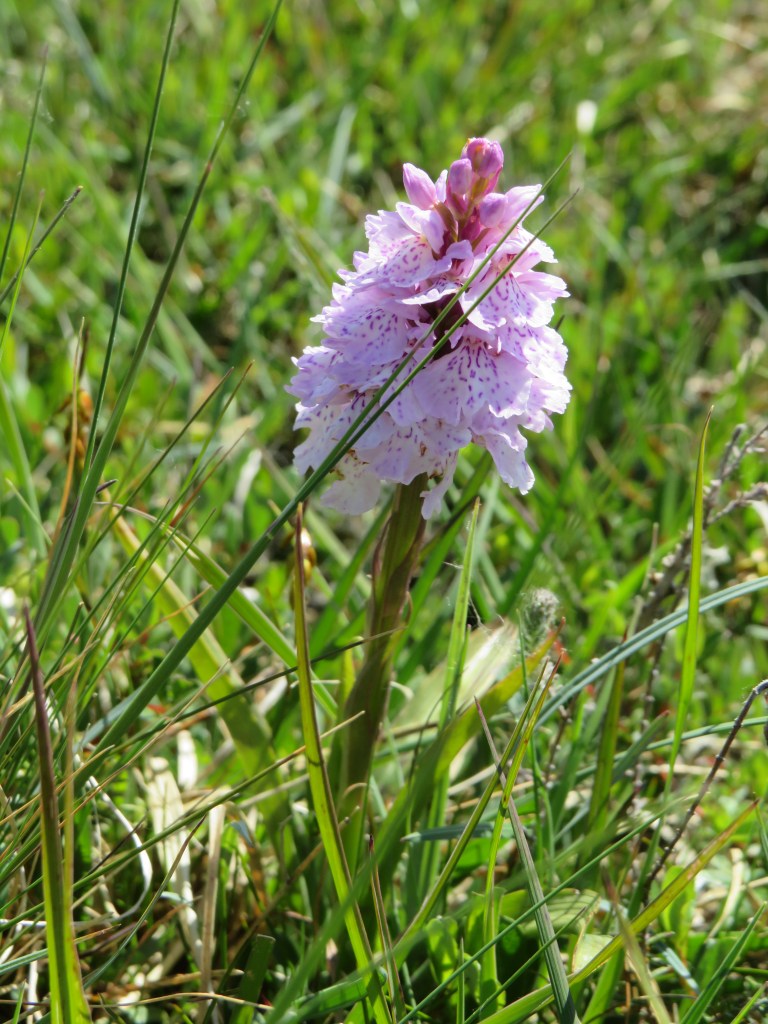
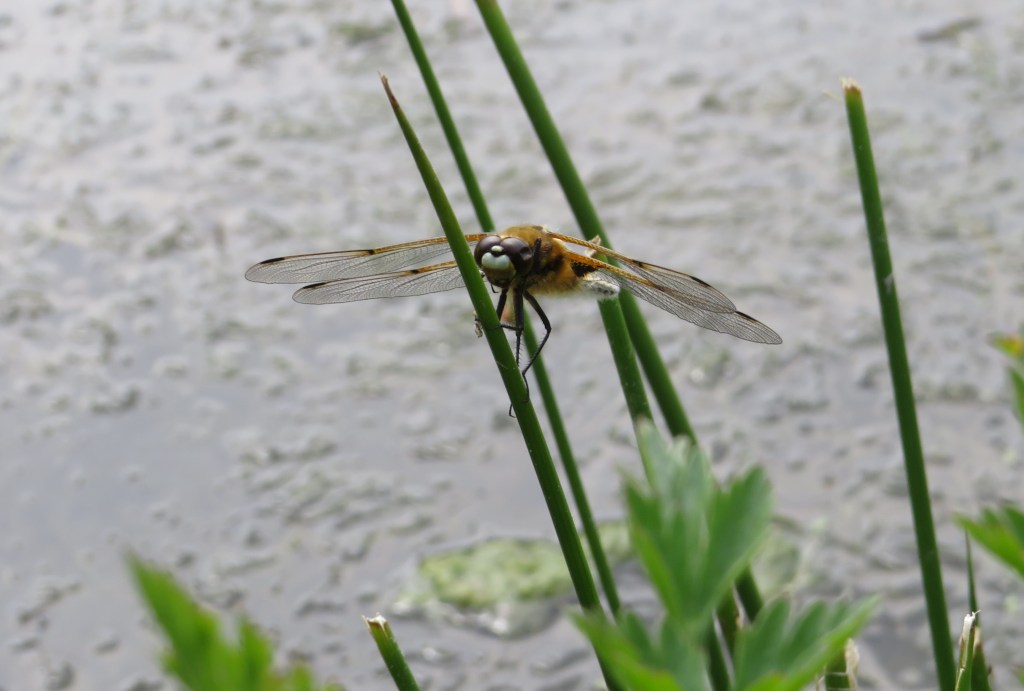
In theory, there was a way-marked route but we somehow missed this and ended up in a field of fennel. Retracing our steps across the cow field we reconnected with the white painted posts that marked our way. Inevitably, there wasn’t much fauna but a variety of flora was a little more in evidence, including heath spotted orchids. We finally came across a couple of drying out ponds, one at least of which looked newly dug. There were dragonflies but little else.
Next, the windmill from which the reserve takes its name. Originally called Lizard Windmill, it is referred to in a document of 1695, although has probably been rebuilt since then. It no longer has sails and ceased working in the 1840s. In the nineteenth century, the notorious Windmill Gang of footpads and sheep rustlers were active in the area. Two members were drowned when trying to escape pursuit.
It is possible to climb to the top of the windmill. My height-hating brain surveyed the see-through metal spiral steps with caution. There might be a good view from the top, thinks I, having read that the windmill was used as vantage point by Home Guard in the Second World War and became part of the RAF base at neighbouring Predannack Airfield. I began to climb. This, dear reader, was a mistake and previous experience with similar scenarios should have been enough to warn me that I would find this terrifying. Locals believe that the windmill is haunted. I often sense when this is the case but in summary, my opinion was – scary staircase yes, haunted no.
Day 9 Monday Minack Theatre
This was the day when we were booked to see Seth Lakeman at the Minack Theatre. I’ll be honest, this was a second best when we failed to get Fisherman’s Friends tickets for the first time in several years. As the campsite is thirty miles from the Minack, I was a little disconcerted when my travelling companion’s remark as we went to leave was, ‘where did I put the car keys?’. Keys located and we were on our way. We were slightly early, what’s new, for the stated ‘car park opens’ time but being a matinee, were let in. We sat in the sun eating ice cream and were within the first fifty or so (of five hundred) in the queue. This is the point at which I panic. Normally, I would have back-up printed tickets but by the time they were emailed, we were in a field miles from any printer. Will my fully charged phone somehow fail to display said tickets when required? Will the back-up fully charged battery pack similarly suddenly be empty? Will I not be able to get a phone signal? None of these unlikely eventualities occurred, although the staff’s scanning machines were being temperamental. We, along with most, people had zone A tickets. As we got to the front of the queue, I was asked to make a snap decision. Did we want to sit on the stone tiered seating, or on a chair directly in front of the stage? Errr, no brainer. Weirdly, some people were opting for stone seats.
The concert was excellent with some virtuoso musicianship from Seth and the other two-thirds of his trio, who had sixteen different instruments between them. There was even a guest appearance from Seth’s father, Geoff, showing just how to play the spoons. All in all we were well pleased with our ‘second best’ choice.
Access to the Minack is ‘interesting’. You don’t want to be trying to head towards the theatre as a show has just ended. Unfortunately, as we and many others wended our way down the single track road both a coach and a tractor were rashly attempting to make their way up the hill. Couple this with a high percentage of drivers who are used to motorway driving, rather than west-country roads and there was somewhat of an impasse for quite a while.
Day 10 A Day of Two Gardens
As it was only half a mile away, we decided we should visit Bonython Gardens. We often stick to places we can get in ‘free’ with my array of life memberships (National Trust, English Heritage, RSPB and RHS) but this was billed as ‘a great garden of Cornwall’, so it seemed like a good investment. This proved to be the case. With the help of two gardeners, the owners have crafted a beautiful landscape, including a walled garden, lakes and a fascinating yew chapel. There was a laid-back refreshment system, where you helped yourself and put the money in an honesty box. The orange cake and fruit cake both got a mark of approval. On the subject of honesty, I also purchased some honesty plants, which have been on my wanted list for a while.
The afternoon was reserved for meeting up with friends of long-standing and we had a lovely wander through the National Trust gardens at Trelissick, reminiscing and catching-up on the last twenty years or so of our lives. As my age advances, far too rapidly, I am on a mission to see in person, as many friends as I can, particularly those who I’ve exchanged Christmas cards with for the last fifty years but rarely see, so I am looking forward to more reunions such as this.
Another day and yet another short drive, this time to Helford, as we remembered that as being an attractive section of the coastal footpath. After a bit of a diversion down to the river ferry terminal we headed round to the tiny St. Francis’ Chapel, where St. F’s main animal of choice seems to be a German Shepherd. Then on along the path towards Frenchman’s Creek of Du Maurier fame. We got to the point where we were overlooking the creek and decided that it was quite a long way down, which would, of course, mean quite a long way back up, so we turned round and retraced our steps.
Day 5
The short walk of choice today was round Goonhilly Nature Reserve. We have come to learn what to expect from nature reserves and Goonhilly lived up to expectations – an almost total absence of wildlife. We did hear a cuckoo but not a great deal else. Here we were close to the tracking station, which sits incongruously against the Cornish landscape and occasional menhir. We may also have deviated from the waymarked route a tad. This involved climbing over gates, which fortunately held our weight and did not mean we ended up in a field with a bull. We also had a choice between being up to our ankles in water, or up to our ankles in mud. This despite it being the driest spring on record. We opted for mud. The advantage of this walk was that it was relatively flat and underlined the fact that it is hills that I have issues with, rather than walking itself. Still, we think ourselves lucky that we can walk as much as we can, as we approach our eighth and nineth decades.
We went on to Cadgwith so that the fisherman of my acquaintance could get a fishing boat fix. This also involved passing some free-range geese and observing two delivery lorries trying to escape and turn on the extremely narrow road, which, in addition, was partly blocked by a scaffolders’ lorry. We didn’t stay to see the resolution of this. From the look of the way things were going, despite some seriously skilled reversing up very narrow alleys, they may still be there.
We were visited by the site’s friendly collie, who came into the van calling for Chris. Balls were thrown and the neighbouring horses chatted to.
Day 6 Penrose and Poldu Cove
We drove to Penrose, a National Trust estate that we hadn’t visited before. This was a pleasant walk that took us to where we could overlook Loe Lake, the largest freshwater lake in the county. There was a very acceptable café where we availed ourselves of ice cream. The walled garden, designed by John Rogers when he inherited Penrose in 1772, is being restored by volunteers. We then decided to drive down to Mullion; another day another cove. We stopped off at Poldhu, a cove we remembered from our walking round the coastal footpath days. Mullion, despite the sat-nav, proved elusive, so we decided to leave that for another time.






 The History Interpreter - Janet Few