Sunday Sunrise and other Adventures

Every Easter Sunday in non-COVID times, there is a church service on the clifftop not too far from me. Whatever your religious belief, or lack of the same, this is always an awe-inspiring experience. We’ve been on several occasions in previous years and decided we’d go again this year. Getting up in time to travel fifteen miles and then walk up to the top of the downs before sunrise is not so much of a challenge when Easter is earlier in the year and therefore sunrise later in the day. This year we needed to be there for 5.45am, which meant leaving home almost an hour before that. It seems I am still able to get up, washed, dressed and breakfasted in quarter of an hour, so the alarm was set for 4.30am. I never use an alarm and had we been leaving at 5.15am I wouldn’t have done so this time but being awake for 4.30am naturally was a step too far, even for me. The fisherman of my acquaintance was already at my house in preparation, so agreed to set an alarm on his phone – not something we normally do. This worked well and I was awake at the first bleep. What we hadn’t factored in was that working out how to set the alarm was only part of the process. We also needed to know how to turn it off. This finally accomplished, we could get ready and be on our way.

As it was still pre-sunrise and we were walking across a headland, miles from the nearest light source bar the moon, we needed a torch. I found one that combines a torch with a panic alarm; I think I acquired it because it was free with something. Let’s just say that it turns out that there is a very fine movement of a dial between turning the torch off and setting the panic alarm going. I am not prepared to say how I know this. Those organising the event had permission to light a small fire but even so, it wasn’t exactly warm. We surprised some wild campers who had chosen to pitch their tent right next to where the service was to be held. Not sure they were expecting to be woken up at 5,30am. For the benefit of those of you overseas, I should point out that wild camping is not allowed in England, so they were somewhat disconcerted to see a couple of dozen people congregating nearby, to say nothing of the sparks from the fire floating towards the tent.

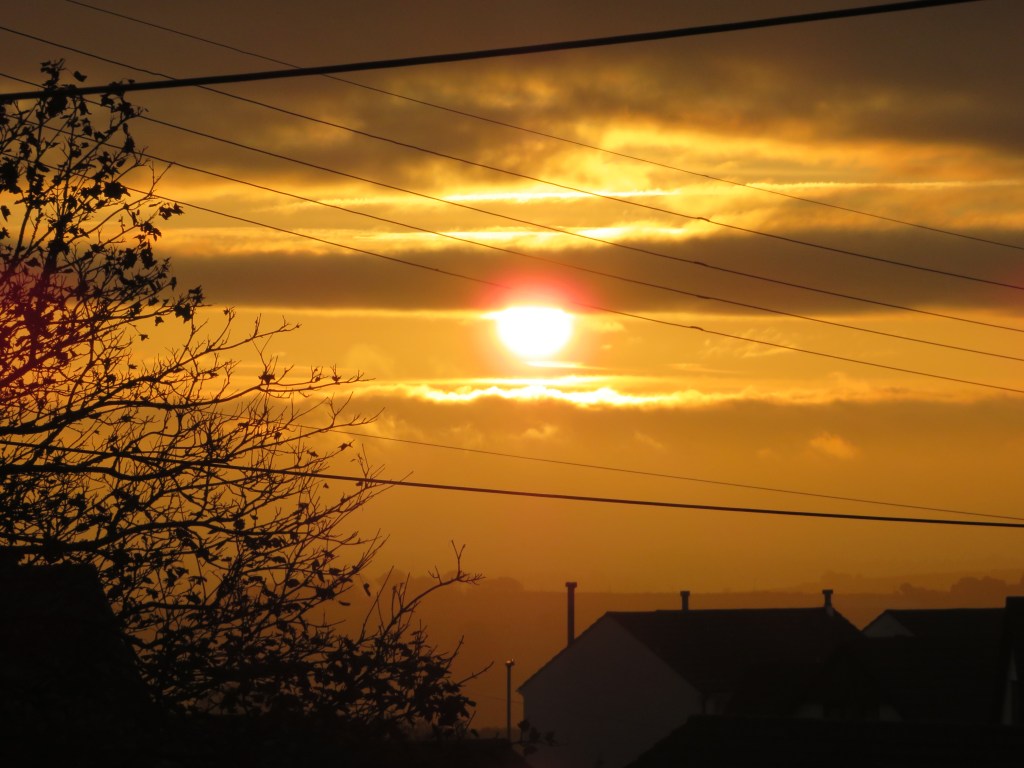
The sunrise was spectacular as always.

In other news, I have a new phone. I don’t know why I am so late to the mobile phone use party, when I spend my life on a computer but I’ve never been a fan. With this new-to-me phone, I may almost be being converted into a phone user. My grandchildren were scathing about the old phone’s Pokémon Go-ing ability and this was an unused upgrade phone that the fisherman of my acquaintance couldn’t get on with, so was happy to pass to me. It is an iphone (not that that means much to me) that outdoes the AR Pokémon features that the grandchildren have (I keep quiet about that). I’ve even managed to use it for things like replying to emails. I’ve still not actually made or received a phone call and please don’t ask me what my number is, I’d have to look it up but that’s for another day.

As promised, here is the booking link for the family history Youth Conference. There are ten speakers, all under the age of thirty, from five countries and everyone, of all ages, is encouraged to come along. This is not just a box-ticking, showing your support, exercise. There are some interesting new perspectives on family history being shared by some extremely knowledgeable speakers. It is going to be a great day.

The Experimental Archaeology Adventure Part 9: from a thing to things

I am now, sadly, halfway through this course. It really does come highly recommended if you are interested in the objects of the past. It is wonderful that it has been made available as an option for distance learning. You have until 3 June to apply for a place on next year’s course. Ideal if you are a traditional craftsperson, historical interpreter or family historian. Although ‘archaeology’ conjures up visions of ancient artefacts and there is, understandably, a good dollop of input about fascinating older ‘stuff’ the flexibility of the course has meant that I can concentrate on a much more recent era. I was sad to miss the opportunity to be in-person at the amazing Centre for Experimental Archaeology and Material Culture (CEAMAC) but it wasn’t to be for me – maybe another time.

The assignment about Jessie’s Locket has been and gone. I created a wonderful powerpoint plus soundtrack before realising that the time limit was ten minutes. I decided that I might not get away with sixteen minutes, so editing was needed. I was in a better position than some of my colleagues whose efforts topped forty minutes but still an issue. I reluctantly axed some of the material and then gabbled away in an unprofessionally speedy fashion to cram what was left into ten minutes and fourteen seconds. I now await the results with trepidation.

Attention has turned to a lengthier assignment, focussing on bringing an archaeological perspective to the examination of a collection of objects. Again, it was difficult to choose but I have decided on the collection of family photographs that pre-date my birth. These photographs are currently housed in a single album. Part one of the assignment is to describe the collection, so I have begun by categorising the images, which are almost all of people, rather than places or events. Having counted them, I was surprised to find that there are 554! They will take a while to catalogue and yes, I do know that I have many still to scan but that is not part of the assignment. The next and most interesting, stage is to write about their significance, their meaning and to think about how I react to these images. I have a horrible feeling that this may become uncharacteristically sentimental if I am not careful. Finally, I have to consider the ongoing future of the collection and look at comparative studies. That’s going to be the difficult bit. If anyone can point me in the direction of papers about the curation and conservation of specific photographic collections, I’d be grateful. So far, I’ve found a book for £198.02 that I might have to give a miss.

I have free rein regarding how I present this assignment and I have decided that one can have too much of chatting to your computer, so this will be an extended, illustrated essay, with plans to put the results on this, or possibly another, website. Watch this (or another) space.

I sometimes think that I have learned as much about social media on this course as I have about Experimental Archaeology. I have scaled the learning curves that are WhatsApp, Discord and now it seems I have found myself on ‘Insta’ (see I am learning the lingo). I did accidentally follow Adele by mistake but I think I am getting the hang. Not yet decided how I might use it but if you want to follow me feel free JanetFewHistory.

Old photograph of a mother and child with a doll's pram
A favourite from my collection 1926

Stripping the Willow – or How Much can you Fit in the Boot of a Volvo?

I am not sure if this should have been one of my experimental archaeology posts. It certainly qualified as an experiment! We headed round the many roundabouts to the Weald and Downland Museum (home of the Repair Shop) for a living willow chair making workshop. There was some confusion over the start time, with the tickets saying 9.30am and the email sent earlier in the week saying 10am ‘but please arrive fifteen minutes early’. We went for arriving at 9.25am – late by my standards. It turned out that it was supposed to be 9.30am but we were the only ones who didn’t think it was 10am, so there was a bit of a delay. We helped with the setting up and I got the initiative test that was assembling the stand to be used as a base to assemble the chair. That achieved, we waited for the others to arrive. A word about the toilet, which randomly had a floor length window. Ok, so it was frosted glass but still a bit disconcerting.

Lead by Ganesh Kings of Creative Willow, eight of us began our weaving. This was physically a little less demanding than the boat riveting of last December but still quite hard on the thumbs and arms. Apparently, there are a whopping 328 species of willow grown in Britain and we had several to choose from of different thicknesses and colours. There is a folkloric aspect to how some of the varieties acquired their names, such as Dicky Meadows Green and. We wove away. I instinctively worked lefthandedly. It seems not all my natural left-handedness has been eroded by a combination of an infants’ school who thought it was a sign of moral weakness and a badly broken left wrist in my teens. My brain still thinks I am lefthanded.

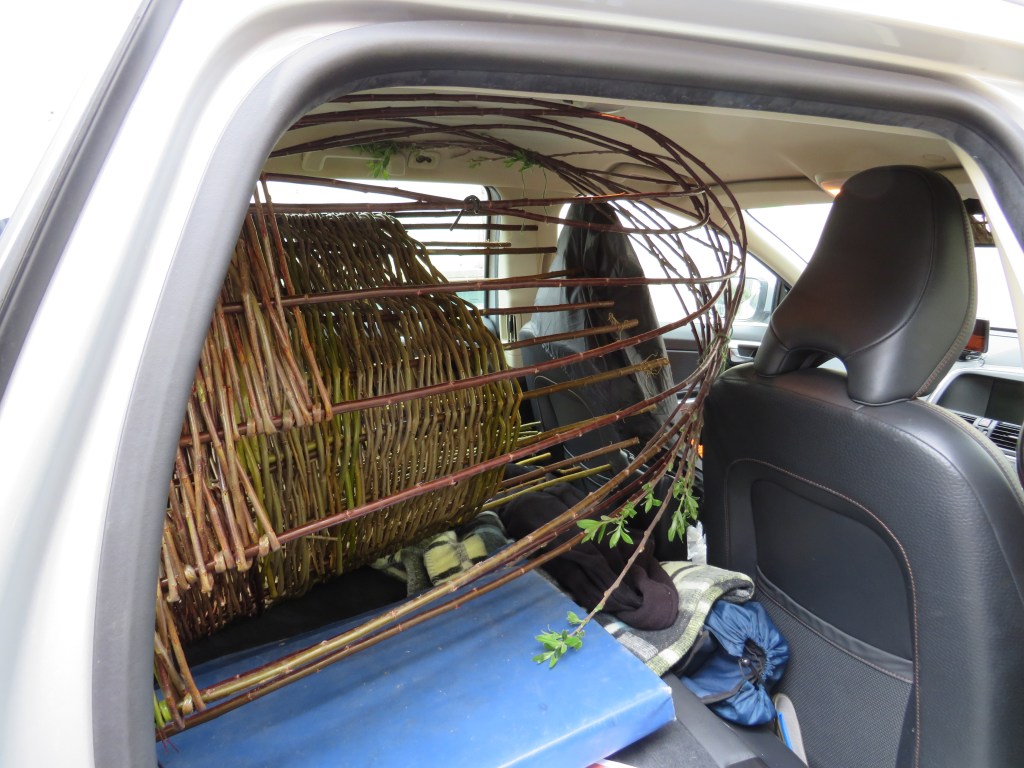
My chair wasn’t the neatest in the world but I was proud of it. I was concerned that spending all day inside would make it difficult to keep up my step count but no. I clocked up six miles walking round and round my chair, weaving as I went. Next came the challenge of getting not one but two completed chairs in the car. It is a Volvo XC60. If like me, your knowledge of makes of car is limited to ‘it has four wheels’, that’s a pretty big car. Back seats down, a bit of pushing and shoving and by agreeing to sit with our knees under our chins, the chairs were in. Sort of. We chopped a bit off a few legs (the chairs’ legs, not our own). In many cars this would have been sufficient. You’d slam the boot lid and the contents would have squished up satisfactorily. Unfortunately, the fisherman of my acquaintance has a relatively posh car with a self-close boot that you can’t override. The boot lid descends automatically. It senses a minute particle in the way and it rises again. Mission eventually accomplished, we realised that it would not be practical to drive round sightseeing with a car full of chairs the following day, so we decided to return home a day early.

The ordeal was not yet over. The chairs had to be planted. Each one has nineteen ‘legs’, fourteen of which will hopefully grow. Not a lot of choice of planting position in my teeny tiny garden and the soil is rock hard. The emphasis is on rock, as much of the garden is a spoil tip from when the chapel next door was rebuilt. Add to that substantial cherry tree roots and creating the required ‘donut’ shapes for two sets of chair legs was a challenge. We had to cut more off the legs than was probably wise but the chairs were finally in situ. Let’s just say, no murderers could dispose of a dead body in my garden without considerable effort.

There was a bit of an elephant in the room as we wove our chairs. Chairs, by definition, are for sitting on. These chairs are hollow structure and have no seats. It seems that the solution is to fill the space with earth and grow a grassy seat. This requires more spare earth than I have, so no sitting on the chairs yet but they look impressive. I also have to decide how I want to arrange the living trees, which can be tied to form a bower if I wish. It will be interesting to see how they grow.

The downside of the workshop was that I was only able to catch up with a few of the amazing History for Ukraine talks, contributed by many of my friends and colleagues over the weekend. What an incredible event organised by Natalie and her team; congratulations to all involved and to all those who helped to raise such a stupendous total. I really hope I get the chance to participate in some satellite events in the future.

Sunny Sussex

I am spending a few days in Sussex, which is indeed sunny. Yesterday, we arrived in time to take a look at the RSPB reserve at Pagham Harbour. This was a pleasant walk with views out towards the sea. The website warned us that the visitors’ centre and toilets would be closed due to staff sickness. Fortunately, only half of this was true.

Today, we headed off to the seventeenth century National Trust property Uppark, the home of the Meade-Featherstonehaugh family. This part of Sussex seems to be overburdened with roundabouts and Sally the Sat-nav was feeling sluggish today, which made exiting said roundabouts in the correct place somewhat tricky but we arrived without too much of a diversion. More Covid related staff shortages meant that only the ground floor of the house was open but there was plenty to see including some incredibly finely worked tapestries, with the tiniest stitches imaginable. Uppark suffered a serious fire in 1989 and had to be extensively restored but there still seemed to be original furniture on view.. We wandered round the grounds and were in time to enjoy the daffodils. Historic plans are being used to restore the garden’s pathways to the original designs by Humphry Repton.

In the afternoon, we explored Bersted Brook Nature Reserve, next to the caravan site. It was a tad underwhelming but it was an opportunity to walk away from the road and the blackthorn blossom was spectacular. We even managed to acquire something for tea from a nearby supermarket, which save us from the decidedly dubious ‘pleasure’ of resorting to one of the numerous local take-away chains.

Family History in Springtime and a Decorating Debacle

It is Women’s History month. I really should be getting on with granny’s biography but that seems to have slipped to the bottom of the very long to do list. I was chuffed to see that The National Archives were recommending my book Remember Then for Women’s History week. There are still copies hiding under the spare bed of a fisherman of my acquaintance, if you’d like you cross my palm with silver. I have no idea why it is on sale on Amazon for £19.90. You can get it from me for the proper price of £12.95, just get in touch. In anticipation of a visit to the area where they originated, I have taken a look at granny’s deeper ancestry. I even managed to find a couple of new 5th and 6th x great grandparents but the mystery of which of two Johns is my 4x great grandfather remains. Fortunately, the Johns are first cousins, so, after what I call a wiring diagram, indicating the either/or, the line can be continued back to the sixteenth century.

Having decided, reluctantly, not to go to Ireland this month, in theory my diary should have been clear. Explain to me then how I have had something on, on thirteen evenings out of the last fifteen. It would have been fourteen but one was cancelled. On the strength of a nominally ‘free’ month. I decided it was time to decorate the hall and landing. The above-mentioned fisherman offered to do the death-defying balancing ladders on the stairs stuff. I was a bit reluctant to agree to this but was persuaded. Fortunately, that part was accomplished without incident. I couldn’t watch. The idea was that I would do most of the rest but in the end my role was limited to affixing miles of masking tape round door frames. This wasn’t as easy as it sounds as the reel of tape had been lying around for a while and peeled off the roll in three inch lengths. After a couple of hours I had completed the task. Halls and landing have so many doors. I sat down to some computer work, smugly content that the job was done. Leaving the room shortly afterwards, I was dismayed to see streamers of masking tape dangling from every point. A new reel of tape was purchased and I did it all again. I should say that my hall and landing could not be smaller. The hall is three foot square and the landing is a narrow corridor. There is nothing in the space. How then, has this decorating endeavour meant that there is evidence of its undertaking in every other room?

I still have a mile long playlist of Rootstech sessions to watch. In the meantime, on the horizon, there are three other key events to highlight. In chronological order:- Do check out the Historians for Ukraine event on 26 and 27 March.  I had hoped to be involved in this but I will be in a field and I don’t know how reliable my internet will be, so I will be cheering from the sidelines and hope to take part in a spin off event. An event that I am actively involved in is a Free 24 Hour Genealogy Marathon, run by Legacy on 7 and 8 April. You can register for that here.

Then on 7 May is the Youth Genealogy Conference. I get a sneak peak at the speakers’ submissions and I’ve been excited by the response. This is going to be a great day, with some thought provoking and interesting talks from some knowledgeable younger presenters. Don’t worry, I will make sure everyone knows how to attend. There is no age limit on the audience!

The website creation for the Braund family continues. I was advised that there were accessibility issues. For example, not all of the many images had alternative text, which is necessary to enable those with a screen reader to know what is in them. A bit of poking about in the bowels of Wix and I discovered a button to press to identify accessibility problems on the site. Button duly pressed, the whole site ground to a halt. After this had happened several times, I started going through the images individually and checking that they had alternate text. I tried the button again and 99 issues remained. It seems that we had had so many issues that we’d broken the system. All sorted now on the accessibility front, so it is back to the exciting job of continuing to add content.

To accentuate the positive, in my hemisphere there are wonderful signs of spring in the air. I am writing this at 5.30 am, watching the sky lighten and it is warm enough to open the window and listen to the symphony that is the birds’ wake up call.

Sunrise

Rootstech Roundup

Well, one week on and I really thought it was time for a RootsTech round up. I have to say that I haven’t yet had time to sample many sessions. That’s the advantage of knowing that these will still be there for me to watch gradually over the coming months. It does also mean that I have been a little lazy about working my way through my playlist. I must admit that, with 1222 presenters, many offering multiple sessions, navigating my way to what might interest or intrigue me is a bit of a challenge. I tend to rely on the recommendations of others and looking for speakers that I know, first of all. Next, I look at topics of interest and I did find it a little difficult to locate these. Finally, I always try to add something that is out of my comfort zone and/or by speakers I don’t know. I’ll be honest I usually avoid the keynote sessions, although I know others enjoy these. This year there was an international line-up but in the absence of anyone I’d heard of, I have given these a miss so far.

I started off very early on the Friday morning, joining in with Michelle Patient and Fiona Brooker of Talking Family History, who were solving brick walls. This was really enjoyable and Fiona and Michelle coped admirably with some technological challenges and the absence of their third panellist due to illness.

I had one other live session high on my list of must watches and that was the discussion led by Lynn Broderick and Jill Ball on ‘Dealing with Ethical Dilemmas in an Online World’. This should be essential watching for all family historians who engage online. Sadly, a prior commitment meant that I couldn’t listen live and it took a few days for it to become available. I was particularly pleased to hear Jill’s opening tribute to the indigenous settlers of their lands and their contribution to the history of the past. Lynn and Jill had assembled an all-star panel to tackle some crucial issues, each of which really deserved a whole session on its own. It was great to have Daniel of The Hidden Branch as part of the team. Again, there were some minor technical gremlins as the presenters tried to share their polls but these did not distract from the discussion. As a viewer of the recording, we couldn’t see the questions, maybe something that presenters should be warned of in advance so they can include a slide with the questions. A shame too that there was no access to the chat after time.

Judy Russell’s contribution to this panel on copyright is also something that many people in the genealogy community need to hear. It is alarming but sadly unsurprising, how many people aren’t adhering to the ethical or even the legal issues in this regard. Just because we can, does not mean we should. Equally unsurprising and worrying was the level of ignorance about which DNA companies use their database for law-enforcement purposes.

For some light relief, I listened to Caroline Gurney on the folk traditions of Maypole and Morris dancing. Next up was ‘Around the World with the 1921 Census’ with Jen Baldwin; great to hear one-place studies getting a mention. An excellent case-study session was Michelle Patient’s ‘Finding Frank’. I have so many more sessions to work through; I’ll comment on these when I get to them. Oh, and I am having great fun with Relatives at Rootstech – of which more another time.

It has also been great to to get positive feedback on my own sessions, which you can find here.

What Janet did Next: a bit about website creating, piano playing and childbirth et. al.

It has been a very long time since I wrote about the day-to-day mayhem that is my life. So, what have I been up to?

The Braund family one-name society is 40 today. In 1982, 200 people who were Braunds, or related to Braunds, gathered in North Devon and formed the Braund Society – and they said it would never last. I was heavily pregnant so didn’t attend but I was a founder member. Over the years, the society has tried to evolve with the times. We’ve had a website for some years but it was looking very tired. Much as I knew that we needed a new website, I’ll be honest, my heart sank as plans for the re-vamp progressed. I knew that the generating of content would take many hours and would be largely down to me. I was wrong, it took twice as long as that. I have to confess that, although I had a quiet (some would say not so quiet) moan about having to take this on, once I started, I really enjoyed doing it and it certainly gave my enthusiasm a boost. I climbed huge learning curves in the process. I have created and run three websites for years and have helped with others but they have all been on the WordPress platform. This was going to use Wix. I had had one brief, unhappy association with Wix in the past. It did not go well. Nonetheless, I gritted my teeth and began. I should add that I had no spare time to take this on. I don’t even burn 8pm oil, let alone midnight oil but I can do getting up early; starting work at 5.30am or 6am isn’t a hardship. By pushing this to 4.30am, gradually the website took shape. It became an obsession. I had to tear myself away from it to do all the other many things I should be doing, like a post-graduate course, writing two books, practicing for my first ever piano exam (it was a bucket list/lockdown thing and I passed—just) and the small matter of earning a living. Don’t even mention housework.

I created a website that I was really pleased with. Then it was pointed out, very nicely, by a beta tester that it looked awful on a mobile phone. As part of the aim was to bring in those who use phones for internet access, this needed addressing. Every page, yes, every flipping page, had to be re-set for a phone. I barely use a phone for making phone calls, let along scrolling webpages. I am not sure I’d even know how to get to a webpage on my phone. I only got the phone because things like banks insist on texting you security codes. I will confess to a recent foray into Pokémon Go to interact with the grandchildren but that’s it. I spent two days adding a whole series of ‘Contact us’ and ‘Read More’ buttons, they were a fiddle but looked great on a laptop. If I’d known then what I know now, I’d have set up the pages differently, with much smaller blocks of text, which would have made getting these buttons in place on the phone version easier. Hindsight and all that ……. . I persevered. Then it appeared that those wretched buttons just wouldn’t stay where they were put. I spent another whole day taking them out again.

But ’tis done and its ‘soft launch’ is today. Please do take a look and feed back on any glitches so I can iron them out. So far, the only issue seems to be that the search box doesn’t. It will search the solitary blog post but not the website itself, sigh. I am also giving a talk about the 40 years of the Braund Society on 3 May, if you are interested. You can register to listen to this here.

Then I have been endlessly playing the same four piano pieces over and over again for months, I was sitting the exam virtually, which meant that I had to record my ‘performance’. Not only did this involve the use of a dreaded mobile phone but there was the slight issue of the absence of a piano. I practice on an electric organ, not the same sound at all. Ah but Martha has a piano. Could I manage to record during a brief stay with her? Added advantage, she also knows one end of a mobile phone from another. I had several attempts at playing my pieces straight through as required. Inevitably, each time a different bit went wrong. I finally lost the will to play Down by the Salley Gardens etc anymore. The whole submitting process was a bit of a challenge but within a week, back came my indifferent result. I try to convince myself that passing was an achievement but once a perfectionist……. .

Whilst on the subject of recording, I have two presentations hidden away in the Rootstech conference that were recorded before Christmas. Living in a very dark house and doing this in December meant that I had to pick a sunny day, which were few and far between. A sunny day dawned. A day that was accompanied by incessant and very loud drilling in the neighbourhood. By the time the drilling ceased, my laptop had been recording and re-recording so long that it started to overheat and the fan came on argghhh. Despite the challenges, there’s a session on our relationship with family photographs and one on uncomfortable family history for you to listen to. Do check them out, along with hundreds of other sessions. It is all free.

I am also doing some writing. Firstly, helping to produce a history of my home parish. This has involved forays into the 1921 census, which has been fun. Then there’s been a chapter on the history of prostitution. That led to an interesting internet search history. As I also have to access images, I have now seen things I can’t unsee. A tip don’t Google ‘Victorian Prostitutes’. Just don’t, well unless you want the address of every street worker in Victoria, Australia, Victoria, Canada etc.. It is ‘nineteenth century prostitutes’ every time.

Along with my lovely group of ladies, I am still working on the biography of my grandmother. I am nine pages in and she is still being born. Plenty of opportunities for context. More ’interesting’ internet searches surrounding child-bearing practices in the 1890s – Call the Midwife it was not. Oh and Call the Midwife. Discussing Family Search’s compare a face app in the post presentation chat with Devon FHS, it was pointed out that I looked like sister Hilda (I can’t see it myself but 50% according to Family Search). The actress has an unusual name and a surname that is on my family tree. While the chat was progressing, I managed to establish that we are 4th cousins twice removed. Sometimes I feel like I have a magic wand 😊.

Despite all the appalling international news, there are things to celebrate. So here is an image from the first seaside walk of the year yesterday in wonderful sunshine. You are welcome.

Young Genealogists at the Helm and some Words about Being Kind

Over the past few months, there has been much discussion about making the genealogical community a more all-embracing space. This covers many groups who are currently not feeling fully included, for a variety of reasons. I have been championing the cause of younger genealogists since I was one myself, a very long time ago. After all the talking and the nodding in the right places, something is finally happening. The Family History Federation have got together with the Society of Genealogists to provide the infrastructure for an online event that will be led by young genealogists across the world and showcase their undeniable talents and expertise.

The idea is to provide a platform for genealogists under the age of thirty to come together, exchange ideas and support each other. This is intended to be an international event enabling young people to contribute to shaping the future of the community. There will be a variety of sessions led by young people. These will include traditional presentations, panels, interviews, discussions and anything else that the contributors like to suggest. Sessions can be live or pre-recorded. Many young genealogists are skilled presenters but it is hoped that this will also be an opportunity for those with less experience to be involved and mentoring is being offered for anyone who is hesitant about stepping forward.

Some of the stakeholders in the genealogy community are coming along to listen to how they can play a part in creating a more inclusive environment. There are hints of possible special offers in the pipeline. We already have some interesting submissions and suggestions. The call for papers is open until 15 March, so if you have something to offer click here. Please spread the word amongst younger family historians in your circles and if you are a younger genealogist yourself, please do put forward ideas for contributions; we are excited to see what you have to offer and are happy to help if needed.

If your days as a younger genealogist, or indeed a younger anything, have passed, please do mark 7 May in the calendar and try to come along to all or part of the event, to encourage this generation of genealogists. We need to create an atmosphere of being amongst supportive friends. Booking details will be available later, don’t worry I will be sure to tell you how you can join in.

I can’t ignore another aspect of this. Incredibly, it seems that, partly due to the announcement of this event, there has been some totally inappropriate activity on social media and some young genealogists have found themselves the victims of online bullying. This is absolutely unacceptable in every way. To begin with, I cannot comprehend why anyone with any human decency and empathy would not welcome the concept of inclusivity and support. That aside, if you can’t see that this is a positive step, why not keep your thoughts to yourself instead of targeting others? Unfortunately, I was a little out of the loop when this was happening but be assured that I will not be standing on the side-lines if I see any evidence of bullying. On the one hand, I hope those responsible are reading this, so I can tell them how much I despise their deplorable behaviour (I edited out stronger comments as I don’t want to sink to their level) on the other hand I don’t want them invading my space, so if you can’t be a decent human being, please unfollow my blog. I am making no excuses for this paragraph, it is not a rant, it is far more important that that. Now back to interacting with the lovely friendly, supportive members of the genealogical community, who fortunately make up the vast majority.

The Experimental Archaeology Adventure Part 8: Choosing a ‘Thing’

Semester two is now well underway and the focus has turned from incomprehensible reading to the first assignment of this module. Writing an essay was so last term; now we are creating presentations. I have to choose a ‘thing’ and tell its story. There’s a bit more to it than that but broadly that’s it. Given that I can pick absolutely anything, the choice is not easy. It was always going to be something of family significance but I am fortunate that I have several things to choose from, so decisions had to be made.

Should it be the patchwork quilt begun by my great grand-mother in the 1880s and worked on by three further generations since? Given that each patch has its own story that would be too complex. I have a slide limit of five for this and one of those has to be the title. What about one of two Victorian christening gowns, or my mother’s wedding dress, made by hand from a parachute? As I write this, I am so tempted to change my mind! Then there’s my grandfather’s long service watch, great granny’s christening mug or one of the artefacts brought back by my great-grandfather from a tea-buying trip to China and India. Maybe once the assignment is done, I will tell all these stories too.

For now though, I have decided to tell the story of Caroline Jessie’s locket. I met Caroline Jessie, possibly only once but I can clearly remember her sitting in a chair in her parlour, alongside two of her sisters. I would have been seven or eight at the time. I have several reasons for finally opting for this particular heirloom. To begin with, Caroline Jessie has no descendants. Her closest living relatives* are seven first cousins twice removed, of which I am one. If one of us doesn’t tell her story who will? This particular item didn’t just belong to a family member, it was made by one. Caroline Jessie’s father was a silversmith and made each of his five daughters a similar locket. The fact that this is one of a collection of five, is another fascinating part of its story.

So far, I have learnt how to tell if something is silver. In this case there is no hallmark to help as it wasn’t sold on the open market, or indeed at all. One suggestion involves putting ice cubes on it, which seems a little bizarre. I am glossing over the fact that I don’t know where the silver was mined, or what processes are involved turning what comes out of the ground into the object I now have. I have got gloriously side-tracked researching the silversmiths’ company for whom Caroline Jessie’s father worked. It seems it was very well-known and co-incidentally, the founder shares a name with one of my grandsons.

I shall now be encouraging people to tell their own stories, tell the stories of their ancestors AND to tell the stories of family heirlooms. I will need several lifetimes.

* In the interests of genealogical accuracy, I should add that there could be great great half nieces and nephews in America, who might be regarded as being closer living relatives but I am not in contact with any of them and the English and American branches of the family seem to have lost contact in the 1920s.

The Experimental Archaeology Adventure Part 7: Thinking about Things

I am now in my second trimester. No, this is not some miracle of science; semesters, or terms, are called trimesters in Ireland. Having somehow achieved pleasing grades for my first two assignments (that probably is a miracle of science), I am raring to go, This module is called ‘Thinking about Things’, or as the southern Irish call it, ‘Tinking about Tings’. It certainly makes you think. Thing Theory involves many abstract concepts and has overlaps with philosophy (I think). I made the mistake of beginning the reading with a book that is either incredibly erudite or total garbage (the jury is still out). I thought I liked long words and complex sentences but I am clearly a mere beginner. The average sentence length in this worthy tome is about forty words. Counting the length of the sentences is probably about as good as it gets. I always thought that the definition of a sentence was that it made sense. I may have to revise that definition. Although I understood most of the words individually, my brain was getting little sense out of them collectively. I did wade my way diligently through to chapter six, which was almost comprehensible but I was thankful to get to the end. This academically expensive treatise may be finding its way onto an online auction site near you shortly. I was going to treat you to a gem from this book but out of respect for the author, I have decided not to. Believe me, anyone who can persuade a publisher to take on this manuscript deserves utmost respect. Pretty much the sum total of what I got from ploughing through all 173 pages (very slowly, I really couldn’t take more than one chapter at a time) was that the essence of a thing is altered by the interaction of humans with it (possibly). Hopefully all will become clearer when tutorials start next week, having been delayed a week by COVID.

Free Image on Pixabay - White Male, 3D Man, Isolated, 3D | 3d man,  Sculpture lessons, Teaching child to read
Image by Pixabay

On a positive note, I have since read some much more interesting and intelligible articles and I think I am going to enjoy this module, especially as the assignment options are very broad. I am very excited about how I might develop this and I am hoping that there will be some overlap with the rest if my life this time. I definitely do want to use this course to move outside of my comfort zone and last term’s assignments certainly did that but the more I read the more I see how what I am learning might be applied to family heirlooms and photographs. There are definite commonalities with one of the sessions, Family Photographs and a Sense of Belonging, that I have prepared for Rootstech. Incidentally, you can register for Rootstech free of charge and listen to as many sessions as you like, mine included. The event takes place from 3-5 March but recordings will be available after those dates as well.

In the meaning time, I’ve been engaged in an experimental archaeology project entitled, ‘What is it like to live in a seventeenth century cottage without the benefit of central heating?’ This was a result of the failure of the oil delivery company to be able to count. They are supposed to top up the tank every three months in winter. They last came in June and claimed that the next visit was due in February. I am still working out how that constitutes three months. Anyway, after 2½ days, the experiment was beginning to lose its appeal, despite the benefits of the wood-burner. Fortunately, the cavalry arrived today and I am now cosy again.