Continuing the Cornish Adventures

We needed to return home for the day and thought it was about time we refuelled the car. The chauffeur of my acquaintance had neglected to bring his wallet. I believe that a newly installed app on my phone might have been a satisfactory substitute but needless to say, despite my increasing proficiency with the phone over the past weeks (to the extent that I have exceeded my, albeit meagre, data allowance), this was a step too far. Fear not, my bank card is in the rucksack. Ah that would not be the rucksack we have with us but the one that is ……. in the caravan. Fortunately, we made it home and were able to retrieve alternative means of paying. Then it was back to the van. The A30 on a Friday rush hour is never a great idea, so the return journey was a little on the slow side but we were back in time for the mobile fish and chip van’s visit to the site and even managed a walk out to Wheal Coates to try to counteract the ill effects of said fish and chips, or in my case, fishcake and chips, in the evening.
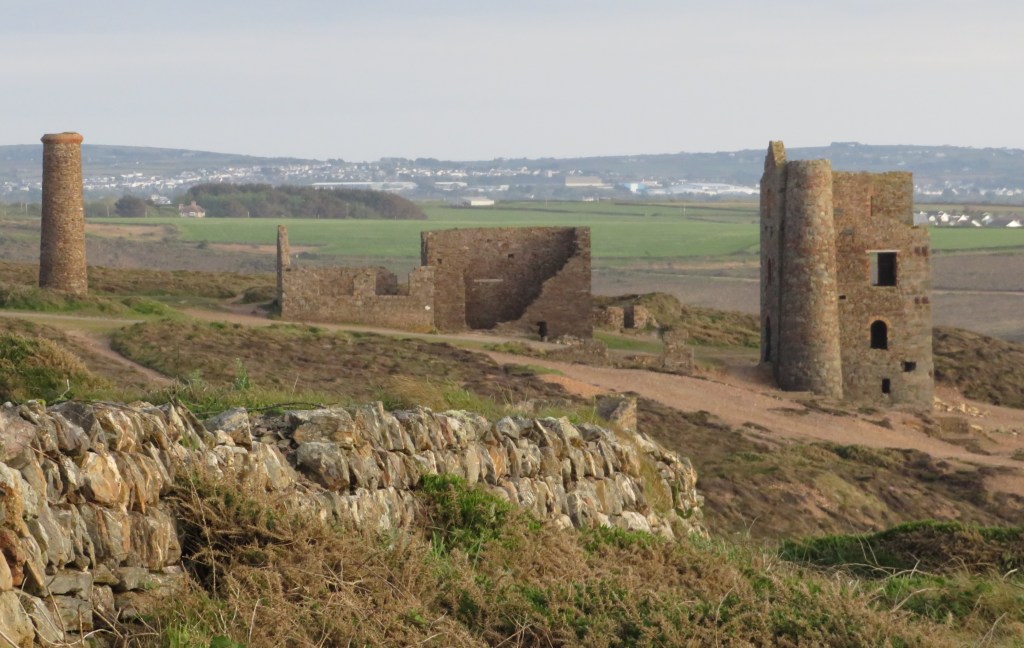
Wheal Coates

Further westward the following day and a trip to Newlyn. We overshot the entrance to the car park and before we had a chance to turn round saw several parked cars with a space for us. We looked carefully for notices that said that parking was restricted, or for permits in the windows of the other cars. A nearby gardener assured us that parking there was fine. I was a little less confident as this lay-by appeared to be a bus stop. Could the other half a dozen cars and the gardener be wrong? I left the decision to the car’s owner and we stayed put. A quick trip to a nearby boatyard so the fisherman of my acquaintance could chat boats, then we walked on to Mousehole where I had the drippiest ice cream cone I have ever encountered. Interesting to see that black-backed gulls seem to be outnumbering herring gulls. No sign of any clamp or parking ticket on the car so we returned to the van via a mercy dash to a supermarket near us to get yoghurt, which we should have brought back from my home fridge yesterday but we failed to do. A late afternoon relax in the sun followed.

Another day and back to the south coast for a visit to St. Michael’s Mount. We’d timed the trip so we could walk out across the causeway. I even managed to show evidence of my booking on my phone, which was an achievement in itself. It is quite a climb up to the castle, so not ideal for anyone with mobility problems but the views over Mounts Bay are impressive.

The Cornish name for the island is Karrek Loos yn Koos, or the grey rock in the woods, which may date from the time 4000 years ago when the mount was not cut off by the tide but was surrounded by woods. The remains of tree trunks are still occasionally seen at very low tides. In 2009, a bronze age hoard was discovered by one of the gardeners, suggesting that, 3000 years ago, the mount was a trading centre. It is thought that Edward the Confessor granted the island to Benedictine monks from Mont St Michel in Normandy and established a chapel there. The mount became a place of pilgrimage but also a focus for conflict. In 1193 it was seized by Henry de la Pomeray, who had disguised his men as pilgrims in order to gain control on behalf of Prince John. John was attempting to stage a coup and take advantage of his brother Richard I’s absence on Crusade. Much of the current building dates from the fourteenth century, with substantial later additions. The dissolution of the monasteries was late to reach the far south west, so the religious community survived until 1548. The following year the mount was seized by those involved in the Prayer Book Rebellion. It became a Royalist stronghold during the Civil War but surrendered to Parliament, with Colonel John St Aubyn as the captain. St Aubyn purchased the castle in 1660 and it has been the home of the St Aubyn family since then.

Several myths and legends are attached to the island. The discovery of a seven foot skeleton on the island, buried vertically, fuelled the legend of ‘Jack the giant killer’; allegedly Jack from Marazion killed Cormoran the giant who built the mount and terrorised locals. Visitors can view the giant’s well and a tiny heart-shaped stone in the cobbles is labelled as the giant’s heart. Some features that caught my eye included the stained glass in the chapel, seventeenth century tiles and the ceremonial barge, that took part in the Queen’s diamond jubilee pageant. This is one of the oldest working boats in the country, having been constructed using wood felled on the St Aubyn estates in 1750. A collection of postcards of the Mount over the decades were cleverly displayed so that you could see both sides. There was also a model of the castle made from champagne corks by the butler. Two observations here, they must have drunk an awful lot of champagne and the butler really needed to get a life.

We wandered back into Marazion, where I felt obliged to sample yet another ice cream flavour, gingerbread this time. Then we beat the rain back to the van.

More Westward Wanderings

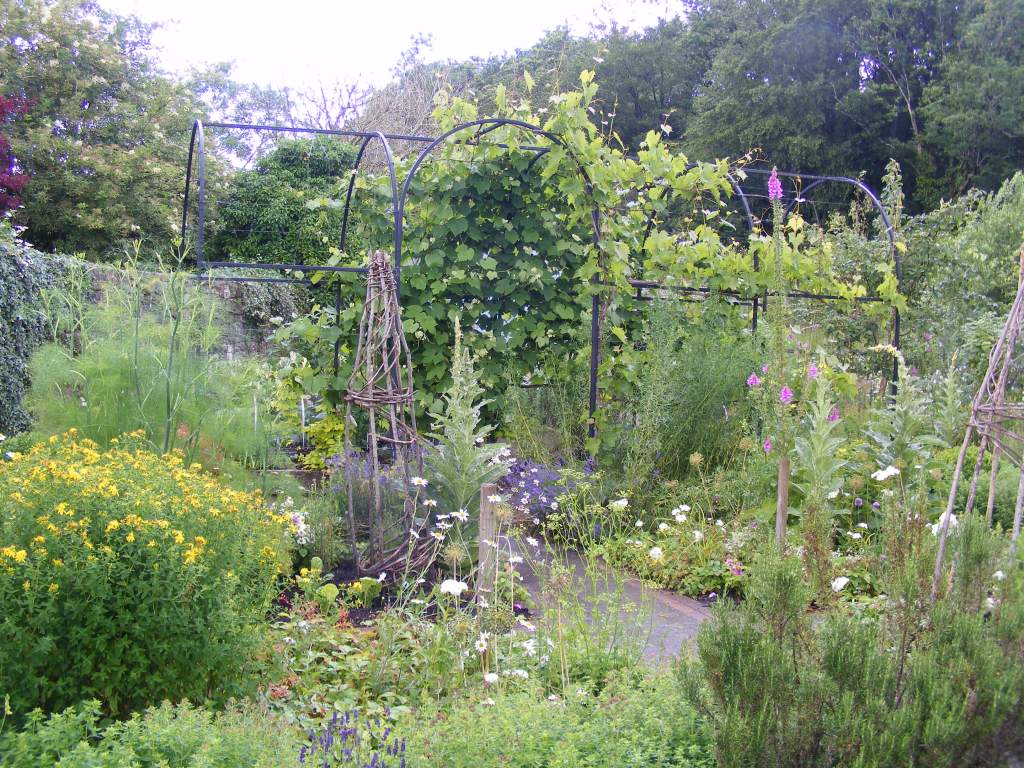
With the forecast heavy rain very much in evidence it seemed sensible to head for somewhere with a modicum of ‘indoors’, so it was off to Trerice, a manor house built by John Arundell in 1570. Inside there is a striking 576 pane window, predominantly made up of C16th and C17th glass. There are also numerous portraits, include some by Kneller. A 1950s wing replaces the former north wing. In the grounds there is an Elizabethan knot garden, given over largely to lavender and also an impressive potager full of vegetable and salad produce. If there were 100 hours in every day I’d want my garden to look like this. There are several mown mazes in the grounds, one being based on the maze at Troy Town on Scilly, which is known as the three circuit maze and was used by Scandinavian fishermen to trap bad spirits. I managed to escape.

Trerice is lovely but there isn’t really the scope for an all day excursion. The weather had improved so we decided to move on to Trengwainton Gardens, getting yet more value form the National Trust life membership. Here the rhododendrons were in full bloom. There is always something soothing about being in a garden and this one has the bonus of overlooking the River Fal. We walked down to where the King Harry chain ferry takes vehicles and passengers across the river. A steam ferry first crossed the river in 1888. It is one of only five chain ferries in England.

Next day and I was awake early to watch the misty dawn break over the sea, all accomplished without getting out of bed! The first stop of a busy day was Restormel Castle, which was built for the Earl of Cornwall, in good defensive position, overlooking River Fowey. It was originally used as a hunting lodge and was set in the largest hunting park in Cornwall. The park was also home to several hermits who were expected to pray for the souls of the castle’s owners. The remains are thirteenth century and the castle was owned by the Black Prince in the fourteenth century. After a skirmish during the English Civil war the castle fell into disrepair and was not deemed to be of sufficient use to maintain. English Heritage are now putting the headings of their interpretation boards in Cornish as well as English, A great first step but it is a pity that the text isn’t in Cornish too.

It doesn’t take too long to exhaust the possibilities of Restormel, so we move on to Lanhydrock House. The volunteer asks if I have visited before. I reply that I have but it was ‘a long time ago’. Do I remember the kitchen? I am asked, perhaps I should have explained that ‘a long time ago’, was about 39 years! The house was the home of the Robartes family, which I’ve always pronounced Row-bar-tes but, according to the information video is Row-barts. In April 1881 Lanhydrock was severely damaged by fire and the then owners died shortly afterwards, leaving the next generation of Agar-Robertes to take over. Ahead of her time, in 1894, the then Lady Robartes opened Lanhydrock to the public and establish a ‘bazaar’ there to raise funds in what seems to have been a glorified jumble sale. Her terse instruction cards to visitors have been replicated.

As always, I am attracted to the huge library, whose collection includes twenty five incunables. I had no idea what that meant either but just so that every day is a school day for you too (unless you already knew of course), these are books printed before 1501. There was also a fascinating and enormous steam jack in the kitchen. The National Trust seem to have developed an unfortunate trend for printing interpretation comments on the soft furnishings, which seriously spoils the authentic look of the rooms. I guess someone decided that it appealed to the visitors – not to this one though. We heard the story of how all the house’s laundry was sent to St Faith’s, a home for fallen women in Lostwithiel; I immediately wanted to scramble for census returns. Lanydrock’s gardens are extensive, with more rhododendrons in evidence. I would think that this is the best time of year for the gardens. I suspect they will be less impressive in a few month’s’ time.

Lanhydrock

On to Fowey and first the challenge of finding a car park. We located one at the top of the town but allegedly there could be one nearer to the church, where we want to be, so we decided to keep searching. Fowey is a tortuous warren of narrow, steep, winding streets. We do narrow, steep and winding but this is something else. Some vehicles were pulling in their wing mirrors to negotiate parts of the one-way system. Just because we were enjoying it so much (not), we completed the circuit several times before ending up in the car park where we first started and getting the town bus down the street. This doesn’t run after 5pm but the driver was able to tell us the best way to get back up the hill to the car park. I thought this might have been a first outing for my newly-acquired bus pass but the service was run by a private company and I didn’t like to ask if passes applied.

Fowey has been an established harbour for over 2000 years, exporting fish, wool and tin and being a point of departure for pilgrims to Spain. The returning vessels brought back with them wine, salt and iron. Fowey is noted for being the home of Daphne Du Maurier and we are here for a concert that is part of the Arts and Literary Festival that formerly bore Du Maurier’s name. There is little left of traditional Fowey, which now clearly caters for the yachting fraternity. Most of the food options were of the two peas and a bit of drizzle for £30 variety. We finally found The Lugger, which was more suitable to the sizes of both our pockets and stomachs.

The day finished with a Fisherman’s Friends concert in the local church. I was able to admire the heraldry round the church and practice my extremely rusty blazoning skills, while I was waiting for the concert to start. The downside was the less than comfortable pews. The evening was a sell out and was excellent, as we expected it to be. Even better, there was a community bus, with just two spaces, waiting to take us a ridiculously long way round to the top of the hill car park.

Cornish Meanderings

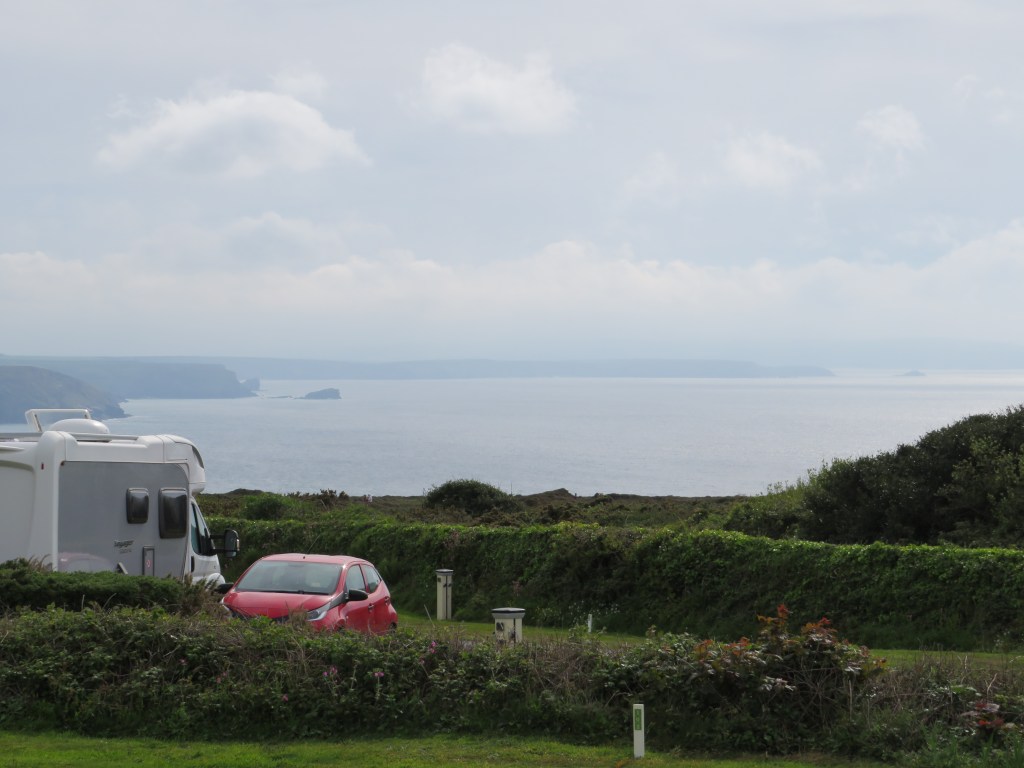
As always, you aren’t getting these posts in real time so apologies if I am saying it is glorious sunshine and it has been pouring with rain with you. May was supposed to be a quietish month so we booked a trip to Cornwall for some R & R. So much for quietish! I have four meetings to attend this week and a heap of writing to do. Nonetheless it makes a change to be somewhere different. As Cornwall is next door and earliest entry to caravan sites is 1pm, we had a leisurely start. I did have a slight panic when, despite what the website implied, on checking the site handbook for directions, I discovered that the wifi was hot spot only. All was well however as by choosing our pitch judiciously, I could avoid standing on one leg under a tree whilst attending my meetings. At least I hope I can. Internet and emails are slow but working, so fingers crossed that Zoom works too. As a bonus, we have one of the best views on site, looking out across the spectacular north Cornish coast.

Arriving at lunchtime provided opportunities for exploration in the afternoon so we set off for a gentle stroll along the south-west coast path, close to the caravan site, heading for Porthtowan, which, on the map, looked about that close (when ‘that’ is not very far). I really should know better. The clue is in the name. We are staying at St, Agnes Beacon. Beacon = high up. Porth = port = sea level. In between there was a lot more upping and downing. We really are too old/too out of practice for six or seven strenuous miles of sliding up and down cliff paths with plenty of loose shingle as an added hazard. The bonus was our encounter with the iconic Cornish coastal landscape, compete with granite cliffs, abundant wild flowers and abandoned tin mines. Limping and panting back to the van, we decided we should have settled for the mid-point at Chapel Porth instead. We survived but resolved not to try that again.

Looking for something somewhat gentler on day two, we drove to the south coast seeking  Pendennis Castle, which after a slight detour, we located. It is nearly forty years since my last visit. Pendennis is one of forty Henrician forts, erected in the sixteenth century, as Henry VIII fell out with many European neighbours. The impressive wooden portcullis was constructed from oaks felled in 1541 but it did seem that wood might not have been the greatest idea if the enemy arrived with fire-power. Guide David took us on a tour of the Tudor part of the fortifications. The castle was built on land owned by the Killigrew family, who provided the first three captains of the castle. The site was subject to continued development, with the large garrison block dating from the early twentieth century and this was still in military use until 1956. There were more incredible views across Falmouth Roads to the companion castle at St Mawes.

After some refreshment, we completed the ‘moat walk’ amidst more spring wild flowers and climbed down to see ‘Little Dennis’ another bastion on the shoreline. Then time to return to the van, via a short walk at Wheal Coates, close to the van. There are records of mining here that go back to the seventeenth century but the buildings that remain are nineteenth century. The tin mine finally closed in 1914.

The view from the temporary office window

More Warwickshire Wanderings

Another day out in Warwickshire. First stop was Baddesley Clinton, just a few miles from our caravan site. This is a fifteenth century, moated manor house, built on the site of a Saxon settlement. We began with a walk round the grounds and were treated with the view of a dozen newly hatched ducklings, hiding in the grass by the side of the lake. Baddesley was the home of the Catholic Ferrers family for twelve generations. In the late sixteenth century it was let to the Vaux sisters and became a centre for secret Jesuit meetings. It boasts a priests’ hole where nine Jesuits managed to escape detection. Said priests’ hole basically doubles as the toilet but anything to avoid being caught, I guess. The house is a joy for fans of heraldry with almost every room boasting coats of arms. We also saw a tapestry in the process of being cleaned and a particularly ornate, nineteenth century chapel.  As an added attraction, the house is the home to the National Trust’s largest collection of children’s books. In a rather more gruesome vein, in the 1480s, Baddesley was the scene of a murder, when Nicholas Brome came home to find the local priest ‘chocking his wife under her chin’ and consequently ran him through. After parting with a considerable amount of money and agreeing to repair two local churches, Nicholas was granted pardons from the king and the pope.

Next was the consumption of chocolate cake. I am not a fan of the regulation requiring the number of calories to be displayed. I am sure it is not a deterrent to those who need to be careful about calorie intake. It only means that we end up overweight and burdened with guilt, rather than just overweight.

In order to walk off just a few of the whopping 534 calories in what was actually quite a modest-sized slice of cake, we went on to Kenilworth Castle. We arrived just in time for ‘Knight School’, sadly we were observers only, being of rather more mature years than the target age for participants. Valuable lessons were nonetheless learned. The first rule of knight school is, ‘don’t get dead’. Kenilworth was established by royal chamberlain Geoffrey de Clinton in the 1120s. He also founded the nearby Augustinian priory of St Mary the Virgin. In 1447, the pope granted the priory abbey status. Kenilworth became a royal residence and was added to by King John, John of Gaunt and Henry V. Much of the twelfth century part is built of sandstone, which is eroding in interesting patterns. Kenilworth is famous for the siege of 1266, when Simon de Montfort held the castle against Henry III for 172 days, the longest Medieval siege. Elizabeth I granted Kenilworth to her favourite, Robert Dudley, Earl of Leicester, who entertained the queen at the castle, creating a pleasure garden in honour of her visit. Dudley was responsible for additional building on the site. He accomplished this largely by using pillaged stone from the nearby abbey, that had been surrendered to Henry VIII during the dissolution of the monasteries. The abbey’s remains were excavated in 1922 but are now protected by soil.

A royalist stronghold during the Civil War, Kenilworth was acquired by Parliamentarian Colonel Joseph Hawkesworth after the war. Retaining the gatehouse as a private residence, Hawkesworth began dismantling much of the castle and selling off the building materials. Kenilworth was saved by Sir John Siddeley, of Armstrong-Siddeley motors fame, who bought it for the nation, giving it to the forerunner of English Heritage in 1937, as well as funding repairs.

Bardic Adventures

Whilst visiting Warwickshire for a lovely family wedding, we decided that we’d look around a little, before heading home. Having never been, we picked yesterday to visit Stratford on Avon and only afterwards realised that we had timed our visit to coincide with Shakespeare’s birthday. We didn’t let the small fact that we hadn’t bought him a card deter us and off we set. We had a timed entry slot at Shakespeare’s birthplace and didn’t want to miss it. As we arrived, it was clear that something was going on as roads were closed and crowds lined the streets. It seemed that Shakespeare’s birthday was to be accompanied by a parade. We listened to a band for a bit and watched some men appear with a bust of Shakespeare, which they proceeded to screw to a plinth (health and safety rules). The band stopped and no one seemed sure what was going to happen next. We needed to be on time for our birthplace visit but it seemed a shame not to see whatever was due to happen too. My intrepid companion approached a man with a clip-board – always a good strategy when in doubt. Said clipboard-toting gentleman suggested that we went for our visit straight away, as then we would be back in time for the planned procession. We complied.

Being seventeenth century types, the birthplace was very interesting, with lovely gardens. Without rushing, we managed to return to the ever-thickening crowds in time to watch the parade of costumed characters, school children, local dignitaries and morris dancers go past and walk to the church where Shakespeare is buried. Only the great and good, most of whom were clutching posies of yellow and purple flowers to lay, were allowed in the church, so that was us out. Instead, we watched the morris dancers and looked at several old buildings clad in wisteria, which is in full flower here; mine at home has barely begun to shoot. Next, a visit to The New Place, Shakespeare’s home in later life. Again, there were lovely gardens, as well as the exhibition itself. There were some Shakespearean themed sculptures in the gardens as well.

A short drive and we were at Anne Hathaway’s cottage, dating from the fifteenth century. More beautiful gardens, an orchard and more sculptures. Here it was the cowslips that were at their best. I invested in a few herbs to take home.

Definitely a recommended visit, even without the bonus of the birthday celebrations. A joint ticket to all three properties is a considerable saving and you don’t have to visit all three on the same day.

Norfolk Tales

Some more recent travel adventures for you, this time to Norfolk. We left home slightly later than we might have, as I began the day by chatting to the lovely Helen Tovey of Family Tree Magazine, making a recording that will be available on their website. Then the inevitable lengthy, cross-country drive. We arrived at our caravan site in Thetford Forest about 5pm and had time for a quick walk in the forest.

A holiday isn’t a holiday without some family history so, the following day, we set off westwards across the county to Aylsham, the birthplace of my great great grandmother. The landscape was what you would expect from Norfolk, flat, large fields and the vernacular brick and flint cottages; there seem to be plenty of new housing developments on the edge of settlements. Having parked somewhere that probably wasn’t a parking space we looked at Aylsham church, then investigated the marketplace, where my ancestor had a grocer’s and draper’s shop in the 1830s.

Next to Felbrigg Hall, a National Trust property, built in the 1620s by John Wyndham, on the site of an earlier house. It was subsequently added to by later generations. The house passed to a step-son, who changed his name to Windham but the estate was lost by the profligate William Frederick Windham, who married a woman of dubious reputation and then lavished thousands of pounds worth of jewellery on her. His uncle’s attempt to have him declared a lunatic failed. The property was sold, complete with contents, in 1863 and coincidentally found its way back to a Wyndham descendant through marriage.

Our first port of call was the church, to try to identify John’s memorial trees that were planted nearly thirty years ago. At the time, it was easy to spot them, as they were the only young oaks in the vicinity. Now it is a little more tricky. Just how large should a thirty year old oak tree be?

We walked round the extensive walled garden. I thought it was a shame that there were so many more recently introduced non-native plants on show but it was impressive. In order to sit down, we forced ourselves to eat cake (me) and a bacon butty (my comrade in arms). There was a handy undercover outside space for this purpose. It had been drizzling all day and it seemed that everyone wanted to be undercover, so there were large queues, both for the café and the house itself. Although we had avoided indoor public spaces up until now, we decided we would go round the house, especially as almost everyone was wearing masks. As a glasses wearer, this does actually mean I can’t see where I am going, as despite purchasing masks described as ‘anti-fog’, I still steam up. I did discover that I could alleviate this by walking round holding my nose. Holding my breath also works but clearly this is not sustainable for more than a few seconds. Holding my nose not only makes me looks slightly ridiculous but comes with its own issues. I am contemplating purchasing one of those nose clips, as worn by synchronised swimmers.

The highlights of the house for me were, of course, the library, with thousands of volumes, including many travel books, brought back by a Windham after an extended Grand Tour. I did wonder how many had ever been read.  The ‘enlightened’ family provided a library of twenty five books for their servants. This did seem a bit underwhelming, given the size of their own library. The eighteenth century Chinese wallpaper was also interesting. Apparently it was peeled off the walls and sent to Cambridge for cleaning, before being reapplied. There was also some floor-covering on a bathroom, that had what appeared to be a nursery rhyme theme. As usual, the servants’ quarters had their appeal. A quick look round the second-hand book shop led to the obligatory purchases, including a book by a friend of mine.

With a months’ rainfall forecast for the late afternoon, we decided walking round Cromer might be best left for another day. We did drive in to see where the sea would have been if it wasn’t masked by heavy cloud. Cromer was gridlocked with those who had taken to their cars to escape the rain, so we resolved to return later in the week if we have time. The evening saw the first of a series of planned, how easy is it to Zoom using pretty ropey caravan site wifi? experiments. Possible it seems, as long as you don’t want to say anything or be seen.

Welsh Adventures Part 3

The final instalment chronicling our adventures in Wales and beyond.

Day 7 Blaenavon Ironworks

We set off for our pre-booked entry at Blaenavon Ironworks. This time the sat-nav, not only gets us to the right place but takes us past some stunning scenery on the way. Blaenavon Ironworks is a fascinating site. We get in free because Cadw, who run the site, have a reciprocal arrangement with English Heritage. The ironworks were established here in the 1780s and the finished products were shipped out by canal. It was at Blaenavon that Sidney Gilchrist Thomas discovered a way to remove phosphorus from iron ore, which was significant for the steel industry. An impressive digital display gave some idea of the noise and heat that was part of the working environment. It was somehow more impactful because part of the commentary was in Welsh. I am drawn to ruined industrial landscapes and this is on par with the Cornish tin mining sites. Here the jackdaws and the feral pigeons have made their home.

A series of workers’ cottages on the site have been furnished to represent different eras from the 1780s to the 1960s, the life of the ironworks. Covid restrictions mean that we can only look in these cottages, rather than enter them but they are still a highlight of the site. Instinctively, I wanted to look them up in the census returns and mentally put real people in them. This is just the sort of site that anyone with ironworking ancestors should visit. An interesting fact that I gleaned was that, in 1851, there were more industrial workers in Wales than agricultural, allowing Wales to claim to be the first industrialised nation in the world.

We went for a short uninspiring walk from close to the car park then headed off home, planning to stop to take photographs of the view on the way. We hadn’t done so on our outward journey as we were keen not to miss our entry timeslot. Strangely, the sat-nav decided to return us to Brecon via a completely different route. Although a circular route has the advantage of exposing us to more of the country, we are disappointed to miss the views. Just as we are lamenting this, the landscape opens up and the vista is amazing. Squelchy bog prevents me getting a great camera angle and views always seem less impressive in photographs, so I will have to rely on memories. The mid-Welsh landscape seems to be darker green than many areas and fields tend to be small and hedged, despite the availability of stone for walls.

On the way home we are reminded that the Brecon Beacons have their fair share of ******* drivers. We reach a bridge that it not only described as weak but is barely wider than the car. This in itself is not a problem but like many Welsh roads, it is not straight and at the point at which you join the bridge you cannot see the end of it. An illuminated sign warns us that there is a vehicle on the bridge. A vehicle emerges the sign goes out and a green light comes on. We launch into the unknown, only to find, as we turn the corner, that someone is coming in the other direction, presumably having ignored the sign at his end. My gallant chauffeur had to reverse 100 yards round corners, with unforgiving walls no more than six inches from the wing mirrors on either side.

Day 8 Thursday Brecon Canal

Today it is sunny, so we decide to walk from the caravan site, down the canal towpath to Brecon. This involves taking our lives in our hands to cross two dual carriageways first but we survive. This is a pleasant walk and we are rewarded by a grey heron allowing us to get to within five yards before flying off. There are more signs of industrial heritage here, with the remains of the limekilns that were in operation in the early nineteenth century. The canal linked Brecon with the industrialised areas in south Wales.

After a short rest we decide to explore more byways of Wales by car. We drive out to Craig-y-nos Country Park but by the time we arrive, dark clouds are looming and as we have already had our walking ration for the day, we return to the van.

Day 9 Friday To Cheltenham (yes, I know this isn’t in Wales)

It is time to move nearer to home and take up residence at the caravan site on Cheltenham Racecourse. We have stayed on racecourses before and although we have views across what is probably the Malvern Hills, I have to say that it isn’t the most picturesque site we’ve been to. Cheltenham too is unexpected, much larger than I was anticipating. In my head I was thinking smallish, Georgian grandeur, maybe a bit like Buxton but it seems not, or not in the part we travelled through.

I hadn’t planned an activity for the afternoon so time to Google for an outside space. I lied when I said that the wifi on the previous site was the slowest in the world, that honour belongs to the Cheltenham Racecourse wifi, which is not the Caravan Club system, for which I have an annual subscription but free Jockey Club wifi. I guess there isn’t much call for surfing the internet when hurtling over jumps on the back of a horse. An additional issue is that we have the ‘delights’ of a ‘Fun Weekend’ event on the racecourse this weekend – deep joy. This appears to involve a fun fair. Peaceful it may not be.

We opt for Beckford Nature Reserve. This comes very close to being another addition to our ‘nature reserves we didn’t find’ list but no, here it is, unsigned until you get to a small gateway hidden in a hedge. A path winds round an algae covered lake. There’s not much sign of wildlife apart from some baby coots, which I am surprised to see have orangy-coloured heads. Despite two perambulations of the lake, I am still 1500 steps short of my target. Time for some jogging up and down on the spot outside the van. This is followed by the Wimbledon men’s singles semi-finals.

Day 10 Forest of Dean

It wouldn’t be a holiday without some family history, so today it is off to the Forest of Dean, the haunt of some of my children’s ancestors. This lot even rate some gravestones, though many were in poor condition. Trailing from churchyard to churchyard is often circumscribed by bladder capacity, because small villages rarely rate toilets but hurrah, today two of the churches on our itinerary had toilets, so we could happily spend hours peering at semi-legible gravestones.

One of our stops is at St. Briavels. St. Briavels Castle, now run as a Youth Hostel, is closed to the public. It was built as a royal hunting lodge in the twelfth century. It became an important centre for the making of cross bows, using iron from the Forest of Dean.

Having got suitably soggy feet from traipsing through grassy graveyards, we take a short walk along a forest path to keep the step count up. Then it is back to the van, where the wifi oscillates from intermittent to non-existent. I hurriedly identify today’s photographs. In the past, I have been known to end up with numerous church photos and not be quite sure which is which.

Day 11 Slimbridge

We have saved the best until last. Today is our pre-booked visit to the Wildfowl and Wetlands Trust centre at Slimbridge, established by Sir Peter Scott seventy five years ago. Last time I visited it was in the spring so there are different things to see today and the opportunity to feed birds is confined to a small area. My favourite part is the new estuary aviary with avocets, oystercatchers, black-tailed godwits, ringed plovers and spoonbills, amongst others. I manage to get a few half-decent photos, despite every bird assiduously going into a preening frenzy at my approach, so that their head are hidden from view.

Welsh Adventures Part 2

Now I am back home and no longer in the land of steam driven wifi, I can continue the story of our Welsh adventures.

Day 4 Ynys-hir Reserve

This is a day to make use of my RSPB life member status and we visit the reserve at Ynys-hir. The reserve is a pleasant setting but notable for its lack of wildlife. Tally, one robin, one thrush, a few squirrels and an unidentifiable, distant bird of prey. In the absence of my own coat, which is sitting on the peg at home, I have appropriated a waterproof coat from the caravan. One of those two words, waterproof and coat, accurately describes this garment. Half way round the second of two trails the heavens open, mostly it seems on my head. We squelch back to the car and call it a day.

Day 5 To Brecon and Llangorse Wildflower Meadows

Time to journey 60 miles down the A470, back towards home and move to a new site at Brecon. This has the advantage of us being able to access more than three TV channels and it has wifi that reaches to the van. Ok, so it is officially the slowest wifi in the world but it beats sitting in a car park. We arrive by lunchtime and decide to explore the nearby wildflower meadows at Llangorse. ‘Park by the common’, it says. First problem, identify the common. It turns out that it wasn’t the tiny, scrubby piece of grass where we leave the car. We do find the enormous common on foot but I am not convinced that we reached the wildflower meadow, unless it was an area of unmown grass with some clover growing on it, not quite the poppies, cornflowers and ox-eye daisies that I was expecting. We did find a Crannog, an ancient lake dwelling familiar from our trip to Scotland and plenty of ducks. If you are wondering why we didn’t use a map, there is a bit of a map issue for this part of the trip. As usual, I made sure I purchased an OS map before leaving home. This is the Brecon Beacons, surely I need a map called Brecon Beacons? No. It turns out that there are three that cover this area and I have chosen the wrong one. Map of the western half of the Brecon Beacons anyone?

Sad to see Emma Raducanu’s enforced retirement from her Wimbledon match on our return to the van.

Day 6 National Botanic Garden of Wales

The National Botanical Garden of Wales is on the itinerary today and this is the furthest we plan to go from a site. Today we have our fair share of road re-surfacers again but all the roads that aren’t being re-surfaced are having their verges/hedges cut, so the stop-go board count rises even further. The sat-nav insists that we have reached our destination. We haven’t. We drive round the block a bit in search of helpful brown signs. After a few miles we pick these up and discover that we should have turned left when the sat-nav insisted on us going right. The gardens were definitely worth the drive and the effort. There is plenty to see, including an Eden Project style biome and a bird of prey centre. Inevitably my favourite parts were the less formal apothecary’s garden and the allotments. There is a display associated with medicinal plants and some beautiful quilt panels depicting herbs. I also learn about the physicians of Myddfai, whose story began with Rhiwallon who was the thirteenth century court physician to the Prince of Deheubarth, Rhys Grug. Their tradition continued until 1739 and the Red Book of Hergest, which records their remedies, is held out to be one of the most important Welsh manuscripts from the Medieval period. I couldn’t resist looking for an English translation.

We return via a local supermarket of our choice. This is the second time I have been in a shop since March 2020. I still have 1000 steps to hit my daily target, which I’ve maintained all year. It is now raining persistently. My options are to circle the site in the rain or to make myself look like an idiot jumping up and down by the cold counter in M********* whilst my companion loads up the yoghurt and milk. I’ve tried getting soaking wet doing laps of a caravan site before. Fun it is not. I go for surreptitious jogging as I examine tins of beans and load the bag at the checkout. Yay 1000 steps accomplished.

Welsh Adventures Part 1

Day 1 To Llanbrynmair

We leave in mist and showers and cross the Prince of Wales bridge, heading to mid-Wales. We pass Raglan Castle and encounter numerous tractors enroute as we drive into the iridescent green Welsh hills. It appears that every possible inch of Welsh road that could be being resurfaced is being resurfaced and stop-go boards abound. I am excited to see several red kites with their iconic forked tails.

We arrive at Gwern-y-Bwlch campsite. It is a pleasant site, snuggled in the forested hills. The only downside is that it has hot-spot only internet, which is why you will be reading this after our visit is over. At least this time I am prepared to be abandoned in a technological black hole. It seems that television signal is a challenge as well. Fortunately, the one side that is available is BBC, so Wimbledon watching is possible if you can accept a bit of buffering as an accompaniment. Having had a serious bout of insomnia the previous night, on arrival, I have a power nap, followed by an exploration of the site.

Day 2 The Centre for Alternative Technology

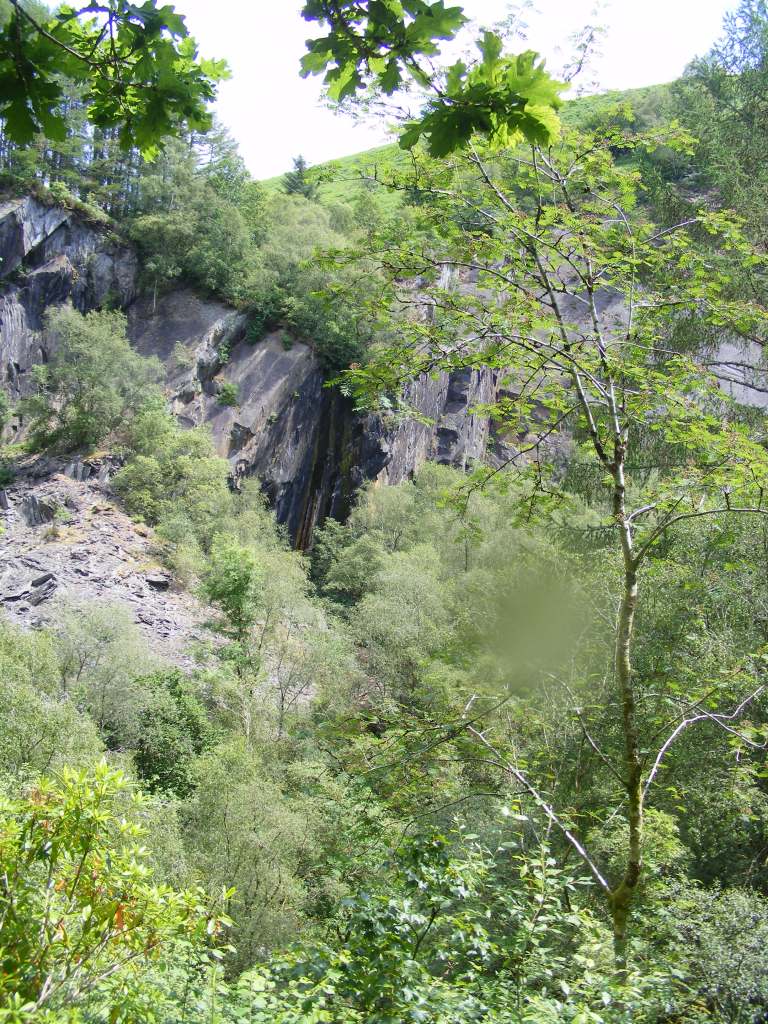
We have pre-booked entry to The Centre for Alternative Technology, which is a Unesco Biosphere, set up in a disused slate quarry near the River Dyfi. Apart from explanations of alternative energy sources and sustainable building, there are beautiful allotment-style gardens growing edible plants and wildflowers to create a diverse habitat.

Sarah takes us on a guided walk through the woodland, which is being managed as a native, broad-leafed habitat. This means that the rhododendrons have to be eradicated, as they discourage growth on the woodland floor. We call in at the café but its offerings, although delicious, are a little too ‘alternative’ for my meat and two veg loving companion.

Day 3 Coed y Brenin National Park

We are trying to avoid anywhere too peopley and to be outside as much as possible, so I have picked a National Park for today’s visit. This is of course Wales and outdoors means that we run the risk of getting wet. For some reason best known to no one at all, I haven’t brought any kind of coat with me. Fortunately, there are coats lurking in the caravan. I have a postcode for the car park for the National Park but finding it seems to be as fruitless a quest as our search for somewhere to park at the Savernake Forest last month. After driving up what almost certainly wasn’t actually a road, managing not to drive over a precipice when three-point turning and retracing our steps, we do find a locked gate to what looks like a car park. We drive on and find another car park, this time with a solid looking boulder blocking the entrance. This is definitely meant to be a car park. The clue is in the notice that says ‘do not linger in the car park’, along with ‘keep two metres apart’ etc.. This time, there is room to park on the accessible side of the boulder, even though that probably isn’t the car park, so we do.

The Coed y Brenin National Park consists of 9000 acres set in the Rhinog mountains. Allegedly, it was part of the historic Nannau Estate, founded in 1100 by Cadougan, Prince of Powys. We are encouraged to call at the state of the art, ‘green’ visitors’ centre. They must have done a good job of blending it into the landscape as it is nowhere to be seen.

This area is obviously designed for extreme off-road cycling and there are numerous cyclists hurtling down steep paths, to the detriment of brakes and tyres, if not life and limb. The routes have names like ‘The Beast’ and ‘The Minotaur’. Realistically, I accept that the seven mile ‘strenuous’ volcano walking trail is not for us. So we stroll along a wide, flattish cycle track (The Fox), alongside, dramatic, fast-running streams in a granite and slate-strewn landscape, managing to pick a dry spell between the showers to do so.

I may have left my coat at home but my travelling companion, who is chief in charge of food supplies, has neglected to put the mince beef in the caravan fridge. I am hoping he has left it in his own freezer, rather than defrosting somewhere in his kitchen. This means we need to find a shop, something, along with petrol stations, that have been conspicuous by their absence. The upside of this is that it takes us into the centre of Dolgellau, instead of bypassing it as we traverse up and down the A470. This is an attractive small town, with narrow streets and looming, grey, stone buildings. We identify a butcher as a likely source of mince. I wait in the car whilst my companion ventures forth. The time spent in making said purchase was probably long enough to lasso the animal in the field and carry out all necessary processes in between but mission accomplished. We arrive back to the van in time to see Emma Raduanou’s impressive third round Wimbledon victory.

Day 2 Coastal Walking or finding out that I am not as young and fit as I hoped I was

To continue the tale of our recent foray to South Devon. The second day started badly. We were driving to the starting point for our walk when I realised I had left no fewer than three things in the caravan. One of these was my fitness watch. No way was I going to not count today’s steps. We retraced our steps. I wish to put on record that my companion also forgot something but didn’t realise in time to collect it during our step-retracing mission.

The plan was to start at the end of our chosen stretch of coastal footpath in Coleton Fishacre, walk to KIngswear and retrace our steps to complete the leg in the correct order and also to end up back at the car. As one of us is a National Trust life member and the other a National Trust volunteer, we hoped we could park in the car park at Coleton Fishacre, which is a National Trust Property. We duly parked. I even worked out how to scan my membership card in order to obtain a ticket.  I had toyed with booking a visitors’ slot for entry to the property, which would have secured us the right to park but decided it was selfish to use up a place whilst entry is limited and we didn’t want to go further than the car park. Mission almost accomplished when the car park attendant loomed. It transpired that no, we couldn’t park there. The man was not open to persuasion, although my companion had a jolly good try. ‘There’s another car park just up the road’, we were told. We could not access the coastal path via Coleton Fishacre. This was all very well. The car park was indeed only about 500 yards away but this gave us access to a different point on the coastal path and with having to do it twice, would add another 1½ miles to a walk that was already at the limit of my likely unpracticed endurance.

Nonetheless, we set off with a spring in our step, enjoying the spectacular views. It is my habit, probably dating from my Girl Guiding days, to keep a note of the birds and wild flowers that I see en-route. My bird identification abilities are probably no better or worse than they ever were. Definitely above average but certainly not expert and I have never been able to recognise bird song. I realised though that my memory for flower names had become somewhat tarnished. When we were walking more regularly, I could identify many more. The flowers were at their best and this is my favourite time of year. Ox-eye daisies, scabious, foxgloves, thrift and ransomes and the last vestiges of bluebells in the small wooded section, which also yielded a jay and a thrush in the bird department. There were many more to add to my list and to begin with, the eight years since we last did a coastal path walk melted away. Don’t get me wrong, it isn’t eight years since we have been for a walk but those walks have been elsewhere, including local stretches of the same path.

To the fitter of my friends, a 7½ mile walk may seem like a gentle stroll. If you’ve never walked the south-west coastal path, be aware, be very aware that, with very few exceptions, gentle stroll it is not. There are hills, lots of them and the path is anything but smooth. I learned two things on this walk. I am definitely not as fit as I used to be and when the guide book says ‘strenuous’ this is not to be taken lightly.

After the first hour, every step we took away from the car was a reminder that it would be a step further in the opposite direction. This stretch of path is blessed with many seats. I sat on most of them. This was ridiculous. We had only last month done several walks of about five miles and here I was three miles in and struggling. It was also the hottest day of the year so far and we were heading towards the heat of the day. We could see our destination in the distance. It seemed, dear reader, a very distant distance. I’d been worried about blisters, well that and the lack of toilets but I always worry about that. Neither of these issues became a problem but I was conscious that I was breathing increasingly heavily. A few years ago, I would probably and possibly foolishly, have carried on regardless. Quitting is not normally in my vocabulary. At the back of my mind though was the niggle that hidden in a place on my medical records that I mostly choose to ignore are the words ‘heart condition’. Was it really sensible to keep on keeping on? We might not yet be half way to Kingswear and then we had to do all this again in reverse. The map suggested that there was a way to come off the path and return to the car by a slightly shorter and certainly less strenuous route. Common sense prevailed and that’s what we did. Altogether we probably walked five miles, although most of it was far from easy walking, this did seem pathetic. I was very annoyed with myself. Then there was the problem of how to proceed. Up to now all our walks have been in the correct order and in the right direction. We could start at KIngswear next time and walk to where we gave up but then what? Could I bring myself to compromise and count this walk as part of the challenge, despite it being in the wrong order and wrong direction? Could I face doing it again the right way round, knowing what I know now about how hard it was? If we can only notch up four miles a time, the remaining 153 miles are going to take a very long time to accomplish and our fitness is hardly going to improve. Always end on a cliff hanger. Stand by for the next instalment to find out what we decided.

Some advice for would-be coastal path walkers. Unless you are super-fit types who think nothing of notching up twenty five miles a day laden with your tent, sleeping bag and all other requisites, don’t leave it until you are of mature years to try to walk 670+ miles round the south-west peninsula. It is so worth it though, the scenery is breath taking. Even if you only walk a small part of the route, everyone should give this a try. I’d also recommend reading Raynor Winn’s The Salt Path about her walk with her husband along the whole length of the path.