Mostly about Mull

You will be relieved to hear that this is the end of the Scottish jaunt. It seems like a lifetime ago! Firstly our trip to Mull.

We are pretty keen on islands and this trip will tick two more off the list. The first concern of the day is, will we find anywhere to park, ideally somewhere free. We had identified a possibility yesterday and do manage to locate a spot a shortish walk from the ferry terminal. The next stress inducing issue is that we have had our coach tickets for some time and I have printed these out at home but the ferry tickets, which I need to produce on four occasions, have only just arrived by email so rely on me having a workable phone. Too late, I realise that I could have forwarded this to my companion, so that we had access in two places. It isn’t even just an email, you have to open the email and then download something. This I can accomplish but my phone has days when it decides that the battery life is about five minutes. I spot a USB charging point in the terminal but for some reason this doesn’t work.

First ferry boarded and on the most beautiful, sunny, calm day we sit outside on the ferry to Craignure on Mull. The crew wear hard hats but none of these are fastened, surely that renders them next to useless? One of the deck hands serenades us with Mull of Kintyre. He really should stick to the day job.

We board a double decker bus, securing upstairs seat and with Andrew as our driver, set off for a thirty seven mile drive along a single track road to Fionnphort. It is an enjoyable drive with plenty of information supplied by Andrew, as well as comments on the inadequacy of the driving of other road users. This is the new road, built between the 1960s and the 1980s and halved the previous journey time. There is plenty of reversing and pulling in to passing places. Some of the other drivers appear to be in vehicles that don’t have reverse gears.

Mull’s population is about 3,000, with 200 on Iona. We spot one of the 8,000 deer on the island; there are also fallow deer. We see evidence of the mussel fishery, a seaweed farm and a forestry industry. Travelling in the coach proves hazardous and I manage to bang my head three times and whack my upper arm into the half raised arm rest.

We leave the bus to take the ferry to Iona. A notice tells us to turn our phones off. a) Why? And b) How is that going to work when our tickets are on our phones then? I have tried charging my phone on the bus, that charging point didn’t seem to work either. So far I am two ferries down with more than half my battery left.

After a short trip we alight on Iona and the first stop is the nunnery, founded in 1200. There is allegedly a carving of a naked women over the window of the refectory that was intended as protection from evil but we don’t spot it. Next, St Ronan’s Chapel, which was built about 1200, although there is evidence of an earlier chapel, dating from c.700. Interestingly, all the skeletons that have been found in this area are female.

Unfortunately, the heritage centre is not open but we probably wouldn’t have had time to explore it. We are still able to find out about the island’s history as a centre of religion. Columba, accompanied by twelve monks, arrived on Iona in 563 and founded the monastery, which would have been a timber construction. An account of Columba’s life, written by Adomnan, Iona’s abbot in the 690s, provides details of the early years of the monastery. It became a Benedictine foundation in 1200, which survived until the Reformation. What we see today is a reconstruction of the abbey as it would have been under the Benedictines. This was accomplished by the Iona Cathedral Trust in the early twentieth century and funded by the Duke and Duchess of Argyll.

Iona was famous for its scriptorium, where monks produced beautifully  illustrated religious manuscripts, including the Book of Kells, created about 800, which we saw in Ireland last year. Remnants of a path, dating from 700, survive. This ‘street of the dead’ was used as a processional route, passing the monastery’s holy places and leading to the shrine of St Columba. Crosses were erected on the route to mark places for contemplation. Viking raiders plundered the abbey from 795. In 806, sixty eight monks were killed. This led Abbot Cellach to take the monastery’s treasures and most of the monks to Kells in Ireland. Some monks remained on Iona. There were strong sea links between Iona and other religious houses in Scotland and Ireland. Viking raids continued for two centuries. In 825, Abbot Blathmac was killed when he refused to give raiders the jewelled casket containing St Columba’s bones. The abbot and fifteen monks were killed on the beach on 25 December 986.

The museum on site of the abbey contains many ancient carvings dating from the early 600s onwards, including huge crosses and tomb tops. In Medieval times many  of those from high society were brought here for burial. The twelfth century St Oran’s Chapel is the burial places of The MacDonalds. The site is home to St John’s Cross, thought to be the first Celtic Cross of its type.

We partake of lunch at the St. Columba Hotel, a little upmarket for us. We decide that we should have something regional, so Cullen skink for my companion and haggis, goat’s cheese and onion marmalade quiche for me. I wouldn’t normally eat haggis but the other options didn’t appeal. We sat outside and observed a cucumber eating dog on the next table. The owner had ordered a whole cucumber that he cut up and gave to the dog as treats.

The return journey passes without incident and we opt to stay  inside on the ferry to Oban as the temperature had dropped. We exited the ferry terminal in a different place, leaving us with a route march back to the car. It has been a lovely, if long day and we couldn’t have hoped for better weather.

The next day, the weather had turned grey but an improvement on what those further down south were experiencing, where there are severe floods. We picked a Scottish National Trust property that isn’t too far away and go to Arduaine Gardens. The coastal garden was created by James Arthur and Ethyl Campbell, who purchased the land in 1897. The garden suffered severe storm damage a couple of years ago, with many trees being blown down, so there is much restoration underway. There are some lovely views of the coast, although the visibility isn’t great. We don’t fancy the cake on offer in the neighbouring hotel, so it is back to the van via Lidl’s, who sadly, don’t have any tiramasu muffins this time. The afternoon is spent enjoying the sea views from the van and tomorrow we begin to wend our way home.

Moving Westward

This was a day when it was ten degrees cooler than the previous day, much more in line with expected temperatures and we headed north to Banff, on the Moray Firth in search of fishing boats for my travelling companion. The harbour took 150 years to build. It was started in 1625 but it was not until engineer John Smeaton was appointed that it was completed in 1775. The harbour’s difficulties with silting were first recorded in 1608 and continue today. The outer north pier, built in 1818, was designed by Thomas Telford. In Medieval times, Banff was a centre for  coastal trade, exporting salmon, wool and fleeces and importing timber, coal and salt. It was also a notorious area for smuggling.

A few miles up the coast is Portsoy, much more of a traditional fishing harbour compared to Banff, where many of the vessels were pleasure yachts. The original harbour was built in 1693. Some of the warehouses along the quay date from a similar time. A ‘new’ harbour was built in the 1820s to accommodate the then flourishing herring fleet. It was damaged in 1839 and eventually refurbished in the 1880s. There is a ‘Salmon Bothy’ and museum but they were not open, so we were unable to investigate further.

Four ancestral churches remained on the list. We located the first, failed to find two and abandoned the last. Our search did take us along more routes that no self-respecting tourist usually touches. I don’t have maps for this part of the journey, so we were relying on the satnav. When church hunting, I usually ask for the ‘city centre’, which is often laughable in itself, as some settlements are definitely of the blink and you’ll miss it variety. This tactic does however, usually take you fairly near the historic church, at least it works in England; Scotland not so much. For some reason this doesn’t work at all when I put in Aberlour, no ‘city centre’ option. I’m not daft , I look through the streets for something like ‘Church Street’, nope. What I should have done is gone for High Street. Did I take this sensible option? I did not, I merely punched in any old road. I use the word ‘road’ advisedly. We found ourselves up a very long winding track in the forest above Aberlour before I realised that this really wasn’t going to work. We did manage to find the town but not the church.

The following day, setting off in mist, we reversed the route we travelled home on on the previous day, driving alongside the River Spey. Here we have the archetypal Scottish scenery, pine forests, lochs and mountains with rowan trees sporting their bright berries, suggesting that we may be in for a hard winter. There was a bit of a hold up in Fort William due to the volume of traffic but the mist had lifted, leaving just a haze, meaning we could actually see the top of Ben Nevis, something that had been hidden on previous visits.

The satnav let us down at the end of the journey, meaning we had to ‘turn around where possible’, which ended up being turning around where it wasn’t actually possible with a caravan on the back. This was the second time we’d been to this site and for the second time we were given a premium pitch, with uninterrupted sea views, at least as long as we looked to the right. The only downside was the lack of onsite wifi.

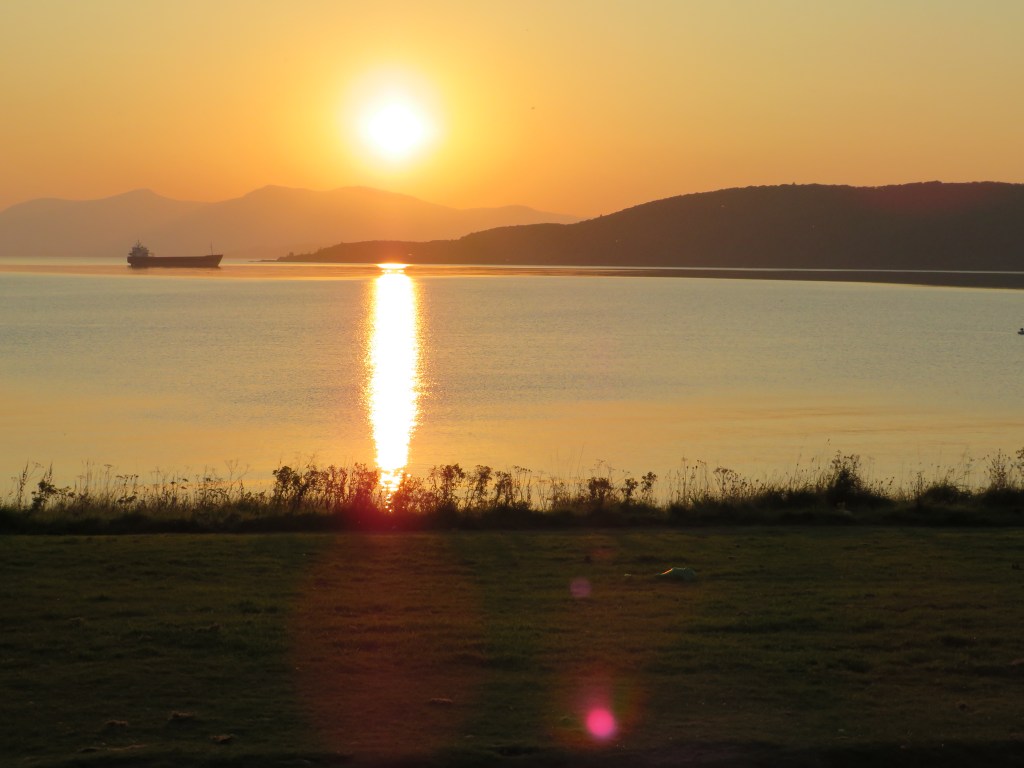
The sun was now glorious and we sat outside for lunch, enjoying the view. We had an early start the next day and unusually on this holiday, had to be at a certain place at a certain time, so we drove into Oban to recee the ferry terminal and parking opportunities ready for the morrow. We watched the beautiful sunset from the van, although it wasn’t a patch on sunsets at home.

Still more Scottish Ramblings

On a glorious sunny September day, with temperatures in the twenties, we set off for Leith Hall in nearby Kennethmont. One of the pleasures of visiting Scotland is that most of your journeys from a to b are through beautiful scenery and are as much part of the experience as the destinations. Here though the landscape is not stereotypically ‘Scottish’. Gone is the dramatic, stark scenery of further south. Instead, we have more benign vast vistas of rolling fields that are currently being harvested.

I like to take notes when I am going round places, or I forget everything that I have been told. I managed to find a writing implement in the bottom of the bag but struggled to find anything to write on. Finally, I unearthed a tiny scrap of paper, which I decided would have to do,  Leith Hall has a history dating back to 1650, when James Leith had it built. It has a chateau-like appearance and inside there’s an arts and crafts movement influence. We arrived just as a guided tour was beginning. Unlike English National Trust properties, where it is usual to have a guide who specialises in each room, here we have one guide who knows everything. There is a complicated family tree of previous owners and I am not sure I always quite grasped who was who. One was fanatical about recycling and the hall ceiling is panelled using pew backs from a church.

There is an elegant Georgian extension, by Alexander Leith, where Chippendale, Hepplewhite and Sheraton are all on display. When the money began to run short the estate was put up for sale, in the 1780s, by Alexander ‘Sandy’ Leith but it was his saved by his great uncle, Andrew Hay, who purchased it and gifted it back to the family. In return, the family hyphenated the name to Leith-Hay. Although they had been Jacobite sympathisers, the family had not been active in the uprisings, so kept their estates after Culloden. In stark contrast, the saviour of the estate, Andrew Hay, was an active supporter of the Jacobite cause. He fought at Prestonpans and Culloden, fleeing to the continent. After eleven years, he returned to Scotland and was pardoned in 1780. Allegedly, he was seven foot two tall, not ideal for a Jacobite trying to be inconspicuous.

There was an interesting photo of the tenants in 1902, including a few women. The estate extended to include the neighbouring village of Insch, which has ancestral connections, so I searched the list for familiar names, even though they’d left the area by 1902 but no luck. Charles and Henrietta Leith-Hay ran the Hall as a hospital in the First World War. Charles and his only son both died in 1939 and Henrietta gifted the hall to The Scottish National Trust.

We looked round the pleasant gardens. There was a sign urging us to close the gate behind us to keep the ’bunnies’ out but there was no gate on the hinges!

The tea room staff seemed a little distrait but the cake came in a variety of unusual flavours; my companion had plum and ginger and mine had an unpronounceable name but was possibly cherry based. Paying was an ‘interesting’ experience as we’d been presented with no bill but were trusted to return to the admission desk and recite what we had had. Surely this is a system open to abuse.

We visited Insch, a parish where my children and one of my sons in law both have ancestry, I have yet to find a mutual ancestor for my daughter and her husband but I will keep trying. A couple of the churches I was interested in are now private dwellings and one alludeed us completely.

We managed to fit in a visit to Fyvie Castle. Having already made the mistake once today, I compounded the difficulty of taking notes by arriving at the ticket desk without anything to write on or with. It was quite a long way back to the car to find the necessary equipment. I was willing to buy a pencil in the gift shop but they came without points, so that idea failed. I decided to blag something of the chap in reception instead. Here, Bob was our knowledgeable tour guide and we were the only people on the last tour of the day. Having worked at a tourist attraction, we strongly suspect that Bob was hoping we just wanted a cursory look, so that he could head off home early but we disabused him of that idea and assured him we’d like the whole tour. Sorry Bob.

Parts of the stone building were already in existence when Sir Henry Preston captured Ralph de Percy in 1390 at the Battle of Otterburn. Percy was a wanted man and the English Crown rewarded Preston by giving him Fyvie Castle. Allegedly, the castle was already cursed. Tammas the Rhymer and been asked to entertain the inhabitants but perceiving some slight when the door was blown shut in his face, he decreed that the eldest son would never inherit, which proved to be the case. Three specific stones have to be thrown from the castle to lift the curse. One of the stones is inaccessible but another is on display and is said to ‘weep’ filling the basin it is lying on with water. In addition, there is a sealed chamber that has not been accessed since the seventeenth century. Breaking the seal is thought to bring about the laird’s death and make his wife blind. Another gruesome tale is that of Lilias Drummond, who failed to give her husband, Alexander Seton, the required son.  Wishing to marry his wife’s niece but being a fervent Catholic, so divorce not being an option, in 1601, Alexander locked Lilias in what is now known as ‘The Murder Room’ and starved her to death. Lilias’s name can be seen carved on an outside window ledge, which supposedly appeared after her death. Her ghost, as ‘the green lady’ is said to haunt the castle.

In 1596, Alexander Seton bought Fyvie from the Meldrum family. Several carved finials adorn the roof. Some of these date from the sixteenth century and six are thought to have been added by Alexander; one strongly resembles a flowerpot man but is allegedly a ceremonial trumpeter. Later owners continued the tradition of adding finials

The future Charles I was brought up at Fyvie, being too sickly to move south with his father James VI when he ascended to the English throne in 1603. The present king celebrated his 60th birthday here.

The towers are named after three of the owning families, Meldrum, Seton and Preston. Steel bands (not the musical kind) have been fitted to the Seton tower to monitor movement and parts of the building are in need of conservation. In the 1890s, Lord Leith installed similar bands, fashioned from railway sleepers. Continued remodelling rendered the foundations insubstantial for the weight of the extended Seton and Meldrum towers. Cracking can be seen and is being carefully monitored.

In 1889, Alexander Leith purchased Fyvie for £175,000, which included the 10,000 acre estate. Born in Scotland, Alexander, along with his wife’s family, had made a fortune in the American steel industry. He added to the collection of armaments, portraits and tapestries at Fyvie. Other symbols of affluence and status include a 1120 piece Waterford chandelier and a large collection of portraits by Raeburn. One portrait bizarrely has a right foot that is always pointing towards you, no matter where you stand in the room. I have no idea how this illusion is achieved. There is a ‘great wheel’ staircase, basically an extra wide spiral staircase. Allegedly, General William Gordon raced horses up and down it.

More Scottish Adventures

Having been to the crannogless crannog centre it was time for the ospreyless Osprey Haven. This was not a surprise, as it is late in the year for osprey and there have been no young at the nest at Loch of the Lowes this year, following the death of the male in the spring. The regular female does seem to have formed a new bond and they have been protecting the nest so there is hope for next year.

This is not the sort of reserve where you go for a walk. There are two hides and there’s also a large window where you can watch a wide variety of small birds at the feeders. There are beaver at work on the loch but you only get to see them first thing in the morning and in the evening. There was no sign of the resident red squirrels either. Despite this, it was good to visit and the journey itself was scenic.

Next, we went in to Aberfeldy for a drink and some cake. The local cinema allows non-customers to use their toilets, which then has the desired effect, as we stayed to use their café. We also managed to stock up on food at the local Co-op. We were a little concerned about our booking at the next caravan site as we hadn’t received an acknowledgement or reminder. We telephoned to check, thinking that if something was awry it was easier to search for an alternative using a laptop and the, albeit very weak, site wifi than it would be on a phone when we got there. It turns out that they had no record of our booking but there was space so we booked by phone.

By this point we had been away for a while. Time for the feat of contortion that is changing a duvet cover in a caravan. You’ve probably tried this in a house but accomplishing the task in a 7 foot by 14 foot caravan takes it to a whole new level. Then there is the ‘getting the fitted sheet on the mattress when you can only reach one of the four sides’ challenge to add to the fun.

On a beautiful autumn morning, with sunshine, heavy dew and fog on the Tay, we took the high road (well the A827 followed by the A9 and A95) north. The first twenty-five miles or so of our journey was on a road full of twists and turns, with no duelling (as in road lanes, not the waving pistols or swords about sort). We were towing a caravan. We were not swift. This kind of journey is also known as how many drivers can you **** off in a very short space of time? Not many as it turns out. The road was quite quiet and we pull over to let speedier stuff pass whenever we can, despite very few acknowledging us. As we got to the A9 and A95 we were in whisky distilling country. There was a ‘whisky trail’ indicated on the road signs, illustrated by a symbol that looks a bit like a witch’s hat. I can’t work out what it is meant to represent that has any connection with whisky.

We arrived at Huntly Castle Caravan Site, not without issues as the satnav insists it is where it isn’t, down a dead end with little caravan turning potential. Fortunately, just in the nick of time, I recalled our being led astray in this fashion on our previous visit and we were able to avoid a repeat of the million point turn that following the satnav necessitates. Strangely it turns out, on arrival, we still didn’t have a booking, despite yesterday’s telephone conversation but that was soon remedied.

We have setting up the caravan off to a fine art, so were soon ready to explore the castle from which the site takes its name. Should we partake of refreshments before heading off to the castle? We decided to treat ourselves at the castle refreshment rooms when we get there. Mistake. The castle has no refreshment rooms; rookie error. Here we benefited from the reciprocal arrangement that Historic Environment Scotland has with English Heritage, so entrance was free. There has been a castle on the site since the 12th century. The earth motte is all that remains as evidence of the original timber castle, which belonged to Duncan Earl of Fife. In 1307, Robert the Bruce came to recuperate in the castle. By the 14th century the Gordon family were in residence and remained so until the 1640s. The palatial stone castle was begun in the mid-fifteenth century and then later remodelled with a nod to the influences of France.

Mary of Guise, widow of James V and mother of Mary Queen of Scots, was entertained at Huntly by Gordon, in 1556. She was treated so lavishly that she felt that he was becoming too powerful. Mary Queen of Scots later defeated the Earl in battle and confiscated goods for the crown. The fifth earl collapsed during a game of football and died in 1576. This would presumably have been the more aggressive form of football, known as campball, with an infinite number of players and goalposts that might be at opposite ends of the village.

For some reason, James VI had the castle blown up in 1594 but it is unclear how much damage this caused.  In 1599, George Gordon became a marquis. In order to advertise his new elevated status, he commissioned an elaborate carving to be added to the front of the palace. Carved symbols advertised their Catholicism; these were defaced when Presbyterian Covenanters occupied the Castle in the 1640s. Seventeenth century tenants’ rents in kind provided the household with foodstuff including 167 cattle, 700 chickens, 40 barrels of salmon and 5284 eggs each year.  As ardent Catholics, they suffered during the English Civil War, with George, the second Marquis, being executed in 1650 for his support of Charles I.

An inventory of 1648 gives an impression of how luxurious the furnishings were at the end of the Gordon’s ownership. Tapestries, paintings and a map of the world could be found and there was also an organ. The castle also houses the oldest wooden toilet seat in the country. The castle came into the care of the state in 1923.

Crannogs, Longhouses and other Scottish Things

Time to move sites again and head north-westward into the Trossachs for a few days in Killin. The weather began fine but in typical Scottish fashion, rapidly turned to rain, nonetheless it was a pleasant drive with lovely views. We wanted to arrive at Killin promptly when it opened for new arrivals at 1pm because we planned to visit Moirlanich Longhouse, which is close to the site and which has very restricted opening hours.

We’d passed the longhouse several times on previous visits but had never been able to go inside before. It is in the care of the Scottish National Trust, so we were able to take advantage of the reciprocal arrangements with the English version. The house is a great illustration of how people would have lived in the past. This particular house was built in 1809 for tenant farmers. It is a cruck-framed house, built in a style that had probably been used for centuries. This was the time when many labourers were turned off the land and moved away but the Robertson family were granted the tenancy of Moirlanich and farmed the surrounding thirty acres, trying cattle, then sheep, before changes to growing oats. The once thatched roof was covered with corrugated tin in the 1930s.  The last member of the family left in 1968 and the house remained empty until 1992, when the trust took over.

Various items were found in the house, including ragged and probably discarded clothing, which appeared to have been used to insulate the chimney. There were multiple layers of paper on the walls. Considering there were only three rooms, plus the byre at the end, it is strange that one room was largely reserved for ‘best’, such as entertaining the minister. The room did contained two box beds that were in regular use.

The next day was beautifully sunny, just right for a drive along several miles of the banks of Loch Tay towards Aberfeldy, in the centre of Scotland. We were paying a return visit to the Crannog Centre, or in this case the Crannogless Centre. We visited the earlier version of this Iron Age living history experience on a previous trip to Scotland but a couple of years ago, a fire destroyed the crannog. A crannog is a dwelling that was constructed on stilts over the water and evidence of nearly six hundred have been found across Scotland, which is probably only a tiny fraction of the number that would have been built. Several of these were on the edge of Loch Tay. Building across water is much more difficult than building on land and was done to reserve the land for food production and possibly also as a sign of status and method of protection.

Following the fire and some serious fund raising, the centre moved to its current site, which they were able to purchase for just £1. They reopened in April and have built several roundhouses using different techniques. Erecting the crannog will be a more complex task and building was due to begin the day after our visit. We arrived just in time for a tour and John showed us the museum exhibits, as well as giving us some background history.

Our first presentation was about Iron Age food. Archaeological finds provide evidence of the ingredients but how they were used is largely speculation. We were treated to flat breads made from the ancient cereals, emma and spelt. These were topped with garlic and honey cheese and optional trout. I passed on the added trout but it was very tasty. Emma no longer grows in Scotland, as the climatic conditions have changed since the Iron Age. We saw a saddle quern and it was explained how arduous and time consuming grinding flour would have been.

Next was the blacksmithy and then the woodworking presentation, some of the turning on the pole lathe was highly skilled. The textile demonstration was particularly interesting, with information about dyes, weaving and spinning. I hadn’t realised that woad required soaking in warm urine for a couple of weeks before it was an effective dye. Who first realised that this was the thing to do? It takes 7,000 metres of spun wool to weave a long sleeved tunic. Lastly, we went in the final round house, which had a basket-like woven framework, covered by stone walls and thatch on the roof. Despite the sun, it was still a little chilly and the restaurant was full with a party so we had our carrot cake and drink outside, where it was perhaps a few degrees colder than ideal. Overall, it was a fascinating trip and highly recommended.

Off to the Farne Islands

Today is a special day and the weather is glorious as we head to Seahouses for our trip to the Farne Islands with Billy Shiel’s fleet. I don’t know why I didn’t think of this option sooner, instead of being fixated on going to the Isle of May. Seahouses’ harbour is undergoing restoration and we have been warned that the harbour car parks are closed and we may need to arrive early to secure parking in town. We can do ‘arriving early’. It also gives a fisherman of my acquaintance the chance to get his fishing boat fix.

The St Cuthbert III is running slightly behind schedule and is full for our trip. We don’t manage to secure a seat on the edge of the boat but that doesn’t matter too much. We set out for the Farne Islands, which are in two groups, the Inner and Outer Farnes. There are 28 islands at low water but only 14 at high tide. Like many islands in the area, the Farnes were a monastic settlement and St Cuthbert died here in the seventh century. We circle the Outer Farnes and view the cliff-side nests and the Atlantic grey seals; there are 3000-4000 of these in the area. We pass the Longstone Lighthouse, of Grace Darling fame, which was built 1825, at a cost of £3000 and was manned until 1919. Grace and her father are notorious for their 1838 rescue of nine survivors from the Forfarshire.

The islands are home to 80,000 puffins or ‘Tommy Noddies’ as they are known locally. They live up to thirty years and mate for life, returning to the same burrows each summer. They spend the winter at sea, not touching land until the following spring. What I hadn’t realised was that they lose their iconic bills in the winter, when the bills are black. The orange colour is generated from their sand eel diet. The more sand eels they eat, the brighter the bill. Natural selection means that the brighter bills, in other words those who are the most efficient providers of food, are the most attractive. Apart from the puffins, there are also 50,000 guillemots nesting on the islands. The smell of guano is powerful and all-pervading.

We disembark on Inner Farne, are greeted by the rangers and run the gauntlet of the dive-bombing, nesting terns. We listen to a short talk by the ranger. We are unable to go in St Cuthbert’s chapel as terns are nesting in the entrance. In fact, birds are everywhere. Even with my not very wonderful, under £100, camera I manage some half decent photographs.

106 23 May 2019 Puffin Farne Islands

So today the wildlife haul included: black-headed gulls, black-backed gulls, herring gulls, eider ducks, lapwing, feral pigeons, house sparrows, starlings, jackdaw, swallows, mallard, cormorants, guillemots, common terns, razor bills, shags, oyster catcher, Atlantic grey seals, a  rabbit and the iconic puffins. The wildflowers are also at their best at this time of year, with red campion, stitchwort, sea campion, poppies, broom and bluebells being prolific. What is really sad is that so many people would struggle to name the wonderful flora and fauna that surround us. It is our planet, we need to take an interest in it, nurture it, celebrate it, protect it and share our love of the beautiful landscapes we encounter.

Rainy in the Trossachs

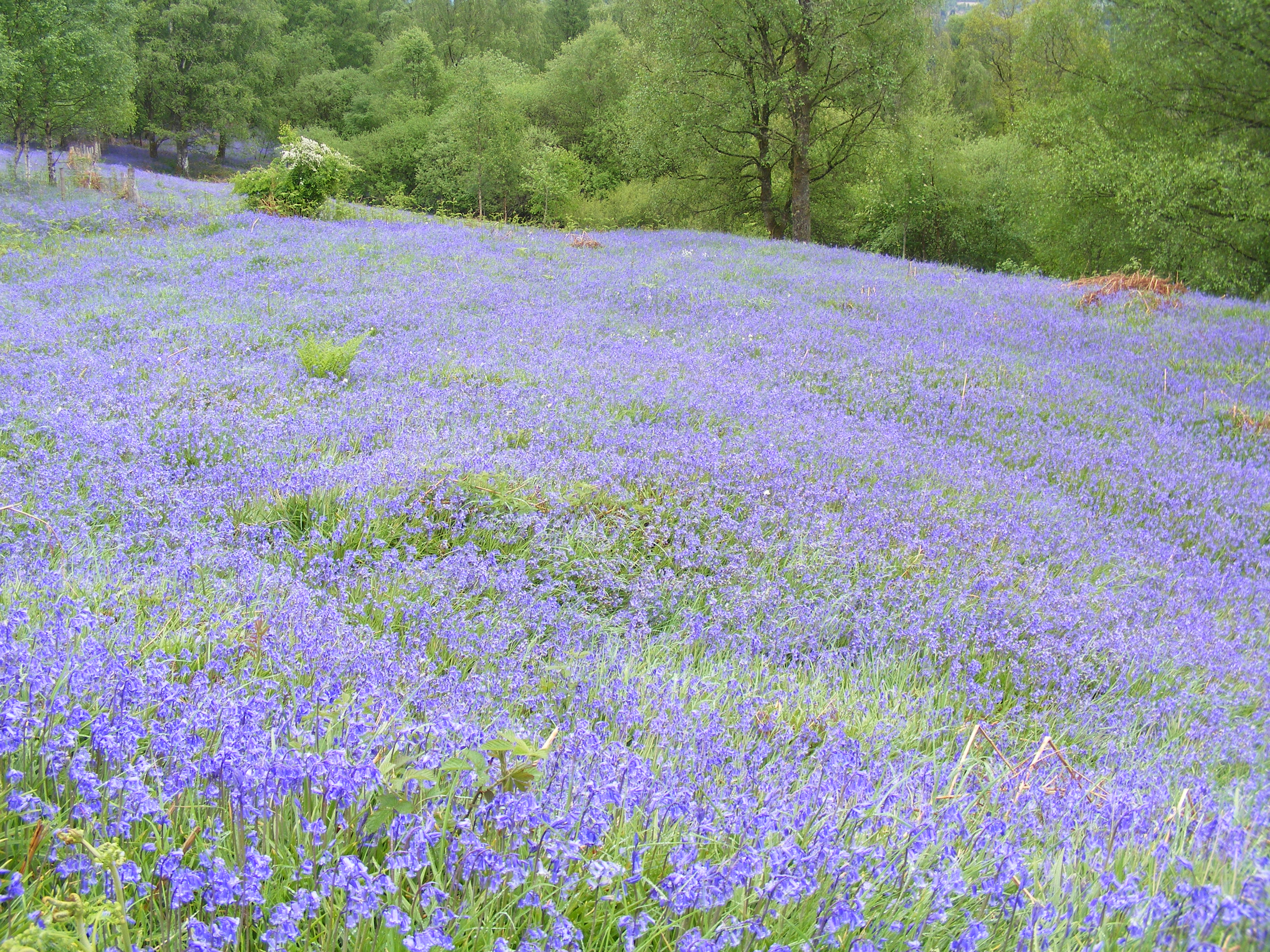
The weather was against us when we moved further north and west to our second and last Scottish stop at Killin. The high ground was blanketed in mist, nonetheless there were glimpses of the impressive scenery as we travelled along the banks of Loch Earn. We secured a lovely pitch on the river bank but decided to have an afternoon in the van rather than brave storm and tempest outside. The next day and the weather was still uncertain, so we opted for a circular drive, recommended in the guide book. This took us round the perimeter of the Loch Lomond and Trossachs National Park. This is a wonderful time of year to be in Scotland. The bluebells were spectacular and many gardens were full of colourful azaleas and rhododendrons.

We stopped off at the RSPB Loch Lomond reserve. This is on a much smaller scale to the one at Loch Levan. Our arrival coincided with a birthday party. I’d be the first to applaud a parent who decides to expose party-going children to the great outdoors but the piercing screams did rather put paid to seeing much in the way of wildlife. The best we could do was hear a cuckoo.

040 19 May 2019 Bluebells Trossach National Park

I was tasked with hiding a panda within sight of Loch Lomond. We stopped by the Loch Sloy hydro-electricity plant, where there is a car park, café and view point. There were also rather a lot of people. I nonchalantly attempted to make it look as if photographing a toy panda is a perfectly normal activity. It is actually quite difficult to do this without drawing attention to oneself. I accomplished the mission as subtly as possible and beat a hasty retreat before I could be accused of leaving litter in a National Park. Not that our lovely pandas are litter of course but you never know.


More Island Misadventures and some Birdwatching

One of the reasons that this holiday to ‘Northumberland’ has seen us detour to Scotland was because I wanted to make a return visit to the Isle of May to see the nesting seabirds, in particular the puffins. Last time we went the weather was truly appalling. It was raining, it was freezing; we were the only sailing that week, all others having been cancelled due to the conditions. This time, I decided I would not book months in advance but would wait until I had some idea of what might be expected from the weather. Unfortunately, everyone else had the same idea, so when I went to book online a few days ago, they were already full. There was no chance on our first choice of day and the only other sailing whilst we were in the area was also full but we were invited to come along on on spec as first reserves.

The sailing is at 9.45 and you have to be there half an hour in advance. The harbour is half an hour away so, naturally, we leave the site at 8am – that is quite restrained for me. By 8.40am we are wandering round Anstruther. The fisherman of my acquaintance comments that, given the state of the tides, the boat looks unlikely to sail within the next couple of hours and indeed the harbour is almost dry. It nears 9am and we approach the booking office. What I have not thought to do is check the sailing times. 9.45am was sailing time on our first choice date. Now the tides have changed and today’s sailing isn’t until 11.30am! We could have had a lie in!

Anstruther is all very lovely, a typical fishing village that has been forced to also embrace tourism. It doesn’t have massive wandering round potential however. An additional problem is that I have believed the weather forecast, which stated that the maximum temperature would be 11 degrees (about 55 in old money). Despite this, people are sitting on the front at 9am in shorts and t-shirts. I however am wearing a long-sleeved t-shirt, my thickest fleece, a waterproof coat and a body warner for good measure, accompanied by my fleecy lined trousers that were purchased for Finland’s minus 23 degree temperatures; I have drawn the line at the thermal long-johns. I am prepared for it being colder out on the ocean. It turns out that the weather forecast is wrong and there is glorious sunshine and despite the keenish wind, the temperature is approaching 20/70. I shed layer after layer. Eventually, the ferry operator arrives and tells us to return at 11.15am. We do as instructed (well, we are there for 11am) and wait with bated breath to see if all those who were booked will turn up to collect their tickets, which are they are supposed to do by 11am. It was close. The last party arrive at 11.27am, so there is no room for us. We are offered places on the rib but I really don’t do adrenaline and this looks a bit ‘adventurous’, so we decline. I am very sad until I realise that we might be able to substitute this trip for a visit to the Farne Islands on our way back through Northumberland.

So another day of plan B. I do have thinner clothes in the car and Mr Bean-like, I manage to wriggle my way into these as we set off for the RSPB reserve at Loch Levan. The Loch provided the water supply for local paper and flax industries but was later drained, so the reclaimed land could be used. More recently, the RSPB have restored the wetland habitat and also created the world’s first bee reserve. We walk round the waterside track and see nesting swallows, shelduck, greylag geese, mutes swans, many nesting black-headed gulls, an oyster catcher, a redshank, a grey heron, mallard, a coot and a wood pigeon but the stars of the show are the nesting lapwing, who have declined noticeably in recent years, so we rarely see them now. We watch three adult lapwing mobbing a stoat, to draw attention away from the nests. This causes consternation when we report back to the ranger as the stoat was inside the predator fence.

036 17 May 2019 Lapwing at Loch Levan (1)

Despite some changes of plan, we have enjoyed our stay in Fife and look forward to moving on tomorrow. To top it all we have a booking for a boat to the Farne Islands!

Rubbing shoulders with Mary Queen of Scots in the Kingdom of Fife

Ten minutes up the road and we are at Falkland Palace and gardens. This is still considered to be a royal palace and there was a hunting lodge on this site as early as the twelfth century. We are there for opening time and historical interpreters are assembling to accompany a school party. I don’t want to be picky but we quickly spot a watch, twenty-first century footwear and an unauthentic hairstyle. I shouldn’t judge though, as Mistress Agnes has had to resort to glasses, following two unpleasant contact lens related incidents. I was therefore pleased to see that ‘Mary Queen of Scots’ was also wearing glasses. In my defence I have made some attempt to make Mistress Agnes’ look vaguely old fashioned. I wanted proper re-enactor’s frames but the optician refused to put lenses into anything but their own frames, so I had to settle for the nearest I could get.

We spend our visit playing dodge the school party. The building was extended in the sixteenth century by James IV and improved further by James V, using French architects, hence the resemblance to a chateau. It seems that the influence of his wife, Mary of Guise, was at work here. His daughter, Mary Queen of Scots, spent time at the palace and we were able to view what is allegedly the oldest real tennis court in the world that is still in use; it dates from 1539.

022 15 May 2019 Falkland Palace

A great deal of damage was done during the ‘English’ Civil War (which was not exclusively English at all), when Cromwell’s troops were billeted here and the banqueting hall wing was destroyed by fire. The Marquis of Bute was responsible for the nineteenth century restorations and the twentieth century hereditary keepers of the palace were the Crichton-Stuart family. The palace contains a functioning Roman Catholic chapel and is the only royal residence to do so.

The palace has adopted an effective method of preventing visitors from sitting on the chairs, each one has a sprig of holly placed on it! No photographs were allowed inside but I was particularly taken with the painted ceilings and the tapestry depicting a British woodland, compete with parrot! They also have an apothecary’s room and a physic garden. The gardens as a whole are beautiful and several gardeners are hard at work. They were designed in the 1940s by Percy Cane who also designed palace gardens in Addis Ababa.

This is meant to be a relaxing ‘chill out’ holiday so the remainder of the afternoon was spent sitting in the sunshine on site, planning next year’s trip to Ireland.

Walking Northward

A slight (planned) hiatus in our holiday occurred at the point we have reached in my narration. This required me to use my thirteen year old ‘emergency’ mobile phone in order to summon a lift. We had recently had an issue when such summoning did not work owing to a technical hitch but on this occasion, it seemed my phone and the recipient’s were now communicating. I decide however to send a text message in preference to a call. Simples. I know how to send text messages. It turns out that I can indeed send text messages, I just cannot write them on my phone. My capitalisation is idiosyncratic and I am unable to work out how to create a space between the words. I write the message Ifinishat4wiLLletUkNowifitcHanges and hope the fisherman of my acquaintance can interpret it. Considering that I am reasonably proficient with computers, it is sad but true that mobile phones are another country.

Amongst all this, panda hiding continues. I head out to photograph a hidden panda in the early hours before we are due to move the caravan on to Scotland. I appear to have forgotten to return the SD card to the camera after uploading previous pictures. Fortunately, I don’t have to walk back up the hill and down to the van as there the van is, just the other side of a fence. I call for assistance and my travelling companion retrieves the card and prepares to hand it over the fence to me. Ah. A slight snag, my side of the fence is accompanied by a stinging nettle filled ditch. Hmm. I am terrified that the card will somehow get dropped in the undergrowth but fortunately this danger is averted and the picture is duly taken.

We arrive in Markinch. My children have Scottish ancestry. In fact, all my grandchildren have kilt wearing credentials on both their mother’s and father’s sides. The closest I get is Northumbrian lineage. I pay tribute to Edward’s ancestors, who come from this area. We decide to go for a walk, following a leaflet we have found at the site. It is a five mile walk. We realise that it probably a while since we walked five miles. It may not sound far but we are out of practice and knocking on a bit now. We used to walk regularly until grandchildren visiting seemed like more fun!

The walk instructions are a tad vague. It starts well, with us finding our way through Markinch then on up a footpath. We are to look for a ‘worn stone step style’ (their spelling). We debate whether a couple of steps constitute a ‘style’. They are supposed to be opposite a parish boundary mark. We climb a bank. No sign of said marker. We dismiss these steps and continue. Our first mistake. It turns out that these were the steps we sought. Road signs are conspicuous by their absence but we manage to recover the route, although have walked on road rather than footpath more that we should. I am wearing soft shoes as opposed to walking boots as the latter are slightly narrower than my feet (story of my life). I should have read all the instructions. They are taking us across a peat bog. My shoes are not peat bog proof. Luckily, the recent dry weather means I can safely negotiate the boggy bits. We try to identify the ruins of Kirkforthar Chapel. The guide tells us a former vicar was called Reverend Zong, allegedly a corruption of Yogh/Young – one for the family historians amongst us. We also see the remains of Kirkforthar House and ‘doocot’. Also on the itinerary is Stob Cross, a monolith of uncertain origin but possibly Pictish.

019 14 May 2019 Kirkforthar House and doocot

As a reward for our strenuous exercise, we treat ourselves to an ice-cream. It may be a day or two before we walk again!