1921 and All That

It is hardly news that this week the genealogy community, or at least those who have C20th English and Welsh ancestry, have been revelling in the release of the 1921 census. I thought I’d share a few of my initial thoughts. Before I do, I can’t ignore the debate that has roused passions on both sides and that is the issue of the charges for access. This is the sort of post that you really need to read to the end, or at least part way, to understand the argument. I’ll tell you when you can stop!

FindmyPast won the contract to undertake the not inconsiderable task of digitising the records, so that those of us who can read this can potentially view these from the comfort of our own homes. In order to recoup the costs of digitisation, transcribing and indexing, there is currently a charge for access. Without indexing and transcribing, you would have to guess where your ancestor was living and work your way through the district page by page in the hope of finding them.  Anyone who researched in the 1970s and 1980s can vouch for how long this took and how often it was unsuccessful because great granny wasn’t where you expected her to be. In recent decades, we have come to expect that we will have the benefit of online countrywide indexes, transcription errors notwithstanding.

It is important to make it clear that, contrary to popular opinion, searching the 1921 census index is free. You do NOT need a FindmyPast subscription for this. So, there is some limited work you can do without any cost. Once you have located someone in the index, there is a charge for each transcription or image of a page that is viewed. These cost £2.50 and £3.50 respectively, although those with the higher level of FindmyPast subscription get a 10% discount. If this follows the pattern of previous dataset releases, after a period of months, accessing the 1921 census will be absorbed into the FindmyPast subscription charge and when the exclusivity period expires, it will be available on other subscription platforms as well.

Unlike previous releases, this time, there has been a significant amount of disquiet regarding charging to view a public document. So where do I stand on this? First some facts. To those who say, ‘but it is volunteers who do the transcribing’, not in this case. The 1921 census has not been digitised, transcribed or indexed by volunteers. It is a project on a massive scale and the logistics of trying to make it available on a countrywide basis by voluntary effort would have been close to insurmountable. I’ve been around long enough to remember the work required producing indexes to the 1851 and 1881 censuses. In any case, most family history societies who undertake voluntary transcribing projects charge for access to these in some way, either by a direct charge, or by making them available only to those who pay the society’s subscription. This provides valuable funds that are ploughed back, to the benefit of family historians.

To those who say, ‘1921 census access should be free’, in some ways it is. There is no charge to view if you have access to The National Archives, Manchester Central Library or the National Library of Wales. The charge is not for access to the record itself but to the digitised images, so in effect the payment is for the convenience of home viewing. Of course, visiting one of the free access points is not possible, practical or affordable for many. Travel to London, Manchester or Aberystwyth for me would involve a two-night stay and with travel costs would be the same as downloading approximately 75 1921 images, assuming I stayed in the caravan. I will not be doing this but I am fortunate, my financial position, my health, my geographical location and my home responsibilities mean that I could visit one of these centres if I chose to. For many that is not an option.

One side of the argument is that we should accept that digitisation is not something that can be achieved for free, the heavy financial investment has to be recouped and the 1921 census is now available to anyone with internet access, or who can get internet access at a library, for the cost of a good cup of coffee or a pint of beer per image. The #FreetheCensus counter argument is that, as a public document, the 1921 census should be freely available to the public and that the current charges are prohibitive for some and thus counter to the #GenealogyforAll ethos.

Although I am better placed now, I began my family history at a time when financial pressures impinged heavily on my ability to research as I would have wished. That doesn’t make it okay, I am just saying that I understand. I am passionate about making family history accessible to as many people as possible, be the barriers financial, geographical, age related, due to a disability, or anything else you can name but there is a BUT. My own view is that there will always be a cost implication associated with researching your family history. If you think you don’t spend anything, think again. At a minimum, you will be paying for internet access or for your phone contract and for the electricity to run and charge these devices. Even if you don’t use technology and you interview granny who lives with you (no travel costs), you need to purchase a writing implement and something to write on. If you can read this, you are already at an advantage over others because you can access the internet, with all that has to offer to help you in your research. In an ideal world it would be an equal playing field and it would all be free, I really wish it was but economic forces just don’t work that way. The best we can do is to try to level that playing field as much as possible, to work together to help and support each other and to keep costs as low as we can.

I am mindful that there are those who are, at the moment, excluded from viewing the 1921 census because of the charge and in one sense I am one of them. I have wider interests than my own immediate family. I would love to be able to access the returns for the communities for which I conduct one place-studies (all four places!) and for all those in my one-name study. I want to look at the entries for unrelated people whose lives impinged on those of my family. I certainly can’t afford to do all this within my family history budget. So, I agree, this is not #GenealogyforAll but I would add one word – yet. It is very difficult to be patient when genealogy social media is full of ‘look what I found in the 1921 census’ but patience is what is required. In time, no time-scale has been announced but my bet (based on zero insider-knowledge) is on six months, access will become part of a FindmyPast subscription and therefore freely accessible via library subscriptions. For those whose libraries only have Ancestry access, the wait will be longer; I believe about three years.

What we have is not ideal and I’ll admit to a sharp intake of breath, coupled with disappointment, when the charges were announced. The current access does allow those whose barrier is geography, disability or family responsibility to do their research and that is a sizeable community, who in the past might have been excluded. In time, those for whom the barrier is financial will also be included. I wish that was now, I really do but I just don’t see how online, countrywide, transcribed and indexed access could be achieved without cost. It seems fairest to recoup that cost from those who are interested in seeing the records. I suppose an alternative would be for this to be government funded and make all taxpayers contribute. Despite what family historians might think, the general public would hardly see this as priority when the country is struggling to fund health and social care and education. The bottom line is, in an unfair and unideal world, whilst not fully inclusive, this is as good as we could hope for. If that makes me sound as if I am resigned to the inevitable and not ready to fight for greater inclusivity, that couldn’t be further from the case. Passion for change does have to be tempered with practicality and at least a small dose of realism. You can stop reading now, unless you want to know what I’ve been up to within my limited 1921 download budget.

Now to the post I was actually going to write. In the three days of 1921 census access, I have only had time for a brief play, having listened to the world’s first live official FindmyPast presentation on using the census at 7am on Friday morning! I do recommend doing some background work before leaping in. The help pages and various videos and blogs that are available, really are worth reading. Look out for a FindmyPast presentation from your local family history society, many will be hosting these in the coming weeks. I made a list of all my direct ancestors who were alive in 1921. There were ten: one parent, four grandparents and five great grandparents. I wasn’t expecting any amazing breakthroughs from the 1921 census, as I already have full birth, marriage and death details for all of these ancestors but I was interested in the additional detail.

I belong to a lovely online group of genealogy friends and we have decided to begin the year by gathering the life stories of one of our grandmothers, so ‘Granny’ was first on the list and easily found in the index, together with her mother and brother. I purchased the image and brought up the filmstrip allowing me to access, for no additional charge, the ‘extra materials’, which included the page providing the address and a useful map. It is a shame that the useful ‘enumerator’s book lists’ from 1911 were destroyed in 1921. Of particular interest to me was the name of the employer, in Granny’s case ‘J. Gardner & co. wholesale caterer etc.’, where she worked as a clerk. The address of the employer, Leadenhall Market, was also given. This confirmed my mother’s memory that Granny had worked for ‘John Gardner & co. at Smithfield’ – wrong market mum but close! The more specific detail has allowed me to identify this company, subsequently taken over by Trust House Forte. The family photograph collection includes pictures of Granny with colleagues named ‘Reidy’ and ‘Carlie’. I can freely search the 1921 census by employer using the advanced search. This brought up 340 entries of people living in London, Middlesex, Surrey or Kent who stated there employer to be J Gardner. Without purchasing the images, it was difficult to be certain the employer was the same J Gardner but I did find a twenty-two year old Elizabeth Reid on the list, who is a candidate for ‘Reidy’. I tried Car* in the first and last name boxes but there were no likely entries for ‘Carlie’, who in any case may not still have been working there in 1921.

Reidy and Carlie

Next up, Granny’s future husband. With a name like Frederick Smith, a little more care was needed before parting with cash. Hoping that he was still with his parents, I by-passed Frederick Smith and tried great grandad instead as he had more unusual forenames and fortunately he was listed with both of them. I was able to hover over the transcription button in the index to check who else was in the household before purchasing the image. That ticked off Herbert Havet Smith, his wife and grandad Fred. The surprise here was that they had already left London and were living in Southend-on-Sea, with grandad commuting to his office in London. Again, it was an employer I recognised; my mother followed in her father’s footsteps and was still working part time from home for the company in the early 1960s.

My father, his parents and two brothers, with the benefit of an unusual name, were also easily found. There are only two people, of any age, with my father’s name in the 1921 census. Co-incidentally the other lived a few hundred yards from my home address, more than 250 miles away from my father. I knew that my father grew up in poverty but it was still a shock to see all five of them living in just two rooms.

Two more great grandparents to find. John Hogg in Morpeth was no trouble, He was living with his ‘widowed’ (she was never married) sister, her adult son and two male lodgers, in three rooms. I can’t imagine what the sleeping arrangements would have been. The final great-grandparent was trickier. In the end I found her by searching for her son. Inexplicably searching for Fanny Thomasine, WITH the variants box ticked, did not bring her up; she had been mis-transcribed as Fanny Homasine. Her writing was pretty awful – maybe I can claim it is genetic! In fairness to great granny, the census was taken just a week before she died; she was described as ‘unable to work’.

I have decided that my children’s direct ancestors can wait until the 1921 census forms part of my subscription, so five households was my limit. I would have paid for great great aunt Fanny if I could have found her. She was in the county asylum, which I also failed to find. I did have a quick look at my home village in the index, using the place search. There do seem to have been some large scale garbling of the house names in my parish. In addition, somehow the parish seems to have become attached to the neighbouring one, in a run-together version of the names. There will be some wholesale correction sending when I can access these via my subscription. I have heard others report that there are some weird and wonderful place name errors, with towns being ascribed to incorrect counties but I gather that this is being worked on.

So overall a positive experience and I am happy to wait for more extensive access. When it really will be the 1921 census for all.

‘Genealogy: the next generation’ update and other excitements

I would like to thank all those who have now listened to my Really Useful Show presentation about making the family history world welcoming for all. There was a mammoth audience at the live presentation and plenty of people have tuned in since. I think you have one more day to catch the recording, if you have a Really Useful Show ticket. The opportunity for discussion afterwards was limited, so there will be an open forum on this topic on Saturday 27th November at 10.30am UK time. I know this isn’t great for those of you in North America but we didn’t want to leave this too long and I don’t have a single evening or weekend afternoon free until mid-December. I am in the midst of a presentations marathon, at one point I did four in twenty-six hours and I am currently running at twelve a week. I do also have other things in my diary! The good news is, that other ‘next generation’ debates are being held and I have been asked to give this presentation again on two futher occasions. Saturday will be about exchanging ideas, not about me talking. If you want to come along, just contact me via the box on the Home Page for the link. If you are not able to listen to the original presentation, then you might like to look at the handout instead.

Having thought that I had had a record audience for the Really Useful Show, I topped that this week when a Norfolk FHS meeting, at which I was speaking, also had Devon FHS attendees. A whopping 385 people Zoomed in!

This week also brought the demise of a memory stick. Even the magicians at my local computer shop have failed to extract data from it. Yes, it is backed up elsewhere but I was due to back up again, so there are recent files that will be lost and gone for ever. I do put some things in the cloud but not everything. Now I’m about to take a deep breath and see how much I can retrieve from elsewhere.

In other news, I am not sure if I should congratulate a large electrical store near pretty much everyone or not. After three years and eleven months and numerous letters, emails and social media rants, I have finally received a gift card with a refund to which I was entitled. Mind you, I haven’t tried to spend it yet (there may only be 2p on it) and actually I am pretty reluctant to darken their doors again but fingers crossed that this is finally resolved.

In other exciting news, I have been approached to write another family history text book. This won’t be happening until my course is over but hoping for a 2023 publication date.

And just because no pictures go with this post, here is a gratuitous sunrise for you.

Genealogy: The Next Generation

As part of the Family History Federation’s Really Useful Show tonight, 12 November, I will be giving a talk on the crucial topic ‘Genealogy: the Next Generation’. This is a live only talk, which will take place at 7.30pm. I set out some of my thoughts on this topic in a previous post and I would encourage you to take a look at this. I had intended that today’s session would be a short presentation, followed by a discussion but unfortunately, the show platform does not lend itself to the level of discussion that this topic deserves. There is also a limited number of places, so some potential attendees may be disappointed. The Friday evening will offer some thoughts and suggestions on the topic, as well as providing some discussion points. The handout for the topic is here. To provide the opportunity for open discussion, there will be a Zoom meeting on this important topic, on Saturday 27th November at 10.30am GMT. This meeting will have the potential for 500 attendees; the discussion will be in small groups. To be sent the log in details for the 27th November meeting, please contact me using the contact box on the home page.

Hope to see you there.

About Family and Family History

I know, I know, I’ve been worryingly silent lately. I think this is my longest ever gap between blogs. You only have to read my previous post to know that I haven’t been sitting around doing nothing. Firstly the family have been visiting. This involves excavating the house from under its protective layer of dust, although I suspect the visitors think I could have done a better job. It also means that I’ve been cautiously out and about digging sandcastles, blowing bubbles, reading stories and other fun things.

The family history continues of course. This month, I have managed to have items in both leading UK family history magazines. My discussion on why our ancestors might have been embarrassing is in the latest issue of Family Tree Magazine and there is a short item about agricultural labourers as part of a feature about genealogy education in Who Do You Think You Are?.

One Pharos course (In Sickness and in Death: researching the ill-health and death of your ancestors) draws to a close and another, First Steps to a One-place Study, begins. I am also checking through Are you Sitting Comfortably: writing and telling your family history ready for October and working on a beginners’ course for Devon Family HIstory Society. There are talks to three countries on the horizon, I’ve done some more brick wall demolition and chatted all thing one-place for an upcoming Family History Federation podcast.

I am still working with my lovely memories group, which is really just chatting with friends. I have got to the end of 1973 in my hugely embarrassing diary read. Another ten years and it might start to get better!

If you’ve been following my ramblings for a while you will know that I am passionate about involving young people in their history and heritage. It is something that I have written about and give talks on. Finally, in no small part due to the wonderful folk at Hidden Branch, there is a real enthusiasm for moving forward in this area. Family history societies need to embrace this if they are to have a future. Down here in Devon we are looking for someone (or several someones) with Devon heritage, or a Devon address, in the 18-25 age range to help us to take our society forward in this respect. If that’s you, or if you know someone, please get in touch. It is no good a load of old people trying to decide what they think younger people want.

Following on from the great loft sort out, I’ve embarked on a bit of a book cull. This may sound like sacrilege but when you have a house as small as mine, it is hard to justify keeping books that you haven’t opened since the 1970s. This week on Twitter someone pointed out that 1980 (which as we all know must be about ten years ago surely) is the same distance from 1939 as it is from 2021 – noooooooo.

We are off on another mini jaunt soon, this time heading east to Norfolk. Time of course to revisit the Norfolk ancestry so I can plan the obligatory churchyard tour. There are images of parish registers online now, which weren’t available last time I worked on this branch and ooh look there are a few new ancestors to be discovered. Currently, I am wrestling with some Norwich woolcombers and Great Yarmouth shopkeepers and trying to negotiate my way past an ancestor who was not baptised and came from a non-will writing family who never appear in the newspapers. The use of more unusual forenames means that I am pretty sure who his parents are but evidence, there’s another thing.

The excitement is building prior to the start of my postgraduate certificate course but I have decided to chart my progress through that in a series of separate posts, so watch this space.

What I do now I am ‘Retired’ – or a few days in the life of a family historian

I always say that I work 100 hours a week, or just spend my life enjoying myself. See what you think. This was a fairly typical week in the busyness stakes.

Wednesday

Most of the day was spent hosting ‘One Place Wednesday Online’. #OnePlaceWednesday takes place each week on Twitter, when those with one-place studies ‘chat’. This was an experiment to see if we could have conversations that were more than 280 characters long. And we could! Here are the topics we covered (I was going to list just some of them but I wanted you to get the full favour of the day):

Why settlements grew up where they did

Organising heritage walks

When does a scandalous story become interesting history? How recent is too recent for the story to be told?

Studying indigenous history in ‘colonial’ one-places

Dating vernacular housing

Mapping gravestones

Places and a sense of belonging

Doing a one-place study without spending money and not using Ancestry/FindmyPast etc

War Memorials

Covid in our places

Preserving the story of the present for the future

What makes a community? – geography, religious persuasion, shared experience?

Bottom up history or top down?

Making one-place studies, history and heritage relevant to all ages

Use of family trees for one-place studies

Rural places being swallowed up by towns

Archaeological surveys

Gravestone styles

Ebay purchases

Lockdown (impact on activities, health, different people/different attitudes, changes to the way we research and things like meeting)

Railway accidents

Availability of records in different places

Interviewing “reluctant” contributors and interview techniques

Australian records

Coincidence (or too much of a coincidence) in a name change mystery

Parliamentary Archives

What a good idea the One-place Wednesday online was

1910 valuation

Multiple births

Then, if that wasn’t enough, I had to accompany Mistress Agnes to her virtual talk on seventeenth century crime and punishment at The Merchant’s House. No idea why she can’t go on her own.

Thursday

I was working on a Brick Walls presentation for Devon Family History Society. Working on the walls is a team effort, then I put them together in a presentation. My lovely memories group met to chat about school days in the evening.

Friday

This was devoted to Devon Family History Society admin, followed by a virtual talk to a local U3A about Memories of 1946-1969 and how to write your own and putting the finishing touches to the Brick Walls session.

Saturday

I went through one of the lessons, ready for my online One-place Studies course that starts next month. (There were still a few spaces last time I looked.) Every time, things need updating and links need checking. Then it was virtually off to North-west Kent Family History Society to give a presentation about agricultural labourers. In the afternoon, it was time to deliver the Brick Walls session, tackling submitted family history problems. I think we have taught people how to circumnavigate their own brick walls too well, as this year’s walls were super-solid, so our success rate was lower than usual but we did give suggestions for further research for those we couldn’t solve and there were some very happy customers.

Sunday

I sent out the second lesson to my Pharos Sickness and Death course students. Then making a start on the second Brick Walls session for August but it was mostly too hot for working. People have weekends off right? Not sure I understand this concept.

Monday

An early meeting with Australia, preparing to assist with another Brick Walls session later in the week. Then I had fun recording a podcast about young people and family history for the Family History Federation. The internet connectivity gremlins (not mine) were out in force but it was a very interesting discussion. Another Brick Wall preparation meeting in the evening.

Tuesday

Some CPD training for the job I must not mention and then that very rare thing for someone who works in the family history field, some of my own family history, prompted by a DNA match. This on a Cornish branch that I haven’t worked on for so long that it has never made it from paper on to Family Tree Maker. Given that my first version of this software was on floppy discs, you can see how long it has been neglected. It is close to forty years since I last took a serious look. The Buckinghams are finally being computerised! Not exactly breaking down my own Buckingham brick wall but some suggestions and it does look likely that they came from Devon, rather than Cornwall. Plus the joy of discovering that my 5x great grandparents were in court for fornication. I so need to get a copy of this record. The day ended with an Education sub-committee meeting for Devon Family History Society.

Wednesday

I spent a long time proofreading my article that is due to appear in the next issue of Family Tree Magazine. I am really pleased with this one but it does contain a tricky, sensitive paragraph, which has been worked and re-worked numerous times. Then I attempted to write a section for a rural history book that my local history group are compiling. This was followed by a hybrid meeting of said group. We were proud to have members from three continents, both in the room and online. We still haven’t quite cracked the sound quality coming from the room but we have plans and the speaker was online, so it wasn’t critical.

I still have the Australian brick wall session, listening to a talk, hosting a talk, hosting a coffee morning, sending for the fornication court report, an online chat for Pharos students, a committee meeting, giving a talk, oh and cleaning the house before the family descend at the weekend.

If you think I need downtime, I have been walking on the beach most days. One disastrous evening walk involved encountering far too many people in order to get from the car to the sand. I must have been in sight of getting on for 500 people only two of whom were wearing masks (apart from me). I am not counting the two with masks on their chins. Ok so it was outside but it was very crowded and it was ‘Freedom Day’. I do understand why this is a good thing for many people but equally it is anything but for others. I have friends with health conditions that not only make them extremely vulnerable but also make the vaccine less effective. There are those who are far more COVID anxious than I. Monday was imprisonment day for them. Whilst many people are being personally responsible and are aware of taking care of others, many are not. There are those whose physical or mental health means that they cannot risk being round idiots who are acting like it is all over and who have zero respect for others. I also feel for the young people who may be vulnerable themselves, have vulnerable family members, or who are just anxious and want to wear masks. Now this is not essential, bullying for mask wearing will escalate and sadly not just amongst children. Whilst lockdown anxiety was a very real problem, freedom anxiety is equally so for others, spare a thought for them. Me, I am sticking to early morning beach walks.

The last word belongs to Edward who has been fund raising for a local (to me not him) charity that helps families like his feel at ease and provides exciting activities in a safe space. He has been walking every day, when even leaving the house can be difficult for him. If you want a heatwave, get Edward to do a charity walk. His efforts always coincide with extremely hot weather. He has also been delivering ‘happy post’ to lift people’s spirits. His fundraising page (in his dad’s name) is still open.

Finally, a recent conversation about university in Edward’s household, Edward (aged 7) tells it like it is.

Edward’s mum: Granny is starting a course on archaeology in September

Edward’s dad: She’ll be looking at old things

Ed (without hesitation): She just needs a mirror

How I like my Beach Visits

Young Genealogists: what can YOU do to nurture the next generation of family historians?

Well, this isn’t the blog post that I was going to write. I was going to tell you about my second day at THE Genealogy Show and in part I still will but this needs saying and it needs saying now. At the show, I listened to Daniel’s presentation Genealogy from a Young Genealogist’s Perspective. In the second half, he challenges older family historians to make life easier for young genealogists, who have a number of barriers to participation. Not least of these is the attitude of some of those of more mature years in the genealogy community. Engaging younger family historians is something I have been advocating since I was just a few years older than Daniel and that’s quite a long time!

Family History and Local History is perceived as a hobby for the older generation. When I attended my first meeting in 1982, I was the youngest person there, probably by about thirty years. Sadly, here we are, forty years later and I am STILL in the younger 25% of attendees. There are certainly younger genealogists out there but family history societies have singularly failed to engage the under 40s, let alone the under 20s. Family historians are constantly bemoaning the fact that their children/grandchildren are not interested in their family history. Here is a revelation. In most cases, what family history societies and individuals have been doing to encourage younger people hasn’t worked up to now. If we carry on doing the same thing, guess what, it isn’t magically going to become engaging and relevant to younger people. Nothing is going to happen except that older family historians will die off, no one will be interested in taking over their research and it will become increasingly difficult to recruit members and officers to societies.

If we value our hobby and our own research, we have to be pro-active in order to broaden its appeal down the age range. We need to be inclusive and work to break down some of those barriers. It is our job to reach out, not the young genealogists’ task to scale those obstacles. Younger genealogists need a safe, affordable place to interact and to pursue OUR hobby, with acceptance and nurturing from more experienced genealogists. We need to understand that the GenZ genealogists (aged c.13-25) have a valuable contribution to make. They have knowledge and a thirst for more, they have energy, they have ideas. Family History Societies need to take advantage of this in a mutually beneficial relationship.

So what can you do, or what can you ask your society to do? How affordable is membership, could it be free for under 18s? The response, ‘We’ve never been asked for under 18s membership’, may be true but is not satisfactory. Free under 18 or student membership needs to be publicised loud and clear in a prominent place on the society website, perhaps with posters on display in places where young people are, or mentions in school and college newsletters. It is no good doing this until the society has something attractive to offer those young genealogists. Can you provide activities that would engage school and college goers? Could you stage events (virtual or in person), where entrance is dependent on bringing along someone under 25? Some societies have premises with access to the major data providers, can we welcome young people to take advantage of this? Not in a passive, ‘well we wouldn’t turn them away’ manner but by doing things to actively promote this in a safeguarding compliant way, at young person’s open day perhaps. Could each society seek out a young person’s advocate to join their committee, if only on an ad hoc/advisory basis? Needless to say that advocate has to be a young person.

So you have read this far and thought a) She is ranting again and b) I’m not on a committee what can I do? If you are a society member, you can make suggestions to your committee. If you are not associated with a society, you can still ensure that you make our hobby engaging and accessible to the young people around you, be that your family, youth groups, schools, or young people in your neighbourhood.

I have been saying this for so long. Young people are interested in family history, they are just not interested in doing it OUR WAY. It is up to US as individuals/societies/whatever to adapt and take our hobby to them where they are, not just carry on in the same old way and lament the absence of those young genealogist in our own milieu.

If you have the opportunity to listen to Daniel’s presentation, please do. It is worth the now reduced entrance fee to THE Genealogy Show on its own. Do something, or before long, your research, your society, our hobby, will be dust.

I had the pleasure of being interviewed by Daniel for his podcast last night but more of that another time. Do take a look at the activities of him and his Hidden Branch colleagues and let us ensure that the younger genealogists are no longer hidden.

429 1 Nov 2019
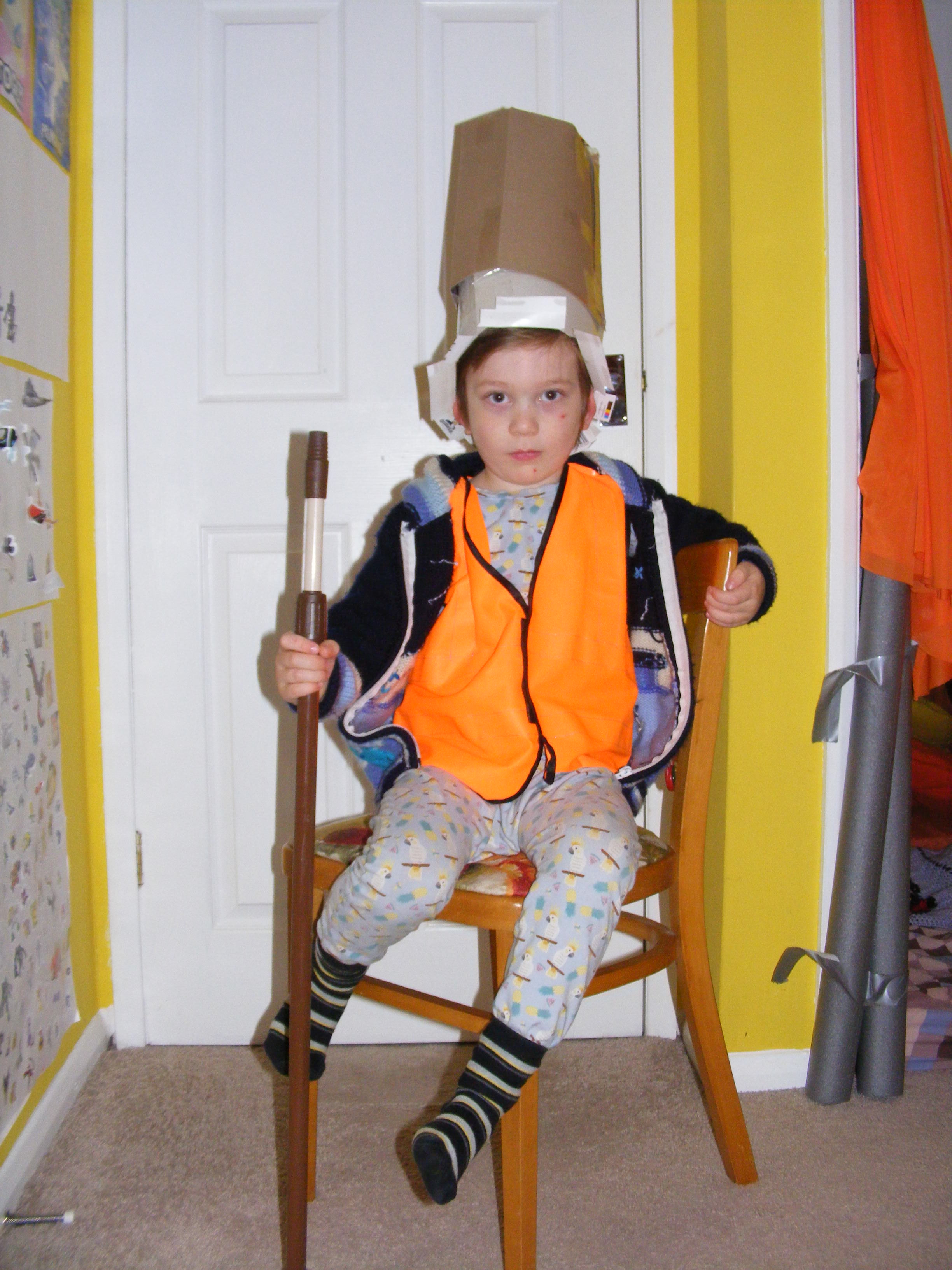
Posing as his 6 x great grandfather

This young man, now aged seven, is interested in his family history and is currently compiling a family history scrap book.

Family History Busyness – THE Genealogy Show Day 1 and other excitements

I’ve been bracing myself for a ridiculously busy couple of days. After virtually presenting in Kent and Norfolk yesterday, today was the first of two THE Genealogy Show days. Talks are being live streamed over 48 hours and my first went live at 4am my time. I was invited to listen to myself (always cringe making) and be on hand to answer questions, I decided to pass on that one. I only just missed the opportunity, so spent the early hours exploring the Show’s website and even manged to sneak in the chance to listen to three exciting young genealogists in a panel discussion about young people and genealogy. It is several decades since I was that young person and it is great to watch the baton passing on.

This was followed by my fortnightly chat with the lovely folk of Talking Family History. They are starting a new series in July, so now would be a good time to join in the fun. Then it was my turn to person the Society for One-Place Studies booth for THE Genealogy Show. Over lunch, I tuned in to Dr Sophie Kay’s Negative Spaces presentation; definitely worth a listen. Later, I had the chance to watch Andy Browning’s fascinating story Following in Family Footsteps.

Other recent feelgood family history moments. A photograph of my, now demolished, first teeny tiny infants’ school being posted on a Facebook Group, together with a picture of the headteacher, albeit about twenty years before my time. A few weeks ago, I was very excited to be offered the chance to acquire a one-name related long case clock. Even better, my nearest and dearest agreed that it could be a belated birthday present. The maker was from a different branch of the family to my own but it is still very special to have it safely ticking away in my living room. Finally, our local history group held its first hybrid meeting, with the speaker and five others in the meeting room and others Zooming in from as far afield as New Zealand and Canada. We still need to work to improve the sound quality but we are proud that a small society such as ours has been able to take a first step towards making our meetings accessible to those who are not comfortable with technology as well as our friends who are too far away to attend in person.

Tomorrow more busyness, more family history talks to give and listen to and an interview with Daniel’s Genealogy in the evening.

Being Presidential and New Horizons

Here I am, three decades after serving on the executive committee of the Family History Federation, having the honour of being voted in as its President. I am following some seriously big names in the genealogical community. To be considered some kind of elder stateswoman, is not only a humbling experience, it also makes me feel incredibly ancient. Perhaps I should point out that during my time on the executive I was the youngest ever serving member; though I think that record has since been passed to someone else. Family history societies are at a cross-roads. Many have seen slowly declining memberships and have struggled to fill committee and volunteer roles in recent years. Now is the time to reinvent ourselves and our function, or to fade into oblivion. We cannot keep repeating the pattern that has not been working well and expect it to suddenly become relevant and appealing. The pandemic has forced us to rethink the way in which we do many things. Societies can either put change in the ‘too hard’ basket or embrace it and perhaps use it as the first step to a resurgence. Societies can still be relevant in today’s genealogical landscape but it takes work and insight to make them so. For many years, I have come into contact with societies across the world as a member, a volunteer and a speaker. In the past year, my ‘catchment area’ has expanded exponentially and I am looking forward to ‘meeting’ many more family historians in the coming months. I am very mindful of the honour that has been entrusted to me in these challenging times.

On the family history front, I have been getting out my sledge hammer and attempting to crash through some family history brick walls for Devon researchers. Despite much of the sleuthing being done by my colleague, I ended up presenting the findings in a FindmyPast podcast, which you can view here. These may not be your personal brick walls but the techniques we used could be effective on your own problem ancestors.

I have also had what is probably classed as an old-age crisis. Before I wrote Barefoot on the Cobbles, I debated whether to write a novel or take a post-graduate course. On that occasion, the novel writing won. I am still playing with ideas for a possible third novel but nothing yet seems quite right, so I have returned to the post-graduate idea. I am excited to have been accepted by University College Dublin as a remote student on their certificate course in experimental archaeology and material culture. I am not quite sure what I have let myself in for but I am not going to be bored.

My ‘Discovering more about your Agricultural Labouring Ancestors’ online course is coming to an end and the students are now compiling case studies about their chosen farming ancestors. I have a few more submissions to read from my ‘Writing and Telling your Family History’ students, then thoughts will turn to next month’s course, ‘In Sickness and in Death – researching the ill-health and death of your ancestors’. As I said, no time to be bored.

For those of you waiting to hear about the end of our short trip to South Devon, watch this space.

DNA Detective Work and the story of a secretive agent

I decided that it was high time that I looked at some of my closer DNA matches, where I am unable to identify a common ancestor. I should explain that ‘closer’ in my case means not very close at all. My lack of cousins means that I only have three matches above 70cM and one of those is my daughter. My attention turned to a 48cM match with no tree. From shared matches, I had placed this person on the Smith/Seear side of my family tree. The Smith/Seears are tricky DNA wise because three generations of Smiths marry Seears, so I am often related to people on this line more than once. This means that suggested relationships are distorted. Without my pedigree collapse, the amount of shared cM with the mystery match might suggest that the relationship was in the region of a 3rd or 4th cousin, maybe with a removed or two.

The profile indicated that the user had joined Ancestry in 2016 and hadn’t signed in for over a year. I don’t want to give the actual name for privacy reasons but the user name looked like it could be the first half of an unusual female christian name and a surname run into one. This isn’t it but think constabolt might be Constance Bolt. I guessed at the name, Googled it and up came an obituary for the husband of someone with that name. This indicated that the person I was searching for was born in a particular smallish town in the south of England. Further internet searches revealed a maiden name and a middle christian name. To make this story easier to follow, yet still anonymise it, I am going to tell it with a fictitious maiden name. Let us say it was ‘Forester’, which probably has a similar rarity value as the actual name. This with the other information was unusual enough for me to locate a birth entry and discover that the lady, if she was still alive, would be in her nineties. Better still, her mother’s maiden name was Seear. Not only did it look as if I was on the right track but a great advantage over Smith. Yay! Eureka and all that. Now all I had to do was find a marriage for a Seear and a ‘Forester’ and I was away. This was going to be easy. Err, no. Not a marriage in sight. I searched for any other ‘Forester’- Seear children. None. Given that the marriage was likely to be not long after the first world war, it seemed probable that Miss Seear had married x before she was married to Mr ‘Forester’.

The Seears’ normal stomping ground is east London. There couldn’t be many in this small southern English town could there? There weren’t. I tried the 1911 census and the 1939 register for that area. I found a family in 1911 with two daughters who were potential wives for Mr ‘Forester’. They both married other people and died with those surnames; no second marriages to Mr ‘Forester’. The 1911 census indicated that there were other children who were not in the household, maybe I could find another daughter. According to the census there had been nine children, three had died and three more needed to be found. The family was headed by a married Emily Seear, no husband in sight. I found her in 1901, still in London, still married and still no husband, this gave me three more children. The children had unusual christian names but I couldn’t identify birth registrations for them all. Checking the births I could find on the GRO site gave me Emily’s maiden name but searching with Seear and the maiden name did not reveal the missing children, nor were they registered under Emily’s maiden name. I had her year of marriage from the 1911 census. This meant that I could find her marriage entry and the name of Mr Seear, who was potentially the grandfather of my DNA match. It was a name I recognised and suggested that the match and I were third cousins once removed twice over. I will continue to refer to him as Mr Seear, although, from this point, I was searching under his full name.

I was left with a gap and some questions. Which daughter of Emily Seear was the mother of my match, why weren’t all the children registered and where the heck was Mr Seear, who died in the 1920s but is elusive between his marriage and that point? He was clearly around to father nine children on Emily, at least one of whom really was his biological child, or there would be no DNA match.

By diligent searching I found one of the daughters marrying under a variant of Seear and then a subsequent marriage, under the surname of her first husband, to Mr ‘Forester’, which proved my link to my DNA match.

I did find the baptism of one of the children whose birth wasn’t registered but I couldn’t find the three who had died by 1911; perhaps Emily was counting still-births. There are some large gaps in the children but given what appears to be a rather odd relationship between Emily and Mr Seear that isn’t surprising.

So what do we know about Mr Seear? Given that he is my first cousin three times removed and not a close relative, I hadn’t researched him beyond his name and appearance with his parents in the 1861 and 1871 censuses before. He married in his home area in East London in August 1881, claiming to be a banker’s clerk, yet he can’t be found in the 1881 census, despite my knowing his address just four months later. Seear is a bit of a nightmare to search. Apart from the variants (Seer, Sear, Seeare and many more), it is often mis-transcribed as Leear or Teear, or indeed it seems something else entirely.

I did find a listing for Mr Seear going to Baltimore in 1883. His occupation was ‘agent’. Much as I’d love to think this was some kind of secret agent, I am quite sure it was as the representative of a company or organisation. Perhaps this is why there is an apparent gap between the first child in 1882 and the second in 1886. I totally failed to find Emily or Mr Seear in the 1891 census. I know they were in east London when a child was born at the end of 1891. I tried every technique I know, including search for christian names and dates of birth, without a surname. I tried the 1890 US census in case they all went to America; they were not there either.

I can’t find any children born between 1886 and 1891 when suddenly there were three children born in as many years, perhaps the relationship was re-kindled. There is then another gap before the final child in 1899. I have a baptism for this child on which Mr Seear calls himself a Dining Room Proprietor.

So we reach 1901 and no surprise that Mr Seear is conspicuous by his absence. Sadly, he seems to have kept his name out of the newspapers as well. Emily, describing herself as a married coffee house keeper, is still in the London area, with six children, including the mother of my DNA match but who is using a different christian name (I suspect an enumerator copying error as the names, although very different, have the same number of letters and shape).

Fast forward to 1911 when Emily and three children are in the south of England. Lo and behold Mr Seear turns up, living in London with his brother, claiming to be unmarried and working as a caterer for a licensed victualler. Two final sad entries, which show that Mr Seear spent time in the workhouse before he died.

This has taken me all morning but I am pleased to be able to untangle the tale. Shame about the other 16,000 unidentified DNA matches!

Image copyright R B

Of Swing Riots, Slander and Seriously Neglected Family History

We are still, it seems, in the depths of winter here in darkest Devon. Time for some family history. That’s nonsense, it is always  time for some family history. I am now in my 44th year of research, so it isn’t always easy to find anything new but every now and again I get out a long untouched branch, dust it down, check that I am happy with the conclusions I drew when record access was poorer and see if anything can be added.

Recently, at the request of my descendants, it was the turn of the Few family, hence the jaunt to the Hampshire/Wiltshire/Berkshire borders. Two issues with this family. Firstly, it is always a nightmare tracing a surname that is also a word, especially when looking at things like newspaper archives. I once had to look for a teacher called Mr Head (I had no forename) up popped every Headteacher in the world but I digress. Secondly, the Fews lived at a point where very short distance moves took them to another country, or another other county, giving me three to consider.

I hadn’t done much on this family for a while (translated to ‘not touched it for decades’) so as I usually do in these cases, I pretended I was starting from scratch. This involves reviewing each generation in turn, writing down my evidence for linking to the next generation and deciding if I am satisfied that I have made a correct link. I don’t use a formal ‘method’ or genealogical proof standard, although what I do amounts to the same thing. I just call it good genealogy. Having reassured myself that what I did thirty plus years ago was sound and that I really couldn’t, with confidence, add a further generation, although others have done so, I looked at the collateral lines. Here there were new generations to add, always a pleasure having been searching for so long.

I have already mentioned the revealing of the prosaically named Fish Coppinger and the four sisters with ten illegitimate children between them ‘but wait’, as my friend would say, ‘there’s more’. I am currently feeding back on pieces sent to me by students on my Pharos online Writing and Telling your Family History course. As an aside, one of these mentioned someone from my one-name study but that’s another digression. Said students are encouraged to enliven the begats and begats with plenty of context. To be fair it is more a case of ‘do as I say’, rather than ‘do as I do’. My own ‘writing up’ is primarily a way of presenting my findings in a relatively (see what I did there?) coherent way. I certainly don’t claim that mine are beautifully crafted, riveting narratives but I do like to throw in a bit of context now and again. I also have students who are currently working on a course about agricultural labouring ancestors, so I thought I should utilise some of the techniques that I have been advocating for them too.

I set to work. Newspapers are always a great source of interesting snippets. I was excited to find that the agricultural labourers that I was researching were living in a parish where Swing Rioters were out in force in the 1830s. Add to the mix the ancestress who dropped dead walking home from working in the fields, the ancestor who narrowly escaped prosecution for slander and the one whose foot was run over by a wagon and I felt that I was starting to get to know these people who had previously just been names on a family tree. If you are very bored and want to see the fruits of my labours, the draft narrative is here. This has not yet been run through the eyes of my ace proof-reader. There will be typos!

In the course of this research, I came across a very sad newspaper account about a child whose name was shared by a family member but who was no connection that I can find. Apologies for the poor reproduction – that’s as god as it gets. Although typical of the time, the callous attitude of the reporter was shocking and I am now tempted down the rabbit hole that is shouting ‘research this child’.

Wiltshire Times and Trowbridge Advertiser 27 June 1874

I did get as far as finding the child in 1881, listed as a scholar with no disability mentioned and there is a burial at age nineteen. Do I invest in the death certificate? They won’t be forgotten as I will be working this in to one or two of my talks.

I now have, by design, a two-week lull in talks, although I am podcasting (I think that’s the word) this afternoon. With ‘winter’ continuing I shall move to Worcestershire (in the virtual family history sense), to see what I can uncover about another long-neglected twig on the tree. See you on the other side.