Wester Ross

Another wet and windy day in the van waiting for the garage to not mend our car. We have an amended plan here on in but it depends on our car being available the day after tomorrow and there are no guarantees. Ah well, I do manage to make progress with the Braund Society Journal whilst stuck in the van.

The next day we decide we really should do something. First, in to Kyle of Lochalsh to find a cash point and get some food. There is a very tiny general store and meat comes from the butcher’s next door. We show ourselves up by being unsure of the weight of the mince that we require. I hate to admit that we normally grab pre-packaged mince in a plastic box that looks the right sort of amount, without being aware of its weight. In this area there are plenty of road signs exhorting us to drive on the left. This of course is for roads that have space for two vehicles to pass and given the number of European tourists, may well be necessary.232 19 August 2014 Wester Ross

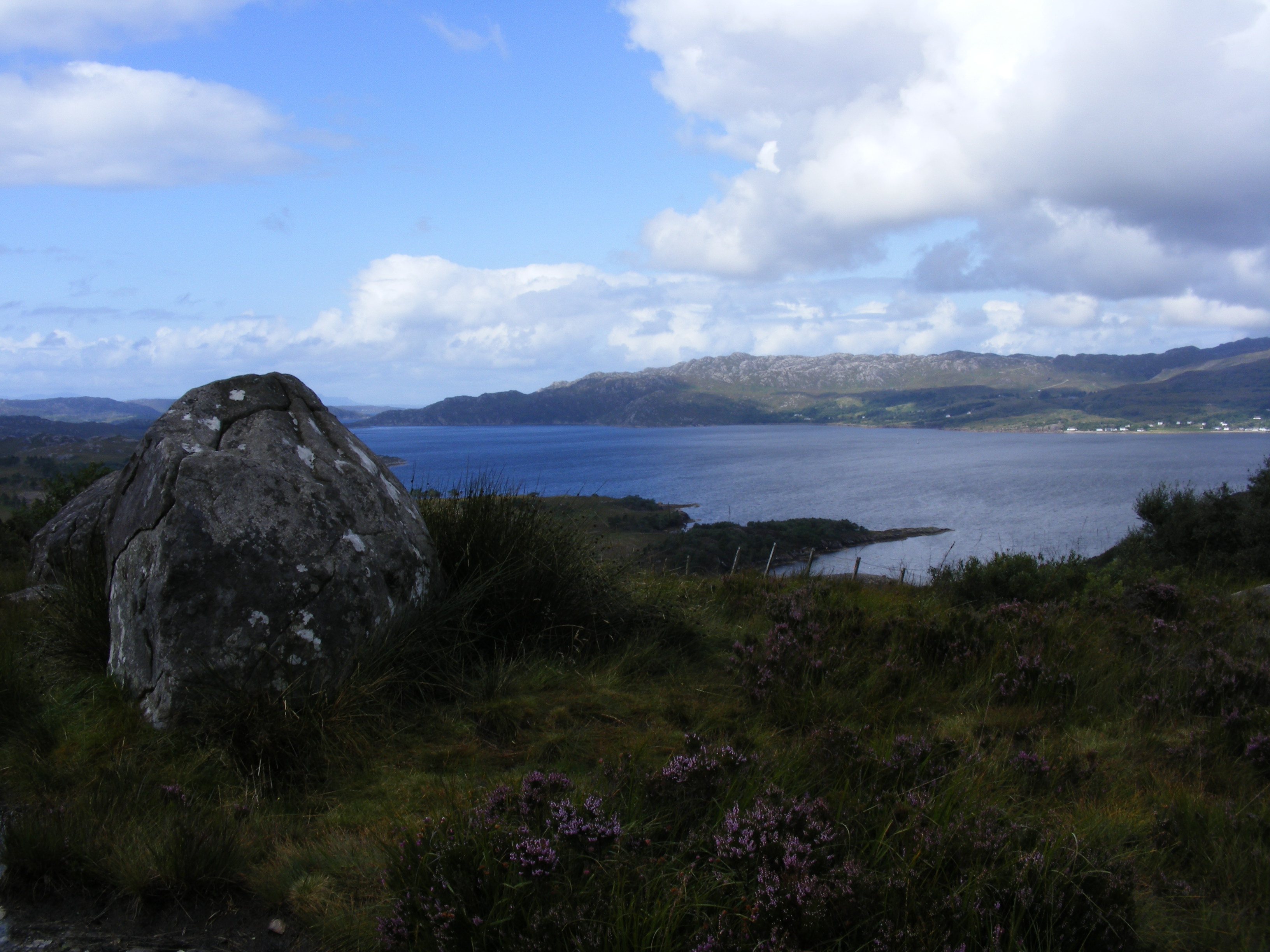
We head north across the breathtaking countryside that is Wester Ross. We have chosen a destination somewhat at random and are aiming for Torridon Countryside Centre. The weather is what we have come to expect of Scotland, raining one minute and sunny the next. Along the Wester Ross Coastal Route we encounter a sign to Stromferry. Helpfully, the sign warns that there isn’t actually a ferry at all at this location. We have seen many abandoned and ruined crofts, either a relict of the ‘clearances’ or signs of where a more recent crofter has found themselves unequal to the demands of life in the remote highlands.244 19 August 2014 Deer

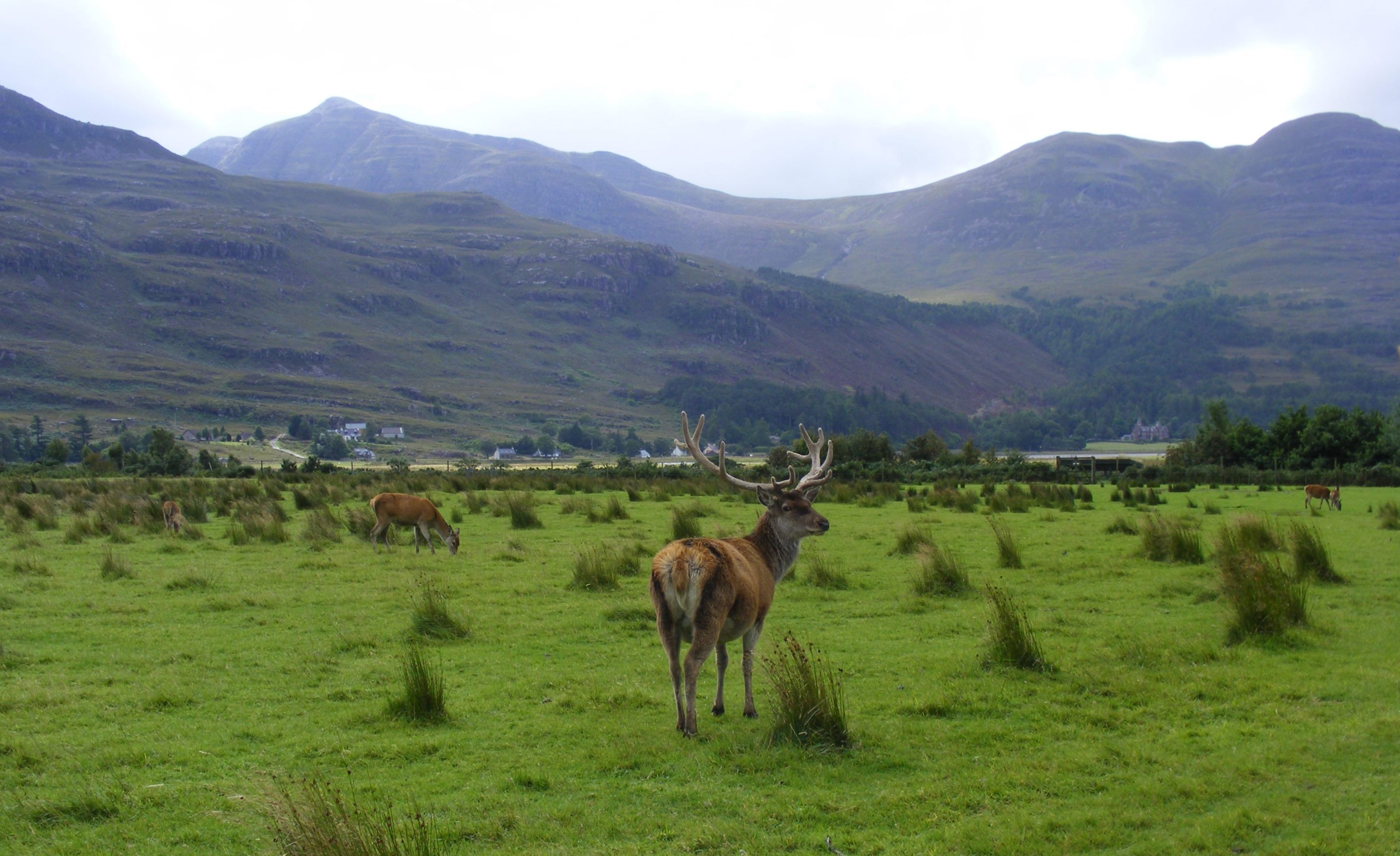
On arrival at the Countryside Centre, we are able to watch a short film about the flora and fauna of the area. Accompanied by an evocative smell of pine, we walk down to the small deer museum and park, where we can see captive Red Deer. There are meadow pipets and curlew and as ever, rowan trees (Mountain Ash) full of berries. As the year progresses and we get further north, the Rosebay Willow Herb that has been prolific since the Lake District is finishing and the heather is becoming more noticeable.

We take a slightly longer way home to avoid retracing the whole of our route. Firstly, along Glen Torridon, alongside the towering Beinn Eighe range, then through Glen Docherty and Glen Carron. Here we re-encounter the convoy of Italian camper vans that we first met at Killin. Here also our first close up view of a wild, full grown, male red deer, unfortunately not in a position where we could take a photograph.

Our car is still being described as ‘a work in progress’, which is less than helpful and may mean that the revised plans require further revisions.

In Search of Monsters

DSCF2319After our exploits on Uist we spend a day recovering in the van; the stormy weather making this an attractive option. The following day we are still marooned in Kintail and the weather is no better. Although we would rather not have had our plans diverted, there is some comfort in realising that this is the day we should have been on a boat going to Orkney. The weather is reputedly worse further north. It remains to be seen if we will get there but if we do the conditions can only be better.

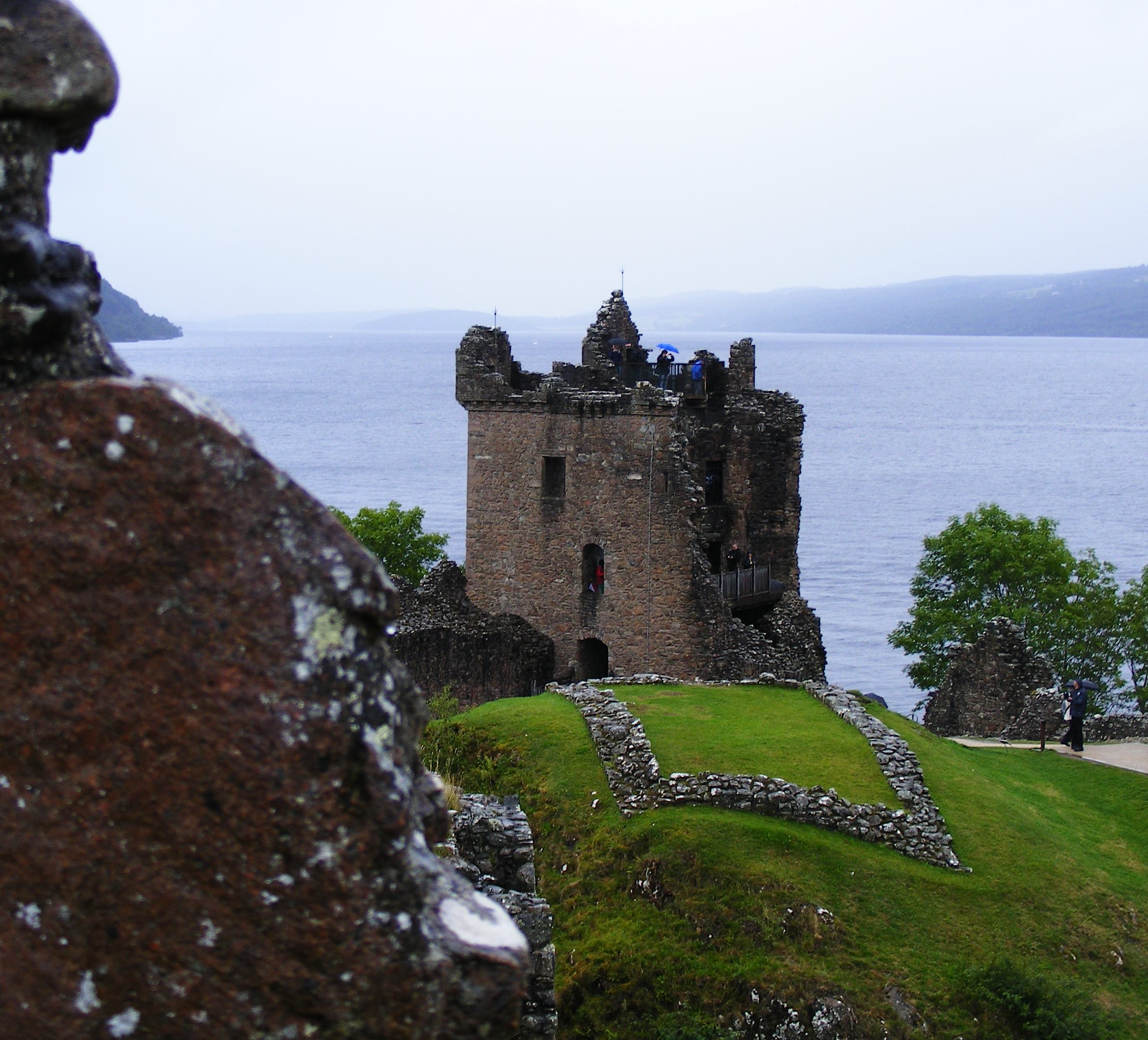
We decide that we will take our courtesy car eastwards to seek out monsters in Loch Ness; maybe our form for wildlife spotting will improve. In rain and mist we pass the site of the battle of Glen Shiel, which took place in 1719 when the Jacobites and their Spanish mercenary allies fought the British troops. This was the last time that the British army faced foreign troops on British soil. We view Loch Ness through wind and rain. We drive further up the loch to Drumnadrochit, planning to utilise the car park of Castle Urquhart, which we can enter free, in order to photograph the loch. Here we encounter numerous foreign tourists on their ‘every possible castle in Scotland and then some’ coach trips and the car park is full. Fortunately someone is just departing and we slot in to their space.

Although it wasn’t on the itinerary, Castle Urquhart (bizarrely pronounced Uff-irt) is an interesting location and yet another example of serious investment in Scottish tourism, with an impressive visitors’ complex. Apparently, this met with local opposition when it was proposed in the 1990s and it is set partly underground to minimise the impact. Like everywhere else, the staff are very friendly and we are greeted by two members of Clan Grant in ceremonial dress. We are asked where we hail from and they decide that Devon just about qualifies us for entry. We are probably more local than 90% of today’s visitors; rain is doubtless keeping the less intrepid British holidaymakers indoors.

We are herded in to watch a well put together video presentation about the history of the castle. In the sixth century, Saint Columba visited the Pictish chieftain Emchath, who owned the fortress on this site, and converted him to Christianity. Sir Alan Durward built the stone Urquhart Castle in 1230. Edward I captured Urquhart in 1296, during the wars of Scottish Independence but it was soon regained. In 1395 it was seized by Donald, Lord of the Isles, seeking to increase his power. In 1509, James IV stripped the MacDonalds of their land and titles and gave Urquhart to the Grants. Raids by the MacDonalds continued. In 1545, they captured 2,000 cattle and many other animals, as well has taking furniture, cannon and the castle gates.

In 1689, the Grants supported William and Mary and there was an unsuccessful Jacobite raid on the castle. Nonetheless the Grants abandoned the castle, firing the gatehouse so that it could not be taken over by their enemies. Grant was compensated by Parliament but although they retained ownership until 1912, the castle remained in ruins. Much of the interpretation for this castle, one of the largest in Scotland, are of the ‘this may have been’ nature. Amongst the remains is what’s left of a ‘Doocot’, or dove-cot, which John Grant was obliged to build as a condition of his being granted the castle in 1509. There is a full size trebuchet in the grounds, accompanied by the proviso that there is no proof that one was ever used at Urquhart. What next, a nuclear war head complete with a similar caption?

Having done enough to feel that we haven’t wasted the day, we retire to the van to watch the European athletics championships.

Up South Uist without a Clutch Pedal: or you couldn’t make it up

I wake up early as usual. This is just as well as we need to leave the van at 7.00am and something weird has happened to my alarm clock, which thinks it is still 1.00am, so it would have been no good relying on that. What more can go wrong? We drive across Skye to Uig. Chris is convinced that this is pronounce ‘You-eee’ and he has been here before so who am I to gainsay him. I would like to place on record that we were not first in the ferry queue, nor indeed, second or third. The ‘Hebrides’ ferry arrives with a distinctly worrying tilt to starboard. We can only hope that this does not have a detrimental effect on our voyage.

We are bound for North Uist and by the judicious use of bridges, will be able to visit five islands for the price of one. Okay, so it was quite a substantial price but there are only two return ferries and one of those leaves five minutes after we arrive. The other is later than we might have chosen but it does mean that we will have plenty of time to explore. On the journey across, we see, ranged across the skyline, the myriad of rocks that make up the tiny islands of the Outer Hebrides. From a distance, they resemble the humps of the fabled Loch Ness monster.

I have brought my laptop with the intention of finishing the Buckland Brewer History Group newsletter whilst on board and make good progress. As the ferry draws in to Lochmaddy we see notices that instruct us to ‘wait for instruction to move before starting engine’. How difficult can this be? Very difficult it turns out, as most of our neighbours are turning their ignitions before the ferry’s ramp is lowered. North Uist, where we land, is distinctive, much flatter than Skye, with many inlets and stretches of water. At last heather is in abundance. I opted to visit this chain of five Outer Hebridian islands, rather than Harris and Lewis, primarily because I liked the sound of Benbecula. First stop is the island of Berneray, so we head north. Like much of Skye, this is single track road with passing places, involving much slowing down and changing of gear. The road is blocked by a van pulling a trailer containing a digger. We wonder why they are hunting around in the ditch instead of moving out of the way. Ah, they are searching for one of their trailer wheels, that explains a lot.

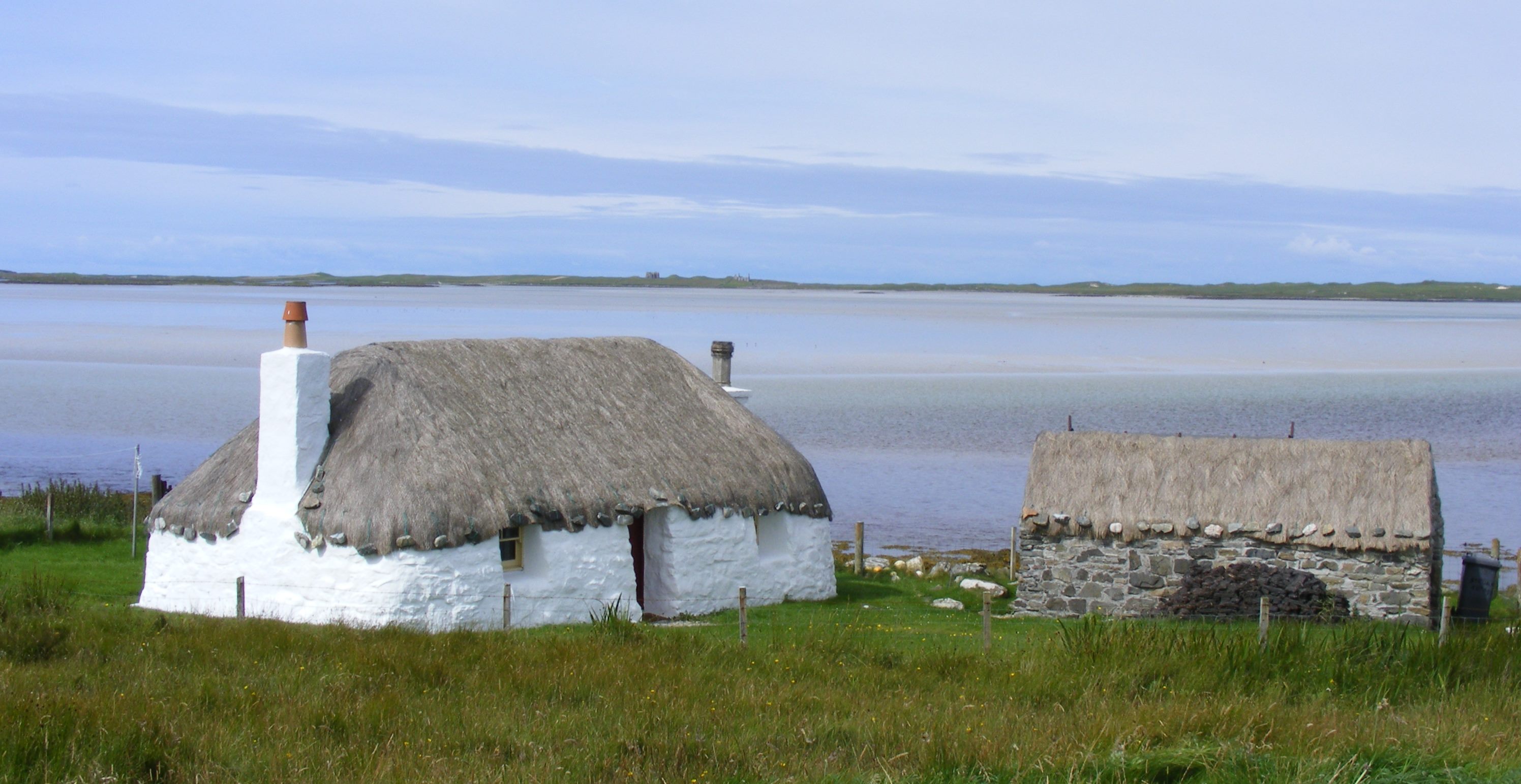
The mobile bank arrives as we draw up at the only shop on Berneray. Chris attempts to get them to part with money but they can only cope with Royal Bank of Scotland customers. We call in at the Berneray Heritage Museum in the old nurse’s house, given to them by the council for a peppercorn rent when the district nurse was discontinued. Worryingly, there were not only problems with the paperwork relating to the original purchase of the building but also with the lease, so they may be on borrowed time. We learn that kelp gathering and horse breeding were the staple industries here. Of a 1911 population of between 500 and 600, 86% were Gaelic speakers, although schooling was in English. Each child took a piece of peat to school every day for the fire. In the 2011 census one Berneray resident from the 1911 census was still on the island. The museum even has a photo of a yacht that Chris’ Devonian grandfather crewed, along with men from the Western Isles. We learn of Angus MacAskill, born on Berneray in 1825, who is accepted as being the world’s tallest man ever at seven foot nine inches. We ask about some of the traditional ‘black houses’, which here have a roof that slopes down inside the line of the front and back walls, leaving a shelf like projection at the top of the wall. We are told that this is to deflect the rain so that it doesn’t drip on those leaving the dwelling. This doesn’t seem very logical to us as surely this makes the walls more vulnerable. The island location means that there is rarely snow here so roofs do not have to cope with that.
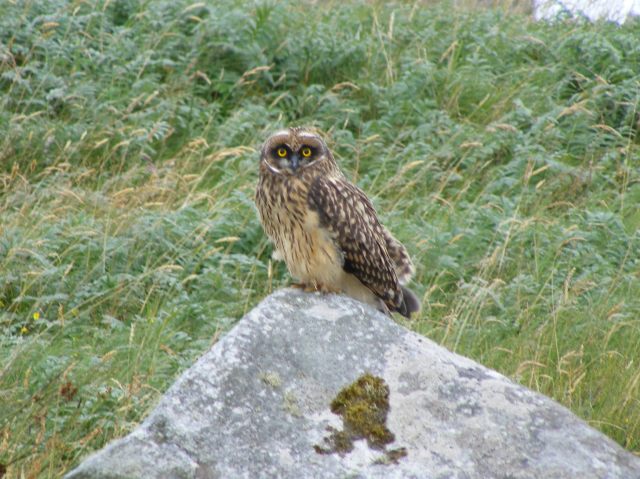
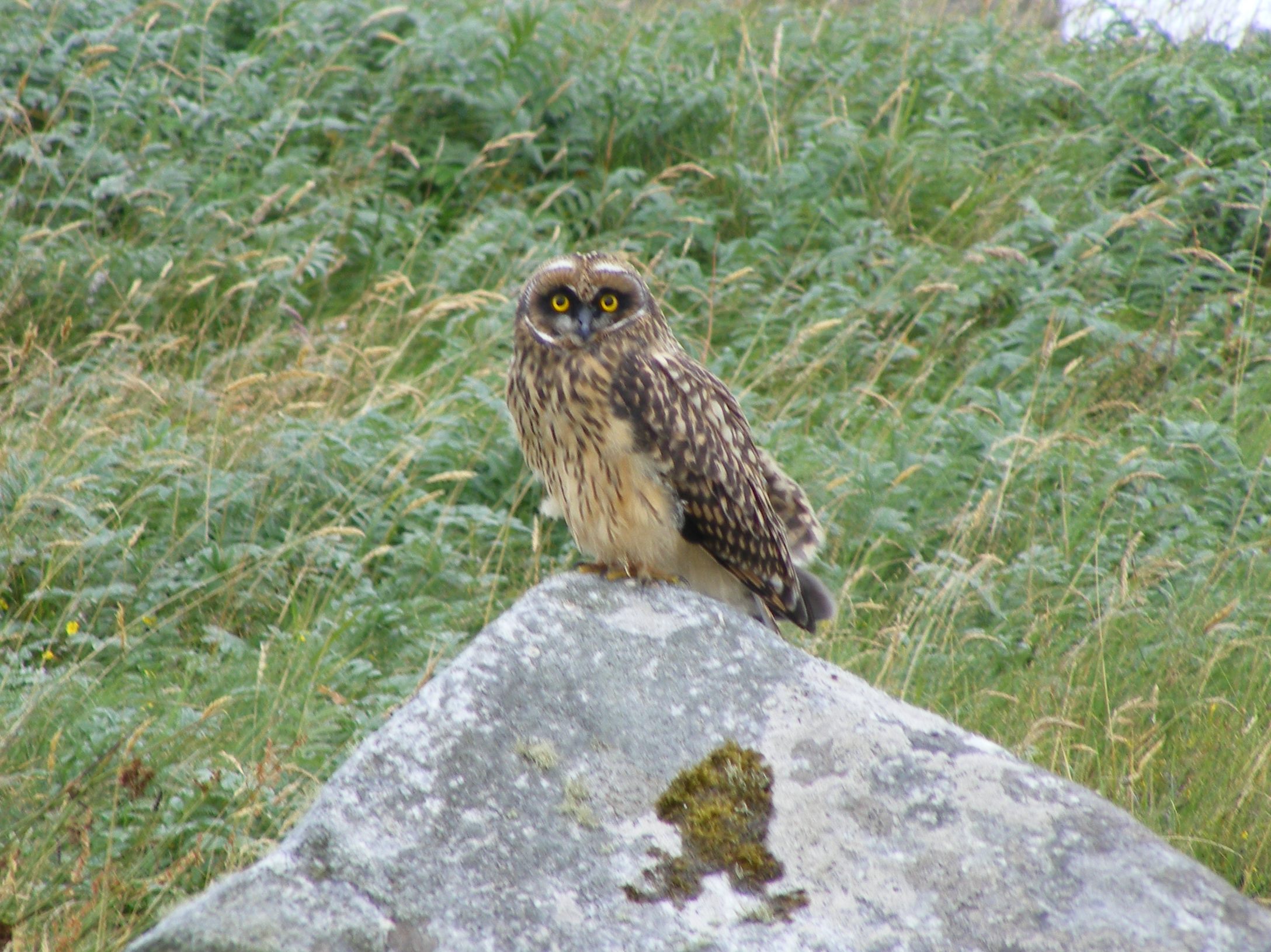
219 15 August 2014 Short eared owl Outer HebridesBack on North Uist we somehow miss the RSPB reserve but nonetheless see lapwing, hear curlew and manage to take a photo out of the car window of a short-eared owl sat on a rock. Our progress is hampered by playing dodge the sheep on the narrow road. We stop at the ruined Trinity Temple, allegedly Scotland’s oldest university. It was a medieval monastery and college founded by Beathag, daughter of Somerland. After an extension in the sixteenth century, it was dissolved during the Reformation, although there were later repairs.

Benbecula may have a cool name but it contains the least of note of today’s islands. As we traverse it, along the slightly longer coastal route, the car begins to make a strange noise. The driver seems unperturbed (or is a very good actor) and we continue to weave our way in and out of the passing places in order to venture on to South Uist. Flora MacDonald was born here, near Kildonan. It was she who helped Bonnie Prince Charlie to escape after his defeat at Culloden in 1746. Peat cutting and kelp gathering are still carried out here. South Uist is hillier than the three more northerly islands in the chain. The car is still not well and there are mutterings about a lack of clutch fluid. We stop at Kildonan Museum, hoping that letting the car cool down will help it recover from the excesses of gear changing over the last couple of days. Kildonan Museum is another example of a Scottish community valuing its heritage in a way that is not seen in England, with archives and research opportunities available on site. South Uist is the heartland of Gaelic culture, home of oral tradition and Fair Isle knitting. There are several telling quotations round the museum’s walls. ‘There is always a danger that history comes to mean the past, as opposed to an interpretation of it.’ and ‘However we interpret it, there is nothing surer than that history has as much to do with the present as the past.’
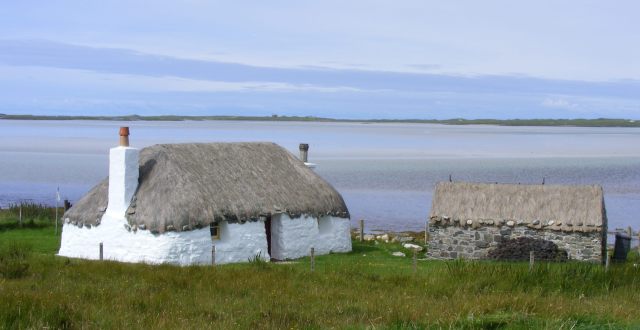
220 15 August 2014On leaving the museum, we find that we no longer have to worry about the clutch being overheated; there is no functioning clutch. We have to abandon plans to reach Eriskay, the southernmost island of the chain, noted for its wild ponies and the wreck of S.S. Politician in 1941. The vessel was laden with 260,000 bottles of whisky and its story became the basis for the book and later film, ‘Whisky Galore’. We limp back towards Lochmaddy, attempting to do so without stopping or changing gear, next to impossible on a single track road. In the middle of absolutely nowhere we find a lorry servicing garage. The mechanic confirms the demise of our clutch. The good news is that he can fix it on Tuesday. It is Friday. If that is the good news I don’t want the bad. We are four islands away from our caravan and several miles from anywhere where we could potentially sleep or obtain food. I have only had a lemon muffin since 6.00am and even Chris’ full English breakfast on the ferry is a distant memory. Now comes the very long wait while the recovery service try to work out if they can indeed recover us. Chris is patiently spelling out our current location, once we confirm where that is, where we have to get to, via where and most importantly by when. We really need to get that ferry back to Uig.

I’ll admit it, I am hopeless at doing nothing. I could read my Kindle but the battery is low. I could use the laptop – ditto. What about good old pen and paper. I can manage the former but the car is lacking in anything to write on. Finally I locate a single A4 printed receipt that I took to exchange for our ferry tickets. If I write very very small I can occupy myself for a while using that. I need something to stem the rising tide of panic, made worse by the fact that we have very little cash, thanks to not being RBS customers and that Chris’ phone battery, like every other battery in our possession, is getting very low. I know, I know, this is a time when I need my ‘emergency phone’; inevitably it is back at the caravan.

After what seems forever, recovery truck one arrives. The car is loaded and the driver ferrets around in the back for something resembling a seat to put in the middle of the cab for me. This ‘seat’ doesn’t rate a seat belt but this seems not to matter. I am sandwiched between a broad Devon accent and a broad Gaelic accent, acting as interpreter but truth be told, I could only follow half of what our rescuer was saying. I did catch the bit when he said he though his clutch was going but I ignored that. In the process of getting the car on the truck it was apparent that no way was our car going anywhere, like on a ferry, unaided. Understandably, our driver would rather not have to tow us on and become marooned on Skye overnight. Not to worry, this is the Outer Hebrides, everyone knows everyone. In the queue there is a random van, with someone known to our driver at the wheel. He is approached to tow us on and off the ferry and our driver even donates a tow rope as a souvenir. I look pathetically at the dispatchers, not difficult as I am both sleep and food deprived and they agree to load us as a towed vehicle, by no means a foregone conclusion. Despite our lack of automotive capacity we are on the ferry.

The ferry is half an hour late arriving and all we want to do is get home but finally we are aboard. After consuming the welcome curry from the café, there was the issue of getting off the ferry. Our helper accelerates away at a great rate and the tow rope snaps. We tie it together but it was short to begin with and now Chris is very close to the almost new van in front. He manages to avoid running in to it and we are handed over to recovery truck two. We are on Skye, this driver drives at Skye speeds. I do have a seat belt this time but as he hurtles round the many twists and turns our knuckles are whitening rapidly. We arrive at the garage, deposit the car and collect a courtesy car that has been left out for us. We are still an hour and a half from ou destination. Arriving back just before 1.00am, I don’t think we have ever been so pleased to see the van. Now we have to work out how to cope when we are fifteen miles from a shop or a phone signal and fifty miles from our car. Thank goodness for the internet connection. Working out what needs cancelling or rearranging in order to get our trip back on track can wait until morning.
Over the …..errr Bridge to Skye


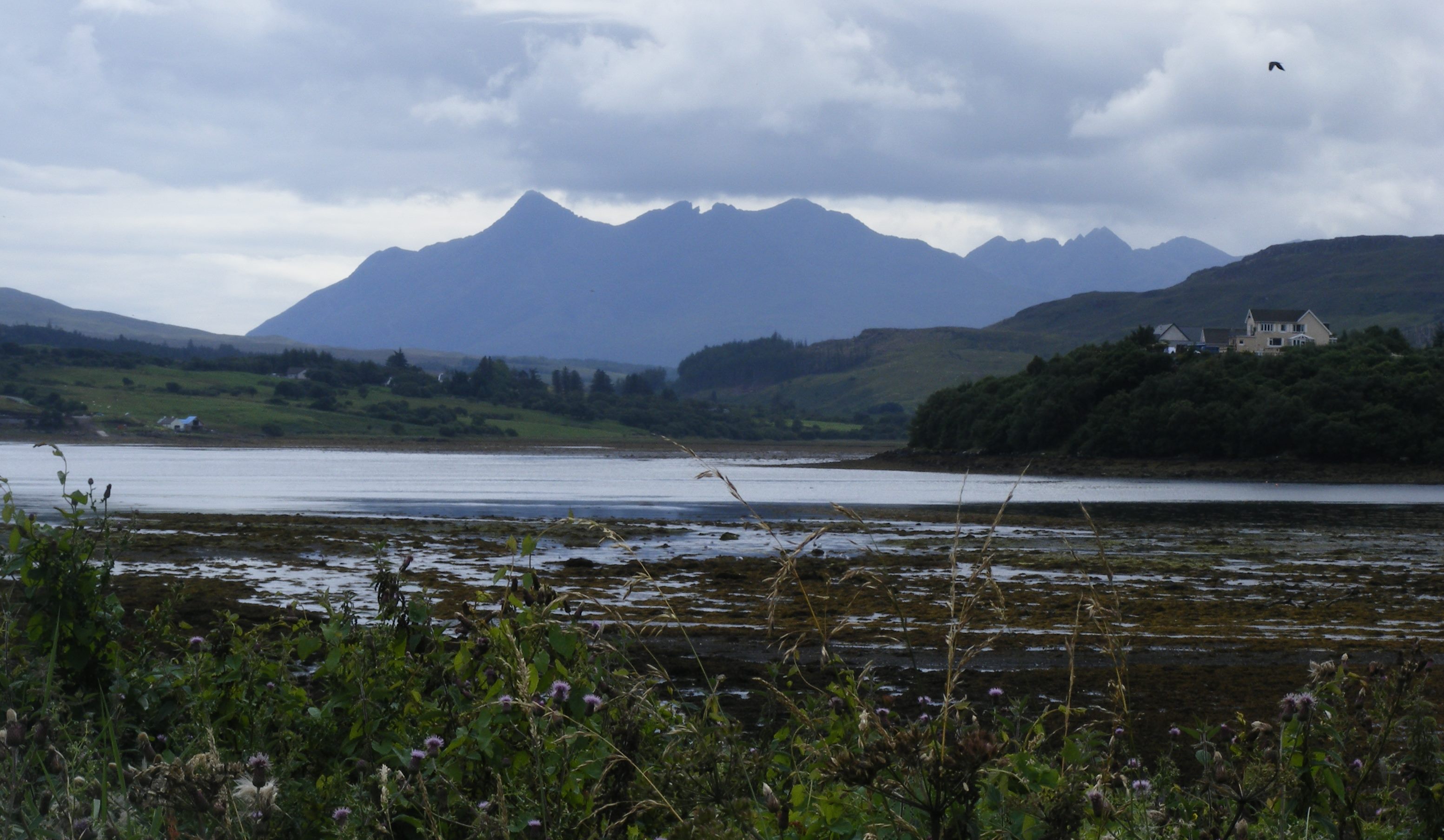
We travel over the bridge to Skye without any bonnie boats, or indeed birds on wings, in sight. Skye, once voted one of top five island in the world by National Geographic magazine, is living up to its Gaelic name, Eilean a’ Cheo – Misty Isle – so the tops of the Cullins aren’t visible. We head to a hide at Kylerhea, supposedly the place to see otters, unless of course you are us. Any potential otters are a good way away out to sea. We think they are otters but I am still not totally convinced that they aren’t seals. We do definitely see a number of those. Using binoculars is always tricky when one wears glasses and today is no exception. I end up with a squint and round rubber marks on my glasses.


Historically cattle from Skye were swum across the 550 metre channel to Glenelg in groups of six or eight. They would be roped in a line behind a boat and rowed to the other side before being walked to market. There don’t see to be many cattle left; there are more sheep. Of course tourists are now the bedrock of Skye’s economic activity and there are plenty of those, the bridge making it easy for coaches to travel across in great numbers. They and many other vehicles, seem obliged to go at ridiculous speeds, hurtling past us at the most inappropriate points.214 Skye


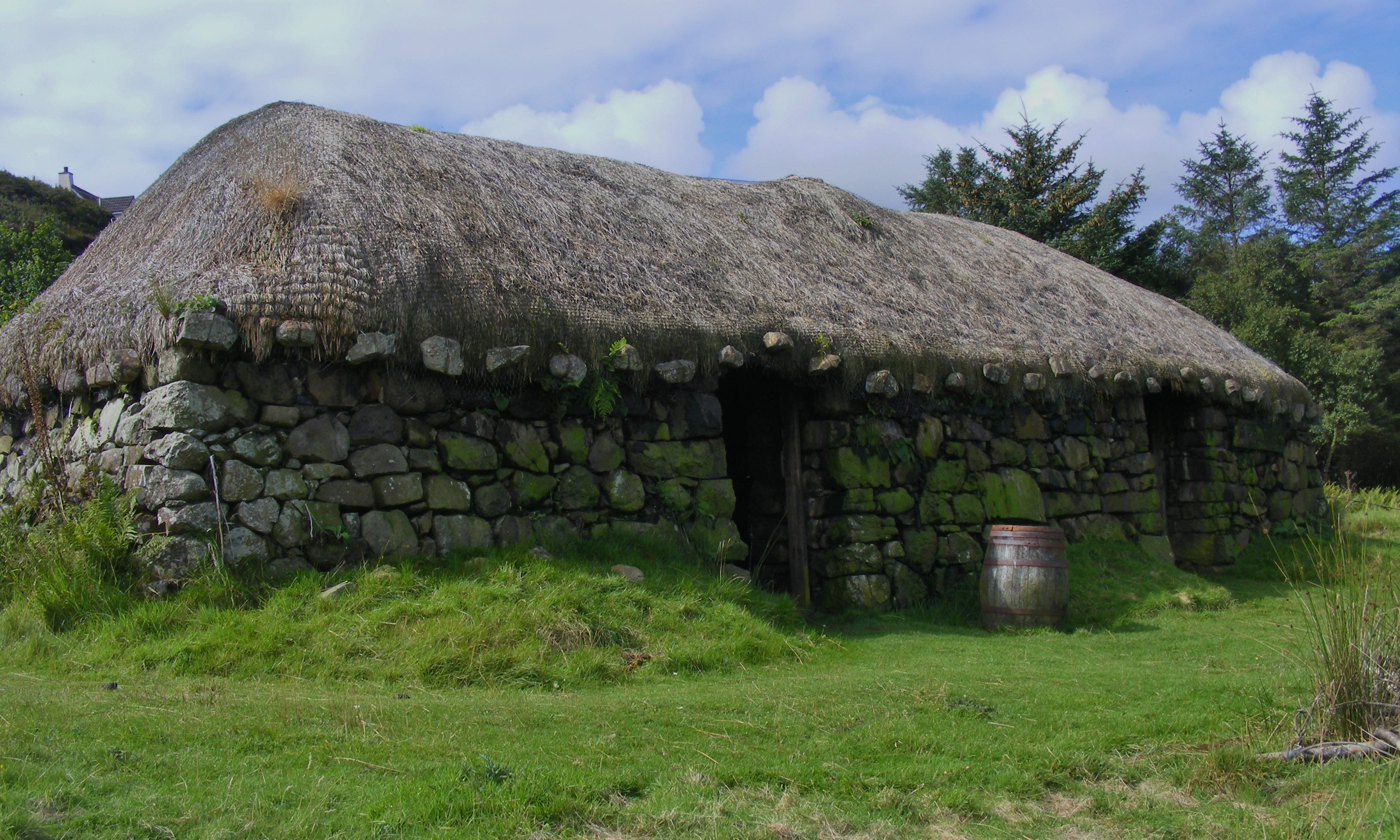
We travel north to Colbost, spotting a stranded campervan on the way. The driver has parked on a soft verge and the nearside is now significantly lower than the offside. Having no method of offering assistance we leave the owners telephoning the recovery services. At Colbost we can see a traditional Skye ‘black hut’, a stone built, two roomed dwelling, with no windows or chimney. There is a central fire and a typical boxed in bed. Animals would have been kept in one end and humans would inhabit the other. The roof would be rush or bracken. Today the rushes are held down with chicken wire and this is weighted by large stones being tied round the edge, rather like the corks on the stereotypical Australian hat. I guess, in the era pre-chicken wire, a net may have served the same purpose. The croft even has the remains of an illicit whisky still behind it.


209 14 August 2014 Croft, Colbost, SkyeWe travel on to Portree, grabbing the last space in the car park. I narrowly avoid being mown down by a bus. It appears that the whole of Skye is in the throes of a power cut. We had seen so little habitation so far that we hadn’t noticed. A swift walk round Portree and we return to the mainland across the barren hillsides of Skye. It is beautiful and rugged here and somehow different from the mainland in an indefinable sort of way. We shall be back tomorrow en-route for the Outer Hebrides.


An Alternative Shower, Shrinking Cupboards and Yes a Little History – I Promise

For those of you who think I am still in Leicestershire – surprise! Our last day in the county was spent visiting Beacon Hill Country Park. Here the rocks are 700 million years old – I promised you some history. With our south-west coastal park experience, we opted for the longest of the suggested routes through the park. All I can say is, there is a reason why the word ‘hill’ appears in the name of the park. Actually is was very pleasant and much of it was flat, a distinct lack of wildlife though. I am a bit ambivalent about country parks. They are, after all, a sanitised version of ‘country’. Still, I suppose they do encourage people to get outside and engage with the environment, if only in its pink and fluffy form. Preferable I guess to the land being built on.

DSCF1505

Once back home, I had this idea, as you do, that I would swap the positions of the two dressers in my kitchen. If you think two dressers is extravagant, there isn’t much else in my kitchen and in fact this move may well be the first step towards there being something else. This lack of kitchen units once landed me in trouble. This incident was so ludicrous it is probably worth repeating.

The phone rings, someone who claims they are not selling anything is on the other end. They clearly are selling something. It’s my lucky day, they want to enter someone from my postcode in a draw for a new kitchen. How old is my kitchen they ask? I try to explain that it is a free standing kitchen, it doesn’t have an age. ‘Freestanding’ is obviously a concept that is new to the telesales person; does she not watch the Home channel? Ageless kitchens are clearly beyond the scope of the ‘how to sell a kitchen’ training manual. She tries again, ‘well how old is it?’ ‘Four hundred years’ I say, only slightly facetiously, the house is, after all four hundred years old. Tele-not-really-selling-anything girl is now very confused. ‘Do you have a kitchen?’ she asks. In words of half a syllable I explain that, yes, I have a kitchen but the furniture in it is all different ages. ‘Shall I put about ten years old then?’, she says, hopefully. By now I am in fully obstructive mode. I am, after all, on the telephone preferencing service, she shouldn’t be ringing at all. ‘The furniture is Victorian’, I say, then, to be helpful, ‘that’s about 150 years old’. She gives up. ‘Well you are entered into our draw anyway.’ Oh joy, now I will get a whole load of advertising literature for a kitchen that may have an age but which I don’t want. Have to say, this was almost as good as the salesman who spent ten minutes trying to sell me up and over doors for the garage I don’t have. He couldn’t grasp that, however wonderful, the doors would look pretty stupid standing there with no garage.

Anyway back to the dresser moving. As said dressers are on the chunky side, I had enlisted help with their removal. Unfortunately this was help, singular. I emptied the dressers and humanely disposed of all the unwanted and unidentifiable bits of kitchen equipment that had been lurking there for the past five years or so. Where do all these containerless lids come from?

My enlisted helper and I exchange the dressers – well we shove at them a bit and they end up in each other’s places. In the meantime, we have removed the dust of ages from behind the dressers. I then replace the contents. I break a few things to make more space. There are still an awful lot of items on the kitchen table that now don’t fit in either cupboard – how can this be? Have the cupboards mysteriously shrunk?

Before we leave these domestic ramblings, there has also been the mysterious incident of the shower in the bathroom. That is not THE shower you understand, which is perfectly well behaved and where it should be. This is another shower, of rain, which is pouring down the walls. Currently a builder is coming to look at it – not sure when – manana is his middle name. In the meantime I am ignoring it and hoping it will go away – not working yet and heavy storms forecast.

NOW the history. Corrected Family Historians’ Enquire Within are on their way back to the printers at last. Hopefully it will be available in time for Santa to pop a copy in your stocking – you won’t want me to say this but 99 days to – oh I wasn’t going to say was I!

Now to the next book, which is to be about One Place Studies. The new society of the same name, with which I am involved, is gaining a great deal of support, as is Buckland Brewer History Group. Whilst on the topic of one place studies, do take a look at this pod cast on The National Archives website.

I’m in the midst of another ‘five talks in a fortnight’ session and next year is filling up fast. Two one day courses for Devon Family History Society are on the calendar for early next year. I also managed to join the Braund Society reunion in Canberra. It was a virtual presence but great to say hello to everyone across the miles.