Christmas Memories

As part of my 1946-1969 project my lovely volunteers are currently writing about their memories of Christmas. Just to prove that I don’t ask them to do anything that I wouldn’t do myself here are my efforts. I have left out the section on tree decorations as I covered that last year. Preserving your recollections of the holiday seasons of the past are part of your family history and what better time of year to start jotting down your own family’s traditions.

The Christmases of my childhood were magical times, although I am sure they were stressful for my mum who, when I was small, normally catered for the extended family at some point during the festive season. The build up to Christmas was accompanied by the opening of the cardboard doors of an advent calendar. These were the sort with pictures behind; it was long before chocolate advent calendars. I would get a new one most years but still kept and opened the old ones. I remember one year we had one with a window for the 26th on – very strange. When I was first married it was a Snoopy advent calendar each year. For Rebecca’s second Christmas she had the cardboard calendars but also a ‘chimney’ with small boxes that could be filled with gifts. When Martha arrived we acquired a set of advent boxes in the shape of houses, so that we had a second way of dispensing advent gifts. It was quite difficult to find things to fit in these containers so mum made a series of bags from wrapping paper, which were slightly larger and the girls swapped between one or other of these calendars until they were adults. At middle school both Martha and Rebecca won several prizes for increasingly impressive home made advent calendars.

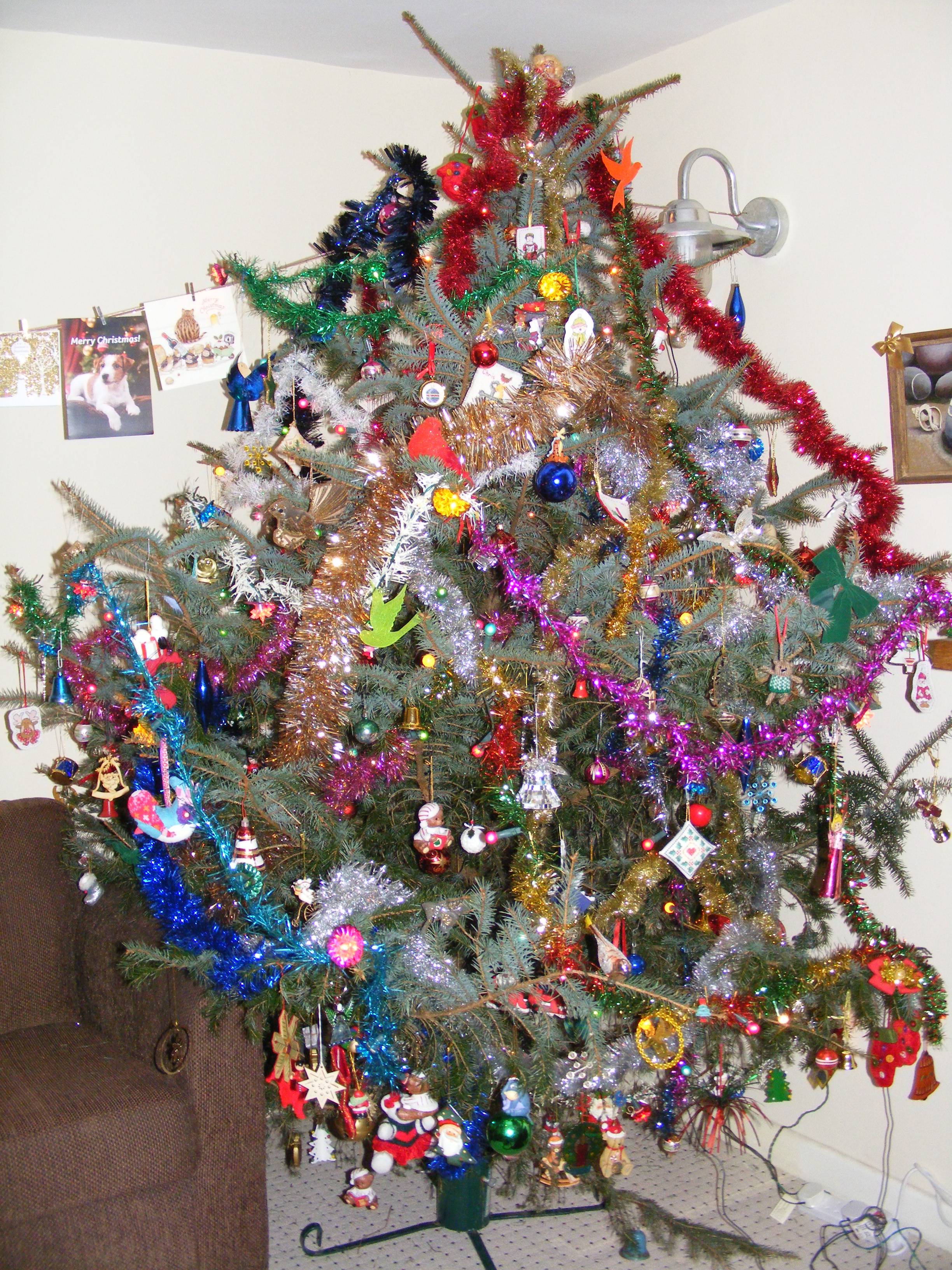
Decorating the house was hugely important and still is. Most of the decorations are old friends and bring back many memories. One year, when we lived at Firsby Avenue, mum made amazing door decorations from coloured shiny paper, that was the latest trend that year. There was an angel, a tree and a stocking amongst the collection. A less successful attempt at home made decorations came from another new invention. Some kind of granules were purchased that could be turned into minute polystyrene balls, perhaps by boiling, I can’t remember the process. These were dyed and glued to twigs from the garden. It was the gluing part that was tricky and polystyrene balls adorned the hall floor all that Christmas season. We had a nativity set that my father had painted. Strangely this had four kings, later I was knowledgeable enough to know that this was not biblically inconsistent – three gifts but no record of the number of donors. I still have ‘angel chimes’ which revolve and make an irritating noise when the candles under them are lit and the heat causes them to move. I also have a cardboard boot, which started life as a container for a present but which still comes out each year as a decoration. These made the Christmases of my childhood a wonderful place. I would hate a colour co-ordinated scheme that had no sentimental associations. Decorations that date from the 1980s included a door mat that, by means of a battery, went ‘Ho, ho, ho, Merry Christmas’ when someone trod on it. The novelty of this soon paled and it used to spend most of the season with its battery detached. On one occasion I was up the other end of the hall and sneezed, always a violent activity. The vibrations set the mat off, something I have never been allowed to forget.

Family traditions were established over the years. Mum made me an enormous netted stocking for my first Christmas that was decorated with ribbon bows. Rebecca later took this over and I made an identically sized one for Martha. There was also a special Christmas ribbon that had to ornament my ‘best’ present. Stocking presents were opened in bed at a very early hour. I knew that childhood Christmases were over when, aged thirteen, I didn’t wake up in the early hours of Christmas morning. Main presents were opened after breakfast and might take most of the morning. They were unwrapped slowly and in turn so we could see what each other had received. We had to use particular pairs of scissors that I think had come from my great-grandmother Clara Woolgar née Dawson. The shape was identical but mum had the larger ‘mummy’ pair and I had the smaller. The paper was always smoothed out and saved for another year, cutting off any sellotape round the edges so the papers got smaller and smaller each year. I still find it really difficult not to do this, even though I have enough paper to last for the rest of my life.Christmas Tree December 2014
As soon as my dad died, at the age of nine, I took Christmas present buying for mum very seriously. I saved six pences in a little boot shaped purse all year and used other pocket money to buy her a range of presents, relying heavily on Woolworths and Boots as sources of these. She didn’t have a stocking but her small under-the-tree presents usually included a reel of cotton and matching bias binding and a walnut whip. I continued this tradition well into adulthood as a joke. One year I purchased a packet of ten cigarettes, which I appear, as a twelve year old, to have been able to do without question and wrapped them individually. I am not sure if they were smokable afterwards! Records survive of some of my purchases. In 1969, amongst other things, I spent 4/11 on a glass animal from Kennards Arcade, 2/4 on hand cream from Woolworths and 11d on a flannel from Boots.

Christmas was never about the food. I do remember how difficult family Christmas cooking was for mum, who was never any more fond of cooking than I am. In the years before my day died when we entertained my paternal grandparents, two uncles and aunt, as well as my mum’s Uncle Percy, there was one year when the roast potatoes found themselves on the floor. I don’t think the three second rule had been heard of then but the potatoes were eaten, we survived and none the wiser. Then there was catering for Uncle Percy, who emphatically didn’t eat turkey – except of course when we convinced him that it was chicken!

When I was married I started making Christmas cakes and puddings each year, both of which I love. I usually produced several of each. The ritual was important and once the girls were old enough, they joined in, taking it in turns to add ingredients. It was always difficult to fit everything in the mixer bowl and someone had to hold a spatula in place at the top of the bowl as the mixer revolved in order to stop everything coming out. More recently I have abandoned the mixer bowl altogether. We have always used the large mixing bowl that mum had as a wedding present to mix the dry ingredients by hand. Cake and pudding making has not been without incident. One year I put silver coins in. No one had warned me that this was not especially hygienic or that they should be inserted after cooking not before. I did forget a vital ingredient one year and on another occasion we used whole almonds because they were cheaper than the ground sort. We tried, unsuccessfully, to chop these up and then attempted to liquidise them. Putting them in whole was not an option as I don’t actually like nuts! The icing has caused problems over the years. I am particularly inept at this so the usually opt for a ‘rough snow’ style. I use royal icing that I mix myself and I don’t always get the consistency right. I did end up with a donut-like ring of icing on the plate round a icingless cake one year when it was too runny to stay on the cake at all. I also remember putting it outside on the door step at Cross Street, where it was cold, to try and get the icing to set. That may have been the year that I didn’t actually ice the cake until Boxing Day.

‘Entertainment’ came in the form of quizzes and games. I can remember one year recording the relatives on my reel to reel tape recorder then playing the voices back at the wrong speed to see if we could guess who was who. We played many board games; there was traditionally a new one each year. We didn’t particularly watch anything on television at Christmas, although we always watched ‘The White Heather Club’ on New Year’s Eve. There would be the usual round of Christmas specials from the likes of Morecombe and Wise and the Two Ronnies. Purchasing the Christmas Radio and TV Times (one giving BBC programmes and the other was for ITV) was essential; these were often fortnightly, instead of weekly, issues. Harry Bellefonte’s ‘Mary’s Boy Child’ was the first Christmas record that I remember. As a teenager we listened to Phil Spector’s Christmas album each year. When my Children were small favourites were the Spinners’ ‘Mrs Hooligan’s Christmas Cake’ and ‘Donald where’s your Trousers’.

We always went to the pantomime shorly after Christmas at the Ashcroft Theatre in Croydon. These normally starred Cyril Fletcher and Dame Peggy Ashcroft and included a Harlequinade, which was superfluous to the plot. We usually had good seats at the front on the left as you faced the stage. I have no idea how early mum had to book, or how much she had to pay, to get these premium seats. Being at the front was very important as at some point children would be invited to go up on stage and it was whoever could get there quickest. I don’t remember being disappointed. The lucky children would then help with the audience participation song and I think, were given a small gift.

Christmas is and always has been very special to me.


Mostly about Santas and Co-incidences

When things are quiet on the blog front you can be sure that they are busy in life. I am currently catching up whilst waiting for a delivery. Said delivery will allegedly occur between 7am and 1pm, hence the need to not only be awake by 7am – never difficult – but also to be dressed and respectable – more tricky. Now that I have made the effort they will probably arrive at 1pm, if at all.

So what have I been up to? I have just completed a 4000 word article about Bible Christians in North Devon. A bit of a pity that a) it started out being 5000 words long and b) that I read the eight page style guide after I had completed it. I have also compiled another chapter for my 1946-1969 book – on housework this time.

Amongst several recent talks, I extolled the virtues of One-Place Studies at the Society of Genealogists. Co-incidentally, amongst the enthusiastic audience was a lady whose ‘place’ was where I grew up and we have since exchanged information. Another co-incidence occurred when I was tracing the family history of a new member of our local history society. Imagine my surprise when I discovered that his ancestors were not long term Devonians but were distantly related to my daughters’ Wiltshire forebears.

I had a great time in Bude as usual, talking about witchcraft this time, my online early twentieth century community history course has come to an end and I have just hosted a Hangout-on-Air for the Society for One-Place Studies. Just a couple more engagements this year, including a return visit to Buckinghamshire Family History Society. Things don’t look like being any less hectic next year as I already have a very full calendar including Who Do You Think You Are? Live in Birmingham, the Guild of One-Name Studies annual conference, a Baltic cruise for an Unlock the Past Cruise and two remote presentations for the Ontario Genealogical Society Conference in May – so much for things calming down!

I have spent a couple of days with seven year olds at the time of the Great Fire of London. My colleague asked if any of the children knew the name of the biggest church in London. One of the adults in the party attempted to whisper ‘St. Paul’s’ to the child next to her. Confidently the child put up his hand. His response – ‘Santa Claus’ – Chinese whispers rules.

DSCF2083On the subject of Santa Claus, I completed my Santa ‘fun run’ at the weekend. Not only was it probably the warmest November day on record but someone had decided that making the Santa suits of felt was a good idea – just a tad cosy. I am very grateful to all those who sponsored me in aid of Children’s Hospice South West; still time for additional sponsors.

The round of Christmas get-togethers has begun with the Braund Society lunch at the weekend. Probably a good job I have been fun-running in preparation for the surfeit of food.


Local and Family History Feel-good Factors

There are some moments in the daily round of historical research that make you feel warm and fuzzy and help to make it all worth while. There have been several of these lately. Yesterday I went to our local school to present prizes to pupils who had entered a competition run by Devon Family History Society’s Acorn Club. This was one of the outcomes of Buckland Brewer History Group’s involvement with the school, helping them to investigate the role of local men in World War 1. I had forgotten to factor in Children in Need day. I was one of the only people in the room not dressed as a super hero. I am not sure that my explanation – ‘I am me on a posh day’ – sufficed.

This week I was able to provide a young person, who is not in contact with half of their family, with details of their ancestors. The reaction ‘This is the best thing that happened to me in a long time. I feel a little bit more placed in this world now I know more of my family. I haven’t stopped smiling.’ reminded me why I do this.

I have enjoyed presenting to appreciative audiences, sharing three very different strands of history. Mistress Agnes aided by Master Christopher, instructed the Bridport Group of Somerset and Dorset Family History Society in the ways of the seventeenth century. This was followed by an online one place study session and a talk about emigration from North Devon to a local U3A. Next, I shall be discussing witchcraft in Bude and then more one place studies at the Society of Genealogists.

It has been ‘Explore Archives’ week in the UK and I visited my local record office. We are now so used to records being available online that we forget the plethora of documents that are only available in repositories; repositories that are increasingly under threat. So the good news that many more Devon records have been uploaded by FindmyPast, is tempered by the realisation that this will decrease the footfall in the record office and help to provide ammunition for those seeking to close the archives. The fact that without archives and archivists documents could not be preserved, catalogued, digitised and made available online, escapes many people. More on this here.

But back to the happy stuff. The wonderful world of genealogical and local historical collaboration came to the surface recently. I have exchanged information with the one-place researcher for the Buckinghamshire village where my grandmother was born. I have been sent a newspaper report, telling me that my great grandmother won prizes at the village show in 1872. In another newspaper report, I learned of the exploits of young people in my home village. All this information was thanks to the generosity of other researchers.

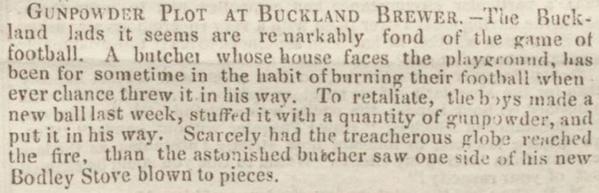
Exeter Gazette 30 September 1830 Guy Fawkes football

Exeter Gazette 1830

In an effort to spread the goodwill, I have enrolled on a (thankfully very short) ‘fun’ run. Can ‘fun’ and ‘run’ be used in the same sentence? So, in aid of Children’s Hospice South West, on November 30th, I shall be dressed as Santa (yes really) ‘running’ along Bideford Quay. I am touched by those who have sponsored me so far; additional sponsors are welcome.


Visits, One Place Studies and an Inadvertent Brush with Experimental Archaeology

Just catching my breath after a hectic round of visits to far flung family and friends. First stop the Isle of Wight. Not, as intended, accompanied by Martha, Rob and Edward, as they were busy moving house. Whilst on the ferry the fire alarm sounds in a protracted manner. Nobody takes any notice. Several minutes later and still no one is taking notice, although a few meaningful glances are being exchanged. Then the announcement. We are not to be dismayed, it is a false alarm. Dismayed? Moi? I am too busy making the most of the free wifi before I drop into an internet free black hole. The frenetic few days of socialising involves a great deal of eating out. I delude myself into thinking that this is compensated for by a daily forty lengths of the caravan site small (that would be really very small) swimming pool and a couple of long walks. It turns out that this is not the case.

Regular readers (and there must be some as this site has now topped 30,000 hits) will remember the car debacle that accompanied our trip to Scotland. This time the car worked perfectly. Our fairly new-to-us caravan however performed less well. It is equipped with many gadgets. Gadgets of course are fine as long as they work. The legs descend at the flick of a key – or not as it turns out. Gale force winds are forecast. Will the caravan cope balanced only on its wheels and a car jack? A call to the manufacturer of the leg lowering equipment enables us to effect a temporary repair. My dread is that the legs will get stuck in the down position but as we leave the Isle of Wight they ascend successfully.

DSCF2024

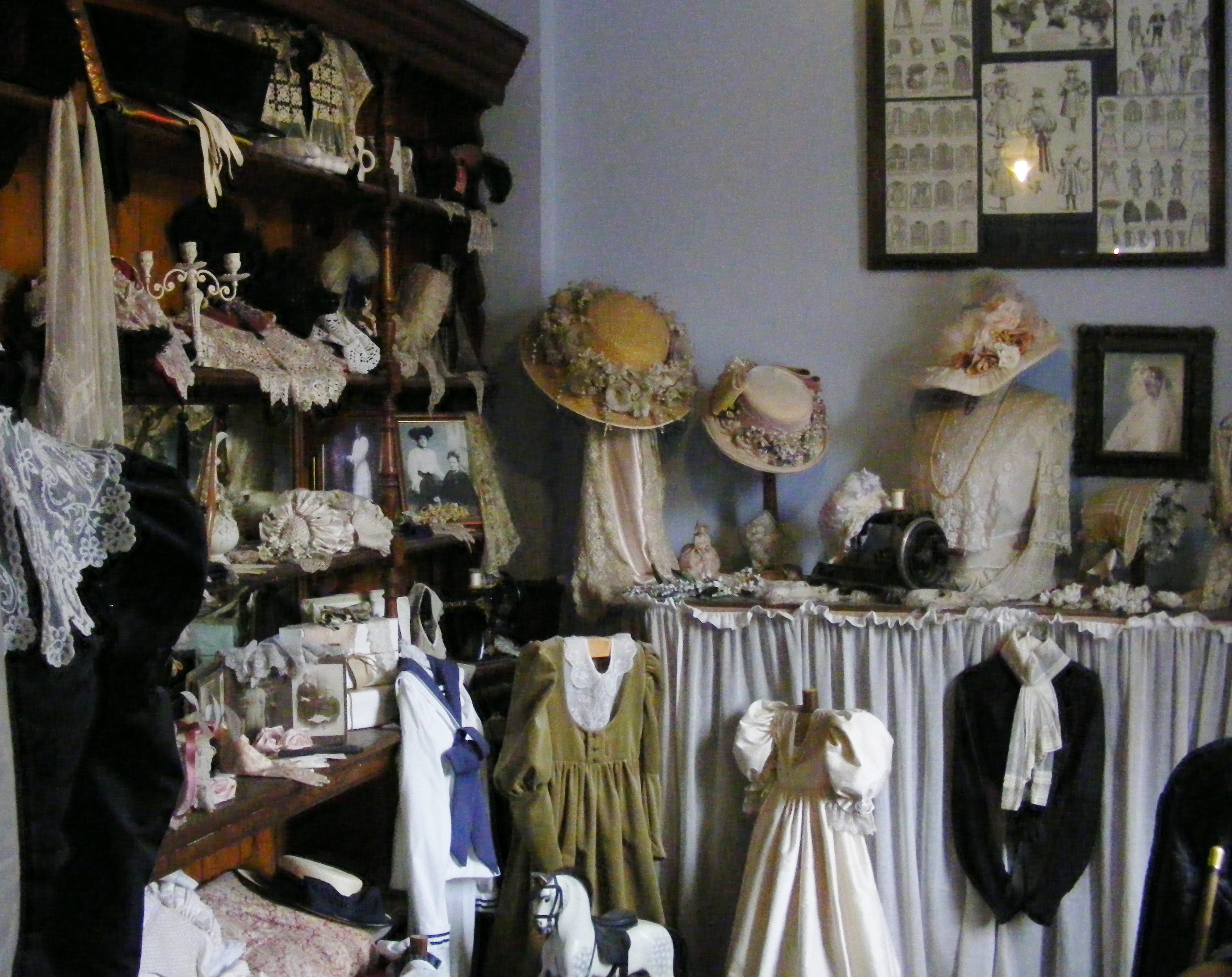
Blist’s Hill Draper’s Shop where I spent rather a lot of money

On to the Society for One-Place Studies’ inaugural conference in Telford. We nearly went to Tamworth instead (long story but to be fair, they both begin with T). A fascinating visit to Blist’s Hill Victorian Village. Then the conference. What a joy to meet with such enthusiasm and friendliness. I now have the honour and responsibility of chairing this organisation and I am looking forward to continuing to promote the cause of one place studies. I am very thankful for the support I’ve already received from committee members, postholders, members and like minded organisations. I also received the news that, following my first foray into appearing at a conference via a web link last month, I am to present at next year’s Ontario Genealogical Society conference.

Next stop Lincolnshire, to move a million (well maybe not quite a million) boxes and give gardening advice in between being in granny mode with Edward. The internet was not yet up and running in their new home so, each morning, I skulked in Boots’ car park to download and send emails. I have no idea what anyone monitoring the CCTV thought we were up to. And the caravan legs? Well here 75% of them worked. The trouble is that, unless the mechanism senses that all four legs are on the ground, it continues in descent mode ad infinitum. Gales have subsided so we settle for being legless for the remainder of the trip. Finally, to Cambridge to celebrate my granddaughter’s first birthday. Surely she cannot be one already.

Meanwhile in darkest Devon it turns out that we have no water; well we have water but just not in the right places. This has been discovered by my friends who have the misfortune to be looking after my house. Last time they were keyholders they encountered the deceased cat, this time there is water pouring through the hall ceiling. Well it is one way of getting out of the job in future. Bless them, they mopped up, drained the tank and turned the water off. Home then to forty eight hours without water, a real taste of living the lives of my ancestors. In the days when all water would have been collected from the village pump or well people would be used to managing with very little water. On day one I have three litres with which to wash and eat, a practical exercise in how difficult life would have been in the past. I hadn’t actually planned on conducting some experimental archaeology at this time but hey ho. Fortunately the water butt is full and its contents can be used for flushing the toilet. The key to using very little water is to reuse and you really need to do things in the right order. So minimal water is in the basin ready for washing and I start cleaning my teeth. Ah, I have neglected to work out where to spit the toothpaste out. I can’t waste the washing water so it has to be a quick trip downstairs. I’d already decided that I could wash my hair in water that I had already been used to wash my body. Fine so far. Next a brilliant idea – I can use the now cold water from my hot water bottle to rinse my hair. A hot water bottle may sound like a waste of precious water but no water equals no heating. Great idea in theory. My antiquated hot water bottle disgorges its liquid contents over my head, accompanied by quantities of bits of perished rubber – great. I did admit defeat with the washing up. In the past I would have been looking for bran and pewterwort (a plant also known as horsetails) to clean my dishes but I just pile them up and put my faith in a twenty first century plumber turning up when he said he would. Normal service is now pretty much resumed but it is a sober realisation that this is not only how our ancestors would have lived but also how people are still having to live in some parts of the world.


Canadian Adventures, Google+ Calamities and Badgers on Set

I know, I know, Mistress Agnes has been uncharacteristically quiet of late. To be fair she has been suffering from some dreaded lurgy. You know the sort – you wonder why you are sitting around doing nothing, go to do something involving minor exertion, like walking across a room and realise just why you have been semi-comatose for a fortnight.

Despite this she has dragged herself off her sick bed to fulfil some speaking engagements, probably being generous with her germs at the same time. Pre-lurgy was the excitement presenting to the conference of the British Isles Family History Society of Greater Ottawa. Sadly I was not actually in Ottawa – maybe next year. I was delivering via Skype, a first for me and them. There were all sorts of minor panics about the technology. What if my laptop made its intermittent 747 about to take off noise, as it often does? Then there were the forecast thunderstorms – what if there’s a power cut? In the end all went well, although it was disconcerting not to be able to see my audience as I was screen sharing my presentation. Fortunately, when I switched back to normal view, the audience were all still there and awake!

Less luck with technology on other fronts though. What on earth possessed me to think that I could host an online course via Google+. I usually consider myself to be reasonably tech savvy but I am quite a baby at Google+. Firstly there were the preliminary ‘test the technology’ sessions with potential students, which, with a bit of effort, were successful. In the end, thanks to kind people who actually know what they are doing, most of us managed to be in the right place at the right time. Just as I felt I was getting to grips with this, I inadvertently deleted my Google+ account. Let me explain. I had a Google+ account that I used and another that I barely remember setting up, which I did not. It seemed sensible to remove the redundant account. Easy! A bit too easy. So easy in fact that I deleted the active account as well. You’d think there’d be one of those nanny state ‘Do you really want to do this?’ messages wouldn’t you? Not so. Normally I am irritated by such messages but just when I could have done with one it was conspicuous by its absence.

Received wisdom suggested that I should be able to retrieve a deleted account within five days and indeed the old account was still visible when you searched, even though I couldn’t access it as the owner. I followed every possible permutation of instructions on the absolutely no help at all pages to no avail. In the end I gave up and started a new account. So if we were in contact on Google+ you will find a new Janet Few has added you to her circles. At the moment the new Janet Few is contact less so please take pity on her and add her back. You will know you have the right one as Mistress Agnes is her avatar.

Whilst on the subject of media, I was involved in some more seventeenth century filming yesterday. It is always a tad incongruous for Mistress Agnes to be televised and I think her role will be minimal to non existent but it was fun as ever and you will see Master Christopher, even if Mistress A is consigned to the cutting room floor. We were working with the internet channel SW1tv and the programme, which is part of a series called ‘Things that go Bump in the Night’, should be online in December. Talking of things that go bump. Imagine Mistress Agnes’ surprise when she went to inspect her seventeenth century abode, prior to filming, only to find that a local badger had adopted our set as his/her sett. Whilst the hovel had been unoccupied over the last few weeks the badger had burrowed in under the wall and made itself at home. Despite living in the country, this was my first encounter with a live badger so I was excited as well as surprised. Let’s just say said hovel now replicates the smells of the seventeenth century. Philip Fulford and Dorcas Fulford (1)

The other excitement is that the Buckland Brewer History Group is now the proud possessor of four glass plate photographs of mid-nineteenth century residents of our place. We are hugely grateful to the person who rescued these from ebay, where they were way beyond our budget and donated them to us.


Is the Twentieth Century History?

The obvious answer is ‘of course it is’; yesterday is already history. Certainly anyone who knows anything about current UK secondary school history teaching would be forgiven for thinking that the twentieth century is the only history. Students seem to leap from conflict to conflict – the second world war, the cold war, the Arab-Israeli conflict, the Irish troubles and if they are really lucky, that dim and distant event, the first world war. For community historians, the twentieth century has an appeal because it is within living memory; oral history projects abound. Why then do family historians seem reluctant to venture further forward than the 1911 census? Some adhere to the concept that the twentieth century is somehow ‘too recent’ and therefore not worthy of investigation. Perhaps this is partly because we often already know the names of our twentieth century ancestors, without the need for research. Are some put off by the difficulties of researching in the twentieth century? Records are subject to closure, people migrate or emigrate more frequently, there are just more people. Then what do you do with any information that you might find? Plastering the names of living second cousins twice removed, whom you have never met, all over family trees is, for most, an unacceptable invasion of privacy.

So do we just go back to the comfort of the nineteenth century and beyond? No; your twentieth century ancestors are every bit as much part of your family tree. Perhaps begin with your direct ancestors who are no longer living. Try this exercise:- Make a list of all parents, grandparents, great-grandparents and so on, who were alive between 1900 and 1940 but who have since died. If they were born during this period, make a note of when, otherwise write their age in 1900 next to their name, so you can appreciate their life stage at the time. You will probably be surprised by how many names are on this list. If you have photographs of any of these ancestors you may like to create a montage, otherwise keep the list of names handy. These are important links in your chain of ancestry. You owe it to them to find out more about their lives, their communities and what they experienced.

So here are my direct ancestors who were alive between 1900 and 1940 – no great aunts, great great uncles or cousins – just my direct line.

Cyril Albany Braund 1915

Gwendoline Catherine Smith 1925

Albany Braund 12

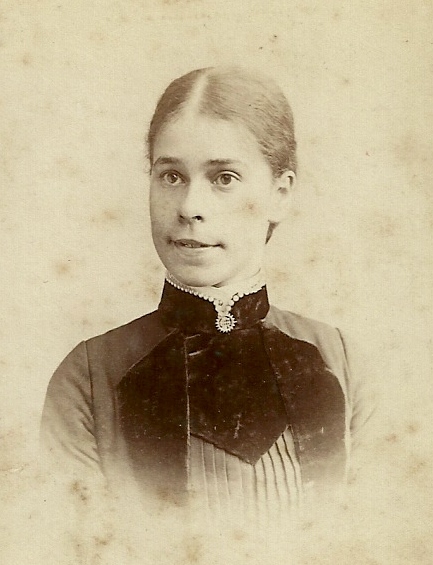
Clara Dawson 1858-1949 possibly taken 1886

Clara Dawson

Elizabeth Ann Hogg 14

Frederick Herbert Smith 6

Ivy Gertrude Woolgar 7

Fanny Thomasine Bishop 31

John Hogg 45

Herbert Havet Smith 34

Catherine Seear 34

Philip James Woolgar 45

Clara Dawson 42

Elizabeth Buckingham 67

Elizabeth Pearson 72

William Howe 69

Anne Stratford 66

Mary Archer Bowyer 69

Eliza Seear 77 – she only just makes it, Eliza died on 1 January 1900

Anne Balls Bulley 65

Writing that felt a little like reading the Roll of Honour on Remembrance Day. Perhaps that is how it should be. These nineteen individuals are my personal role of honour, as are all those who died before 1900. I shall be holding them in my mind as I begin my online course on Tuesday ‘Discovering Your Ancestors’ Communities in the early Twentieth Century’. I still have a couple more spaces in the ‘room’ if you would like to join in and feel you can cope with Google+.


The United Kingdom and our Ancestors

Ok, so I am almost as far away from Scotland as I could be, given that I am in the UK. Nonetheless I have taken quite an interest in the history-making Scottish independence referendum; fuelled perhaps by my recent visit to Scotland. Media of all kinds have brought this campaign to a world-wide audience and anyone who considered this issue realised that the impact of the result, whatever the result might have been, would stretch way beyond Scotland itself.

Of course being an historian, especially one with an interest in the seventeenth century, I can’t help wondering how the bringing together of England and Scotland might have affected our ancestors. It was of course a two stage process. The accession of James I/VI in 1603 created the Union of the Crowns of England and Scotland; from then on we shared a monarch, almost by default. On that occasion it was England who were reluctant for their parliament to be subsumed in that of Scotland, rather than vice versa. Had, as King James no doubt expected, the union of the crowns been also an immediate union of parliaments, would Edinburgh rather than London have been the seat of the united government?

Despite abortive attempts during the seventeenth century (1606, 1610, 1667 after the Restoration and 1689 under William and Mary), it was to be a century down the line before the parliaments of the two countries were united. An Act for a Union of the Two Kingdoms of England and Scotland was finally passed in 1706 and came into effect on 1 May the following year. This was in part prompted by the potential constitutional crisis that was on the horizon, as a less then healthy Queen Anne, who had singularly failed to provide an unequivocal heir, neared the end of her life. In 1706 the decision was in the hands of a few. In 2014 a huge majority of the population of Scotland, male and female, of all income brackets had their say.

113 4 August 2014 Wallace Monument from Stirling Castle

View of the monument to William Wallace, hero of an earlier attempt at Scottish independence

I think of the ancestors that I can name, who would have been alive at the time. A young John Braund, living in Devon (wish I knew where). His future wife Florence (I am not even sure of her surname). The Madicks and the Elfords, also of Devon and the Oughs of Cornwall. How would the new regime have affected them? Well I strongly suspect that they were blissfully unaware of what was going on. It may have been days before they were aware of a change of monarch, let alone a change of regime. Would the Act of Union eventually have been announced from the pulpit or on a news sheet? John Braund and Peter Elford may have been able to read, the latter was an overseer of the poor but I think it is unlikely that they had much understanding of the workings of parliament, united or otherwise. I doubt that any of my ancestors had the vote until 1832 at the earliest.

I do also have ancestors from Northumberland. I don’t know the names of those who lived there in the seventeenth and early eighteenth century but they are every bit as much my ancestors as those who I can name. I feel that this may have had more of an impact on their lives. To me, putting our ancestors in the context of the national events of their time is an integral part of being a family historian. So how did the Union of the Crowns or Parliaments effect my ancestors? I don’t know but it is right that those questions should be asked.


The Last Word on Rockstars or Mistress Agnes is Stunned into Silence (a rare occurrence)

I never win anything, not even the fete raffle. Well I did come third in a hurdles race when I was eleven but that was only because the person in front of me didn’t realise that you had to carry on running after you cleared the last hurdle. So imagine my amazement when I found out that I was the gold medal awardee for Britain in the recent Genealogical Rockstars poll, organised by John Reid of Anglo-Celtic Connections. Humbled, overawed, excited and a million other emotions. Now I guess comes the acceptance speech, where I thank my family, my agent and my cat. I would like to thank my family who have endured my historical obsessions since I took this up seriously 37 years ago – I was of course barely out of them pram at the time. I didn’t have an agent but people did champion my cause, so thank you too. And the cat? Well the cat has gone to the great cats’ home in the sky. Most of all I was truly moved by all the lovely comments from those who told me that they would be voting for me. I genuinely had no idea that my historical net had stretched so wide or had such an impact. When I look at the other award winners and nominees I know I am in illustrious company. They include people whose presentations I have listened to, hanging on every word; people whose blogs are thought provoking; people who write ‘must have’ books. An awesome line up.

GoldNow I have to live up to the accolade. So what do rock stars do? I am not about to develop drink or drug habits, to lead a bizarre personal life or to start smashing up hotel rooms, as some of the musical equivalents are prone to do. I guess I just carry on doing what I have always done, trying to enthuse others with a love of history in its many forms. So this week I have a meeting of the parish history group. I will be taking the final (surely it really is final this time) pictures of local gravestones. I will be preparing an online one-place studies course and getting ready to address the British Isles Family History Society of Greater Ottowa, sadly not in person but via Skype, Then there is the next topic in the memories of 1946-1969 to tackle, there are family and local history queries to answer – as I have said before, so much history, so little time.


Of Diaries, Domestic Issues and a little about Rock Stars

DSCF1701I am still playing catch up after my summer away, hence the lack of blog posts. Things have been taking off on the local history front and it has been very satisfying to unite more than one set of distant relatives who have origins in my village. I also now have on loan, just over there, a diary written by a farmer from my parish between 1830 and 1864. I am hugely grateful to the owner for entrusting me, a complete stranger, with such a treasure. I can’t wait to examine it in more detail. There are one line entries for each day commenting on farming duties, the weather, local funeral, emigrations and chapel activities. Some girls like diamonds, me I would chose this over jewels any day. Happy smiley one-place studier here! Similarly, yesterday my inbox offered me two invitations for Saturday, one a free pampering day at the local outlet village and two, a change to survey a local hill fort – no contest!

The society for one-place studies has been shortlisted for a grant to develop a community mapping project and we would be really grateful for your votes. More details can be found here and voting takes place via this link.

While you have your voting fingers at the ready, there are still twenty four hours or so in which to vote for your favourite genealogical rockstars. This is an annual opportunity to acknowledge those from the English speaking genealogical world whom you think deserve recognition. I was amazed and flattered to find my name included as one of 150 nominees who were considered worthy of consideration. There are some seriously big names on there, so I am humbled to be listed in the same breath as some of these genealogical heavyweights; do vote for your favourites. First of course you have to decide what you think warrants rock-stardom, there are some hints on the voting instructions. Is it someone who delivers inspiring, entertaining and informative presentations? Someone who works tirelessly and often inconspicuously, to further the cause of family history? Maybe your rockstar has written a ‘must have’ book or maintains an informative web-presence. Often more than one of these criteria will apply. I voted for those who I feel help to enthuse others about matters historical. It is all quite light-hearted, at least as far as I am concerned but it is a chance to show your support for anyone who you think has made a noteworthy contributing to the genealogical world over the past year.

Now to matters domestic. There have been some strange household incidents lately. Firstly a new item of furniture is to be ‘delivered to my kerbside’. ‘Good luck with that one’ I thought – living where I do behind another house and up a footpath, I do not have a kerbside. Then there was trying to track down the dongle that was, according to the instruction ‘supplied’ with the not yet smart enabled TV. The conversation went something like:-

Representative of a well known electrical retailer: ‘we don’t supply those’

Us: ‘but it says ‘insert dongle open bracket, supplied, close bracket’ in the instructions’.

Representative of a well known electrical retailer ‘but we don’t supply them. You will have to pop into your local store’

All very well representative of a well known electrical retailer but ‘popping’ involves a 32 mile round trip. Still not resolved this one.

Then there are the spam emails that have been arriving at a local history archive alias that re routes to me. Am I gullible enough to think that a local history archive will have purchased nine tickets to see Peter Pan in Bournemouth?


What Happened Next or Never Rely on the Internal Combustion Engine

Will we or won’t we get our car back today? Finding out is an effort in itself as there is no phone signal for ten miles and we have to resort to using the telephone box for which the minimum charge per call is 60p. I am sure it was 2d last time I used one. At 11.00 we are to ring back at 3.30. We decide to be optimistic, pack up the van ready to hitch up and start to head for Skye in the courtesy car, intended to ring as soon as we have signal and turning round if our car is not finished. So we head over the bridge to Skye for the third and in this case unscheduled, time. We top the courtesy car up with petrol. Strangely, the more petrol we put in, the lower the petrol gauge seems to go. Confident that we must have returned the contents of the tank to the required level, notwithstanding what the gauge suggests, we seek an opportunity to contact the garage. Unfortunately phone signal and potential passing places do not coincide. As soon as we spot a signal indicating bar appearing on the phone screen we pull in to a turning, as the road is too narrow just to pull up. Immediately we do so the bar flickers and disappears. This happens several times before finally signal and parking opportunity coincide and we are told we can collect the car in an hour and a half’s time, at 5.30. At this point we realise that we really should have eaten our main meal in the middle of the day. We use the spare time before car collection to acquire some very good fish and chips from Portree harbour, highly recommended. It is raining, what a surprise, so we have to eat these in the car. This means that we have to continue our journey with all the windows open in an attempt to alleviate the smell of fish and chips.

We find the garage and there is our beloved car minus its wheels. Correction, it is Chris’ car. When I see the size of the repair bill it is most definitely Chris’ car. Wheels affixed, we set off, hoping to get to Grantown-on-Spey tonight, some 150 miles away from the garage on Skye. We make good time back across Skye to the caravan site. Van attached and we feel our holiday is back on track. Five miles up the road and the car begins to sound like a jumbo jet, there is also a rather alarming smell of burning paint. Admitting defeat we limp back to the site we have just vacated and settle in for the night.

The next day we return to the phone box for another call to the recovery services. Whatever is wrong seems unrelated to the previous problem and we are told the car will get us home. Ok, I’ll admit, there was no mention of when. I am not clear on the nature of the problem in technical terms – something to do with thrusts or turbos. In practical terms our top speed is 50mph and that’s going downhill, uphill is a very noisy 30mph. This is the highlands of Scotland. The clue is probably in ‘high’; there are a lot of hills. Chris is convinced that it is ‘all downhill’ on the way home; I am sceptical. We have 642 miles to go and Bank Holiday traffic is looming, deep joy.

We begin the journey home as soon as we can, at midday. The weather is that typical Scottish combination of beautiful sunshine one minute and rain the next, although this is probably the best weather we’ve seen for a fortnight – inevitable really. We nurse the car southward, including along past Loch Lomond on a route that we have not traversed previously. After 150 miles and 4½ hours of annoying the traffic behind us we reach our first dual carriageway. We arrive in Glasgow for rush hour. Signs warn us that progress will be slow for seven miles, or in our case four hundred and seventy seven miles. Our not recently updated satnav doesn’t recognise this bit of road. We decide to ignore her instruction to ‘turn around where possible’ in the middle of the M74. We finally give up at Carlisle but at least we are back in England and the site has a television signal so we can watch Who Do You Think You Are?

An early start the next day as we still have 375 miles to go and the sooner we reach the south west peninsula the more likely we are to miss the worst of the weekend get-away traffic. The weather is glorious – no comment. Now we have motorway we can manage a steady 50mph, when the road works, traffic jams and accidents allow. On spotting a caravan that has come adrift from its towing vehicle on the M6, fortunately it seems without injuries, we realise that we could be worse off. In fact looking at the traffic heading north, which is solid from Manchester to Tewkesbury, we could be a great deal worse off. Getting through Bristol, eight hours in to our journey and during the rush hour build up is time consuming. Beyond Bristol things improve for us but there are clearly still serious north bound delays. At last we are thirty miles from home and the end is in sight when we see the dreaded ‘road closed due to accident diversions are in place’. Said diversion was up a narrow (narrowish – our caravan passed another going in the opposite direction without mishap) road and our convoy is being led by someone who has clearly never driven on anything more slender than a motorway. Their response to being on a road with only four foot on either side of their vehicle is to drive at twenty miles an hour; at least we are no longer getting the blame for impeding the flow of traffic. This diversion puts another hour on what has already been a ten hour journey. I reflect that, in the past, ten hours to travel the length of England, without getting wet or saddle sore, would have seemed like a dream; sadly though I have twenty first century expectations. At least I am compensated for the debacle and missing what promised to be some of the ‘best bits’ of the holiday by the fact that half my family are waiting to greet me at home. I have gate crashed their time in Devon but at least I can enjoy being a Granny.