My travelling companion is still plague-ridden and has had a very bad night, which by extension, means that I have too. We don’t quite make the first lecture but I am up next with part three of my writing-up workshop, this time concentrating on occupations. This is followed by Eric talking about emigration from Germany. Although I have no German ancestry, this is interesting, as I am fascinated by motivations for migration and migration processes.
Rosemary then outlines the advantages of The Genealogist website. I am planning on taking out a subscription as soon as they upload more of the Valuation Office Records, which are a favourite of mine. Its smart searches are a feature not shared by other sites and allow for searching for suggested siblings or parents. There is also a facility for overlaying maps of different eras.
Roast beef is on offer at lunch time so, although I have been avoiding eating too much in the middle of the day, I break the habit of a holiday and choose this. Then it is a full afternoon of lectures. Michelle describes how to break down Irish brick-walls, followed by Paul’s guide to researching at the National Archives. We are encouraged to plan ahead and use the research guides. Apparently the National Archives have a YouTube Channel, who knew? I finish the afternoon with my Darlington to Wellington story, which seems to go reasonably well. The final session of a very long day is Paul again, this time telling us about Quarter Sessions records.
The following day is also packed with lectures and finally I feel a little less shattered. Even my lurgy-filled companion is showing signs of improvement. Although several of our party are suffering with sore throats, coughs and headaches, it does not seem to be infectious as cabin companions are not being struck down. Michelle starts us off by encouraging us to review our research, something I shall certainly be doing when I get the opportunity. A combination of timelines, checklists, DNA and robust research techniques should help us to make progress. Rosemary reminds us of the value of Directories and Almanacs. Many historic directories can be found via Internet Archive or the Leicester University historic directories site. Amongst other things, she mentions lists of sheep brands. Not you understand, as in brands or breeds of sheep but the distinguishing marks used to brand sheep in order to identify their owners. A quick search by those with internet access suggests that these are a thing in England too. I so have to check this out and use it in a talk somehow.
Next is the first of my two writing up sessions of the day. Part four focusses on the social history. Sue follows with another of her family case-studies, this time about Georgian abuse and Victorian divorce as she recounts Mary Stephenson’s journey in the Bawdy Courts. My last writing-up session includes a lively discussion on the ethics of including sensitive issues in our family stories. It is sad that my contributions are over. In a way I wish I could have ended with a different talk but I have enjoyed sharing my presentations and hope that they have been enjoyable, informative and above all have enthused my audience and made them think – that’s the aim anyway. I am excited that some of the Queenslanders plan to replicate my Remember Then project in Australia.
Paul’s final session records the workings of the Scottish Burghs. I am fascinated by a Glasgow Police Return of 1841, which gives details of the names, living conditions and health concerns of many described as destitute. I hope there is access to this online. Michelle talks about some of the Breakthroughs, Surprises and Skeletons in her family tree. Sue’s evening talk is about using forenames as a guide when investigating a family. I have rashly consumed too much cake and indeed food in general.

 A group of Guild on One-name Studies’ members foregather in the Windjammer in the evening and we consume yet more copious amounts of food.


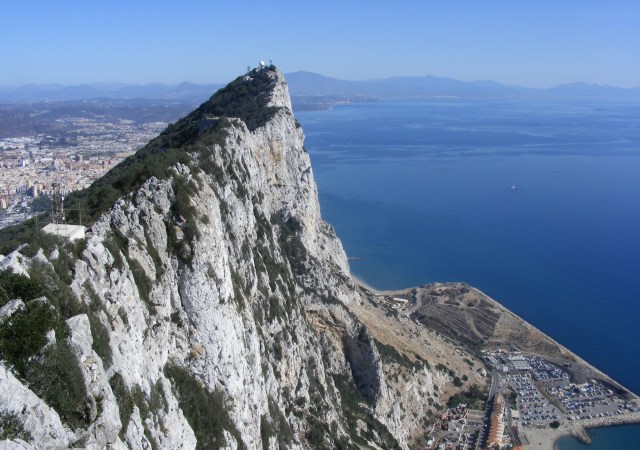 After an interesting and warm trip to Gibraltar, we return to the ship. The layer of pollution is evident over the sea but the views are still good. I was particularly interested in Michelle’s talk about ‘Thrulines and Theories of Relativity’. I am eager to get back to the land of the internet so that I can explore mine. It was probably just as well that it was our turn to entertain in the evening, as otherwise we would have struggled to stay awake. I have no idea why we are still so tired. ‘Coffers, Clysters’ is well-received as usual and one of our number receives a seventeenth century make-over.
 Paul Milner begins the conference with an interesting session on ‘The English Context: history, sources, repositories and processes.’ A veritable minefield for those researching from overseas, as most of the audience are; there are only five Brits at the conference. We debate why some counties are shires and some are not. Could it be the migration patterns? Why is County Durham, the only county to be described in this way? Probably because it is the only non-shire to have a county town (or indeed city) of the same name as the county, so it is a way of distinguishing between the county and the city. And so to bed. On our way past a public area an enthusiastic member of the entertainments’ team is exhorting his audience to believe they are butterflies. Numerous apparently sane adults are waving their arms, sorry wings, about. We don’t linger to find out what all this is about. The ways of cruise ships are unfathomable.