I’ve been bracing myself for a ridiculously busy couple of days. After virtually presenting in Kent and Norfolk yesterday, today was the first of two THE Genealogy Show days. Talks are being live streamed over 48 hours and my first went live at 4am my time. I was invited to listen to myself (always cringe making) and be on hand to answer questions, I decided to pass on that one. I only just missed the opportunity, so spent the early hours exploring the Show’s website and even manged to sneak in the chance to listen to three exciting young genealogists in a panel discussion about young people and genealogy. It is several decades since I was that young person and it is great to watch the baton passing on.
This was followed by my fortnightly chat with the lovely folk of Talking Family History. They are starting a new series in July, so now would be a good time to join in the fun. Then it was my turn to person the Society for One-Place Studies booth for THE Genealogy Show. Over lunch, I tuned in to Dr Sophie Kay’s Negative Spaces presentation; definitely worth a listen. Later, I had the chance to watch Andy Browning’s fascinating story Following in Family Footsteps.
Other recent feelgood family history moments. A photograph of my, now demolished, first teeny tiny infants’ school being posted on a Facebook Group, together with a picture of the headteacher, albeit about twenty years before my time. A few weeks ago, I was very excited to be offered the chance to acquire a one-name related long case clock. Even better, my nearest and dearest agreed that it could be a belated birthday present. The maker was from a different branch of the family to my own but it is still very special to have it safely ticking away in my living room. Finally, our local history group held its first hybrid meeting, with the speaker and five others in the meeting room and others Zooming in from as far afield as New Zealand and Canada. We still need to work to improve the sound quality but we are proud that a small society such as ours has been able to take a first step towards making our meetings accessible to those who are not comfortable with technology as well as our friends who are too far away to attend in person.
Tomorrow more busyness, more family history talks to give and listen to and an interview with Daniel’s Genealogy in the evening.
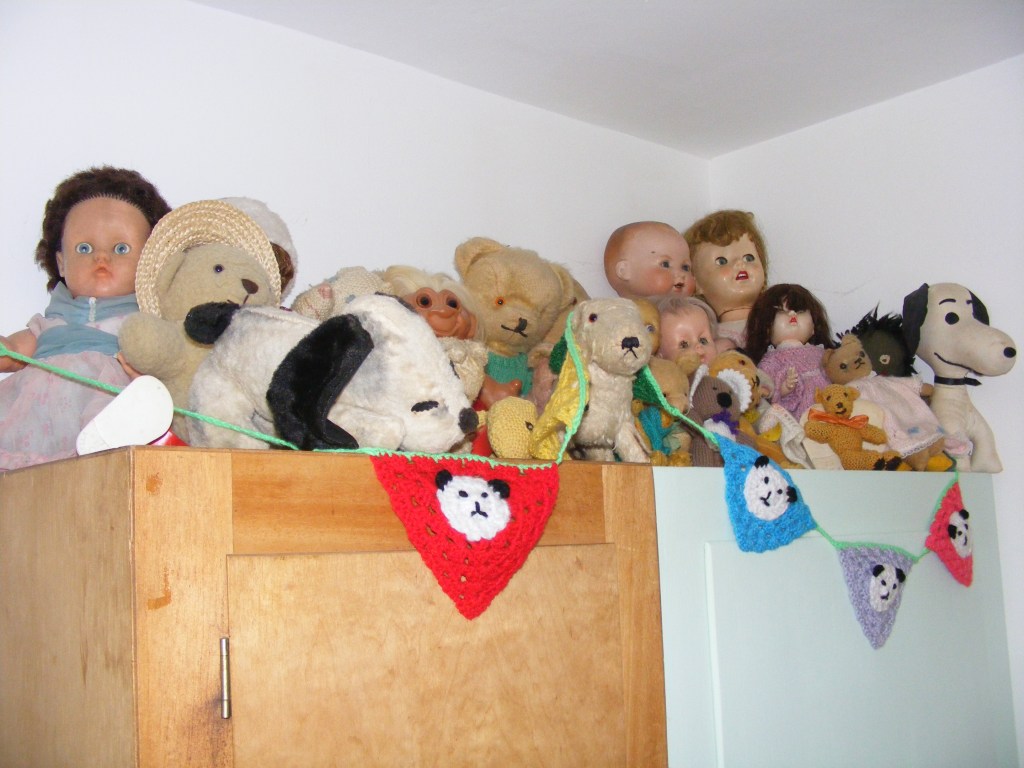
What else do you do on a summer Saturday but excavate the historic doll/stuffed toy collection from under the dust of ages and I do mean ages. I am not sure that the stuffed toys have had the dust bashed out of them for decades.
Meet the motley crew, some of who are almost centenarians.
They were removed from their cupboard-top home, stripped naked, apart from the two that my mother appeared to have sewn into their clothes and readied for the major operation.
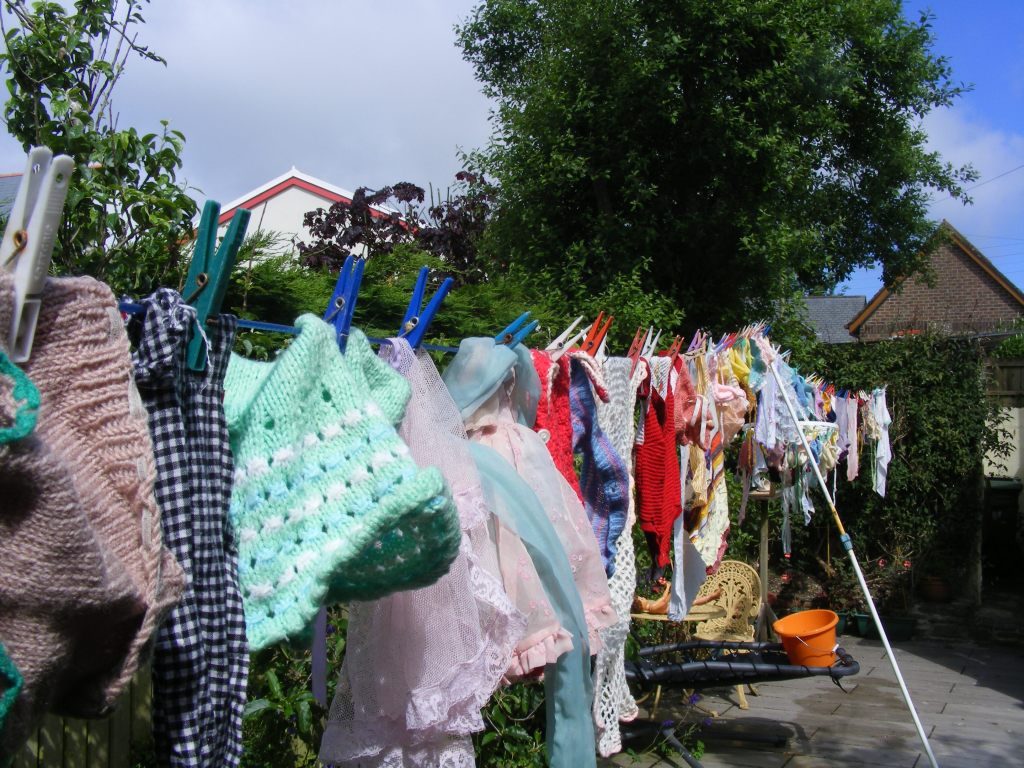
Next, to wash the clothes, some of which needed hand washing. It might be a while since they were last washed but I know from bitter experience these are old fabrics that are far from colour fast. Sadly, since they were last laundered, it seemed that the moth had made a meal of some of the woollen items, lovingly knitted by three generations.
The shoes were scrubbed and left to drain.
Then bath time. I don’t have a real bath (I have what is officially the smallest bathroom in the world – seventeenth century cottages not being too hot on bathrooms, so I replaced the bath with a shower). No bath means no bubble bath, so I substituted washing up liquid. It turned out that I also had to use a rather rough washing up sponge to scrap the dust from grubby limbs and faces – sorry dollies.
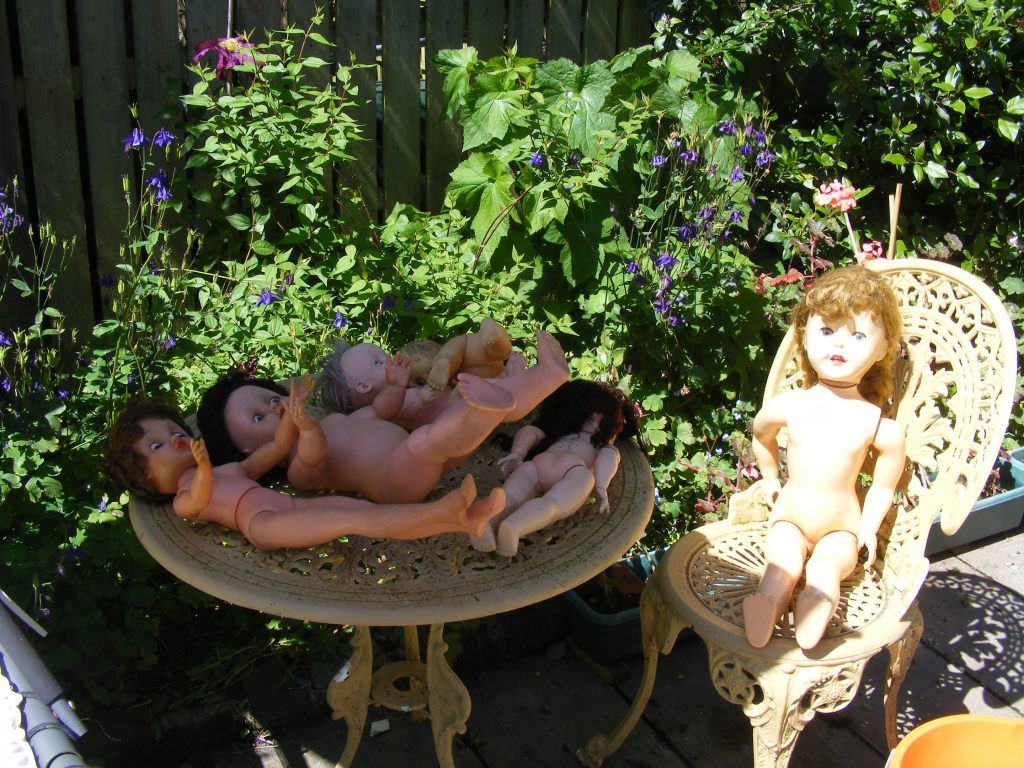
From the left: Christine, Jilly, Mary, Jane, Betty, Sally, Big Peter – you can pin point my generation just from the names.
As you will see, the baby bath has stood the test of time. I am wondering if this will be marked up as an inappropriate image.
Mary and Jilly
You have no idea how long it takes to peg umpteen small items on the washing line. Take it from me – a long time and it used up every inch of line and every peg I could find.
The dolls were left in the sun to dry. I did have to temporarily amputate a few limbs and even one head, in order to let the water drain out.
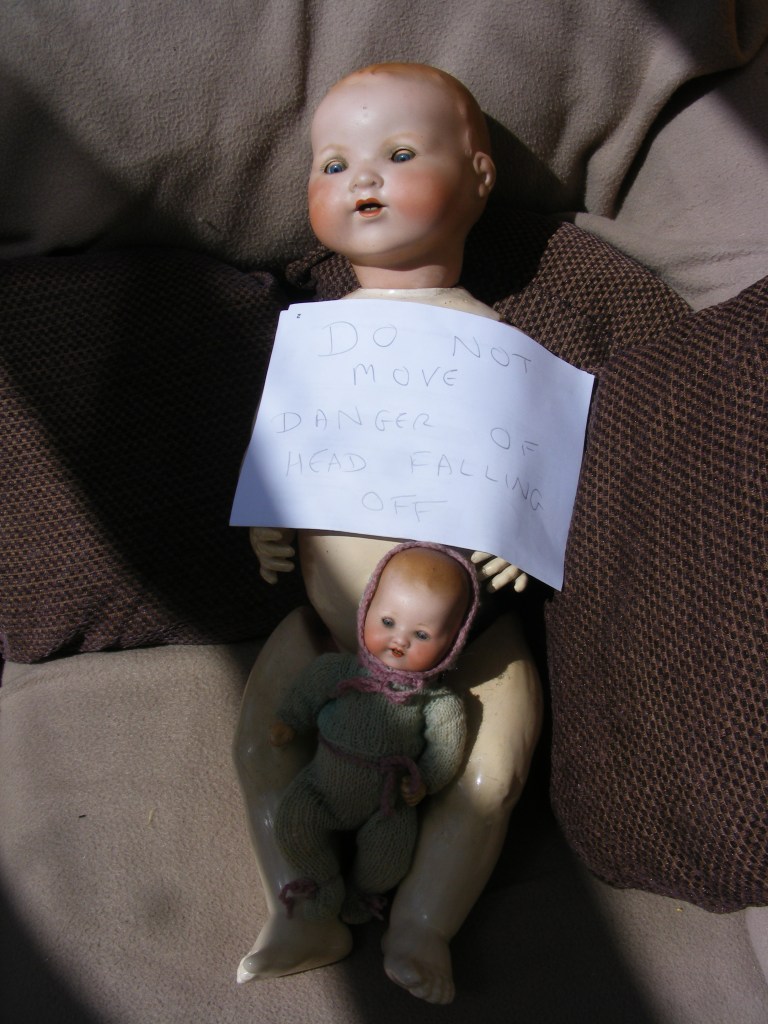
Big Peter and baby Peter (not a lot of imaginative naming on the part of my mother there), now in their late nineties, were spared total immersion, not least because baby Peter’s clothes don’t come off. In fact I fear for the stability of the wires attaching Big Peter’s limbs and heads, hence the warning notice.
Then it was time to bash the soft toys together and stand well back as the dust flew.
A quick bake in the sun followed. Today they will be redressed and replaced on top of the cupboard. It is a sobering thought that if they wait as long for their next washing as they did for this one, I may not be around to do it.
My lovely memories group ladies are writing about the toys and games of their childhood at the moment. I am fortunate to have many of mine still in my possession. The great loft sort has revealed a feast of goodies. They may just become the subject of a talk. In the meantime, whether you still have the contents of your toybox or not, I would encourage you to record the memories of your own particular treasures.
NB no dolls were permanently harmed in the creation of this blog – well, I am not sure I should have washed Jane’s hair (already her second lot of hair) but she will get over it.
Here I am, three decades after serving on the executive committee of the Family History Federation, having the honour of being voted in as its President. I am following some seriously big names in the genealogical community. To be considered some kind of elder stateswoman, is not only a humbling experience, it also makes me feel incredibly ancient. Perhaps I should point out that during my time on the executive I was the youngest ever serving member; though I think that record has since been passed to someone else. Family history societies are at a cross-roads. Many have seen slowly declining memberships and have struggled to fill committee and volunteer roles in recent years. Now is the time to reinvent ourselves and our function, or to fade into oblivion. We cannot keep repeating the pattern that has not been working well and expect it to suddenly become relevant and appealing. The pandemic has forced us to rethink the way in which we do many things. Societies can either put change in the ‘too hard’ basket or embrace it and perhaps use it as the first step to a resurgence. Societies can still be relevant in today’s genealogical landscape but it takes work and insight to make them so. For many years, I have come into contact with societies across the world as a member, a volunteer and a speaker. In the past year, my ‘catchment area’ has expanded exponentially and I am looking forward to ‘meeting’ many more family historians in the coming months. I am very mindful of the honour that has been entrusted to me in these challenging times.
On the family history front, I have been getting out my sledge hammer and attempting to crash through some family history brick walls for Devon researchers. Despite much of the sleuthing being done by my colleague, I ended up presenting the findings in a FindmyPast podcast, which you can view here. These may not be your personal brick walls but the techniques we used could be effective on your own problem ancestors.
I have also had what is probably classed as an old-age crisis. Before I wrote Barefoot on the Cobbles, I debated whether to write a novel or take a post-graduate course. On that occasion, the novel writing won. I am still playing with ideas for a possible third novel but nothing yet seems quite right, so I have returned to the post-graduate idea. I am excited to have been accepted by University College Dublin as a remote student on their certificate course in experimental archaeology and material culture. I am not quite sure what I have let myself in for but I am not going to be bored.
My ‘Discovering more about your Agricultural Labouring Ancestors’ online course is coming to an end and the students are now compiling case studies about their chosen farming ancestors. I have a few more submissions to read from my ‘Writing and Telling your Family History’ students, then thoughts will turn to next month’s course, ‘In Sickness and in Death – researching the ill-health and death of your ancestors’. As I said, no time to be bored.
For those of you waiting to hear about the end of our short trip to South Devon, watch this space.
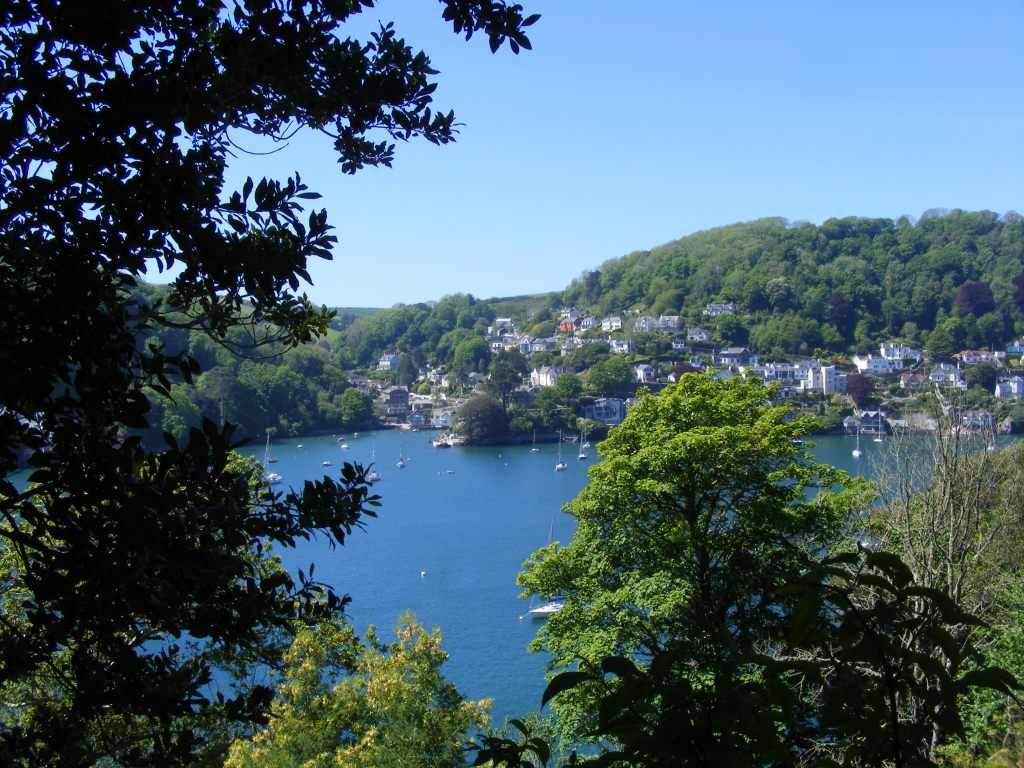
Undaunted, well fairly undaunted, we drove to Kingswear to try to tackle the coastal footpath in the right order from that end. It would be a mere two miles from where we finished the previous day (and then another two miles back to the car). We would then decide if we wanted to repeat the bit we’d done in the wrong order to ‘do it properly’. Kingwear has a very attractive harbour, even though it is sad to see the fishing fleet of the past has been replaced with pleasure yachts. The first part of the walk from Kingswear in the Brixham direction is on pavements out of the town. The gradient is, shall we say, challenging, even if it is smooth underfoot. I just about managed this and then the route took us through a wooded section. I was very thankful for the shade as it was another very hot day. After half an hour, there was an encouraging sign that told us it was only 1¼ miles to where we had abandoned the walk the previous day. Yay! 1¼ miles is but nothing. Except that it was.
We descended into the valley via a flight of steps and a rough path to Mill Bay Cove. I am used to reading Ordnance Survey maps. Perhaps I should have taken better note of quite how close together the contour lines were – that would be practically on top of each other. I started to climb the steps cut into the path as we left the cove. I stopped for a rest. I climbed some more. I rested some more. I climbed a little further. My body really wasn’t playing ball. Reluctantly, I decided that a walk was a walk and I ought to be proud of how far we have come since Minehead, rather than how much we didn’t complete. Even though my future walks will need to be on flatter terrain, I guess I should be grateful that I am still able to go for a walk, albeit a flattish one.
We returned to the safety of the car; its thermometer told us that the outside air temperature was thirty degrees. That seemed to escape the weather station statistics. An afternoon of rest, if not full recouperation, followed.
Taking it easyish seemed to be the best plan for the next few days. Day four was showery and cooler but humid. In search of places that wouldn’t be too peopley, we drove out beyond Buckfastleigh, on the edge of Dartmoor. Venturing down some byways that were, at least in theory, roads, we reached Hembury Woods. Lacking a map, we were keen not to get lost on our woodland wander. Our first attempt was unadventurous and based on keeping left but we ended up back at the car after about three hundred yards. We would need to be more daring and try to remember lefts and rights. One woodland path does look very much like another. We tried leaving field signs – once a Girl Guide …….. – although I was concerned that a passer by might move our carefully laid twig arrows. In the end, it seemed we were following a pre-laid trail, as small piles of sawdust were laid at intervals along our way. The woodland was strewn with a wildflower, later identified courtesy of the flowers book as Small Cow-wheat. Not heard of it? No, me neither.
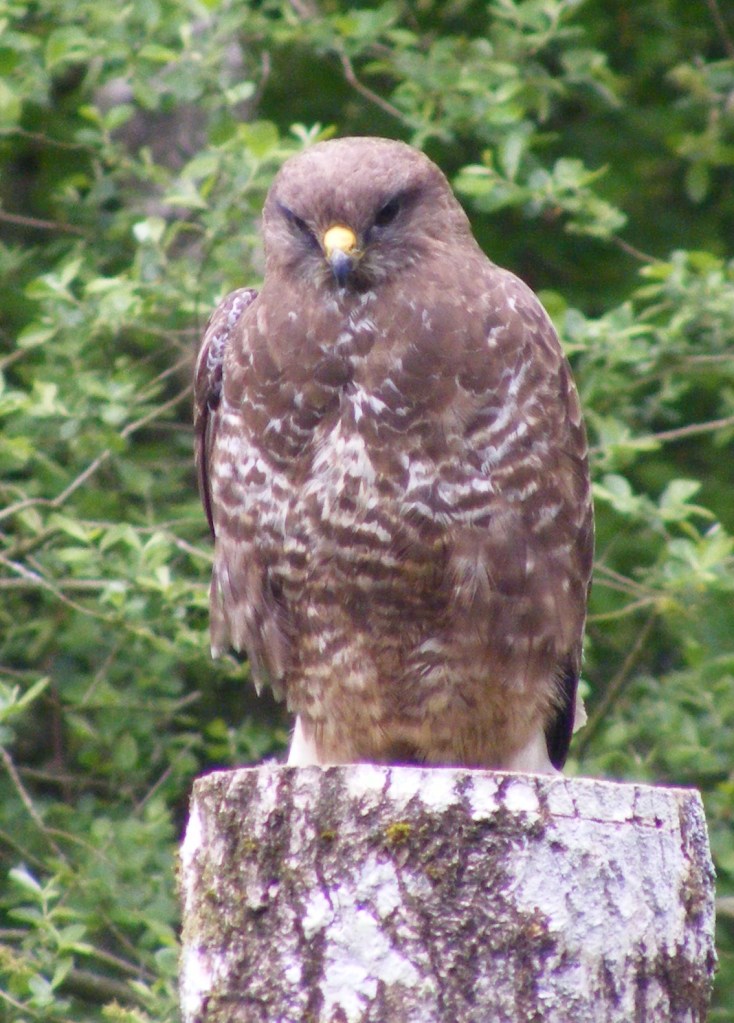
Having reached what I felt was a suitable half way point if we were to have a not too strenuous walk, I was keen to retrace our steps but my companion was confident we could make a circular route. I was less convinced but we soldiered on. Behold and lo! There was the car. In order to keep the step count up, we also returned to the country park next to the site and were rewarded by the site of a roosting buzzard. Small birds and squirrels were feeding heedlessly nearby but perhaps the buzzard had had its lunch.
To continue the tale of our recent foray to South Devon. The second day started badly. We were driving to the starting point for our walk when I realised I had left no fewer than three things in the caravan. One of these was my fitness watch. No way was I going to not count today’s steps. We retraced our steps. I wish to put on record that my companion also forgot something but didn’t realise in time to collect it during our step-retracing mission.
The plan was to start at the end of our chosen stretch of coastal footpath in Coleton Fishacre, walk to KIngswear and retrace our steps to complete the leg in the correct order and also to end up back at the car. As one of us is a National Trust life member and the other a National Trust volunteer, we hoped we could park in the car park at Coleton Fishacre, which is a National Trust Property. We duly parked. I even worked out how to scan my membership card in order to obtain a ticket. I had toyed with booking a visitors’ slot for entry to the property, which would have secured us the right to park but decided it was selfish to use up a place whilst entry is limited and we didn’t want to go further than the car park. Mission almost accomplished when the car park attendant loomed. It transpired that no, we couldn’t park there. The man was not open to persuasion, although my companion had a jolly good try. ‘There’s another car park just up the road’, we were told. We could not access the coastal path via Coleton Fishacre. This was all very well. The car park was indeed only about 500 yards away but this gave us access to a different point on the coastal path and with having to do it twice, would add another 1½ miles to a walk that was already at the limit of my likely unpracticed endurance.
Nonetheless, we set off with a spring in our step, enjoying the spectacular views. It is my habit, probably dating from my Girl Guiding days, to keep a note of the birds and wild flowers that I see en-route. My bird identification abilities are probably no better or worse than they ever were. Definitely above average but certainly not expert and I have never been able to recognise bird song. I realised though that my memory for flower names had become somewhat tarnished. When we were walking more regularly, I could identify many more. The flowers were at their best and this is my favourite time of year. Ox-eye daisies, scabious, foxgloves, thrift and ransomes and the last vestiges of bluebells in the small wooded section, which also yielded a jay and a thrush in the bird department. There were many more to add to my list and to begin with, the eight years since we last did a coastal path walk melted away. Don’t get me wrong, it isn’t eight years since we have been for a walk but those walks have been elsewhere, including local stretches of the same path.
To the fitter of my friends, a 7½ mile walk may seem like a gentle stroll. If you’ve never walked the south-west coastal path, be aware, be very aware that, with very few exceptions, gentle stroll it is not. There are hills, lots of them and the path is anything but smooth. I learned two things on this walk. I am definitely not as fit as I used to be and when the guide book says ‘strenuous’ this is not to be taken lightly.
After the first hour, every step we took away from the car was a reminder that it would be a step further in the opposite direction. This stretch of path is blessed with many seats. I sat on most of them. This was ridiculous. We had only last month done several walks of about five miles and here I was three miles in and struggling. It was also the hottest day of the year so far and we were heading towards the heat of the day. We could see our destination in the distance. It seemed, dear reader, a very distant distance. I’d been worried about blisters, well that and the lack of toilets but I always worry about that. Neither of these issues became a problem but I was conscious that I was breathing increasingly heavily. A few years ago, I would probably and possibly foolishly, have carried on regardless. Quitting is not normally in my vocabulary. At the back of my mind though was the niggle that hidden in a place on my medical records that I mostly choose to ignore are the words ‘heart condition’. Was it really sensible to keep on keeping on? We might not yet be half way to Kingswear and then we had to do all this again in reverse. The map suggested that there was a way to come off the path and return to the car by a slightly shorter and certainly less strenuous route. Common sense prevailed and that’s what we did. Altogether we probably walked five miles, although most of it was far from easy walking, this did seem pathetic. I was very annoyed with myself. Then there was the problem of how to proceed. Up to now all our walks have been in the correct order and in the right direction. We could start at KIngswear next time and walk to where we gave up but then what? Could I bring myself to compromise and count this walk as part of the challenge, despite it being in the wrong order and wrong direction? Could I face doing it again the right way round, knowing what I know now about how hard it was? If we can only notch up four miles a time, the remaining 153 miles are going to take a very long time to accomplish and our fitness is hardly going to improve. Always end on a cliff hanger. Stand by for the next instalment to find out what we decided.
Some advice for would-be coastal path walkers. Unless you are super-fit types who think nothing of notching up twenty five miles a day laden with your tent, sleeping bag and all other requisites, don’t leave it until you are of mature years to try to walk 670+ miles round the south-west peninsula. It is so worth it though, the scenery is breath taking. Even if you only walk a small part of the route, everyone should give this a try. I’d also recommend reading Raynor Winn’s The Salt Path about her walk with her husband along the whole length of the path.
A last minute change of plan meant that we were left with a few free days. I wonder what they are? The weather had finally decided that it was no longer winter, could we find the one caravan site in the country with vacancies? It turned out that we could, so we decided to head south to recommence our walk round the South West Coastal Path. We began this seventeen years ago when we were a lot younger and fitter. Even then, not for us the twenty-five mile a day stretches, complete with tents to our backs. No, this is supposed to be pleasure. Over the course of ten years, we completed the Somerset coast, north Devon, the whole of Cornwall and got as far as Dartmouth. It took us 73 walking sessions to cover 477½ (don’t forget the half) miles. Then the grandchildren arrived and we found better places to go when we have days to spare. We had also reached an off putting stretch where there is no public transport to get us back to the start. The options being, walk 10½ miles described as ‘strenuous’ and get an expensive taxi back. Or cover this in three sections walking about 3½ miles in both directions in order to get back to the car. It really is very dispiriting to have to walk twenty miles to end up only ten miles further on. If we were ever going to finish the remaining 153 miles however now was the time. 10½ ‘strenuous’ miles is probably just within our capabilities but given that I have spent a year barely walking further than the front gate, it didn’t seem sensible. So the bullet needed to be bitten, three lots of there and back it was to be.
Day 1 consisted of arriving at the caravan site and completing a warm up stroll round the beautiful neighbouring country park, when the wildlife actually played ball. There was also a lengthy conversation with the caravan site wifi help line. I wasn’t going to be caught in an internet black hole again. It turns out that it was a ‘no help at all’ line but I solved the problem by reregistering with another of my many email addresses. I just have to remember who they now think I am.
I decided that it was high time that I looked at some of my closer DNA matches, where I am unable to identify a common ancestor. I should explain that ‘closer’ in my case means not very close at all. My lack of cousins means that I only have three matches above 70cM and one of those is my daughter. My attention turned to a 48cM match with no tree. From shared matches, I had placed this person on the Smith/Seear side of my family tree. The Smith/Seears are tricky DNA wise because three generations of Smiths marry Seears, so I am often related to people on this line more than once. This means that suggested relationships are distorted. Without my pedigree collapse, the amount of shared cM with the mystery match might suggest that the relationship was in the region of a 3rd or 4th cousin, maybe with a removed or two.
The profile indicated that the user had joined Ancestry in 2016 and hadn’t signed in for over a year. I don’t want to give the actual name for privacy reasons but the user name looked like it could be the first half of an unusual female christian name and a surname run into one. This isn’t it but think constabolt might be Constance Bolt. I guessed at the name, Googled it and up came an obituary for the husband of someone with that name. This indicated that the person I was searching for was born in a particular smallish town in the south of England. Further internet searches revealed a maiden name and a middle christian name. To make this story easier to follow, yet still anonymise it, I am going to tell it with a fictitious maiden name. Let us say it was ‘Forester’, which probably has a similar rarity value as the actual name. This with the other information was unusual enough for me to locate a birth entry and discover that the lady, if she was still alive, would be in her nineties. Better still, her mother’s maiden name was Seear. Not only did it look as if I was on the right track but a great advantage over Smith. Yay! Eureka and all that. Now all I had to do was find a marriage for a Seear and a ‘Forester’ and I was away. This was going to be easy. Err, no. Not a marriage in sight. I searched for any other ‘Forester’- Seear children. None. Given that the marriage was likely to be not long after the first world war, it seemed probable that Miss Seear had married x before she was married to Mr ‘Forester’.
The Seears’ normal stomping ground is east London. There couldn’t be many in this small southern English town could there? There weren’t. I tried the 1911 census and the 1939 register for that area. I found a family in 1911 with two daughters who were potential wives for Mr ‘Forester’. They both married other people and died with those surnames; no second marriages to Mr ‘Forester’. The 1911 census indicated that there were other children who were not in the household, maybe I could find another daughter. According to the census there had been nine children, three had died and three more needed to be found. The family was headed by a married Emily Seear, no husband in sight. I found her in 1901, still in London, still married and still no husband, this gave me three more children. The children had unusual christian names but I couldn’t identify birth registrations for them all. Checking the births I could find on the GRO site gave me Emily’s maiden name but searching with Seear and the maiden name did not reveal the missing children, nor were they registered under Emily’s maiden name. I had her year of marriage from the 1911 census. This meant that I could find her marriage entry and the name of Mr Seear, who was potentially the grandfather of my DNA match. It was a name I recognised and suggested that the match and I were third cousins once removed twice over. I will continue to refer to him as Mr Seear, although, from this point, I was searching under his full name.
I was left with a gap and some questions. Which daughter of Emily Seear was the mother of my match, why weren’t all the children registered and where the heck was Mr Seear, who died in the 1920s but is elusive between his marriage and that point? He was clearly around to father nine children on Emily, at least one of whom really was his biological child, or there would be no DNA match.
By diligent searching I found one of the daughters marrying under a variant of Seear and then a subsequent marriage, under the surname of her first husband, to Mr ‘Forester’, which proved my link to my DNA match.
I did find the baptism of one of the children whose birth wasn’t registered but I couldn’t find the three who had died by 1911; perhaps Emily was counting still-births. There are some large gaps in the children but given what appears to be a rather odd relationship between Emily and Mr Seear that isn’t surprising.
So what do we know about Mr Seear? Given that he is my first cousin three times removed and not a close relative, I hadn’t researched him beyond his name and appearance with his parents in the 1861 and 1871 censuses before. He married in his home area in East London in August 1881, claiming to be a banker’s clerk, yet he can’t be found in the 1881 census, despite my knowing his address just four months later. Seear is a bit of a nightmare to search. Apart from the variants (Seer, Sear, Seeare and many more), it is often mis-transcribed as Leear or Teear, or indeed it seems something else entirely.
I did find a listing for Mr Seear going to Baltimore in 1883. His occupation was ‘agent’. Much as I’d love to think this was some kind of secret agent, I am quite sure it was as the representative of a company or organisation. Perhaps this is why there is an apparent gap between the first child in 1882 and the second in 1886. I totally failed to find Emily or Mr Seear in the 1891 census. I know they were in east London when a child was born at the end of 1891. I tried every technique I know, including search for christian names and dates of birth, without a surname. I tried the 1890 US census in case they all went to America; they were not there either.
I can’t find any children born between 1886 and 1891 when suddenly there were three children born in as many years, perhaps the relationship was re-kindled. There is then another gap before the final child in 1899. I have a baptism for this child on which Mr Seear calls himself a Dining Room Proprietor.
So we reach 1901 and no surprise that Mr Seear is conspicuous by his absence. Sadly, he seems to have kept his name out of the newspapers as well. Emily, describing herself as a married coffee house keeper, is still in the London area, with six children, including the mother of my DNA match but who is using a different christian name (I suspect an enumerator copying error as the names, although very different, have the same number of letters and shape).
Fast forward to 1911 when Emily and three children are in the south of England. Lo and behold Mr Seear turns up, living in London with his brother, claiming to be unmarried and working as a caterer for a licensed victualler. Two final sad entries, which show that Mr Seear spent time in the workhouse before he died.
This has taken me all morning but I am pleased to be able to untangle the tale. Shame about the other 16,000 unidentified DNA matches!
We are still, it seems, in the depths of winter here in darkest Devon. Time for some family history. That’s nonsense, it is always time for some family history. I am now in my 44th year of research, so it isn’t always easy to find anything new but every now and again I get out a long untouched branch, dust it down, check that I am happy with the conclusions I drew when record access was poorer and see if anything can be added.
Recently, at the request of my descendants, it was the turn of the Few family, hence the jaunt to the Hampshire/Wiltshire/Berkshire borders. Two issues with this family. Firstly, it is always a nightmare tracing a surname that is also a word, especially when looking at things like newspaper archives. I once had to look for a teacher called Mr Head (I had no forename) up popped every Headteacher in the world but I digress. Secondly, the Fews lived at a point where very short distance moves took them to another country, or another other county, giving me three to consider.
I hadn’t done much on this family for a while (translated to ‘not touched it for decades’) so as I usually do in these cases, I pretended I was starting from scratch. This involves reviewing each generation in turn, writing down my evidence for linking to the next generation and deciding if I am satisfied that I have made a correct link. I don’t use a formal ‘method’ or genealogical proof standard, although what I do amounts to the same thing. I just call it good genealogy. Having reassured myself that what I did thirty plus years ago was sound and that I really couldn’t, with confidence, add a further generation, although others have done so, I looked at the collateral lines. Here there were new generations to add, always a pleasure having been searching for so long.
I have already mentioned the revealing of the prosaically named Fish Coppinger and the four sisters with ten illegitimate children between them ‘but wait’, as my friend would say, ‘there’s more’. I am currently feeding back on pieces sent to me by students on my Pharos online Writing and Telling your Family History course. As an aside, one of these mentioned someone from my one-name study but that’s another digression. Said students are encouraged to enliven the begats and begats with plenty of context. To be fair it is more a case of ‘do as I say’, rather than ‘do as I do’. My own ‘writing up’ is primarily a way of presenting my findings in a relatively (see what I did there?) coherent way. I certainly don’t claim that mine are beautifully crafted, riveting narratives but I do like to throw in a bit of context now and again. I also have students who are currently working on a course about agricultural labouring ancestors, so I thought I should utilise some of the techniques that I have been advocating for them too.
I set to work. Newspapers are always a great source of interesting snippets. I was excited to find that the agricultural labourers that I was researching were living in a parish where Swing Rioters were out in force in the 1830s. Add to the mix the ancestress who dropped dead walking home from working in the fields, the ancestor who narrowly escaped prosecution for slander and the one whose foot was run over by a wagon and I felt that I was starting to get to know these people who had previously just been names on a family tree. If you are very bored and want to see the fruits of my labours, the draft narrative is here. This has not yet been run through the eyes of my ace proof-reader. There will be typos!
In the course of this research, I came across a very sad newspaper account about a child whose name was shared by a family member but who was no connection that I can find. Apologies for the poor reproduction – that’s as god as it gets. Although typical of the time, the callous attitude of the reporter was shocking and I am now tempted down the rabbit hole that is shouting ‘research this child’.
Wiltshire Times and Trowbridge Advertiser 27 June 1874
I did get as far as finding the child in 1881, listed as a scholar with no disability mentioned and there is a burial at age nineteen. Do I invest in the death certificate? They won’t be forgotten as I will be working this in to one or two of my talks.
I now have, by design, a two-week lull in talks, although I am podcasting (I think that’s the word) this afternoon. With ‘winter’ continuing I shall move to Worcestershire (in the virtual family history sense), to see what I can uncover about another long-neglected twig on the tree. See you on the other side.
Two more days of shower dodging and ancestral parish visiting were planned. Firstly, I returned to the hotspot for the next deluge of emails. Ah the hotspot was no longer hot. I failed to connect to the internet. Fortunately, during the previous day’s foray online I thought I had better send the next lesson to my online students whilst I could, even though it was a few days early. That would have worked well except I had inadvertently sent lesson five masquerading as lesson four. There was nothing for it but to try to do things on my fairly new to me phone, beyond making a phone call. This, dear reader, was a learning curve. I managed to use up my miniscule data allowance (miniscule because this is not how I normally use my phone) and work out how to access some of my emails. I even manage to send replies and an s.o.s to my boss who could send my poor students the correct lesson on my behalf. I tried again to book our National Trust tickets. Still no email confirmation but a booking number appears on the website so I was hopeful that that it was indicative of a booking.
The parish visiting took us through several picturesque villages on the Hampshire/Wiltshire borders and I discovered that, in the 1840s, the family lived on a farm that had been targeted by 300 Swing Rioters, ten years earlier. Driving from parish to parish, punctuated by shower-dodging photography, is not very conducive to accomplishing my three miles a day of walking, that I have managed to keep up all year so far. My solution at home is to jog up and down on the spot to make up the steps. My travelling companion doubts that the caravan floor will cope with this. Walking round the caravan site proved to be the only option. On day three the weather did not play fair and although I set off in the dry to complete an estimated ten circuits of the site, before I got to the end of circuit two, it began to rain. By circuit three it was torrential and as I was wearing wellies, I had developed blisters. Did I give up? Well it was very tempting, especially as I kept passing the warm and dry van but no, I soldiered on.
No family history for our last day. Instead a drive out past Stonehenge to Stourhead Gardens. These are beautifully landscaped grounds that were laid out in the eighteenth century, complete with numerous classical follies. It turns out that my initial booking had gone through, as had my attempt to book using the phone, so we could in theory have gone twice!
My only previous visit to Stourhead was forty years ago. We walked round the path that meanders round the lake, amongst mature trees and rhododenrons that were at their best. There were swans, coots, mallards and Canada geese on the lake. A double bonus. This was the best day weather-wise so we stayed dry and the designated, strictly one-way only, walk round the grounds was more than enough for my daily step-count, so no circulations of the campsite were required.
All in all this wasn’t quite the relaxing break we had planned but better luck next time. I am not looking forward to catching up with 600 or so emails on a borrowed computer. I am hoping that my own was curable and will be ready soon, although I am aware that I may have to bite the new machine bullet before too long.
Things started so well for our planned few days away. My second vaccination appointment was potentially due to coincide with the dates that we had chosen but fortuitously, the call came through for day 77 and not days 79-84. We even managed to finally get Chris’ second vaccination, which was nearly three weeks overdue, for the same day. Beyond that, matters began to go downhill a little. On the morning of departure, my laptop developed a probably terminal blue screen of death. Bother (or similar sentiment). I had things I needed to do both before leaving and while I was away. Frantic appeals went out for Chris to pack his, which uses different software making it less than ideal. I also looked out my ancient ‘on-its-last-legs’ net book, which has the right programmes but an irritatingly tiny typo-engendering keyboard. It also experiences periodic blue screen of deathness but fortunately it limps on.
Having left just a little later than planned in order to take the laptop to computer hospital we set off in torrential rain for the caravan site. On arrival, whilst enjoying a welcome cup of coffee, I struggled with the teeny tiny laptop and discovered, to my alarm, that I had booked a site that doesn’t have wifi. That’s not strictly true, wifi is advertised; it is just that to access it you have to stand on one leg under a tree in the rain by the car park. This means that all the map checking and itinerary planning I was intending to do on arrival had to be achieved by guesswork. We contented ourselves with a wander along a local footpath. The beech trees were sporting their new-minted leaves and there were bluebells, cowslips and wild strawberries in flower.
The next day dawned and the forecast rain was not in evidence. I investigated the hotspot from the safety of the car. This was not without its challenges. The worn out teeny tiny laptop has a battery life of several milliseconds, it also has a ‘battery-saving,’ almost unreadably dull, screen when not plugged in. Seventy odd emails, that had been sent in the preceding twenty four hours, came hurtling in. We attempted to book tickets to visit a National Trust property, which only became available today. Despite it appearing to be successful, no confirmatory email arrived.
Next, we set off to investigate some villages once inhabited by the Fews and associated families. A combination of pandemic restrictions and the ‘blink and you’ll miss it’ nature of the places on the itinerary, meant that the duration of our explorations had to be directly related to bladder capacity. We were in the chalk vales of Wiltshire, a land of ancient earthworks and army camps. There were some very picturesque and probably incredibly expensive, houses, with many more retaining their thatched roofs than you find further west. There were also several thatched cob walls.
We took a look at the fields in the area, where an ancestress was working at harvest-time when she was taken ill and died, then moved on to the small village of Wootton Rivers. Next up was the Savernake Forest, allegedly a nature reserve with potential for a walk. We spectacularly failed to find any car park or way in that was not accompanied by signs reading ‘private’. We decided that we might try again another day. We drove through Marlborough. By co-incidence, I was there virtually just two days previously. Then a quick look at Devizes, a much larger settlement, before heading back to the van via the spread out village of Woodborough. Just time to stop off at Woodhenge as we passed by. Although this was once a prehistoric site, with large wooden uprights arranged in concentric circles, it is now concrete henge as the wood, unsurprisingly, does not survive, so short concrete bollards indicate where the pillars once stood.
Back at the van and footpath walk done, I returned on foot to the ‘hotspot’ to send the replies to the morning’s emails. Ironically, the sun put in a weak appearance at this point. Without the shelter of the car, the screen was completely illegible. My helpful companion suggested that I put my coat over my head and the computer. I will own that this did solve the problem but I looked like a total idiot in a public place. I was reassured that ‘there’s nobody about’ but the sound of footsteps belied this. I suppose at least hiding under my coat meant I was anonymous. For reasons that will become apparent, you will be reading this once I have returned to the comfort of my internet enabled home.