Irish Adventures Days 1 & 2

As always, you get my holiday news with a time lag but here is the start of our Irish adventures.

Day 1

Things were not looking good as yesterday the sat nav decided it would wipe itself clean instead of updating and we only have a small scale maps of Ireland, so the prospect of getting from a to b was looking challenging. After an hour with the ‘not actually any help’ guy, whose main aim seemed to be to claim we needed to buy extremely expensive anti-virus software, the sat nav did at least turn on and recognise where we were. We decided we were safe to head to Pembroke (or possibly somewhere else if the sat nav wasn’t actually working). Despite a very convoluted diversion on the link road, the journey was uneventful. We realised that Irish speed limits are probably going to be in kilometres. Chris’ car speedo is in miles only. We envisaged plenty of dividing by eight and multiplying by five, or is it the other way round?

Once in Wales, I attempted to translate some of the bilingual signs, on the strength of my knowledge of Cornish, which can be similar. We arrived at our overnight stop, a very peaceful, small site, with a friendly owner and the bonus of wifi. It seemed odd to have nothing to do. I have resolved to put house not-moving to the back of my mind and rejoice in the fact that my paperwork is pretty well up to date, so there won’t be much work I have to do while I’m away. It will be very unusual to have a trip with no family history element, although my dad was stationed in Ireland in the war, so I may just take a look at where he was billeted.

On the advice of the site owner, we ate at the nearby Carew Inn before battening down the hatches for the night.

Day 2

As the ferry was not until mid-afternoon we decided to make a quick bonus visit to nearby Carew Castle. The persistent drizzle wasn’t particularly conducive to ruined castle exploration but we managed a good look round. We did pass on moving on to the tidal mill, as that was a ten minute soggy walk away. The current mill is thought to date from the early C19th, although there was a mill on the river in the sixteenth century.

Carew Castle was built in wood on the site of an Iron Age fortification at the end of the C11th by Gerald de Windsor, constable of Pembroke Castle, who wanted an additional fortification further up the river. He made a dynastic marriage to Princess Nest. Nest was abducted in an ambush by Prince Owain who she lived with for several years before returning to Gerald. Gerald escaped capture because he was in the garderobe.

The stone castle was largely the work of Nicholas de Carew who died in 1311. C15th additions were made by Sir Rhys ap Thomas. He was a favourite of Henry VII, after aiding him at Bosworth and it is said that it was Rhys who killed Richard III. Rhys was made a Knight of the Garter and held a massive tournament and five day feast in 1507 to celebrate. Sir Roland Rhys was allegedly killed by his pet ape, which is said to haunt the castle.

Finally, the castle was developed into an Elizabethan manor house by Sir John Perrot. Perrot’s role was to clamp down on piracy and smuggling but he ended up becoming involved himself.  During the Civil War, Royalist Sir George Carew owned the castle and it changed hands several times during the conflict. The castle and mill are now administered by the Pembrokeshire Coast National Park authority.

There was supposed to be signs of a Nine Men’s Morris Board carved on the wall in the chapel. The theory was that if the devil came in the window he would be distracted by playing the game, rather than entering the chapel. I am not convinced that the faint line that I spotted was it. We learned of the legend of the giant, Skomar Oddy, who lived in the Preseli Hills and rescued sea creatures in the Daugleddau Estuary from sea monsters. It is said that the giant’s footsteps formed the nearby inlets and beaches. The castle is designated as a Site of Special Scientific Interest because of various wild flowers and also because it is inhabited by bats. In order to keep dry, we watched a horrible histories style presentation about the castle’s worst jobs. It was a shame the enthusiastic staff didn’t have a larger audience.

We headed off for the ferry in good time, as is our wont and just as well, as it took half an hour to travel the final two miles to the dock. A quick search of the van and boot by customs and we were on board. Despite being used to ferry crossings, this one was very boring. The limited free wifi didn’t seem to materialise. Even the progressively drunken students, making liberal use of the duty free, didn’t offer much by way of entertainment value. We did break the monotony by having an early evening meal on board. Good job we made it early, as the catering shut up shop a good hour before the ferry docked.

Another realisation whilst on board. Although somehow going to Ireland doesn’t seem like really ‘abroad’, it is. For the first time it dawned on us that we will probably need European plugs, not so much for our appliances as the caravan has conventional sockets but in order to connect the caravan to the electricity supply, we may need an adaptor. Chris has one of these, hurrah. Unfortunately it is at home in one of his many garages.

We made our way to St Margaret’s Beach campsite, just a few miles from the ferry terminal. It is a very pleasant small site with a mixture of static and touring vans. We had a warm welcome and even better, our electricity cable was compatible with the socket provided.

People and Places of the Past

Most of the month has been taken up with family visits and being weirdly unwell, with a return of the mystery allergic reaction I had three years ago. Maybe I am just allergic to August, who knows? Anyway that is receding now and I am trying to take my mind off the fact that no one who wants to buy my house can sell theirs. There’s been plenty to keep me busy. As two Pharos courses draw to a close, I am already preparing for the next one: Discovering Your British Family and Local Community in the early 20th Century. I particularly like leading this course, as it combines both family history and one-place studies. It starts in October if you want to come along for the five week online ride. Following my own advice and immersing myself in early twentieth century family history, my granny’s biography has now reached the outbreak of the Second World War. The story so far is available here.

The recent Forgotten Women Friday also led to investigating women who reached adulthood in the early twentieth century. More than fifty volunteers have been looking at the lives of the first cohort of women to train as teachers at Cheshire County Training College in Crewe. The finished stories are starting to be uploaded to our website. It is hard to believe that in less than nine months we have preserved the memories of more than two hundred women.

On the one-place front, the revisions for the second edition of Putting Your Ancestors in Their Place are done and that should be available in the new year. So many URLs have changed and I have added some more suggested sources for one-placers. More one-place news; I am excited to be joining a stellar cast for the All About the Place event. My ten minute slot is recorded and I have also done three short readings about places. This promises to be a great collaboration.

Dinosaur Poo, Milking Pigs and Being Me

I apologise for yet another post with poo in the title. This stems from the great discussions I’ve been having with my current cohort of Pharos students on the Discovering more about your Agricultural Labourering Ancestors course. They are a brilliant bunch and our chats range far and wide, including, yesterday, investigations into the use of coprolite (that’s the dinosaur poo) for fertilizer and whether it is possible to milk a pig. The jury is kind of out on that one. Obviously pigs do produce milk but milking them is not generally advised, although there are some ‘interesting’ YouTube videos. Don’t be distracted by the possibilities of milking Minecraft pigs however, that’s another thing entirely.

So someone has decided they’d like to be me. Well, I know I am pretty cool and all that but seriously, although I enjoy being me, it is a bit of an acquired taste. What appears to be (and hopefully is) a very restricted portion of my friends and colleagues have received emails from a spurious email address that does not include my name but is signed with by me with the title of one of my volunteer roles. After a full investigation it has been confirmed that this is not hacking or a virus but identity theft and there’s not a lot I can do. If you get one of these weird emails, check with me on an email address you know is mine and then, if it isn’t me, forward the offending message to report @ phishing.gov.uk. On the upside, as I am now two people, I will race through the to do list at the speed of light. The other me is a little tardy doing the washing-up though.

Excitingly, the first proofs of Marginalised Ancestors have arrived. Less excitingly, that means the dreading black hole that is indexing is looming. Hey, maybe the other me could do that part.

Of this and that with a dash of cat’s poo

So what have you been up to? I am sure you are not asking. It has been a busy few weeks, with the usual round up talks in person and online. I’ve just begun the journey with the latest cohort of students on my Pharos online course that helps to uncover the stories of agricultural labouring ancestors and this week also sees the start of the course on One-Place Studies. I’ve been putting the finishing touches to the next Braund Society magazine that I have been editing for an unbelievable thirty years. Add to this preparing an index for a forthcoming book, working on updates for a new edition for another and starting to produce a third and there’s not been much time for anything else. The job I must not mention is drawing to a close for another season and has brought its usual delights and frustrations. There is already a buzz about Rootstech 2024. I am pleased to have been accepted on to their media team once again. Having made the decision that I would take a year off from speaking at Rootstech in 2023, I have applied to present again in 2024. Stand by for something a little different from me, if it gets accepted. The Call for Papers is still open, if you want to apply. Cornish lessons have finished for the year. The ‘progress’ doesn’t really warrant a post of its own but after thirty hours of lessons, I have a reasonable vocabulary but still zero ability to turn that into sentences.

Then there is the house not moving. There have been several weeks of, let’s be honest, zero progress and being told on all sides that the housing market is the slowest since, well since I last moved house. You want the housing market to slow down? Call on me, I’ll decide to move. Suddenly though, there is a slight chink in the armour and I have a viewing on my property, as do the people who are frantically trying to sell theirs in order to buy mine. Cue a manic cleaning/tidying/gardening spree. Fortunately, this coincides with the arrival of one portion of my descendants, so I can kill two cleaning/tidying birds with one duster. Unfortunately, it also coincides with the visitation of no fewer than three plagues of flying ants. What’s all this ‘they only swarm once a year’ lark? Please could someone inform my local flying ants of this ‘fact’. I still have to dispose of the bodies from round three.

The gardening is another matter. Having been bitten by an unidentified flying insect, I stepped in a deposit ‘kindly’ provided by a neighbouring cat. Said cat and I are already not friends, as it has been catching birds in my garden. I know, I know, it is what cats do but it isn’t pleasant to see it make off with a bird in its mouth. I don’t know what this cat had been eating but boy did it smell. I can still image that smell a day later. Then there was the tree felling. A couple of tree branches were getting dangerously near to the overhead electric cable. Dilemma. Do I risk a serious electrical incident, or do I send an aging fisherman of my acquaintance ten foot up an extremely wobbly ladder because, said fisherman insists, I do not need to get a tree fella in to be a tree feller? We went for the latter option and I just shut my eyes and hopped about in the garden minus my poo-laden shoe. All is well and I would like to put on record for the benefit of the F-O-M-A’s nearest and dearest that I did tell him it wasn’t a good idea. It did take rather a lot of time and energy that I was hoping to spend on other garden tidying but hey ho. Today is the time for duster, mop and bucket and a request for all the positive vibes you can muster, so that I can move on to the next chapter.

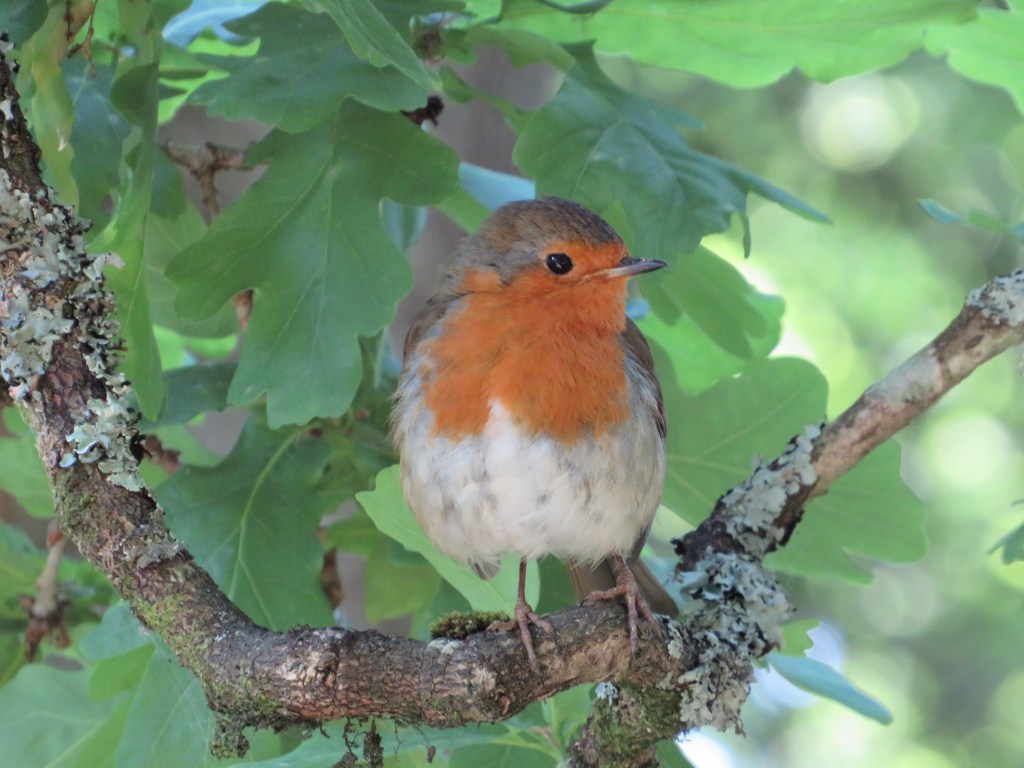
A photo because (sorry cat lovers) birds are better than cats.

Books, books and more books – or ideally fewer books

So still no progress on the moving house front. While I wait for a chain to complete underneath my potential buyer, I am trying to simultaneously put it all to the back of my mind and do something, so that I don’t feel totally impotent in the whole process. This means that I am working round the house triaging my possessions, in the hope of being less crowded in a new property and saving the removal men from having to lug a load of stuff, at my expense, that I really don’t need. The progress so far is: garden sheds tick, bathroom (not much of a challenge) tick, conservatory (apart from the children’s books which are awaiting said children) tick, my bedroom tick. This week it was time to start on the difficult stuff, the two bedrooms that contain between them eleven full height book cases (well, actually ten and two half width ones). That is an alarming sixty six shelves worth. Two of these bookcases are built in and I’d like to lose the two narrow ones, or relegate them to the garage. That means I need to find eighteen shelves of books that I can live without.

First stop the history books, six shelves of these. I tried to take a critical look. Most were acquired in the late 1970s and early 1980s they have accompanied me on three or four house moves. The vast majority of them haven’t been opened for at least forty years and if I am honest, some of them weren’t read even then. Why am I giving them house room? That’s one and a half shelves gone. Next half bookcase, local history of places other than Devon. This was harder but some more joined the ‘to be disposed of’ pile. Two book cases didn’t make much of an impact as one narrow one is seventeenth century social history and I need those. The other is family history research files rather than books, so that all stays. That left two book cases in that room still to do.

Two shelves of social history first, reduced to one and a half. Now it was getting really tricky. Next were family history books and the Devon local history books. I decided that I really didn’t want forty six years of back numbers of a family history society journal. I don’t think I have looked at back numbers more than once. Fortunately someone else was pleased to take these off my hands. Another, shorter, run from a different society also hit the ‘to be humanely disposed of’ pile. A bit of rearranging and one of the narrow bookcases was now empty, the equivalent of three shelves. I am trying not to think of the other fifteen that I need to free up.

Many of the family history books are 1990s vintage. Although the sources don’t change, the techniques do. More of these have been referred to in the past few years but some, like other items consuming shelf space, have not been opened since they were unpacked from my previous house move seventeen years ago. Out they go. I am on a roll. Still to do, the two shelves of Devon local history, I suspect I will be keeping most of those. Then it will be on to the six bookcases in the spare bedroom. These were culled during lockdown but I have hopes of significant weeding when I get to the three and a half book cases of fiction. I know some date from the sixties and early seventies, when there was a fashion for very tiny print that I can no longer read. If I started now I doubt I have enough life left to read all these again. I will be seriously asking myself how likely I am to read each one and hopefully there will be a pile to move on to charity shops.

There are of course also two banana boxes of children’s books under the spare bed. I haven’t even thought about what I do with those. Many are paperbacks that have lost their glue so the pages are loose and my grandchildren have very different reading tastes. I know that these really should go too but I may not be in the right frame of mind for that just yet. I will report on my progress – just wait until I get to the extremely full loft!

Image Peggy Marco Pixabay

Things or Heirlooms?

Two things have prompted this post. Firstly, today and tomorrow I have two rather different, yet similar, presentations to give about heirlooms. The first is a 15-20 minute conference paper for the Family Archives and their Afterlives conference. Wednesday is a 90 minute heirlooms workshop for the Society of Genealogists. The clue is in the title. Workshop means that I will be putting the audience to work. The second thing is that I am embarking on the inevitable ‘you might be going to move this year/next year/who knows’ cull of possessions. Incidentally, because I know people don‘t like to ask, the position is that someone is desperate to buy my house but is waiting to sell theirs, so I may be here some time.

I am faced with the accumulated ‘stuff’ that survived my major downsize seventeen years ago, augmented by the additional stuff that I acquired when my mother died. Why are some items more precious than others? What has prompted me, my mother and in some cases preceding generations, to keep x over y and z? What do I keep or discard and why? Many of these things have no aesthetic qualities and serve no practical purpose, yet they ‘need’ to be kept. They have moved beyond the realm of being ‘things’ to be heirlooms. I don’t envisage that I will be disposing of anything that has a family significance. If it has already been treasured for two, three, or more generations, then it is my role to continue to do that, even if I feel that the generations that come after me may not wish to do the same. I hope to persuade them to keep at least some of these treasures. That is part of the aim of the Treasures section of my Granny’s Tales website. It is the stories that turn things into heirlooms, so I need to tell the stories. It will be a long job, I just need to last long enough for all the stories to be told. At least I have made a start.

Then there are the things that have a personal significance for me, important of course but somehow perhaps on a lower rung than the items that stretch back to touch the past. At the moment, I can’t be sure how much space I will have when I move. The aim is not to have less than I do currently, so in theory I could keep everything. In practice, it is a good opportunity to reduce the task that my descendants will face when I go and join the ancestors. I’ve made a start. I’ve done the bathroom. Not much of a challenge there. I did throw away manky looking products that have been around for years. I even threw away a few stiff flannels. My bathroom is officially the second smallest in the world (ironically larger than the one I had in my previous 5 bedroomed house) so there were only two small cupboards to go through.

Slightly more demanding were the two sheds, although the majority of the contents of one contained the possessions of the fisherman of my acquaintances (who has four garages a barn and a shed of his own and those are the ones that he admits to). I decided that I really didn’t need 200 plastic flower pots or a dozen tins of solid paint. Easy this throwing away lark isn’t it? I am actually very pleased with the shed clearance. A trailer load disappeared to the tip and more to the owner’s barn.

Moving inside, the conservatory is also done. Well, it is awaiting visits from my descendants to triage the children’s books. That will be trickier. I know most are now too young for my grandchildren but they have seen two generations and some three. What will stay and what will go? I know we will be keeping some that probably no one will read in my lifetime. I do hope my body will keep working to read them to a fourth generation but realistically, it probably won’t. I don’t see my grandchildren being likely to have children young. So they will sit in a box in a loft, in an as yet to be identified property, until my children have to repeat the triage in the future.

The conservatory also contains many inherited ornaments, some dating from my great-grandfather’s trip to India and China. They stay, waiting to appear as one of Granny’s Treasures; another culling decision deferred.

Today maybe I’ll start on the bedroom. The clothes part is easy. I do an annual cull and in any case, as anyone who has met me will know, I am not a clothes person. But and there’s a huge but the bedroom also contains a china cabinet, itself an heirloom, inherited from my mother’s cousin and we believe, made by my great grandmother’s brother. It holds more ornaments, ornaments that I have known all my life. They have sat in the china cupboards of my mother and grandmother and now they sit in mine. A few of the items reach back to touch my great-grandparents’ lives. Then there are the photograph albums. Many of these are the sticky plastic variety, containing colour photographs from the 1980s. Photographs that are fading into weird and wonderful versions of their former selves. I did have a spell of remounting these and scrapbooking them in new albums. Maybe I will have time to continue that process. Do I now take the opportunity to be selective? Shall I retain the images of people and remove the pictures of random stately homes and scenery? I have yet to decide. In any case that is for that dim and distant time labelled ‘later’. Unless my worst moving nightmares are realised and it takes years rather than months for me to complete a chain, they will move with me in their current state.

With the honour of being the custodian of the family archive, comes the responsibility for its curation and care. I also need to be its interpreter. What I should be doing of course is writing those stories, preserving those memories, making sure that I am not the only person who understands the significance of these items. Some already have partial or damaged stories. There are things that I know belonged to my mother’s grandparents but which grandparents? I am committed to making sure that the items I pass on are real heirlooms, with what is left of their stories intact.

A Few Yorkshire Days with a Family History Twist

Last week, we made a whistle-stop trip to York. This was mainly so that I could take part, along with the rest of the A Few Forgotten Women Team, in the York Festival of Ideas. We were working with The Mount School and The Rowntree Society to raise the profile of women’s history. After a panel discussion, we helped attendees to research a woman or girl who was associated with The Mount School, either as a pupil, a teacher, or another member of staff. The school is a Quaker foundation, so there was some delving into Quaker records and some fascinating stories emerging. With the aid of our team, other researchers worked on a Voluntary Aid Detachment nurse. If this sounds like your idea of fun, you can join in. For details see here.

York isn’t exactly next door, 335 miles to be exact, so we went a couple of days early to spread the driving load. The journey up was protracted, not least because of the ten mile/one hour tail-back on the motorway as people tried and failed to exit on to the gridlocked slipway at Castle Donnington for something called the Download Festival.

We decided to steer clear of the city on our two days ‘off’ and visited the lovely gardens at Beningbrough Hall. The Georgian house itself, former home of the Bourchier family, is closed for refurbishment until next month but the gardens were beautiful and we did an extended walk round the parkland by the River Ouse. In the evening, I was virtually chatting all things ag lab with Wiltshire Family History Society. The next day, we opted for Kirkham Priory and another riverside walk. The priory was founded in the mid-twelfth century and was an Augustinian foundation. Dissolved with other monastic foundations by Henry VIII, Kirkham fell into disrepair. Unusually, it was used for military training purposes in the run-up to the D-day landings.

After the research day in the beautiful surroundings of The Mount School library, Mistress Agnes and Master Christopher were on parade, extoling the delights of life in the seventeenth century. With soaring temperatures, it was just a little cosy being in the seventeenth century, especially as I had neglected to bring my thinner bodice. Good fun was had nevertheless.

We left at very silly o’clock to try to beat the forecast heat and fortunately, were driving towards the cooler (when cooler is a relative term) part of the country. The homeward journey was not beset with festival goers and as a bonus, none of my plants seem to have died during my absence. Now to the rigours of the job we must not mention; I may be quiet for a while.

Beningbrough Gardens

From Elusive Ancestors to Ag Labs

Amidst a quick trip to Yorkshire (of which more another time) and the uber frustrations of fourteen tedious hours attempting (and mostly failing) to get access to vital software for the job we must not mention, I have been spreading the family history love with my latest cohort of Pharos family history students. Unbelievably, I have been teaching online family history courses for Pharos Tutoring and Teaching for seven years now. Last night saw the first presentation of a new course draw to a close. The learners have been investigating ancestral migrations. Those pesky ancestors who won’t do the decent thing and spend their whole lives living in one place lead us a merry dance as they trip from one area to another, often leaving gaping holes in their life stories in their wake. This course was designed to help the students tell those migration stories, investigate possible motivations for movement and hopefully come a little closer to tracking down their elusive ‘brick wall’ ancestors. Unfortunately, I don’t have a magic wand, otherwise I wouldn’t have any brick wall ancestors of my own but it was pleasing to find the students reporting that they had to change their case study elusive ancestors as they had found them!

No sooner does one course end than another begins, or, in my case, two begin. Next up, Agricultural labourers, a five week course that starts on 17 July. We all have them don’t we? The ubiquitous ag labs who drip from every branch of the family tree. Do we dismiss them as somehow more boring than the sagger-maker’s bottom knockers? Not such a great job tile of course but ag labs are fascinating in their own right. What I love most about leading this course is seeing the students create stories about their own ag lab ancestors, stories that I then sometimes see published in family history society journals or online. Sometimes I join in with the students and use the course as an opportunity to tell an ag lab story of my own. The job I must not mention won’t allow it this time around, so, just to prove that I do sometimes practice what I preach, here is one I prepared earlier (you will also need this outline pedigree to follow the twists and turns). This is the story of a Wiltshire ag lab filled family, or series of families, who, like many others, ended up abandoning the countryside for life in Reading and later Croydon.

My second course for July is for those starting out on the all-absorbing branch of research that is one-place studies. They have such an adventure ahead! To add to the excitement, Pharos have a brand new shiny website, which not only looks good but make life easier for students and tutors. Most importantly, it is stuffed full of exciting and absorbing courses (not just mine) to help you hone your family history skills. I recently had a discussion about the importance of getting the balance right between learning more about how to do family history and actually doing it. Even if you’ve been a researcher for years there is always more to learn and joining a group often provides great encouragement. Important though gaining new skills is, you need to keep this in proportion and allow time to actually put it into practice. I do try to bear this in mind when I am writing courses and make sure that students can learn more about their own families as they work their way through the suggested exercises. Why not come along and join me for the ride? Last time I looked there were still spaces on the Ag labs and One-place studies courses. If you want to track down elusive and migratory ancestors, you will have to wait until next year.

The (Family History) Story of Alice and May or don’t believe all you hear

This week, amidst obsessively checking for houses coming on the market and trying to stop myself mentally moving in to one I like, I have been researching the lives of Alice and May. The full story will appear on Granny’s Tales shortly. Alice and May are not newcomers to my family tree; I have known them all my life. I should qualify that, they both died before I was born but their photographs are in the treasured family album and they formed part of the lexicon of family lore that was repeated by my mother and great aunt. ‘Auntie Alice’ was one of my great grandmother’s sisters and ‘Cousin May’ was her daughter. The stories went something like this:

Alice’s first husband was a Mr Fludder, who was May’s father. Alice then married Mr Hart. May married a William Pleoney or Fleoney. Auntie Alice died in a fire when home alone in Whitstable, Kent. Normally, the family stories that were passed to me have proved to be pretty accurate when placed under the scrutiny of documentary family history research; not so these ‘facts’ about Alice and May. Decades ago, I established that almost everything I’d been told about Alice and May was wrong.

May was illegitimate. Her birth was registered as May Bula Dawson. Although there were Fludders in the area, there is no evidence that Alice was ever in a relationship with on of them and she certainly didn’t marry one. When Alice married Thomas Sanders Hart, a widower, nine years after May’s birth, May took the surname Hart and was to claim that Thomas Hart was her father when she married. Married that is to a William Dear. Goodness knows where Phleoney came from. Who was May’s father? For a long time I suspected the solitary Mr Bula who could be found in the census closest to May’s birth. Was it indeed a Mr Fludder? Was it, as May claimed, Thomas Hart? I am now, thanks to help from another researcher, pretty sure I know which is correct but I am afraid you will have to wait for the release of Alice and May’s story to find out.

Then there was the ‘burnt to death in a fire’. Well not unless she caught pneumonia as a result she wasn’t, as pneumonia, coma and thrombosis is what is on Alice’s death certificate. I looked in the newspapers, for mentions of a fire in Whitstable around the time of Alice’s death to no avail. This week I tried again. Additional newspapers have been made available. Yes, there was a fire, yes someone died whilst home alone but it wasn’t Alice. Who lost their life? Why did the family think it was Alice? Stand by for the big reveal, although diligent researchers might be able to get there first, even with just the few clues that I have given you here.

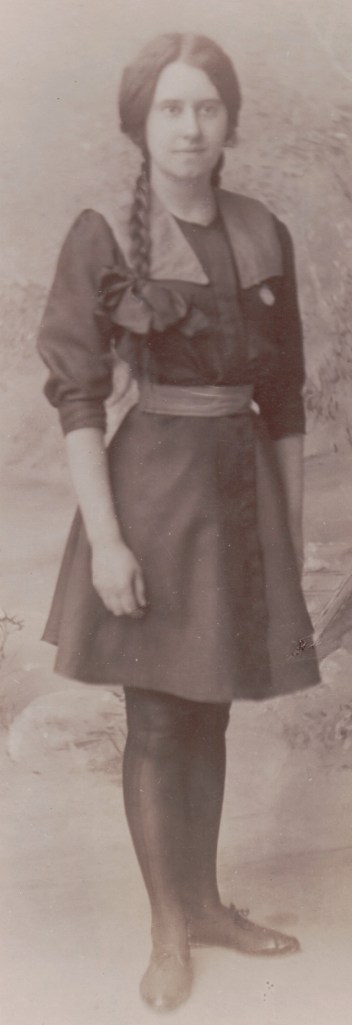
Finally, I’d welcome comments on May’s attire in this photograph. She was born in 1889, surely this is shockingly short. Could it be some kind of theatrical costume? The never-ending hunt continues.

Moving up, Moving out, Moving on

Seventeen years ago this week I fell in love with my house. After a very protracted moving process during which my chain free, mortgage free, in a hurry  buyer turned out to be none of those things, six months later, I moved in. It has been an honour to be the custodian of such a special property but for various reasons, none of which are connected to the house or the wonderful friendly village in which I live, it is time to go.

What will I miss most? The garden, the woodburner, the privilege of living in a cottage that is almost certainly four hundred years old and belonging to a community. I will miss waking up to the sound of birdsong and occasionally sheep baa-ing but it is time for the next phase of my life.

My house is on the market – if anyone wants a seventeenth century cottage in north Devon, complete with a documented house history back to 1750, now is the time to say. It is in the centre of a village, yet intriguingly hidden away, it is quirky, it is home. I’ve lavished time, effort, love and a significant amount of money on it since I have been here. It might have been my rest of my life home but I have decided otherwise. It is a weird feeling. Mentally I have had to move on but I am still here and may be here for some time, waiting for that special person who will also fall in love with this unique property. I am trying to put the whole horrendous process that is moving home in the UK to the back of my mind, whilst making sure the house is looking its best and obsessively checking Rightmove to see what is currently top of my to buy list for when that right person comes along.

As I am giving up such a lovely place I need my new home to be special too, so I need to find something I will love but not fall in love with it quite yet, in case someone else buys it before I can, or I am gazzumped. I need to think about what I might get rid of before I move but not yet, as I don’t know what I might need or have room for. So there’s an awful lot of ‘not yet’ and even more trying to convince myself that what is meant to happen will happen and everything happens, or doesn’t happen, for a reason. This is, of course, interspersed with raised stress levels and convincing myself to stop mentally redecorating the current favourite to buy property.

Much as I don’t want to wish my life away, it would be good to just jump to moving in day in a few months (please don’t let it be years) time. Oh, to save you asking, I won’t be going far.

Photo credit Harding and co