The (Family History) Story of Alice and May or don’t believe all you hear

This week, amidst obsessively checking for houses coming on the market and trying to stop myself mentally moving in to one I like, I have been researching the lives of Alice and May. The full story will appear on Granny’s Tales shortly. Alice and May are not newcomers to my family tree; I have known them all my life. I should qualify that, they both died before I was born but their photographs are in the treasured family album and they formed part of the lexicon of family lore that was repeated by my mother and great aunt. ‘Auntie Alice’ was one of my great grandmother’s sisters and ‘Cousin May’ was her daughter. The stories went something like this:

Alice’s first husband was a Mr Fludder, who was May’s father. Alice then married Mr Hart. May married a William Pleoney or Fleoney. Auntie Alice died in a fire when home alone in Whitstable, Kent. Normally, the family stories that were passed to me have proved to be pretty accurate when placed under the scrutiny of documentary family history research; not so these ‘facts’ about Alice and May. Decades ago, I established that almost everything I’d been told about Alice and May was wrong.

May was illegitimate. Her birth was registered as May Bula Dawson. Although there were Fludders in the area, there is no evidence that Alice was ever in a relationship with on of them and she certainly didn’t marry one. When Alice married Thomas Sanders Hart, a widower, nine years after May’s birth, May took the surname Hart and was to claim that Thomas Hart was her father when she married. Married that is to a William Dear. Goodness knows where Phleoney came from. Who was May’s father? For a long time I suspected the solitary Mr Bula who could be found in the census closest to May’s birth. Was it indeed a Mr Fludder? Was it, as May claimed, Thomas Hart? I am now, thanks to help from another researcher, pretty sure I know which is correct but I am afraid you will have to wait for the release of Alice and May’s story to find out.

Then there was the ‘burnt to death in a fire’. Well not unless she caught pneumonia as a result she wasn’t, as pneumonia, coma and thrombosis is what is on Alice’s death certificate. I looked in the newspapers, for mentions of a fire in Whitstable around the time of Alice’s death to no avail. This week I tried again. Additional newspapers have been made available. Yes, there was a fire, yes someone died whilst home alone but it wasn’t Alice. Who lost their life? Why did the family think it was Alice? Stand by for the big reveal, although diligent researchers might be able to get there first, even with just the few clues that I have given you here.

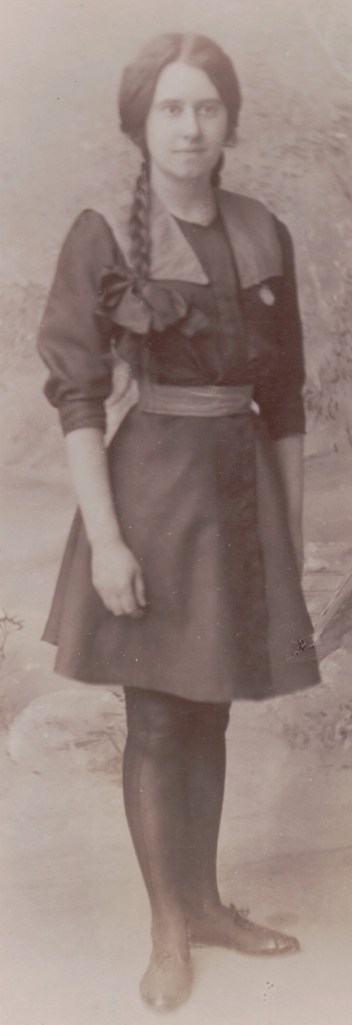
Finally, I’d welcome comments on May’s attire in this photograph. She was born in 1889, surely this is shockingly short. Could it be some kind of theatrical costume? The never-ending hunt continues.
Moving up, Moving out, Moving on

Seventeen years ago this week I fell in love with my house. After a very protracted moving process during which my chain free, mortgage free, in a hurry  buyer turned out to be none of those things, six months later, I moved in. It has been an honour to be the custodian of such a special property but for various reasons, none of which are connected to the house or the wonderful friendly village in which I live, it is time to go.

What will I miss most? The garden, the woodburner, the privilege of living in a cottage that is almost certainly four hundred years old and belonging to a community. I will miss waking up to the sound of birdsong and occasionally sheep baa-ing but it is time for the next phase of my life.

My house is on the market – if anyone wants a seventeenth century cottage in north Devon, complete with a documented house history back to 1750, now is the time to say. It is in the centre of a village, yet intriguingly hidden away, it is quirky, it is home. I’ve lavished time, effort, love and a significant amount of money on it since I have been here. It might have been my rest of my life home but I have decided otherwise. It is a weird feeling. Mentally I have had to move on but I am still here and may be here for some time, waiting for that special person who will also fall in love with this unique property. I am trying to put the whole horrendous process that is moving home in the UK to the back of my mind, whilst making sure the house is looking its best and obsessively checking Rightmove to see what is currently top of my to buy list for when that right person comes along.

As I am giving up such a lovely place I need my new home to be special too, so I need to find something I will love but not fall in love with it quite yet, in case someone else buys it before I can, or I am gazzumped. I need to think about what I might get rid of before I move but not yet, as I don’t know what I might need or have room for. So there’s an awful lot of ‘not yet’ and even more trying to convince myself that what is meant to happen will happen and everything happens, or doesn’t happen, for a reason. This is, of course, interspersed with raised stress levels and convincing myself to stop mentally redecorating the current favourite to buy property.

Much as I don’t want to wish my life away, it would be good to just jump to moving in day in a few months (please don’t let it be years) time. Oh, to save you asking, I won’t be going far.

Photo credit Harding and co

Visiting Homes of Status and Power

Are you still there? I hear you cry. Well, actually I don’t but yes, I am still here. There’s been a lot going on lately, of which more another time but for now, I thought I’d share some details of a few days we recently spent on the Yorkshire/Derbyshire borders.

We travelled via grandchild sitting to a quiet caravan site just outside Sheffield. This was in part to deliver a Christmas present in the shape of attendance at an André Rieu concert. Inevitably, this was accompanied by the usual angst – will we find the venue? Will we find the car park? Can I make the app work to display our tickets? Come back actual printed tickets, all is forgiven. It turns out that all the fears were unfounded and the concert was safely attended.

We also took the opportunity to meet up with family, which was lovely and do some touristy things. First stop Hardwick Hall, home of formidable Tudor woman Bess of Hardwick, familiar to me from the exam syllabus. Hardwick Hall was built in the sixteenth century to showcase the power and status that Bess accrued, largely due to four advantageous marriages. Our visit coincided with a parade by the parachute regiment, who were stationed at Hardwick during World War 2.

The Earl of Shrewsbury, one of Bess’ husbands, was responsible for Mary Queen of Scots during her house arrest and although Mary was never in residence at Hardwick there are artifacts that are believed to have belonged to her. The many tapestries are a feature of the house and adorn almost every wall. The gardens were lovely too.

Next stop Bolsover Castle, where I fell out with the audio guide, which kept defaulting to the introduction rather than the area we were in. Bolsover was the home of the Cavendish family and another symbol of wealth and power, this time of William Cavendish, Marquis of Newcastle, grandson of Bess of Hardwick. The seventeenth century castle was built on the site of a Medieval fortress and has some impressive views.  The late C11th castle was owned by William Peveril and its ruins were the inspiration for Cavendish’s ‘Little Castle’, built in the early 1600s. Charles I and Henrietta Maria were entertained at the castle. The Cavendishs suffered for supporting the king during the Civil War but returned to the castle after the Restoration and commenced a programme of building and rebuilding. The riding house and stables are a reminder of Cavendish’s passion for equestrianism. There are some unusual wall and ceiling paintings that have been preserved. William met his wife Margaret whilst taking refuge in Europe; she was maid of honour to the exiled queen Henrietta Maria. Margaret was a prolific writer and philosopher who challenged the female stereotypes of her time. Her eccentricities meant that she was later known as ‘Mad Madge’ and described by Pepys as ‘mad, conceited and ridiculous’.

When the male line died out the castle became little more than a holiday home and gradually fell into disrepair. The opening of the nearby mines in 1889 were the death knell of the castle as it suffered from subsidence and the associated pollution. It was given to the nation in the mid-twentieth century and further decay has been prevented.

A Genealogist’s Nightmare: tracing the Smith Family in London

A few months ago, I was invited to give a talk to  London, Westminster and Middlesex Family History Society. They particularly wanted something with a London flavour. Nothing in my repertoire quite fitted the bill so I suggested, rashly, that I could put together something based on my Smith ancestors of London. These things always seem like a good idea from the safety of several months away. It should be easy. I’d already written the Smith family story. I even had a short power-point about them. I ‘just’ needed to pull together all the detail about the sources I’d used for the genealogy and the context and I’d be away. I set out to do ‘just’ that very thing. Perhaps, thought I, this would be a good opportunity to revisit that branch of my family, as I do periodically, in case anything new could be found. Forget rabbit holes. I descended into a pit roomy enough for a decent-sized elephant. It is one of those scenarios where the brick wall seems paper thin but is nonetheless impenetrable. Surely x must be the father of y but how do I confirm that, especially with a name like Smith in a highly populated area?

A saving grace for my Smith family is that they like marrying ladies from the Seear family. My three times great grandfather John Jeremiah Smith married Charlotte Seear, his son, my great great grandfather William Joseph Smith married his first cousin, Charlotte’s niece, Eliza Seear. Their son, Herbert Havet Smith, my great grandfather, married Eliza’s niece, Catherine Seear, who was simultaneously Herbert’s wife, his first cousin and his second cousin. I do hope that you are following this. You are probably thinking that it accounts for a great deal. It certainly makes DNA research on this branch ‘interesting’. You’d think Seear would be easy to research. I’ll own that it is an improvement on Smith but there a list of variants longer than several arms and once you stray into Hertfordshire/Buckinghamshire/Bedfordshire there are probably more of them than there are Smiths.

You are probably waiting for me to tell you that, as a result of taking another look at the family, there was a eureka moment and I added several generations to my family tree. Sadly, no but there are fewer bricks in the wall. I was looking for an example to use for the talk and decided to input Seear rather than Smith. This led me to a will that I hadn’t looked at before. A will that should crack my Seear brick wall but doesn’t, still, I now have the names of the siblings of my Seear brick wall ancestor and John Jeremiah Smith featured as a beneficiary. I also reread a will for a John Smith, someone I felt should be John Jeremiah’s father (I knew his father was John). I had previously dismissed it as there is no mention of John Jeremiah, or those I had identified as his likely siblings. Paring this will with marriage witnesses in the family, it now looks as if it is indeed the will of my 4x great grandfather and that the children he does mention are his oldest children, who I had not previously noted as potential siblings for John Jeremiah. I even have three teeny tiny DNA matches to descendants of one of these older children. Is this proof? Of course not but this John Smith of the will has moved from ‘probably not my ancestor’ to ‘almost certainly my ancestor.’ Will he ever be inked in as my 4x great grandfather, probably not but I can hope.

Oh and if anyone is reading this who is expecting me to give a talk on the Smiths in a few days’ time, never fear, I climbed out of the elephant pit eventually and there is a talk prepared.

My Smith Ancestors

Drunken Women, Large (Family) Trees and other excitements

‘What have you been up to lately?’, I hear you cry. Well, actually, I don’t but I’m going to tell you anyway.

I have been spending time with some drunken women, I should hasten to explain that this is in the historical, not actual, sense. Our Few Forgotten Women Team, aided by more than fifty helpers from all parts of the English-speaking world, have been tracing the stories of women found in two inebriate homes in the 1901 census. Their stories are mostly pretty tragic cycles of despair and degeneration but it is important that they are told. Photographs of many of the women survive in the online Habitual Criminals’ registers and they tell their own story. The stories of eighty six women are beginning to appear here.

There’s been a bit of a social media discussion lately about large online trees. Do people take large trees seriously? How large is too large? Here is my take on the issue. I was 100% against EVER putting my family tree online until I took an Ancestry DNA test about five years ago. I didn’t even have an Ancestry account at this point, being an inveterate FindmyPast fan (and I still am, finding their searching infinitely easier. Horses for course and familiarity is a great  thing, others will feel differently). Anyway, I took the test, the results came, I started looking for matches. Which were the matches I was prioritising? Those with online trees. Well, I thought, maybe I’d just add a very basic, private tree of my direct line. So I did. With all those thousands of DNA matches, in my case mostly very tiny, I found myself concentrating on those with public trees; so I went public. Of course, to link with DNA matches you need to be wide and deep, so I began, slowly to add all those individuals that lurk on my family tree, garnered over nearly fifty years of research. This I did cautiously and meticulously, one person at a time. One reason for not importing a tree wholesale was because I don’t have one single tree but about twenty different trees for different branches, as I prefer to work that way. Yes, I could have merged them and then uploaded in one go but I deliberately chose not to, using it as an opportunity to check what I’d done. Only one 9x great grandmother was felled from the tree as a result.

I wasn’t going to add sources because why would I? This was not my primary way of recording my tree, this was just for DNA. Then of course I realised that I was only taking online trees seriously if they were sourced, so sources were added. I included my children’s ancestors as well as my own and then, later, some of my grandchildren’s. I began by only adding individuals that I considered to be verified. Then, hesitantly, I have added a few individuals, clearly labelled ‘hypothesis’, in case the hypothesis is right and a DNA match could help to support it. Even with all this, as of today, my tree contains 3161 people. Maybe it isn’t larger because I never add information from other trees, although I do use them as clues to further research.

So what is wrong with larger trees? Do I dismiss them out of hand? Well no, that would be short-sighted but I must admit to a certain amount of scepticism as the numbers stretch beyond 5000. I find myself wondering if each one of those individuals really is carefully researched and verified using original sources. I’ve been at this for since 1977 and spend more time than I am going to admit on it. No way could I add upwards of 5000 people with any confidence. Of course, in some cases, these ultra large trees are well researched. Some are large because they are the result of one-name or one-place studies. It doesn’t take a great deal to gain an impression of the quality of the research on these mega trees and sort the good from the downright ridiculous. Is there a danger though that a large tree might give an impression of careless research? The jury is still out on that one but it is an interesting debate.

There’s been a lot more going on but this post is already too long so I’ll leave you with the tale of my mother’s day gifts. One daughter sent a package that included a mystery book (she chose the genre not the title) the title is ‘Family might be the death of you’, possibly not the most appropriate! A planted (I use the word advisedly) floral arrangement from other daughter was delivered to the neighbouring chapel porch, which shares my postcode. Fortunately, someone spotted it, retrieved it and handed it to me. It was also delivered by someone who had clearly ignored the ‘this way up’ notice and arrows. I seem to have successfully salvaged/replanted it and it is now flourishing but there was quite a bit of earth everywhere.

RootsTech Roundup Day 3 #NotAtRootsTech

On the third day of  RootsTech I had been really looking forward to Wanda Wyporska’s session (from late UK time on day 2) about researching women and was sad to see that it was not able to be recorded. As the custodian of ancestral christening gowns, wedding dresses and quilts Preserving your Ancestors’ Textiles and Handmade Treasures by Melissa Barker was another that was high on my ‘must watch’ list. Again, if you watch, you can skip the first 3 minutes 19 seconds of setting up chat. Sadly my house is too small to follow all of her advice. Interesting to learn that folded textiles should be refolded in a different way every few months to avoid deterioration along the creases.

Next, another talk from Diahan Southard, My Messy, Complicated Birth Roots Story. This was a fascinating and well-presented session, highlighting the problems of trying to identify DNA matches, particularly if you are related to someone through two different family lines. Highly recommended.

30 Fun and Meaningful Activities for Kids and Grandkids to Celebrate their Ancestors Sharlene Habermeyer was also on my watch list. Two minutes in before this one starts. I do appreciate and welcome the fact that these videos have been made available so quickly but wonder if a little editing out of the set up might have been useful. The presentation does what it says in the tin and Sharlene’s website has free downloadable resources http://www.growinglittleleaves.com/printables.html. A few are US orientated but there are others that are applicable to all. I did cringe however at her suggestion of cleaning graves and making rubbings of them. This is common practice elsewhere but is definitely not advised, or indeed legal, in Britain, where the lichens that grow on gravestones are protected. I did love the idea of sharing memorabilia; I just wish my grandchildren visited often enough to do this. Trying on ancestral wedding dresses or uniforms was another great idea, although I don’t see why this should be a gendered activity. Plenty of really good suggestions for using ancestral photos. I shall be reading the full details of the activities mentioned by Sharlene on her website and trying some of the ideas; first I think will be the talents and hobbies activity and the timeline. On a similar topic, I listed to Sarah Day’s short GenZ Genealogy presentation from 2022, outlining how we can support 10-24 year olds on the genealogical journeys. She also suggests what GenZ themselves can do. Pleased to hear that this included joining societies. Another catch up from last year was Write your Family Stories (in 30 minutes or less) by Brenda Hudson. Useful suggestions here for those who struggle with starting to write stories.

So that’s a wrap. I do still have a couple left on this year’s play list and few few lingering from previous years. I will no doubt add more when others share their recommendations. I will try not to leave it until next year to watch these. The dates for next year are announced – so make a note in your diaries.

Irish Adventures

No, this is not me trying to learn another language. The Cornish continues (note I didn’t say progresses) and I will report on that another time.

I had a wonderful once-in-a-lifetime holiday touring the whole of the island of Ireland planned and booked. What could possibly go wrong? What went wrong was that the holiday was planned for May 2020. It is always difficult to arrange to spend long periods away from home but finally, later this year was to be the time for the rearranged Irish holiday. I do like everything planned in advance. Some call me organised and in a sense I am but this is not a virtue, it is a coping mechanism. I revisited the 2020 itinerary, tweaked a few things, made sure the tourist attractions we planned to visit hadn’t permanently closed and prepared to re-book everything.

When you are touring, three days here, four days there, everything hinges on the start date. This means I needed to begin by confirming the ferry. I didn’t do a year long course with an Irish University without learning how beautifully laid back the atmosphere is in Ireland (and no, still no certificate, one month after it was posted), so, in early January, it was not a surprise to learn that bookings had not yet opened for the ferry crossings later in the year. ‘Try next week’. After several ‘next weeks’, finally, a confirmed ferry booking.

Next step, caravan sites. Some of those we’d hoped to stay in were no longer running, others didn’t open until May and weren’t taking bookings yet. I know, I know, ‘’Twill be grand’ and all that but I really do like to know that we will have somewhere to pitch the van. Sites don’t seem to be anything like as plentiful as on mainland Britain, so arriving somewhere and hoping for the best is definitely not a great idea, at least not if you are me. Wild camping is illegal on the island of Ireland, or perhaps it isn’t, Mr Google is unclear on the matter. Having read ‘it isn’t strictly legal but you’ll probably get away with it’, I know this isn’t an option. The one person who won’t get away with it will be me. So back to trying to book sites. It was a real mixture, some online booking forms wanted to know the equivalent of the inside leg measurements of all guests, other sites took days to answer emails. We still can’t book a site for the end of the holiday. It was difficult enough finding one anywhere near the right place. Some only took motor homes not caravans, some closed for the season before we wanted to stay. In the end, we’ve had to settle for ‘just turn up no need to book’, which really doesn’t sit well with me. There are fifty odd pitches on this site, what happens if fifty one someones ‘just turn up’ and we are number fifty one? We had a site issue in Canada, two sites that we had booked had decided to close early for the season, leaving us in the lurch. Really hope this doesn’t happen again.

Tours then, booking tours is particularly important as we are only in a place for two or three days, so if we can’t get a ticket on a particular day, we can’t just go the following week. Surely we can book tours to things that say ‘early booking essential’? It seems not. ‘Early’ seems to equate to a couple of days in advance, which means we will already be away and I will have to struggle to do this when we have wifi or by phone, deep joy.

After a hectic week of googling ‘touring caravan site near x’ we are as prepared as Ireland will let us be. Apart from regular checking to see if ‘early’ is now, all that is left is to anticipate the trip and keep everything crossed that fire, famine, plague or earthquake don’t mean we have to rearrange again.

Forgotten Women, Lost Ancestors and a few Other Things

I am still recovering from our Few Forgotten Women Friday back in January. In the end, fifty three of us each took one or more of the girls from the Leeds Industrial School and attempted to find out more about them. Given that we had a zero budget (though a few of us did succumb to buying a certificate or two) and were restricted to what we could find online, we were remarkably successful. Of course there were those for whom very little could be found and others where we found someone of the right name but couldn’t be sure we had the right person. The nature of the lives that these girls and their families led meant that they were likely to avoid appearing in the official records, or did so under an alias. Nonetheless, some fascinating stories are emerging. Sadly, many of them did not end happily but some of the girls did seem to turn their lives around. The stories are gradually appearing on the website, so do take a look. There’s a now a new Forgotten Women Friday on the horizon in March. So do get in touch if you fancy honing your research skills on an inebriate woman.

Every now and then I revisit one of my family lines to see what more can be found. It is currently the turn of the Smiths of London (I know – someone has to take one for the team). I have (possibly rashly) agreed to make them the subject of a talk, focussing on the possibilities when researching the country’s most common surname in the most highly populated city. It is surprising what a range of sources can be used, both for the genealogy and the contextual history. I am getting lost down more rabbit holes than you can imagine.

Whilst on the subject of elusive ancestors, I have been working on a new course for Pharos Teaching and Tutoring about Migration and those ancestors that just disappear. A positive warren of rabbit holes here. If any of you have managed, thus far, to escape being drawn in to the obsession that is family history, despite reading my blog, now is the time to start. Pharos have just launched a two-part Foundations of Family History course that can be taken at any time; ideal for those who are just stepping their toes in the water but be warned – there is no going back. While I am on the topic of courses. There’s another chance to take my online ‘Are you Sitting Comfortably? Writing and Telling your Family History’. This usually runs twice a year but this will be the only chance in 2023 and there is an option to submit a piece for me to feed back on if you wish. The course starts with Pharos Teaching and Tutoring on 13 March.

Writing has mostly been about finishing the draft of the non-fiction book I’ve been working on for the past year. I’m afraid the title is embargoed and it may be a year before copies hit the bookshelves but it has been great fun to write. I am now dealing with the dreaded task of sourcing copyright free illustrations. There are plenty of documents I’d love to include but the responses are usually along the lines of ‘that will be £200 please’, which means it will cost me a fortune to produce the book. I accept that, if it sells well, I will be making a few pence an hour for writing it but that really is, literally, a few pence, so shelling out to use illustrations is not an option. Despite what trawling the internet might suggest, you really can’t just use images as and where you please.

I’ve been keeping in touch with my lovely colleagues from the Experimental Archaeology Course and there was great excitement three weeks ago as certificates marking our success began to be delivered. I eagerly searched my doormat – nothing. Days passed – still nothing. I know I live in the back of beyond, where postmen rarely dare to tread but certificates have reached Australia and I still don’t have mine. I have asked the powers that be and am now anxiously awaiting a reply as well as a certificate.

I’ve been giving talks here and there, in person and on line and had a chat about family history to Radio Devon last week, as you do. Everything you know about family history in ten minutes was a tad of a challenge but always a pleasure to speak to the lovely Pippa Quelch.

Signs of spring are wonderful. I just wish the sun could shine without showing quite so much dust.

Looking Forward – Looking Back – mostly family history and a few other things thrown in

The holiday season is over, although I have to confess that I still have Christmas cards and a Christmas tree to take down. Bearing in mind that half the cards didn’t arrive until January, it seemed a shame not to display them for a while. I am probably risking the wrath of the bad luck fairy that dictates that decorations have to be away by the 6th (or is it on the 6th – who knows?) but I’ll survive.

I was away from home at New Year, so didn’t do the typical old year reflection/new year plans post. Better late than never – highlights of last year (in no particular order): spending time with friends and family; visiting some beautiful English coast and countryside; working on the revamped Braund Society website; being part of the Few Good Women group and launching the Few Forgotten Women project (another website created); passing (just) my grade 1 piano exam; passing (with rather more success) my postgraduate certificate in Experimental Archaeology and Material Culture; starting to learn Cornish; creating a living willow chair (even though ‘living’ is up for debate), some fused glass and learning to plait straw; making two separate, exciting family history discoveries in asylum records.

Plans for 2023: more of the same and finishing some projects started in 2022 including a book to complete, a dedicated family history website to launch, a course to write, Ivy’s biography to finish and a new one to create; Ireland to visit (postponed from 2020); more Cornish to learn, speaking in sentences would be good!

Even though I have only had a few days back in the old routine, there has been so much going on. My article The Family History Revolution, looking back over five decades of the world of family history, with thoughts on what may come, has appeared in Family Tree Magazine. The book I am writing is finally nearing completion, with half a chapter an introduction and a conclusion to go. It is a non-fiction family history book. I can’t announce the subject yet but you won’t be surprised to learn that it isn’t all sweetness and light. There is some overlap with my work on the Few Forgotten Women Project. What fun that is proving to be and it is such a lovely group of ladies to be working with.

Just before Christmas, some of our Forgotten Women team chatted to Helen Tovey of Family Tree Magazine and the podcast has just been released. Our next venture is a joint research project on Friday 20 January, dedicated as what we hope will be the first of a series of Forgotten Women Fridays. We are going to look at a particular set of records that feature forgotten women and collectively research those ladies on that day. We are inviting family historians to help us, so if any of my genealogy readers want to give us a hand, we’d love to allocate you one of the women from our chosen list. You have a day to find out as much as you can, using what is available online. Keep an eye on the Few Forgotten Women website on Friday for full details.

Another collaborative project: our local history group is preparing for a cemetery workshop at the end of the month. We are trying to compile mini biographies of those who are commemorated in our churchyard.

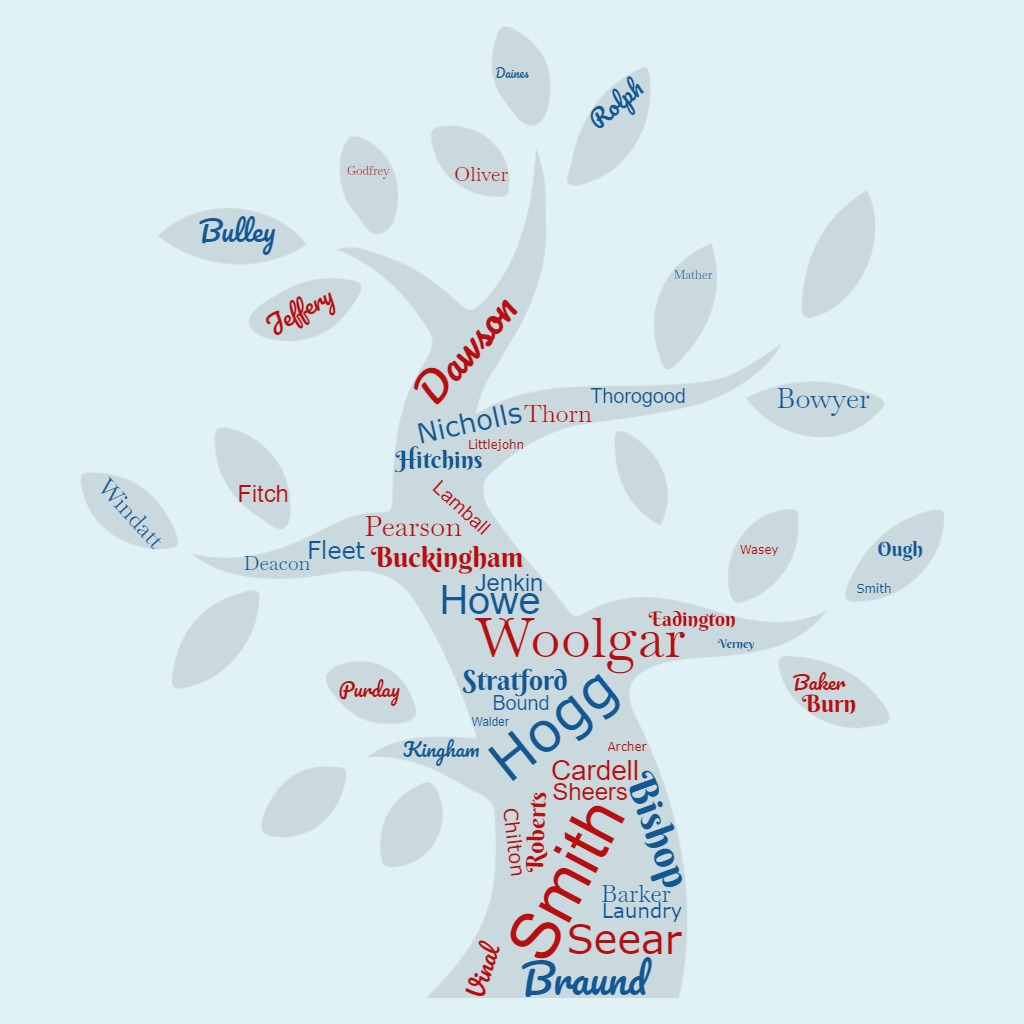
As part of my preparation for my, as yet to be revealed, website showcasing my own family history, I was looking at the surnames of my direct ancestors and created this using Wordclouds. There is a choice of outlines and colours. It includes the forty nine surnames I’ve discovered in my direct ancestry, back to my 4x great grandparents. I could have included the other sixty eight names from earlier generations but I rather lost the will. In theory, the names that feature in my more recent ancestry should be larger but that is not exact.

A Chance to Win a Ticket to RootsTech 2023

This draw is now closed thank you for participating.

To wish you all a Happy New Year, I am announcing my free give-away of a ticket to RootsTech 2023. As a RootsTech Influencer, I have an in-person three-day pass to give to one of my readers. This pass, worth $98, includes access to all on-site classes, entrance to all keynote and general sessions, as well as the Expo Hall.

RootsTech is the biggest event in the international genealogical calendar and this year, takes place in Salt Lake City from 2-4 March. There is an exciting line-up of speakers from across the global, many of whom I am proud to call friends. Already purchased a ticket? Not to worry, the winner’s ticket price will be refunded if that is the case. Can’t get to Salt Lake? Then there is a virtual option, which will cost nothing at all.

I thought I’d make you do a little work in order to take part. This will involve you visiting some other websites that are part of my family history life.

To enter, just send me a message using the contact box on the home page with the answers to the following questions.

Using this website, tell me the title of one of my historical novels.

Visit the Forgotten Women website and name one of the ladies whose stories feature.

On the Swords and Spindles website, visit the links and resources page, scroll down and follow the link to name one book in the ‘Books for Children and Young People’ section.

Go to the website of The Braund Society and tell me when the Society was founded.

Finally, look and the website of Buckland Brewer History Group and tell me the name of the speaker we will be listening to in May 2023.

The winner will be chosen at random from all the correct responses received by midnight (London time) on Sunday 29 January.

Good luck!