Today would have been my mum’s 100th birthday. It therefore seems very appropriate that I have just sent out the first lesson of my online course for Pharos about Putting your Female Ancestors into context. This is the first presentation of this course and I am planning to work alongside the students to tell my mother’s story. Who am I kidding? The course lasts five weeks. It took me three years to finish my grandmother’s story but at least I can have aspirations and make a start. I will get a second chance in September, as the course will be repeated then. There are still spaces on the September course, if you would like to join in.
Anyway, I have begun and today will be spent adding to a timeline, which will become the framework for my story and scanning in photographs that I haven’t yet scanned. I will keep you posted with my progress, or I fear lack of it.
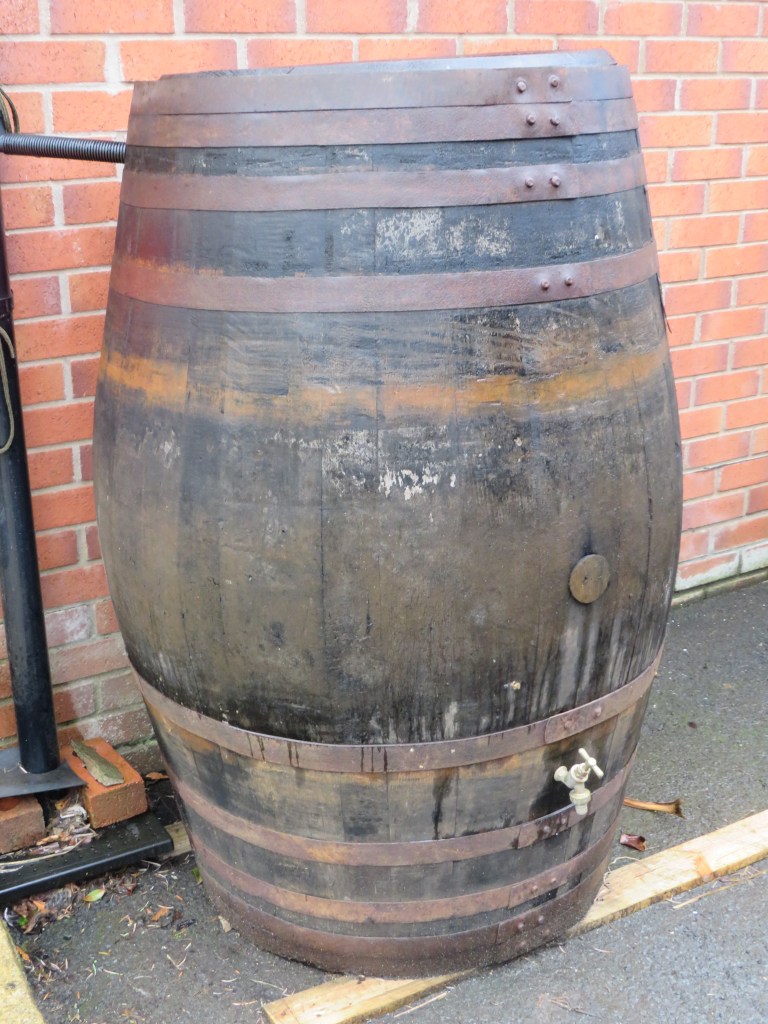
It has been about ten weeks since my last update and as I am a fair-weather gardener and the weather hasn’t exactly been fair, there’s not a lot to report. The main addition is the new water butt, which was a very extravagant Christmas present. As I have much of my garden in pots, plenty of watering is required in dry spells. Strangely, the two existing, unattractive, plastic water butts, that came with the house, collect water from the tiny summerhouse and the garage respectively. It seemed strange that nothing was gathering what fell on the, much larger, roof of the bungalow itself. This led to my new acquisition, which is a former whisky barrel and believe me you could get seriously hungover just breathing in the fumes that emanate from it. The first job was to manoeuvre it into position once it had been deposited on the door step. Fortunately its arrival coincided with some visiting muscle, so with a bit of an effort, it was moved to where it needed to be. Next, it needed to be attached to the downpipe, also not totally straightforward or without incident. A couple of heavy downpours later and it was filling up nicely. The water butt is situated between the house and garage, on some unexciting tarmac. The next stage is to put some battening by the back gate and cover the mossy tarmac with chippings to match another part of the garden.
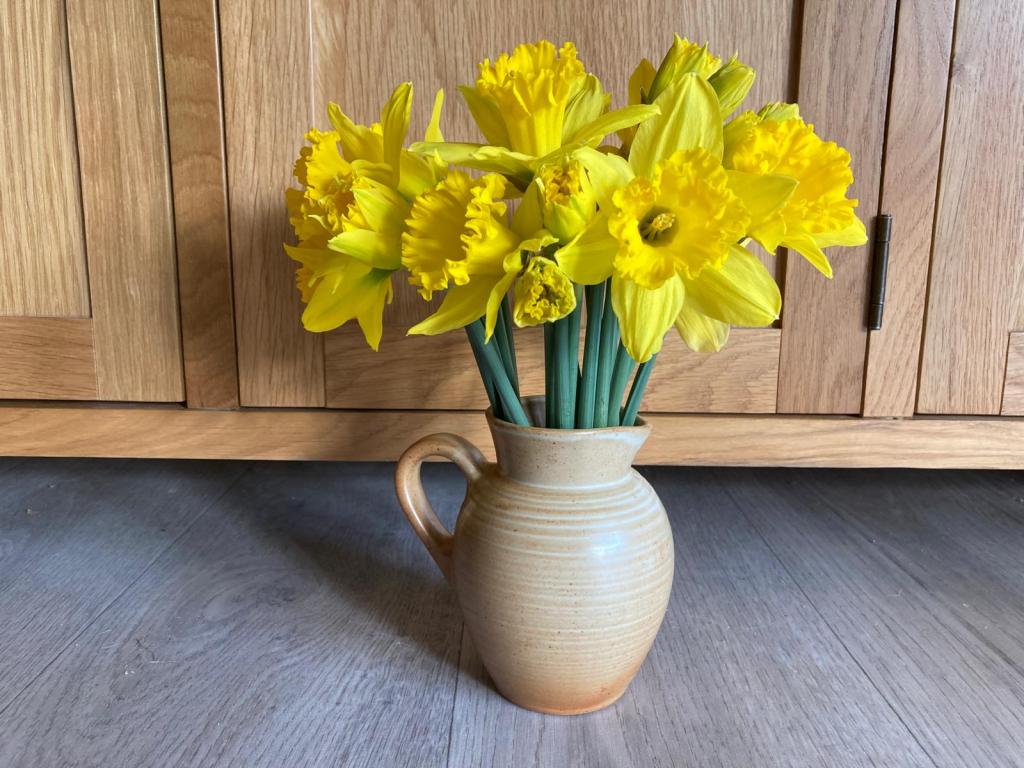
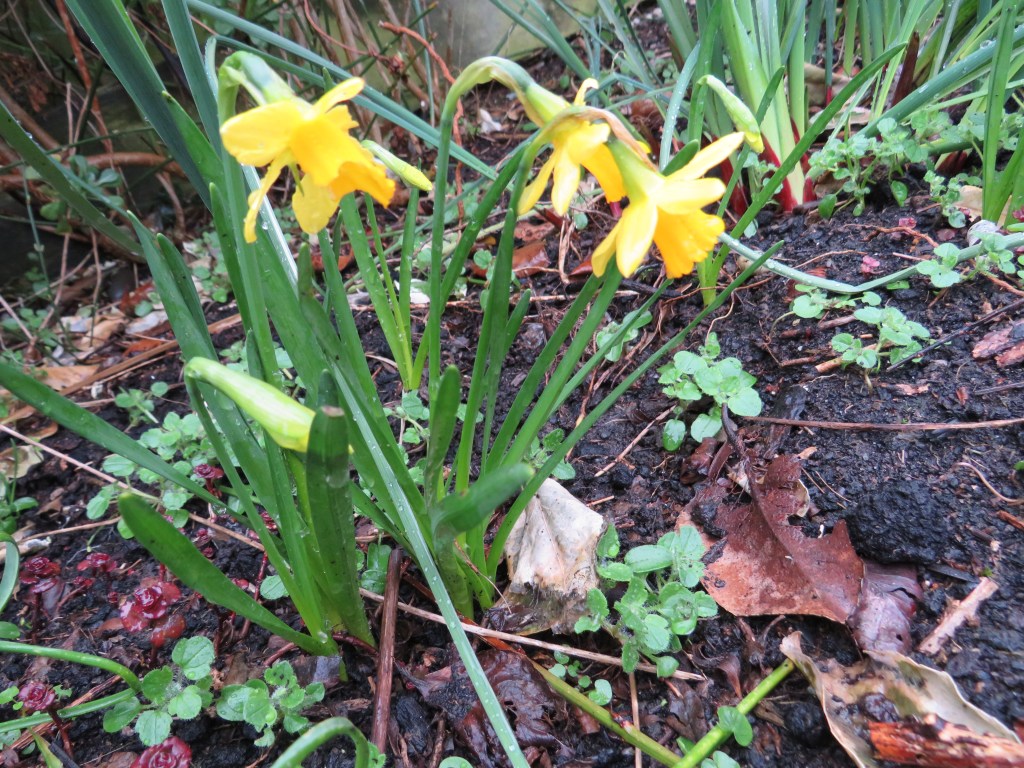
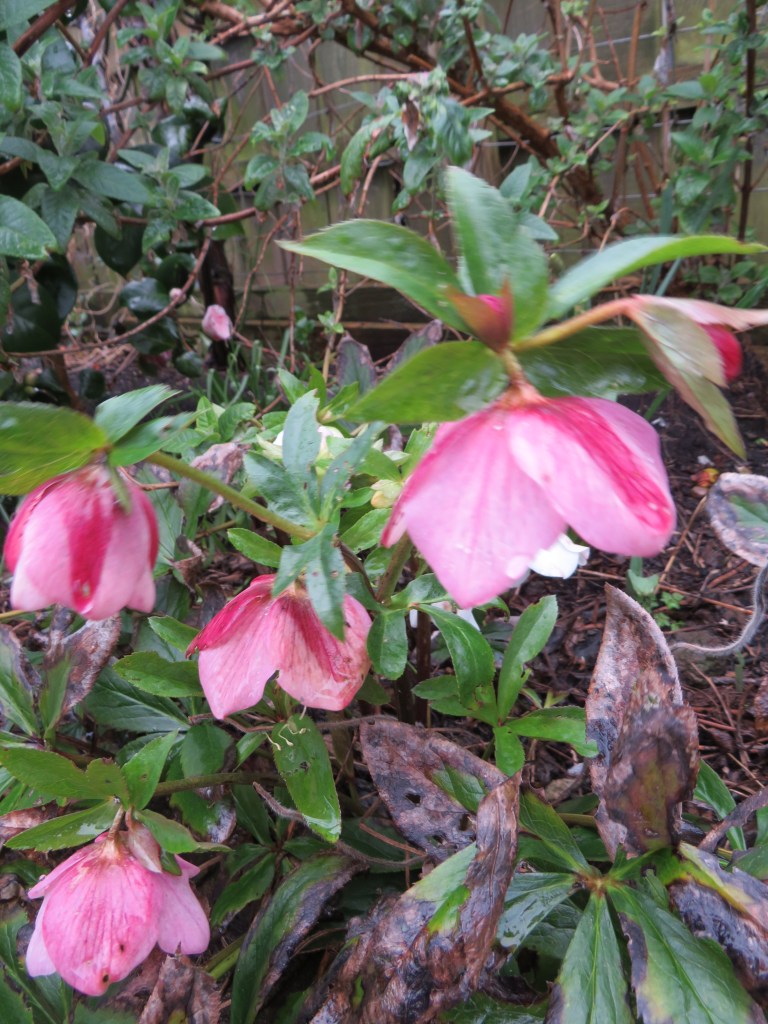
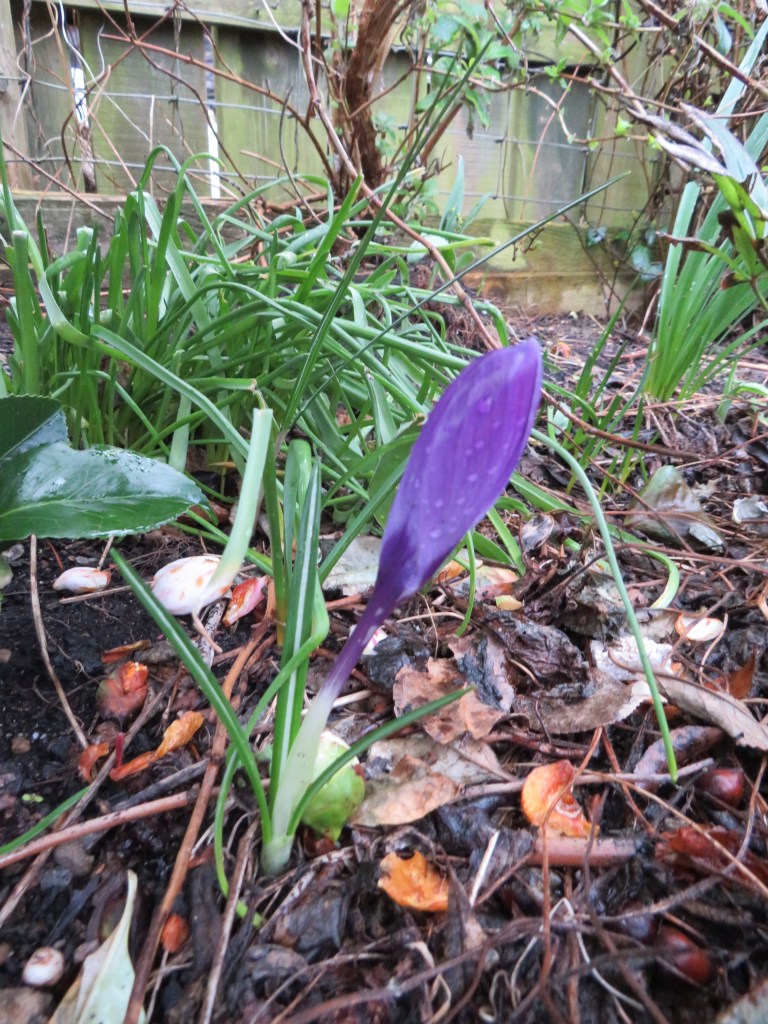
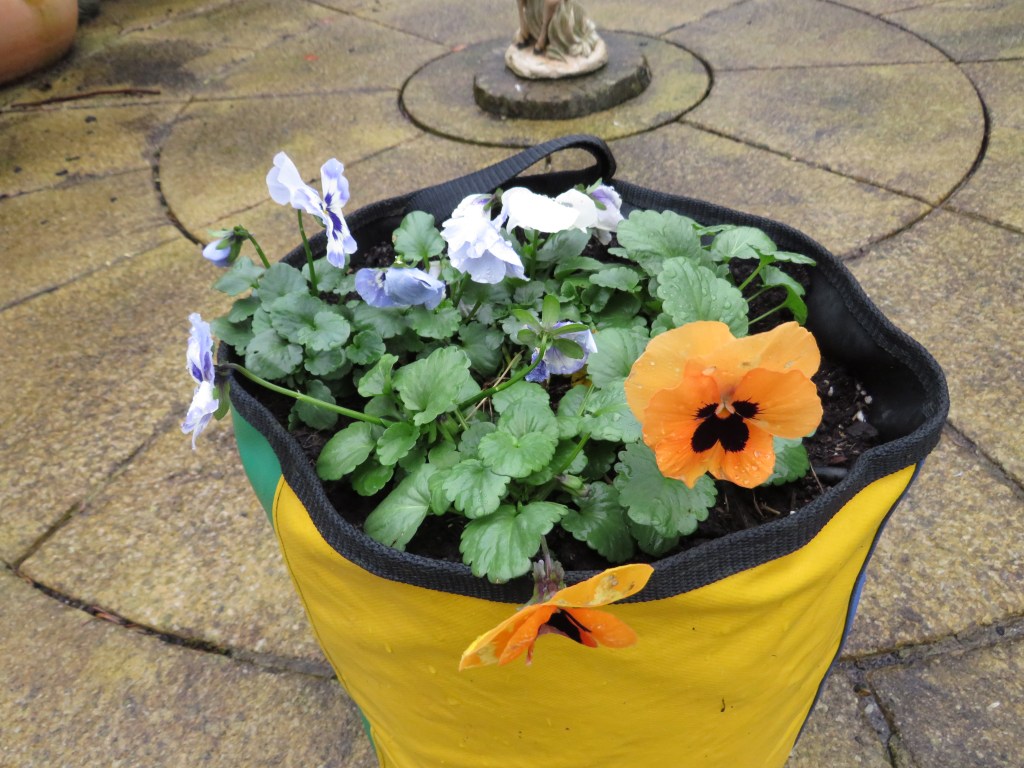
I am still waiting for temperature, health and strength and lack of rain to all align, so that I can get outside and start tidying up after winter. Most things are now showing signs of sprouting and the garden is fulfilling it’s promise from last year, with something in flower all year round. Things do however seem to be later than they were last year. The quince is barely budding but was in full flower this time last year. The camellias have been lovely and two that were behind the now moved shed can be seen this year. The snowdrops seem to have disappeared but miniature daffodils, a solitary crocus, hyacinths and grape hyacinths are all showing colour. The standard sized daffodils have flowered but are providing a meal for something. Hellebores and pansies are flowering with some wallflowers and forget-me-nots showing colour.
I am sad that the bluetits and great-tits have deserted the garden but I am hoping they may return. Robins, sparrows and blackbirds look likely to nest and I can usually spot woodpigeons, magpies, jackdaws and herring gulls. I leave you with some signs that spring is round the corner.
Life has been full of presentations, both online and in person. Every routeway in Devon seems to be fraught with road closures at the moment, so some of the in person ones have involved ‘interesting’ journeys. On one occasion, we were foiled in both directions by signs that said ‘Road closed follow the diversion’. This on a road that had had no turnings for a mile or so and not a diversion arrow in sight. We are used to narrow twisty lanes but I swear some of the places we ended up weren’t roads – no visible signs of tarmac at any rate. Then, about a mile up a road that was barely wide enough for the car, a sign that said ‘Danger no Entry’ and a firmly barred farm gate. Cue a million point turn. The joys of presenting in out of the way areas.
I have just started delivering a monthly ‘Biography Club’ for the Society of Genealogists. The first session was met with plenty of enthusiasm and yet again, I have vowed to keep up with the attendees and fill in the gaps in my own biography. I’ve made a good start but some sections still need to be tackled. I am also coming to the end of a full Pharos course for those wanting to find out more about their agricultural labouring ancestors. As one course closes another begins and it will soon be time for the first presentation of my online course for Pharos about putting female ancestors into context. I am really looking forward to this and have deluded myself that I might keep up with the students for this one too, looking at my mother’s story. The course is full to capacity and beyond but it will run again later in the year and if you are interested, you can book a place now.
Next on the horizon is Rootstech from 6-9 March and I look forward to learning from colleagues across the world. I just have one short recorded presentation this time. ‘Where am I? Are you searching in the right place?’ My pre-recorded sessions from last year are also available.
8 March is International Women’s Day and I am presenting for the Alfred Gillett Trust. My own presentation is to be followed by telling the stories of working women, with my A Few Forgotten Women friends. You can book for this free event here. Then March is crowded with the Three Counties Fair at Malvern, which is just for fun and then the Really Useful Show in Kinson near Poole, where I am speaking.
Advance notice too that I will be giving two presentations at theSecrets and Lies conference in Peterborough in September, organised by the Halstead Trust. Early bird bookings are now being taken.
On the writing front, I have done a couple of articles for Who Do You Think You Are? Magazine. The first, on researching female ancestors, should be in the next issue. My next book, ‘A History of Women’s Work‘, due for publication in May, is now available to pre-order if you want a hardback. Paperbacks and ebooks will also be available.
Some months ago, because I teach ‘Writing and Sharing your Family History’ courses, I was given access to the, then brand new, WeAre family and local history sharing platform. I need to say first of all that this came without any strings. I am not obliged to review it, mention it, or recommend it and I have zero financial interest in the software. Platforms with similar aims have come and in some cases, gone but I was keen to give this a try. I can say that it is definitely the best sharing platform of its kind that I have seen.
When it first arrived, I had a little play. I had recently set up my own Granny’s Tales website. I do wonder if WeAre had come first, whether I would have used that instead but I was not going to abandon Granny’s Tales. What could I do with WeAre that was different/complementary to my other ways of publicising my research? One of the main features of WeAre is the ability to share your research with relatives and if you wish, allow them to collaborate. This is always a tricky one – what relatives? Lacking siblings or first cousins and second cousins numbering just six, it is pretty stony ground for me. That left my children and grandchildren. I have used Family Tree Maker software for my family trees since it was on 3½” floppy disks but I don’t have a single tree; I could never control that. This meant that I didn’t have a GedCom that I could upload containing all the family members that I have gathered in nearly fifty years of research. I did however have a ‘tree’ which just included all my children’s direct ancestors, so I uploaded that. I added my father’s brothers and a few photos and pretty much forgot about it.
Then WeAre added features that were geared towards One-Place Studies, so I decided I would dust off my One Place Study for Thockrington and use it for that. I uploaded about forty people, wrote an introduction, added a little general stuff and promptly returned it to the back burner. Then my lovely Forgotten Womencoven friends, several of whom were also using WeAre, decided that we would Zoom and all work on our sites on a specific day. This worked really well, both in terms of mutual encouragement and also technical assistance. What one person hadn’t worked out how to do, another had. This reignited my enthusiasm for my one place study and firmed my resolve to get on and add more. We are definitely going to have more mutual help sessions to encourage us to actually get things done to our sites.
I decided to begin with Thockrington’s graveyard, adding those commemorated on the surviving stones. This will not be quick; it took me two days to do ten stones. There are fifty four. Then of course there are parish registers, censuses, wills, tax lists and all the other sources I have used, so I will need to live until I am 150 but baby steps. I can’t even say the site is still in its infancy, more like still in the womb but maybe it is entering its second trimester. I have made it live, so the others from the mutual encouragement group can see it but there’s so much to be done, that it is probably best to say that it is a soft launch!
Then, out of the blue, Edward, aged ten, asked some family history questions. I have been trying to interest young people, including my grandchildren, in family history and heritage since forever, so I grasped this straw with both hands. I was reminded that his direct ancestry was all there on WeAre. He started by looking for houses that he and his parents had lived in to add to the map. Then he wanted to chat about family history on Zoom. He was interested in ‘the medieval period, famous people who aren’t you Granny, funny names and weird jobs.’ Hmm this was something of a challenge. I quickly exhausted the possibilities of the founder of Smith’s crisps, who was my great grandfather’s cousin. I do still have Anne Balls Bulley up my sleeve but where to go next?
Then a friend reminded me that Family Search has an activity that tells you how you are related to ‘famous people’. Unfortunately, this is based on the Family Search ‘one tree’, which is stuffed full of what we will call kindly ‘creative genealogy’ aka total garbage. Last time I looked at my famous relatives, I firmly removed my connection to Princess Diana for the nth time. Fortunately Princess Di no longer features, leaving me with Benjamin Franklin, Winston Churchill, Lucille Ball, Elvis Presley and Helen Keller. Edward had heard of Winston Churchill and Elvis at least. He happily went away and found out about Helen Keller, although I have to say that the link is ‘speculative’. Of the five, the most convincing is the connection to Churchill. At least here my own line does go back to the alleged mutual ancestor. If Edward wants to add Churchill to our tree he is welcome. He can add Helen Keller if he chooses. This is not my main ‘correct’ tree, it is not public. If it sparks his interest that’s what matters. The ‘what is the evidence for this, are we sure?’ conversation can come later. The key to encouraging young people is to let them do things their way. Edward added his cats to the tree; I will take being grandparent to two cats. I am anticipating Edward’s cousin may want to add her tankful of tropical fish one by one, right down to the snails that inhabit her tank but it doesn’t matter. Give birth to fifteen guinea pigs if you have to, do whatever it takes to ignite that curiosity about the past. WeAre having fun.
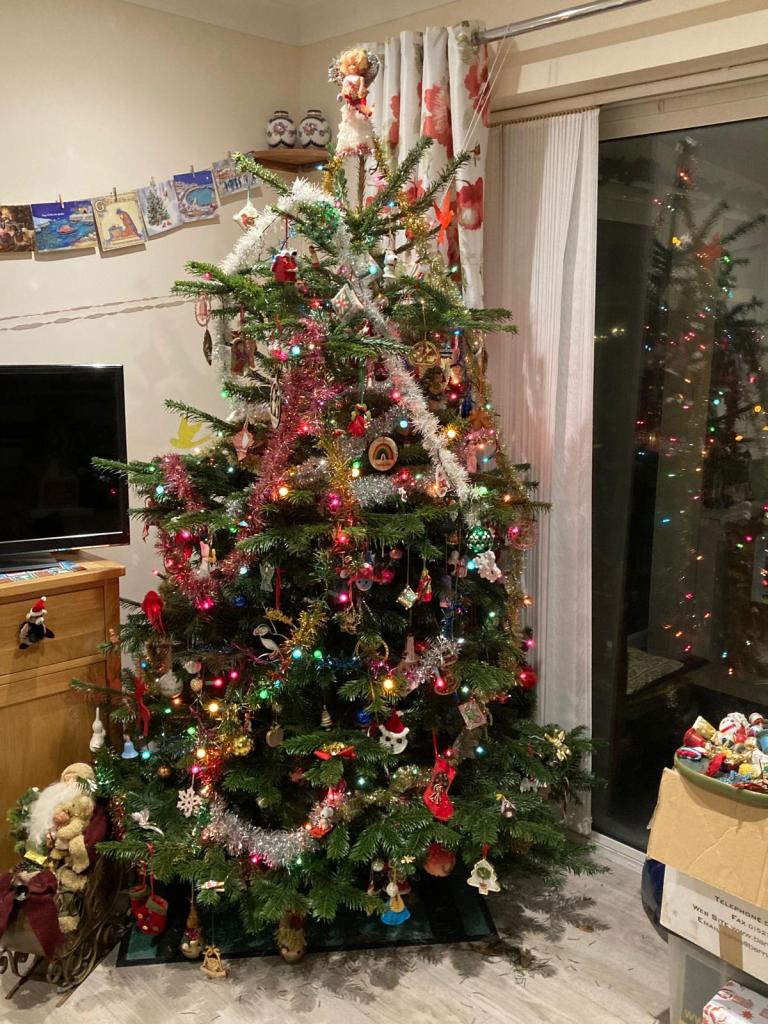
Having moved the week before Christmas last year, I missed all the excitement and anticipation so I was determined to start early this year. There was no time for considered placement of decorations when I was in the throes of moving, so the tree went in the conservatory. It was in full view of the living room but somehow wasn’t the same, so this year, into my tiny living room it had to go. This has involved a certain amount of furniture removing and I am not sure how or where I am going to put the dining table up but I’ll cross that bridge when the time comes. I do love Christmas traditions and I am proud that my tree contains ornaments that span nine decades. The earliest my parents had when they first married in the 1940s. The family come for Christmas each year, with copies of historic family photos strung up on peg lights that are designed for Christmas cards. Not many people have their 4x great grandfather observing the festivities.
Sadly, not everyone has happy memories of Christmases past, nor are they able to enjoy Christmas present. If your childhood Christmases were special, do record your recollections for future generations. You can read mine here. I’ve also written about the historic Christmas tree decorations, how many did you have on your childhood trees and do you still have them?
On a glorious sunny September day, with temperatures in the twenties, we set off for Leith Hall in nearby Kennethmont. One of the pleasures of visiting Scotland is that most of your journeys from a to b are through beautiful scenery and are as much part of the experience as the destinations. Here though the landscape is not stereotypically ‘Scottish’. Gone is the dramatic, stark scenery of further south. Instead, we have more benign vast vistas of rolling fields that are currently being harvested.
I like to take notes when I am going round places, or I forget everything that I have been told. I managed to find a writing implement in the bottom of the bag but struggled to find anything to write on. Finally, I unearthed a tiny scrap of paper, which I decided would have to do, Leith Hall has a history dating back to 1650, when James Leith had it built. It has a chateau-like appearance and inside there’s an arts and crafts movement influence. We arrived just as a guided tour was beginning. Unlike English National Trust properties, where it is usual to have a guide who specialises in each room, here we have one guide who knows everything. There is a complicated family tree of previous owners and I am not sure I always quite grasped who was who. One was fanatical about recycling and the hall ceiling is panelled using pew backs from a church.
There is an elegant Georgian extension, by Alexander Leith, where Chippendale, Hepplewhite and Sheraton are all on display. When the money began to run short the estate was put up for sale, in the 1780s, by Alexander ‘Sandy’ Leith but it was his saved by his great uncle, Andrew Hay, who purchased it and gifted it back to the family. In return, the family hyphenated the name to Leith-Hay. Although they had been Jacobite sympathisers, the family had not been active in the uprisings, so kept their estates after Culloden. In stark contrast, the saviour of the estate, Andrew Hay, was an active supporter of the Jacobite cause. He fought at Prestonpans and Culloden, fleeing to the continent. After eleven years, he returned to Scotland and was pardoned in 1780. Allegedly, he was seven foot two tall, not ideal for a Jacobite trying to be inconspicuous.
There was an interesting photo of the tenants in 1902, including a few women. The estate extended to include the neighbouring village of Insch, which has ancestral connections, so I searched the list for familiar names, even though they’d left the area by 1902 but no luck. Charles and Henrietta Leith-Hay ran the Hall as a hospital in the First World War. Charles and his only son both died in 1939 and Henrietta gifted the hall to The Scottish National Trust.
We looked round the pleasant gardens. There was a sign urging us to close the gate behind us to keep the ’bunnies’ out but there was no gate on the hinges!
The tea room staff seemed a little distrait but the cake came in a variety of unusual flavours; my companion had plum and ginger and mine had an unpronounceable name but was possibly cherry based. Paying was an ‘interesting’ experience as we’d been presented with no bill but were trusted to return to the admission desk and recite what we had had. Surely this is a system open to abuse.
We visited Insch, a parish where my children and one of my sons in law both have ancestry, I have yet to find a mutual ancestor for my daughter and her husband but I will keep trying. A couple of the churches I was interested in are now private dwellings and one alludeed us completely.
We managed to fit in a visit to Fyvie Castle. Having already made the mistake once today, I compounded the difficulty of taking notes by arriving at the ticket desk without anything to write on or with. It was quite a long way back to the car to find the necessary equipment. I was willing to buy a pencil in the gift shop but they came without points, so that idea failed. I decided to blag something of the chap in reception instead. Here, Bob was our knowledgeable tour guide and we were the only people on the last tour of the day. Having worked at a tourist attraction, we strongly suspect that Bob was hoping we just wanted a cursory look, so that he could head off home early but we disabused him of that idea and assured him we’d like the whole tour. Sorry Bob.
Parts of the stone building were already in existence when Sir Henry Preston captured Ralph de Percy in 1390 at the Battle of Otterburn. Percy was a wanted man and the English Crown rewarded Preston by giving him Fyvie Castle. Allegedly, the castle was already cursed. Tammas the Rhymer and been asked to entertain the inhabitants but perceiving some slight when the door was blown shut in his face, he decreed that the eldest son would never inherit, which proved to be the case. Three specific stones have to be thrown from the castle to lift the curse. One of the stones is inaccessible but another is on display and is said to ‘weep’ filling the basin it is lying on with water. In addition, there is a sealed chamber that has not been accessed since the seventeenth century. Breaking the seal is thought to bring about the laird’s death and make his wife blind. Another gruesome tale is that of Lilias Drummond, who failed to give her husband, Alexander Seton, the required son. Wishing to marry his wife’s niece but being a fervent Catholic, so divorce not being an option, in 1601, Alexander locked Lilias in what is now known as ‘The Murder Room’ and starved her to death. Lilias’s name can be seen carved on an outside window ledge, which supposedly appeared after her death. Her ghost, as ‘the green lady’ is said to haunt the castle.
In 1596, Alexander Seton bought Fyvie from the Meldrum family. Several carved finials adorn the roof. Some of these date from the sixteenth century and six are thought to have been added by Alexander; one strongly resembles a flowerpot man but is allegedly a ceremonial trumpeter. Later owners continued the tradition of adding finials
The future Charles I was brought up at Fyvie, being too sickly to move south with his father James VI when he ascended to the English throne in 1603. The present king celebrated his 60th birthday here.
The towers are named after three of the owning families, Meldrum, Seton and Preston. Steel bands (not the musical kind) have been fitted to the Seton tower to monitor movement and parts of the building are in need of conservation. In the 1890s, Lord Leith installed similar bands, fashioned from railway sleepers. Continued remodelling rendered the foundations insubstantial for the weight of the extended Seton and Meldrum towers. Cracking can be seen and is being carefully monitored.
In 1889, Alexander Leith purchased Fyvie for £175,000, which included the 10,000 acre estate. Born in Scotland, Alexander, along with his wife’s family, had made a fortune in the American steel industry. He added to the collection of armaments, portraits and tapestries at Fyvie. Other symbols of affluence and status include a 1120 piece Waterford chandelier and a large collection of portraits by Raeburn. One portrait bizarrely has a right foot that is always pointing towards you, no matter where you stand in the room. I have no idea how this illusion is achieved. There is a ‘great wheel’ staircase, basically an extra wide spiral staircase. Allegedly, General William Gordon raced horses up and down it.
Having been to the crannogless crannog centre it was time for the ospreyless Osprey Haven. This was not a surprise, as it is late in the year for osprey and there have been no young at the nest at Loch of the Lowes this year, following the death of the male in the spring. The regular female does seem to have formed a new bond and they have been protecting the nest so there is hope for next year.
This is not the sort of reserve where you go for a walk. There are two hides and there’s also a large window where you can watch a wide variety of small birds at the feeders. There are beaver at work on the loch but you only get to see them first thing in the morning and in the evening. There was no sign of the resident red squirrels either. Despite this, it was good to visit and the journey itself was scenic.
Next, we went in to Aberfeldy for a drink and some cake. The local cinema allows non-customers to use their toilets, which then has the desired effect, as we stayed to use their café. We also managed to stock up on food at the local Co-op. We were a little concerned about our booking at the next caravan site as we hadn’t received an acknowledgement or reminder. We telephoned to check, thinking that if something was awry it was easier to search for an alternative using a laptop and the, albeit very weak, site wifi than it would be on a phone when we got there. It turns out that they had no record of our booking but there was space so we booked by phone.
By this point we had been away for a while. Time for the feat of contortion that is changing a duvet cover in a caravan. You’ve probably tried this in a house but accomplishing the task in a 7 foot by 14 foot caravan takes it to a whole new level. Then there is the ‘getting the fitted sheet on the mattress when you can only reach one of the four sides’ challenge to add to the fun.
On a beautiful autumn morning, with sunshine, heavy dew and fog on the Tay, we took the high road (well the A827 followed by the A9 and A95) north. The first twenty-five miles or so of our journey was on a road full of twists and turns, with no duelling (as in road lanes, not the waving pistols or swords about sort). We were towing a caravan. We were not swift. This kind of journey is also known as how many drivers can you **** off in a very short space of time? Not many as it turns out. The road was quite quiet and we pull over to let speedier stuff pass whenever we can, despite very few acknowledging us. As we got to the A9 and A95 we were in whisky distilling country. There was a ‘whisky trail’ indicated on the road signs, illustrated by a symbol that looks a bit like a witch’s hat. I can’t work out what it is meant to represent that has any connection with whisky.
We arrived at Huntly Castle Caravan Site, not without issues as the satnav insists it is where it isn’t, down a dead end with little caravan turning potential. Fortunately, just in the nick of time, I recalled our being led astray in this fashion on our previous visit and we were able to avoid a repeat of the million point turn that following the satnav necessitates. Strangely it turns out, on arrival, we still didn’t have a booking, despite yesterday’s telephone conversation but that was soon remedied.
We have setting up the caravan off to a fine art, so were soon ready to explore the castle from which the site takes its name. Should we partake of refreshments before heading off to the castle? We decided to treat ourselves at the castle refreshment rooms when we get there. Mistake. The castle has no refreshment rooms; rookie error. Here we benefited from the reciprocal arrangement that Historic Environment Scotland has with English Heritage, so entrance was free. There has been a castle on the site since the 12th century. The earth motte is all that remains as evidence of the original timber castle, which belonged to Duncan Earl of Fife. In 1307, Robert the Bruce came to recuperate in the castle. By the 14th century the Gordon family were in residence and remained so until the 1640s. The palatial stone castle was begun in the mid-fifteenth century and then later remodelled with a nod to the influences of France.
Mary of Guise, widow of James V and mother of Mary Queen of Scots, was entertained at Huntly by Gordon, in 1556. She was treated so lavishly that she felt that he was becoming too powerful. Mary Queen of Scots later defeated the Earl in battle and confiscated goods for the crown. The fifth earl collapsed during a game of football and died in 1576. This would presumably have been the more aggressive form of football, known as campball, with an infinite number of players and goalposts that might be at opposite ends of the village.
For some reason, James VI had the castle blown up in 1594 but it is unclear how much damage this caused. In 1599, George Gordon became a marquis. In order to advertise his new elevated status, he commissioned an elaborate carving to be added to the front of the palace. Carved symbols advertised their Catholicism; these were defaced when Presbyterian Covenanters occupied the Castle in the 1640s. Seventeenth century tenants’ rents in kind provided the household with foodstuff including 167 cattle, 700 chickens, 40 barrels of salmon and 5284 eggs each year. As ardent Catholics, they suffered during the English Civil War, with George, the second Marquis, being executed in 1650 for his support of Charles I.
An inventory of 1648 gives an impression of how luxurious the furnishings were at the end of the Gordon’s ownership. Tapestries, paintings and a map of the world could be found and there was also an organ. The castle also houses the oldest wooden toilet seat in the country. The castle came into the care of the state in 1923.
What with the job I must not mention and visiting family, I have been a little quiet lately but behind the scenes things have been as hectic as usual. Firstly, I have been writing and recording my contributions to All About That Place. This is a free online extravaganza of short presentations, all loosely associated with family history places. It runs from 27 September to 6 October. You can find out more and sign up here. There is an international line-up of speakers and there will be so much to learn and enjoy.
Both of my presentations are on 1 October, which is the day dedicated to Town and Country. I chose to record my sessions and you will be able to access them after the event if you can’t make it live. If you do want to watch live, 11am (UK time) is my first slot, when I will be telling the story of my great great grandmother, Anne Stratford. Anne counts as an ancestor that I am particularly attached to. After I had moved away, having spent three years living in Buckinghamshire, I discovered that the road I’d been living in was the road where Anne lived as a child. Until that time, I had no idea that I had any connections to Buckinghamshire. If that doesn’t make the hairs stand up on the back of your neck, nothing will.
The talk is about Victorian life in rural Buckinghamshire and the dependence of the community on the straw plait trade, with a bit of Swing rioting thrown in for good measure. Inevitably, the original talk was far too long, despite my talking very fast. I will also be mentioning Anne when I am talking about the role of women in farming communities for the Society of Genealogists on 30 August. You can join this day, which includes other excellent presentations about researching agricultural labouring ancestors, online, though this one is a paid event.
What is lovely about All About that Place is that so many of my friends are also presenting. Seven of the A Few Forgotten Women team applied to speak and all were accepted, so we have nine talks on the programme between us, most of which are Forgotten Women based. We are also frantically getting ready for the next Forgotten Women communal research day, known as Forgotten Women Friday, on 24 August, which focusses on pupils from two schools for the deaf.
Talk two for All About that Place is at 2.00pm and is an introduction to The General View of Agriculture, an invaluable series of books that don’t get anything like enough prominence. Come along, or listen after the event, to find out what you might learn about your rural ancestors from these volumes.
There are various hazards when recording talks. Now that I have no landline, I can at least turn the phone off but I am left with the seagulls, which are fine in winter when you can shut doors and windows but in summer you have to hope they are elsewhere or boil.
More online fun starting next week with another run of my course for Pharos Teaching, which helps set folk on the right path to writing and interesting family history. This comes with the (optional) opportunity to have a short family history story critiqued. The prospect of this always engenders mild panic but basically I just comment on particular strengths and make constructive (I hope!) suggestions for improvement. Last time I looked there were still spaces, so why not decide that now if the time to put fingers to keyboard and make some sort of coherent end product from all those research notes.
I also have edits of my next book about the history of women at work to work through – busy times.
It has been a bit of a week regarding things that should work. Firstly, the car. I don’t use my car a great deal so a planned solo trip some thirty miles over the border into Cornwall was a big event for it and me. Off I set. About twenty miles in, a little orange light showed up ABS. I was aware that this was something to do with brakes, a tad essential but I thought I’d keep going and hope it went away. Next a red light that looked like someone with a ball on their lap. I guessed (correctly as it turned out) that this was something to do with the airbag. I have been in a car when the airbag goes off; it definitely hadn’t but this now looked more serious so I pulled into a layby to summon assistance. Said trusty assistant, who was some forty minutes away, said ‘you are nearly there, keep going slowly and I’ll come along and have a look when you get there’.
I hang up and turn the ignition. Nothing, zilch, not even the strangled cow coughing noise. Another call to the trusty assistant who is on his way. I am now in a layby, in full sun, on the hottest day of the year with nothing at all to do for forty minutes. I am really bad at ‘nothing to do’. I am reluctant to use my phone whose battery drains like something that drains very quickly. The only blessing was I had opened the windows, which of course are electric, before everything died. I run through Cornish vocabulary in my head. This is frustrating as I have no means of looking things up when I can’t remember. The large lorry in front of me pulls out leaving a blessed patch of shade. More in desperation than hope, I try the ignition, ta dah! All working, I pull forward.
Trusty assistant and I have tracking things on our phones, not because we are obsessed with what the other is doing but in case I go for a walk on my own and fall in a ditch. I can see he is only ten minutes away. He arrives and agrees to follow me the remaining miles to my destination. We set off. A few minutes later the yellow light reappears, then the red light. I persevere. Just as I reach the outskirts of a town the CD player stops, then a few seconds later so does the car, with a gentle sort of ‘I’ve had enough’, it grinds to a halt. Good job I was only going slowly. I am now on the main road through north Cornwall, stationary, just as there are bollards to aid crossing the road on my right. My trusty assistant is behind me. We are totally blocking very a busy road. He rushes to my aid. I am not sure that a man of his advancing years should be pushing a car when the temperature is in the high twenties but needs must. Two slightly more appropriate car-pushers come to assist. My steering has locked, I am now stuck on a high kerb. We rectify this and I am able to pull on to a grass verge outside a vets, with my assistant behind me. A very long queue of traffic escapes. By now it is a good two hours since I left home. A big shout out to Penbode Vets in Bude. When I went to explain why I was parked on their verge, they offered refreshment, toilet facilities (hurrah) and the use of their air conditioned waiting room. I availed myself of one of these.
We ring the recovery service; I am covered under the breakdown cover of the trusty assistant. Oh. It turns out I am not, that’s new. The lovely vets have also provided the phone number of the garage. They can recover me in about an hour for an eye-watering sum (the garage is less than half a mile away) but can’t look at my car for a fortnight. Alternatively, they can recover me to a garage near home for very little extra. We opt for that. Trusty assistant meanwhile delivers me to where I was heading, only an hour late and returns to guard the car. In the end he was there two hours, then bless him, he waited to collect me from my day out. I did leave early but at least it wasn’t a totally wasted trip, even if it was an expensive one.
Then the dishwasher. I am new to dishwashers; this one came with the house. Apart from commercial dishwashers in places of work, I had never had anything to do with dishwashers before. I’ve been using this one a couple of times a week since I moved. I’ve run ‘cleaning washes’. I’ve even taken out the filter thingy and given it a bit of a wash, Increasingly though, things have come out of the dishwasher covered in stuck on gritty mank. I sought advice from dishwasher owning friends (pretty much everyone I know). ‘Maybe you’ve run out of salt’. Salt? Dishwashers need salt? ‘Or rinse aid’. This was getting more complicated by the minute. Sure enough I have red lights that indicate that I need both rinse aid and salt, who knew? ‘Oh and clean out the blades’. With a bit of tugging I remove the blades and they are best described as pretty unsavoury. With the aid of a needle and tweezers I even removed a piece of tape that ties up bread bags from those tiny holes. Some more expensive ‘three in one’ tablets were purchased. To be fair, the ones I inherited were also three in one but were probably a couple of years old. Do dishwasher tablets go out of date? The first wash went like a dream, the second one not quite so much – no mank but not everything was clean. Maybe I still need salt and rinse aid.
I am still not convinced I ‘get’ dishwashers. Mine is meant to take ten place settings – goodness knows how. My plates are too large for the underneath section and surely what you really want to wash is pots and pans. I can’t fit in all our roast dinner for two pots and pans without piling them up, which I understand is a no no. So my understanding is, you have to rinse stuff off (probably more than I have been) before you put it in and some stuff doesn’t always get clean, so you need to wash it afterwards, so really you might just as well wash it properly by hand in the first place. At the moment it just seems like a way to use electricity and a lot more water for not great results. It is however still a bit of a novelty, so I may buy the salt and rinse aid and persevere for a bit. The jury is definitely out.
Oh and good news about the car. It was a faulty alternator. This was new only a couple of months ago, so they replaced it totally free of charge, not even charging for the labour. Good job I went to my own garage and not the one near to where I ground to a spectacular halt.
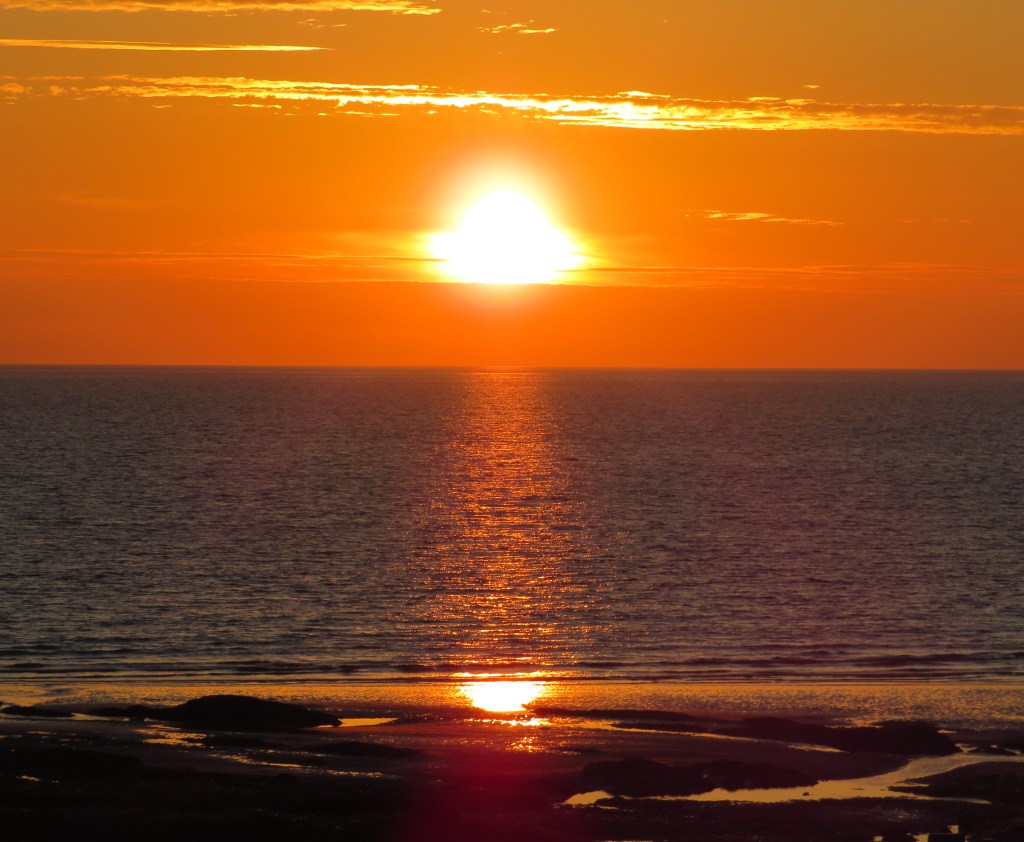
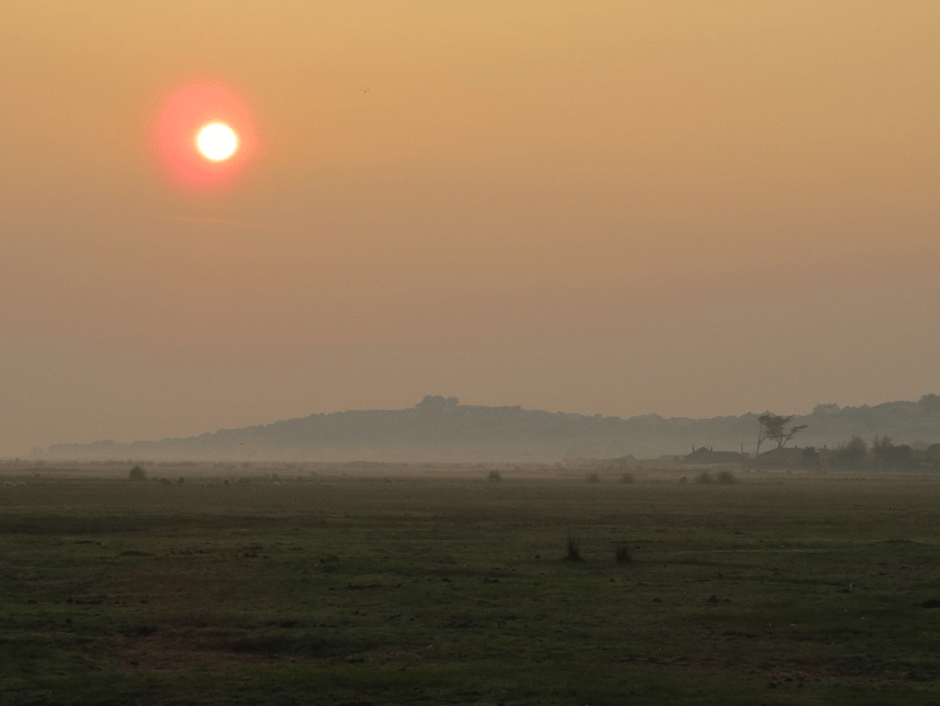
Just because things are good, here is last week’s sunset, minutes from home.
There’s not much to report but I thought I should mark the fact that it is exactly six months since I moved house. The time has flown by, not helped by losing a month to Covid. The house is pretty well settled. There are things I want to do but nothing urgent. Everything has a place and I am just awaiting some shelves to unpack the last two boxes of ornaments. I am loving being able to see the sea almost every day, although I am ashamed to say that I have not yet co-ordinated time, tide and temperature to dip my toe in. I’ll leave gardening progress to a post of its own. Much of my local walking takes place in the early hours of the morning. This photo was taken at 6am less than ten minutes from home.
Recent excitements have included a few days seeing family and walking on the Isle of Wight. ’Walking’ makes it sound like we going on ten mile hikes; sadly those days have passed. We did manage a couple of five milers but it was mostly strolling along the cliff path. Then there was a trip on PS Waverley in full OAP mode, using my bus pass to get to the pick-up point. There have been meals out with friends and more to come. Mistress Agnes may also have been spotted at an event commemorating the 475th anniversary of the Prayer Book Rebellion, trying armour on unsuspecting passers by and killing people off sixteenth century style. This was quite fun as members of the audience succumbed to plague, warfare and accusations of witchcraft amongst other things.
It hasn’t all been fun and games and I have yet to comprehend what ‘retirement’ might mean. The job I must not mention is now in full flow, so other things will take a back seat for the next couple of months. I do still have some talks to give and my online One-Place Studies course for Pharos Tutors starts on Monday. That will be swiftly followed by another run of Writing your Family History. There’s a new course in preparation for next year but more of that another time. It won’t go public until I’ve actually written it! I have managed to get another non-fiction book off to the publishers but that won’t see the light of day until well in to next year.








 The History Interpreter - Janet Few