Method Genealogy – standing in the footsteps of your ancestors

Until recently, I was a columnist for the In-depth Genealogist Magazine and also wrote for their blog. Now the magazine is sadly no more, contributors have been invited to re-post their blog material elsewhere so that it is preserved. This is a post that I wrote in October 2016. Comments in {} are new additions.

We are probably all familiar with the concept of Method Acting, where the actor attempts to fully identify with a part by living as their character lived, or sharing experiences but method genealogy? As diligent family historians, it is something that we should all be practising. We need our ancestors to be as fully rounded as possible, to lift them from the two-dimensional pedigree and to understand what their lives would have been like. When I wrote my book Coffers, Clysters, Comfrey and Coifs, about seventeenth century social history, I said, “Our seventeenth century ancestors may be people that we can identify, or they may be lurking, nameless, waiting to be discovered. In either case they existed, therefore we owe it to them to find out more about their way of life.” The same is true of more recent inhabitants of our family tree. {Incidentally, if you would like to contribute to the campaign to make room for me to publish more books – copies can be obtained from me}.

Option 2 - CopyI recently discovered this beautiful photograph of a member of a family that I am researching. It isn’t actually my own ancestry but she will one day I hope be part of a novel based on incidents in her family’s life, so this could be my cover photo. She has bare feet. She lived on a cobbled street. What is it like to walk that street barefoot? I don’t know but I need to. Ok, I’ll be honest, I’m probably going to wait for better weather but I will be trying this. {Yes I wrote the book and yes I tried it – but not for long. And yes – another opportunity to relieve me of book stock and increase the free space in my house}.

Part of my life is spent as an historical interpreter, so I do get to dress in period costume. Have you any idea how difficult it is to go upstairs in a full length skirt? What about household tasks? That bucket you need to fetch from the well could weigh four stone (30kg), oh and you probably need eight bucketfuls of water a day. What is a home like without electricity? I get to try this in my 400 year old cottage when our power fails.

Reality television has often attempted to get people to turn back time. In some cases they go back to their centrally heated homes and twenty-first century luxuries every night. Even if it is a more sustained experiment, the participants know it is only temporary but such experiences are the closest we may get to the lives of our ancestors. What is it like to carve a homestead from virgin forest, to clear, to plough, to plant and to hope for an eventual harvest? How does it feel to set off on a six week sea voyage, knowing  that you will never again see those you have left behind?

If we are physically capable, we need to enter the realms of experimental archaeology to find out what processes were involved in the occupations of an ancestor. If we know they walked a certain route to school, to work, or to migrate, then can we walk it too (if only virtually with the aid of Google Earth)? What was the terrain like? What marks on the natural or built landscape may they have passed?

Family History is not just about following shaky leaves {and believe me, ‘shaky’ is an appropriate description for many} and amassing the largest family tree in the world. It is about getting under the skin of those we have discovered and doing the best we can to gain an insight into their ways of life. {Oooh, opportunity for another advertisement – if you would like to add depth to the deaths of your ancestors, join me on my Pharos Tutors online course ‘In Sickness and in Death: researching the ill-health and deaths of our ancestors’ – starts on Tuesday folks!}.

More Cornish Wanderings with Family History for Good Measure

I know it was a while ago now but I did have another day of holidaying to share. So just in case anyone is wondering why they have been left in limbo, or in our case in Cornwall, here is the final episode.

After an early morning look at Looe for another fishing boat fix for my travelling companion, we head to Cotehele. On the way we fit in another family history parish. Since I have been home, I have been trying to take these newly-found Cornish ancestors further. One just might be a ‘gateway’ ancestor, taking me back to Medieval times and potentially royalty but let’s not get ahead of myself. It holds together well back to 7x great-grandfather Richard Rowse/Roose/Ruse/Ruze but I need to convince myself that his potential father Walter (who does seem to be the only Walter around at that date, didn’t marry until he was in his forties. Further speculation needs to wait until I can get to the new Cornwall archives.

082 15 July 2019 CoteheleOur first task at Cothele is to hunt out our memorial tree in the fruit orchard. We think we know roughly where it is. We also think we know what variety it is but we fail to locate it. Once again we are hampered by the environmentally friendly attempt to let the orchard go wild. Tramping through long grass trying to find a variety label that has probably long since gone is not fun. Reception provide us with a guide, which suggests that we are looking for the wrong type of tree. I am still not sure that the tree we pay homage to is actually the one that Martha and I planted in 2008; we are both convinced it was a different variety, to the extent that I purchased one of the same type for my garden.

We tour Cothele house, which belonged to the Edgecumbe family. Most of the present building is Tudor but the interior is largely seventeenth century in style. It is one of my favourite National Trust properties and always seems very homely. Surprising then to discover that the family only lived there full time during Civil War. Somehow this had escaped me on previous visits. Not bad for a holiday home. They used it as a showcase for their various collectables. To this end, bizarrely, they have a china closet in the bedroom, presumably so guest can admire the cups and saucers at night. This showcasing lark is not always successful as various tapestries have had bits hacked off them in order to fit the rooms. We manage to miss being in the right place to hear the iconic clock strike twelve. We walk down to the quay before deciding that it really is too hot to be outside and returning to our van.

All in all, it was a gentle sort of holiday and because we are not far from home and have been many times before and hopefully can again, there was no pressure to rush round places thinking this will be our only opportunity. Nothing beats glorious landscapes, the sea, sunshine and the chance to immerse yourself in heritage, both personal and more general.

Are your Ancestors Dead? – a family history post

One thing that all but our most recent ancestors have in common is that they are dead. Particularly when we first start out on our genealogical journey, we all have those ancestors hanging from our family tree who are 327 and we have not yet killed them off, in the nicest possible way. The temptation is to focus on births/baptisms and marriages, as they are more likely to progress our tree but it is vital to seek out deaths/burials as well. It is not unusual to find people constructing a tree based on someone who died at the age of two, so could not possibly have married great-granny. It is not just about when they died though; what about the how and the why. Do you know how your ancestors died, or what conditions were prevalent at the time of their deaths, or how their occupation might have impacted on their health? Do you know your byssinosis from your convulsive ergotism and which ancestor would be more likely to suffer from which?

The health problems and deaths of our ancestors are an integral part of our family’s history. Sickness was a very real fear for those who lived in past centuries, diagnosis was not straightforward and cures and preventatives could be ‘unusual’ at best and useless at worst. Illness and disease was such a fundamental part of our ancestors’ lives that we owe it to them to investigate this aspect further, if we want those ancestors to be more than just a two-dimensional name on a page. I do have a particular interest in this topic and several of my presentations cover aspects of the history of medicine. A number of you will have heard tales of my ancestors who habitually fell off (or into) things.

This is the time of year when I revisit this topic, as I am about to present my five-week online course for Pharos Teaching and Tutoring In Sickness and in Death researching the ill-health and death of your ancestors. If you think this post is some kind of convoluted advertisement, you’d be right but it is also because I feel that this is a very important but often neglected, topic. The course will help you to set your ancestors’ lives in context by looking at the illnesses, disabilities and diseases that brought about their deaths or had an effect on their well-being. It covers a variety of records that might provide information about ill-health, or causes of death for specific ancestors, or about prevalent threats to health in the past. The causes, symptoms and treatment of various illnesses are investigated in all their gory and fascinating detail and significant medical developments of the last 400 years are explored. If any of my writer friends have persevered this far, it could be great for historical novelists too. The first lesson begins on 13 August, so if you do want to fill one of the remaining spaces, don’t delay. It can all be done in your own time, from the comfort of your own keyboard, so there are no excuses. The only part that is time-prescribed is the weekly online ‘chat’. I should add that no webcams are used in this process, all you need to do is to type your comments, so you are free to join in wearing your pyjamas. The sources that are referred to are from English records, as they are what I have access to but the principals apply world-wide and you are encouraged to relate what you have learned to your own ancestors.

Advert over – normal service will resume shortly and yes, I know I have left you hanging in Cornwall – one more post to get us home soon, I promise.

Bill of Mortality

An Ancestral Odyssey – or churchyards we have known

We spend a day touring round numerous, remote Cornish parishes that have ancestral associations. I am reminded how much I enjoy map reading, or following along on an Ordnance Survey map, with the sat-nav for back-up.

We drive out past Kit Hill, which is a former mining area on the edge of Bodmin Moor and enjoy the spectacular views. I know it is not a good idea to tour churches on a Sunday, nonetheless here we are doing it. On the upside, it may mean they are open but it also means they are full of worshippers. So begins a game of dodge the congregation, at which we are only partially successful.

We start in Sydenham Damerel, which is actually back across the Tamar in Devon and arrive just before the service begins. My 7x great grandparents, Matthew Deacon and Joan Cowl, married here 200 years ago. The church was burned down and rebuilt on smaller scale to reflect diminishing congregations, so only tower is original. This means I cannot imagine them walking down the aisle. The proximity to the River Tamar is significant, as the Deacon family end up further down the river in later generations. It is always a good idea to look at maps to understand ancestral migration routes and remember that, historically, water is far more likely than land. The next stop is Stoke Climsland and here the service is just finishing. Unusually, it seems they have a thriving congregation. Two branches of the family married here. The next generation of Deacons, Walter Deacon and Mary Bennett in 1752 and 6x great grandparents Samuel Braund and Jane Lucas in 1741.

Stoke Climsland 61

Stoke Climsland

I descend from the Kenner family. This is a branch that my online searching in the caravan has potentially extended by three generations. There is a likelihood that they once inhabited Trekenner (Tre being Cornish for farmstead). We drive past but there is no obvious old farmhouse. At this point there is a diversion to a nearby superstore for a toilet stop. The places we are visiting consist of a few cottages and a church. There are no public toilets, cafés or pubs and even if there were, cafes and pubs would necessitate buying a drink and thus somewhat defeat the object.

We resume at South Petherwin where the service is finishing. 7x great grandfather, Thomas Kenner was baptised here in 1664. We take a look at Kennard Farm, another likely abode for the family but again can only spot modern buildings. On to Lewannick and at last, an empty church Two more ancestral marriages took place here. Thomas Buckingham and Ann Davey in 1732 and William DiIling and Susannah Davey in 1733. I am sure the two Davey brides are related but I have not yet found their baptisms.

The final port of call is North Hill and the only locked church of the day. The churchyard has been deliberately left to be wildlife friendly. Whilst this is very laudable, it does mean that we encounter long grass, stinging nettles, ants’ nests and other hazards in our hunt for gravestones. This is the only location where there are any relevant headstones, probably because this was home to more recent generations of the Buckingham family. None of my direct ancestors rate a gravestone but they are here somewhere.

It is so important to walk in the footsteps of your ancestors, to get a feel for where they lived and the landscape they would have encountered. If you can’t do this literally, I recommend a virtual trip using Google Earth. Here, back on the edge of Bodmin Moor, it looks glorious today but it is very isolated and would have been bleak in winter. I suspect the Buckinghams had little time to appreciate the scenery, which would have been unremarkable to them as it was all they knew. I am now fired up for taking another look at this part of my ancestry. All I need is a few days with 48 hours in them……..

Getting Stuck and Making (family history) Progress

I know you thought I’d abandoned you all in the depths of Cornwall but no! There is still more to reveal, it is just that the job I must not mention has kept me busy for the past few days. We move sites again and are now (well not now this minute obviously but we were when I wrote this) just outside Looe, I bet you never even noticed, did you? The journey was uneventful and with the aid of our special caravan sat-nav, we miss the roads that the instructions warn us to avoid. Once pitched, we set off for a supermarket near us. We have told the sat-nav we are now a car, so it takes us up the shortcut. This is clearly the no-go road for caravans as our wing-mirrors are touching the hedges on either side. There are occasional passing places should something be coming the other way, which inevitably it does. Heading up hill towards us is a jeep pulling a large trailer that is wider that the car. We know the drill, give way to things coming up hill, especially when they are bigger than you. All this narrow roads lark is a doddle to us anyway, we are used to it and we go to reverse. Behind us is another car that clearly needs to reverse first. By this time, there is a car behind the trailer too. No one is moving. Eventually, the car behind us begins to go backwards, into the hedge, she drives forward again (I hate to admit it was a female driver). Backwards a couple of yards, into the hedge again, forwards a yard, she repeats this numerous times. The jeep driver and I are exchanging ‘good grief’ gestures. In all she is going to need to go back 200 or 300 yards, we could be here all day. In the end my travelling companion gets out and offers to drive the car for her. She insists she can do this. It is not clear on what experience she is basing this claim. She thinks the car with the trailer should be reversing instead. Granted he was nearer to a passing place but trailers do make reversing difficult. To be fair, it isn’t clear why he is on this road (and I use the word advisedly) in the first place. Eventually, the inept reverser manages to travel backwards sufficiently to tuck into a passing place. After all this, once back in the van we decide to stay there watching Simona Halep slaughter Serena Williams in the Wimbledon final, followed by an incredibly close and lengthy men’s doubles.

074 15 July 2019 Looe

Meanwhile, I am preparing for a family history tour tomorrow by revisiting some of my southeast Cornish ancestral lines. Most of these branchlets of my family tree have been lying dormant for forty years, a long while B.C (before computers – or before home computers at any rate). Time to take them out, dust them off and revisit them. A quick look at what is now online, including the super-useful Cornwall Online Parish Clerk’s website, suggests that I can potentially add several new ancestors. It will need checking out in the original records when I can get to the soon-to-be-opened new Cornwall Records Office but it looks like my 11x great grandfather was one Henry Speare of Lezant, who would have been born about 1515. If this stands up to scrutiny, he will be the earliest ancestor on my tree. It is likely that he was born about thirty years before my previous earliest ancestor (also an 11x great grandfather) William Elford. Coincidentally, they are both ancestors of my great grandmother Fanny Thomasine Bishop.

Occupational Hazards – Levant Mine

I always encourage my family history students to investigate the working lives of their ancestors and Levant Mine is a ‘must see’ for those with mining ancestors. My own Cornish ancestors worked on the land, rather than under it but it was fascinating nonetheless. Today was a great opportunity to learn more about Cornwall’s industrial heritage.

We arrived at the mine just in time for a guided tour by the indefatigable Richard and boy did he know his stuff. If you plan on visiting the mines, do try to coincide with a guided tour. Tours like this enhance a visit, as there is only so much you can learn from guide books and interpretation boards. Richard talked to us about the mine’s history, without the aid of notes, for two hours. No one dropped out of the tour, not even the two year old or the dog. We gained a real insight into the working lives of the miners. Any errors in what follows are mine and not Richard’s.

There are 1000 mine shafts and hundreds of miles of tunnels on the ‘tin coast’ in the far south-west of Cornwall and commercial mining, notably of copper and tin, has been going on here for 2000 years. There are several Zawns (wave-cut clefts) in close proximity and these might have revealed surface ore that encouraged the early miners. Written records of mining in this area date back to 300BC. The first documentary evidence of speculative mining at Levant is a map of 1748. This mining was by tunnel, rather than shaft and the tunnels were upward sloping, to allow water to drain out and also so gravity would aid the carts loaded with ore. The ore was then taken up to the dressing floor by horse whim. In the eighteenth and early nineteenth centuries there were several small-scale copper mining ventures in the area but in 1820, twenty investors got together to fund the sinking of the first shaft. Their collective initial investment was £400. The shaft was quickly profitable and further shafts were sunk. As they went deeper, water became a problem and a series of increasingly large, steam-powered pumps were purchased over the ensuing years. By 1836 they were not only pumping water but also raising ore by engine.

In 1840 they purchased a beam engine from Harvey’s, the famous foundry in nearby Hayle. This engine remains in situ and running; the oldest engine to be in working order and still at its original site. In the early 1850s a depression resulted in the mass emigration of Cornish miners to hard-rock mining areas throughout the world. They took Cornish customs and the iconic Cornish mine architecture with them to places such as Mexico, South Africa and Moonta in South Australia.

There was some economic recovery in the late 1850s and in 1857, a man engine was installed. This was a hugely significant innovation as no longer did men have to climb 1200 feet of ladders at the beginning and end of the shift. With the engine, they descended in 12 foot increments, in time with the engine’s piston. In this way they made the descent in 130 stages and it took 26 minutes. The structure also allowed the out-going shift to come to the surface and the in-coming shift to descend simultaneously. Previously, there was only space for a single ladder, so it was not possible for miners to be going up and down at the same time.

The mine closed briefly in 1870 as removing water and digging through granite to follow the lodes was becoming prohibitively expensive but new investors were found and it re-opened. This decade saw an increasing use of steam engines and by 1880, pneumatic rock drills were use. These were huge and required several operators. They also created a great deal of dust, that led to lung complaints amongst the miners. Pit ponies were also used. They spent eighteen months continually underground before being retired to the surface, rehabilitated and sold.

In 1919 the man engine collapsed and thirty one miners were killed. This was followed by the bottom dropping out of the tin market. Treasury loans were taken out but they could not repay them and the mine closed in 1930. The workings were in use in the 1960s, as an extension of nearby Geevor mine but this too closed in 1990 and the shafts were allowed to flood.

Conditions underground were harsh, with 30 degree temperatures and debilitating levels of humidity. Add to this the smoke from the tallow candles, which were the only form of lighting and the dust and it is no wonder that the health of the miners was compromised and life expectancy was about forty. Surface work was undertaken by the bal maidens who worked the rock to extract the pure ore. Ragging, spalling, cobbing and bucking gradually reduced the rock in size and finally it was buddled to leave crushed ore. This had to be graded, or jigged, using a pumping action to force water through the ore. Copper smelting took place in Swansea, to save the cost of importing the coal. Tin however was governed by the ancient stannary laws and had to be smelted in Cornwall, so was taken to Penzance.

024 6 July 2019 Levant Mine

The noise of the mechanical tin stamps must have been overpowering. After the tin was buddle, a calciner was used to drive off the impurities, largely arsenic and sulphur. The smoke from the calciners would drift over local villages with resulting ill-effects on health. It was discovered that arsenic was a useful ingredient in insecticides that were used to combat the cotton bol-weevil. This meant that the arsenic was now a valuable by-product. There was an awareness that arsenic could be absorbed through the skin so exposed areas were coated with a thick, white clay paste to combat this. Working with arsenic also caused infertility and allegedly, men volunteered to work with arsenic as a method of family planning.

Richard is going to take us down a tunnel. This is slightly scary but we are up for (almost) anything. It is suggested that we remove our sunglasses as visibility is poor. I have recently acquired glasses that are also sunglasses for the first time. I am proudly wearing them. Great, so now I have the choice between not being able to see because I am wearing sunglasses and not being able to see because I have taken them off. I go for keeping them on. We wander down the tunnel and it certainly is quite dark. Then Richard realises that the lights aren’t working, so all we have is the emergency lighting. He fiddles with the fuse box a bit. We have already walked down the tunnel. I am wondering how we will get back if all his fiddling somehow extinguishes the emergency lighting as well. Never fear, a few messages on his radio and full lighting is restored. The trip ends with a visit to the engine room where we can see the 1840 engine in action, aided by Ron and Tim. Despite all this engagement with mining heritage, there is no sign of Aiden Turner.

I had originally planned to move on to Hayle but decided to go to Trengwaniton Gardens instead. We find this with no trouble but I had failed to check that the opening times would allow for this rearranged itinerary. They don’t. We may or may not return tomorrow. So it is back to the van for more relaxing, more fish and chips (fortunately for the ‘diet’ they only visit twice a week) and some Wimbledon on TV.

For more information about historic Cornish mining see here. If, like me, you are interested in the history of medicine and the ill-health of our ancestors, next month sees another opportunity to take part in my five week online course, ‘In Sickness and in Death: researching the ill-health and death of your ancestors’; there are still a few spaces.

A Genealogical Conundrum – In search of the 32: who was John Hogg?

[Updated 6 July & 14 July 2019 and 12 September 2020] Recently, there have been various posts on social media, with family historians naming their 32 3 x great grandparents. At present, I can only name 29 of mine, or does this story reveal two more? I have always known that my great great grandfather was John Hogg. His son’s original 1885 marriage certificate was handed down through the family and is now in my possession and that tells me his name and that John was a gardener. After forty two years of genealogical research, I am still not absolutely certain who John’s parents are. I am almost sure I know but I have still not ‘inked in’ the next generation. I know my genealogical friends like a bit of a brain-teaser, so I thought I would outline the story so far and ask the question – if John were your ancestor, would you be adding another generation to your family tree? I am probably doubly cautious having nearly got my fingers burnt earlier this year. I was very close to expanding one of my ancestral lines (the one that involved the third of my missing 32). In that instance, I realised just in time that I would have been climbing the wrong family tree. For that sad story see here. This is an abbreviated account of the story so far but I am afraid that what follows is a long post; I hope you will persevere.

So, back to John Hogg. Working backwards from the most recent document, the twenty five pieces of evidence that I have for great great grandfather, John Hogg are as follows:

  1. According to his death certificate, John died on 23 January 1876. He was a farm servant of Well Way, Morpeth, Northumberland and was then aged 76, meaning, if this was accurate, that he was born between January 1799 and January 1800. The informant was his son, also called John, who was my great grandfather, of the same address.
  2. On 2 April 1871, the census for Well Way, Morpeth, Northumberland (RG10 5164 folio 50) records that John was an ag lab aged 68 (i.e. born April 1802 – April 1803) and his birthplace was given as birthplace Bavington, Northumberland. (Little Bavington is in the parish of Thockrington and Great Bavington is in the adjacent parish of Kirkwhelpington). With him were his wife Elizabeth and 3 children, John, Jane & Margaret.
  3. On 7 April 1861 the census for Newgate Street, Morpeth, Northumberland (RG9 3871 folio 27) lists him as an ag lab age 56 (i.e. born April 1804 – April 1805). This time, the birthplace was Kirknewton (Kirknewton is on the Scottish border, so, looking at the evidence in the other records, it seems possible that the birthplace was an enumerator error and should have read either Kirkwhelpington or Kirkheaton; the latter borders Thockrington.). He is with his wife Elizabeth and four children, Frances, John, Jane and Margaret. A slight spanner in the works is that, in this census, ‘John’ is enumerated as ‘George’. Given that the details of the rest of the family are consistent and they are at Newgate Street, where his son was born in 1855, I am happy that this is the same person. There are no Georges baptised in Kirknewton around 1804/5 and there is no George who fits with this George in 1851 or 1871. After extensive research, I am confident that ‘George’ is indeed the man who appears in every other record as John.
  4. On 1 January 1860, the index to the baptism register tells us that John’s daughter Margaret was baptised at St Mary’s Morpeth and that her mother was Elizabeth. I need to get a copy of the original entry which would give John’s abode and occupation.
  5. 26 October 1859 the birth certificate shows that his daughter Margaret Newgate Street, Morpeth (later calls herself Margaret Catherine) father an agricultural labourer mother Elizabeth Pearson
  6. On 7 February 1858 an index to the baptism register records that John’s daughter Jane was baptised at St Mary’s Morpeth, her mother was given as Elizabeth. Similarly to Margaret, I could get copy of the entry.
  7. 4 September 1857 the birth certificate shows that his daughter Jane was born at Newgate Street, Morpeth, father an agricultural labourer, mother Elizabeth née Pearson.
  8. On 9 March 1856 the original baptism register records that John’s son John junior was baptised at St Mary’s Morpeth. John senior, was a labourer of Morpeth and the mother was Elizabeth.
  9. According to the birth certificate, John junior was born on 4 November 1855 at Newgate Street, Morpeth. John senior, was an ag lab and the mother was Elizabeth née Pearson.
  10. On 14 March 1854 the birth certificate for John’s daughter Frances Isabella, shows that she was born at High Espley, High and Low Highlaws, which is in Mitford parish, John, her father, was a husbandman and her mother was Elizabeth née Pearson.
  11. A newspaper item in the Newcastle Journal of 16 April 1853, records the marriage of Mr John Hogg and Miss Elizabeth Pearson, both of Espley, which took place at Lamberton on 13th April. This was an irregular Scottish marriage at Lamberton Toll, a less well known version of Gretna Green. The records for this date have been lost.
  12. 27 July 1851 death of son James High Espley, High and Low Highlaws. According to the death certificate, the informant was Elizabeth Hogg, his sister. Note that  four months earlier his sister Elizabeth was in service in Rothbury and not at home with the family; perhaps she returned home to take care of James. The eldest sister Mary Jane was at home in March 1851.
  13. 27 July 1851 the Bishop’s Transcripts record the burial of John’s son James in Netherwitton. James was of High Espley, Mitford. His age was 18.
  14. 30 March 1851 the census for Glororum, Stannington, Northumberland (H107 2413 folio 34) lists John as a farm labourer aged 42 (born March 1808 – March 1809) birthplace Kirkheaton (Kirkheaton borders both Thockrington and Kirkwhelpington). John is a widower living with two of his children (Mary and James). See below for why I believe that this is the same John Hogg as the John Hogg who has children with Elizabeth Pearson.
  15. 10 July 1849 the Bishop’s Transcripts record the burial of John’s ‘wife’ Cecily Hogg of Glororum at Netherwitton, Northumberland. Inexplicably there is no death registration in Northumberland for any Cecilys/Sisilys with any surname or any Hoggs who could be Cecily. I asked the local registrar to check in case the record was lost between local and central registration but there is no local registration and she suggested, as this was before the 1874 Birth and Death Act, there may be under-registration of deaths at this period. I am aware of this in relation to births but not deaths. An Act for registering Births, Deaths, and Marriages in England 17 August 1836 6 & 7 Will. IV. c.86, which introduced civil registration required a death certificate to be produced before burial, so how did the incumbent get away with this (there are also two other burials in the extended family for whom no death certificates survive).
  16. 29 January 1844 the Bishop’s Transcripts suggest that John’s ‘wife’ Cecily may have had a child, John, by Mark Ainsley. The child was baptised in Hartburn on 28 April, with the mother given as Cecily Hay. There is no birth registration as Ainsley (or variants) Hogg or Hay. He was possibly buried in January 1848 as John Hay, with the address of Cecily’s brother. There is no corresponding death certificate as Hay, Hogg or Ainsley (and variants). There is no birth or baptism record for John Hay b. c. 1844. There is no record of any other Cecily Hays at this time in Northumberland. Given the propensity for this family to avoid appearing in the records however it is possibly that Cecily Hay, mother of John Ainsley, was in fact an otherwise unrecorded niece of Cecily ‘wife’ of John Hogg.
  17. 6 June 1841 the census for Ashington and Sheepwash, Bothal, Northumberland (HO107 834/1 folio 2) lists John as an agricultural labourer age 40 (rounded down age so born 1796-1800 BUT he was younger than his wife so may have adjusted his age). With him are ‘Siscely’, Elizabeth, James and George.
  18. 10 August 1837 the birth certificate shows that his son George was born at Ashington, Bothal. father as husbandman, mother Sisceley Hogg née Hay.
  19. 5 November 1837 the index to the baptism register, records John’s son George being baptised at Bothal, John was a hind of Ashington. I could get a copy of the entry.
  20. 19 April 1835 the Bishop’s Transcripts show that John’s daughter Margaret was buried at Netherwitton ‘of Buckshaw, Mitford’.
  21. 13 April 1835 the index to the baptism register shows that John’s daughter Margaret was baptised at Mitford. John was a labourer of Buckshaw, Mitford.
  22. 14 October 1832 the index to the baptism register shows that John’s son James was baptised at Mitford. John was a labourer of Edington, Mitford.
  23. 31 October 1830 the index to the baptism register shows that John’s daughter Elizabeth was baptised at Bothal. John was a hind of Ashington, Bothal.
  24. 31 August 1828 the index to the baptism register shows that John’s daughter Mary Jane was baptised at Netherwitton. John was a husbandman of Ruffles, Netherwitton.
  25. 1820-1827 The 1841 census, the baptisms of their children and the burial of John’s ‘wife’, indicates that there was a ‘marriage’ to Cecily Hay but no record has been found. In England or Scotland.

So why do I believe that John ‘husband’ of Elizabeth Pearson and John ‘husband’ of Cecily Hay are the same person? I have followed up all John and George Hoggs who were born between 1797-1808 anywhere in Northumberland, who appear in the 1851 English census (anywhere in the country) and I have looked for them in 1841 and succeeding censuses, to see which one could be the ‘George’ Hogg in Newgate Street in 1861. I have also tried to relate these to baptisms. The John ‘widower’ of Cecily Hay is the only one not accounted for. In addition, his stated birthplace of Kirkheaton in 1851 is not inconsistent with Bavington, his stated birthplace in 1871. After exhaustive research, I am happy with the conclusion that the John Hogg, father of my great grandfather, also had children by Cecily Hay. An added link is that his son James by Cecily Hay was buried in Netherwitton in 1851 and was at the time of High Espley, Mitford (a handful of cottages), which is where John’s first child by Elizabeth Pearson was born in 1854.

I believe that my great great grandfather, John Hogg, was almost certainly the son of Robert and Mary Hogg of Hallington, St John Lee but who was baptised in neighbouring Thockrington. According  to the baptism register, was born and baptised in 1804. There are no John Hoggs baptised in Kirknewton 1795-1814 and the Thockrington baptism is the only one within 10 miles of Bavington. I can find no plausible alternative future for the John baptised at Thockrington. If I have identified the correct baptism, John was orphaned at a very young age, which may account for him being unsure of his birthplace and age. It must however be noted that, as an orphan, this child will presumably have been brought up with another family and could possibly have taken their surname. There is no obvious relative who might have taken John and his younger sister Mary, on. There are no surviving poor law records for Thockrington.

So what do we know of the John Hogg, son of Robert and Mary?

  1. 18 June 1808 the burial register records the burial of John’s mother Mary in Thockrington, of Great Bavington, which is in the neighbouring parish of Kirwhelpington, late of Hallington.
  2. 31 August 1806 the baptism register records the baptism of John’s sister Mary in St. John Lee, of Hallington.
  3. 3 December 1805 the burial register records the burial of John’s father Robert in Thockrington, of Hallington.
  4. 2 September 1804 the baptism register records the baptism of John son of Robert and Mary in Thockrington, of Hallington.
  5. 23 June 1804 the baptism register gives this as John’s birth date

This family are non-land-owning, agricultural labourers who move around frequently. They do not appear in newspapers (as per British Newspaper Library index). There are no surviving poor law records for the relevant parishes at the appropriate times. They do not leave wills (Northumberland Archives, Prerogative Court of York and The National Archives indexes checked) or own land. They do not appear in electoral rolls nor did they serve in the army or navy. There is nothing in the catalogue at Northumberland Archives that relates to the family, leaving me with vital records only. There is a tantalising mention in the Quarter Sessions court records to John Hogg, alias Willes Jock of Redeswood, yeoman; at Chollerton, who stole eight ewes worth 6s. 8d. each, the property of Edward Reed of Chollerton but this is two hundred years earlier and the absence of seventeenth century parish records means that I am very unlikely to get this far back. I have taken a DNA test but there are no matches for any members of any Hogg family. This is unsurprising because there are no known living descendants of Robert and Mary Hogg apart from those who potentially descend from John (‘husband’ of Cecily and Elizabeth).

So are Robert and Mary of Thockrington my 3 x great grandparents? What do you think?

St Aiden's Thockrington (4)

Thockrington Church – was my great great grandfather baptised here?

So what is Rootstech all about? How to win a free ticket

So Rootstech is coming to the UK. Unless you are involved in the international family history world you may not be aware of Rootstech. Or you may have heard of it and are wondering what it is all about. If you are trying to decide if this event is for you, then read on. Even if you are a die-hard Rootstech attendee and have already purchased your ticket, read on, as here is an opportunity to get a refund on your ticket price.

Rootstech, hosted by Family Search, is quite simply the biggest genealogical event in the world. It has been running for several years in the US and is getting bigger and better each year. From 24-26 October Rootstech will be in London. There will be some modifications to the US model to suit a British, or as they hope European, audience but do not expect this to be in the same mode as national events you may have attended in the UK. There will be some similarities but it will be unique is several respects. For a start, the US and the UK are two nations divided by the same language and you will need to familiarise yourself with some different terminology. What we would call lectures, or presentations, are ‘classes’. Don’t be put off by this, you won’t be going back to school but there will certainly be an abundance of learning opportunities.

With the exception of the keynote sessions (of which more later) there are ten, yes ten, sessions, sorry ‘classes’ to choose from at any one time. You will find classes by presenters who are well-known in the UK alongside names that will almost certainly be new to you. The important thing to note is that there is no additional charge for any of these. Once you have paid for your ticket (oops, must remember to call it a ‘pass’) everything, including the keynote sessions, is open to you at no further cost. This means that it is an ideal opportunity for you to try out speakers whose names you do not recognise, as well as your ‘must see’ favourites. I shall certainly be going along to some of the classes on more niche topics; maybe those that I don’t feel will be directly related to my research but nonetheless sound fascinating. I will be speaking on Thursday 24th on Remember Then: memories of 1946-1969 and how to write your ownIf you think you’ve heard me give this talk before – you haven’t. This will be a different version, more directly related to compiling your own reminiscences.

There is no booking system for the talks. I am assured that the area set aside for the keynotes will fit in everyone who has a pass for the day but the rest will be first come first served. The excellent and varied programme – or schedule – is already available, although do check back nearer the time for any minor amendments or additions. With ten sessions running simultaneously, I think we can expect smaller arenas than we might be used to at UK national events, so it might be a good idea to choose a reserve, when planning which sessions you will attend, in case your first choice is full. There will be an app available to help you organise your visit but as regular readers will know, I scarcely recognise an app when it bites me on the nose. As an aside, I am still congratulating myself for managing (at the fourth attempt) to top up my pay-as-you-go mobile (that’s a cell phone to US readers) with credit. It has taken me 13 years to use £25 worth!

Back to the translations. You many find handouts referred to as ‘the syllabus’ or ‘speaker notes’. The concept of keynote speakers seems to be something that some of the UK potential audience are finding it difficult to get their heads around. We are used to these sessions being the opportunity to bring out the genealogical heavyweights. Not so at Rootstech. They embrace the cult of celebrity and choose keynotes who will provide inspiration and motivation, as well as embodying family values. Another reason for choosing non-genealogical keynotes is to encourage attendance from fans who might not otherwise come along. So far, Donny Osmond has been announced as a keynote. He has spoken at the US version of the event and was very well received. So, if you were one of the sceptics, keep an open mind on this one. There will be more razzamataz than we Brits are used to but that’s not necessarily a bad thing.

There will be ‘booths’ – think ‘stands’ or ‘exhibitors’. These have not yet been announced but there will be a mixture of commercial vendors selling products of interest to family historians and societies offering advice and services. The balance between these will become clearer nearer the time. There will be plenty of chance to visit the booths in the ‘vendors’ area’, as a time is set aside each day when there are no classes scheduled. Oh and a word about timing. The first classes start at 9am. Believe it or not, that is later than at the US equivalent. So be prepared for some early starts as you will need to allow time to register on arrival, in the same way as you might expect at a conference – another difference. Just think of all that extra family history time each day.

Now the price; currently, early bird passes are £49. This may seem more than we are used to in the UK but remember this is an all-in payment for all events on that day. Once you walk through those doors, you only need to spend money on refreshments or purchases from the stands. If you are the sort of person who thinks twice about a 30 mile journey and a £15-£20 spend (and that includes your lunch) for your county family history society day conference, why not embrace a different mind-set and make Rootstech your big genealogical adventure. What you glean from those classes or learn from the stall-holders could break down those brick walls and save you time and your research budget. If travel to London really is not for you, keep an eye out for the virtual passes, as some sessions will be being recorded and will be available to you at home.

So how can you avoid paying altogether? Over the next few weeks, Rootstech Ambassadors, myself included, will be offering the chance to win one three-day free pass (full-price value £149). This includes access to any virtual sessions that you may have missed during the three days. If the winner has already purchased a ticket, then they will get a full refund. For my give-away, there is a little more involved than just jumping up and down and saying ‘Me! Me!’ as I know how many people follow this blog and I don’t want a trillion emails. To enter please contact me janetfew @ hotmail.com (without the spaces) with the answers to these five questions all of which can be found on the Rootstech website or on my own webpages (not including the blog posts) or both. I am accepting one entry only from each email address and it must be sent to the email address on the above link, not to any of my other manifestations. The winner will be drawn at random from all correct entries at 12.00 midday British Summer Time on Monday 12 August 2019. The decision is final and I will not enter into any discussion about the competition – though I will try to remember to tell you the answers to the questions! Good luck!

  1. What is the venue for Rootstech London 2019?
  2. I am giving a talk with the same title as my Rootstech session (although it is a different talk) at another venue in the next year. What group am I giving this talk to? (At the moment there is only one answer to this question – if I get another booking there may be more than one – any will be accepted)
  3. The blurb to my novel Barefoot on the Cobbles begins ‘In the euphoria of the armistice a young woman lay dying.’ What eight words follow this? Hint this phrase is obviously on the book itself but is also used elsewhere to advertise the book, including on this website – it is the same 8 words.
  4. What time will the Expo Hall open on Thursday 24 October? (it seems that there have been two advertised times in different places – I will accept either)
  5. What is airport is the nearest to the London Rootstech venue?

Capture

THE Genealogy Show

We set off early to beat both rain and traffic and accomplish this successfully. In the absence of shuttle buses from South Car Park we walk down to Hall 2 at the NEC. There was a happy, gentle atmosphere with a real international vibe. It was lovely to meet several world-renowned genealogists who had only been virtual friends until now. Unfortunately, I had places to be and people to see, so I was unable to spend more than a few minutes in the ever-widening circle of heavyweight genealogical chat that continued in the meeting area throughout the two days of the show.

As a show speaker, I was given two tickets to talks of my choice and I had opted for those by genealogical crime writer, Nathan Dylan Goodwin. His first session described how he researches and writes his books. Very interesting and I appropriated a few ideas. Next, I was acting as a ‘wizard’ attempting to help show-goers with their problems and brick walls. Unfortunately, I was not provided with the required magic wand but I hope I that most people left with a few things they could try. There did seem to be a preponderance of people with Suffolk queries. I coped with foundlings and German ancestry but was a little bemused by the client who spent the twenty minute slot showing me forty or so documents but despite my repeated ‘how can I help?’ comments, didn’t actually appear to have a question or problem. I was reduced to ‘mmm lovely’, as yet another document was whisked past my nose. If you plan to take the opportunity of seeking expert advice in the genealogical equivalent of speed dating, please do come prepared and come with a succinct limited question, or indeed I’d settle for any sort of question!!

Then my allocated two hours on the stall of the Society for One-place Studies, to which I drifted back and forth throughout the day. We had a steady stream of enquiries and a pleasing number of people decided to take up the one-place challenge. The thought of taking on a new, tiny, place did cross my brain, like I have so much spare time! I sold almost all my stock of Putting your Ancestors in their Place and a few other books, despite having issues with the credit card machine. On the downside, my voice was beginning to disappear – cue the Strepsil overdose.

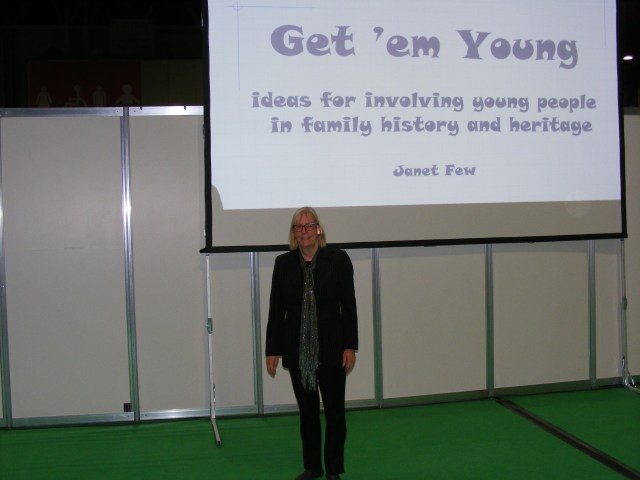
Day two and this time there was no avoiding the rain. Be-decked in waterproof trousers, wielding an umbrella and with spare socks and shoes in my bag, we set forth into the downpour. On arrival, we advise the security staff on tracing ancestry in India. This was more along the lines of ‘we know a man/woman who does.’ My talk was up first. Let us just say the audience was more noted for its quality than quantity. Judging by the ‘I wanted to hear your talk but …’ comments that I received later in the day, a significant reason for this was because I was scheduled half an hour after the show began. At this point, folk were still shaking raindrops from coats and getting their bearings. The real shame was not for me but for the missed opportunity. I was speaking about ideas for engaging young people in history and heritage. This is a crucial topic. On an almost daily basis, I hear people moan that younger generations are not interested in their genealogical research, yet often they are not willing to make any efforts to spark that interest.

DSCF1437.JPG

A quick gap and then I was part of a three-woman panel chatting about surname studies, to a larger audience this time. At least my voice held out. Then back to more wizardry, fielding questions about dancing masters and apprentices amongst other things. The event ended as it had begun, with another talk from Nathan Dylan Goodwin, this time a fascinating account of his own family history research. All too soon, it seemed to be over. I really wish I had had more time to network with people. I had brief chats with so many friends. It is great to be at an event like this, when you know almost every other person. There were evening get-togethers but evenings and I do not get on. Next year and there is to be a next year, I will make more effort to stay awake beyond 6pm and join the fun. The next big genealogical event is Rootstech, of which more later.

Speaker

The job we must not mention is about to hit the fan so there may be radio silence for a few weeks but I will do my best to keep in touch.

Pillories and Preparations

In the brief week at home, idleness has not been an option. Firstly, my home village staged a re-enactment to commemorate the 200th anniversary of the arrival of Methodism in the village. William Reed and Samuel Thorne chose the day of the revels to preach on the village green, were duly arrested and fined. I have to admit that being part of the action, exactly 200 years later, was a ‘hairs standing up on the neck’ moment. Mistress Agnes was present in Victorian guise and a few reprobates were pilloried in the newly acquired community pillory – every home should have one. There was also a truly spectacular flower festival. As someone whose idea of successful flower arranging is remembering to put water in the vase, I was in awe.

1 June 2019 William Reed Commemorations (4)1 June 2019 William Reed Commemorations (6)

I did briefly get back to writing novel number two, after a gap of a few weeks. This has necessitated me buying a book. Thanks to Martha’s research, I did get it half price but it is still the most expensive book I have ever purchased. Then, with assistance, I tried to rediscover my garden. The grass had to be scythed and the weeds still have to be tamed.

Then it was onward and upwards and back ‘up north’ to THE Genealogy Show. Yesterday was spent setting up and greeting friends from across the world, some of whom I have only previously ‘met’ online. My two (well one and a third) presentations are tomorrow so today will be more relaxing. A talk to hear, some brick-wall bashing for attendees who have booked appointments with an expert (a few of them have got me – oh well) and helping out on the Society for One-place Studies stall in between. It is going to be a good day.

TheGenShow