More Scottish Adventures

Having been to the crannogless crannog centre it was time for the ospreyless Osprey Haven. This was not a surprise, as it is late in the year for osprey and there have been no young at the nest at Loch of the Lowes this year, following the death of the male in the spring. The regular female does seem to have formed a new bond and they have been protecting the nest so there is hope for next year.

This is not the sort of reserve where you go for a walk. There are two hides and there’s also a large window where you can watch a wide variety of small birds at the feeders. There are beaver at work on the loch but you only get to see them first thing in the morning and in the evening. There was no sign of the resident red squirrels either. Despite this, it was good to visit and the journey itself was scenic.

Next, we went in to Aberfeldy for a drink and some cake. The local cinema allows non-customers to use their toilets, which then has the desired effect, as we stayed to use their café. We also managed to stock up on food at the local Co-op. We were a little concerned about our booking at the next caravan site as we hadn’t received an acknowledgement or reminder. We telephoned to check, thinking that if something was awry it was easier to search for an alternative using a laptop and the, albeit very weak, site wifi than it would be on a phone when we got there. It turns out that they had no record of our booking but there was space so we booked by phone.

By this point we had been away for a while. Time for the feat of contortion that is changing a duvet cover in a caravan. You’ve probably tried this in a house but accomplishing the task in a 7 foot by 14 foot caravan takes it to a whole new level. Then there is the ‘getting the fitted sheet on the mattress when you can only reach one of the four sides’ challenge to add to the fun.

On a beautiful autumn morning, with sunshine, heavy dew and fog on the Tay, we took the high road (well the A827 followed by the A9 and A95) north. The first twenty-five miles or so of our journey was on a road full of twists and turns, with no duelling (as in road lanes, not the waving pistols or swords about sort). We were towing a caravan. We were not swift. This kind of journey is also known as how many drivers can you **** off in a very short space of time? Not many as it turns out. The road was quite quiet and we pull over to let speedier stuff pass whenever we can, despite very few acknowledging us. As we got to the A9 and A95 we were in whisky distilling country. There was a ‘whisky trail’ indicated on the road signs, illustrated by a symbol that looks a bit like a witch’s hat. I can’t work out what it is meant to represent that has any connection with whisky.

We arrived at Huntly Castle Caravan Site, not without issues as the satnav insists it is where it isn’t, down a dead end with little caravan turning potential. Fortunately, just in the nick of time, I recalled our being led astray in this fashion on our previous visit and we were able to avoid a repeat of the million point turn that following the satnav necessitates. Strangely it turns out, on arrival, we still didn’t have a booking, despite yesterday’s telephone conversation but that was soon remedied.

We have setting up the caravan off to a fine art, so were soon ready to explore the castle from which the site takes its name. Should we partake of refreshments before heading off to the castle? We decided to treat ourselves at the castle refreshment rooms when we get there. Mistake. The castle has no refreshment rooms; rookie error. Here we benefited from the reciprocal arrangement that Historic Environment Scotland has with English Heritage, so entrance was free. There has been a castle on the site since the 12th century. The earth motte is all that remains as evidence of the original timber castle, which belonged to Duncan Earl of Fife. In 1307, Robert the Bruce came to recuperate in the castle. By the 14th century the Gordon family were in residence and remained so until the 1640s. The palatial stone castle was begun in the mid-fifteenth century and then later remodelled with a nod to the influences of France.

Mary of Guise, widow of James V and mother of Mary Queen of Scots, was entertained at Huntly by Gordon, in 1556. She was treated so lavishly that she felt that he was becoming too powerful. Mary Queen of Scots later defeated the Earl in battle and confiscated goods for the crown. The fifth earl collapsed during a game of football and died in 1576. This would presumably have been the more aggressive form of football, known as campball, with an infinite number of players and goalposts that might be at opposite ends of the village.

For some reason, James VI had the castle blown up in 1594 but it is unclear how much damage this caused.  In 1599, George Gordon became a marquis. In order to advertise his new elevated status, he commissioned an elaborate carving to be added to the front of the palace. Carved symbols advertised their Catholicism; these were defaced when Presbyterian Covenanters occupied the Castle in the 1640s. Seventeenth century tenants’ rents in kind provided the household with foodstuff including 167 cattle, 700 chickens, 40 barrels of salmon and 5284 eggs each year.  As ardent Catholics, they suffered during the English Civil War, with George, the second Marquis, being executed in 1650 for his support of Charles I.

An inventory of 1648 gives an impression of how luxurious the furnishings were at the end of the Gordon’s ownership. Tapestries, paintings and a map of the world could be found and there was also an organ. The castle also houses the oldest wooden toilet seat in the country. The castle came into the care of the state in 1923.

Crannogs, Longhouses and other Scottish Things

Time to move sites again and head north-westward into the Trossachs for a few days in Killin. The weather began fine but in typical Scottish fashion, rapidly turned to rain, nonetheless it was a pleasant drive with lovely views. We wanted to arrive at Killin promptly when it opened for new arrivals at 1pm because we planned to visit Moirlanich Longhouse, which is close to the site and which has very restricted opening hours.

We’d passed the longhouse several times on previous visits but had never been able to go inside before. It is in the care of the Scottish National Trust, so we were able to take advantage of the reciprocal arrangements with the English version. The house is a great illustration of how people would have lived in the past. This particular house was built in 1809 for tenant farmers. It is a cruck-framed house, built in a style that had probably been used for centuries. This was the time when many labourers were turned off the land and moved away but the Robertson family were granted the tenancy of Moirlanich and farmed the surrounding thirty acres, trying cattle, then sheep, before changes to growing oats. The once thatched roof was covered with corrugated tin in the 1930s.  The last member of the family left in 1968 and the house remained empty until 1992, when the trust took over.

Various items were found in the house, including ragged and probably discarded clothing, which appeared to have been used to insulate the chimney. There were multiple layers of paper on the walls. Considering there were only three rooms, plus the byre at the end, it is strange that one room was largely reserved for ‘best’, such as entertaining the minister. The room did contained two box beds that were in regular use.

The next day was beautifully sunny, just right for a drive along several miles of the banks of Loch Tay towards Aberfeldy, in the centre of Scotland. We were paying a return visit to the Crannog Centre, or in this case the Crannogless Centre. We visited the earlier version of this Iron Age living history experience on a previous trip to Scotland but a couple of years ago, a fire destroyed the crannog. A crannog is a dwelling that was constructed on stilts over the water and evidence of nearly six hundred have been found across Scotland, which is probably only a tiny fraction of the number that would have been built. Several of these were on the edge of Loch Tay. Building across water is much more difficult than building on land and was done to reserve the land for food production and possibly also as a sign of status and method of protection.

Following the fire and some serious fund raising, the centre moved to its current site, which they were able to purchase for just £1. They reopened in April and have built several roundhouses using different techniques. Erecting the crannog will be a more complex task and building was due to begin the day after our visit. We arrived just in time for a tour and John showed us the museum exhibits, as well as giving us some background history.

Our first presentation was about Iron Age food. Archaeological finds provide evidence of the ingredients but how they were used is largely speculation. We were treated to flat breads made from the ancient cereals, emma and spelt. These were topped with garlic and honey cheese and optional trout. I passed on the added trout but it was very tasty. Emma no longer grows in Scotland, as the climatic conditions have changed since the Iron Age. We saw a saddle quern and it was explained how arduous and time consuming grinding flour would have been.

Next was the blacksmithy and then the woodworking presentation, some of the turning on the pole lathe was highly skilled. The textile demonstration was particularly interesting, with information about dyes, weaving and spinning. I hadn’t realised that woad required soaking in warm urine for a couple of weeks before it was an effective dye. Who first realised that this was the thing to do? It takes 7,000 metres of spun wool to weave a long sleeved tunic. Lastly, we went in the final round house, which had a basket-like woven framework, covered by stone walls and thatch on the roof. Despite the sun, it was still a little chilly and the restaurant was full with a party so we had our carrot cake and drink outside, where it was perhaps a few degrees colder than ideal. Overall, it was a fascinating trip and highly recommended.

Mostly about Wildlife

It was not a great night for our patient but once up there were signs of improvement. Light exercise is recommended and he was keen to embark on another drive. We had left behind the dramatic Northumbrian landscape but the countryside and far reaching views were beautiful nonetheless. This area seems more suitable to arable faming, with heavy red soil and red stone houses. This week seemed to have been designated as harvesting week and there were many tractors.

The church tour of the day met with some success and took us to places other holidays don’t reach. We ended up on the coast at St Abbs. The EbbCarrs Café provided us with a kipper roll and Biscoff cheesecake. Definitely a recommended location and the bonus of fishing boats for the convalescent to look at.

Then it was time to move on again, this time to Balbirnie Park at Glenrothes. We have left behind the area of my own ancestors and potential ancestors and are now moving through territory known to the ancestors of my children and grandchildren. Some traffic hold-ups on the Edinburgh by-pass but otherwise an uneventful journey. We were now on a wifi hotspot only site but the warden kindly allowed us on a pitch where you could get wifi in the van but which is normally reserved for the staff. This meant I could do some essential work while I was there.

So that we didn’t waste the day, we went for a short walk at Loch Leven RSPB reserve in the afternoon. In the 1830s the loch water was harnessed for use in linen bleaching and in the corn, wool and paper mills. This resulted in the loch’s water level dropping, adversely impacting the wetland habitat. Recent management and restoration has provided homes for a variety of wildlife. About a thousand pink-footed geese had just arrived. More will follow, as usually fifteen thousand over-winter there. I also spotted some green-winged teal. The reserve is the site of the country’s first bee reserve but we saw no bees.

Allegedly the weather was supposed to have improved. True, the bitter wind had gone but so had the sun. We decided to visit the nearby Scottish Deer Centre. Currently, this attraction is waving its admission prices in lieu of donations because of refurbishments but we felt it was fair to pay the normal admission price and it was certainly worth it. As the name suggests, there were deer, lots of deer of different types, some of whom you could feed. We walked round by ourselves and then again under the guidance of Owen, who provided us with deer facts, which I will pass on.

Unlike horns, antlers are pure bone and are surprisingly heavy. Reindeer are the only female deer to have horns and as males shed their horns in winter Santa’s reindeer, at least in the northern hemisphere, are all female. There’s also some weird thing about reindeer being able to ensure that the frozen blood supply below their knees doesn’t reach the rest of their bodies in severe weather. In the wild, reindeer form super herds of up to half a million. As it can be hard to see each other in the snow, the use their UV vision to follow urine trails. Fallow deer, the pretty spotty bambi-like ones, are not native but were introduced by the Romans as a food source. Though, as we discovered at Belton, not all fallow deer are dappled. Sika deer, brought from Japan by the Victorians, are an invasive species as they interbreed with native red deer, making it difficult to ensure the continuance of true red deer. Elk, aka moose, like to swim and are predated on by whales. Pere David deer became extinct in their native China but are now part of a successful captive breeding programme.

Our presence normally makes any self-respecting wildlife, including those in captivity, dive for cover but we were luckier than usual this time. Apart from the deer, we saw other species including a wolf, a brown bear and a Scottish wild cat. I was particularly pleased to see the otters. The are clearly ethical issues surrounding keeping animals in captivity but on balance, anything that can encourage people to take an interest in wildlife is important and captive breeding programmes are essential to the survival of some of species kept here. 

We stayed to watch the birds of prey display. You’d think ‘seen one seen them all’ but this was particularly good, with the Eagle Owl landing on the table of the picnic bench where we were sitting. For those visiting with younger family members there was plenty provided in the way of play equipment, so highly recommended as a destination. I did manage to keep the senior member of my party off the zip wire this time.

and Back in Northumberland

This is now nearly a month ago but here is what happened next.

It was lovely and sunny but a with a bitingly cold wind as we revisited Great Bavington Presbyterian Chapel then a detour via Hallington and on to one of my favourite places in the world, Thockrington, subject of one of my One-Place Studies and home of the Hogg family who I am ‘that’ close to ‘inking in’ as my ancestors. I haven’t done so because I am super cautious and am hoping for just one more piece of supporting evidence that probably doesn’t exist. Next to Chollerton and then, a new destination for us, Simonburn. I am busy trying to reach many parishes that ‘probably’ have ancestral connections so that, by the time I decide they are definitely ‘mine’ (if I ever do), I am prepared with photographs and impressions of the area,

We stopped off at Wallington, a National Trust property that we’ve visited before, the former home of the Trevelyan family. This was just a brief visit to avail ourselves of the café and facilities.

We did have a quick look at the house, which the guide described as having a Cluedo board layout.  It was good to see that sensory bags were available. My favourite finds were a Meissen tea set depicting insects, a dolls’ house display and several photographs of the servants. Around the central courtyard, which now has a roof, are impressive murals depicting scenes from Northumbrian history, famous local people and flowers found in the area.  Given the artic wind (that refers to the weather not the state of our digestion) and my companion’s delicate state we gave the gardens a miss.

As said companion’s ailments didn’t seem to be improving it seemed prudent to seek medical advice, This was to be more complicated than you’d think. First stop at 10am the not so local pharmacy. He needs anti-biotics but they can’t prescribe, he’ll need to phone 111 or his own doctor. He opts for 111. ‘What is the postcode of where you are now?’ Errr no clue. The 111 person speaks to the pharmacist. Still no one is keen to do anything, they will ring back. Five hours later they haven’t, so he tries his own surgery, who will ring back. The signal is dodgy here so they text. They won’t prescribe without seeing him. We find details of the nearest surgery (twelve miles from where we are staying). We ring. He will have to go to the pharmacy. Oh wait, we’ve been there. Doctor’s receptionist expresses amazement that the pharmacy was no help. He will have to wait for a call from their doctor. We explain the lack of signal issues and reluctantly they agree we can come in and he can register as a temporary resident. We arrive at just after 3pm. We see just one other person in the waiting room the whole time we are there. We are told we will definitely have to wait until after 5pm, possibly until 6.30pm. We wait and wait some more in the now deserted waiting room. To be fair, perhaps the doctor was dealing with telephone appointments. At 4.45pm my ailing companion was summoned. Turns out he has pneumonia and the vital anti-biotics are issued. The patient insists that he doesn’t want to abandon our trip and to be honest, he is more likely to rest here than at home, so we will be taking it easy. [Progress report, once home a second dose of, stronger, antibiotics was prescribed and seem to be helping].

The next day, first some taking it easy for the patient this morning. We were due to move to another site just thirty miles away and couldn’t arrive before 1pm so an ideal opportunity to do not a lot before we moved on.

We arrived in Berwick on Tweed, overlooking the river. The patient decided he was up for a drive round. This was not a spectacular success as I usually head for a church but any kind of church was conspicuous by its absence. As we left Powburn, I had been informed that we had sufficient fuel for 250 miles. We got to the middle of nowhere, having travelled about fifty miles and it appeared that fuel was low, so finding a garage became a priority. Fortunately, one was located with the bonus of the cheapest diesel that we’d seen since we left home. We drove through Kelso and Jedburgh. The latter looked interesting but we didn’t have much time and in any case it probably wasn’t a good idea for the invalid to walk round in what was still a very cold wind. This time last year we were in Ireland where the temperature was over thirty degrees. Here there was frost forecast overnight.

We did manage to locate Oxnam Kirk, a low-lying seventeenth century building with an unusual T-shaped footprint. Outside is a miniature stell (circular, stone sheep enclosure), erected to remember the 2001 foot and mouth outbreak. The centre stone came from the farm with the greatest losses and twenty six surrounding coping stones represent all the local farms where a total of 4,732 cattle and 21,319 sheep were slaughtered. In this way, the epidemic was contained within the parish and did not spread to surrounding farms.

Back to the van via the supermarket for more convalescing.

Wallington

A Diversion to the Home Counties

I know, I know, I was last seen in the wilds of the Northumbrian-Scottish borders and the stories of those adventures will be back but while it is almost current news, I thought I’d divert to last weekend’s foray to the Home Counties instead.

Having barely recovered from the holiday we spent a weekend staying on the Buckinghamshire-Oxfordshire borders. When I say ‘barely recovered’ on the health front my coughing companion was coughing a good deal less but I, recovering from a summer cold, was carrying the vestiges of an ‘interesting’ voice and the occasional coughing fit. Just what was needed to do two talks in two days.

There were ancestral parishes from two branches of the family within reach, so having set up the van on a farm site, we popped to Ambrosden, home of the Verney family, distant ancestors of my paternal grandmother. The church was interesting but unfortunately locked and much of the areas was built close on 300 years after my ancestors set their feet on Ambrosden soil. The soft yellow Cotswold stone is characteristic of the area and only goes to underline how different vernacular architecture is in different parts of the country.

On Friday, I was due to attend day one of the Families in British India Society conference. Having organised several residential conferences, I know how difficult this can be and the organisers had done a very good job. In the morning, I was one of several designated ‘experts’. I fielded some interesting enquires that ranged from what to do with a cache of nineteenth century letters, written from India, to the son of a circus acrobat, whose circus appeared to have been sent to India in the 1880s to entertain the expats. The afternoon brought my talk on Writing your Family History, which is an exercise in trying to get about five hours’ worth of material into a very short talk but it seemed to be very well received. I then listened to Else Churchill talk about sources for British India at the Society of Genealogists’ Library.

It had been raining a great deal in this area and I do mean a great deal, with more than a month’s rain falling in twenty four hours and this on already saturated ground. On our way back to the van, on the only road to the site there is a strategically placed ‘road closed’ sign. We pause. We have no idea how to circumvent this, if indeed we can. A helpful local coming from the allegedly closed road, slowed and asked where we needed to get to. On hearing the answer, he appraises the car and judges that we will be ok if we keep to the right. Fortunately, this proved to be true as the farm entrance was in a dip and there was flood water either side of the only access. Thank goodness for a large car. I suppose the fact that the adjacent village is called Water Stratford, should have rung alarm bells.

With no rain overnight, we were fortunately not stranded on our campsite, so were able to travel to Northamptonshire Family History Society’s conference. We were meeting at the beautiful Delapre Abbey, originally a nunnery, then a stately home and for decades after the Second World War the County Record Office. It then fell into disrepair and was eventually saved from demolition and restored to create an events centre. This first session was from the local archivist, about family history resources in the archives. I don’t know about you but I usually find this kind of talk pretty dull, especially when I have zero family interest in the county concerned. Boy, was this different. Definitely the best talk of its kind I’ve heard for decades. It was delivered with re-enacted incidents from various parish chest documents and an unbounded enthusiasm that would surely send anyone rushing to the archives. Next up was Dave Annal whose talks are always good. This one was called Lying B*st*rds and was about the impact of illegitimacy. It was lovely to catch up with long-standing family history friends over lunch. I was up next and managed to get through my Marginalised Ancestors talk without coughing. This is another exercise in getting several quarts into a pint pot. Colin Chapman, on ‘Sin, Sex and Probate’, provided the end to a day of talks that dovetailed beautifully together.

We decided to stay in the area for an additional day to do more ancestral parish visiting; as if we hadn’t had enough of this on our Northumbrian/Scottish adventures. This part of the family are ancestors of my maternal grandfather and Oxfordshire arrives in my ancestry in the shape of three x great grandmother (twice over – best not to ask) Ann Lamaball. I have written previously about the ridiculous number of Josiah Lamballs dotted around, so the plan was to visit as many home parishes of Josiah Lamballs as possible, pending my working out which the heck is the one I want. I have a theory but in the absence of a baptism record, or indeed any other helpful documentation, I am not sure I will ever be able to satisfactorily confirm the link.

We began the day with a walk round the gardens at what is now Stowe School. The current house at Stowe was built by Viscount Cobham in 1717 but we decided not to tour the house as well. The Georgian landscape gardens were the work of Charles Bridgeman and Sir John Vanbrugh and are pretty hot on vistas and follies. ‘Pretty hot’ did not describe the weather, so we didn’t linger too long. Then the game of hunt the church, six out of seven wasn’t a bad haul, although the tour was enlivened by the additional activity known as ‘dodge the flood’. It is so important to get a real ‘on the ground’ feel for areas where your ancestors lived.

A dry day, so the flood at the site entrance had subsided. The caravan is on grass, so I had some concerns about it getting stuck in the mud but we judiciously parked at the top of the hill and my companion who has been getting caravans out of tricky situations for nearly fifty years was confident. Rain overnight made me wonder if we would be marooned but I needn’t have worried and I am now trying to play catch up with all kinds of things that have been neglected whilst I’ve been gadding about. Not least of these is listening to All About That Place talks by friends, colleagues and others. My own two contributions are due for transmission today and you can listen for free.

Ancestral Ramblings in Northumberland

With visibility as bad as ever, this time accompanied by rain, it was a day to choose a largely indoor activity. We opted for a return visit to nearby Cragside, so my still ailing travelling companion didn’t have far to drive. Little did he suspect that I was softening him up for tours of ancestral parishes, which often involve traversing routes that many might consider do not rate the status of a road. Miraculously, the rain had stopped by the time we arrived so we had a quick look at the Pinetum and a scramble through the perilously steep rock garden. Probably not recommended after rain and when wearing varifocals, so you can’t focus on which slippery rock you are placing your feet.

Cragside was built in 1863 by arms manufacturer William Armstrong and it became known for its many innovative feats of engineering; it was the first house in the country to be lit by hydro-electricity. Other attractions for Victorian and Edwardian visitors included central heating, a hydraulic lift and a water-powered roasting spit. I quite liked the heated seats in the billiard room. When Edward VII and Queen Alexandra were due to visit, an impressive extension was built, complete with a massive marble fireplace that stretched from floor to ceiling. Some of the rock face had to be blasted away to make space for the additional rooms. William Watson Armstrong, great nephew of the original William Armstrong, lived in the house in the 1890s and conducted all kinds of experiments with electricity.

It was refreshing to see that there was a quiet room set aside for those who were finding the visit overwhelming.

We opted for honeycomb ice-cream as our midday treat, then set off round the six mile carriage drive. This is at its best when the many rhododendrons are out but was still a diversion on a wet afternoon. We did make the obligatory trip to the antiques centre near to the site before calling it a day.

Finally, a day when there was some visibility, so we set off to visit some ancestral parishes. The issue with ancestral parish visiting, particularly in what is officially the middle of nowhere, is the potential lack of toilet facilities. Undaunted, away we went. First on the list was Alwinton, home of ‘almost certainly my ancestors’ the Newlands and Corbitt families. We were fortunate to be able to actually see the spectacular scenery on the way. On to nearby Elsdon, where the village hall open up to provide toilet facilities, tick. On through Rochester to the little chapel at Byrness. I’ve been here before and was hoping that my some miracle a gravestone that was illegible in vital places four years ago, would now magically be readable.

First problem find the gravestone. The churchyard is on a steep slope and had been ‘rewilded’ with wet grass higher than the gravestones. Unsurprisingly, I failed to find the stone. I looked inside the chapel and discovered a grave plan and gravestone inscriptions that were done more than fifty years ago! Result. Gravestone found and a little more that was readable when the transcription was done in 1973 suggests the ‘almost certainly my ancestor’ must have had an additional marriage. Annoyingly the absence of online registers, or indeed I think any surviving registers, means I am none the wiser. His previous wife certainly isn’t the one eleventy billion people on Ancestry claim as his. At least unless he was a bigamist. The eleventy billion conveniently kill off the ‘almost certainly my ancestress’ in order to make sense of these two marriages. Here is her gravestone, she had several children after this so called second marriages. In any case, this gravestone suggests that he had children before he married my potential ancestress. Did he come from Jedburgh as some evidence suggests, or had the family lived in this area for generation but no records have survived?

Not my ancestor’s gravestone

Actually Northumberland this Time

It was time for the holiday proper to start as we headed north in the footsteps of the Romans on what is now the A1. Roadworks made the journey more protracted than we might have hoped but we arrived in Powburn in the early afternoon. Having spent five hours sat in a car, we went for a quick walk round neighbouring Branton lakes. ‘Lakes’ there certainly are but sadly, vegetation means that glimpses of said lakes are few and far between.

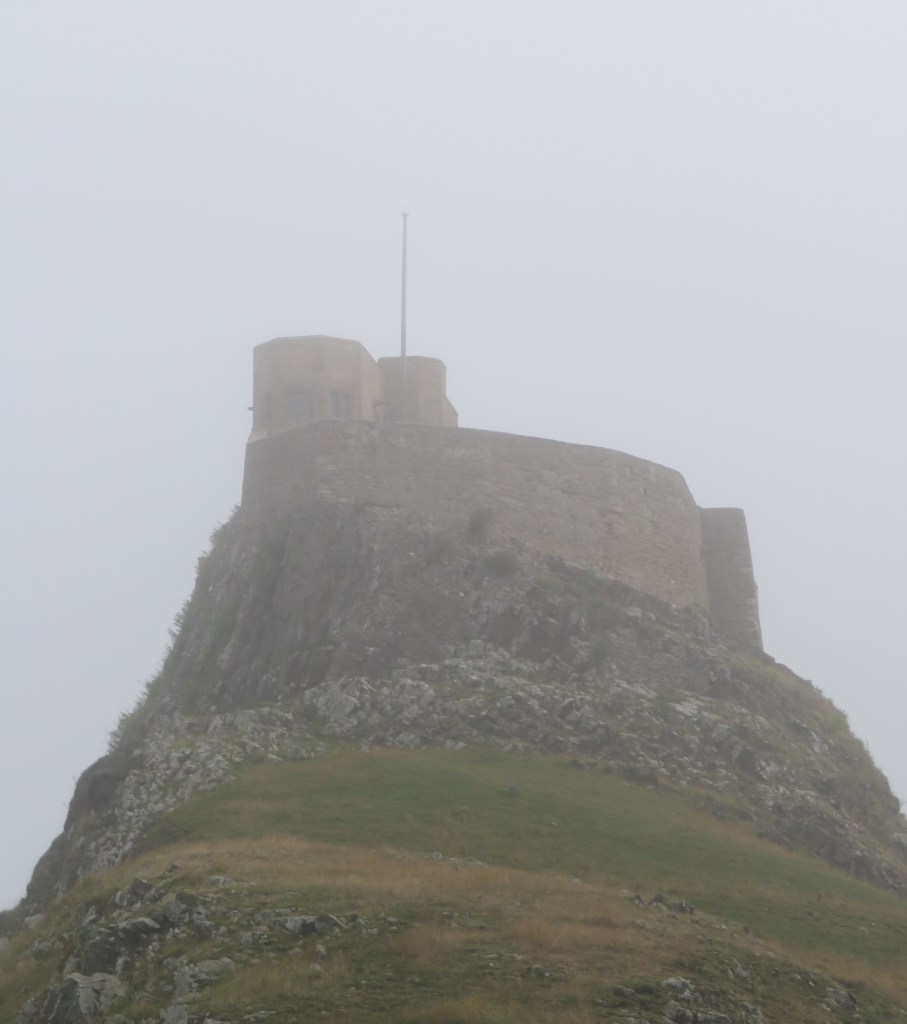
The next morning’s weather was not so much fog on the Tyne but fog across the whole of Northumberland. Undaunted, we set off to Lindisfarne admiring the hedges as we passed, which was about as far as we could see. We crossed the causeway to Holy Island just after it opened. We walked round the island past the old boats that have been upturned to use as sheds, then doubled back to walk toward the Castle. We had to get pretty close before you knew there was a castle and could see it looming through the mist. Built as a fort, the castle was converted into a holiday home by Edward Hudson, showcasing the work of Edward Lutyens as he did so. The garden was designed by Gertrude Jekyll. We had visited before and as one of our party was not in full health we decided to give climbing to the top to not see anything but fog a miss. We did look round the ruins of the priory and the accompanying exhibition.

Holy Island’s first monastery was found by  St Aiden from Iona in 635. In the 670s, Cuthbert became the prior and the island developed as a destination for pilgrims visiting Cuthbert’s shrine. It is perhaps best known as the place where the beautifully illustrated Lindisfarne Gospels were created about 1300 years ago. A Viking raid in 793 resulted in the monks leaving the island, together with Cuthbert’s remains and the monastery’s treasures. They settled, first in Chester-le-Street and finally in Durham. Lindisfarne was still revered as a holy site and was probably the burial place of Northumbrian nobles. It was reinforced by a community from Durham Cathedral, who built the priory that can be seen today in the style of Durham Cathedral. In medieval times cattle were farmed on Lindisfarne, perhaps so that their skins could be used as vellum. Holy Island remained as a centre for religion until the Dissolution of the Monasteries in the 1530s. Unlike many religious houses, the priory was not destroyed on the orders of Henry VIII because he wanted to use the building for defensive purposes. This was largely because of its proximity to the Scottish border. With the fog starting to lift, it was good to see some wading birds as we re-crossed the causeway.

A supermarket stop was next on the list, so we drove down the coast road to Alnwick, where I was pleased to remember exactly where the supermarket of choice might be found. In the absence of having coffee and cake out, I treated myself to a most acceptable Lidl’s tiramisu muffin.

More Travelling Adventures

I always write these holiday posts with a time lag, so I am home before you even know I’ve gone, which is why my comments about the weather don’t always tie up. So here is the first part of our most recent travels.

Having spent a morning in the seventeenth century, it was a rapid turn around and a quick change before setting off on our way to Lincoln. After an uneventful journey, it was time for a late meal and watching some Paralympics.

The opportunity for a day with the family and looking through multiple boxes of stuff in a garage, deciding what needed to be kept and what could be humanely disposed of. The miscellaneous items that have been designated for me will be collected on our way home and I fear for the suspension.

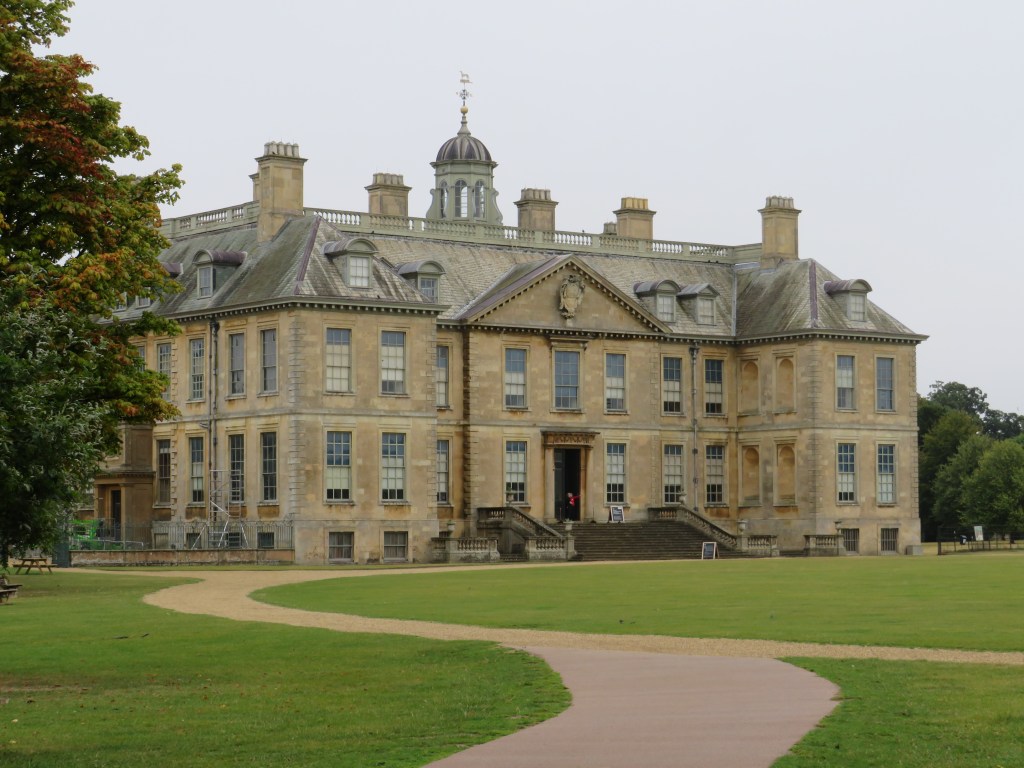
We set off in the drizzle for Belton House. Built in the reign of Charles II, this is a house that is very much influenced by the Baroque style, with plenty of decorative flourishes and impressively high ceilings. It was built for Sir John Brownlow and remained in the family for three hundred years but was predominantly used as a holiday home.

Grinling Gibbons carvings, mostly involving deceased game, provide a dusting nightmare. There is an interesting painted floor showing heraldic symbols and overall there is plenty of evidence of the family’s greyhound symbol. The house is home to 20,000 books, the earliest dating from 1493; one wonders how many remain on the TBR pile. Queen Adelaide, wife of William IV slept here, as did the future Charles III when a young Prince of Wales. It was good to see plenty of signs of ongoing conservation and preservation.

I have to say this is probably not the most inspiring National Trust property I’ve visited but I suspect the real gem is the fifty acres of garden and further 1300 acres of grounds. Unfortunately, it was not the weather for exploring the typically seventeenth century garden, perhaps that’s for another visit. The herd of fallow deer were much in evidence, although not easily captured on camera, with stags in full antler ready for the rut and including those with white, dark and dappled coats.

The younger members of the family joined us for the afternoon, by which time it was at least dry but more reminiscent of late October than early September. Autumn has certainly arrived early with falling leaves and autumnal fogs. The impressive adventure playground went down well but I have doubts about the advisability of the oldest member of our party testing the zip wire.

Up the Garden Path 11

Autumn is just around the corner. Surely it should still be about April. I went on a buying spree intending to get things to fill the newly cleared side bed. Annoyingly, most of the things on the list weren’t available. For now, I have put a net up as the climbers, that were cut back pretty much to ground level, start to regrow and have planted some bulbs. In fact, the main consequence of the plant buying trip was that I somehow lost my debit card. I got it ready as I approached the checkout. As if by magic, by the time I reached the checkout it had disappeared and was nowhere to be seen. The twenty something on the checkout was very impressed that someone as ancient as I had an app and (after a bit of faffing) was able to use it to block said card within five minutes.

The pond does now have water and plants. It looks a bit murky but some insect life seems to like it. I’ve tidied up the large raised bed, which was looking very much past it best. The olive tree now has a larger pot, as well as a few tiny olives. I picked the single apple that was my apple harvest.

I acquired some wallflowers and chrysanthemums. I also ended up with a sunflower that was self-seeded from the birdseed. Apart from sparrows, I have been deserted by smaller birds, I hope they return in the spring. I always knew that moving house would deplete my supply of garden birds. I do still get visits from jackdaws, magpies, wood pigeons and herring gulls, so I have to make do with those.

Unless I can get any of the plants on the wanted list, there will be a lull in gardening over the winter. It will just be the continuation of the convolvulus wars and a bit of tidying. It is still very much a work in progress and I am still not completely happy with it but it is on its way.

Family History Round-up

I have been hidden down so many rabbit warrens with family history research this week that I may have grown long ears and a fluffy tail. I’m definitely in full on family history mode. I’ve attacked three major brick walls with a wrecking ball but still they stand, although in one case, I am tempted to climb over the rubble and add the ‘almost certainly my 3x great grandfather’ to my tree.

Problem one, Josiah Lamball, great unusual name you’d think wouldn’t you but no. Every last cousin for generations in and around Bampton, Oxfordshire called their child Josiah. Forget being called Lamball, let’s just throw in a Lambert or Lambeth for good measure. Definitely let’s ignore eleventy billion online trees who are convinced my Josiah descended from another specific Josiah. He didn’t. Look at the original records guys. This Josiah witnesses his father’s will with a totally different signature to the one on my Josiah’s marriage. I am pretty sure I know who his grandfather was and teeny tiny DNA matches agree but as they are all related anyway ………..

Leaving Oxfordshire (virtually) I travel to Northumberland, where I will shortly be literally, hence revisiting these branches now in case I want to add any places to my must visit list. Here, I am still frantically trying confirm my hypotheses that will take me back to my first non-English ancestor. The Elliotts first, who, lovely people, help by leaving wills. Sadly though, these rule out the strongest candidate for the father of Mary Elliott of Chollerton. I am now pinning my hopes on two wills that are not online via the wonderful North East Inheritance Database. I have taken out a second mortgage to order these from the Borthwick.

Don’t get me started on John Newlands who married Ann (Nanny) Corbit in Alwinton. Helpfully, this marriage is also recorded in the register for Oxnam in Roxburghshire, where it seems banns were called. Mortgage for Scotland’s People alert. I’ll give you that this entry says he married Bettie Corbit (Ann’s mother’s name) but it also gives the name of the farm where she lived in Alwinton, so it is the same couple. No burial record for John but I do have a photograph that I took of his gravestone. It has his age and date of death but despite all the photo manipulation in the world I can’t read it. Can I hope that it will have miraculously become legible five years further down the line when I visit? There’s even a highly likely looking baptism, naming a patterns fit etc. etc.. Those eleventy billion people with online trees of epic proportions would agree that this is the one. Except, there’s a much more plausible marriage for this John Newlands. No problem, say the eleventy billion, we will kill off wife number one so he can marry twice. Except, she is still alive, well and bearing children for the next ten years. There are no alternative likely baptisms. Could he have been ‘married’ to two women, one either side of the border at the same time? I suppose so but pretty unlikely. Firmly stuck here.

Aside from all this, I’ve been giving my ‘Researching your British Ancestors and their Communities in the early Twentieth Century’ online course a revamp ready for its next presentation. Unlike Paddy McGuinness in this week’s episode of Who Do You Think You Are? I expect you know the names of your grandparents but how much do you actually know about their lives and the communities in which they grew up? This course is a great springboard for telling the stories of those ancestors. Yes, I know my granny’s biography has been stuck in 1939 for far too long. It is on the to do list I promise. Read the story so far here. Why not join me on the course and find out more about your own grandparents? It is also a great chance for all those One-place studiers out there to focus on their places in the years 1900-1945.

Then I’ve been working on the background to Homes for ‘Fallen Women’ for A Few Forgotten Women, who will be looking at this in November. Next Friday, we are researching pupils from schools for the deaf but that’s another story. Anyway, fallen women. I was seeking a suitable case study, whose story I could record for International Day of the Girl in October. I spent literally a whole day false starting numerous girls before I found one that involves accusations of murder and four generations of illegitimacy. She’s the one!

The All About That Place excitement is hotting up and they now have a website. I have a list as long as my to do list of talks I want to listen to. Many are by friends, others will be new to me speakers with fascinating topics. My own two contributions are an Introduction to the General View of Agriculture, which I try to drag into every talk I give and Over One Under Two – the story of my straw plaiting great great grandmother Anne Stratford from Aston Clinton in Buckinghamshire. She is always up there among my favourite ancestors since I discovered that she grew up in the road where I lived for three years, although I didn’t know I had any connections to Buckinghamshire at the time. This was over forty years ago, I was still being fooled by my uncle saying they were from Cumberland! Ann will also get a mention in the online talk I am giving Women’s Lives on the Farm which is part of the Society of Genealogists ‘Was your Ancestor an Agricultural Labourer? Day There’s still time to sign up for that one.

In other matters. I now almost have shelves so I can unpack the last two post move boxes (not counting the things that live in boxes). I don’t know who needs to know this but if you move a heavy dresser there’s the likelihood that the doors won’t shut when you move it back. I have been risking fingers trying to shove bits of cardboard under one corner whilst the trusty assistant manfully lifts one corner. Dear reader, my fingers survived.