Crannogs, Longhouses and other Scottish Things

Time to move sites again and head north-westward into the Trossachs for a few days in Killin. The weather began fine but in typical Scottish fashion, rapidly turned to rain, nonetheless it was a pleasant drive with lovely views. We wanted to arrive at Killin promptly when it opened for new arrivals at 1pm because we planned to visit Moirlanich Longhouse, which is close to the site and which has very restricted opening hours.

We’d passed the longhouse several times on previous visits but had never been able to go inside before. It is in the care of the Scottish National Trust, so we were able to take advantage of the reciprocal arrangements with the English version. The house is a great illustration of how people would have lived in the past. This particular house was built in 1809 for tenant farmers. It is a cruck-framed house, built in a style that had probably been used for centuries. This was the time when many labourers were turned off the land and moved away but the Robertson family were granted the tenancy of Moirlanich and farmed the surrounding thirty acres, trying cattle, then sheep, before changes to growing oats. The once thatched roof was covered with corrugated tin in the 1930s.  The last member of the family left in 1968 and the house remained empty until 1992, when the trust took over.

Various items were found in the house, including ragged and probably discarded clothing, which appeared to have been used to insulate the chimney. There were multiple layers of paper on the walls. Considering there were only three rooms, plus the byre at the end, it is strange that one room was largely reserved for ‘best’, such as entertaining the minister. The room did contained two box beds that were in regular use.

The next day was beautifully sunny, just right for a drive along several miles of the banks of Loch Tay towards Aberfeldy, in the centre of Scotland. We were paying a return visit to the Crannog Centre, or in this case the Crannogless Centre. We visited the earlier version of this Iron Age living history experience on a previous trip to Scotland but a couple of years ago, a fire destroyed the crannog. A crannog is a dwelling that was constructed on stilts over the water and evidence of nearly six hundred have been found across Scotland, which is probably only a tiny fraction of the number that would have been built. Several of these were on the edge of Loch Tay. Building across water is much more difficult than building on land and was done to reserve the land for food production and possibly also as a sign of status and method of protection.

Following the fire and some serious fund raising, the centre moved to its current site, which they were able to purchase for just £1. They reopened in April and have built several roundhouses using different techniques. Erecting the crannog will be a more complex task and building was due to begin the day after our visit. We arrived just in time for a tour and John showed us the museum exhibits, as well as giving us some background history.

Our first presentation was about Iron Age food. Archaeological finds provide evidence of the ingredients but how they were used is largely speculation. We were treated to flat breads made from the ancient cereals, emma and spelt. These were topped with garlic and honey cheese and optional trout. I passed on the added trout but it was very tasty. Emma no longer grows in Scotland, as the climatic conditions have changed since the Iron Age. We saw a saddle quern and it was explained how arduous and time consuming grinding flour would have been.

Next was the blacksmithy and then the woodworking presentation, some of the turning on the pole lathe was highly skilled. The textile demonstration was particularly interesting, with information about dyes, weaving and spinning. I hadn’t realised that woad required soaking in warm urine for a couple of weeks before it was an effective dye. Who first realised that this was the thing to do? It takes 7,000 metres of spun wool to weave a long sleeved tunic. Lastly, we went in the final round house, which had a basket-like woven framework, covered by stone walls and thatch on the roof. Despite the sun, it was still a little chilly and the restaurant was full with a party so we had our carrot cake and drink outside, where it was perhaps a few degrees colder than ideal. Overall, it was a fascinating trip and highly recommended.

Mostly about Wildlife

It was not a great night for our patient but once up there were signs of improvement. Light exercise is recommended and he was keen to embark on another drive. We had left behind the dramatic Northumbrian landscape but the countryside and far reaching views were beautiful nonetheless. This area seems more suitable to arable faming, with heavy red soil and red stone houses. This week seemed to have been designated as harvesting week and there were many tractors.

The church tour of the day met with some success and took us to places other holidays don’t reach. We ended up on the coast at St Abbs. The EbbCarrs Café provided us with a kipper roll and Biscoff cheesecake. Definitely a recommended location and the bonus of fishing boats for the convalescent to look at.

Then it was time to move on again, this time to Balbirnie Park at Glenrothes. We have left behind the area of my own ancestors and potential ancestors and are now moving through territory known to the ancestors of my children and grandchildren. Some traffic hold-ups on the Edinburgh by-pass but otherwise an uneventful journey. We were now on a wifi hotspot only site but the warden kindly allowed us on a pitch where you could get wifi in the van but which is normally reserved for the staff. This meant I could do some essential work while I was there.

So that we didn’t waste the day, we went for a short walk at Loch Leven RSPB reserve in the afternoon. In the 1830s the loch water was harnessed for use in linen bleaching and in the corn, wool and paper mills. This resulted in the loch’s water level dropping, adversely impacting the wetland habitat. Recent management and restoration has provided homes for a variety of wildlife. About a thousand pink-footed geese had just arrived. More will follow, as usually fifteen thousand over-winter there. I also spotted some green-winged teal. The reserve is the site of the country’s first bee reserve but we saw no bees.

Allegedly the weather was supposed to have improved. True, the bitter wind had gone but so had the sun. We decided to visit the nearby Scottish Deer Centre. Currently, this attraction is waving its admission prices in lieu of donations because of refurbishments but we felt it was fair to pay the normal admission price and it was certainly worth it. As the name suggests, there were deer, lots of deer of different types, some of whom you could feed. We walked round by ourselves and then again under the guidance of Owen, who provided us with deer facts, which I will pass on.

Unlike horns, antlers are pure bone and are surprisingly heavy. Reindeer are the only female deer to have horns and as males shed their horns in winter Santa’s reindeer, at least in the northern hemisphere, are all female. There’s also some weird thing about reindeer being able to ensure that the frozen blood supply below their knees doesn’t reach the rest of their bodies in severe weather. In the wild, reindeer form super herds of up to half a million. As it can be hard to see each other in the snow, the use their UV vision to follow urine trails. Fallow deer, the pretty spotty bambi-like ones, are not native but were introduced by the Romans as a food source. Though, as we discovered at Belton, not all fallow deer are dappled. Sika deer, brought from Japan by the Victorians, are an invasive species as they interbreed with native red deer, making it difficult to ensure the continuance of true red deer. Elk, aka moose, like to swim and are predated on by whales. Pere David deer became extinct in their native China but are now part of a successful captive breeding programme.

Our presence normally makes any self-respecting wildlife, including those in captivity, dive for cover but we were luckier than usual this time. Apart from the deer, we saw other species including a wolf, a brown bear and a Scottish wild cat. I was particularly pleased to see the otters. The are clearly ethical issues surrounding keeping animals in captivity but on balance, anything that can encourage people to take an interest in wildlife is important and captive breeding programmes are essential to the survival of some of species kept here. 

We stayed to watch the birds of prey display. You’d think ‘seen one seen them all’ but this was particularly good, with the Eagle Owl landing on the table of the picnic bench where we were sitting. For those visiting with younger family members there was plenty provided in the way of play equipment, so highly recommended as a destination. I did manage to keep the senior member of my party off the zip wire this time.

and Back in Northumberland

This is now nearly a month ago but here is what happened next.

It was lovely and sunny but a with a bitingly cold wind as we revisited Great Bavington Presbyterian Chapel then a detour via Hallington and on to one of my favourite places in the world, Thockrington, subject of one of my One-Place Studies and home of the Hogg family who I am ‘that’ close to ‘inking in’ as my ancestors. I haven’t done so because I am super cautious and am hoping for just one more piece of supporting evidence that probably doesn’t exist. Next to Chollerton and then, a new destination for us, Simonburn. I am busy trying to reach many parishes that ‘probably’ have ancestral connections so that, by the time I decide they are definitely ‘mine’ (if I ever do), I am prepared with photographs and impressions of the area,

We stopped off at Wallington, a National Trust property that we’ve visited before, the former home of the Trevelyan family. This was just a brief visit to avail ourselves of the café and facilities.

We did have a quick look at the house, which the guide described as having a Cluedo board layout.  It was good to see that sensory bags were available. My favourite finds were a Meissen tea set depicting insects, a dolls’ house display and several photographs of the servants. Around the central courtyard, which now has a roof, are impressive murals depicting scenes from Northumbrian history, famous local people and flowers found in the area.  Given the artic wind (that refers to the weather not the state of our digestion) and my companion’s delicate state we gave the gardens a miss.

As said companion’s ailments didn’t seem to be improving it seemed prudent to seek medical advice, This was to be more complicated than you’d think. First stop at 10am the not so local pharmacy. He needs anti-biotics but they can’t prescribe, he’ll need to phone 111 or his own doctor. He opts for 111. ‘What is the postcode of where you are now?’ Errr no clue. The 111 person speaks to the pharmacist. Still no one is keen to do anything, they will ring back. Five hours later they haven’t, so he tries his own surgery, who will ring back. The signal is dodgy here so they text. They won’t prescribe without seeing him. We find details of the nearest surgery (twelve miles from where we are staying). We ring. He will have to go to the pharmacy. Oh wait, we’ve been there. Doctor’s receptionist expresses amazement that the pharmacy was no help. He will have to wait for a call from their doctor. We explain the lack of signal issues and reluctantly they agree we can come in and he can register as a temporary resident. We arrive at just after 3pm. We see just one other person in the waiting room the whole time we are there. We are told we will definitely have to wait until after 5pm, possibly until 6.30pm. We wait and wait some more in the now deserted waiting room. To be fair, perhaps the doctor was dealing with telephone appointments. At 4.45pm my ailing companion was summoned. Turns out he has pneumonia and the vital anti-biotics are issued. The patient insists that he doesn’t want to abandon our trip and to be honest, he is more likely to rest here than at home, so we will be taking it easy. [Progress report, once home a second dose of, stronger, antibiotics was prescribed and seem to be helping].

The next day, first some taking it easy for the patient this morning. We were due to move to another site just thirty miles away and couldn’t arrive before 1pm so an ideal opportunity to do not a lot before we moved on.

We arrived in Berwick on Tweed, overlooking the river. The patient decided he was up for a drive round. This was not a spectacular success as I usually head for a church but any kind of church was conspicuous by its absence. As we left Powburn, I had been informed that we had sufficient fuel for 250 miles. We got to the middle of nowhere, having travelled about fifty miles and it appeared that fuel was low, so finding a garage became a priority. Fortunately, one was located with the bonus of the cheapest diesel that we’d seen since we left home. We drove through Kelso and Jedburgh. The latter looked interesting but we didn’t have much time and in any case it probably wasn’t a good idea for the invalid to walk round in what was still a very cold wind. This time last year we were in Ireland where the temperature was over thirty degrees. Here there was frost forecast overnight.

We did manage to locate Oxnam Kirk, a low-lying seventeenth century building with an unusual T-shaped footprint. Outside is a miniature stell (circular, stone sheep enclosure), erected to remember the 2001 foot and mouth outbreak. The centre stone came from the farm with the greatest losses and twenty six surrounding coping stones represent all the local farms where a total of 4,732 cattle and 21,319 sheep were slaughtered. In this way, the epidemic was contained within the parish and did not spread to surrounding farms.

Back to the van via the supermarket for more convalescing.

Wallington

A Diversion to the Home Counties

I know, I know, I was last seen in the wilds of the Northumbrian-Scottish borders and the stories of those adventures will be back but while it is almost current news, I thought I’d divert to last weekend’s foray to the Home Counties instead.

Having barely recovered from the holiday we spent a weekend staying on the Buckinghamshire-Oxfordshire borders. When I say ‘barely recovered’ on the health front my coughing companion was coughing a good deal less but I, recovering from a summer cold, was carrying the vestiges of an ‘interesting’ voice and the occasional coughing fit. Just what was needed to do two talks in two days.

There were ancestral parishes from two branches of the family within reach, so having set up the van on a farm site, we popped to Ambrosden, home of the Verney family, distant ancestors of my paternal grandmother. The church was interesting but unfortunately locked and much of the areas was built close on 300 years after my ancestors set their feet on Ambrosden soil. The soft yellow Cotswold stone is characteristic of the area and only goes to underline how different vernacular architecture is in different parts of the country.

On Friday, I was due to attend day one of the Families in British India Society conference. Having organised several residential conferences, I know how difficult this can be and the organisers had done a very good job. In the morning, I was one of several designated ‘experts’. I fielded some interesting enquires that ranged from what to do with a cache of nineteenth century letters, written from India, to the son of a circus acrobat, whose circus appeared to have been sent to India in the 1880s to entertain the expats. The afternoon brought my talk on Writing your Family History, which is an exercise in trying to get about five hours’ worth of material into a very short talk but it seemed to be very well received. I then listened to Else Churchill talk about sources for British India at the Society of Genealogists’ Library.

It had been raining a great deal in this area and I do mean a great deal, with more than a month’s rain falling in twenty four hours and this on already saturated ground. On our way back to the van, on the only road to the site there is a strategically placed ‘road closed’ sign. We pause. We have no idea how to circumvent this, if indeed we can. A helpful local coming from the allegedly closed road, slowed and asked where we needed to get to. On hearing the answer, he appraises the car and judges that we will be ok if we keep to the right. Fortunately, this proved to be true as the farm entrance was in a dip and there was flood water either side of the only access. Thank goodness for a large car. I suppose the fact that the adjacent village is called Water Stratford, should have rung alarm bells.

With no rain overnight, we were fortunately not stranded on our campsite, so were able to travel to Northamptonshire Family History Society’s conference. We were meeting at the beautiful Delapre Abbey, originally a nunnery, then a stately home and for decades after the Second World War the County Record Office. It then fell into disrepair and was eventually saved from demolition and restored to create an events centre. This first session was from the local archivist, about family history resources in the archives. I don’t know about you but I usually find this kind of talk pretty dull, especially when I have zero family interest in the county concerned. Boy, was this different. Definitely the best talk of its kind I’ve heard for decades. It was delivered with re-enacted incidents from various parish chest documents and an unbounded enthusiasm that would surely send anyone rushing to the archives. Next up was Dave Annal whose talks are always good. This one was called Lying B*st*rds and was about the impact of illegitimacy. It was lovely to catch up with long-standing family history friends over lunch. I was up next and managed to get through my Marginalised Ancestors talk without coughing. This is another exercise in getting several quarts into a pint pot. Colin Chapman, on ‘Sin, Sex and Probate’, provided the end to a day of talks that dovetailed beautifully together.

We decided to stay in the area for an additional day to do more ancestral parish visiting; as if we hadn’t had enough of this on our Northumbrian/Scottish adventures. This part of the family are ancestors of my maternal grandfather and Oxfordshire arrives in my ancestry in the shape of three x great grandmother (twice over – best not to ask) Ann Lamaball. I have written previously about the ridiculous number of Josiah Lamballs dotted around, so the plan was to visit as many home parishes of Josiah Lamballs as possible, pending my working out which the heck is the one I want. I have a theory but in the absence of a baptism record, or indeed any other helpful documentation, I am not sure I will ever be able to satisfactorily confirm the link.

We began the day with a walk round the gardens at what is now Stowe School. The current house at Stowe was built by Viscount Cobham in 1717 but we decided not to tour the house as well. The Georgian landscape gardens were the work of Charles Bridgeman and Sir John Vanbrugh and are pretty hot on vistas and follies. ‘Pretty hot’ did not describe the weather, so we didn’t linger too long. Then the game of hunt the church, six out of seven wasn’t a bad haul, although the tour was enlivened by the additional activity known as ‘dodge the flood’. It is so important to get a real ‘on the ground’ feel for areas where your ancestors lived.

A dry day, so the flood at the site entrance had subsided. The caravan is on grass, so I had some concerns about it getting stuck in the mud but we judiciously parked at the top of the hill and my companion who has been getting caravans out of tricky situations for nearly fifty years was confident. Rain overnight made me wonder if we would be marooned but I needn’t have worried and I am now trying to play catch up with all kinds of things that have been neglected whilst I’ve been gadding about. Not least of these is listening to All About That Place talks by friends, colleagues and others. My own two contributions are due for transmission today and you can listen for free.

Ancestral Ramblings in Northumberland

With visibility as bad as ever, this time accompanied by rain, it was a day to choose a largely indoor activity. We opted for a return visit to nearby Cragside, so my still ailing travelling companion didn’t have far to drive. Little did he suspect that I was softening him up for tours of ancestral parishes, which often involve traversing routes that many might consider do not rate the status of a road. Miraculously, the rain had stopped by the time we arrived so we had a quick look at the Pinetum and a scramble through the perilously steep rock garden. Probably not recommended after rain and when wearing varifocals, so you can’t focus on which slippery rock you are placing your feet.

Cragside was built in 1863 by arms manufacturer William Armstrong and it became known for its many innovative feats of engineering; it was the first house in the country to be lit by hydro-electricity. Other attractions for Victorian and Edwardian visitors included central heating, a hydraulic lift and a water-powered roasting spit. I quite liked the heated seats in the billiard room. When Edward VII and Queen Alexandra were due to visit, an impressive extension was built, complete with a massive marble fireplace that stretched from floor to ceiling. Some of the rock face had to be blasted away to make space for the additional rooms. William Watson Armstrong, great nephew of the original William Armstrong, lived in the house in the 1890s and conducted all kinds of experiments with electricity.

It was refreshing to see that there was a quiet room set aside for those who were finding the visit overwhelming.

We opted for honeycomb ice-cream as our midday treat, then set off round the six mile carriage drive. This is at its best when the many rhododendrons are out but was still a diversion on a wet afternoon. We did make the obligatory trip to the antiques centre near to the site before calling it a day.

Finally, a day when there was some visibility, so we set off to visit some ancestral parishes. The issue with ancestral parish visiting, particularly in what is officially the middle of nowhere, is the potential lack of toilet facilities. Undaunted, away we went. First on the list was Alwinton, home of ‘almost certainly my ancestors’ the Newlands and Corbitt families. We were fortunate to be able to actually see the spectacular scenery on the way. On to nearby Elsdon, where the village hall open up to provide toilet facilities, tick. On through Rochester to the little chapel at Byrness. I’ve been here before and was hoping that my some miracle a gravestone that was illegible in vital places four years ago, would now magically be readable.

First problem find the gravestone. The churchyard is on a steep slope and had been ‘rewilded’ with wet grass higher than the gravestones. Unsurprisingly, I failed to find the stone. I looked inside the chapel and discovered a grave plan and gravestone inscriptions that were done more than fifty years ago! Result. Gravestone found and a little more that was readable when the transcription was done in 1973 suggests the ‘almost certainly my ancestor’ must have had an additional marriage. Annoyingly the absence of online registers, or indeed I think any surviving registers, means I am none the wiser. His previous wife certainly isn’t the one eleventy billion people on Ancestry claim as his. At least unless he was a bigamist. The eleventy billion conveniently kill off the ‘almost certainly my ancestress’ in order to make sense of these two marriages. Here is her gravestone, she had several children after this so called second marriages. In any case, this gravestone suggests that he had children before he married my potential ancestress. Did he come from Jedburgh as some evidence suggests, or had the family lived in this area for generation but no records have survived?

Not my ancestor’s gravestone

A Few Days in Malvern Part 2

You’d think I would remember that it isn’t a great idea to tour churches on a Sunday but no. With my children’s family history in mind, we went for drive and walk round Hanley Swan and Hanley Castle. Sadly, most of the buildings are too late to have been family residences but we were able to get an overview of the area. We arrived at the church at 10.15am. Good news, the service wasn’t until 11am and the church allegedly was open from 10am daily, except that today it wasn’t. I was able to photograph the outside though.

On to Upton on Severn. This was Blues Festival weekend so roads were closed and the streets were crammed with street food vans, buskers, festival outlets and people. It made for a lively vibe but not ideal for photographing churches, one of which was a gig venue so I couldn’t even get near to it.

After an afternoon back in the van we headed to Llanthony Secunda Priory in Gloucester for an outdoor Fisherman’s Friends Concert. A very quick stop off to look at Ashleworth Tithe Barn on the way and we reached Gloucester. There was a slight issue accessing a car park that didn’t require us to do something complicated online on our phones but that overcome we took a short walk through the docks to the venue. The Augustinian Priory was established in 1136 as a second house to Llanthony Prima in Wales.

We were carrying our own chairs and I decided I could get away without encumbering myself with the umbrella or a coat in addition to my fleecy zip up top. As black clouds loomed I doubted this ‘wisdom’ but the umbrella was not needed. By the end, I did wish I had brought my coat but my noble companion sacrificed his. What is it about open air venues that makes people think it is ok to talk loudly throughout? We were probably the only audience members not to avail ourselves of the bar and food offerings at inflated prices. The concert was excellent of course but there was a teeny difficulty locating the car park for our homeward journey. We found a car park easily enough, just not the right one. It wasn’t helped by the fact that places looked familiar because we’d driven past them in the quest for a car park in the first place. I am sure we could have done something clever with our phones when we got out of the car but ‘clever with our phones’ is not us. After what I will describe as a ‘slight detour’ round Gloucester Docks thankfully the car hove into sight.

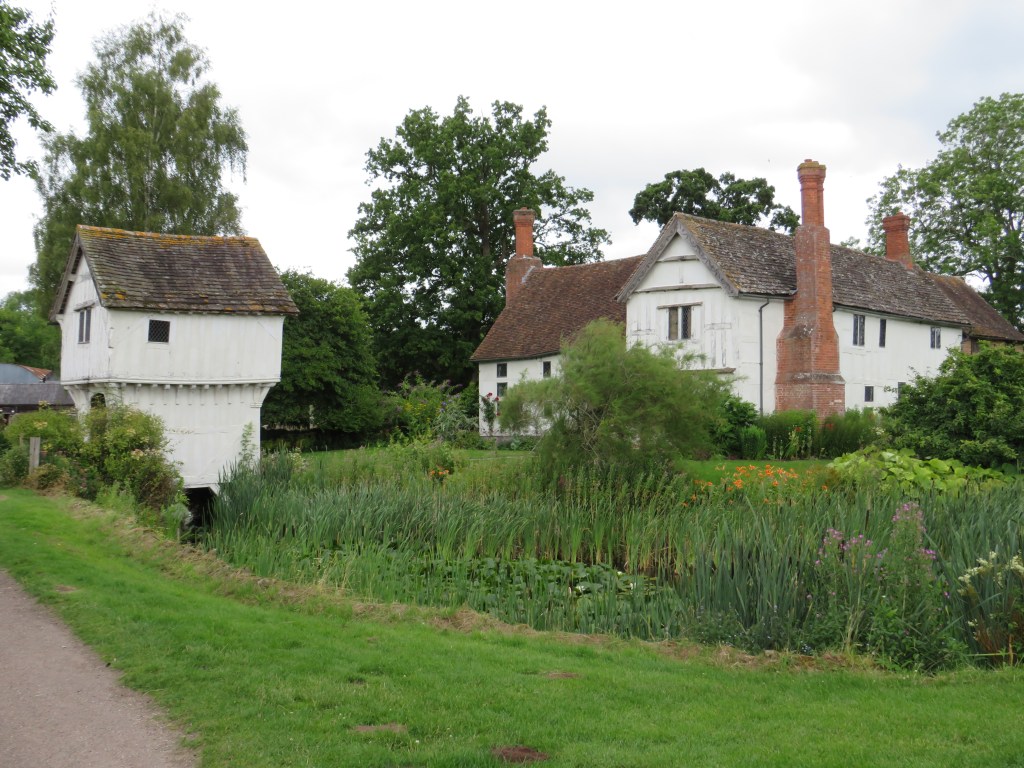
The next day, we headed north into Herefordshire to visit the Brockhampton Estate, definitely highly recommended. First up was the fifteenth century house with its sixteenth century gatehouse. The archetypal Tudor timber-framed home sports white wood and not the traditional black but apparently this is historically accurate, Black and white was not popularised until the Victorian era, when tar replaced limewash on the wood. Tar however was later found to trap moisture and cause rot. Brockhampton house’s wood has been limewashed and was therefore white. The original, cruck-framed building was constructed in the 1420s for John Domulton and his wife Emma Brockhampton. Later owners were the Barneby and then the related Lutley families. Renovations in the 1870s were overseen by John Chessell Buckler. Buckler was known for his work on Lincoln Cathedral. He was also the runner up for the design of the new Houses of Parliament when they were rebuilt after a fire in 1834. By the nineteenth century the house, was the home of estate workers. The whole estate was given to the National Trust in 1946.

The rooms in the house have been furnished to show different eras of occupation from the 1400s to the 1950s. The table in the main hall was set with square wooden trenchers. Each one contained a mini biography of a different inhabitant of the house from its earliest times until the twentieth century. There were plenty of interactive opportunities and items that could be handled. The house should be commended for its efforts to be disabled friendly, with captions in braille, and typed descriptions of each room, that are suitable for those who can turn text into audio. You could also borrow noise cancelling headphones and fidget toys.

Armed with a map of the estate, we decided to embark on the yellow route walk. To be fair, this was flagged as being ‘hard’ but we have cut our walking legs on ‘strenuous’ sections of the coastal footpath and we rashly decided that National Trust’s ‘hard’ might not be too bad. It was more difficult than we anticipated, mainly because it was uphill, at least on the way out. Once at the top of the hill, we swapped to the red route to see the advertised views. The views were good but perhaps not worth the mile and a half uphill walk to get there, especially as we could have driven up there and parked in an auxiliary car park.

We looked round the chapel, built in the late eighteenth century in a very ornate in style, with perhaps a Russian influence in the panel behind the altar.

Next, to another parish church with family history connections before returning to the van via a supermarket shop.

Battling Storms and Other News

Having barely moved from my chair for three weeks, whilst desperately search for my energy and motivation, which have both gone awol post Covid, Sunday was a day to venture out. We’d booked to see a Fisherman’s Friends concert in Torquay, about 70 miles from home. Although driving back after the concert was an option, plan a was to take the caravan down overnight. Site duly booked, all was well until the prospect of Storm Isha loomed. ‘Keep clear of the coast’, they said. The theatre is right on the sea front. ‘Don’t drive unless you have to’, they said. Hmm. Having braved both Storm Agnes and Storm Gerrit with the caravan this season, the decision was made to think of a plan b. Driving back along country roads in the dark at the height of the storm wasn’t it. Because it was a last minute booking, we managed to secure a budget motel room at little more than the cost of the caravan site. This seemed like a win so far.

With wind freshening, we set off on Sunday afternoon. We even avoided the learning curve of struggling with the accommodation’s parking app, as there was a space in the road, which had the added advantage of being free. Next, a drive down to the seafront car park that is fairly close to the theatre and not too far from where we’d booked to eat. ‘Not too far’ when there’s a 70mph wind and rain is actually quite a long way. I know from my handy not actually very fit watch that it is 1100 steps, about half a mile. Still, getting as far as the restaurant wasn’t too bad, considering my step count had averaged under 300 a day for the last three weeks. The only casualty so far was my feet. I’d gone for comfortable shoes, which, it seems, have holes in the soles as I was now squelching along nicely.

Meal eaten, it was time for the return walk paddle to the theatre. We waited for a heavy hail shower to pass and set off in what was a light drizzle. As a bonus, the wind was behind us to begin with. Optimistically, I was heard to mutter, ‘I don’t want to speak too soon but this isn’t too bad.’ Dear reader, I spoke to soon. About half way along the sea front, with wind crashing in the masts of the moored yachts and Torquay’s palm trees struggling to stay upright, we turned a corner just as driving hail hit us straight in the face. We could see the theatre up ahead, we knew we were walking towards it but somehow it didn’t seem to get any nearer. By the time we reached it, everything from neck up and knees down was as if I’d been plunged in a bucket of water. I was also really noticing how I so hadn’t recovered from Covid. I went to ineffectively attempt to dry my hair under the hand dryer. Not helped by the fact that it cut out automatically after about five seconds. What was really weird was that people who arrived moments before and after us seemed to be completely dry. Women with beautifully coiffured hair surrounded my drowned rat look at every turn as we crowded into the foyer. The rain hadn’t stopped, how had they kept so dry? I’ll admit, the wait to be let in to the auditorium and thus gain access to the ability to sit down, was a struggle. Upright is not a position I’ve encountered much lately, especially not after fighting against wind and rain.

We gradually got our breath back and steamed our way through an excellent concert. Then it was back out into the elements to the car park. I sat dripping in the car whilst my brave companion queued in the rain to pay. We were very thankful to have a few minutes’ drive to the hotel, rather than best part of two hours to home.

Next up, breakfast. We’d opted not to pay £9.95 each for an all you can eat breakfast that we didn’t actually want. I am though really bad at missing some kind of breakfast. Not to worry, we had brought the ingredients with us. Granola, formerly frozen berries and yoghurt awaited. What, in our hurried change of plans, we’d neglected to do, is remember that a bowl and spoon would have been a good idea. We managed to improvise by using one of the ingredients’ containers as a bowl and appropriating the room’s tea spoon. Then it was time to return home, in conditions that were much calmer than the night before. Now we await storm Jocelyn.

In other news, box emptying is awaiting more energy and slightly warmer weather, as I am on to the rooms in the garage and the sheds now. Current total of emptied boxes is 189 and we are not quite done yet. I was also challenged to count my books. Despite several serious culls, 1145 remain, with the children’s books still to be counted. The next challenge is trying to fix heavy shelves to a cavity wall. This is not going to be easy folks.

Some fruits of research that I did last year can now be revealed. Back in the summer, I was contacted by a BBC researcher, in conjunction with Lucy Worsley’s Lady Killers podcast, which was due to feature a local murder. Could I identify the property involved in the story? With help from a friend, I located the ruins of said property and was able to report back to the production team, along with providing other information to help with the local background. I am not sure this quite came across in the finished episode but I did get an honourable mention. You can listen to Sarah Bird’s story here.

Irish Adventures Days 33-35 The End!

Yes, this really is the end of the adventure.

Day 33

The sun was back with us for our last full day so we set off for Kinsale and were only slightly fooled by the new road layout on the outskirts of Cork. Finally at Kinsale we were able to find some working fishing boats for a fisherman of my acquaintance to study. Ireland does seem to have a shortage of public toilets but we located one in Kinsale. It was one of those pod type ones and cost €1 for twenty minutes. We won’t go into why anyone could possibly want twenty minutes but I know some people take an inordinately long time; I am usually standing behind several of them in a queue. €1 did seem rather a lot and we only had one 1 euro coin between us. We hoped that if I went in first and came out again within the allotted twenty minutes the other member of our party could follow me in. Unfortunately, it didn’t work like that and you couldn’t reclose the door for a second person. I’ll just leave that there. Just outside Kinsale there were mud flats with some wading birds for me to take fuzzy photos off. In my defence I was about 100 metres away and the sun was in the wrong direction.

Day 34

We weren’t due at the ferry terminal until the evening but with a long drive ahead we didn’t want to go far, especially as it was raining again. We drove to nearby Ballycotton where there were more fishing boats to examine. One thing we have noticed is that gardens here are usually fairly plain but virtually every one has hydrangeas, if nothing else.

Packing up the van was quickly accomplished, we are dab hands at this and we set off for the ferry terminal. We were directed to lane 19. We joined the end of the queue in lane 19, which was full. An excitable terminal employee braved the driving rain to let us know we were about to head off to Dunkirk; we were in fact in lane 20. The final lane 20 car was across two lanes obscuring the numbers. Adjustments made, we ended up in lane 19 next to a convoy of jeeps taking aid to Ukraine. I attempted to access the limited (20 minutes) free wifi on the ferry. This proved impossible. After I had taken up four minutes of my allotted time complying with repeated requests to put in my details, without actually being connected, I gave up. The driver amongst us was supposed to be sleeping. He normally sleeps as soon as he sits down but because he needed to sleep this time he was remarkably wakeful.

Day 35

We arrived in Pembroke at 1.15am and headed for home, planning to stop at any sign of tiredness from the driver; there was none. Bless him, we arrived home at 6.48am having done 3630 miles since we left. There are thirty two historic counties in Ireland. We stayed in nine, visited another nine and travelled through four more, which isn’t a bad haul.

I promised you my top ten days out and it was a difficult choice but here they are:

Ulster American Folk Park 

Strokesdown Park House and Famine Museum

Ring of Kerry with Dunloe Gap (only this high because of Dunloe Gap)

Irish National Heritage Park

Dingle Peninsula 

Donegal

Connemara and National Museum of Rural Life

Newgrange 

Rock of Cashel 

Giant’s Causeway

And that’s the lot, thanks for coming along for the ride. Normal ramblings of an historical nature will resume shortly, if anything about my life can actually be called ‘normal’.

Irish Adventures Day 32

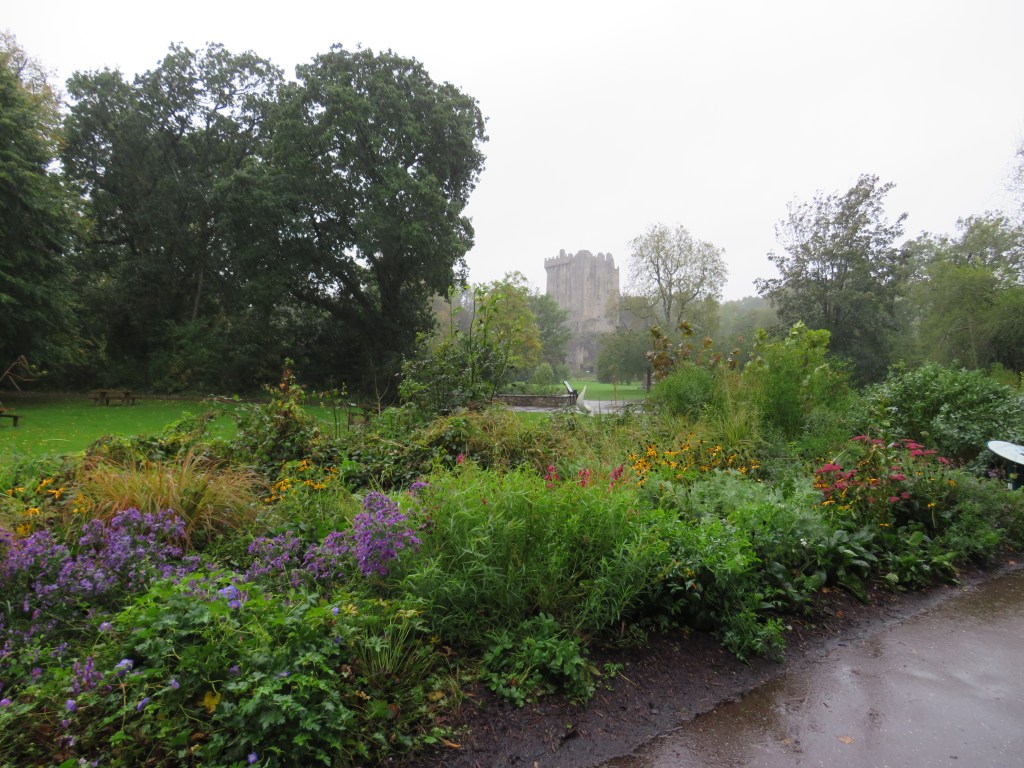
This was not really a great day for going anywhere weather wise. Undaunted, well may just a little bit daunted, we set off for Blarney Castle. In the early thirteenth century a stone structure replaced the tenth century wooden hunting lodge on the site. The stone building was demolished in the mid fifteenth century, so Dermot McCarthy could use the stone for the current tower house or castle. Like so many others, the castle fell to the Parliamentarians in the English Civil War. Although the castle  was restored to the McCarthys by Charles II, it was once again confiscated by William III, as the Catholic McCarthys supported James II. Caves beneath the tower are known as the Badger Caves and several legends are associated with them, with tales of prisoners being thrown into a pit in the caves and passages from the caves leading to Cork and Kerry. The inhabitants are supposed to have escaped with their valuables down these passages in Cromwell’s time, leaving little for his troops to loot.

We thought that the entrance fee was a bit on the steep side, especially as you would normally have to pay to  park as well. The machines were out of order so we escaped this. Of course the tourist honey pot here is the Blarney Stone, which has been kissed by tourists for over two hundred years, in order to be rewarded with the gift of the gab. Allegedly Queen Elizabeth I associated the word Blarney with smooth talking flattery because the then lord of the castle Cormac MacDiramada, tried to persuade the queen of his loyalty to prevent her from seizing Blarney for the crown. She shrewdly saw through his sycophancy.

There were signs warning visitors of the ‘arduous’ climb to the stone, which is at the top of the castle on the battlements. They aren’t wrong about this. Clambering up what I think was four floors worth of very narrow spiral steps that were slippery with rain was possibly not one of my better ideas. Be warned, this is an all or nothing climb, once you are on the path to the top there doesn’t seem to be any option to bail out half way. We passed on the kissing the stone thing, not least because I talk too much anyway, although I don’t think I am guilty of ‘smooth talking flattery’. Kissing the stone involves taking off glasses and emptying pockets in case anything falls out, false teeth weren’t mentioned but maybe those are in peril too. You then lie down on what was on the day of our visit a very soggy mat and bend backwards with your head considerably lower than your bottom, supporting yourself by gripping on to metal bars. The men who were disinfecting the stone between kisses and hanging on to people to stop them plunging head first to their doom had prominently displayed bowls for tips and then you could pay more for photos (I heard the sum of €10 mentioned) that were taken of you in a very strange position. It all seemed a bit like fleecing gullible tourists to me. To be fair, the gardens and grounds were extensive and we did explore a little. I was particularly keen on the poison garden. Blarney House, built in 1874, is on the site but is not open to the public. In half decent weather woodland and riverside walks would have given us better value for our entrance money.

Irish Adventures Day 31

As we were unable to go to Craggaunowen because it had shut for the season before we got near enough and we combined Rock of Cashel and Kilkenny in one day, we were left with two spare days. The original plan was to visit Waterford on the way to the ferry but now we were able to give it a day to itself and just as well as we could never have parked the car and caravan. We opted to avoid the toll road again and after a sunny drive, approached Waterford via an industrial estate. We found a car park but were only able to park for two hours, which was a shame as Medieval Waterford had a great deal to offer. Understandably, they make a great deal of their Viking heritage. There were also several building with murals.

We had a variety of museums to choose from; these were clustered together close to the cathedral. Should it be the Time Museum, The Irish Wake Museum or the Silver Museum? I was tempted by the virtual reality Viking experience but I am not sure how well virtual reality goggles go with glasses so we went for the tamer option of the Medieval Museum, which was very good. You are able to buy combined tickets for more than one museum, which seems like a good idea for those who want to go to more than one. We had already passed the Franciscan friary that Henry III agreed to the build in 1241. Richard II stayed here when he visited in 1394. After the dissolution, Henry VIII allowed a Catholic alms house to be built, where prayers were said for Henry VIII’s soul until the mid twentieth century. William III encouraged the Huguenots to settle in Ireland and there was a community in Waterford who used part of the friary as their church.

Inside the museum, photography was tricky as, understandably, light was low, no flash was allowed and there was reflection from the glass cases. We saw the cloisters and the wine cellar, which had a wattle and daub roof. There were many of the city’s charters on display and a list of mayors dating back to 1284; the first female mayor was not elected until 1991.

This part of Ireland was one of the first to be settled and it is believed that the Mesolithic settlers came from Wales c.7700 BCE. 10,000 artefacts were found in Bally Lough during a project in the 1980s and 1990s. The Medieval city was walled, with several towers, of different dates, along its length. Reginald’s Tower, which is mentioned as a stone structure in 1088, was where the city’s Viking leaders were taken during the Anglo-Norman invasion of 1170; two were executed there. The tower was rebuilt by King John and an additional two floors were added in the fifteenth century.

In the thirteenth century, Waterford was granted a monopoly for the importation of wine, so all wine imports in southern Ireland had to come through the port. This led to great rivalry with the neighbouring port of New Ross and smuggling took place. Initially, the wine came from France but during the Hundred Years’ War, Iberian wine predominated. The Great Charter Roll, which was on display, was put together to convince the king of the city’s long standing association with the crown and to ensure that it continued to be favoured over New Ross. The main exports were woollen rugs and cloaks. In 1566, woman were forbidden from being wine taverners or drawers (the equivalent of barmaids) because of their bad reputation in the taverns. ‘Naughty corrupt women’ were leading ‘honest damsels into folly’.

Apparently, Perkin Warbeck, a pretender to Henry VII’s throne, besieged the city in 1495, supported by the 9th Earl of Desmond, from Cork and foreign mercenaries. Cannon in Reginald’s tower fired on the invaders’ ships and two were sunk. This is the earliest record of cannon being used in Ireland. After eleven days the besiegers were defeated and Warbeck escaped; Desmond was pardoned. Although Waterford was the only town not to succumb to Cromwell himself, it was taken in 1650 by Cromwell’s son-in-law Henry Ireton, when the citizens were weakened by plague. The city was looted but incredibly, fifteenth century vestments survived because they had been hidden in a secret chamber under the cathedral’s floor. They were not rediscovered until 1773 when the medieval cathedral was demolished and the current one was built. These were on display in very dim light but were intricately and lavishly embroidered and must have been very heavy to wear. We saw the Great Parchment Book of Waterford, chronicling activities in the city from 1356-1649. The entry declaring Charles II to be king upon the execution of his father was erased when the city was taken by Cromwell’s New Model Army.

We travelled back along the small coastal roads in order to have some different scenery for part of the way. Our sojourn at the Victorian Farm is over, so we began to work our way through the first series of Coast in the evenings.