Continuing the Cornish Adventures

We needed to return home for the day and thought it was about time we refuelled the car. The chauffeur of my acquaintance had neglected to bring his wallet. I believe that a newly installed app on my phone might have been a satisfactory substitute but needless to say, despite my increasing proficiency with the phone over the past weeks (to the extent that I have exceeded my, albeit meagre, data allowance), this was a step too far. Fear not, my bank card is in the rucksack. Ah that would not be the rucksack we have with us but the one that is ……. in the caravan. Fortunately, we made it home and were able to retrieve alternative means of paying. Then it was back to the van. The A30 on a Friday rush hour is never a great idea, so the return journey was a little on the slow side but we were back in time for the mobile fish and chip van’s visit to the site and even managed a walk out to Wheal Coates to try to counteract the ill effects of said fish and chips, or in my case, fishcake and chips, in the evening.
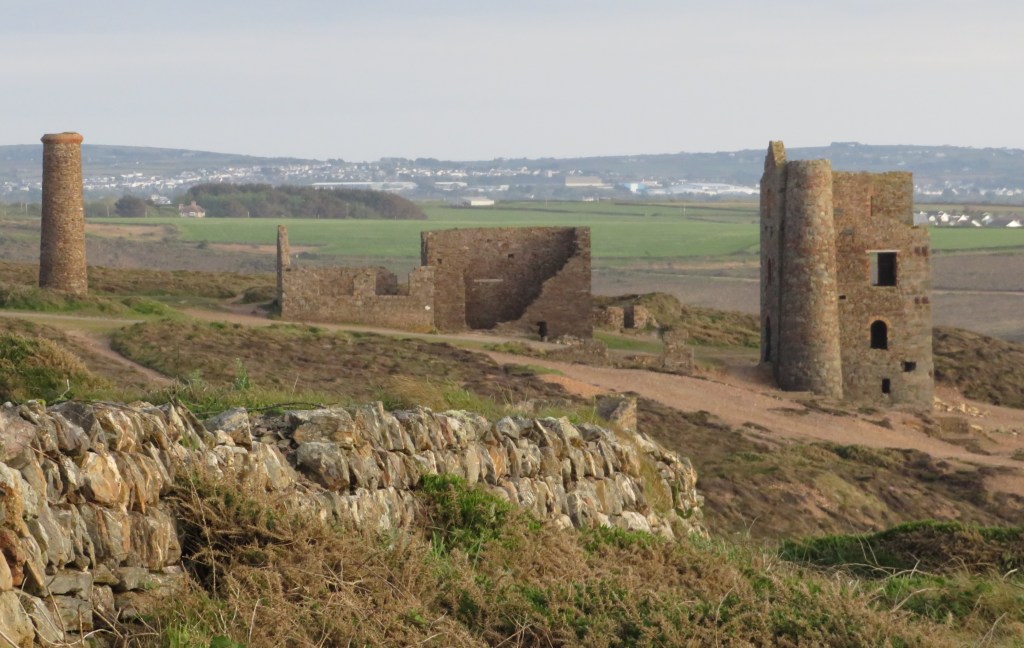
Wheal Coates

Further westward the following day and a trip to Newlyn. We overshot the entrance to the car park and before we had a chance to turn round saw several parked cars with a space for us. We looked carefully for notices that said that parking was restricted, or for permits in the windows of the other cars. A nearby gardener assured us that parking there was fine. I was a little less confident as this lay-by appeared to be a bus stop. Could the other half a dozen cars and the gardener be wrong? I left the decision to the car’s owner and we stayed put. A quick trip to a nearby boatyard so the fisherman of my acquaintance could chat boats, then we walked on to Mousehole where I had the drippiest ice cream cone I have ever encountered. Interesting to see that black-backed gulls seem to be outnumbering herring gulls. No sign of any clamp or parking ticket on the car so we returned to the van via a mercy dash to a supermarket near us to get yoghurt, which we should have brought back from my home fridge yesterday but we failed to do. A late afternoon relax in the sun followed.

Another day and back to the south coast for a visit to St. Michael’s Mount. We’d timed the trip so we could walk out across the causeway. I even managed to show evidence of my booking on my phone, which was an achievement in itself. It is quite a climb up to the castle, so not ideal for anyone with mobility problems but the views over Mounts Bay are impressive.

The Cornish name for the island is Karrek Loos yn Koos, or the grey rock in the woods, which may date from the time 4000 years ago when the mount was not cut off by the tide but was surrounded by woods. The remains of tree trunks are still occasionally seen at very low tides. In 2009, a bronze age hoard was discovered by one of the gardeners, suggesting that, 3000 years ago, the mount was a trading centre. It is thought that Edward the Confessor granted the island to Benedictine monks from Mont St Michel in Normandy and established a chapel there. The mount became a place of pilgrimage but also a focus for conflict. In 1193 it was seized by Henry de la Pomeray, who had disguised his men as pilgrims in order to gain control on behalf of Prince John. John was attempting to stage a coup and take advantage of his brother Richard I’s absence on Crusade. Much of the current building dates from the fourteenth century, with substantial later additions. The dissolution of the monasteries was late to reach the far south west, so the religious community survived until 1548. The following year the mount was seized by those involved in the Prayer Book Rebellion. It became a Royalist stronghold during the Civil War but surrendered to Parliament, with Colonel John St Aubyn as the captain. St Aubyn purchased the castle in 1660 and it has been the home of the St Aubyn family since then.

Several myths and legends are attached to the island. The discovery of a seven foot skeleton on the island, buried vertically, fuelled the legend of ‘Jack the giant killer’; allegedly Jack from Marazion killed Cormoran the giant who built the mount and terrorised locals. Visitors can view the giant’s well and a tiny heart-shaped stone in the cobbles is labelled as the giant’s heart. Some features that caught my eye included the stained glass in the chapel, seventeenth century tiles and the ceremonial barge, that took part in the Queen’s diamond jubilee pageant. This is one of the oldest working boats in the country, having been constructed using wood felled on the St Aubyn estates in 1750. A collection of postcards of the Mount over the decades were cleverly displayed so that you could see both sides. There was also a model of the castle made from champagne corks by the butler. Two observations here, they must have drunk an awful lot of champagne and the butler really needed to get a life.

We wandered back into Marazion, where I felt obliged to sample yet another ice cream flavour, gingerbread this time. Then we beat the rain back to the van.

More Westward Wanderings

With the forecast heavy rain very much in evidence it seemed sensible to head for somewhere with a modicum of ‘indoors’, so it was off to Trerice, a manor house built by John Arundell in 1570. Inside there is a striking 576 pane window, predominantly made up of C16th and C17th glass. There are also numerous portraits, include some by Kneller. A 1950s wing replaces the former north wing. In the grounds there is an Elizabethan knot garden, given over largely to lavender and also an impressive potager full of vegetable and salad produce. If there were 100 hours in every day I’d want my garden to look like this. There are several mown mazes in the grounds, one being based on the maze at Troy Town on Scilly, which is known as the three circuit maze and was used by Scandinavian fishermen to trap bad spirits. I managed to escape.

Trerice is lovely but there isn’t really the scope for an all day excursion. The weather had improved so we decided to move on to Trengwainton Gardens, getting yet more value form the National Trust life membership. Here the rhododendrons were in full bloom. There is always something soothing about being in a garden and this one has the bonus of overlooking the River Fal. We walked down to where the King Harry chain ferry takes vehicles and passengers across the river. A steam ferry first crossed the river in 1888. It is one of only five chain ferries in England.

Next day and I was awake early to watch the misty dawn break over the sea, all accomplished without getting out of bed! The first stop of a busy day was Restormel Castle, which was built for the Earl of Cornwall, in good defensive position, overlooking River Fowey. It was originally used as a hunting lodge and was set in the largest hunting park in Cornwall. The park was also home to several hermits who were expected to pray for the souls of the castle’s owners. The remains are thirteenth century and the castle was owned by the Black Prince in the fourteenth century. After a skirmish during the English Civil war the castle fell into disrepair and was not deemed to be of sufficient use to maintain. English Heritage are now putting the headings of their interpretation boards in Cornish as well as English, A great first step but it is a pity that the text isn’t in Cornish too.

It doesn’t take too long to exhaust the possibilities of Restormel, so we move on to Lanhydrock House. The volunteer asks if I have visited before. I reply that I have but it was ‘a long time ago’. Do I remember the kitchen? I am asked, perhaps I should have explained that ‘a long time ago’, was about 39 years! The house was the home of the Robartes family, which I’ve always pronounced Row-bar-tes but, according to the information video is Row-barts. In April 1881 Lanhydrock was severely damaged by fire and the then owners died shortly afterwards, leaving the next generation of Agar-Robertes to take over. Ahead of her time, in 1894, the then Lady Robartes opened Lanhydrock to the public and establish a ‘bazaar’ there to raise funds in what seems to have been a glorified jumble sale. Her terse instruction cards to visitors have been replicated.

As always, I am attracted to the huge library, whose collection includes twenty five incunables. I had no idea what that meant either but just so that every day is a school day for you too (unless you already knew of course), these are books printed before 1501. There was also a fascinating and enormous steam jack in the kitchen. The National Trust seem to have developed an unfortunate trend for printing interpretation comments on the soft furnishings, which seriously spoils the authentic look of the rooms. I guess someone decided that it appealed to the visitors – not to this one though. We heard the story of how all the house’s laundry was sent to St Faith’s, a home for fallen women in Lostwithiel; I immediately wanted to scramble for census returns. Lanydrock’s gardens are extensive, with more rhododendrons in evidence. I would think that this is the best time of year for the gardens. I suspect they will be less impressive in a few month’s’ time.

Lanhydrock

On to Fowey and first the challenge of finding a car park. We located one at the top of the town but allegedly there could be one nearer to the church, where we want to be, so we decided to keep searching. Fowey is a tortuous warren of narrow, steep, winding streets. We do narrow, steep and winding but this is something else. Some vehicles were pulling in their wing mirrors to negotiate parts of the one-way system. Just because we were enjoying it so much (not), we completed the circuit several times before ending up in the car park where we first started and getting the town bus down the street. This doesn’t run after 5pm but the driver was able to tell us the best way to get back up the hill to the car park. I thought this might have been a first outing for my newly-acquired bus pass but the service was run by a private company and I didn’t like to ask if passes applied.

Fowey has been an established harbour for over 2000 years, exporting fish, wool and tin and being a point of departure for pilgrims to Spain. The returning vessels brought back with them wine, salt and iron. Fowey is noted for being the home of Daphne Du Maurier and we are here for a concert that is part of the Arts and Literary Festival that formerly bore Du Maurier’s name. There is little left of traditional Fowey, which now clearly caters for the yachting fraternity. Most of the food options were of the two peas and a bit of drizzle for £30 variety. We finally found The Lugger, which was more suitable to the sizes of both our pockets and stomachs.

The day finished with a Fisherman’s Friends concert in the local church. I was able to admire the heraldry round the church and practice my extremely rusty blazoning skills, while I was waiting for the concert to start. The downside was the less than comfortable pews. The evening was a sell out and was excellent, as we expected it to be. Even better, there was a community bus, with just two spaces, waiting to take us a ridiculously long way round to the top of the hill car park.

More Cornish Wanderings with Family History for Good Measure

I know it was a while ago now but I did have another day of holidaying to share. So just in case anyone is wondering why they have been left in limbo, or in our case in Cornwall, here is the final episode.

After an early morning look at Looe for another fishing boat fix for my travelling companion, we head to Cotehele. On the way we fit in another family history parish. Since I have been home, I have been trying to take these newly-found Cornish ancestors further. One just might be a ‘gateway’ ancestor, taking me back to Medieval times and potentially royalty but let’s not get ahead of myself. It holds together well back to 7x great-grandfather Richard Rowse/Roose/Ruse/Ruze but I need to convince myself that his potential father Walter (who does seem to be the only Walter around at that date, didn’t marry until he was in his forties. Further speculation needs to wait until I can get to the new Cornwall archives.

082 15 July 2019 CoteheleOur first task at Cothele is to hunt out our memorial tree in the fruit orchard. We think we know roughly where it is. We also think we know what variety it is but we fail to locate it. Once again we are hampered by the environmentally friendly attempt to let the orchard go wild. Tramping through long grass trying to find a variety label that has probably long since gone is not fun. Reception provide us with a guide, which suggests that we are looking for the wrong type of tree. I am still not sure that the tree we pay homage to is actually the one that Martha and I planted in 2008; we are both convinced it was a different variety, to the extent that I purchased one of the same type for my garden.

We tour Cothele house, which belonged to the Edgecumbe family. Most of the present building is Tudor but the interior is largely seventeenth century in style. It is one of my favourite National Trust properties and always seems very homely. Surprising then to discover that the family only lived there full time during Civil War. Somehow this had escaped me on previous visits. Not bad for a holiday home. They used it as a showcase for their various collectables. To this end, bizarrely, they have a china closet in the bedroom, presumably so guest can admire the cups and saucers at night. This showcasing lark is not always successful as various tapestries have had bits hacked off them in order to fit the rooms. We manage to miss being in the right place to hear the iconic clock strike twelve. We walk down to the quay before deciding that it really is too hot to be outside and returning to our van.

All in all, it was a gentle sort of holiday and because we are not far from home and have been many times before and hopefully can again, there was no pressure to rush round places thinking this will be our only opportunity. Nothing beats glorious landscapes, the sea, sunshine and the chance to immerse yourself in heritage, both personal and more general.

A Riverside Walk

We return to the south coast to revisit one of our favourite stretches of the south-west coast path. I picked up a ‘where to park for free if you are a National Trust member’ card at Bedruthan and this is proving handy. We head for Bosveal, which is pretty much a car park and nothing else. Following the coastal footpath westwards to Durgan takes us to the back entrance of Glendurgan Gardens. Thinking it would rude not to take a look, we enter. Let’s be clear, this is a legitimate entrance and the notice on the gate instructs us to pay, or in our case show our membership cards, at the main entrance. Main entrance? We walked up, we walked down, we declined the option to walk round the maze, which is in any case full of a school party. We seem to be in a maze of our own. We think we can see where we need to go but that pathway is marked private.

The garden is beautiful by the way, nestled in a valley which gives it a near sub-tropical climate. The weather has turned quite humid today, which adds to the atmosphere. In the end we give up the fruitless hunt for the main entrance and continue along the path to Helford Passage with the Helford River estuary on our left. We are decidedly out of walking practice and it really is very hot. Conscious that every step we go forward, means another step to go back, we return to Bosveal, with a short stop for an ice-cream on the way.

043 10 July 2019 Helford River

A quick supermarket visit before driving north once again The good thing about Cornwall is that is a long narrow county, so it is never very far from north to south. Fortunately, our evening meal was cooking before I noticed that a mobile pizza van, whose owner has enhanced grammatical skills in comparison to that of the fish and chip van proprietor, is due to visit the site tonight.

Elizabethan Delights

The weather continues to be hot and sunny, an ideal counterpoint to the Cornish landscape. Today we head to Trerice, another property owned by the National Trust. Again we arrive in time for an introductory talk. This is not on the scale of Richard’s in-depth presentation at Levant Mine, which is probably just as well, as I am standing in full sun. I am smothered in factor 50, unusual for me as my boot-leather skin withstands most that our climate throws at us but this prolonged sunny spell has had even me turning to the bottle.

This area has been farmed since the iron age and there is a record of an Udo Trerice owning a longhouse in 1300. The name means farmstead (Tre) by the ford on the running water (rice). The fact that, until the sixteenth century, the river at the back of Trerice was navigable to the coast and that the river was fordable at this point, explains the decision to build here. Michael Trerice, son of Udo, had a daughter Jane but no sons. She married Ralph Arundell and the estate passed to the Arundell family. Strangely, I have always pronounced this Arun-dull (like the place in Sussex) but our guide is saying A-rundell. Regardless of pronunciation, the Arundells were on the up and became one of the major landowning families in Cornwall. In 1572, John Arundell built the current Trerice in order to have a home that was commensurate with his status. The house is small but bears many of the hallmarks of the archetypal Elizabethan manor. It was created in the traditional, symmetrical E shape, in honour of the queen. One wing of the house is now missing. We find it difficult to make sense of the layout. The ‘front’ is clearly more ornate but somehow, to us, the ‘back’ is more convincing as the original front, if you see what I mean.

The house is built from locally-quarried Elvan stone, which is a warm yellow colour. The regular-sized, hand-hewn blocks were just one of many features that were a testament to the wealth of the owner. There were fashionable Dutch gables, a ‘feature’ glazed window in the hall, chimneys, plasterwork ceilings and a long gallery, so the residents could exercise in bad weather. There is also a knot garden, which is currently filled with lavender.

The Arundells were staunch Royalists. During the English Civil War, John Arundell, known as ‘Jack for the King’, held Pendennis Castle against the Parliamentarian forces for five months before surrendering, despite being in his seventies at the time. He was also instrumental in getting Queen Henrietta Maria and Prince Charles (the future Charles II) safely to the continent. Although the estate was sequestered, it was returned at the Restoration. A North Devon connection is that his wife was Mary Carey of Clovelly.

The male Arundell line died out and the estate passed firstly to the Wentworths and then to the Dyke-Aclands of Killerton. From this point, Trerice was not lived in on a permanent basis and little maintenance was done, leading to considerable damage. It was owned by Cornwall County Council for a time and they utilised the land to provide tenant farmsteads for soldiers returning from the First World War. In the 1950s the Elton family held Trerice on a repairing lease and amongst other things, replaced the roof with Delabole slate.

040 9 July 2019 Trerice

Inside we find another ‘homely’ residence. There is armour on display, we are invited to try on helmets. It hardly seems fair to mention that I have several of my own at home. There are also replica Tudor games on display and several long-case clocks. I know lighting is kept to a minimum in these places, in order to prevent damage but Trerice does seem particularly gloomy. It is only when I remove my glasses to read some small print that I realise it is the fault of my sunglasses. I need to get used to taking the ordinary glasses round with me as well. We sit and have a refreshing drink, strongly resisting the cake, then wander round the gardens. We decline the opportunity to play kyles, a Cornish version of skittles and slapcock, an early version of badminton but played with participants standing in a circle and batting a chicken’s head to each other. No wonder the shuttlecock was devised as an alternative. I should perhaps add that no chickens would have been harmed had we decided to play as there was a more acceptable alternative available.

Wonderful though the weather is, it really doesn’t make walking very far an appealing option, so once again it is back to the site to sit in the shade. I could get used to this relaxing lark. Despite a sign reading ‘Fish and Chips here on Tuesday’s’, I manage to overcome my hatred of mis-used apostrophes sufficiently to partake of said delights, well I would be rude not to. The diet starts errr……. Let’s just hope the next site doesn’t have a visiting fish and chip van too.


Mostly About Gardens

Today we visited Godolphin House and gardens. Godolphin is only a few miles from our caravan site and the village fête was being held in the grounds; I am not sure that the latter was an advantage! Godolphin house was built in 1475, on the site of an earlier fortified dwelling and the family made its money from mining. There were major renovations to the house in 1540. These were probably funded following an incident that took place in 1527. A Portuguese flag-ship ran aground nearby and the member of the Godolphin family who was then in residence, along with a St Aubyn of St. Michael’s Mount and other gentry, claimed the proceeds of the wreck. There was an enquiry, when the King of Portugal attempted to get his property returned. Those heading up the enquiry claimed that appropriating the cargo of wrecks was ‘the custom of the county’ and there was no case to answer. This may be because both Godolphin and St Aubyn conducted the enquiry!

When the National Trust acquired the house about ten years ago, it was in a poor state structurally. The infrastructure does not allow for sufficient footfall to support the house through visits alone, so it was decided to sympathetically convert it into holiday apartments. This means that the house is only open to the public, one week a month; although the gardens are open every week. We were fortunate that our stay coincided with one of the house open days. It is a very friendly house, with a lovely atmosphere. There is some impressive linen-fold panelling and a carved fireplace dating from 1603. I was also taken with a chandelier and an oak table that appeared to have been patched but I failed to photograph this. The Godolphin family have been notable in the horse-racing fraternity and Sidney Godolphin was Prime Minister under Queen Anne.

We walk round the gardens, which are a profusion of cottage garden plants and wild flowers. We make a cursory circuit of the fête and my travelling companion is able to look at the tractors and military vehicles on display, one of which he was responsible for selling. We go on to Trengwainton Gardens, which we were unable to visit yesterday. I’ll be honest, I am a little underwhelmed here, although I should think they are stunning when the rhododendrons are in full flower. Maybe I am just gardened out.

035 7 July 2019 Trengwainton Gardens034 7 July 2019 Godolphin House033 7 July 2019 Godolphin House036 7 July 2019 Trengwainton Gardens029 7 July 2019 Godolphin House Linen-fold panelling028 7 July 2019 Godolphin House030 7 July 2019 Godolphin House031 7 July 2019 Godolphin House 1603


Occupational Hazards – Levant Mine

I always encourage my family history students to investigate the working lives of their ancestors and Levant Mine is a ‘must see’ for those with mining ancestors. My own Cornish ancestors worked on the land, rather than under it but it was fascinating nonetheless. Today was a great opportunity to learn more about Cornwall’s industrial heritage.

We arrived at the mine just in time for a guided tour by the indefatigable Richard and boy did he know his stuff. If you plan on visiting the mines, do try to coincide with a guided tour. Tours like this enhance a visit, as there is only so much you can learn from guide books and interpretation boards. Richard talked to us about the mine’s history, without the aid of notes, for two hours. No one dropped out of the tour, not even the two year old or the dog. We gained a real insight into the working lives of the miners. Any errors in what follows are mine and not Richard’s.

There are 1000 mine shafts and hundreds of miles of tunnels on the ‘tin coast’ in the far south-west of Cornwall and commercial mining, notably of copper and tin, has been going on here for 2000 years. There are several Zawns (wave-cut clefts) in close proximity and these might have revealed surface ore that encouraged the early miners. Written records of mining in this area date back to 300BC. The first documentary evidence of speculative mining at Levant is a map of 1748. This mining was by tunnel, rather than shaft and the tunnels were upward sloping, to allow water to drain out and also so gravity would aid the carts loaded with ore. The ore was then taken up to the dressing floor by horse whim. In the eighteenth and early nineteenth centuries there were several small-scale copper mining ventures in the area but in 1820, twenty investors got together to fund the sinking of the first shaft. Their collective initial investment was £400. The shaft was quickly profitable and further shafts were sunk. As they went deeper, water became a problem and a series of increasingly large, steam-powered pumps were purchased over the ensuing years. By 1836 they were not only pumping water but also raising ore by engine.

In 1840 they purchased a beam engine from Harvey’s, the famous foundry in nearby Hayle. This engine remains in situ and running; the oldest engine to be in working order and still at its original site. In the early 1850s a depression resulted in the mass emigration of Cornish miners to hard-rock mining areas throughout the world. They took Cornish customs and the iconic Cornish mine architecture with them to places such as Mexico, South Africa and Moonta in South Australia.

There was some economic recovery in the late 1850s and in 1857, a man engine was installed. This was a hugely significant innovation as no longer did men have to climb 1200 feet of ladders at the beginning and end of the shift. With the engine, they descended in 12 foot increments, in time with the engine’s piston. In this way they made the descent in 130 stages and it took 26 minutes. The structure also allowed the out-going shift to come to the surface and the in-coming shift to descend simultaneously. Previously, there was only space for a single ladder, so it was not possible for miners to be going up and down at the same time.

The mine closed briefly in 1870 as removing water and digging through granite to follow the lodes was becoming prohibitively expensive but new investors were found and it re-opened. This decade saw an increasing use of steam engines and by 1880, pneumatic rock drills were use. These were huge and required several operators. They also created a great deal of dust, that led to lung complaints amongst the miners. Pit ponies were also used. They spent eighteen months continually underground before being retired to the surface, rehabilitated and sold.

In 1919 the man engine collapsed and thirty one miners were killed. This was followed by the bottom dropping out of the tin market. Treasury loans were taken out but they could not repay them and the mine closed in 1930. The workings were in use in the 1960s, as an extension of nearby Geevor mine but this too closed in 1990 and the shafts were allowed to flood.

Conditions underground were harsh, with 30 degree temperatures and debilitating levels of humidity. Add to this the smoke from the tallow candles, which were the only form of lighting and the dust and it is no wonder that the health of the miners was compromised and life expectancy was about forty. Surface work was undertaken by the bal maidens who worked the rock to extract the pure ore. Ragging, spalling, cobbing and bucking gradually reduced the rock in size and finally it was buddled to leave crushed ore. This had to be graded, or jigged, using a pumping action to force water through the ore. Copper smelting took place in Swansea, to save the cost of importing the coal. Tin however was governed by the ancient stannary laws and had to be smelted in Cornwall, so was taken to Penzance.

024 6 July 2019 Levant Mine

The noise of the mechanical tin stamps must have been overpowering. After the tin was buddle, a calciner was used to drive off the impurities, largely arsenic and sulphur. The smoke from the calciners would drift over local villages with resulting ill-effects on health. It was discovered that arsenic was a useful ingredient in insecticides that were used to combat the cotton bol-weevil. This meant that the arsenic was now a valuable by-product. There was an awareness that arsenic could be absorbed through the skin so exposed areas were coated with a thick, white clay paste to combat this. Working with arsenic also caused infertility and allegedly, men volunteered to work with arsenic as a method of family planning.

Richard is going to take us down a tunnel. This is slightly scary but we are up for (almost) anything. It is suggested that we remove our sunglasses as visibility is poor. I have recently acquired glasses that are also sunglasses for the first time. I am proudly wearing them. Great, so now I have the choice between not being able to see because I am wearing sunglasses and not being able to see because I have taken them off. I go for keeping them on. We wander down the tunnel and it certainly is quite dark. Then Richard realises that the lights aren’t working, so all we have is the emergency lighting. He fiddles with the fuse box a bit. We have already walked down the tunnel. I am wondering how we will get back if all his fiddling somehow extinguishes the emergency lighting as well. Never fear, a few messages on his radio and full lighting is restored. The trip ends with a visit to the engine room where we can see the 1840 engine in action, aided by Ron and Tim. Despite all this engagement with mining heritage, there is no sign of Aiden Turner.

I had originally planned to move on to Hayle but decided to go to Trengwaniton Gardens instead. We find this with no trouble but I had failed to check that the opening times would allow for this rearranged itinerary. They don’t. We may or may not return tomorrow. So it is back to the van for more relaxing, more fish and chips (fortunately for the ‘diet’ they only visit twice a week) and some Wimbledon on TV.

For more information about historic Cornish mining see here. If, like me, you are interested in the history of medicine and the ill-health of our ancestors, next month sees another opportunity to take part in my five week online course, ‘In Sickness and in Death: researching the ill-health and death of your ancestors’; there are still a few spaces.

Gardens, Books, Chips and a few other things

The day begins with a look at Longframlington Gardens. These are clearly a labour of love for the owner, who we chat to. There is a strong commitment to environmental principles and we wander through the arboretum and wild meadow. The gardens also boasts rope sculptures, including a swing, which I road test until Chris points out that one of the uprights looks decidedly unstable. We attempt the garden maze quiz, where correct answers to gardening questions lead you successfully out of the maze. We escaped but probably not solely due to our gardening knowledge. We also look at the attached garden centre, well it would be rude not to and I succumb to purchasing a mock orange (Philadephus). Now we are back to impersonating Burnham Wood.

We travel on to Alnwick (pronounced Annick), where we fail to find our supermarket of choice, despite having what was, allegedly, its exact address. We did find a substitute supermarket and also paid the obligatory visit to Barter Books. This is a second-hand book shop on steroids, set in a former station and complete with electric train running above the bookshelves. Refreshments and comfy chairs are available as well as a vast array of books. I purchase a map to help with locating ancestral villages, which are annoyingly and probably inevitably, centred on an area that is on the edges of four separate maps, of which I now possess two. Then it is back to the van to deposit the supermarket haul.

We decided to pay repeat visit to Cragside, rather than stay in the van for the afternoon. Cragside is an impressive Victorian edifice; the former home of Lord William Armstrong who was a notable engineer and pioneer in the field of electricity. Cragside was the first home in the world to be lit using hydroelectricity. Armstrong installed a lift, a water powered jack to turn the roasting spit and a Turkish bath. There is real cooking going on in the kitchen and we sample Earl Grey cake; fortunately, the Earl Grey is not discernible. There is also brass cleaning in progress. Here, pine cones discourage visitors from sitting on the chairs. I suppose that is one up on the holly at Seaton Delaval. The gardens are impressive and are famed for their rhododendrons. These are already beautiful but look set to be even more spectacular in a few weeks’ time. We drive along the five mile ‘carriage drive’ round the grounds. As we pass through Powburn, fortuitously, the mobile fish and chip van is in situ – no brainer.

122 24 May 2019 Cragside

Off to the Farne Islands

Today is a special day and the weather is glorious as we head to Seahouses for our trip to the Farne Islands with Billy Shiel’s fleet. I don’t know why I didn’t think of this option sooner, instead of being fixated on going to the Isle of May. Seahouses’ harbour is undergoing restoration and we have been warned that the harbour car parks are closed and we may need to arrive early to secure parking in town. We can do ‘arriving early’. It also gives a fisherman of my acquaintance the chance to get his fishing boat fix.

The St Cuthbert III is running slightly behind schedule and is full for our trip. We don’t manage to secure a seat on the edge of the boat but that doesn’t matter too much. We set out for the Farne Islands, which are in two groups, the Inner and Outer Farnes. There are 28 islands at low water but only 14 at high tide. Like many islands in the area, the Farnes were a monastic settlement and St Cuthbert died here in the seventh century. We circle the Outer Farnes and view the cliff-side nests and the Atlantic grey seals; there are 3000-4000 of these in the area. We pass the Longstone Lighthouse, of Grace Darling fame, which was built 1825, at a cost of £3000 and was manned until 1919. Grace and her father are notorious for their 1838 rescue of nine survivors from the Forfarshire.

The islands are home to 80,000 puffins or ‘Tommy Noddies’ as they are known locally. They live up to thirty years and mate for life, returning to the same burrows each summer. They spend the winter at sea, not touching land until the following spring. What I hadn’t realised was that they lose their iconic bills in the winter, when the bills are black. The orange colour is generated from their sand eel diet. The more sand eels they eat, the brighter the bill. Natural selection means that the brighter bills, in other words those who are the most efficient providers of food, are the most attractive. Apart from the puffins, there are also 50,000 guillemots nesting on the islands. The smell of guano is powerful and all-pervading.

We disembark on Inner Farne, are greeted by the rangers and run the gauntlet of the dive-bombing, nesting terns. We listen to a short talk by the ranger. We are unable to go in St Cuthbert’s chapel as terns are nesting in the entrance. In fact, birds are everywhere. Even with my not very wonderful, under £100, camera I manage some half decent photographs.

106 23 May 2019 Puffin Farne Islands

So today the wildlife haul included: black-headed gulls, black-backed gulls, herring gulls, eider ducks, lapwing, feral pigeons, house sparrows, starlings, jackdaw, swallows, mallard, cormorants, guillemots, common terns, razor bills, shags, oyster catcher, Atlantic grey seals, a  rabbit and the iconic puffins. The wildflowers are also at their best at this time of year, with red campion, stitchwort, sea campion, poppies, broom and bluebells being prolific. What is really sad is that so many people would struggle to name the wonderful flora and fauna that surround us. It is our planet, we need to take an interest in it, nurture it, celebrate it, protect it and share our love of the beautiful landscapes we encounter.

Some Family History, Family Reunions and a visit to Seaton Delaval

Our first day in Northumberland and the weather really was a bit much for us soft southerners. We repaired to the archives at Woodhorn, a wonderful facility but in common with many archives, its opening hours have been drastically cut since our last visit. We struggled against the biting wind to cross the car park and began to look for evidence to confirm the parentage of my great great grandfather John Hogg. I am pretty sure I know who his parents are but a bit more evidence would be helpful. Great great grandfather John has done everything he can to be elusive. His censuses entries give different places of birth each time. The birth years calculated from these entries and his death certificate are inconsistent. Not only am I confused about where and when he was born, he even calls himself George in one census! In theory, he ‘marries’ twice. His second ‘marriage’ should be well within the era of civil registration. A marriage certificate could confirm (or refute) the putative father I have pencilled in but marriage certificate is there none. I know, at this point, the antennae of my family history friends will be twitching and they will be keen to see if they can succeed where I have failed. So, if you can find a marriage for a John Hogg and Elizabeth Pearson I would be very grateful. They were not married in 1851, when John was a widower living just outside Morpeth Northumberland. Their first child was registered in 1854 and the certificate implies they are, by then, married. Elizabeth too was born in Northumberland and was in Morpeth in 1851.

The evening was set for a reunion with my second cousin and her husband. We were due to meet in an Indian Restaurant. I have made a note of the address of the restaurant for sat-nav purposes. I have failed to make a note of the name. Surely there can’t be many Indian restaurants in that part of Whitley Bay. Oh! It turns out there can. I have the full address but none of the shops are displaying numbers. I think the restaurant probably begins with S. We hesitantly enter one of two adjacent Indian restaurants beginning with S. Relief; we are being waved at, so either we are all in the wrong place or we have picked the right one. The meal was lovely, it was even bargainous special menu day and the company was great too. We speculate what our mothers and grandmothers might have thought at us meeting up many years down the line and so far from where we grew up.

What a difference a day makes. The sun shines on the righteous and on us as well. We even cast our clouts (well our coats at least) until a sharp wind blows up in the afternoon. We decide to avoid Newcastle as apparently half of it has been cordoned off into a ‘fan zone’ for a rugby match tomorrow. Instead, we travel a couple of miles up the road to Seaton Delaval. This stately home is undergoing serious renovations and learning about these was part of the visitor experience.

Extensive estates and a Saxon church were gifted to Hubert De La Val by William I after the conquest and a member of the family married William’s niece. A fortified dwelling was constructed on the site. Family fortunes declined and in 1717, Admiral George Delaval bought out his impoverished cousin. He commissioned John Vanbrugh to build a home, on a much smaller scale than Castle Howard and Blenheim Palace, for which Vanbrugh is better known. Neither the owner nor architect lived to see the completion of the house. Admiral Delaval was killed falling from a horse in 1723. The work was finished under the ownership of Delaval’s nephew, Captain Francis. He too met an unfortunate end when he fell from a terrace, to be succeeded by his son Sir Francs Blake Delaval. The ‘Gay Delavals’ spent the best part of the eighteenth century hosting flamboyant parties on the estate. They were known to play practical jokes on their guests, including rigging rooms so that the walls disappeared, or the beds could be lowered into baths of cold water, when the unsuspecting guests were asleep.

The Delavals were able to establish successful businesses, exploiting the saltpans at Seaton, founding a bottle and glass manufactury and benefitting from mining interests. They created the sluice at Seaton to enable larger vessels to enter the harbour. By the end of the eighteenth century, their lavish lifestyle became unsustainable and in 1822, a fire gutted the property, destroying the south-east wind entirely. The estate passed through the female line to the Astley family, who held the title of Lord Hastings. Some attempts at restoration were attempted in the 1860s but the property remained largely a shell. The property was requisitioned in both world wars and this left its mark. Some improvements were made in the second half of the twentieth century and the west wing of the house was again lived in before the property was given to the National Trust.

We wander round the beautiful gardens and are guided by Hilary on a ‘Spotlight’ tour. I was particularly taken with the high-viz jackets sported by the cherubs on the roof. We learn about the repairs to the ‘muses’, statues that have been created by plastering over an iron framework. In order to stop the iron rusting, they have had an electric current passed through them using innovative cathodic protection technology.

007 10 May 2019 Repairs at Seaton Delaval

Enthusiastic guides show us round The Church of Our Lady, which was extended by the Delavals and consecrated in 1102. A record survives of the baptism of Henry de Laval in 1343.

A quick look at the sluice itself and then back to the van.