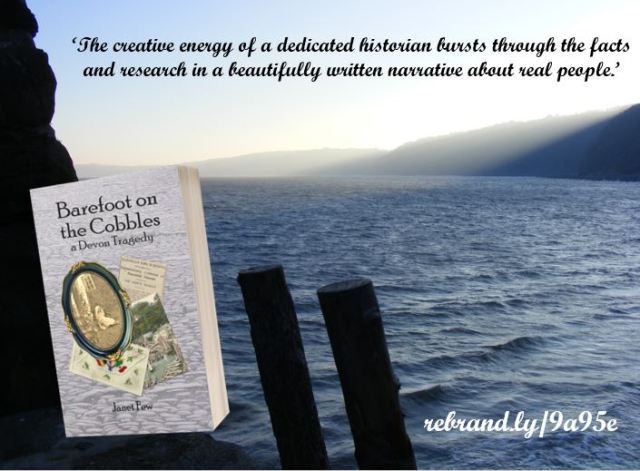
Pruning the Family Tree and other adventures – Day 19

I, like many others in these strange times, am finding it difficult to concentrate, least of all on what I should be doing. After a couple of totally unproductive days. I revisited a branch of my family tree that has been virtually untouched for over forty years. Before you scoff, bear in mind how difficult research was then. No digital images, no indexes, just trawling through page after page of original parish registers in archives. In fact, much of this was done by another trusted researcher. It is only now that I have got around to going over the earlier generations and verifying the information. Or in this case not verifying it. I come from a long line of Bishops. Not actual bishops you understand but people with the surname Bishop. This included four successive generations of chaps called Christopher.

It seems that the original researcher was pretty hot on baptisms and marriages. She also spent ages doing in-depth research in churchwardens’ and overseers’ accounts in which they feature, all good stuff. What she failed to do was to attempt to kill these guys off. First, I discover that the lady who held the distinction of being 9x great granny, Annes (or Agnes) Maddick, died before alleged 8x great granddad was born. Cue the substitution of Jane Thorne, second wife of 9x great granddad Christopher Bishop I, in the role of 9x great granny. Oh hang on, here was a burial of a Christopher Bishop just two weeks after the supposed baptism of 8x great granddad Christopher Bishop II. Clearly ‘my’ Christopher Bishop, who married Mary Bowman and went on to have yet another Christopher (lacking in imagination these Bishops), was not only not the son of Christopher and Annes but not the son of Christopher and Jane either. In the absence of probate material for Devon, I doubt if I will ever be able to be conclusive about my 9x great-grandparents on this line but never mind, I’d rather have a shorter tree that was accurate.

I have also undertaken the biannual excavation of the flies’ graveyard that is the shelf round my conservatory where the ‘walls’ join the roof. This involves much precarious balancing on window sills and is not to be recommended. Said shelf contains many historic ornaments, all of which have to be taken down and wiped in order to remove the fly pooh. What is it about flies and conservatories? The warmth I suppose. I maintain that I leave the cobwebs there (and believe me there are plenty of those) for six months in order to catch the flies. Are you convinced?

After over a week of ‘block’, I have just written some more of novel number two. Still scheduled for launch in August, even if it can only be a virtual launch of a digital version at first. It is so nearly finished. Probably about 4000-5000 words left to write. Today’s clue. Although the characters in the modern strand inhabit a rather different version of 2020, there are references to COVID-19.

Oh and the Cornish? Still not got beyond dydh da I’m afraid but a helpful book arrived in the post today.

And a pretty sunrise from my bedroom window (December 2017), just because I can.
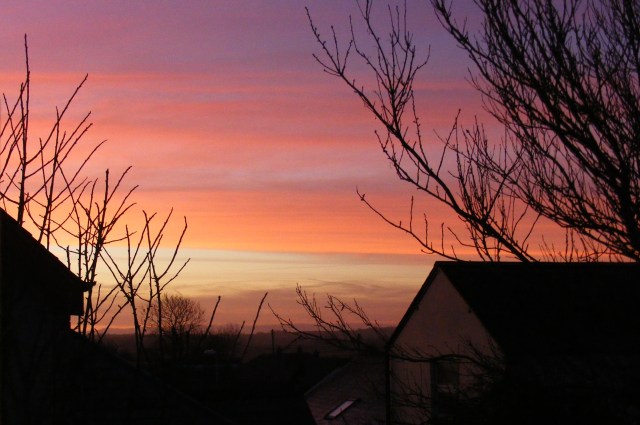
19 Dec 2017 1 (2)


Of all Things New: presentations, courses, books and more

New year, new things on the horizon. Here is just a selection. Last week I spent a very interesting day at the headquarters of Family Tree Magazine, filming two presentations for their downloadable content. Despite the fact that I am used to presenting, it is actually very difficult to talk for nearly an hour (x2) with no audience participation, no hesitation, deviation, umms and ahhs, coughs, pauses to swig gin etc.. The presentations will be available in a month or two. One is on tracing twentieth century English ancestry and the other on pauper ancestors.

Whilst on the subject of Twentieth Century ancestry, my online course for Pharos begins in a couple of weeks and is filling up fast, book now to avoid disappointment and all that. I am also preparing two new online courses, which will be available through Pharos. There will be an introductory one-place studies course, which will begin in September (ok, so that isn’t written yet either). The previous course, run by Celia Heritage, is no longer available, as Celia has other commitments. This one will be a brand new; I have deliberately not looked at Celia’s version. A course to help those tracing Agricultural Labouring Ancestors is planned for 2021. I also have a new presentation on the same topic, Sons of the Soil, which will premiere at Dorset Family History Day  in March. Err, no, that isn’t written yet either.

Back to one-place studies for a minute. Putting your Ancestors in their Place is now very nearly out of print. I am preparing a new booklet, which will have a rather different approach and a more international feel. It will also be available for Kindle, which I hope will be popular. With luck, that may be ready for THE Genealogy Show in June and yes, you’ve guessed it, not actually written yet. Add to this the book that I may need to write in connection with the job I must not mention and there are no prizes for guessing what I shall be doing over the next few months.

Deepest Darkest Devon

And now for something completely different, something that is actually written! Hurrah! Exeter Authors Association of which I am very much an inactive member, have produced an anthology of short stories with a Devonian slant, Tales of Deepest Darkest Devon. I am not by nature a short story writer but one of mine (ok the only one of mine) Brought to Book is in that collection. If you enjoyed Barefoot it is similar in style and based on a true story that took place in Devon in the 1820s and 1830s. You also get to read all the varied and fascinating contributions by other local authors. Priced at £4.99, it is due for publication on 31 March and is currently available in Kindle format only. It can be pre-ordered now here. Part of the proceeds will be donated to Devon Air Ambulance Trust.

My next novel is due to be launched on 29th August, ok, so there is the small matter of a third of it still to be written (have you spotted a theme here?) – that’s a mere detail. Advance notice that I will not be creating a millstone round my neck and writing 100 blog entries about the characters and locations as I did for Barefoot but I will be drip-feeding some hints and teasers in my blog posts in the meantime. #1 It is, like Barefoot, based on a true story. So, stand by, there will be more and a title reveal is imminent (when I have decided what it is to be that is!).

Whilst I look forward to these excitements, my thoughts are with my many Australian friends and the appalling fires that are currently threatening their homes and families. On a more positive note, it is exciting to see that several of my favourite genealogy presenters will be participating in Family History Down-under in March 2021. I think that it is very unlikely that I will be able to attend but if you live nearer than half a world away (or even if you don’t) this is going to be a major event on the genealogy calendar.

Not actually a Family History Advent Calendar Part 5 Page 69 and the Ecclesiastical Census

Nothing Christmassy to report today but a number of my writer friends are publishing page 69 of their novels and commenting whether they think it is typical of the book as a whole. So here is Barefoot page 69 for those who havent read it. Maybe those who have can decide if it is typical – it is probably cheerier than some parts! If you do want a paperback copy, I am on a mission to dispose of a least one more box before Christmas, so please contact me (post free in the UK). The pile behind the settee is currently distressingly uneven! Of course if you are a e-reader person you will need to go to the large online retailer I’m afraid. All the links on on the Barefoot on the Cobbles page.

Barefoot on the Cobbles page 69

Polly was always careful that they had sufficient money ready for rent day. Albert trusted her to ensure that they did not get in to debt, not an easy task when a fisherman’s income was so uncertain. He knew that she remembered Mrs Powell’s anguish and fretted when their savings ran low. The carefully harvested shillings in the brown jug were their nest-egg, something to fall back on in hard times.

‘’Twill not be for long Pol,’ he assured her. ‘The fishin’s been good of late, so I’ll soon earn enough to pay it back.’

Polly cut a thick, uneven slice from the loaf that she held close to her waist. She wielded the knife in a sideways motion, sawing the sharp blade back and forth towards her own body but Albert was not alarmed, this was her normal habit. She smeared a generous dab of dripping across the rough surface and handed it to her husband with a smile, thankful that Alb was such a good provider. She had chosen well.

By the time the message came to say that the boat was ready, Polly was able to give her husband a pile of florins and half crowns to take to Appledore. Albert left early to walk the fourteen miles to the ship-builders’ yard. Strapped to his back was a pair of oars, he would need those for the return journey. Polly’s father had worked for Philip Waters for years, this would be a sturdy boat that would suffice for as long as Albert was able to put out to sea. He had years left to him yet, his grandfather had hauled pots until he was in his eighties and was still hand lining until his death, a few years ago.

Book and Clovelly.JPG

And todays advent favourite family history website entry (actually it is three websites, so a bonus!) E is for Ecclesiastical Census.

In Britain, in 1851, an ecclesiastical census accompanied the regular census. A series of questions were sent to the leaders of all congregations, of whatever denomination. The returns describe, for each place of worship, the location, date of erection or foundation, the name of the minister and the size of the congregation on 30th March 1851. The originals are at The National Archives in Class HO129, arranged by county and Poor Law Union. These are available as free digital downloads. The Scottish returns are at the National Archives for Scotland. The returns have been published for some counties. For background, see here. The full report can also be downloaded. Some of those filling in the entries included fascinating comments, often excuses as to why attendance was lower than usual. Strangely, no one seemed to claim that they had more worshippers than average on 31 March!

Here is the entry for South Molton Chapel:

Independent Chapel, South Molton, Devon. Built about 1600, re erected and enlarged 1833 200 free sittings, 310 other sittings and standing room for 40. 258 attended on the morning of 30th March 1851 with 52 in the Sunday School. In the evening 200 attended. Comment –  ‘the afternoon is devoted to teaching in the Sabbath School when the number of children is much greater than in the morning, as many of the attendants live in the country and are seldom present in the evening.’ ’

Many of the entries in this year’s advent calendar are based on my book Family Historian’s Enquire Within. I would be very grateful if anyone in the UK wanting to buy a copy would get in touch with me directly (there will be no charge for UK postage). I am trying to free up book storage space ready for novel two arriving!


News from the Cobbles for fans of Barefoot

I hope no one is reading this expecting Coronation Street spoilers. There have been some lovely communications regarding Barefoot on the Cobbles lately. Firstly, two lovely readers, without internet access, took the trouble to write me letters saying how much they had enjoyed it. I also had an email from a reader from New Zealand who not only praised the book but said I had inspired her to write the story of her own family history tragedy. I have also been contacted by two relatives of the minor characters in the novel. One leading to ongoing research into the family, which may turn out to be intriguing.

This has been interspersed with precious time spent with my descendants; there may be more about that later. I have also started another run of my In Sickness and in Death course and the students are wonderfully active, sharing stories of the ailments of their ancestors. One of the best parts about Pharos courses is the interactions between the students. This has all taken my mind off a few recent technical hitches. Yesterday a very forbearing audience sat through a presentation that really did need the accompanying slides, when my laptop (and a backup laptop) failed to communicate with the projector. I am also juggling external hard drives, in an attempt to recover files that have been damaged due to a corrupted memory stick. Fortunately they were backed up and I realised before I overwrote the complete files for another back up. A salutary lesson not to rely on memory sticks/data sticks/flash drives, call them what you will.

In the course of checking files to see if they were damaged, I came across I passage that I wrote for part of Chapter 1 of Barefoot but which was left on the cutting-room floor. I thought you might like to read a little about Polly as a young girl.

1884

Polly Wakely leaned back on the Devon bank that edged the lane leading from Horns Cross to Peppercombe. Her two younger sisters, tired of gathering bluebells, sat beside her. All had severely plaited hair and identical rough, linen smocks. Polly, on the brink of womanhood, had abandoned her bonnet in an act of defiance. She was meant to be shepherding her sisters home from school but the temptation to linger in the spring sunshine, to stretch the time between the agonies of the classroom and the drudgery of chores at home, had got the better of her. Polly did not begrudge having to mind Ada and Ethel, in fact she quite enjoyed it. She hoped that she might have children of her own one day, in an unfathomable future that seemed impossibly far ahead. The role of chaperone to the younger members of the family had, until recently, been the task of her older sister, Jane. Jane, shy and retiring had found it difficult to discipline the two youngest girls but Polly was firmer. Despite their very different personalities, the Wakely sisters had always been self-sufficient, content with each other’s company and united against the taunts of their classmates.

            A small group of children turned the corner and spotted the Wakelys. Here was an easy target.

            ‘Yer ma tellin’ fortunes today then?’

            Polly was not as feisty as her eldest sister, Lydia, now working away in service but she had had years of practice standing up to bullies and defending her own. She knew that the comment was intended to provoke a reaction, perhaps to initiate a fight. She had succumbed to this when she was younger, arrived home with hair pulled, face scratched and pinafore torn. She considered herself too old for such scraps now and she had learned that there was nothing the tormentors hated more than to be ignored. She turned her back and pretended that she had not heard, putting a warning hand on Ada’s arm, to indicate that she should do the same.

            The oldest boy picked up Ethel’s discarded bouquet.

            ‘What’s these ole flowers for then?’ he mocked, tossing the drooping blooms over the hedge. ‘Going to pop them in the pot and make a spell?’

            Polly groaned inwardly, would this stupid tale never cease to dog their lives. Ethel was less resilient than her sisters and was distressed at the loss of her flowers but she knew that she must not give this big boy the satisfaction of seeing her cry.

            One of the girls in the group was regarding them with sympathy but her companions quelled any attempts at compassion.

            ‘Them’s nought better than gypos, don’t you go frettin’ over them. Turn you into a toad as soon as, they would.’

            Polly knew she had to be brave, that her ma would be cross if Ada or Ethel went home in tears and told tales of what was responsible for their distress. As each of her children left toddlerhood behind, Eliza Wakely had urged them to ignore such taunts. She understood their pain, she had suffered the same in her turn. In fact, thought Polly, although there had been no school to endure in those days, it had been worse for ma and her sisters. Their very surname, Found, had marked the family as out of the ordinary. It had all been ages ago, before even ma’s grafer’s time but still the rumours swirled. Going back some, the original Found had been just that, found in the church porch over Morwenstow way and Polly and her sisters were suffering for it still.

Peppercombe

Come and Meet Mistress Agnes at #FamilyTreeLive – a chance to buy my books at reduced prices on stand 167

Just to say that I will be on duty at Family Tree Live as Mistress Agnes, in company with various disreputable characters, on stand 167 – so do come and experience the lives of your C17th ancestors. See Swords and Spindles website for more details of what is in store. All my books will be on sale on that stand. I don’t want to fiddle with 1ps and 5ps so there will be an opportunity to save a few pennies. Coffers, Clysters, Comfrey and Coifs: the lives of your seventeenth century ancestors will be 15% off with the voucher that will be in your Goody Bag.

CCCC front coverThere is a limit to what you can get in a Landrover (there really is – I was surprised too), so what with armour, instruments of torture, costumes of various sizes, toys and a multitude of household items, I will not have an infinite number of every book title – so if you were hoping to relieve me of one of my publications, let me know and I will save you a copy. I would advertise my workshop and presentation but I am afraid (well, afraid for you, glad for me) that they are fully booked.
Looking forward to seeing you all.

Day 24 #bfotc sources

The final day of the ‘advent calendar’ focusing on some of the historical/genealogical sources that I used in the writing of Barefoot on the Cobbles.

Exminster aslylum

Several of the characters in the novel experience periods of mental ill-health and some of them spent time in the county asylum. I went to the Heritage Centre in Exeter where the admissions’ registers are held. The amount of information that is given varies with date but I was able to view details of my characters’ diagnoses, home life, treatment and progress whilst they were in the asylum. There were lengthy accounts of their behaviour and the symptoms that had led to their commital. Many of the personal records also give detailed physical descriptions. No photographs of Aunt Matilda survive. Everything that the reader learns of her appearance is based on what I could glean from her asylum register entry. Although I didn’t use this for the novel, an excellent website on the history of mental health is the Museum of the Mind, which focuses on Bethlem Hospital. These records are both fascinating and tragic; they are high up on my list of favourite sources.

More information about Barefoot on the Cobbles can be found here. Copies are available at various events and at all my presentations. You can order from Blue Poppy Publishing or directly from me. Kindle editions are available for those in the UK, USA, Australasia and Canada.

Day 23 #bfotc sources

Day twenty-three of the ‘advent calendar’ focusing on some of the historical/genealogical sources that I used in the writing of Barefoot on the Cobbles.

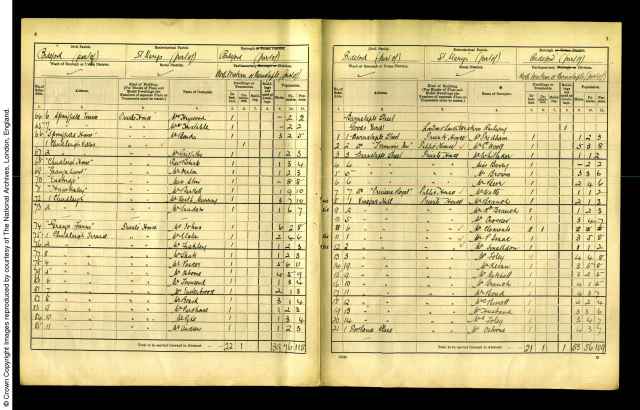
GBC_1911_RG78_00781_0155

An Enumerator’s Book List

When trying to work out precisely where my characters lived, I made use of the census returns, particularly the 1911 census. This is a key resource for family historians but many do not venture beyond the household schedules. The key data providers, that most people use in order to access these records, allow us another opportunity. Having found a return for a single household, in the usual manner, it is possible to opt to view ‘related images’. Of these, I find the one described ‘enumerator’s book list’ very useful. This is pretty much what its name suggests. It is a list of the properties on that enumerator’s route. Not only are these lists normally in a logical order, with properties in close proximity next to each other on the list but occasionally the lists give the name of a property that is merely described as ‘village’ on the household schedule. The ways of accessing these lists differ between data providers. I use FindmyPast but I understand these lists can also be viewed on other sites.

I spent hours agonising over a series of census returns, the 1939 register and street directories, in an attempt to identify exactly which house the Powells inhabited in Bideford. This was made more difficult because, historically, several properties bore the same name. In fact, chapter 2 stalled for many months during a period of frustration because I could not associate the family with a particular property. In the end, I am fairly confident that I have selected the correct one. It was probably a good job that I did not write the novel in the right order and I was able to work on later chapters whilst I was waiting to feel comfortable with chapter 2.

More information about Barefoot on the Cobbles can be found here. Copies are available at various events and at all my presentations. You can order from Blue Poppy Publishing or directly from me. Kindle editions are available for those in the UK, USA, Australasia and Canada.

Day 22 #bfotc sources

Day twenty-two of the ‘advent calendar’ focusing on some of the historical/genealogical sources that I used in the writing of Barefoot on the Cobbles.

CaptureWhen tackling the horrors of the Western Front, I chose Abraham Tuke as my ‘point of view’ character. Research into his background revealed that he had been the editor of his college magazine. I decided that, like others involved in the Great War, he might relieve the stress of being in a combat zone by writing poetry. I re-read the classic World War One poets, Wilfred Owen, Siegfried Sasson, Rupert Brooke, Lawrence Binyon and other well known names. I was also fortunate to have access to a collection of works by poets who are not household names and whose work is a little less polished, The Forgotten Tommy Poets of WW1. I tried to absorb the topics, the timbre and the language used in these poems. The subject matter frequently addressed the futility of war, the blundering of those in authority and the sheer boredom that was punctuated by death and fear. Often, a certain black humour permeates the lines that they composed. This research allowed Abraham to write his own poems; poems that I hope sit comfortably with those written during the war. I did reassure myself that he did not need to be a very accomplished poet! The poetry that I read was also very helpful in my attempt to keep the phrases, the euphemisms and the slang in period. I am not sure that my vicarious poetry writing will inspire me to write more verse but I am tempted to find time to read poetry again, something I have not done for decades.
More information about Barefoot on the Cobbles can be found here. Copies are available at various events and at all my presentations. You can order from Blue Poppy Publishing or directly from me. Kindle editions are available for those in the UK, USA, Australasia and Canada.

Day 21 #bfotc sources

Day twenty-one of the ‘advent calendar’ focusing on some of the historical/genealogical sources that I used in the writing of Barefoot on the Cobbles.

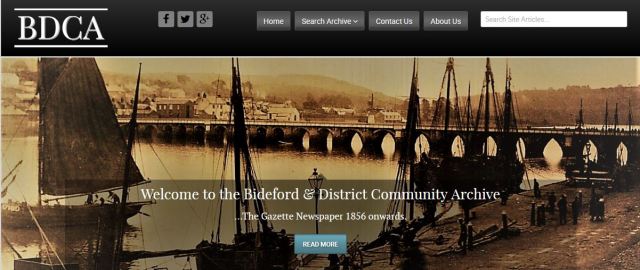
CaptureI would like to mention another local archive today: The Bideford and District Community Archive. The Bideford Archive was established in 1983 and has premises in Northam, where its holdings can be consulted. There is also an excellent website, which can be searched by place, personal name or topic. I used the archive principally in order to consult original copies of the local newspaper, the Gazette, which I could not access online. The archive is a treasure trove of local information, some of which is not available elsewhere. If you want to delve into the history of Bideford and the surrounding rural hinterland do pay them a virtual or actual visit.

More information about Barefoot on the Cobbles can be found here. Copies are available at various events and at all my presentations. You can order from Blue Poppy Publishing or directly from me. Kindle editions are available for those in the UK, USA, Australasia and Canada.

Day 20 #bfotc sources

Day twenty of the ‘advent calendar’ focusing on some of the historical/genealogical sources that I used in the writing of Barefoot on the Cobbles.

Capture

I am an inveterate reader of historical novels but one of the things that is likely to make me abandon a book halfway through is the use of inappropriate language. By this I don’t mean a text that is peppered with swear words; I am referring to novels that include words, phrases, metaphors or idioms that were not in use at the time. Novels I have rejected include a book set in 1800 that mentioned cardigans and suitcases and an early 1900s saga where the characters greeted each other with ‘Hiya’.

The historical novelist has to tread a fine line between accuracy and unintelligibility. A Medieval saga written in Chaucerian language, or a Tudor tale that faithfully reproduces every aspect of Shakespearean dialogue, would be incomprehensible to the majority of readers. Yet getting the language right is an important part of evoking an era. Reading novels, newspaper reports, diaries and letters that were written in the appropriate period can help when an author is trying to get a feeling for the vocabulary and turns of phrase of a time. It is important to remember though, that ordinary people did not speak in the way a novelist would write, in the same way as we do not sound the same when we are chatting to our friends as we would delivering a eulogy or being interviewed for a job.

Avoiding linguistic anachronisms is a vital part of giving an historical novel the right ambience. I use an idiom dictionary and you can also put the phrase and ‘idiom first used’ into the search engine of your choice. These are not infallible but will often quote early uses of the phrase in literature, so that you know you are safe to use it in books set after that point. You can’t ‘paper over the cracks’ until after the 1860s, or play with a ‘doll’ until the eighteenth century (before that it would be a poppet or puppet), yet a ‘millstone round the neck’ is biblical so can be used in all but the earliest historical novels. I had great fun trying to ‘iron out’ (fourteenth century) any inconsistencies in the language that I used.

More information about Barefoot on the Cobbles can be found here. Copies are available at various events and at all my presentations. You can order from Blue Poppy Publishing or directly from me. Kindle editions are available for those in the UK, USA, Australasia and Canada.