Welsh Adventures Part 3

The final instalment chronicling our adventures in Wales and beyond.

Day 7 Blaenavon Ironworks

We set off for our pre-booked entry at Blaenavon Ironworks. This time the sat-nav, not only gets us to the right place but takes us past some stunning scenery on the way. Blaenavon Ironworks is a fascinating site. We get in free because Cadw, who run the site, have a reciprocal arrangement with English Heritage. The ironworks were established here in the 1780s and the finished products were shipped out by canal. It was at Blaenavon that Sidney Gilchrist Thomas discovered a way to remove phosphorus from iron ore, which was significant for the steel industry. An impressive digital display gave some idea of the noise and heat that was part of the working environment. It was somehow more impactful because part of the commentary was in Welsh. I am drawn to ruined industrial landscapes and this is on par with the Cornish tin mining sites. Here the jackdaws and the feral pigeons have made their home.

A series of workers’ cottages on the site have been furnished to represent different eras from the 1780s to the 1960s, the life of the ironworks. Covid restrictions mean that we can only look in these cottages, rather than enter them but they are still a highlight of the site. Instinctively, I wanted to look them up in the census returns and mentally put real people in them. This is just the sort of site that anyone with ironworking ancestors should visit. An interesting fact that I gleaned was that, in 1851, there were more industrial workers in Wales than agricultural, allowing Wales to claim to be the first industrialised nation in the world.

We went for a short uninspiring walk from close to the car park then headed off home, planning to stop to take photographs of the view on the way. We hadn’t done so on our outward journey as we were keen not to miss our entry timeslot. Strangely, the sat-nav decided to return us to Brecon via a completely different route. Although a circular route has the advantage of exposing us to more of the country, we are disappointed to miss the views. Just as we are lamenting this, the landscape opens up and the vista is amazing. Squelchy bog prevents me getting a great camera angle and views always seem less impressive in photographs, so I will have to rely on memories. The mid-Welsh landscape seems to be darker green than many areas and fields tend to be small and hedged, despite the availability of stone for walls.

On the way home we are reminded that the Brecon Beacons have their fair share of ******* drivers. We reach a bridge that it not only described as weak but is barely wider than the car. This in itself is not a problem but like many Welsh roads, it is not straight and at the point at which you join the bridge you cannot see the end of it. An illuminated sign warns us that there is a vehicle on the bridge. A vehicle emerges the sign goes out and a green light comes on. We launch into the unknown, only to find, as we turn the corner, that someone is coming in the other direction, presumably having ignored the sign at his end. My gallant chauffeur had to reverse 100 yards round corners, with unforgiving walls no more than six inches from the wing mirrors on either side.

Day 8 Thursday Brecon Canal

Today it is sunny, so we decide to walk from the caravan site, down the canal towpath to Brecon. This involves taking our lives in our hands to cross two dual carriageways first but we survive. This is a pleasant walk and we are rewarded by a grey heron allowing us to get to within five yards before flying off. There are more signs of industrial heritage here, with the remains of the limekilns that were in operation in the early nineteenth century. The canal linked Brecon with the industrialised areas in south Wales.

After a short rest we decide to explore more byways of Wales by car. We drive out to Craig-y-nos Country Park but by the time we arrive, dark clouds are looming and as we have already had our walking ration for the day, we return to the van.

Day 9 Friday To Cheltenham (yes, I know this isn’t in Wales)

It is time to move nearer to home and take up residence at the caravan site on Cheltenham Racecourse. We have stayed on racecourses before and although we have views across what is probably the Malvern Hills, I have to say that it isn’t the most picturesque site we’ve been to. Cheltenham too is unexpected, much larger than I was anticipating. In my head I was thinking smallish, Georgian grandeur, maybe a bit like Buxton but it seems not, or not in the part we travelled through.

I hadn’t planned an activity for the afternoon so time to Google for an outside space. I lied when I said that the wifi on the previous site was the slowest in the world, that honour belongs to the Cheltenham Racecourse wifi, which is not the Caravan Club system, for which I have an annual subscription but free Jockey Club wifi. I guess there isn’t much call for surfing the internet when hurtling over jumps on the back of a horse. An additional issue is that we have the ‘delights’ of a ‘Fun Weekend’ event on the racecourse this weekend – deep joy. This appears to involve a fun fair. Peaceful it may not be.

We opt for Beckford Nature Reserve. This comes very close to being another addition to our ‘nature reserves we didn’t find’ list but no, here it is, unsigned until you get to a small gateway hidden in a hedge. A path winds round an algae covered lake. There’s not much sign of wildlife apart from some baby coots, which I am surprised to see have orangy-coloured heads. Despite two perambulations of the lake, I am still 1500 steps short of my target. Time for some jogging up and down on the spot outside the van. This is followed by the Wimbledon men’s singles semi-finals.

Day 10 Forest of Dean

It wouldn’t be a holiday without some family history, so today it is off to the Forest of Dean, the haunt of some of my children’s ancestors. This lot even rate some gravestones, though many were in poor condition. Trailing from churchyard to churchyard is often circumscribed by bladder capacity, because small villages rarely rate toilets but hurrah, today two of the churches on our itinerary had toilets, so we could happily spend hours peering at semi-legible gravestones.

One of our stops is at St. Briavels. St. Briavels Castle, now run as a Youth Hostel, is closed to the public. It was built as a royal hunting lodge in the twelfth century. It became an important centre for the making of cross bows, using iron from the Forest of Dean.

Having got suitably soggy feet from traipsing through grassy graveyards, we take a short walk along a forest path to keep the step count up. Then it is back to the van, where the wifi oscillates from intermittent to non-existent. I hurriedly identify today’s photographs. In the past, I have been known to end up with numerous church photos and not be quite sure which is which.

Day 11 Slimbridge

We have saved the best until last. Today is our pre-booked visit to the Wildfowl and Wetlands Trust centre at Slimbridge, established by Sir Peter Scott seventy five years ago. Last time I visited it was in the spring so there are different things to see today and the opportunity to feed birds is confined to a small area. My favourite part is the new estuary aviary with avocets, oystercatchers, black-tailed godwits, ringed plovers and spoonbills, amongst others. I manage to get a few half-decent photos, despite every bird assiduously going into a preening frenzy at my approach, so that their head are hidden from view.

Young Genealogists: what can YOU do to nurture the next generation of family historians?

Well, this isn’t the blog post that I was going to write. I was going to tell you about my second day at THE Genealogy Show and in part I still will but this needs saying and it needs saying now. At the show, I listened to Daniel’s presentation Genealogy from a Young Genealogist’s Perspective. In the second half, he challenges older family historians to make life easier for young genealogists, who have a number of barriers to participation. Not least of these is the attitude of some of those of more mature years in the genealogy community. Engaging younger family historians is something I have been advocating since I was just a few years older than Daniel and that’s quite a long time!

Family History and Local History is perceived as a hobby for the older generation. When I attended my first meeting in 1982, I was the youngest person there, probably by about thirty years. Sadly, here we are, forty years later and I am STILL in the younger 25% of attendees. There are certainly younger genealogists out there but family history societies have singularly failed to engage the under 40s, let alone the under 20s. Family historians are constantly bemoaning the fact that their children/grandchildren are not interested in their family history. Here is a revelation. In most cases, what family history societies and individuals have been doing to encourage younger people hasn’t worked up to now. If we carry on doing the same thing, guess what, it isn’t magically going to become engaging and relevant to younger people. Nothing is going to happen except that older family historians will die off, no one will be interested in taking over their research and it will become increasingly difficult to recruit members and officers to societies.

If we value our hobby and our own research, we have to be pro-active in order to broaden its appeal down the age range. We need to be inclusive and work to break down some of those barriers. It is our job to reach out, not the young genealogists’ task to scale those obstacles. Younger genealogists need a safe, affordable place to interact and to pursue OUR hobby, with acceptance and nurturing from more experienced genealogists. We need to understand that the GenZ genealogists (aged c.13-25) have a valuable contribution to make. They have knowledge and a thirst for more, they have energy, they have ideas. Family History Societies need to take advantage of this in a mutually beneficial relationship.

So what can you do, or what can you ask your society to do? How affordable is membership, could it be free for under 18s? The response, ‘We’ve never been asked for under 18s membership’, may be true but is not satisfactory. Free under 18 or student membership needs to be publicised loud and clear in a prominent place on the society website, perhaps with posters on display in places where young people are, or mentions in school and college newsletters. It is no good doing this until the society has something attractive to offer those young genealogists. Can you provide activities that would engage school and college goers? Could you stage events (virtual or in person), where entrance is dependent on bringing along someone under 25? Some societies have premises with access to the major data providers, can we welcome young people to take advantage of this? Not in a passive, ‘well we wouldn’t turn them away’ manner but by doing things to actively promote this in a safeguarding compliant way, at young person’s open day perhaps. Could each society seek out a young person’s advocate to join their committee, if only on an ad hoc/advisory basis? Needless to say that advocate has to be a young person.

So you have read this far and thought a) She is ranting again and b) I’m not on a committee what can I do? If you are a society member, you can make suggestions to your committee. If you are not associated with a society, you can still ensure that you make our hobby engaging and accessible to the young people around you, be that your family, youth groups, schools, or young people in your neighbourhood.

I have been saying this for so long. Young people are interested in family history, they are just not interested in doing it OUR WAY. It is up to US as individuals/societies/whatever to adapt and take our hobby to them where they are, not just carry on in the same old way and lament the absence of those young genealogist in our own milieu.

If you have the opportunity to listen to Daniel’s presentation, please do. It is worth the now reduced entrance fee to THE Genealogy Show on its own. Do something, or before long, your research, your society, our hobby, will be dust.

I had the pleasure of being interviewed by Daniel for his podcast last night but more of that another time. Do take a look at the activities of him and his Hidden Branch colleagues and let us ensure that the younger genealogists are no longer hidden.

429 1 Nov 2019
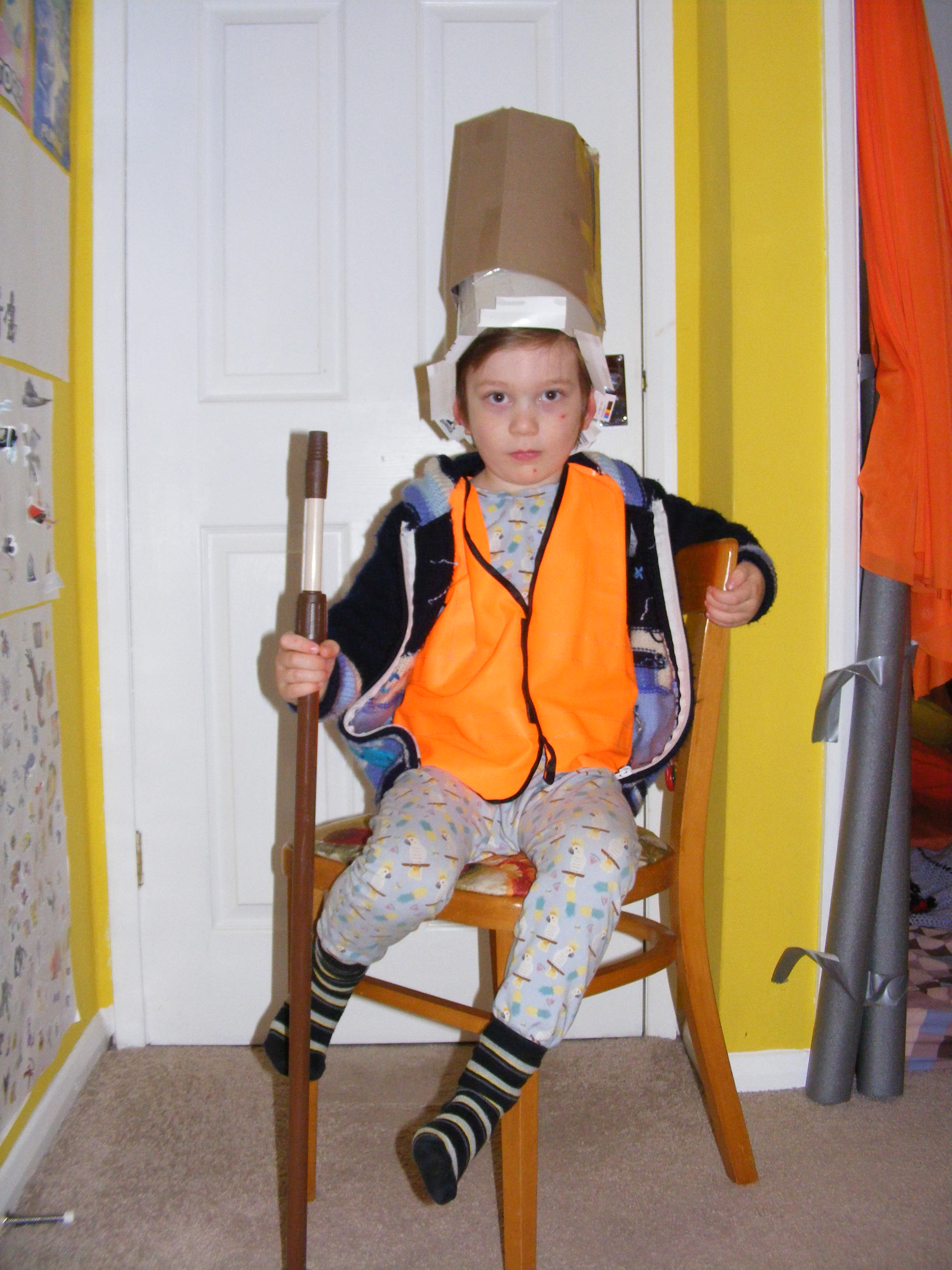
Posing as his 6 x great grandfather

This young man, now aged seven, is interested in his family history and is currently compiling a family history scrap book.

Family History Busyness – THE Genealogy Show Day 1 and other excitements

I’ve been bracing myself for a ridiculously busy couple of days. After virtually presenting in Kent and Norfolk yesterday, today was the first of two THE Genealogy Show days. Talks are being live streamed over 48 hours and my first went live at 4am my time. I was invited to listen to myself (always cringe making) and be on hand to answer questions, I decided to pass on that one. I only just missed the opportunity, so spent the early hours exploring the Show’s website and even manged to sneak in the chance to listen to three exciting young genealogists in a panel discussion about young people and genealogy. It is several decades since I was that young person and it is great to watch the baton passing on.

This was followed by my fortnightly chat with the lovely folk of Talking Family History. They are starting a new series in July, so now would be a good time to join in the fun. Then it was my turn to person the Society for One-Place Studies booth for THE Genealogy Show. Over lunch, I tuned in to Dr Sophie Kay’s Negative Spaces presentation; definitely worth a listen. Later, I had the chance to watch Andy Browning’s fascinating story Following in Family Footsteps.

Other recent feelgood family history moments. A photograph of my, now demolished, first teeny tiny infants’ school being posted on a Facebook Group, together with a picture of the headteacher, albeit about twenty years before my time. A few weeks ago, I was very excited to be offered the chance to acquire a one-name related long case clock. Even better, my nearest and dearest agreed that it could be a belated birthday present. The maker was from a different branch of the family to my own but it is still very special to have it safely ticking away in my living room. Finally, our local history group held its first hybrid meeting, with the speaker and five others in the meeting room and others Zooming in from as far afield as New Zealand and Canada. We still need to work to improve the sound quality but we are proud that a small society such as ours has been able to take a first step towards making our meetings accessible to those who are not comfortable with technology as well as our friends who are too far away to attend in person.

Tomorrow more busyness, more family history talks to give and listen to and an interview with Daniel’s Genealogy in the evening.

Operation Toy Excavation

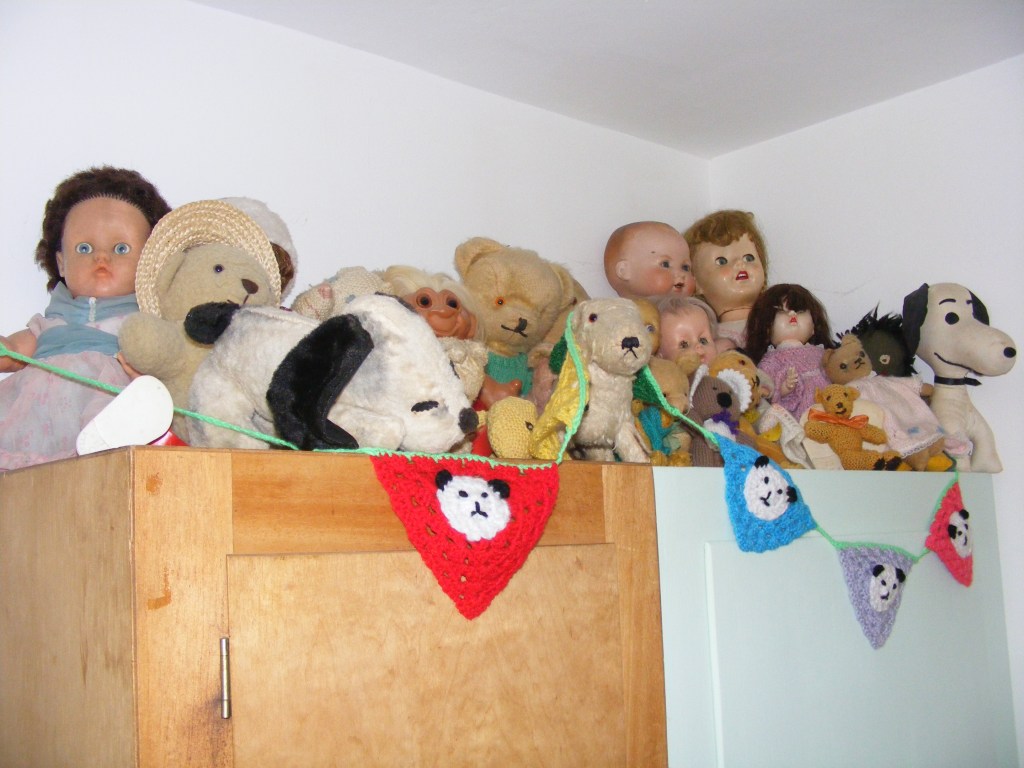
What else do you do on a summer Saturday but excavate the historic doll/stuffed toy collection from under the dust of ages and I do mean ages. I am not sure that the stuffed toys have had the dust bashed out of them for decades.

Meet the motley crew, some of who are almost centenarians.

They were removed from their cupboard-top home, stripped naked, apart from the two that my mother appeared to have sewn into their clothes and readied for the major operation.

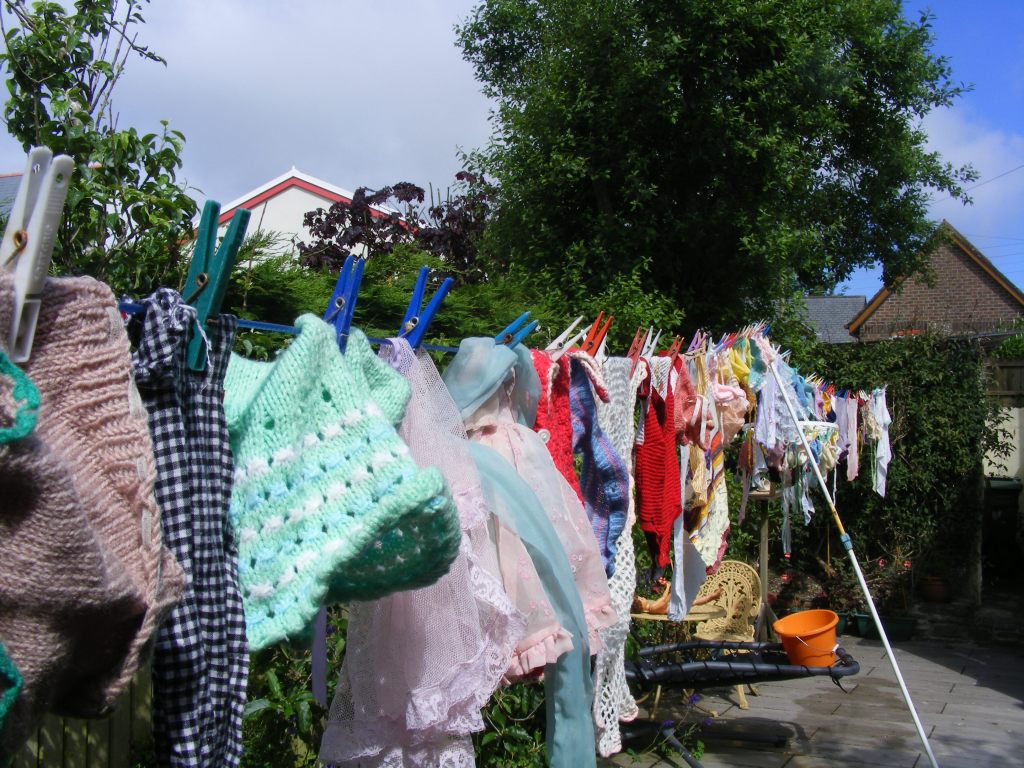
Next, to wash the clothes, some of which needed hand washing. It might be a while since they were last washed but I know from bitter experience these are old fabrics that are far from colour fast. Sadly, since they were last laundered, it seemed that the moth had made a meal of some of the woollen items, lovingly knitted by three generations.

The shoes were scrubbed and left to drain.

Then bath time. I don’t have a real bath (I have what is officially the smallest bathroom in the world – seventeenth century cottages not being too hot on bathrooms, so I replaced the bath with a shower). No bath means no bubble bath, so I substituted washing up liquid. It turned out that I also had to use a rather rough washing up sponge to scrap the dust from grubby limbs and faces – sorry dollies.

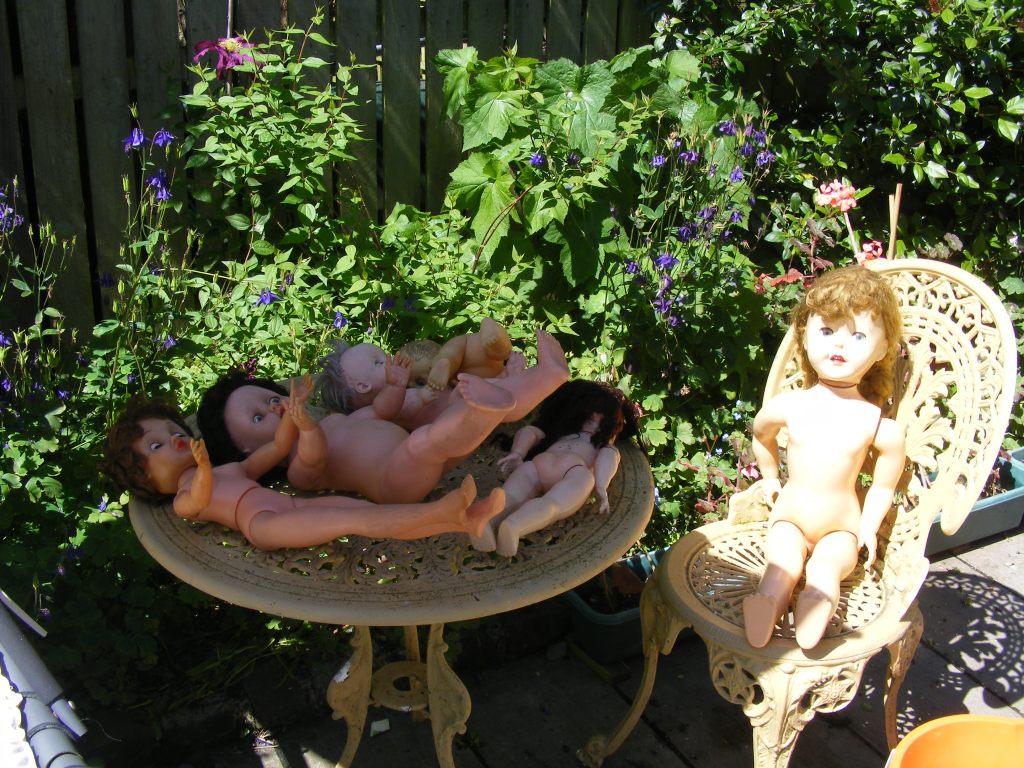
From the left: Christine, Jilly, Mary, Jane, Betty, Sally, Big Peter – you can pin point my generation just from the names.

As you will see, the baby bath has stood the test of time. I am wondering if this will be marked up as an inappropriate image.

Mary and Jilly

You have no idea how long it takes to peg umpteen small items on the washing line. Take it from me – a long time and it used up every inch of line and every peg I could find.

The dolls were left in the sun to dry. I did have to temporarily amputate a few limbs and even one head, in order to let the water drain out.

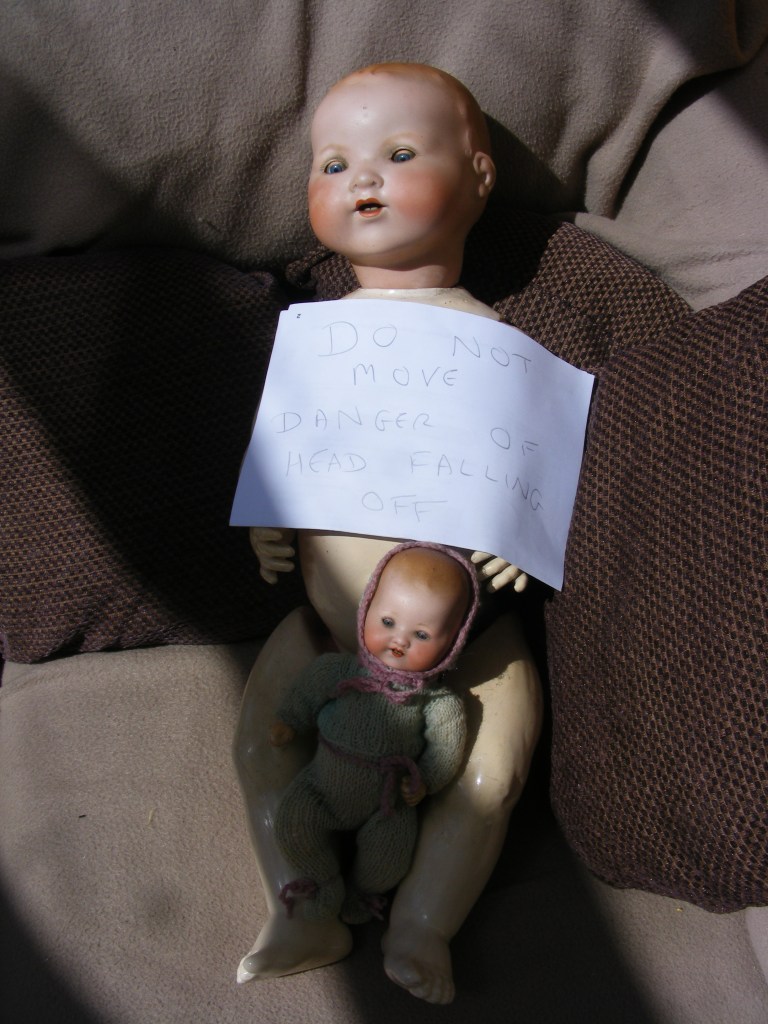
Big Peter and baby Peter (not a lot of imaginative naming on the part of my mother there), now in their late nineties, were spared total immersion, not least because baby Peter’s clothes don’t come off. In fact I fear for the stability of the wires attaching Big Peter’s limbs and heads, hence the warning notice.

Then it was time to bash the soft toys together and stand well back as the dust flew.

A quick bake in the sun followed. Today they will be redressed and replaced on top of the cupboard. It is a sobering thought that if they wait as long for their next washing as they did for this one, I may not be around to do it.

My lovely memories group ladies are writing about the toys and games of their childhood at the moment. I am fortunate to have many of mine still in my possession. The great loft sort has revealed a feast of goodies. They may just become the subject of a talk. In the meantime, whether you still have the contents of your toybox or not, I would encourage you to record the memories of your own particular treasures.

NB no dolls were permanently harmed in the creation of this blog – well, I am not sure I should have washed Jane’s hair (already her second lot of hair) but she will get over it.

Being Presidential and New Horizons

Here I am, three decades after serving on the executive committee of the Family History Federation, having the honour of being voted in as its President. I am following some seriously big names in the genealogical community. To be considered some kind of elder stateswoman, is not only a humbling experience, it also makes me feel incredibly ancient. Perhaps I should point out that during my time on the executive I was the youngest ever serving member; though I think that record has since been passed to someone else. Family history societies are at a cross-roads. Many have seen slowly declining memberships and have struggled to fill committee and volunteer roles in recent years. Now is the time to reinvent ourselves and our function, or to fade into oblivion. We cannot keep repeating the pattern that has not been working well and expect it to suddenly become relevant and appealing. The pandemic has forced us to rethink the way in which we do many things. Societies can either put change in the ‘too hard’ basket or embrace it and perhaps use it as the first step to a resurgence. Societies can still be relevant in today’s genealogical landscape but it takes work and insight to make them so. For many years, I have come into contact with societies across the world as a member, a volunteer and a speaker. In the past year, my ‘catchment area’ has expanded exponentially and I am looking forward to ‘meeting’ many more family historians in the coming months. I am very mindful of the honour that has been entrusted to me in these challenging times.

On the family history front, I have been getting out my sledge hammer and attempting to crash through some family history brick walls for Devon researchers. Despite much of the sleuthing being done by my colleague, I ended up presenting the findings in a FindmyPast podcast, which you can view here. These may not be your personal brick walls but the techniques we used could be effective on your own problem ancestors.

I have also had what is probably classed as an old-age crisis. Before I wrote Barefoot on the Cobbles, I debated whether to write a novel or take a post-graduate course. On that occasion, the novel writing won. I am still playing with ideas for a possible third novel but nothing yet seems quite right, so I have returned to the post-graduate idea. I am excited to have been accepted by University College Dublin as a remote student on their certificate course in experimental archaeology and material culture. I am not quite sure what I have let myself in for but I am not going to be bored.

My ‘Discovering more about your Agricultural Labouring Ancestors’ online course is coming to an end and the students are now compiling case studies about their chosen farming ancestors. I have a few more submissions to read from my ‘Writing and Telling your Family History’ students, then thoughts will turn to next month’s course, ‘In Sickness and in Death – researching the ill-health and death of your ancestors’. As I said, no time to be bored.

For those of you waiting to hear about the end of our short trip to South Devon, watch this space.

DNA Detective Work and the story of a secretive agent

I decided that it was high time that I looked at some of my closer DNA matches, where I am unable to identify a common ancestor. I should explain that ‘closer’ in my case means not very close at all. My lack of cousins means that I only have three matches above 70cM and one of those is my daughter. My attention turned to a 48cM match with no tree. From shared matches, I had placed this person on the Smith/Seear side of my family tree. The Smith/Seears are tricky DNA wise because three generations of Smiths marry Seears, so I am often related to people on this line more than once. This means that suggested relationships are distorted. Without my pedigree collapse, the amount of shared cM with the mystery match might suggest that the relationship was in the region of a 3rd or 4th cousin, maybe with a removed or two.

The profile indicated that the user had joined Ancestry in 2016 and hadn’t signed in for over a year. I don’t want to give the actual name for privacy reasons but the user name looked like it could be the first half of an unusual female christian name and a surname run into one. This isn’t it but think constabolt might be Constance Bolt. I guessed at the name, Googled it and up came an obituary for the husband of someone with that name. This indicated that the person I was searching for was born in a particular smallish town in the south of England. Further internet searches revealed a maiden name and a middle christian name. To make this story easier to follow, yet still anonymise it, I am going to tell it with a fictitious maiden name. Let us say it was ‘Forester’, which probably has a similar rarity value as the actual name. This with the other information was unusual enough for me to locate a birth entry and discover that the lady, if she was still alive, would be in her nineties. Better still, her mother’s maiden name was Seear. Not only did it look as if I was on the right track but a great advantage over Smith. Yay! Eureka and all that. Now all I had to do was find a marriage for a Seear and a ‘Forester’ and I was away. This was going to be easy. Err, no. Not a marriage in sight. I searched for any other ‘Forester’- Seear children. None. Given that the marriage was likely to be not long after the first world war, it seemed probable that Miss Seear had married x before she was married to Mr ‘Forester’.

The Seears’ normal stomping ground is east London. There couldn’t be many in this small southern English town could there? There weren’t. I tried the 1911 census and the 1939 register for that area. I found a family in 1911 with two daughters who were potential wives for Mr ‘Forester’. They both married other people and died with those surnames; no second marriages to Mr ‘Forester’. The 1911 census indicated that there were other children who were not in the household, maybe I could find another daughter. According to the census there had been nine children, three had died and three more needed to be found. The family was headed by a married Emily Seear, no husband in sight. I found her in 1901, still in London, still married and still no husband, this gave me three more children. The children had unusual christian names but I couldn’t identify birth registrations for them all. Checking the births I could find on the GRO site gave me Emily’s maiden name but searching with Seear and the maiden name did not reveal the missing children, nor were they registered under Emily’s maiden name. I had her year of marriage from the 1911 census. This meant that I could find her marriage entry and the name of Mr Seear, who was potentially the grandfather of my DNA match. It was a name I recognised and suggested that the match and I were third cousins once removed twice over. I will continue to refer to him as Mr Seear, although, from this point, I was searching under his full name.

I was left with a gap and some questions. Which daughter of Emily Seear was the mother of my match, why weren’t all the children registered and where the heck was Mr Seear, who died in the 1920s but is elusive between his marriage and that point? He was clearly around to father nine children on Emily, at least one of whom really was his biological child, or there would be no DNA match.

By diligent searching I found one of the daughters marrying under a variant of Seear and then a subsequent marriage, under the surname of her first husband, to Mr ‘Forester’, which proved my link to my DNA match.

I did find the baptism of one of the children whose birth wasn’t registered but I couldn’t find the three who had died by 1911; perhaps Emily was counting still-births. There are some large gaps in the children but given what appears to be a rather odd relationship between Emily and Mr Seear that isn’t surprising.

So what do we know about Mr Seear? Given that he is my first cousin three times removed and not a close relative, I hadn’t researched him beyond his name and appearance with his parents in the 1861 and 1871 censuses before. He married in his home area in East London in August 1881, claiming to be a banker’s clerk, yet he can’t be found in the 1881 census, despite my knowing his address just four months later. Seear is a bit of a nightmare to search. Apart from the variants (Seer, Sear, Seeare and many more), it is often mis-transcribed as Leear or Teear, or indeed it seems something else entirely.

I did find a listing for Mr Seear going to Baltimore in 1883. His occupation was ‘agent’. Much as I’d love to think this was some kind of secret agent, I am quite sure it was as the representative of a company or organisation. Perhaps this is why there is an apparent gap between the first child in 1882 and the second in 1886. I totally failed to find Emily or Mr Seear in the 1891 census. I know they were in east London when a child was born at the end of 1891. I tried every technique I know, including search for christian names and dates of birth, without a surname. I tried the 1890 US census in case they all went to America; they were not there either.

I can’t find any children born between 1886 and 1891 when suddenly there were three children born in as many years, perhaps the relationship was re-kindled. There is then another gap before the final child in 1899. I have a baptism for this child on which Mr Seear calls himself a Dining Room Proprietor.

So we reach 1901 and no surprise that Mr Seear is conspicuous by his absence. Sadly, he seems to have kept his name out of the newspapers as well. Emily, describing herself as a married coffee house keeper, is still in the London area, with six children, including the mother of my DNA match but who is using a different christian name (I suspect an enumerator copying error as the names, although very different, have the same number of letters and shape).

Fast forward to 1911 when Emily and three children are in the south of England. Lo and behold Mr Seear turns up, living in London with his brother, claiming to be unmarried and working as a caterer for a licensed victualler. Two final sad entries, which show that Mr Seear spent time in the workhouse before he died.

This has taken me all morning but I am pleased to be able to untangle the tale. Shame about the other 16,000 unidentified DNA matches!

Image copyright R B

Of Swing Riots, Slander and Seriously Neglected Family History

We are still, it seems, in the depths of winter here in darkest Devon. Time for some family history. That’s nonsense, it is always  time for some family history. I am now in my 44th year of research, so it isn’t always easy to find anything new but every now and again I get out a long untouched branch, dust it down, check that I am happy with the conclusions I drew when record access was poorer and see if anything can be added.

Recently, at the request of my descendants, it was the turn of the Few family, hence the jaunt to the Hampshire/Wiltshire/Berkshire borders. Two issues with this family. Firstly, it is always a nightmare tracing a surname that is also a word, especially when looking at things like newspaper archives. I once had to look for a teacher called Mr Head (I had no forename) up popped every Headteacher in the world but I digress. Secondly, the Fews lived at a point where very short distance moves took them to another country, or another other county, giving me three to consider.

I hadn’t done much on this family for a while (translated to ‘not touched it for decades’) so as I usually do in these cases, I pretended I was starting from scratch. This involves reviewing each generation in turn, writing down my evidence for linking to the next generation and deciding if I am satisfied that I have made a correct link. I don’t use a formal ‘method’ or genealogical proof standard, although what I do amounts to the same thing. I just call it good genealogy. Having reassured myself that what I did thirty plus years ago was sound and that I really couldn’t, with confidence, add a further generation, although others have done so, I looked at the collateral lines. Here there were new generations to add, always a pleasure having been searching for so long.

I have already mentioned the revealing of the prosaically named Fish Coppinger and the four sisters with ten illegitimate children between them ‘but wait’, as my friend would say, ‘there’s more’. I am currently feeding back on pieces sent to me by students on my Pharos online Writing and Telling your Family History course. As an aside, one of these mentioned someone from my one-name study but that’s another digression. Said students are encouraged to enliven the begats and begats with plenty of context. To be fair it is more a case of ‘do as I say’, rather than ‘do as I do’. My own ‘writing up’ is primarily a way of presenting my findings in a relatively (see what I did there?) coherent way. I certainly don’t claim that mine are beautifully crafted, riveting narratives but I do like to throw in a bit of context now and again. I also have students who are currently working on a course about agricultural labouring ancestors, so I thought I should utilise some of the techniques that I have been advocating for them too.

I set to work. Newspapers are always a great source of interesting snippets. I was excited to find that the agricultural labourers that I was researching were living in a parish where Swing Rioters were out in force in the 1830s. Add to the mix the ancestress who dropped dead walking home from working in the fields, the ancestor who narrowly escaped prosecution for slander and the one whose foot was run over by a wagon and I felt that I was starting to get to know these people who had previously just been names on a family tree. If you are very bored and want to see the fruits of my labours, the draft narrative is here. This has not yet been run through the eyes of my ace proof-reader. There will be typos!

In the course of this research, I came across a very sad newspaper account about a child whose name was shared by a family member but who was no connection that I can find. Apologies for the poor reproduction – that’s as god as it gets. Although typical of the time, the callous attitude of the reporter was shocking and I am now tempted down the rabbit hole that is shouting ‘research this child’.

Wiltshire Times and Trowbridge Advertiser 27 June 1874

I did get as far as finding the child in 1881, listed as a scholar with no disability mentioned and there is a burial at age nineteen. Do I invest in the death certificate? They won’t be forgotten as I will be working this in to one or two of my talks.

I now have, by design, a two-week lull in talks, although I am podcasting (I think that’s the word) this afternoon. With ‘winter’ continuing I shall move to Worcestershire (in the virtual family history sense), to see what I can uncover about another long-neglected twig on the tree. See you on the other side.

A Surfeit of Mead: a family history tale

Yes, it has been a bit quiet here lately. A whole nine days without giving a Zoom talk, although I have attended a few. I deliberately left a gap, thinking that family might be able to visit. Sadly not to be. I have had some family Zoom time including joining in with the construction of a mega Harry Potter Lego set, with the participants kindly holding up the board to the camera, so that I could witness every step. I have also forced myself off the laptop and have begun the mammoth task that is turning out the loft, of which more later as this is a family history story.

I had reached a bit of a halt whilst re-examining my children’s paternal line. This did include the excitement, mentioned previously, of discovering four sisters who had ten illegitimate children between them and also an ancestor who dropped dead on her way back from working in the fields but I digress. I felt that I was getting a little bogged down with this story so, prompted by the imminent visit of my daughter to Whitby, I turned to look again at her Mead ancestors who came from that area. This was a real case of restart, revisit, review, as all I had done on this line in the past twenty five years was to add on the 1901 and 1911 census entries. Almost all the research had been done pre-computer, using certificates, censuses and the IGI (the forerunner of family search). I had never had the opportunity to visit a Yorkshire record office.

So, with new eyes, access to images of original registers and online indexes, I was gratified to confirm my previous research, which stretched back to my children’s 4x great grandparents. Fairly swiftly, four further generations were added. These solidly respectable (glossing over a few very short pregnancies for eldest children) and comparatively prosperous Yorkshire yeoman farmers did lack imagination when it came to naming their children. Seven generations in the direct line and every blessed one was called John or Francis. All the Francises had brothers called John and you’ve guessed it, all the John’s have brothers called Francis. Ok, I’ll concede, one was called John Edward but really.

Then I started on the families of the brides. This is still ongoing but it is fascinating, well to me anyway. I am back to the seventeenth century here so the contextual social history is not a problem. Remember though that I am a soft southerner. One with strong emotional and familial links to Northumberland but definitely a southerner. I am now immersing myself in the local history, which is new territory for me. I skim read the relevant General View of Agriculture, being very grateful that I can still speed read as it is 392 pages. Now I am dredging the depths of my knowledge of sixteenth and seventeenth religious history and giving it a new application. I am currently embroiled in tales of priest’s holes and recusancy, as it turns out that one of the brides came from a staunchly Catholic parish and that her very unusual surname appears on lists of those whose estates were sequestered. It is also a surname that seems to now be extinct, just nine English/Welsh births (in all three spelling variants) and only one, a female, in the last ninety years, another fascination. Today I may be doing a mini-one name study of the name in the sixteenth-eighteenth centuries. I am forcing myself to put this research aside in order to tick at least one thing off the to do list every day and also to incorporate some loft-sorting but I am enjoying this immensely. Just keeping everything crossed that the Borthwick Institute restart their coping service soon and there isn’t some massive backlog as almost every generation of Meads left a will. I have zero desire to rush to a hairdresser or a café when lockdown eases but I need those wills!!

And the loft-sorting you ask. That was going well. I was able to sort through my ‘souvenirs’. This was particularly helpful as, in company with the lovely ladies of my online memories group, I am filling in the gaps in my auto-biography. I have now opened the suitcase containing my diaries (daily entries since 1 January 1971 and a few isolated entries prior to that). It turns out that in 1968 (which I abandoned in September) I not only noted the weather but also all the books I read and more bizarrely what I wore, ‘wore school uniform, changed into kipper tie dress’ etc.. What with that and the Meads and associated families, I may be some time. Oh, I have twelve Zoom presentations to give this month, ah well, I foresee some early morning starts.

Mastering the Art of Talking in my Sleep or Continuing my Campaign to do Two Things at Once

This week has seen me enter my 45th year of serious family history research, although I drew up my first family tree at the age my oldest grandchildren are now. It is the obsession (hobby really doesn’t cut it) that keeps on giving and I can still find something new. This last week or so it has been a potpourri of discoveries. An exciting new one-place source, of which more another time. The story of the interesting four Gilbert sisters who had ten illegitimate children between them, plus a niece with one and an aunt with three more. After that I thought I’d better stop looking. Filling in my census and trying not to die between the day I submitted it and actual census day and creating an account of my own census day memories. I have recorded a video of a family history story for my grandchildren, well I had fun with it anyway. I have half written one talk and recorded another, so a fair bit achieved this week.

A few weeks ago, I managed to be in two places at once. Now I have mastered the art of accomplishing tasks whilst sleeping. This is going to be sooo useful. I appeared as a speaker for the Family History Down Under conference, which went live in Australian time. Hence, I was able to give a talk whilst I was asleep and wake up to a raft of lovely comments and questions. My final session on Embarrassing Ancestors is due to go live any minute and as it was a brand new talk, written with audience discussion in mind, I am keen to know what others think. You can still register for this conference and listen to all the sessions, or register for just one of four streams.

I have also made a possibly rash decision about how to spend my time over the next academic year and if am successful, stand by for accounts of my latest adventure. Only one life and all that. It might mean delaying novel number three, which wasn’t really happening anyway and I might start being a bit more hard hearted when asked to give talks; I have twelve booked for April and that pace really isn’t sustainable.

In non-historical matters, I was asked to complete a random Covid test, to assess levels of asymptomatic disease. Assembling the accompanying box to return the test was a challenge. The instructions were on the underside of the box I was trying to reconstruct. Do I hold it above my head? Do I try to assemble it upside down? Do I look, memorise and then assemble? Then there was the stick it down your throat and up your nose (ideally in that order) thing. The next challenge was putting the swab in the tiny transparent tube. This was a bit of a fail. Having taken my glasses off so I could see my tonsils in the mirror (my close sight is better without glasses), the tube was beyond my clear sight range and it took a few goes to get the stick in. I know, I know, I should have moved it closer. What a wonderful thing hindsight (or indeed just sight) is. Next step to put the test in the fridge and await to see if the courier who was, I was told, going to arrive between 15.03 and 17.03, could find my house. What’s with the .03 business? With a two hour window you’d think it would just be 15.00. Should I refuse him entry if he arrives at 15.02? Unsurprisingly, since apart from the empty next door chapel and the mobile post van fifty yards away, I have only left the house three times since October, it was negative. Or at least my hand which accidently touched the swab with all the getting it in the tube malarky is uninfected.

The excavation of the office continues. I have sorted out and sent three sacks full of paper to recycling. No, I really don’t need all the rough scribbles for my PhD. There are a few more files to cull and I have to decide if I am ever likely to read photocopies of umpteen academic articles. Oh and if anyone local wants a huge pile of House Beautiful Magazines dating back four years you are welcome. At least I can say they come from a Covid free home.

Spring is on the way and just to prove it here are some catkins from my newly pruned trees.

My Life in Seven Censuses #Census2021 #Censusdayphoto

Fresh from filling in my census form in last week and then keeping my fingers crossed that I would live until census day to avoid confusing my descendants, I decided to look back at my appearances in censuses past. I have found the forms that I saved in 2011, 2001 and 1991, so I know exactly what I put then and I have copied the latest one too. I am sure I have the 1981 return somewhere but unearthing that may involve a trip into the uncharted territory of the loft. I have tried to pick photographs that were taken as near to census day as possible. It was difficult to find later pictures for years ending in 1 as I am the photographer, so appear in very few. 1991 was a total fail – I don’t seem to have anything between 1989 and 1993. So here is my offering; please do likewise and create your own census day stories.

23 April 1961

This is one of only two censuses where I appear as part of a complete family unit. I have just had my fifth birthday. I am living in a three-bedroomed terraced house at 28 Sundridge Road, Addiscombe, Croydon with my parents. Recent censuses ask about central heating and I believe past ones have included questions about radio ownership. At this point, we do not have central heating, although we do have both radio and television, as well as a fridge. I am about to start my second term at Tenterden School. I am a little hazy about when my father moved from job to job but he is working as a projectionist and I think, has just started working for Associated Electrical Industries. My mother is probably doing freelance book-keeping at home. I will shortly be going for a week’s holiday to Bognor. I have just been given my second tortoise, Emma.

25 April 1971

I am a stroppy teenager and am just about to return to Croydon High School after a term off having broken my wrist and ankle. Breaking both at once means that I haven’t been able to use crutches. School is two bus rides away and involves many flights of stairs, so attendance isn’t practical whilst I am in plaster. At least, that’s what I am claiming. I am studying for eight O levels (this will reduce to seven after my absence, although actually I learn better at home than I do at school). Whilst I am home from school, I am volunteering at the nursery school up the road; the first of many voluntary jobs involving children that I will take on. I am also recovering from a severe bout of flu, leading to my weight dropping to under six stone. I have just met my first ‘proper’ long-term boyfriend.

By this time, my father has died and my mum and I are living in a two bedroomed maisonette at 3 Parkfields, Shirley, Surrey. Thus, the census shows no record of my living at what I regard as being my childhood home, 57 Firsby Avenue, Shirley. We had solid fuel central heating at Firsby Avenue but now have electric, oil-filled radiators.

Mum is working both at home and in the office as a book-keeper for the instrument makers Negretti and Zambra. Around this time I am working in the restaurant at Crystal Palace Athletics Stadium at weekends. An important member of our family is our dog, Sparky but she won’t appear on any official document.

5 April 1981

I have been married for nearly eight months and I am living in my first home of my own; a three-bedroomed Victorian terrace, 31 Cross Street, Sandown, Isle of Wight. We have gas central heating. Although I have had a colour television for nine years, we have reverted to black and white to save the license fee. I am working as a school secretary and my husband is a civil servant for the Customs and Excise Department. Censuses are keen on asking about qualifications, so I will record that, at this point, I have seven O levels, three indifferent A levels and a Diploma of Higher Education in history and sociology (DipHE was a short-lived and fairly meaningless qualification that was the equivalent to two years of degree level study). I am working to convert this into a full degree through the Open University. I am looking forward to starting a family and I am just about to go on holiday to Guernsey.

21 April 1991

My second and last census as a complete family unit and a short stay in Aston Clinton, Buckinghamshire has slipped between the enumerators’ nets. Now I am in the ‘forever’ home at 12 Ranelagh Road, Lake, Isle of Wight. This is a detached three-bedroomed house with a two-bedroomed flat in the basement. We now have gas central heating, a washing machine and a freezer but the television is still black and white. Both my daughters feature in this census as school children. I have completed my honours degree and also have a Further & Adult Education Teachers’ Certificate Parts I & 2 (City & Guilds).

I am teaching genealogy evening classes and doing free-lance research. My husband is still with the Customs and Excise but is now commuting daily to Portsmouth to do so. My mum has moved to a bungalow round the corner.

I have learned to drive so the household has a car to record in the census for the first time (my dad’s short spell as a car owner fell between two censuses).

I am actively involved with Isle of Wight Family History Society, running their bookstall and library. I am also the Honorary Education Liaison Officer for the Federation of Family History Societies, traveling to Birmingham for the meetings. I am a governor at my daughters’ primary school.

29 April 2001

I am still at the same address, the first home to appear on two censuses. We finally have a coloured television. I am now a widow; one daughter is at university and the other is on the roll at the local High School.

My short stints as a lecturer for The Open University and a school dinner lady have come and gone. I am working part time teaching history in a private faith school, with a handful of pupils. I will later also teach geography and law, as well as taking on a role as school bursar. I am also working as a relief special needs classroom assistant, which I love.

I have added to my qualifications with a Part 2 certificate in Genealogy and Heraldry from the Institute of Heraldic & Genealogical Studies.

I am still involved with Isle of Wight Family History Society and also the Braund one-name Society as their historian and editor.

27 March 2011

Now I have relocated to Devon and downsized drastically to live alone in my current seventeenth century cottage. It has three bedrooms but two are little more than box rooms, a tiny garden compared to the 250 foot that I have left being and central heating fed by an oil-powered Rayburn.

The intended early retirement has certainly not happened. I have now spent nearly ten years with the job I must not mention and have been promoted to a position of responsibility. I work occasionally as a traffic census enumerator. I am also enjoying working as a seventeenth century historical interpreter for a local tourist attraction. Living where I do, my lecturing opportunities have greatly expanded. I volunteer for Devon Family History Society and the Braund Society. I have also completed my PhD. Both my children are now married. I have begun to travel abroad regularly; later this year I will visit Australia.

My daughters and sons in law are staying at my house on census night, in preparation for my mum’s funeral the following day. [Although I have put a note to this effect with my form, I didn’t include them as visitors. I have no idea why, perhaps I had already filled it in.]

21 March 2021

Again a home appears in two censuses, although this one is now sporting an additional conservatory, giving me 35% more downstairs space. I am still living here by myself, although due to COVID, I have a ‘bubble’. I have not seen my family, which now includes three grandchildren, for six or seven months. There are no holidays on the horizon.

I have had two more promotions in the job I must not mention but this is currently greatly reduced due to the pandemic. I am still giving family and social history lectures to a worldwide audience, although this is being accomplished virtually at present and this is keeping me busier than ever. Following the closing of the tourist attraction for which I was working, five years ago, I went free-lance as an historical interpreter but my colleagues and I haven’t been able to present in person for over a year.

I am now chairman of Devon Family History Society and also of my local history group and I continue to work for the Braund Society. I am a published author of both fiction and non-fiction.

What will 2031 bring?