Regular readers will know that, apart from my descendants, I am singularly lacking in relatives: no siblings, no first cousins, only six second cousins, all on the same side of the family. When I say that people often think I mean those are all the cousins I know about but no, that’s really all there are and they are very important to me. Third cousins and I have met two of those for the first time in the last couple of years, are practically my closest relatives. Actually, that’s not strictly true, one of those third cousins was in my class at school but we didn’t know we were related at the time.
The advantage of having three grandparents who had no siblings that survived babyhood is that I am the inheritor of the heirlooms. On my father’s side, there is very little but on my mother’s there are many photographs, non-valuable jewellery, documents, ornaments and textiles. They have little or no intrinsic value but they are priceless to me. I am very aware of what a privilege it is to be their custodian.
The way I look at heirlooms has been shaped by my recent material culture certificate experience. For an object to become a treasure, rather than just a thing, it needs to have a story, that’s what gives it an emotional dimension. The implications of this Open University article are that an emotional attachment to things is not healthy. The article says ‘Each object is associated with important people, places or experiences and they become incorporated into the self, so that the prospect of getting rid of a possession feels like losing part of oneself. Everyone does this but hoarders see deeper meaning and value in far more items and a much wider variety of items.’ I like to think that I haven’t reached hoarding level, I can still walk across all the rooms in my house. Yes, getting rid of some possessions would be like losing part of myself, although the lockdown clear out of the loft did see me jettison some of the collections that my mother treasured, although I still have many more. You name it, mum collected it, stamps, cheese labels, matchboxes, tea and cigarette cards, the list goes on.
I know I need to tell the stories behind the ‘things’ that are currently in my possession; that way my descendants will at least know what they are discarding, if discard they do, although of course I hope they won’t. This is as important as telling the stories of the family.
I really enjoyed running my heirlooms workshop for the recent Really Useful Show, in which I aimed to encourage others to look at heirlooms in a rather different way and to tell their stories. I don’t get the chance to spend much time with my descendants and rarely are they able to visit me, so I don’t get the opportunity to bombard them with stories of the family treasures that are in my home. I’ve begun working on a website that will ‘house’ both family stories and the meaning behind the objects that I have inherited. Sadly, some of those stories are already lost and I am left with, ‘this has been around for years not sure if it was made by my mum or granny’, or ‘this belonged to the Smith family but I don’t know much more.’ Despite having thought I had asked my mum everything there was to ask, clearly I didn’t. If you still have people in your family you can ask, do it now, Christmas is the season when we connect with family, even if it is only a Christmas card (yes people of my generation do still sometimes send those). Ask. Ask. Ask. If, like me, you are your own oldest relative then the mantra is tell, tell, tell. Don’t wait for your descendants/heirs to ask the questions, make sure you leave the answers for them to find.
For some years I have had an inventory that mentions what things around the house are, along the lines of ‘hideous pink vase on third shelf was Auntie Annie’s’. This does rely on me not moving things. The one I worry about most is, ‘All the Christmas decorations in the turkey box date from the 1960s or earlier’. What happens if I go to join the ancestors when they are on the Christmas tree? So, it is time to tell their stories. I have begin to work on a website that will do just that and I will make sure the information is in another format as well, a photobook would be good. I may be some time. I know the website will be of limited interest to outsiders but it seemed a good format to choose; it isn’t really meant for anyone except my descendants. I could keep it private but I won’t, in the hope that it encourages others to do likewise. It needs a lot more work before there’s enough to make it live but it is a work in progress.
I have also been helping to work on another website that I hope more will appreciate, that goes live next week but that, as they say, is another story.
I leave you with a picture of the (unfinished) patchwork quilt. There is a reason it is unfinished but you will have to wait until I tell its story to find out why. It has been worked on by four generations of my family and now my grandchildren are big enough to hold a needle without too much collateral damage, I plan to get my children and grandchildren to work on it too, so we will have six generations who have played their part.
It has been a while since my last post but I have not been idle. Buckland Brewer History Group published a book last month and I’ve been frantically wrapping and posting, watching the pile in my kitchen diminish as orders come in from hither and yon. This was a joint project, involving contributions from fifty people and we are very proud of it.
I’ve been really knuckling down to my writing project and now have nearly half the chapters completed, with several others well on their way. I don’t want to give too much away but let’s just say, in line with many of my talks, this book does concentrate in the grittier side of life. It has led me to some wonderful online sources. Following an excellent talk about the Temple Lodge Home for Inebriate Women that was given to Devon Family History Society by Liz Craig this week, I decided it was time to tackle the scheduled chapter on the inebriate. Liz had pointed us to The Birmingham Black Books, what a treasure trove. This is a record of ‘habitual drunkards’, complete with photographs, who were identified in the early years of the twentieth century. The book was issued to local publicans so that they would not serve those who were included. My work-in-progress book includes a series of case studies and I have spent most of this week following the life of one of those black-listers, Sarah Grosvenor, who chalked up over 200 drunk and disorderly charges. I am really frustrated that I can’t identify her during the first forty years of her life as I feel that might shed some light on why she ended up on this path.
There have been exciting family history discoveries of my own too. Access to the 1921 census as part of my FindmyPast subscription means I have been following up the extended family and I have discovered another relative who spent time in a mental hospital, then known as an asylum. I have been able to access the case books and – cue really exciting bit – letters survive between the sister on the patient and the institution. I am able to have copies of these letters, which I hope a lovely researcher will get for me next month – watch this space.
I have also revisited the family history of the fisherman of my acquaintance, looking at a branch that hadn’t been examined for several years. Newly available records did reveal the need for a bit of tree surgery. The branch that was lopped off were his geographically further flung ancestors – they came from a parish seventy miles from where he was born. Now I have identified the correct Elizabeth Nicholls, every one of his direct ancestors, on all lines, was baptised within fifteen miles of where he was born. Is this some kind of record? I also managed to crack a persist brick wall finding, that his 3x great-grandfather invented a surname. You can’t fool me Robert, I know who you really were.
The Cornish Adventure continues – more of that in a post of its own soon. Most of yesterday was spent biting the Mastodon bullet. As people seem to be deserting Twitter in droves, I’ve joined others in the genealogical community who have set up accounts on this social media platform that pretty much no one had heard of three weeks ago. Here one Toots rather than Tweets and it proves that there are new learning curves to be mastered and that every day is a school day. You can find me on Mastodon here.
The other bandwagon on which I have jumped is the new app from MyHeritage, which using AI to turn you into a Viking, a Green Goddess, a Punk Rocker or even a cyborg. This is free to try for a limited period. I do have a few reservations about this, particularly regarding creating ones that lead you down the path of mis-appropriation of ethnic identity and then there is the whole issue of tampering with the evidence that is original photos. I do think it might be something that would be a way of interesting young people in the past, although there is a strict ban on using this with photographs of minors. So how does it work? ‘Upload 10-25 photographs of yourself’. Do I even have 10-25 photographs of myself that don’t go back decades? I managed to scrape together ten by dint of lopping off the other people in them. Then the weird and wonderful images were created. Some are decidedly odd and distorted, probably because I only uploaded the minimum number of photos. In some I look like the late Queen but others have said the same, perhaps this is a default. I leave you with (allegedly) me as a Celt, in the 1950s, the 1970s and the 1980s. I think the 1970s one is my favourite as that does actually look like me in the 1970s. I have spared you the cyborg.
I have had a particular affinity with my great, great grandmother, Ann Stratford, ever since I discovered that her childhood home was in the road I myself lived in for three years. Ann was the third of the five children of Richard and Grace Stratford née Kingham.[i] She was baptised on the 13th of May 1834 at St. Michael and All Angels, Aston Clinton, Buckinghamshire[ii] and it seems that she spent the first twenty-one years of her life living there.[iii] Aston Clinton is a village situated on the main road between the towns of Tring, in Hertfordshire and Aylesbury in Buckinghamshire. Once married, Ann moved six miles away to Little Kimble,[iv] another Buckinghamshire village whose economy was dependent on agriculture. In company with many rural areas, Buckinghamshire was a flourishing centre for home industry, in particular lace-making and straw-plaiting. Many members of the Stratford family were involved in the plaiting and distribution of straw for the hat trade, which centred on Luton. Born on the eve of the Victorian era, in 1834 and dying a month before Edward VII, in 1911, Ann Stratford’s life-story spans not just the Victorian age but also the rise and demise of the domestic straw-plait trade.
St. Michael and All Angels, Aston Clinton
At the time of Ann’s birth, Buckinghamshire was still suffering from the aftermath of the Swing Riots. In 1830, following an agricultural depression and a series of bad harvests, the plight of agricultural labourers led to protests, during which threshing machines across the south of the country were destroyed under the auspices of the mythical Captain Swing. Conditions and wages were poor, with workers increasingly being hired on short term contracts and having to find their own accommodation, leaving them destitute when work was scarce. Prior to the Poor Law Amendment Act of 1834, poor relief was inadequate and the obligation of church tithes was punitive. The riots spread across the south of England and were prevalent in Buckinghamshire and the surrounding counties.
The Swing rioters targeted those they perceived as wealthy and overseers of the poor were sent threatening letters, ostensibly from Captain Swing. The rioters demanded increased wages, better conditions, reductions in rents and tithe payments, as well as the destruction of threshing machines. Groups of rioters roamed the countryside damaging threshing machines, burning ricks and attacking property. As labourers in an agricultural community, even if they were not actively involved, the Stratfords must have been affected by causes and consequences of these troubles.
Before Ann’s birth, in 1829, her father Richard, had twice been in court for petty theft.[v] This may have been as a result of the actions of a headstrong young man but the stealing of firewood and turnips suggests perhaps that the family were in dire straits. As poverty tightened its grip, families, such as the Stratfords, were increasingly dependent on income from home industries, in their case straw-plaiting. In 1839, Ann’s short-lived younger brother was born.[vi] In the January of 1840, her two and a half year old sister, Mary, died of convulsions.[vii] Just a month later, Ann’s mother, Grace, mother died of tuberculosis.[viii] This left Ann’s father, a straw dealer, with three young children, Ann and her two older brothers, to care for. Just over three months after the death of his first wife, Richard Stratford married again, to nineteen year old Hannah Young;[ix] Ann was just six years old.
The plait trade flourished in the years known as the ‘hungry forties’. The Stratford’s local market would have been five miles to the east, in Tring. By 1846, a new market opened up to the west in Aylesbury, four miles away from Aston Clinton. The first Aylesbury market was held on the 3rd of October and twenty children under the age of twelve, from surrounding villages, were give monetary prizes for their plait; one of the winners was eleven-year-old Ann Stratford.[x] Ann was recorded as a plaiter in the 1851 census. She was living with her family in Green End Street, Aston Clinton, where I was to live in the 1980s.[xi] It was in 1851 that Anthony Nathan de Rothschild purchased the Aston Clinton estate from The Duke of Buckingham.[xii] The Rothschilds were to set up a model farm in the parish.
Green End Street, Aston Clinton
According to Gróf, 4% of the female population of Buckinghamshire in 1851 were involved in the plait trade, yet in some parishes, such as Edlesborough, the figure was as high as 58%.[xiii] Conditions were notoriously hard for straw-plaiters, who would be brought weekly supplies of straw by the plaitman and paid by the score (twenty yards) for what they produced; the more complex patterns commanding the highest rates. From a very young age, children would be expected to contribute to the family income in this way, some in plait schools that gained a reputation for ‘places of child exploitation amid exceptional squalor, and even cruelty’.[xiv]
In 1851, Ann was one of one hundred and eighteen females aged between five and twenty five in Aston Clinton, 59% of whom were involved in the plait trade. In all, 60% of Aston Clinton females, including children, were recorded with some form of occupation; two thirds of them were plaiters.[xv] Ann Stratford’s father Richard was a straw dealer,[xvi] as was her older brother Peter;[xvii] another brother, Henry, was a straw drawer, preparing the straw for plaiting.[xviii] The graph below shows the age and gender distribution of the two hundred and thirty nine plait workers in Aston Clinton in 1851; they made up 41% of the workforce in the parish.
Inhabitants of Aston Clinton in 1851 who were involved in the Plait Trade[xix]
Children as young as three would begin to learn to plait. Plaiting expert, Veronica Main, has found a record of a child of eighteen months involved.[xx] The children would be crowded into plait schools, held in small cottage rooms= that had poor lighting and were full of fumes from the ‘chaddy pot’ charcoal heaters that they put under their skirts for warmth. Those running the schools were accused of exploiting their labour-force. School is a misleading appellation, the education provided related solely to plaiting. Ann was illiterate, signing her marriage certificate and registering her daughters’ birth with a cross.[xxi] A child’s early attempts at plait would not be saleable and were termed ‘widdle waddle’ but by the age of ten, a child could earn two-thirds of an adult’s income.
The plaiters would work twelve or fourteen hour days but the rewards were significant; the most proficient, who produced the more complicated patterns, might earn more than their agricultural labouring husbands. Plain plait was worth seven pence a score. In 1813, Priest wrote, ‘women and children here make great earnings by making lace and platting [sic] straw, unfortunately to the disadvantage of agriculture; for whilst they can earn by such work from 7s. to 30s. per week ……, it can scarce be expected they would undertake work in the field’.[xxii] Lucy Luck referred to the straw season, as being from January to June, saying that there was less work during the remainder of the year[xxiii] but there was a good living to be made from plaiting.
There were several roles involved in the plait trade, including drawers, strippers, cutters, splitters, sorters, bleachers, dyers and the plaiters themselves. One splitter could provide enough straw for fifty plaiters. Although it was possible to fulfil more than one of these roles, increasingly, individuals specialised in one or the other. At the top of the hierarchy were the straw dealers, some having large-scale, highly profitable businesses. At the first Aylesbury plait market, held in 1846, Mr Thorn of Aston Clinton brought 500 score of plait to sell; the most productive dealer bringing 1300 score and nearly £1000 of plait changed hands.[xxiv]
There were health hazards associated with plaiting. Plaiters developed cracks at the corners of their mouths, from dampening the straw. If dyed straws were used, the dye transferred to the plaiter’s mouth. The posture required also led to hunched left shoulders.
Throughout the nineteenth century, middle-class men passed judgements on the lifestyle of the straw-plaiters. Straw-plaiting was regarded as leading to immorality and ignorance, with plaiters deemed to be more likely to have illegitimate children and lack proficiency in essential domestic tasks. The plaiters’ husbands were accused of being lazy and living on their wives’ incomes. In 1882, it was reported that plaiters
“are a sadly untidy and unthrifty set of people, scarcely knowing how to do a stitch of needlework, or cook a potato; addicted to making a cup of tea and eating dry bread and butter if they can afford it.”[xxv]
Goose writes that,
“The Clergy Visitation Returns for Buckinghamshire in 1854 and 1866 blamed high levels of illegitimacy squarely on the industry. At Stewkley and Linsdale the ‘evils’ of the trade were castigated, while at Aston Clinton the local clergyman complained that plaiters became independent of their parents too soon, leading to early marriages and unspecified ‘immorality’ which, it was claimed, frequently took place on Buckland Common.”[xxvi]
Goose goes on to point out that, in 1864, the Royal Commission on Children’s Employment reported that children could earn 6d a week from straw-plaiting, therefore there was a significant incentive for parents to put them to work, thus, “it is not surprising… that ignorance and vice abound among a population so reared.”[xxvii] As early as 1804, Arthur Young wrote in General View of Agriculture of the County of Hertfordshire that, “the farmers complain of it, as doing mischief, for it makes the poor saucy, and no servants can be procured, where this manufacture establishes itself.”[xxviii] George Culley’s report to the Royal Commission on the Employment of Children, Young Persons and Women in Agriculture of 1867/8, commented on the “great want of chastity amongst the plait girls,” blaming the early independence from their parents, that earnings from plait allowed and the fact that, “male and female plaiters go about the lanes together in summer engaged in work which has not even the wholesome corrective of more or less physical exhaustion”.[xxix]
Despite these contemporary claims, Gróf’s study of Edesleborough in Buckinghamshire[xxx] concluded that the assertions of higher illegitimacy rates amongst plait workers were unfounded. Goose’s wider study of Hertfordshire suggests that despite indications of enhanced rates of illegitimacy in some plaiting areas, this was not necessarily attributable to plaiting, other factors being at work.[xxxi]
Plait-School
Image George Washington Brownlow in the public domain
Studying the Stratford family shows that Aston Clinton was similar to Edlesborough, in that their women played a vital role in the family economy. These villages had far more women with recorded occupations than the county average of 4%. Two of the factors that Pennington and Westover cite as being likely to result in the emergence of home industry, such as plaiting, were low wages for men and the prevalence of casual labour; both factors which also stimulated the Swing Riots.[xxxii] It can be seen that Ann was part of a much wider pattern of female employment.
On the 13th of March 1855, Ann gave birth to an illegitimate daughter, Mary Ann Howe Stratford in Aston Clinton.[xxxiii] There is no DNA evidence to confirm or refute the identity of Mary Ann’s father but it seems almost certain that he was William Howe. Ann was to marry William three months later in his home village of Great Kimble, where the couple set up home. What then of the allegation of immorality amongst plait workers? Ann’s eldest brother had been born three months before her parents’ marriage. Ann’s own first child was also born out of wedlock. Would Ann, or her mother Grace, have been subjected to the ‘rough music’ that traditionally accompanied illegitimate births? This involved banging saucepan-lids or tins cans together to cause a commotion outside the mother’s home. At her baptism, which took place in Great Kimble after the marriage of William and Ann, Mary Ann’s parents were listed as Robert and Charlotte Howe, who were in fact William’s parents.[xxxiv] As Charlotte would have been fifty at the time this seems unlikely, also Mary appears in the 1861 census as William’s daughter.[xxxv] Mary Ann’s birth was registered as Mary Ann Howe Stratford,[xxxvi] underlining the probability that she was the child of William and Ann and illustrating that the baptism record is misleading.
St. Nicholas’, Great Kimble
From this single instance it is difficult to draw any conclusions about pre-marital pregnancy however, in this respect Ann was adding weight to those who reviled the straw-plaiting women as being promiscuous. Gróf mentions an unreferenced Parliamentary Report of 1842 which stated that, “the moral condition of the lace-makers seems nearly as low as that of the plaiters… chastity is at a sad discount … prostitution is at a high premium.”[xxxvii]
Ann’s husband, William, was an agricultural labourer. Despite the Swing Riots and increased demand for labourers following waves of emigration, agricultural wages were still low in Buckinghamshire in the 1850s. Perhaps attracted by the promise of up to £6 bounty, in 1852, whilst still a single man, William Howehad responded to a recruiting poster and enlisted in the Royal Bucks King’s Own regiment of militia.[xxxviii] The militia were groups of amateur soldiers, mustered in times of strife or perceived threat. The Militia Act of 1852 was a response to the fear of French invasion and 80,000 men were sought. It was hoped to recruit sufficient volunteers but the Act did provide for a ballot to force men to enrol should they not come forward. Private 492 William How [sic] was recruited on the 28th of October 1852 at the age of twenty years and eight months[xxxix]. His height was 5’ 6¼”, his occupation was listed as labourer and he received an initial bounty of sixteen shillings. Over the next two years William undertook several periods of service throughout the county, receiving regular bounty payments of up to £3 13/- a quarter.[xl] This illustrates how wider reaching foreign affairs affected the life of a simple agricultural family in the provinces.[xli]
When Ann married William Howe at St. Nicholas’, Great Kimble on the 26th of June 1855; she was described as a servant of Great Kimble and William was recorded as being a militiaman.[xliii] It appears that William and Ann spent thirty years in the same cottage.[xliv] It is likely that they moved there on marriage in 1855 and were still there in 1886 when their daughter, Caroline, returned from Battersea in south London, in order to give birth to her daughter, my grandmother, Elizabeth Ann Hogg.[xlv] The census returns of 1861 and 1871[xlvi] suggest that this cottage was close to a chapel and the Crown Inn, with just one cottage between the Howe’s and the Inn. In Little Kimble, when I visited in the 1990s, Old Chapel Close indicated the site of the Chapel and an Indian Restaurant inhabited what appears to be the former Crown Inn. Next door was one cottage, then named ‘*** ******’, clearly old enough to have been built by the 1850s. Further on again, was Brookside House, where William and Ann’s daughter Jane was working in 1881.[xlvii] So where could William and Ann have lived? Had it been demolished? Looking more carefully at ‘*** ******’ it became obvious that this was once two cottages; the brickwork round a second front door was clearly visible to the left of the existing door. So, the right-hand half of ‘*** ******’ was home to William, Ann and their nine children. In 1861, the family, by then with four children, even found room for a lodger, George Fleet; almost certainly an economic necessity. According to the 1861 census, Ann was still plaiting.[xlviii]
The Probable Former Home of William and Ann Howe
William and Ann went on to have five more daughters and three sons. They all survived to adulthood and married, which seems unusual in times of poverty and poor public health. It is possible that there were miscarriages but the children are very evenly spaced.[xlix]
Although no occupation is listed for Ann in the censuses from 1871 to 1891,[l] it is almost certain that she would have continued to plait; women’s occupations are notoriously under-represented in the census returns. Toward the end of their lives William and Ann went to live in Weston Road, in Ann’s home parish of Aston Clinton, next to their son Joseph, for a time. They were there in 1891, when, at the age of sixty, William was working as a roadman and by this time, Ann had lost her hearing.[li] Ten years later, they had returned to Great Kimble and were living in Smokey Row. William was working as a horseman on a farm. Ann was then recorded as plaiting straw.[lii] William, described as a farm labourer, died in Great Kimble of exhaustion and acute bronchitis on the 14th of December 1904. His death was registered by his daughter-in-law Louisa, who had come down from Fulham and had been in attendance at the time of William’s death.[liii]
Ann’s generation was the last to depend on straw. The market had collapsed in the face of cheap imports and former plaiters were forced to turn to sewing the foreign plait into bonnets, or to seek other means of contributing to the domestic economy. Of Ann’s daughters, only the eldest, Mary Ann, took up plaiting, something she did into adulthood, although by the time she was widowed, in 1911, she was engaged in laundry work, there being no longer any demand for plaiting.[liv] The remaining daughters went into domestic service, or worked as dressmakers.[lv]
On the 1st of April 1911, Ann died in Saunderton Workhouse infirmary of old age and exhaustion. Her death was registered as Hannah How.[lvi] Ann was buried with her husband at Great Kimble.[lvii]
Clarke, E. ‘Plait and Plaiters’ in Cassell’s Family Magazine (1882) Vol. 8 pp. 76-79.
Davis, Jean Straw Plait Shire Publications Ltd. (1981).
Few, Martha unpublished, untitled essay for The Open University course A173 (2008).
Goose, Nigel ‘How saucy did it make the poor?: Illegitimacy fertility and the family in nineteenth century Hertfordshire’ in History Vol. 91.4 304 (2006) pp. 530-556.
Gróf, Lázló L., Children of Straw, Baron, Buckingham (2002).
Luck, Lucy ‘Lucy Luck Straw-plait Worker’ in Burnett, John Useful Toil: autobiographies of working people from the 1820s to the 1920s Routledge (1974) pp. 53-62.
Pennington, S and Westover, B., A Hidden Workforce, homeworkers in England 1850-1985, Macmillan Education, Basingstoke (1989).
Page, William [ed.] ‘The parishes of Aylesbury hundred: Aston Clinton’, in A History of the County of Buckingham: Volume 2,Victoria County Histories (1908), pp. 312-319. Accessed via British History Onlinehttp://www.british-history.ac.uk/vch/bucks/vol2/pp312-319 accessed 23 September 2022.
Priest, St. John General View of Agriculture of the County of Buckinghamshire (1813).
Tremenheere, Hugh S. Commission on Employment of Children, Young Persons and Women in Agriculture H. M. Stationery Office (1867)
Young, Arthur General View of Agriculture of the County of Hertfordshire (1804).
Acknowledgements
Thanks to Martha Barnard, Lorna Brooks, Stephen Daglish, Vicki Morphew.
[i] Aston Clinton entries from Buckinghamshire Baptisms Index via www.findmypast.so.uk original document reference PR8/1/4. 1851 census for Green End Street, Aston Clinton, Buckinghamshire HO107 1721 folio 485.
[ii] Aston Clinton entries from Buckinghamshire Baptisms Index via www.findmypast.so.uk original document reference PR8/1/4.
[iii] Aston Clinton entries from Buckinghamshire Baptisms Index via www.findmypast.co.uk original document reference PR8/1/4. 1851 census for Green End Street, Aston Clinton, Buckinghamshire HO107 1721 folio 485.
[iv] 1861 census for Great Kimble, Buckinghamshire, RG9 861 folio 91.
[v]Bucks Gazette 16 May 1829 p. 4 col. d. Bucks Gazette 28 November 1829 p. 4 col. c.
[vi] Birth certificate of male Stratford 1839 digital image from the General Register Office.
[vii] Death certificate of Mary Stratford 1840 digital image from the General Register Office.
[viii] Death certificate of Grace Stratford née Kingham 1840 pdf from the General Register Office.
[x]Bucks Advertiser & Aylesbury News 10 October 1846 p. 4 col. d.
[xi] 1851 census for Green End Street, Aston Clinton, Buckinghamshire HO107 1721 folio 485.
[xii] Page, William [ed.] ‘The parishes of Aylesbury hundred: Aston Clinton’, in A History of the County of Buckingham: Volume 2,Victoria County Histories (1908), pp. 312-319. Accessed via British History Onlinehttp://www.british-history.ac.uk/vch/bucks/vol2/pp312-319 accessed 23 September 2022.
[xiii] Gróf, Lázló L., Children of Straw, Baron, Buckingham (2002).
[xiv] Gróf, Lázló L., Children of Straw, Baron, Buckingham (2002) p. 65.
[xv] 1851 Census Index CD, Buckinghamshire Family History Society.
[xvi] 1851 census for Green End Street, Aston Clinton, Buckinghamshire HO107 1721 folio 485.
[xvii] 1861 census for Plumbers Arms, Weston Road, Aston Clinton, Buckinghamshire RG9 867 folio 8.
[xviii] 1841 census for College Farm Road, Aston Clinton, Buckinghamshire HO107 40/1 folio 10.
[xix] Few, Martha unpublished, untitled essay for The Open University course A173 (2008).
[xx] BBC2 Made in Britain: hats first screened 2018.
[xxi] Marriage certificate of William Howe and Ann Stratford 1855 from the Local Registrar. Birth certificate of Mary Ann Howe Stratford digital image from the General Register Office.
[xxii] Priest, St. John General View of Agriculture of the County of Buckinghamshire (1813) p .346.
[xxiii] Luck, Lucy ‘Lucy Luck Straw-plait Worker’ in Burnett, John Useful Toil: autobiographies of working people from the 1820s to the 1920s Routledge (1974) p. 63.
[xxiv]Bucks Advertiser & Aylesbury News 10 October 1846 p. 4 col. d.
[xxv] Clarke, E. ‘Plait and Plaiters’ in Cassell’s Family Magazine (1882) Vol. 8 p. 76.
[xxvi] Goose, Nigel ‘How saucy did it make the poor?: Illegitimacy fertility and the family in nineteenth century Hertfordshire’ in History Vol. 91.4 304 (2006) p. 534.
[xxvii] Goose, Nigel ‘How saucy did it make the poor?: Illegitimacy fertility and the family in nineteenth century Hertfordshire’ in History Vol. 91.4 304 (2006) p. 535.
[xxviii] Young, Arthur General View of Agriculture of the County of Hertfordshire (1804) p. 222.
[xxix] Tremenheere, Hugh S. Commission on Employment of Children, Young Persons and Women in Agriculture H. M. Stationery Office (1867) p. 135 mentioned in Goose, Nigel ‘How saucy did it make the poor?: Illegitimacy fertility and the family in nineteenth century Hertfordshire’ in History Vol.91.4 304 (2006) p. 535.
[xxx] Gróf, László Children of Straw: the story of straw plait, a vanished craft and industry Baron (2002).
[xxxi] Goose, Nigel ‘How saucy did it make the poor?: Illegitimacy fertility and the family in nineteenth century Hertfordshire’ in History Vol. 91.4 304 (2006) pp. 530-556.
[xxxii] Pennington, S and Westover, B., A Hidden Workforce, homeworkers in England 1850-1985, Macmillan Education, Basingstoke (1989).
[xxxiii] Birth certificate of Mary Ann Howe Stratford digital image from the General Register Office.
[xxxiv] Aston Clinton entries from Buckinghamshire Baptisms Index via www.findmypast.co.uk original document reference PR8/1/4.
[xxxv] 1861 census for Great Kimble, Buckinghamshire RG9 861 folio 91.
[xxxvi] Birth certificate of Mary Ann Howe Stratford digital image from the General Register Office.
[xxxvii] Gróf, Lázló L., Children of Straw, Baron, Buckingham (2002) p.80. He is presumably refering to the second report of the Children’s Employment Commission.
[xxxviii] WO13 199 Muster Books and Pay Lists Royal Bucks King’s Own Regiment of Militia Enrolment Account 1852.
[xxxix] He was in fact twenty one years and eight months old.
[xl] WO13 199 Muster Books and Pay Lists Royal Bucks King’s Own Regiment of Militia Enrolment Account 1852.
[xli] Some of the information in this paragraph is based on Few, Martha unpublished, untitled essay for The Open University course A173 (2008); used with permission.
[xlii] Recruiting Poster reproduced in Beckett, Ian Call to Arms: Buckinghamshire’s Citizen Soldiers Barracuda Books (1985) p. 49.
[xliii] Marriage certificate of William Howe and Ann Stratford 1855 from the local registrar.
[xliv] 1861 census for Great Kimble, Buckinghamshire RG9 861 folio 91; 1871 census for Aylesbury Road, Little Kimble, Buckinghamshire RG10 1408 folio 109; 1881 census for Aylesbury Road, Little Kimble, Buckinghamshire RG11 1469 folio 95.
[xlv] Birth certificate of Elizabeth Ann Hogg 1886, short certificate in family possession, full certificate from the General Register Office.
[xlvi] 1861 census for Great Kimble, Buckinghamshire RG9 861 folio 91; 1871 census for Aylesbury Road, Little Kimble, Buckinghamshire RG10 1408 folio 109.
[xlvii] 1881 census index for Brookside, Little Kimble, Buckinghamshire RG11 1469 folio 97.
[xlviii] 1861 census for Great Kimble, Buckinghamshire RG9 861 folio 91.
[xlix] 1861 census for Great Kimble, Buckinghamshire RG9 861 folio 91; 1871 census for Aylesbury Road, Little Kimble, Buckinghamshire RG10 1408 folio 109; 1881 census for Aylesbury Road, Little Kimble, Buckinghamshire RG11 1469 folio 95. Birth indexes of the General Registrar.
[l] 1871 census for Aylesbury Road, Little Kimble, Buckinghamshire RG10 1408 folio 109; 1881 census for Aylesbury Road, Little Kimble, Buckinghamshire RG11 1469 folio 95. 1891 census for Weston Road, Aston Clinton, Buckinghamshire RG12 1146 folio 37.
[li] 1891 census for Weston Road, Aston Clinton, Buckinghamshire RG12 1146 folio 37.
[lii] 1901 census for Smokey Row, Great Kimble, Buckinghamshire RG13 1352 folio 83.
[liii] Death certificate of William Howe 1904 from the Local Registrar.
[liv] 1911 census for Great Kimble, Buckinghamshire RG14 7901 sn 7.
[lv] 1881 census for 10 Church Street, Aylesbury, Buckinghamshire RG11 1472 folio 32. 1891 census for Church Cottages, Great Kimble, Buckinghamshire RG12 1142 folio 79. 1891 census for 37 Park Lane, St, George’s Hanover Square, London RG12 67 folio 87. 1881 census for Brookside, Little Kimble, Buckinghamshire RG11 1469 folio 97. 1891 census for 100 Fetter Lane, London RG12 238 folio 34. 1881 census for 14 Rickford’s Hill, Aylesbury, Buckinghamshire RG11 1472 folio 24.
[lvi] Death certificate (pdf) Hannah How 1911 from the General Register Office.
[lvii] Gravestone at St. Nicholas’ Great Kimble, Buckinghamshire.
It has been a long time since I wrote about my experimental archaeology adventures, partly because I have been having fun completing the final assignment but also because anything involving technology has been hampered by the long and sorry lack of a laptop saga. I won’t bore you further with that but in summary, after nearly seven weeks of inadequate computing, making everything take twice as long as it should, the issue was finally resolved. This involved buying a replacement machine, which I could have done in the first place, hindsight and all that.
Back to the experimental archaeology. The final trimester of my course was entitled Crafts, Making and Storytelling, which, as the name suggests, involved actually making something. Having received very pleasing and unexpected grades for my second trimester assignments, I began the new module full of enthusiasm. In April, I began to consider what I could make for the assignment. Initially, I had contemplated something fishing related, which would be appropriate for my coastal connections and build on my assignment for module one. Having dismissed the idea of a coracle as being too impractical, I wondered whether a traditional withy lobster-pot might be an alternative. A willow-weaving workshop made me flirt with the idea of basketry.
As a family historian, I wanted to experience an activity that would have been familiar to my ancestors, which led me to straw-plaiting. My great great grandmother, Ann Stratford and many of her immediate family were straw-plaiters. I already had an affinity with this lady, as I spent three years living in her home county of Buckinghamshire in the 1980s, before I knew I had ancestral connections to the area. It was only after I left that I discovered I had been living not just in the county or village of her birth but in the road in which Ann had been born.
I began to research the history and craft of straw-plaiting, discovering that it is on the red list of endangered heritage crafts, with fewer than twenty crafts-persons plaiting on a professional or amateur basis. I wasn’t anticipating becoming an accomplished practitioner but the prospect of trying something unusual appealed. My decision was made.
That was the easy part. Then craftsperson’s block set in. Whilst my colleagues were off casting bronze, building cloam ovens and shooting beavers to make robes (this last in the US I should add), I retreated into my comfort zone and spent ages on the storytelling element, revisiting my research into the life of great great granny and the craft of straw-plaiting, There were a variety of plaiting techniques of differing complexity. I learned about plain, pearl and brilliant designs and read of the possibilities of enhancing the plait with coloured straws, or using two straws together to improve the plait. I found illustrations of satin box, middle, wagon wheel and feather edge plaits. Finally, after a reinvigorating Zoom chat with fellow students, I realised that this was a making project and something needed to be produced. I sourced and ordered some straw, which then sat on my kitchen table for two weeks before I could bring myself to open the package. I moved on to researching straw-plaiting but I still wasn’t making anything. I am not by nature a quitter so eventually I made a start.
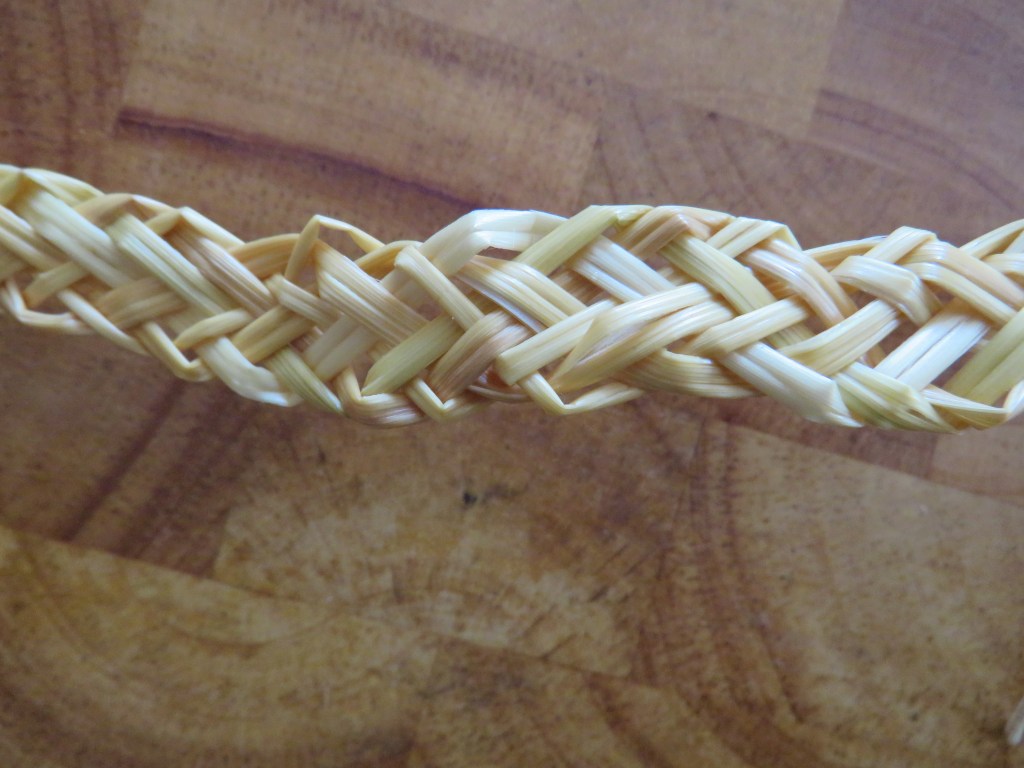
I decided to keep it simple and use a basic seven-strand plait. I had done this before as a child but had no recollection of how it was achieved. Online illustrations revealed that the plaiters’ rhyme, ‘under one, over two, pull it tight and that will do’, told you all that you needed to know. Unwilling to waste straws, I began by practicing with string. It didn’t take long to get into the rhythm but I only managed to avoid confusing the strands by lying them on a flat surface and securing the knotted end at the bottom with Sellotape. If I stopped and walked away, despite carefully laying out the strands, it was difficult to pick up where I left off. It was also very slow. I manage to produce something passable, if short and a little uneven. Even though straw has very different qualities to string it was difficult to imagine how plaiting could be done by holding seven straws in the air, let alone using thumbs and middle fingers, which was the approved technique.
As straw-plaiting was a family activity, with ten-year-olds allegedly being as proficient as adults, I practiced string plaiting with some of my descendants. They all mastered the technique quickly. My adult daughter produced a neat plait. The eight-year-old had trouble pulling it taught but realised her deficiency and declared hers to be widdle-waddle (the plaiters’ term for a child’s unsaleable plait). I don’t think either of the children thought it would be much fun as a long-term activity.
It was time to try using straw. I cut the ends off with a knife and tried splitting the straw but either my straw was thinner than nineteenth century straw or I lacked a sufficiently steady hand, as all I produced were small slivers of straw. I had read that ‘early home-made hats were crude and bulky’ and would have used un-split straw. This sounded like a description of something that I might produce, so I decided that I would use whole straws. I was not going to attempt the bleaching or dying parts of the process, which, in any case, would not have been universal. I ‘milled’ the full length of the straw with my rolling pin. Next came the soaking. The fifteen inch lengths fitted in my sink but straw floats, so I weighted it down with a knife.
I chose seven straws, tied the ends together with yarn and began to plait. The approved method of using my thumbs and middle fingers to plait and my forefingers to turn splits, or in my case, straws, sounded rather like patting one’s head and rubbing ones stomach but I started slowly. I began by laying the straw on a flat surface, as I had with the string. This went well until I reached the end of the straws; all seven ran out at the same time. I made a terrible mess of trying to join in new straws. With hindsight maybe I should have started with straws of different lengths. As I progressed joining new straws became a little easier, as only one or two needed replacing at the same time. I gradually progress from the table to holding the straws in my hands but had to recite the ‘over one under two’ rhyme to keep me in rhythm. After an hour of plaiting, I had produced thirty inches of plait. The literature is contradictory about likely output but opinions ranged from ten to twenty-seven yards per day; I clearly had a long way to go.
My next plaiting session, I tried a different method of joining on new straws, slotting the hollow end of the new straw over the narrow end of the previous one. This wasn’t always successful as sometimes the end of the new straw split but it was an improvement. I was finding the straw more difficult to manage and realised I had forgotten the milling stage. This resulted in a much less neat plait but did mean I had preserved the hollow ends, thus enabling me to join straws using these. I resolved in future to mill but not to continue this to the very end, so that I could still slide one straw over another and avoid so many loose ends. Still chanting the rhyme, I achieved a similar output to the previous session.
By the third attempt, I was getting quicker but certainly not neater. After an hour and a half I had another ninety inches of plait. I had expected to find working the straw rough to the touch but this wasn’t the case. Keeping the straw wet meant that my fingers were continually damp and having plaited for longer, my right arm and shoulder were aching. By now, visions of plaiting were appearing before my eyes when I closed them.
Fortuitously, at this point, BBC2 re-screened a programme about the Luton hat trade. This revealed several useful pieces of information. Firstly, I had been using my straw splitter incorrectly. I was trying to score the straw with the point but it seems that the point needed to be inserted in the end of a straw and pulled down. I tried this technique but the results were little better than those achieved using my method. Alarmingly, I learned that 4000 straws were required to make a hat. I am glad I didn’t know this beforehand as I would not have contemplated investing £240 on straw. More encouragingly, the narrator went on to say that nine yards of plait could make a hat. I already had nearly five yards having used about fifty straws so something wasn’t computing here.
By day four I was getting both fast and neater, achieving 1·5 yards in twenty minutes. Joining in new straws was still not very tidy but in general, the finished plait looked less messy than my first attempts, partly because I wasn’t plaiting to the thinnest end of the straws. I still wasn’t able to use my fingers in the approved manner. The discomfort in my right arm and shoulder continued and I still needed to recite the rhyme as I plaited but it was definitely becoming more instinctive. I did try putting the straws in my mouth, as Victorian plaiters would have done but I failed to see how the whole straw could be kept damp in this way.
At this point, I was excited to discover that great great granny, at the age of twelve, had won a prize for her plaiting. I am not sure those particular skills have passed to me. I began writing the final assignment, concentrating on describing the craft and telling the story.
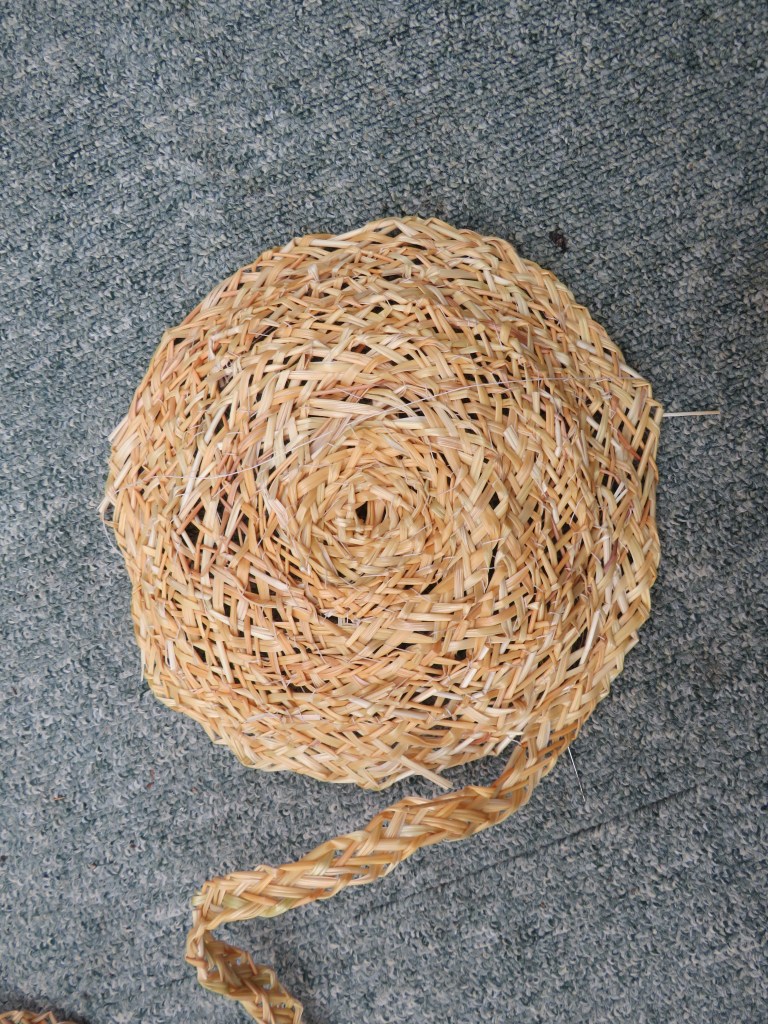
Three more plaiting sessions and I thought I might have enough to make a hat. I started in the centre and began to pull the braid into a spiral, working in an anti-clockwise direction; this may be because I am naturally left-handed. This was a more uncomfortable process, with the rough straw scraping at the skin on the backs of my fingers. It was also difficult to keep the plait damp. I decided not to overlap the braid in the English fashion as that would require more plait. I didn’t really have much idea how to create a hat shape and wondered if I would end up with a flat circle. Professional hat-makers would have used a head-shaped block and steamed the straw into shape. I didn’t have the wherewithal to do this. In the end the shape evolved of its own accord as I continued to sew. I was concerned that it might be difficult to finish off the ends but this was relatively simple as the ends of unplaited straw could be tucked into the weave.
The finished object resembled a pudding basin or lampshade, rather than a hat and certainly wasn’t neat and stylish. The underside of the straw is very scratchy, making it uncomfortable to wear. I did try tying it on as an alternative way to wear it.
Whilst I was pleased to have created a finished product, I was a little disappointed not to have made something that I could actually wear in public, even if only when I am living in the seventeenth century. I am not a natural crafts-person and I am also a perfectionist. What I produced was far from perfect but I enjoyed the process. The repetitive action of the plaiting was therapeutic but I certainly wouldn’t want to spend my working life as a plaiter of straw. I particularly valued the chance to step into my ancestor’s shoes and feel an even closer connection to Ann as a result of this project. Highly recommended for all family historians. Would I try this again? My heart says yes but my head knows that there isn’t room in my life to pursue craft activities with much rigor. I can see myself demonstrating the plaiting technique if the occasion arises. I have revisited my research into Ann’s family, with particular emphasis on the social context and the role that straw-plaiting played in the community and her life; I feel that I can now do so with greater insight. Watch this space for a post about Ann.
The course has been a great experience. I have learned a great deal about experimental archaeology and still more about material culture. I have climbed some technological hills and crafting mountains. I have met some hugely talented, diverse fellow students and we plan to keep in touch. So what next? There are plans. It may be that there will be an online MA on offer, which is tempting, further study does appeal. I am however mindful of how many things I still want to achieve and maybe I need to start prioritising as tempus is fugitting away like mad (it is still May isn’t it?). There is an exciting potential project in the offing with my coven lovely group of ladies. I have a non-fiction book to finish writing. I really want to focus on telling more stories from my own family history and as a result of this course, focussing on some of the family heirlooms and telling their stories before they are lost. I do still hanker after learning Cornish, remember I got as far as buying the books in lockdown?
Please be aware that this post contains information about an historic child murder and mental distress.
I am still fighting the not-quite-working computer issues but I have paused the list of 101 things to do before September (err that would be tomorrow – oops) to share the story of Ann Palmer.
I first came across Ann when researching for a talk and book chapter about investigating the stories of our ancestors in asylums. This led me to a class of records that are at The National Archives but also online at Ancestry. The Criminal Lunatic Asylum Registers, kept by the National Lunatic Asylum and county and metropolitan asylums, are in class HO20 and cover the period 1800-1843. These contain a wealth of detail about those who had been convicted of criminal offences but were deemed to be insane. I could have spent hours looking at the detailed accounts of these tragic situations but one in particular caught my eye. This was the entry for Ann Palmer, from Dagenham, Essex, who was convicted of murder at Chelmsford Assizes in 1823. It read:
‘The jury having found that she was insane at the time of the commission of the offence declare that she was acquitted by them on account of such insanity. From Dagenham, Essex.
Previous to Commitment. About 25 years since she partially cut her throat while she lived servant at Newington. Is said to have been a good and affectionate mother. Was married to a very afflicted man who kept a small public house at Marks Gate, Padnell Corner, Dagenham and became much afflicted in her mind at her husband’s death, which happened a short time before her commitment in consequence of her being informed that his body had been stolen from the grave.
Conduct in goal since. Decidedly insane, sometimes violent, at others dull and moody but not dangerous to those about her.
Thos. Cawkivell Goaler, Jas. Hutchinson Chaplain.
The state of her bodily health varied much during the period of her confinement but more particularly since the time of her trial. She was at one time reduced to so feeble a state that considerable apprehensions were entertained of her probable dissolution but she has within the last 10 or 12 days become more tranquil and has appeared gradually to acquire a strength insomuch that I have no hesitation in pronouncing her capable of safe removal to any place which may be appointed for her. 14 August 1823 G A Gepp Surgeon.’
The record also revealed that Ann was 43 years old and died on 23February 1824.
I had a quick look for Ann in the newspaper archive but failed to find anything and Palmer was a common name, so I wasn’t getting anywhere and in any case, I had other things on the urgent list.
Every couple of weeks I get together with a lovely group of ladies to chat about family history; we enjoy encouraging each other and sharing our successes, failures and tips. I brought Ann’s case to the group. Collectively we found not one but two newspaper reports. The first, in the Public Ledger and Daily Advertiser of the 21st of July 1823 gave details of Ann’s crime.
‘Chelmsford July 17. Ann Palmer was indicted for the murder of her infant son, at Romford. This case excited considerable interest, and sensibly affected a very crowded auditory. The wretched prisoner, a poor widow with nine children, was place at the bar in a state of mental stupor, and it was with difficulty she was made to understand the arraignment. She, however, pleaded not guilty, and the trial proceeded.
Ann Savell deposed that she had known the prisoner about three months. On the 23rd of May the prisoner’s eldest daughter called witness into the prisoner’s house, when she saw the deceased, who was only eleven months old, stretched lifeless upon a bed, but the body was still warm. The prisoner was in the room, and witness said to her, “the dear baby is no more, but you must reconcile yourself to the event. The Lord’s will be done, not ours.” She replied, “the Lord had nothing to do with it; I killed my baby.” She seemed then much agitated, and witness left the house horror-struck at the circumstance.
Mary Palmer, the prisoner’s eldest daughter, deposed that her father had been dead about four months. Her mother was quite overpowered with grief at his loss. There was a rumour that his body had been disturbed in the grave, which very much increased her grief. Indeed she was quite distracted with sorrow, and at times did not know what she said or did. She was a woman of very acute feelings, and was doatingly attached to her husband and children. She had suckled the deceased baby herself, and was passionately fond of him. She had often sat whole days since her husband’s death, weeping over the baby. She had often said she would kill herself, Before this time she had frequently said, laughing wildly, that the baby was dead and gone to heaven. On the 24th May she called to witness, and told her the baby was dead. She was then crying bitterly and wringing her hands. There was a small black mark on the left temple.
A Constable of Romford deposed that he saw the prisoner some time after the child was found dead. She was then violently beating her head, weeping and wringing her hands. She said, distractedly, “Hell! Hell, hell! I have murdered my baby. I meant the blow or myself, but it fell upon the baby. The beetle with which I did it stands behind the door. I have murder in my heart, and have carried a razor about me this fortnight.” She appeared quite wild and distracted.
Mr Curruthers, a surgeon, deposed that he examined the body often child. Its death was occasioned by a blow to the back of the head. It might have been with such an instrument as a beetle or mallet.
This was the case for the prosecution; upon which Mr Baron Graham intonated, that he thought it unnecessary to call upon the prisoner for her defence. It was quite obvious that poverty and grief had overpowered the better affections of the heart, and had bereft the prisoner of her reason. If the Jury were of this opinion, they would find the prisoner not guilty upon that ground.
The Jury immediately found the prisoner Not Guilty, on the ground that she was insane at the time she committed the fatal act.
The prisoner was then ordered to be detained in custody.”
The Cambridge Chronicle and Journal of 25 July 1823 carries and almost identical report but adds that the child’s name was Thomas and the National Burial Index lists the burial of a Thomas Palmer in Romford on 27 May 1823.
Burning some midnight oil we found more entries in the online indexes to Essex parish registers, including the burial of a Joseph Palmer on 13 March 1823 ‘of Dagenham’ at Stapleford Abbotts. There are baptisms of several children of Joseph and Ann. Some of the children seem to have been baptised more than once, including in January 1824, in Dagenham, which seems odd, as Joseph would have been dead by then. The Dagenham baptisms do state that Joseph was a publican.
Next step, to persuade the member of our group who lives closest to take a look at the original records.
No appropriate image, so some flowers for Ann and her family.
Sources
Cambridge Chronicle and Journal 25 July 1823 p. 4 col. c.
Public Ledger and Daily Advertiser 21 of July 1823 p. 4 col. a.
Where have you been? I hear you cry. Actually, I suspect that you never noticed that this is probably my longest gap between posts ever. My recent adventures have included a lovely week on the Isle of Wight with some of my descendants, frantically trying to keep up with the grandchildren on Pokémon Go and some uplifting walks along the beach in the early morning. I have also been able to meet more than one set of old friends who have been holidaying in the area. It is a wonderful feeling when you get together with people you haven’t seen for twenty years and you can’t believe that you didn’t last chat a few weeks ago. There was also the chance to meet much newer online friends in person.
Mistress Agnes has ventured into a school for the first time since lockdown, you really can’t keep that good woman down. She is now frantically concocting herbal cures for some aggressive bites, acquired when standing in a field whilst her colleague shot a few people. There have been talks to give to audiences across the world, sadly only a virtual trip to Australia this time and courses to prepare. Next up is my five week online course for Pharos Tutoring and Teaching that focuses on researching family and local history in the first half of the twentieth century, with a whole new section to write on the 1921 census. Still space for you to enrol if you want to join in the fun on this one. As I was reviewing the course, I decided to go through it myself and add to the biography of my grandmother, which is making very slow progress.
The next non-fiction book now has nearly three chapters done, the latest has seen me researching a fascinating family from the Romani community, which includes the notorious ‘Gypsy King’, Wisdom Smith. The final term of my post-grad course has begun and with it the incentive to focus on a great great grandmother’s story but more of that in a separate post.
I have also done a fair bit of procrastinating and doing things that aren’t even on the frighteningly long to do list. I can’t even remember why I thought I’d do this but I took a look at how many direct ancestors I have discovered in 45 years of research. To save you the maths, if you go back to your 6x great grandparents, who, if you are my generation, were probably born in the first half of the eighteenth century, there are a potential 510 direct ancestors. I have full names for 203 of them, approximately 40%. I don’t count the ones where I don’t have the woman’s maiden name. I do have the names of more distant ancestors but after the 6x great grandparents the numbers are frightening and the success rate dwindles significantly, so I stopped at this point. My percentage found is probably not bad for someone with English ancestry; these ancestors come from nine English counties. One quarter of my ancestry suffers from pedigree collapse, as first cousins marry in two successive generations. This probably explains a lot but also means that one set of 4x great grandparents appear in my direct ancestry three times.
I decided I would put off doing what I should be doing and see how evenly spread these ancestors were across different branches of my family. To explain what I mean: I looked at each of my eight great grandparents in turn and calculated how many of their direct ancestors I had found in the preceding five generations; there are potentially 62 for each great grandparent. The greatest success is with my direct paternal, west country, line. I can identify 40/62 of great grandfather William James Braund’s ancestors, closely followed by 35/62 ancestors for his wife Fanny Thomasine Bishop. In fact, my father’s family holds third place too, with 33/62 ancestors of Caroline Howe on the tree. We will draw a veil over the 9/62 for great grandfather John Hogg. In my defence I am 95% sure of some of the missing ones. I just feel that I need one more piece of supporting evidence to ink in several generations of John Hogg’s Northumbrian ancestry. The statistics on my mother’s side are hampered by those pesky repeated 4x great grandparents who create a brick wall in three places, although again, I have my suspicions of who fits in the gaps.
The upshot of all this is that I tried to boost the numbers by looking again at a brick wall that I hadn’t investigated much before. Oh boy this looked interesting, potash makers, gentlemen, a chap who endorsed a quack doctor, claiming to have his hearing restored, in a newspaper advert of 1785 – great stuff. Slight side-track while I check exactly what potash makers did and add the newspaper advert to my history of medicine course. This branch was not a straightforward family to trace, due to their use of a very limited range of Christian names and the fact that they come from a county whose parish registers are only online in indexed form. Ooh look though, they left wills and I could obtain these from a very efficient record office within twenty four hours. This would be just the final confirmatory piece of the jigsaw I needed, then I too could follow the lead of the umpteen online trees who joined the potash maker (he of the miracle cure) and the gentleman to my tree. Except I can’t. A great will, mentioning five generations of the testator’s family, which clearly none of those online tree compilers have read. Back to the drawing board and I feel a mini one-name study coming on, when I should of course be doing something else entirely. Is the potash maker mine or not? Watch this space.
To add to the fun, the job I must not mention has now arrived with a vengeance but I may post here as light relief.
Now that the dust is settling after the Young Genealogists’ conference, it is time for some reflections. What hasn’t settled is the buzz on social media, where #GenieYouthCon comments are still coming in. Firstly, a huge thank you to all who contributed in any way. The Society of Genealogists and the Family History Federation, who came together to get this off the ground, the hosts, everyone, of all ages, who came along to listen, those who responded so readily when I asked for door prizes: Pharos Tutoring and Teaching, the Society for One-Place Studies and Devon Family History Society, My Heritage and the Society of Genealogists who offered membership discounts, I will be casting my net wider next time! Those who spread the word on social media, the list goes on. Most of all, thank you to the ten speakers, who came from across the English-speaking world to enthuse, inspire and educate us.
The day exceeded my expectations; I must admit to a couple of sleepless nights with three weeks to go, when bookings were coming in very slowly. Obviously, I could be said to be biased, so here are some comments from other people (these were taken at random – I haven’t cherry-picked the 5* reviews): ‘It was a wonderful day of talks, and note taking of new ideas. Thank you jointly, for getting this conversation going.’ ‘It was a great event! Thank you to everyone involved. I missed a couple of speakers but hoping they crop up again in some other events. I didn’t apply to talk this year as the anxiety was just too real!! But..maybe next year?!’ ‘Echoing those calling for the #GenieYouthCon to be a fixture in the Genie calendar. I was there to share the benefits of @AGRAGenealogy membership but came away with my whole perspective change. It was a real education and left me excited for the future of the profession.’
We didn’t ask the attendees their age but I estimate that perhaps 40% of those who took part were under forty. The majority of the audience were from the UK, understandable in view of the time zones but there were attendees from Australia, New Zealand, Canada, Ireland and the USA. I was expecting people to drop in for one or two sessions and depart. A few did do that but a hard core stayed all day, even a couple for whom ‘all day’ was 2am-2pm.
To me, the most positive parts of the event were the discussions; not just those that took place in the time-tabled discussion slots but also the conversations that were had during what were meant to be breaks but when people couldn’t bear to tear themselves away.
Was it perfect in every way? Of course not. It was an inaugural event and there are inevitably things that would be tweaked another time. In any case, one person’s ‘perfect’ is another person’s ‘falling short’. In retrospect, maybe it was a shame that it wasn’t set up to make it possible for at least some of the presentations to be available for people to watch later. That decision was taken from a safeguarding standpoint; we were mindful that we were encouraging young people to take part, including those under the age of 18. In fact, some of the presenters are now putting their own presentations in a public forum and others are repeating their sessions elsewhere. I do feel that the conference succeeded in showcasing some exciting young presenters and I am sure many of them have already been booked to talk elsewhere. We’ve had discussions about what younger family historians want from the wider genealogy community and I really feel that we have moved the debate forward in a positive way. Roll on next time.
As someone who is now in their forty sixth year of serious family history research, I have watched the family history movement grow and change (not always for the better) over many years. That growth and development will continue and so it should. We should not be content with doing things the way that they have always been done. Neither, of course, should we look to make changes just for change’s sake. The pandemic has forced changes on many aspects of our lives and the way that genealogical societies function is no exception. The past few years has, finally, seen the door to the family history community open a little wider. There is still a long way to go along the road to inclusivity but those first small steps are being taken, even if the difference may seem imperceptible.
Genealogy has, with some justification, long been perceived as a pursuit for middle-aged (ok let’s be honest here – old), middle-class, white people. This needs to change. There are ways of enabling all to engage in the hobby/obsession that many of us enjoy but it is not up to those who currently feel excluded to break down the barriers. There are things that we should all do to be more welcoming and to make the family history world more accessible and inclusive. Everyone has a heritage and no one should feel excluded from exploring their own story. It is clear that one group who have felt that the some aspects of the genealogy community have not been welcoming or accessible, are younger family historians. I know they are not the only group who have felt this but for now, let us focus on the young because without them, before long, there will be no genealogy community.
Understandably, as part of the evolutionary process of the family history movement, many young people want to pursue the search for their heritage in a different way to those of us whose journey began in the 1970s, or 1990s, or 2010s. There is an increasing focus on identity, in its many forms, on story-telling and on understanding the past as a vehicle towards well-being in the present. The genealogical world is evolving and there is the prospect of a fascinating future emerging. It won’t look like the family history world that some of us older genealogists have become comfortable with but there is room for all. Please, don’t think I am suggesting that everything needs to change. I know many were quite content with the status quo. New ways of approaching research, of running genealogical societies, of opening up the community, can sit alongside what is already in place, not necessarily replace provision that is already there.
I hope that everyone who takes family history seriously will be interested in this intriguing ‘what next?’. Your chance to glimpse the future is here. You can attend the online youth conference, organised jointly by the Society of Genealogists and the Family History Federation, on 7 May. This event showcases young presenters. There are some interesting new perspectives on family history being shared by some extremely knowledgeable speakers. The presenters are young but the conference is for everyone. There are more than twelve hours of presentations for the token amount of £1.50. It would be unbearably patronising of me to suggest that attendance was about supporting the next generation of family historians, although they would welcome that support. You will enjoy what is on offer and learn from those who are making their mark in the genealogy community. Come to hear one presentation, come to hear them all but please do register for the day. These are real-time only presentations, so no recordings but even if you can only pop in to listen to one or two, it is a bargain. I know that we will be hearing more from these young people in the future. The day is also an opportunity for programme organisers to find new speakers for meetings and conferences. There are ten presenters, all under the age of thirty, from five countries and everyone, of all ages, is encouraged to come along. It is going to be a great day. The programme is here and bookings can be made here.
I am now, sadly, halfway through this course. It really does come highly recommended if you are interested in the objects of the past. It is wonderful that it has been made available as an option for distance learning. You have until 3 June to apply for a place on next year’s course. Ideal if you are a traditional craftsperson, historical interpreter or family historian. Although ‘archaeology’ conjures up visions of ancient artefacts and there is, understandably, a good dollop of input about fascinating older ‘stuff’ the flexibility of the course has meant that I can concentrate on a much more recent era. I was sad to miss the opportunity to be in-person at the amazing Centre for Experimental Archaeology and Material Culture (CEAMAC) but it wasn’t to be for me – maybe another time.
The assignment about Jessie’s Locket has been and gone. I created a wonderful powerpoint plus soundtrack before realising that the time limit was ten minutes. I decided that I might not get away with sixteen minutes, so editing was needed. I was in a better position than some of my colleagues whose efforts topped forty minutes but still an issue. I reluctantly axed some of the material and then gabbled away in an unprofessionally speedy fashion to cram what was left into ten minutes and fourteen seconds. I now await the results with trepidation.
Attention has turned to a lengthier assignment, focussing on bringing an archaeological perspective to the examination of a collection of objects. Again, it was difficult to choose but I have decided on the collection of family photographs that pre-date my birth. These photographs are currently housed in a single album. Part one of the assignment is to describe the collection, so I have begun by categorising the images, which are almost all of people, rather than places or events. Having counted them, I was surprised to find that there are 554! They will take a while to catalogue and yes, I do know that I have many still to scan but that is not part of the assignment. The next and most interesting, stage is to write about their significance, their meaning and to think about how I react to these images. I have a horrible feeling that this may become uncharacteristically sentimental if I am not careful. Finally, I have to consider the ongoing future of the collection and look at comparative studies. That’s going to be the difficult bit. If anyone can point me in the direction of papers about the curation and conservation of specific photographic collections, I’d be grateful. So far, I’ve found a book for £198.02 that I might have to give a miss.
I have free rein regarding how I present this assignment and I have decided that one can have too much of chatting to your computer, so this will be an extended, illustrated essay, with plans to put the results on this, or possibly another, website. Watch this (or another) space.
I sometimes think that I have learned as much about social media on this course as I have about Experimental Archaeology. I have scaled the learning curves that are WhatsApp, Discord and now it seems I have found myself on ‘Insta’ (see I am learning the lingo). I did accidentally follow Adele by mistake but I think I am getting the hang. Not yet decided how I might use it but if you want to follow me feel free JanetFewHistory.
It is Women’s History month. I really should be getting on with granny’s biography but that seems to have slipped to the bottom of the very long to do list. I was chuffed to see that The National Archives were recommending my bookRemember Then for Women’s History week. There are still copies hiding under the spare bed of a fisherman of my acquaintance, if you’d like you cross my palm with silver. I have no idea why it is on sale on Amazon for £19.90. You can get it from me for the proper price of £12.95, just get in touch. In anticipation of a visit to the area where they originated, I have taken a look at granny’s deeper ancestry. I even managed to find a couple of new 5th and 6th x great grandparents but the mystery of which of two Johns is my 4x great grandfather remains. Fortunately, the Johns are first cousins, so, after what I call a wiring diagram, indicating the either/or, the line can be continued back to the sixteenth century.
Having decided, reluctantly, not to go to Ireland this month, in theory my diary should have been clear. Explain to me then how I have had something on, on thirteen evenings out of the last fifteen. It would have been fourteen but one was cancelled. On the strength of a nominally ‘free’ month. I decided it was time to decorate the hall and landing. The above-mentioned fisherman offered to do the death-defying balancing ladders on the stairs stuff. I was a bit reluctant to agree to this but was persuaded. Fortunately, that part was accomplished without incident. I couldn’t watch. The idea was that I would do most of the rest but in the end my role was limited to affixing miles of masking tape round door frames. This wasn’t as easy as it sounds as the reel of tape had been lying around for a while and peeled off the roll in three inch lengths. After a couple of hours I had completed the task. Halls and landing have so many doors. I sat down to some computer work, smugly content that the job was done. Leaving the room shortly afterwards, I was dismayed to see streamers of masking tape dangling from every point. A new reel of tape was purchased and I did it all again. I should say that my hall and landing could not be smaller. The hall is three foot square and the landing is a narrow corridor. There is nothing in the space. How then, has this decorating endeavour meant that there is evidence of its undertaking in every other room?
I still have a mile long playlist of Rootstech sessions to watch. In the meantime, on the horizon, there are three other key events to highlight. In chronological order:- Do check out the Historians for Ukraine event on 26 and 27 March. I had hoped to be involved in this but I will be in a field and I don’t know how reliable my internet will be, so I will be cheering from the sidelines and hope to take part in a spin off event. An event that I am actively involved in is a Free 24 Hour Genealogy Marathon, run by Legacy on 7 and 8 April. You can register for that here.
Then on 7 May is the Youth Genealogy Conference. I get a sneak peak at the speakers’ submissions and I’ve been excited by the response. This is going to be a great day, with some thought provoking and interesting talks from some knowledgeable younger presenters. Don’t worry, I will make sure everyone knows how to attend. There is no age limit on the audience!
The website creation for the Braund family continues. I was advised that there were accessibility issues. For example, not all of the many images had alternative text, which is necessary to enable those with a screen reader to know what is in them. A bit of poking about in the bowels of Wix and I discovered a button to press to identify accessibility problems on the site. Button duly pressed, the whole site ground to a halt. After this had happened several times, I started going through the images individually and checking that they had alternate text. I tried the button again and 99 issues remained. It seems that we had had so many issues that we’d broken the system. All sorted now on the accessibility front, so it is back to the exciting job of continuing to add content.
To accentuate the positive, in my hemisphere there are wonderful signs of spring in the air. I am writing this at 5.30 am, watching the sky lighten and it is warm enough to open the window and listen to the symphony that is the birds’ wake up call.







 The History Interpreter - Janet Few